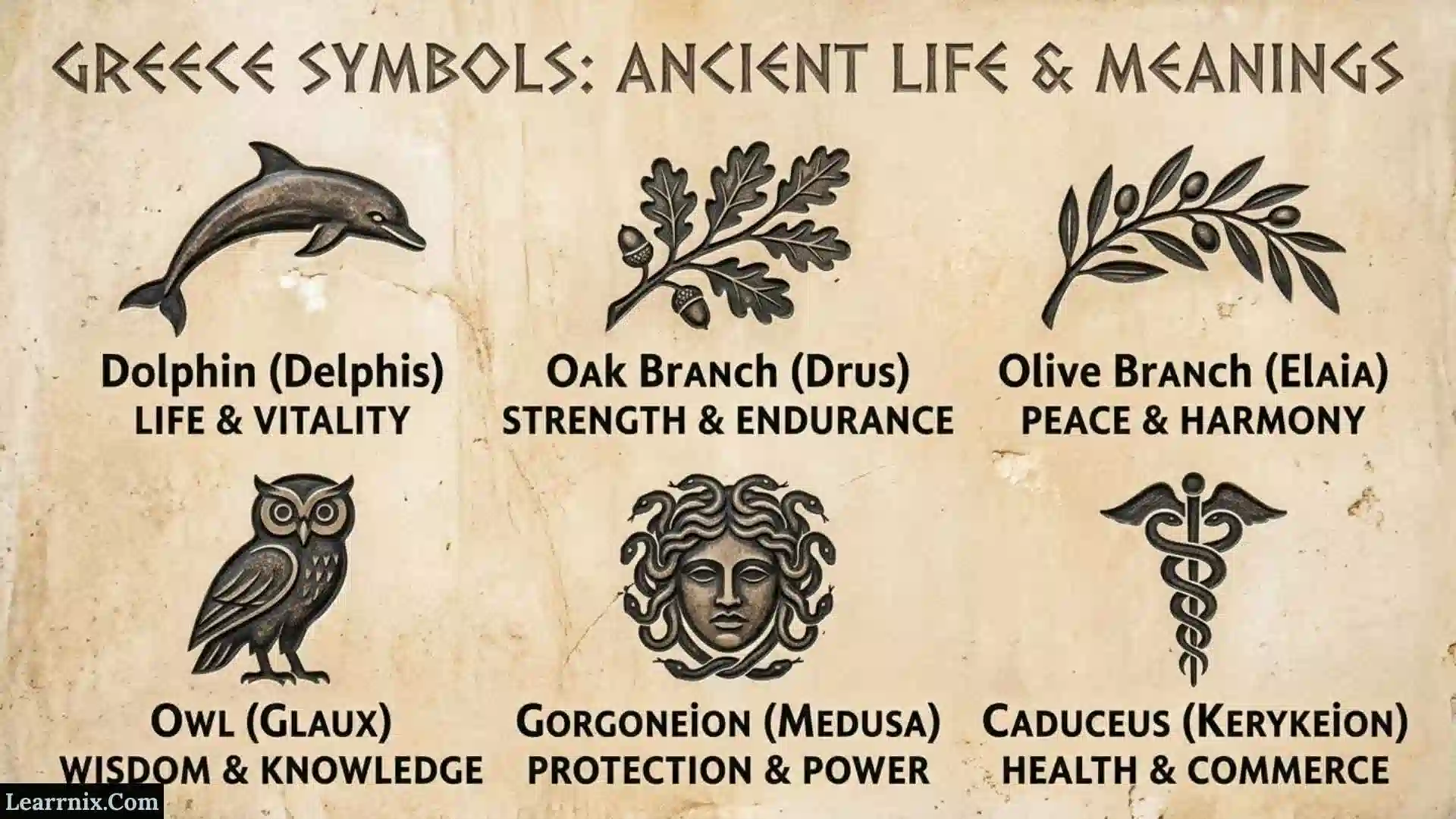
Greece is represented by some of the world’s most recognizable symbols. The blue-and-white flag, the owl of Athena, olive branches, laurel wreaths, the Parthenon, Greek columns, and the famous Evzones all bring Greece to mind.
However, an important distinction is often missed: not every famous Greek symbol is an official national symbol of modern Greece.
The official symbols of the Hellenic Republic are the national flag, national emblem, and national anthem. Other well-known images belong to ancient Greek civilization, Byzantine history, Greek Orthodox tradition, or modern Greek culture. Understanding the difference helps students, travelers, writers, designers, and researchers use these symbols accurately.
This complete guide explains the most important Greek symbols, what they represent, where they come from, and how they fit into the country’s long history.
Quick Answer: What Are the Symbols of Greece?
The principal official symbols of modern Greece are:
- The Greek national flag
- The national emblem of the Hellenic Republic
- The national anthem, “Hymn to Freedom”
These symbols are formally identified by the Presidency of the Hellenic Republic.
Other important symbols commonly associated with Greece include:
- The owl of Athena
- The olive branch and olive tree
- The laurel wreath
- The Greek key or meander
- Athena
- The Parthenon
- Doric, Ionic, and Corinthian columns
- The double-headed eagle
- The Evzone
- Blue and white as national colors
The easiest way to understand Greek symbolism is to divide it into official state symbols, ancient symbols, Byzantine and religious symbols, and modern cultural symbols.
Key Takeaways About Greece Symbols
- Greece has three principal official state symbols: the flag, national emblem, and national anthem.
- The Greek flag has nine alternating blue and white stripes and a white cross in the upper-left section.
- The national emblem features a white cross on a blue shield surrounded by laurel branches.
- The owl of Athena is a major symbol of wisdom and ancient Athens, but it is not the modern state’s principal official symbol.
- The olive tree connects Greek mythology, agriculture, peace, and cultural heritage.
- The Parthenon and classical columns symbolize Greece’s ancient architectural and intellectual legacy.
- The double-headed eagle is mainly associated with Byzantine and Orthodox heritage.
- The Evzones are living symbols of modern Greek tradition, independence, and ceremonial identity.
- The most accurate articles separate symbols by their historical period and official status.
Official Symbols of the Hellenic Republic
The modern Greek state has a clearly defined group of official symbols. These should be separated from the many historical images that people associate with ancient or cultural Greece.
The Greek National Flag
The Greek flag is one of the country’s most recognizable symbols.
It consists of nine horizontal stripes, with five blue stripes and four white stripes. In the upper-left corner is a blue field containing a white cross. The modern form and colors of the national flag were established during the early years of the modern Greek state.
According to the Greek Ministry of Foreign Affairs:
- Blue symbolizes the sky and seas.
- White represents the purity of the Greek struggle for independence.
- The white cross represents Christianity.
- The nine stripes are associated with the nine syllables of “Eleftheria i Thanatos,” meaning “Freedom or Death.”
The flag is important because it combines geography, national history, religion, and independence into one design.
The National Emblem of Greece
The national emblem, also known as the coat of arms of Greece, consists of a blue shield or escutcheon with a white cross, surrounded by two laurel branches. It appears in official state contexts, including on military and security-related uniforms and insignia.
The history of the emblem also shows how Greek national identity developed over time.
The first national emblem was established in 1822. Earlier versions included figures such as Athena and the owl, while other versions reflected periods of monarchy and republic. The contemporary form dates from the modern republican period.
This history provides an important insight: some ancient Greek symbols, including Athena and the owl, have appeared in the history of Greek state imagery without becoming the principal official symbols of Greece today.
The Greek National Anthem
The national anthem of Greece is “Hymn to Freedom” or “Hymn to Liberty.”
The poem was written by Dionysios Solomos in 1823 and later set to music by Nikolaos Mantzaros. The complete poem contains 158 stanzas, although only part of it forms the national anthem, and the first two stanzas are normally used during official occasions. It became Greece’s national anthem in 1864.
Its central theme is liberty.
That makes the anthem closely connected to the Greek struggle for independence and the creation of the modern Greek state.
Greece Symbols at a Glance
The table below helps separate official symbols from cultural and historical ones.
| Symbol | Category | Main historical connection | Official status | Common meaning |
| Greek flag | State symbol | Modern Greece | Official | National identity and independence |
| National emblem | State symbol | Modern Greece | Official | The Hellenic Republic |
| Hymn to Freedom | State symbol | Greek independence | Official | Liberty and national identity |
| Owl of Athena | Ancient symbol | Classical Athens | Cultural/historical | Wisdom and knowledge |
| Olive branch | Ancient and cultural symbol | Ancient Greece to modern culture | Cultural | Peace, heritage, endurance |
| Laurel wreath | Ancient symbol and state design element | Ancient Greece | Cultural; used in emblem | Victory and honor |
| Greek key | Artistic symbol | Ancient Greek art | Cultural | Classical Greek design |
| Parthenon | Architectural symbol | Ancient Athens | Cultural and historical | Greek civilization |
| Double-headed eagle | Byzantine and religious symbol | Byzantine tradition | Historical/religious | Byzantine and Orthodox heritage |
| Evzone | Ceremonial symbol | Modern Greek history | Cultural and ceremonial | Independence and tradition |
The main lesson is simple: a symbol can represent Greece without being an official state symbol.
Also Check This Post: 75+ Architectural Symbols: How to Understand Design Drawings
Ancient Greek Symbols and What They Mean
Ancient Greece produced many symbols that remain important today. Their meanings often developed through mythology, religion, art, politics, and everyday life.
The Owl of Athena
The owl is one of the best-known symbols connected with ancient Greece.
It was associated with Athena, the ancient Greek goddess of wisdom and the patron deity of Athens. The owl became especially important in Athenian art and coinage, which is why it remains strongly linked with wisdom, knowledge, learning, and intellectual life.
The owl is a useful example of why historical context matters. It is widely recognized as a Greek symbol, but describing it simply as “the official national symbol of Greece” would be misleading.
A more accurate description is:
The owl of Athena is one of the most important symbols of ancient Greek culture and is especially associated with wisdom and Athens.
The history of the Greek national emblem also shows that Athena and the owl appeared in early Greek state imagery, giving the symbol an additional connection to the formation of modern Greece.
The Olive Tree and Olive Branch
The olive tree has deep roots in Greek history and culture.
In Greek mythology, the olive tree is closely associated with Athena. According to the famous myth surrounding the patronage of Athens, Athena offered the olive tree as a gift to the city.
The olive has therefore become connected with ideas such as:
- Peace
- Wisdom
- Prosperity
- Agriculture
- Endurance
- Greek heritage
The symbol also has a practical side. Olive cultivation has been part of Mediterranean life for thousands of years, so the tree represents more than mythology. It connects ancient stories with food, farming, landscapes, and everyday culture.
For a school project, the olive branch is particularly useful because it can represent both ancient mythology and the long-term relationship between Greek society and the Mediterranean environment.
The Laurel Wreath
The laurel wreath was a symbol of honor, achievement, and victory in the ancient world.
Laurel was associated with Apollo and became linked with recognition and distinction.
The symbol also connects ancient Greece with modern state imagery because laurel branches surround the blue-and-white shield in Greece’s national emblem.
This makes the laurel especially interesting. It is not simply an ancient symbol preserved in museums; its imagery also appears in the visual identity of the modern Greek state.
Athena as a Symbol of Greek Heritage
Athena was one of the most important deities in ancient Greek religion and mythology.
She was associated with:
- Wisdom
- Strategic thinking
- Craftsmanship
- Civic life
- Athens
Her traditional symbols include the owl, olive tree, helmet, and spear.
Athena represents ancient Greek intellectual and cultural heritage rather than the official identity of the modern Hellenic Republic.
When writing about her, it is best to use terms such as:
- Ancient Greek symbol
- Mythological symbol
- Cultural symbol
- Symbol associated with Athens
This keeps the historical context accurate.
The Greek Key and Other Symbols From Ancient Art
Not every important symbol is an animal, plant, or national emblem. Greece is also represented by artistic patterns that have survived for centuries.
The Greek Key or Meander Pattern
The Greek key, also called the meander, is a repeating geometric design strongly associated with ancient Greek art.
It appears on:
- Pottery
- Architecture
- Decorative borders
- Mosaics
- Textiles
- Modern Greek-inspired design
Because of its continuous form, modern interpretations often connect it with continuity, unity, or infinity. However, symbolic meanings can vary, so it is safer to describe the meander primarily as an important decorative motif from ancient Greek art.
This is especially useful for designers, students, and writers. The Greek key immediately creates a visual connection to classical Greece without incorrectly presenting it as a government emblem.
Ancient Greek Columns
Greek architecture has also become symbolic of Greece itself.
The three major classical orders are:
- Doric
- Ionic
- Corinthian
These architectural styles influenced buildings around the world, including museums, universities, monuments, and government buildings.
Columns can represent:
- Classical architecture
- Ancient Greek civilization
- Art and engineering
- Order and proportion
- The global influence of Greek design
For visual projects, columns are often a good choice when the goal is to represent ancient Greece rather than modern Greek national identity.
The Parthenon
The Parthenon is one of the most recognizable monuments associated with Greece.
Located on the Acropolis of Athens, it has become a global symbol of ancient Greek architecture and cultural heritage.
The Parthenon can represent:
- Ancient Athens
- Classical architecture
- Greek artistic achievement
- Cultural heritage
- The influence of Greek civilization
However, it should be classified as a historical and cultural symbol, not the official national emblem of modern Greece.
Byzantine and Religious Symbols of Greece
Greek identity was shaped by more than ancient classical civilization. Byzantine history and Greek Orthodox Christianity also form important parts of the country’s cultural heritage.
The Double-Headed Eagle
The double-headed eagle is strongly associated with the Byzantine world and Greek Orthodox tradition.
It should not be treated as a replacement for Greece’s official national emblem. Instead, it is best understood as a historical and religious symbol connected with Byzantine heritage.
This distinction matters because the symbol has been used in different regions and traditions over time. Context is essential.
For an article or presentation, the safest description is:
The double-headed eagle is an important symbol associated with Byzantine history and Greek Orthodox heritage.
The Cross in Greek National Identity
The cross appears prominently on both the Greek flag and national emblem.
According to the Greek Ministry of Foreign Affairs, the cross on the flag represents the Christian religion.
Its presence shows how religion became part of the symbolism of the modern Greek state.
However, the cross should also be understood within Greece’s broader historical context. Greece’s cultural identity includes ancient Greek traditions, Byzantine heritage, and Orthodox Christianity alongside the modern history of the Hellenic Republic.
The Evzone: A Living Symbol of Modern Greece
The Evzones of the Presidential Guard are among the most recognizable symbols of modern Greece.
Unlike an ancient statue or archaeological monument, the Evzone is a living ceremonial tradition.
The Presidential Guard traces its history to 1868, while the uniform is closely connected with Greece’s modern history and liberation struggles. Today, Evzones guard important national sites and participate in official ceremonies.
What the Evzone Uniform Represents
The uniform contains several symbolic details.
According to the Presidency of the Hellenic Republic:
- The fustanella has 400 pleats, traditionally representing the years of Ottoman occupation.
- White elements symbolize the purity of the struggle for national independence.
- The red cap symbolizes sacrifice and bloodshed during the liberation struggles.
- Black elements represent mourning.
- Blue and white details connect with the Greek flag.
This makes the Evzone an excellent example of how clothing can function as a national symbol.
The Evzone does not replace the flag, emblem, or anthem as an official state symbol. Instead, it represents Greece through ceremony, historical memory, and public tradition.
Also Check This Post: 93+ Adinkra Symbols and Meanings: Powerful Symbols
A Brief Timeline of Greek Symbols
Understanding Greek symbols becomes easier when they are placed in historical order.
Ancient Greece
Important symbols include:
- Owl of Athena
- Olive tree
- Laurel wreath
- Greek key
- Athena
- Classical columns
- The Parthenon
These symbols are connected with mythology, religion, art, architecture, Athens, and ancient Greek civilization.
Byzantine Greece
Important imagery includes:
- The double-headed eagle
- Christian symbols
- Orthodox religious traditions
This period added another major layer to Greek cultural identity.
The Greek War of Independence
During the struggle for independence, symbols connected with:
- Freedom
- National identity
- Christianity
- Sacrifice
- Liberation
became increasingly important.
The national motto associated with the flag, “Freedom or Death,” reflects this historical period.
Modern Greece
The modern Hellenic Republic is formally represented by:
- The national flag
- The national emblem
- The national anthem
These symbols connect the modern state with its history and national identity.
Official Symbols vs. Cultural Symbols
This distinction is one of the most useful parts of understanding Greece symbols.
Official Symbols
These are formally associated with the modern state.
Examples include:
- The Greek flag
- The national emblem
- The national anthem
These are the best choices for:
- Government-related content
- Formal educational materials
- Official presentations
- Accurate descriptions of the modern Greek state
Cultural and Historical Symbols
These symbols represent Greece through history, mythology, art, religion, or tradition.
Examples include:
- Owl of Athena
- Olive branch
- Greek key
- Parthenon
- Athena
- Double-headed eagle
- Evzone
These are useful for:
- School projects
- Travel content
- Historical articles
- Cultural presentations
- Greek-inspired design
The key is to match the symbol to the purpose.
How to Choose the Right Greek Symbol
If you are creating a project, presentation, article, logo concept, or educational poster, use this simple decision guide.
What are you trying to represent?
↓
Modern Greece as a country or state?
→ Use the Greek flag, national emblem, or national anthem.
↓
Ancient Greece and classical civilization?
→ Use the owl of Athena, Greek key, olive tree, laurel wreath, columns, or Parthenon.
↓
Byzantine or Orthodox heritage?
→ Use historically appropriate religious or Byzantine imagery, such as the double-headed eagle.
↓
Greek culture and ceremonial tradition?
→ Consider the Evzone, traditional dress, or other clearly identified cultural imagery.
This approach helps avoid one of the most common mistakes: using an ancient symbol to describe a modern official institution without explaining the difference.
Practical Examples: Which Symbols Should You Use?
Different projects need different symbols.
For a School Project
A balanced selection could include:
- The Greek flag for modern national identity.
- The owl of Athena for ancient Greece.
- The olive branch for mythology and cultural heritage.
- The Parthenon for architecture and history.
This gives the project historical depth without confusing official and cultural symbols.
For a Travel Article
Good choices include:
- The Greek flag
- The Parthenon
- Olive trees
- Classical architecture
- The Evzones
These symbols help communicate the country’s history, landscapes, and culture.
For an Academic Presentation
Organize symbols by period:
- Ancient Greece
- Byzantine Greece
- Greek independence
- Modern Greece
This method is more accurate than placing all symbols in one random list.
For Government or Formal Content
Use officially recognized symbols where appropriate.
Do not substitute the owl, Parthenon, or Greek key for the national emblem when discussing official institutions.
Common Mistakes When Discussing Greece Symbols
Mistake 1: Calling Every Famous Symbol a National Symbol
The owl, Parthenon, olive tree, and Greek key are strongly associated with Greece, but that does not automatically make them official state symbols.
The modern Hellenic Republic formally identifies the national flag, national emblem, and national anthem as its state symbols.
Mistake 2: Mixing Ancient and Modern Greece
Ancient Greece and the modern Greek state are separated by thousands of years and several major historical periods.
For example:
- Athena belongs to ancient mythology.
- The Parthenon belongs to classical Athens.
- The double-headed eagle is associated with Byzantine and Orthodox heritage.
- The national flag represents the modern Greek state.
Historical labels improve accuracy.
Mistake 3: Giving Every Symbol Only One Meaning
Symbols often change meaning depending on context.
The olive branch, for example, can represent peace, mythology, agriculture, heritage, and Mediterranean culture.
The laurel can represent victory, achievement, honor, and its role within the national emblem.
Avoid reducing complex symbols to one oversimplified meaning.
Mistake 4: Using Popular Tourism Images as Official Symbols
Blue-domed churches, white island buildings, and beautiful coastal landscapes are strongly associated with Greece.
However, they are primarily visual and cultural images rather than official state symbols.
A useful rule is:
A popular image does not always mean an official symbol.
Expert Checklist for Writing About Greece Symbols
Before publishing an article, school project, or presentation, check the following:
- Is the symbol officially recognized by the modern Greek state?
- Have you identified its historical period?
- Are you distinguishing ancient, Byzantine, religious, and modern symbols?
- Have you avoided calling every Greek icon a “national symbol”?
- Have you explained what the symbol represents?
- Have you used authoritative sources for official state information?
- Have you avoided oversimplifying complex historical meanings?
- Have you selected symbols that match the purpose of your project?
This checklist adds accuracy and helps create stronger educational content.
Why Greece Has So Many Recognizable Symbols
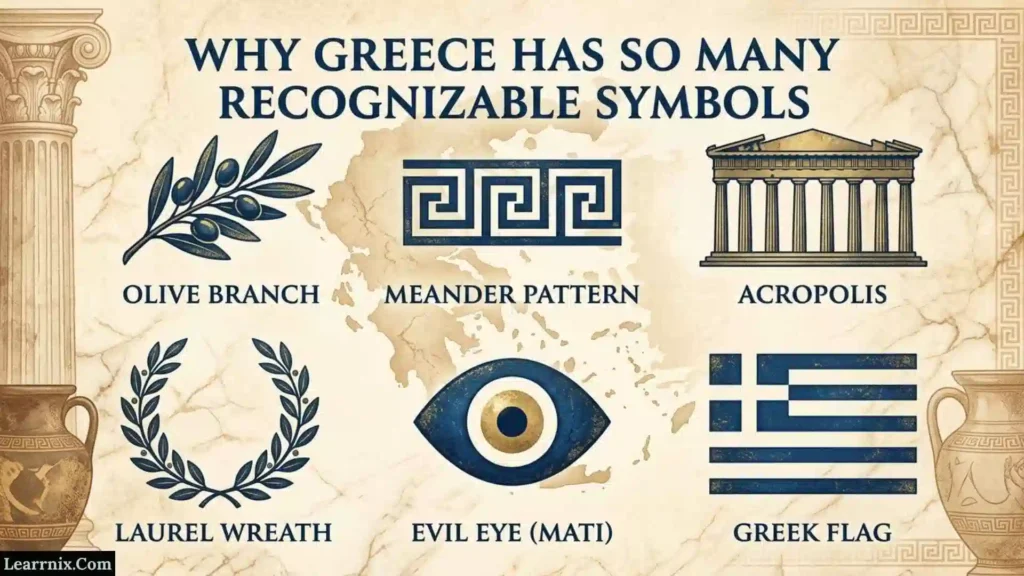
Greece has an unusually rich symbolic heritage because its history covers several major cultural periods.
The country is connected with:
- Ancient Greek mythology
- Classical Athens
- Greek philosophy and art
- The Olympic tradition
- Byzantine civilization
- Greek Orthodox Christianity
- The struggle for independence
- The modern Hellenic Republic
As a result, there is no single image that can explain Greek identity completely.
The flag may represent the modern nation.
The owl may represent ancient wisdom.
The Parthenon may represent classical civilization.
The double-headed eagle may point to Byzantine heritage.
The Evzone may represent modern ceremonial tradition.
Together, these symbols show how Greece’s identity has developed across centuries.
Frequently Asked Questions About Greece Symbols
What are the official symbols of Greece?
The principal official symbols of the Hellenic Republic are the national flag, national emblem, and national anthem.
What is the national symbol of Greece?
Greece does not rely on one single principal national image. The official state symbols are the national flag, national emblem, and national anthem.
The national emblem consists of a blue shield with a white cross surrounded by laurel branches.
What does the Greek flag symbolize?
The Greek Ministry of Foreign Affairs explains that blue symbolizes the sky and seas, white represents the purity of the Greek independence struggle, and the cross represents Christianity. The nine stripes are associated with the motto “Freedom or Death.”
Is the owl the symbol of Greece?
The owl of Athena is one of the best-known symbols associated with ancient Greece, wisdom, and Athens.
However, it should be described as an ancient and cultural symbol rather than the principal official state symbol of modern Greece.
Why is the olive branch important in Greece?
The olive branch has connections to Greek mythology, especially Athena and Athens. It also represents peace, endurance, prosperity, agriculture, and Greek cultural heritage.
What does the Greek key symbolize?
The Greek key, or meander, is a repeating geometric motif strongly associated with ancient Greek art and design. It is widely used as a visual symbol of classical Greece.
Modern interpretations sometimes connect its continuous form with continuity or infinity, but its clearest historical description is as a major decorative motif in Greek art.
What animal represents Greece?
There is no single animal identified among the three principal state symbols of the Hellenic Republic.
The owl, particularly the owl of Athena, is the animal most strongly associated with ancient Greek wisdom and the city of Athens.
What is the most famous ancient Greek symbol?
The answer depends on the context, but the owl of Athena, olive branch, laurel wreath, Greek key, and Parthenon are among the most recognizable symbols associated with ancient Greece.
What symbols represent modern Greece?
The strongest symbols of the modern Greek state are the national flag, national emblem, and national anthem. The Evzones are also widely recognized as ceremonial representatives of modern Greek tradition and national history.
What symbols should I use for a Greece school project?
A balanced project should include at least one official modern symbol and several historical symbols.
A good combination is:
- Greek flag
- National emblem
- Owl of Athena
- Olive branch
- Parthenon
This combination shows the difference between modern Greece and its ancient heritage.
Can the Greek owl be called a national symbol?
It is safer to call the owl a symbol of ancient Greece, wisdom, and Athens.
Although it has historical importance and appeared in early Greek national emblem imagery, it is not one of the three principal state symbols currently identified by the Presidency of the Hellenic Republic.
Conclusion
The symbols of Greece represent a history that stretches from ancient mythology to the modern Hellenic Republic.
The Greek flag, national emblem, and national anthem are the principal official symbols of the modern state.
Beyond them, Greece is represented by powerful cultural and historical symbols such as the owl of Athena, olive tree, laurel wreath, Greek key, Parthenon, double-headed eagle, and Evzone.
The most important lesson is to understand the context behind each symbol.
A symbol may represent:
- Ancient Greek civilization
- Athens
- Byzantine heritage
- Greek Orthodox tradition
- The independence movement
- Modern national identity
- Cultural tradition
By separating these categories, readers can understand not only what the symbols of Greece are, but also why they matter and what they truly represent.
Also Check This Post: 67+ North Carolina Symbols: Top Symbols and Their Meanings

I am Michael Carter, an educational content creator who believes that knowledge has the power to transform lives.
I create resources focused on modern education, digital learning, and building essential skills for the future.
I love helping readers discover simple and effective ways to improve their learning journey.
Books by Michael Carter:
- Modern Education for Tomorrow’s World
- Learning Skills for Future Success
 Charlotte Anderson