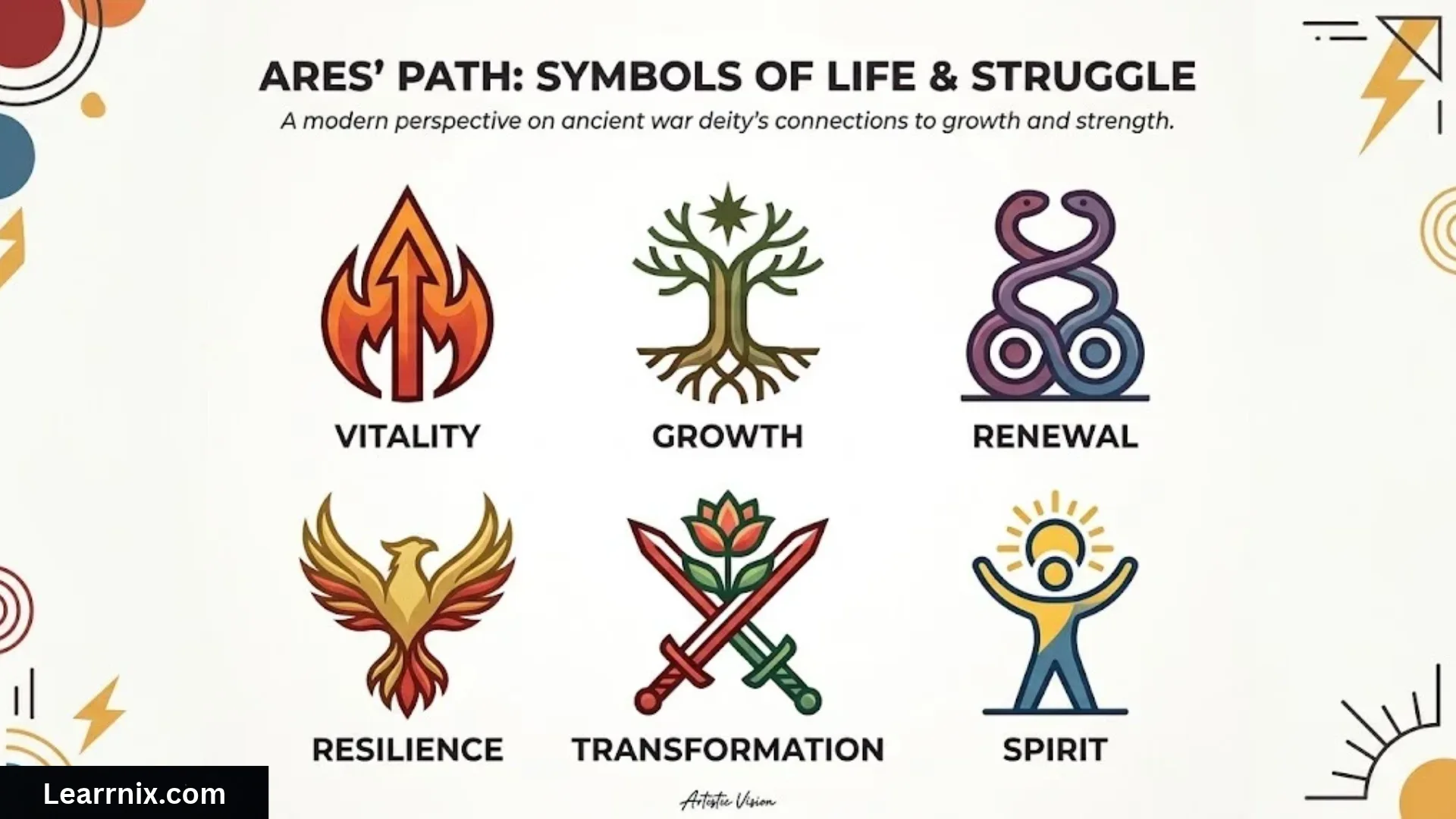
Ares symbols reveal the character of one of the most powerful and controversial gods in Greek mythology. Known as the god of war, Ares represents battlefield aggression, physical strength, courage, and the destructive force of conflict. His familiar attributes include a spear, helmet, shield, and sword, each connected with his identity as a divine warrior.
The meaning of Ares symbols goes beyond weapons and armor. Animals such as the boar and dog, along with birds associated with warfare, add further layers to his mythological image. Red, black, and bronze are also popular colors in modern artwork inspired by Ares, although these colors should not be mistaken for an official ancient Greek color system.
In this guide, you will learn about Ares symbols and their meanings, his animal associations, personality, powers, colors, and weapons. You will also discover how Ares differs from Athena, what his symbols have in common, and how to interpret his attributes in Greek mythology.
What Is Ares, the God Of
Ares is the ancient Greek god of war and one of the twelve Olympian gods. He is traditionally identified as the son of Zeus and Hera. His Roman counterpart is Mars, although Roman Mars developed a broader religious identity than the Greek Ares.
Ares represents the violent and unpredictable side of warfare. He is associated with the clash of weapons, the fury of soldiers, physical courage, and the destruction that follows armed conflict. His character reflects the intensity of battle rather than the careful planning needed to win a war.
Ares is often compared with Athena, another Greek deity associated with warfare. However, their roles differ in important ways.
- Ares: Represents aggression, battlefield violence, fighting strength, and the emotional intensity of combat.
- Athena: Represents wisdom, military strategy, disciplined action, and intelligent decision-making.
This difference helps explain why Ares is sometimes portrayed as reckless despite his extraordinary power. He may possess courage and strength, but those qualities do not always lead to victory or wise decisions.
Ares appears in several ancient myths, including stories connected with the Trojan War and his relationship with Aphrodite. These stories show that the god is more complex than a simple emblem of military success.
What Are Ares Symbols
Ares symbols are the weapons, armor, animals, and other attributes associated with the Greek god of war. They help readers recognize him in mythology, ancient artwork, and modern illustrations.
The most recognizable Ares symbols include:
| Symbol | Meaning |
| Spear | Attack, aggression, and combat |
| Helmet | Warrior identity and protection |
| Shield | Defense and survival |
| Sword | Close combat and fighting strength |
| Boar | Ferocity and destructive power |
| Dog | Vigilance and associations with warfare |
| Vulture | Death and the aftermath of battle |
| Chariot | Movement and the force of warfare |
| Burning Torch | Destruction and the outbreak of conflict in some traditional interpretations |
The spear and helmet are particularly strong identifiers of Ares in Greek mythology. Ancient descriptions and artistic representations frequently show him armed for battle, often with a shield and other protective equipment.
Not every attribute is exclusive to Ares. Greek warriors wore helmets, and other gods, especially Athena, could also carry spears and shields. Identification depends on the surrounding artwork and mythological context.
The animal associations require similar care. The boar is connected with a specific myth involving Adonis, while dogs and vultures appear in traditional accounts of Ares’ sacred animals. Their meanings can differ depending on the story or artistic tradition.
Ares Symbols Greek Mythology
In Greek mythology, Ares symbols communicate both the power and the dangers of warfare. Ancient Greeks understood war as a force that could demonstrate bravery but also cause suffering, death, and destruction.
The spear is a direct representation of offensive power. It was a familiar weapon in ancient Greek warfare and appears frequently in depictions of Ares. The helmet and shield show the protective side of military life, reminding viewers that warriors also faced serious danger.
Ares’ mythology includes conflicts with other gods and heroes. In Homer’s Iliad, he takes part in the Trojan War and experiences a painful defeat after confronting forces supported by Athena. This episode illustrates that divine strength does not always guarantee success.
Animals also contribute to the symbolism surrounding Ares. A boar can represent ferocity, while a vulture evokes the grim consequences of battle. A dog can suggest alertness and aggression, although these associations are not equally emphasized in every ancient source.
When studying Greek mythology symbols, it is helpful to distinguish between ancient literary evidence and modern interpretations. The spear and helmet are well-established attributes of Ares, while color schemes and some popular symbolic meanings are often modern creative choices.
Greek God Ares Symbols
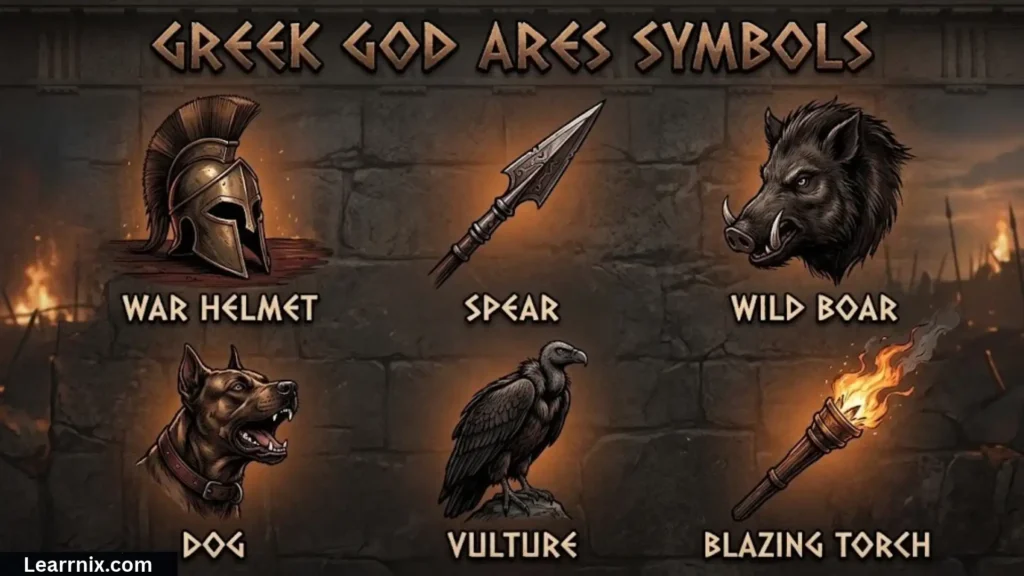
The Greek god Ares is commonly identified through martial attributes that establish his identity as a warrior. His appearance in classical art often includes a helmet, spear, shield, and armor.
These objects have practical meanings as well as symbolic ones. A spear is designed for combat, a shield protects the warrior, and a helmet guards the head. When these objects appear together, they create a clear image of a battle-ready figure.
Ares can appear as a mature, bearded warrior or as a youthful, athletic figure. Artistic representations changed across different periods, so there is no single appearance that applies to every depiction.
His attributes are also useful when comparing Greek gods. Hermes is often recognized by his winged footwear or staff, while Poseidon is associated with the trident. Ares is identified primarily through his military equipment.
For readers exploring ancient statues or mythology illustrations, the combination of weapons, armor, and the surrounding story is more reliable than any single object. A helmet by itself may represent Ares, Athena, or an ordinary warrior.
God Ares Symbols
The symbols of the god Ares represent different aspects of conflict, from attacking an opponent to defending against danger. Understanding each symbol separately makes their shared meaning easier to recognize.
- Spear: Represents direct attack, battlefield strength, and readiness to fight.
- Helmet: Communicates protection, preparation, and military identity.
- Shield: Suggests defense, endurance, and survival in combat.
- Sword: Represents close-range fighting and the physical intensity of warfare.
- Boar: Evokes ferocity, aggression, and uncontrolled strength.
- Dog: Can represent vigilance and the dangerous atmosphere associated with battle.
- Vulture: Evokes death and the aftermath of armed conflict.
These meanings are useful for interpreting Ares-inspired artwork, tattoos, and historical illustrations. However, a symbol does not always carry one fixed meaning. A shield might represent protection in one image and military authority in another.
Ares’ symbols become especially recognizable when several attributes appear together. A helmet paired with a spear and shield creates a strong visual connection to the god of war, while an accompanying animal may add another layer of meaning.
Ares Symbols And Meanings
Each Ares symbol communicates a different idea, but most relate to battle, protection, aggression, or the consequences of violence. These meanings can help you understand ancient artwork or choose an appropriate design for a mythology-inspired project.
| Symbol | Main Meaning | Best Interpretation |
| Spear | Aggression | The force of direct confrontation |
| Helmet | Protection | Preparation for dangerous situations |
| Shield | Defense | Resisting attacks and surviving conflict |
| Sword | Combat | Fighting at close range |
| Boar | Ferocity | Untamed and destructive strength |
| Dog | Vigilance | Alertness and aggression |
| Vulture | Death | The aftermath of warfare |
| Chariot | Military power | Movement and participation in battle |
| Torch | Destruction | Fire and the devastation of conflict |
The spear and helmet are among the most dependable choices when identifying Ares in ancient art. His traditional attributes are described in ancient literary sources, while the exact appearance of individual objects depends on the artist and historical period.
The boar deserves special attention because it connects with a particular myth. In a later account recorded by Ovid, Ares transforms into a boar and kills Adonis, a youth loved by Aphrodite. This story links the animal with jealousy, danger, and destructive force, although it should not be treated as the only meaning of the boar in Greek mythology.
For a modern design, select symbols according to the message you want to communicate. A spear suggests confrontation, a shield emphasizes defense, and a boar creates a more forceful image of untamed power.
Ares Symbols And Attributes
Ares’ attributes include the objects and features that help identify him as a god of war. They also reveal how ancient artists imagined his divine role.
His best-known attributes are a crested helmet, spear, shield, and armor. Some depictions also show him with a sword, a chariot, or other elements associated with warfare.
His mythological attributes extend beyond physical objects. Ares is connected with courage, rage, fighting strength, and the fear experienced on a battlefield. In some traditions, his children include Phobos, associated with fear, and Deimos, associated with terror. These figures reinforce the emotional dimension of warfare in Greek mythology.
The following distinctions are helpful:
- Physical attributes: Helmet, spear, shield, sword, and armor.
- Battle-related attributes: Chariot, horses, and military equipment.
- Animal associations: Boar, dog, serpent, and certain birds in different traditions.
- Character traits: Aggression, courage, anger, and a love of combat.
Not all of these elements appear together in every source. The spear and helmet are particularly well-established, while other animals and details depend on the specific myth or tradition.
When identifying Ares, consider his attributes as a group. This approach avoids the common mistake of assuming that every ancient warrior holding a spear must represent the god himself.
Ares Symbols And Weapons
Weapons are central to Ares’ identity because they connect him directly with armed conflict. They also represent the physical demands of warfare in the ancient Greek world.
The Spear
The spear is one of Ares’ most recognizable weapons. Greek soldiers commonly used spears in battle, and ancient literature frequently describes Ares carrying one. Symbolically, it represents offensive power, aggression, and the willingness to confront an opponent.
The Sword
The sword represents close combat. It was useful when fighting at short range, particularly when a spear was no longer practical. In Ares-inspired artwork, it communicates direct confrontation and the intensity of battle.
The Shield
A shield is defensive equipment rather than an attacking weapon. Its association with Ares highlights the risks of combat and the need to protect the body. In symbolic designs, it can suggest resilience, defense, and determination.
The Helmet
The helmet protects a warrior’s head and contributes to the recognizable appearance of an ancient Greek fighter. For Ares, it represents readiness for battle and military identity.
The Chariot
Ares is also associated with a chariot drawn by extraordinary horses, including fire-breathing horses in mythological accounts. The chariot represents movement, divine power, and his presence in major battles.
Together, these weapons and attributes portray Ares as an armed warrior. They should not be confused with magical objects that belonged exclusively to him; many were ordinary forms of military equipment that gained symbolic significance through their association with the god.
Helmet Helmet Ares Symbols
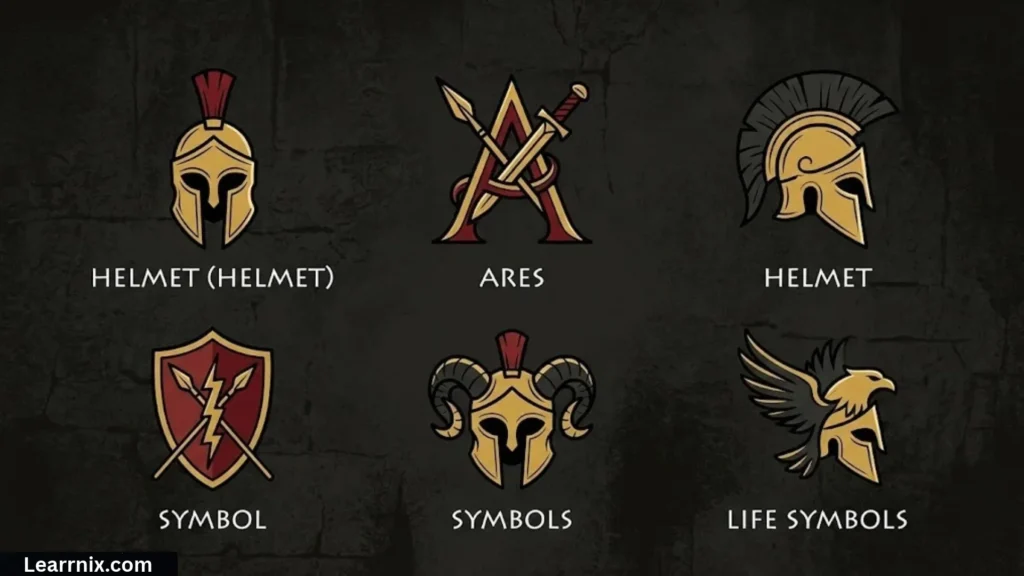
The helmet is one of the most recognizable Ares symbols, and its importance comes from both its practical function and its visual connection with warfare. The repeated word in this heading emphasizes the relationship between helmets and the Greek god.
Ancient Greek helmets were made in different shapes and styles. Some covered much of the face, while others provided less coverage. A crested helmet could create an imposing appearance and make a warrior stand out in battle.
In depictions of Ares, the helmet communicates several ideas:
- Readiness for battle: The god is prepared to enter combat.
- Protection: Armor represents the need to guard against injury.
- Strength: A fully equipped warrior appears formidable.
- Military identity: The helmet helps establish Ares’ role as a war god.
However, helmets are not exclusive to Ares. Athena also wears a helmet in many artistic representations, and ordinary Greek soldiers used similar equipment. A helmet alone is therefore not sufficient proof that an image represents Ares.
For a drawing or mythology-inspired design, a crested helmet combined with a spear and shield provides a recognizable reference to the god. The details should reflect the intended artistic style rather than an assumed official emblem.
Ares Animal Symbol
The boar is a well-known animal associated with Ares, particularly through the story of Adonis. Its aggressive nature and physical strength make it a fitting image for the more destructive aspects of the god’s character.
Ares is also linked with dogs and vultures in traditional accounts of his sacred animals. Some descriptions of his attributes additionally mention serpents and certain birds associated with war or ill fortune. These associations vary between sources, so the boar should not be presented as the only animal connected with Ares.
The Boar
The boar can represent ferocity, danger, and untamed strength. Its connection with the Adonis myth gives it a particularly violent association in some retellings of Greek mythology.
The Dog
The dog is associated with alertness and the atmosphere of conflict. Its traditional connection with Ares reflects the dangerous environment surrounding warfare rather than one universal symbolic meaning.
The Vulture
The vulture evokes death and the aftermath of battle. Its association with Ares reflects the destructive consequences of war and the suffering left behind.
The Serpent
The serpent appears among the animal associations described in some accounts of Ares. Its meaning depends on the context, and it should not automatically be interpreted as a universal symbol of war or aggression.
If you want to choose an animal for an Ares-themed design, the boar is a strong option for ferocity, the dog for vigilance, and the vulture for the darker consequences of conflict.
Ares Colors And Symbols
Red, black, bronze, and dark gray are common choices for modern artwork featuring Ares. They suit his warrior identity, but these colors are best understood as artistic interpretations rather than an official set of sacred colors established by ancient Greek tradition.
| Color | Common Meaning | Connection With Ares |
| Red | Blood, passion, aggression | Evokes the intensity of battle |
| Black | Danger, death, mystery | Reflects the destructive side of war |
| Bronze | Armor, endurance, strength | Recalls ancient Greek military equipment |
| Dark Gray | Metal, seriousness, conflict | Creates a rugged warrior aesthetic |
Red is often used to emphasize Ares’ fierce temperament. Black creates a darker atmosphere, while bronze connects the design to ancient weapons and armor.
These associations are not universal. Red can also symbolize love or celebration in other contexts, and bronze may simply refer to the material used for a historical object.
For a mythology-themed illustration, a bronze helmet against a dark background with restrained red accents can create a clear visual identity. A simpler design might use only the outline of a helmet or spear, allowing the object itself to carry the meaning.
Ares Personality
Ares is commonly portrayed as aggressive, passionate, courageous, and quick to anger. His personality reflects the intensity of battle and the unpredictable emotions that accompany violent conflict.
Unlike Athena, who emphasizes strategy and wisdom, Ares is associated with the physical force of fighting. He may show courage in the face of danger, but his impulsive nature can also lead to poor decisions.
His main personality traits include:
- Aggression: A readiness to confront enemies and engage in combat.
- Courage: The ability to face danger without backing away.
- Anger: A tendency toward violent reactions and conflict.
- Pride: A strong identification with his power as a warrior.
- Impulsiveness: A willingness to act before considering the consequences.
These qualities make Ares a complicated mythological figure. Courage can be admired, but aggression without restraint can cause destruction. His stories explore the difference between bravery and reckless violence.
His personality also helps explain his symbols. The spear reflects direct action, the helmet represents preparation, and the boar suggests fierce strength that may be difficult to control.
Ares Powers
As an Olympian god, Ares possesses divine abilities that distinguish him from mortal warriors. His powers are primarily connected with warfare, physical strength, and participation in conflicts among gods and humans.
Divine Strength
Ares is portrayed as a formidable warrior with extraordinary physical power. His strength makes him a dangerous opponent, although ancient myths do not suggest that he is unbeatable.
Combat Ability
Ares is associated with weapons, armed fighting, and the fury of battle. His spear and armor emphasize his role as a divine participant in warfare.
Divine Endurance
As an immortal god, Ares is not subject to ordinary human mortality. Nevertheless, myths can show him being wounded, humiliated, or defeated, illustrating that immortality does not mean freedom from pain or setbacks.
Influence Over Battle
Ares personifies the aggression, confusion, and violence of warfare. This is a mythological role, not a precise magical ability with a fixed set of rules.
Chariot And Horses
Ares is associated with a chariot pulled by extraordinary horses. In traditional accounts, the horses have fiery characteristics that emphasize the god’s powerful and fearsome presence.
Ares’ powers are best understood through ancient stories rather than modern fictional power rankings. His mythology emphasizes force and battle fury, while Athena represents a more strategic approach to warfare.
Ares Facts
These facts summarize Ares’ identity, relationships, symbols, and place in Greek mythology.
| Fact | Information |
| Greek Name | Ares |
| Mythology | Ancient Greek |
| Divine Role | God of war and battle |
| Parents | Zeus and Hera |
| Roman Counterpart | Mars |
| Main Symbols | Spear and helmet |
| Other Attributes | Shield, armor, sword, and chariot |
| Animal Associations | Boar, dog, serpent, and certain birds in different traditions |
| Common Modern Colors | Red, black, and bronze |
| Famous Mythological Conflict | The Trojan War |
| Personality | Fierce, aggressive, courageous, and impulsive |
Ares is one of the twelve Olympian gods, but his character was not always admired. Greek literature often emphasizes the frightening and destructive aspects of warfare rather than presenting him as a model of wise leadership.
He appears in Homer’s Iliad, where he participates in the Trojan War. His conflicts with other divine figures illustrate that even a powerful god can be outmaneuvered or defeated.
Ares is also associated with Aphrodite, the goddess of love and beauty. Their relationship creates an interesting contrast between love and war, two powerful forces that can produce very different human experiences.
Another important detail is that the Greek Ares and Roman Mars should not be treated as completely interchangeable. The Romans gave Mars a significant role in the protection and identity of their state, while Greek accounts often stress Ares’ violent and turbulent nature.
What Are Ares Symbols in Greek Mythology
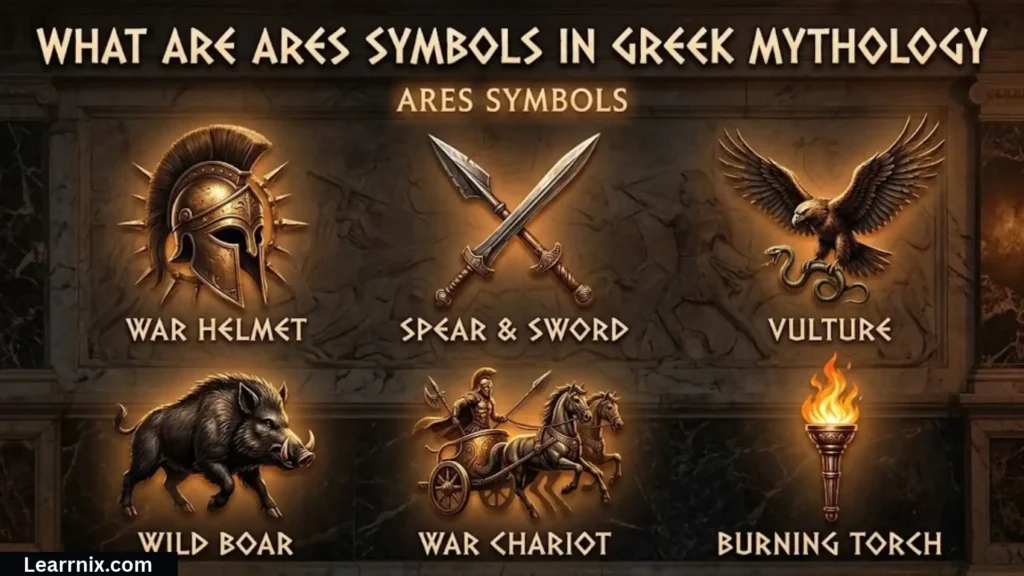
The main Ares symbols in Greek mythology are the spear, helmet, shield, and armor. These attributes identify him as a warrior and connect him with the physical reality of ancient Greek warfare.
The spear represents offensive power, while the shield reflects defense. The helmet establishes the warrior’s identity and offers protection, and the sword represents close combat. When these objects appear together, they create a recognizable image of a battle-ready god.
Animal associations add another dimension to this symbolism. The boar is linked with a myth involving Adonis, while dogs and vultures appear in traditional descriptions of animals associated with Ares. Some sources also connect him with serpents and certain birds.
It is useful to distinguish these established attributes from more recent interpretations. Red and black are popular colors for Ares in contemporary art, but the ancient Greeks did not leave behind a universally accepted color chart for every deity.
When interpreting an ancient image, look at the whole scene rather than one object. The character’s equipment, companions, and mythological setting provide stronger clues to identity than a single spear or helmet.
Greek Mythology Ares Symbols
This heading highlights the wider subject of Ares symbols within Greek mythology. Understanding the broader tradition helps explain why the god is represented through several different objects instead of one exclusive emblem.
Ancient Greek religion did not use a single standardized symbol system in which every god had only one identifying mark. Artists and storytellers communicated divine identity through attributes, clothing, companions, and narrative context.
Ares’ martial equipment is central to this visual tradition. His helmet and spear appear in descriptions of the god, while his shield and armor reinforce his image as a warrior. Chariots and extraordinary horses appear in accounts of his participation in battle.
The way Ares is portrayed also changes over time. Some artworks depict a mature, bearded warrior, while others show a youthful figure with a helmet and spear. These differences reflect artistic traditions rather than contradictions about his basic identity.
The best way to study Ares symbols is to separate three things: what ancient texts describe, what surviving artwork depicts, and what modern artists add for creative effect. This approach helps preserve the mythology’s meaning without presenting every modern design choice as an ancient fact.
What Do Ares Symbols Have in Common
Ares symbols share a connection with warfare, physical power, aggression, and the dangers of conflict. Although each object has a different function, together they express the central themes of his mythology.
The spear and sword represent attacking an opponent. The helmet and shield represent protection against danger. The boar evokes fierce and potentially destructive strength, while the vulture suggests the consequences of battle.
These symbols also reveal the tension within Ares’ character. Weapons and armor can suggest preparation and discipline, yet Ares is frequently portrayed as impulsive and driven by anger. His mythology shows that strength without judgment can create serious consequences.
The shared meanings can be summarized as follows:
- Power: The ability to confront a formidable opponent.
- Aggression: The force that drives physical conflict.
- Protection: The need to defend against danger.
- Courage: The willingness to face threatening situations.
- Destruction: The suffering and death that warfare can cause.
For a tattoo, illustration, or mythology-inspired design, choose an attribute according to the message you want to express. A helmet can represent protection, a spear can communicate aggression, and a boar can symbolize ferocity. Their meanings become clearer when understood within the larger story of Ares.
Ares Symbols FAQs
What is the most recognizable symbol of Ares?
The spear and helmet are among the most recognizable symbols of Ares. They represent his identity as a warrior and appear frequently in descriptions and artistic depictions of the Greek god of war.
What animal is associated with Ares?
The boar is associated with Ares, especially through the myth of Adonis. Dogs and vultures also appear in traditional accounts of his animal associations, while some sources mention serpents and certain birds.
What do the colors of Ares mean?
Red, black, and bronze are popular modern color choices for Ares-inspired artwork. Red suggests aggression, black evokes danger, and bronze recalls ancient armor. These are common interpretations rather than an official ancient color code.
How are Ares and Athena different?
Ares represents the aggressive and violent side of warfare, while Athena is associated with military strategy, wisdom, and disciplined action. Both are war-related deities, but their mythological roles emphasize different qualities.
Can Ares symbols be used for tattoos and artwork?
Yes. The spear, helmet, shield, and boar are suitable choices for mythology-inspired tattoos, drawings, and decorative designs. Their meanings depend on context and personal interpretation, so they should not automatically be treated as official emblems.
Conclusion
Ares symbols provide a useful way to understand the Greek god of war and his place in ancient mythology. His spear, helmet, shield, and sword connect him with the equipment of battle, while animal associations reflect the aggression and destructive potential of conflict.
His personality and powers add depth to these attributes. Ares represents courage and physical strength, but his stories also explore anger, impulsiveness, and the suffering caused by warfare. His contrast with Athena highlights the difference between battlefield aggression and strategic wisdom.
When choosing an Ares symbol for a design or personal reference, focus on the meaning you want to communicate. The spear suggests direct confrontation, the helmet represents protection, and the boar evokes ferocity. Understanding the ancient context helps you appreciate these symbols without confusing historical evidence with modern artistic interpretations.

I am Michael Carter, an educational content creator who believes that knowledge has the power to transform lives.
I create resources focused on modern education, digital learning, and building essential skills for the future.
I love helping readers discover simple and effective ways to improve their learning journey.
Books by Michael Carter:
- Modern Education for Tomorrow’s World
- Learning Skills for Future Success
 Charlotte Anderson