Masonic symbols have attracted attention for centuries because they connect traditional craftsmanship, moral teachings, architecture, and the history of Freemasonry. From the famous square and compass to the letter G, these designs represent ideas such as honesty, self-discipline, knowledge, and personal growth. They appear in lodge buildings, jewelry, historical documents, artwork, and discussions about American history.
Many people search for Masonic symbols and meanings because they want to identify specific designs or understand what they represent. Others are curious about the eye and pyramid on US money, the history of Masonic symbolism in Washington, DC, or the relationship between Freemasonry and Mormon temples. These subjects involve a mixture of documented history, religious interpretation, and popular theories.
This guide explores the most recognizable Masonic symbols, their traditional meanings, and the historical evidence behind their use. It also explains how to interpret ancient imagery, distinguish Masonic emblems from similar designs, and understand the connections between Freemasonry, American landmarks, and Latter-day Saint history.
What Are Masonic Symbols
Masonic symbols are signs, letters, geometric shapes, and objects used to communicate moral lessons and philosophical ideas within Freemasonry. Freemasonry is a fraternal organization whose modern traditions developed from historical associations connected with stonemasonry and later lodge-based practices.
Many Masonic symbols come from the practical tools of traditional builders. Stonemasons used squares to check angles, compasses to draw circles, and levels to assess horizontal surfaces. Over time, these familiar tools became symbols of personal conduct and ethical responsibility.
Here are some recognizable examples:
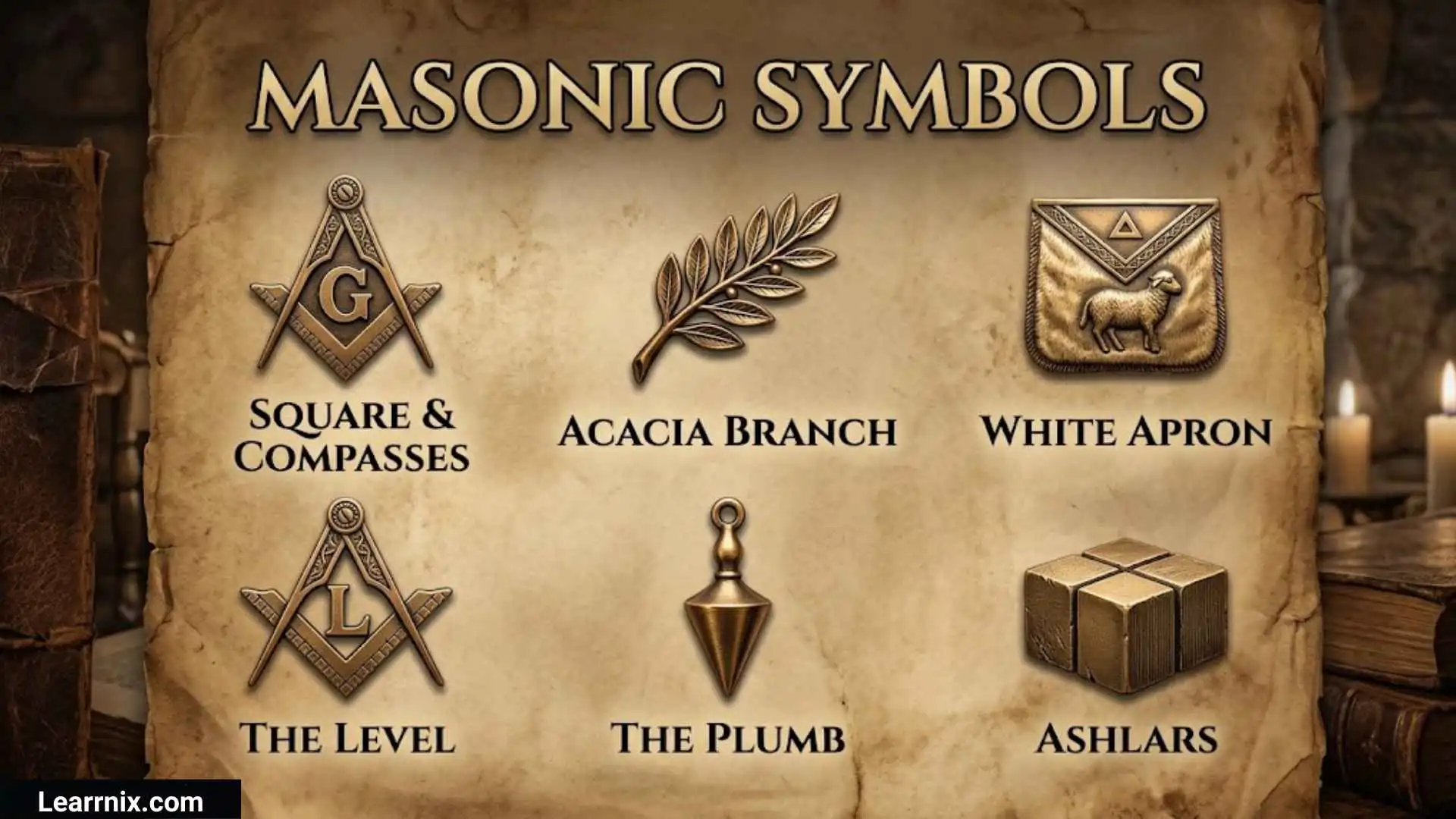
- Square and Compass: The best-known Masonic emblem, traditionally associated with fairness, self-discipline, and responsible behavior.
- Letter G: Commonly associated with God or geometry in many Masonic traditions.
- Level: A symbol of equality and the idea that people deserve dignity regardless of social position.
- Plumb Rule: Represents upright conduct and integrity.
- Rough Ashlar: An unfinished stone representing a person who is still developing their character.
- Perfect Ashlar: A finished stone symbolizing refinement through learning and personal effort.
- Eye of Providence: An eye associated with divine oversight in several religious and artistic traditions, although it is not exclusively Masonic.
Not every symbol that looks Masonic actually belongs to Freemasonry. Eyes, stars, pillars, triangles, and geometric patterns have appeared in many cultures and institutions. Their meanings depend on the historical period, the organization using them, and the surrounding imagery.
Masonic Symbols And Meanings
Masonic symbolism turns familiar objects into reminders of ethical principles. Rather than treating every emblem as a mysterious code, it is more useful to understand how these designs connect practical craftsmanship with personal improvement.
| Masonic Symbol | Common Traditional Meaning |
| Square | Honesty, fairness, and moral conduct |
| Compass | Self-control, moderation, and personal boundaries |
| Letter G | God or geometry, depending on context |
| Level | Equality and shared human dignity |
| Plumb Rule | Integrity and upright behavior |
| Rough Ashlar | An unfinished character |
| Perfect Ashlar | Personal development and refinement |
| Beehive | Industry, cooperation, and collective effort in some traditions |
| Pillars | Strength, stability, and temple imagery |
| Eye of Providence | Divine watchfulness in relevant historical contexts |
Why Tools Have Symbolic Meanings
The square and compass are practical instruments, but their symbolic meanings extend beyond construction. A square can remind a person to act fairly, while a compass can represent controlling impulses and respecting appropriate limits.
The rough and perfect ashlars express a related idea. Just as a stone may need cutting and polishing before it fits into a building, people can improve their character through education, reflection, and experience.
Are Masonic Symbols Secret Codes?
Some Masonic ceremonies use symbols, signs, and traditional teachings that have specific meanings within the organization. However, it is inaccurate to assume that every pyramid, eye, star, or unusual architectural feature conceals a Masonic message.
A reliable interpretation should consider the object’s provenance, date, inscriptions, and historical purpose. This approach separates documented symbolism from speculation.
Masonic Symbols Square And Compass
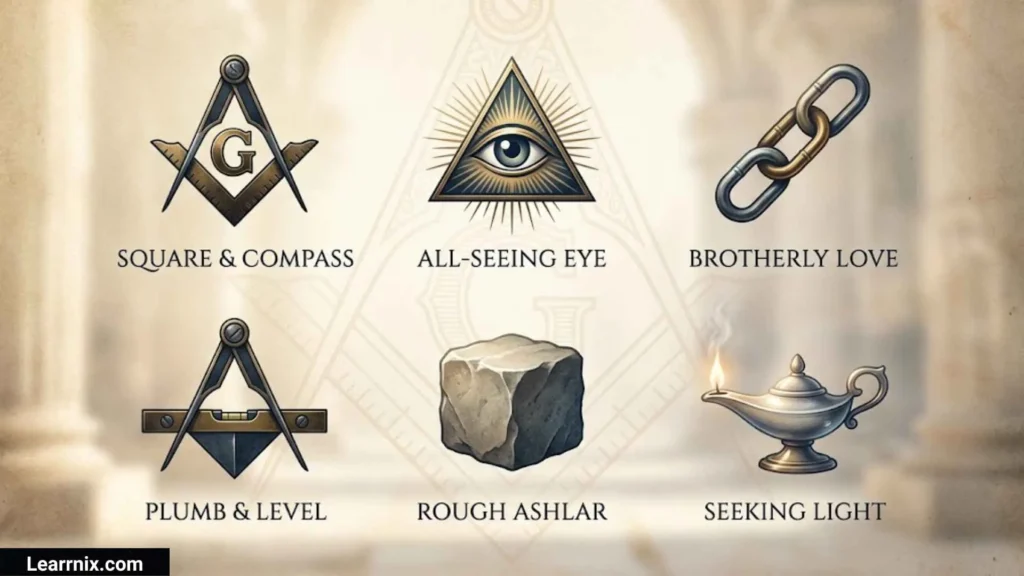
The square and compass is the most recognizable emblem associated with Freemasonry. It usually depicts a builder’s square and a pair of compasses arranged together. In many American versions, the letter G appears between the tools.
What Does the Square Represent?
The square is traditionally associated with fairness, honesty, and ethical behavior. Builders use it to check right angles and maintain accuracy. In Masonic teachings, this practical purpose becomes a lesson about making fair decisions and treating others properly.
What Does the Compass Represent?
The compass represents self-restraint, moderation, and the ability to keep personal desires within reasonable boundaries. Its circular movement provides a visual reminder of discipline and responsibility.
Together, the two tools express complementary ideas: act fairly toward others and exercise control over your own behavior.
Why Is the Letter G Included?
The letter G is commonly interpreted as referring to God or Geometry. God reflects the spiritual dimension of many Masonic traditions, while geometry represents the mathematical knowledge used in building and architecture.
The letter is not interpreted identically by every Masonic jurisdiction, and some versions of the emblem do not include it. Its meaning should therefore be understood within the particular tradition in which it appears.
How to Recognize the Emblem
Look for the recognizable combination of a right-angled square and two pointed compass legs joined at a pivot. Other crossed tools may look similar, but the arrangement of the square and compass, particularly when accompanied by the letter G, provides a stronger indication of Masonic imagery.
Masonic Symbols G
The letter G is one of the most frequently discussed elements in Masonic symbolism. It commonly appears in the center of the square-and-compass emblem, especially in American Masonic designs.
Its two principal interpretations are God and geometry. These ideas connect spiritual belief with the mathematical principles used to create accurate structures.
God: In many Masonic traditions, the letter refers to a Supreme Being. Freemasonry is not a single religion, and its religious requirements differ across jurisdictions. Where belief in a Supreme Being is required, members may still have different religious backgrounds.
Geometry: Geometry represents measurement, proportion, order, and the knowledge needed for construction. Symbolically, it can also suggest that learning and reason help people understand the world and improve themselves.
The letter G does not automatically identify a particular deity, political movement, or secret group. Its meaning depends on the emblem and the setting in which it appears.
For text use, you can copy this character: G. However, there is no single standard Unicode character that reproduces every version of the Masonic letter G emblem. The full design is usually shared as an image or vector illustration.
Ancient Masonic Symbols
Ancient Masonic symbols draw on several historical sources, including building tools, geometric principles, biblical imagery, and classical architecture. However, the history of a symbol is not necessarily the same as the history of Freemasonry.
Modern organized Freemasonry developed over time from earlier traditions associated with stonemasons and the emergence of speculative lodges. Many designs now used in Masonic settings existed long before modern Freemasonry.
Common Historical Symbols
- Pillars: Associated in Masonic tradition with Boaz and Jachin, the pillars described in biblical accounts of Solomon’s Temple.
- Sun And Moon: Celestial imagery that can represent cycles, order, and the natural world, depending on the context.
- Eye Of Providence: An eye, sometimes placed inside a triangle with rays, associated with divine observation in several religious and artistic traditions.
- Geometric Shapes: Squares, circles, and triangles that can have practical, decorative, philosophical, or religious meanings.
- Rough And Perfect Ashlars: Stones used to illustrate the transformation from an unfinished state to a refined one.
Did Ancient Civilizations Use Masonic Symbols?
Ancient Egyptians, Greeks, Romans, and other civilizations used geometric designs, monumental pillars, and symbolic imagery. Some of these elements were later incorporated into different religious, artistic, or fraternal traditions.
That does not establish that these civilizations practiced modern Freemasonry. A symbol may have an ancient origin and a later Masonic interpretation without proving that the original culture used it in the same way.
When investigating a claimed ancient Masonic emblem, check the object’s date, archaeological context, inscriptions, and reliable historical documentation. Similar appearance alone is not enough to establish a direct connection.
Masonic Symbols On Money
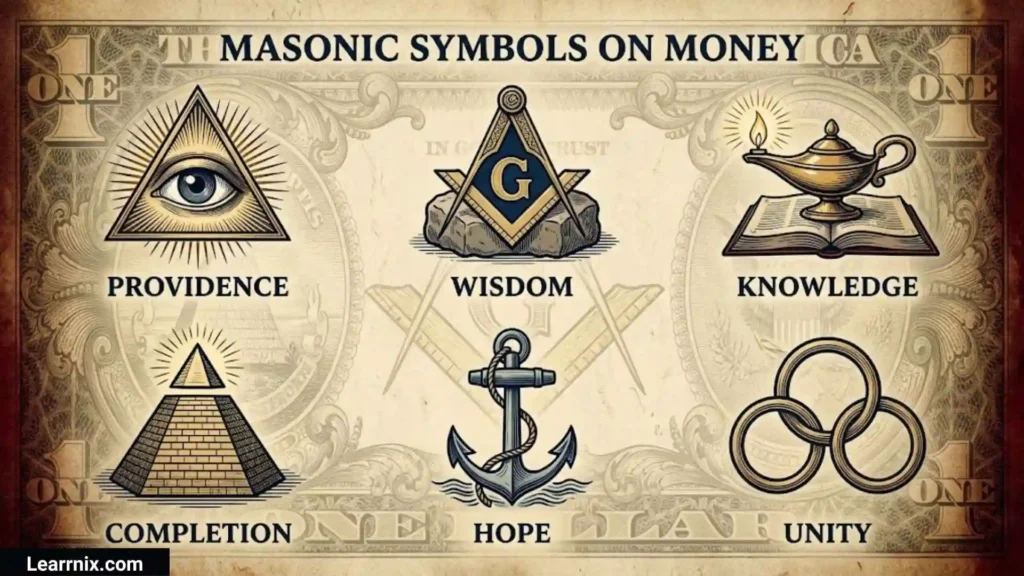
Masonic symbols on money are a popular search topic because American currency features an eye and an unfinished pyramid that are sometimes linked to Freemasonry. The most discussed example is the reverse of the US one-dollar bill.
The Eye Of Providence On The Dollar Bill
The Eye of Providence appears above an unfinished pyramid on the reverse of the one-dollar bill. It represents divine providence, or the idea of God’s watchful care and guidance.
The eye has appeared in religious and artistic settings beyond Freemasonry. Its presence on American currency does not, by itself, prove that the design is a uniquely Masonic symbol or that Freemasons secretly control the government.
The Great Seal of the United States was adopted in 1782, and its reverse design appears on the dollar bill. The eye and pyramid are part of that national emblem.
What Does The Unfinished Pyramid Mean?
The pyramid is commonly interpreted as representing strength and endurance. Its unfinished appearance expresses the idea that the United States was still developing when the Great Seal was created.
The Roman numerals MDCCLXXVI at the pyramid’s base represent 1776, the year of American independence. The accompanying Latin motto Annuit Cœptis is commonly translated as a reference to providence favoring American undertakings, while Novus Ordo Seclorum refers to a new order of the ages.
These elements have documented explanations within the history of the Great Seal. They should not automatically be treated as evidence of a hidden Masonic message.
Are There Official Masonic Symbols On US Currency?
The standard one-dollar bill does not display the square-and-compass emblem as part of the Great Seal. The Eye of Providence has broader historical and religious associations, so describing it as exclusively Masonic would be misleading.
When researching Masonic symbols on money, distinguish between official currency designs, money issued by Masonic organizations, and unofficial interpretations. This makes it easier to identify what historical evidence actually supports.
Masonic Symbols In Washington Dc
Washington, DC, contains historic buildings, monuments, and memorials that have inspired questions about Freemasonry. Some connections are documented, while others come from interpretations of architectural shapes and city planning.
George Washington was a Freemason, having joined a lodge in Fredericksburg, Virginia, in 1752. He later participated in the cornerstone ceremony for the US Capitol in 1793. This is a documented connection between a prominent American leader, Freemasonry, and the capital’s history.
The US Capitol
The Capitol’s cornerstone ceremony in 1793 is one of the clearest historical examples of a Masonic connection in Washington, DC. George Washington participated in the ceremony, which was conducted with Masonic elements.
This historical event supports a specific connection between Freemasonry and the Capitol’s early history. It does not establish that every feature of the building was designed according to Masonic symbolism.
The Washington Monument
The Washington Monument is an obelisk, a form of architecture with ancient Egyptian associations that became popular in later Western memorial design. Obelisks can carry cultural, commemorative, or national meanings.
Its shape alone does not prove a Masonic purpose. To establish a direct connection, researchers need evidence from original plans, construction records, inscriptions, or contemporary accounts.
Masonic Buildings And Historical Objects
Masonic lodge buildings and memorials are more direct places to find explicit Masonic imagery. Their emblems, inscriptions, records, and ceremonial objects can help researchers identify how particular symbols were used.
When studying Washington, DC, it is useful to distinguish between a building with a documented Masonic history and one that simply contains columns, triangles, stars, or other common architectural shapes.
Washington Dc Masonic Symbols
Searches for Washington, DC, Masonic symbols often focus on whether the city’s street layout, monuments, and public buildings contain hidden geometric patterns. The topic combines genuine historical connections with theories that are not always supported by documentary evidence.
The capital’s original plan was designed by Pierre Charles L’Enfant, with later surveying and planning work by Andrew Ellicott. Its avenues, circles, and intersecting streets create geometric patterns, but those patterns are not proof of a Masonic design.
Symbols Commonly Discussed In Washington, DC
Square And Compass: This emblem is associated directly with Freemasonry and may appear on lodge buildings, ceremonial objects, or memorials connected with Masonic organizations.
Eye Of Providence: This symbol appears on the Great Seal of the United States and the one-dollar bill. It has broader religious and artistic roots and is not exclusive to Freemasonry.
Obelisks And Pillars: These forms appear in many architectural traditions. Their presence may reflect historical style, commemoration, or structural design rather than a Masonic message.
Geometric Street Patterns: Triangles and other shapes can be created by connecting roads or landmarks on a map. Without evidence of deliberate intent, such patterns should not be treated as proof of hidden symbolism.
How To Verify Claims About Masonic Designs
When you encounter a claim about a Masonic symbol in Washington, DC, ask a few practical questions:
- Is the symbol physically present, or does it appear only when locations are connected on a map?
- Is there a historical document explaining the design’s intended meaning?
- Was the architect or commissioner connected with a Masonic organization?
- Do credible historical sources support the claim?
- Could the shape have an ordinary architectural, engineering, or planning explanation?
These questions help separate historical facts from speculation and make the city’s architectural history easier to understand.
Masonic Symbols On Mormon Temple
Masonic symbols and Mormon temples are often discussed together because of the historical relationship between early Latter-day Saint leaders and Freemasonry. Understanding this connection requires distinguishing documented events from interpretations of religious symbolism.
Joseph Smith joined Freemasonry in Nauvoo, Illinois, in March 1842. The first Latter-day Saint endowment ceremony in Nauvoo followed in May of that year. The timing has led historians to examine possible relationships between Masonic practices and early LDS temple ceremonies.
Why Are Mormon Temples Linked To Freemasonry?
The historical connection developed during a period when Freemasonry became established in Nauvoo and several Latter-day Saint men joined local lodges. Researchers have compared elements of Masonic ritual with early LDS temple practices, while recognizing that the traditions have different religious foundations.
Some writers argue that Masonic practices influenced the presentation of certain early temple ceremonies. Other scholars emphasize that Latter-day Saint temple teachings also draw on biblical traditions and doctrines developed before Joseph Smith joined a Masonic lodge. The extent and meaning of these connections remain subjects of scholarly discussion.
Symbols Commonly Compared
- Pillars: Associated with biblical temple imagery and architectural traditions.
- Square And Compass: A recognizable emblem of Freemasonry, traditionally connected with moral discipline and craftsmanship.
- Geometric Designs: Shapes that may have decorative, architectural, or symbolic purposes.
- Eye Of Providence: A symbol of divine watchfulness found in various religious and artistic contexts.
The presence of a pillar or geometric pattern inside a religious building does not prove that the design is Masonic. A sound interpretation requires historical evidence about the particular building and its original purpose.
Masonic Symbols In Mormonism
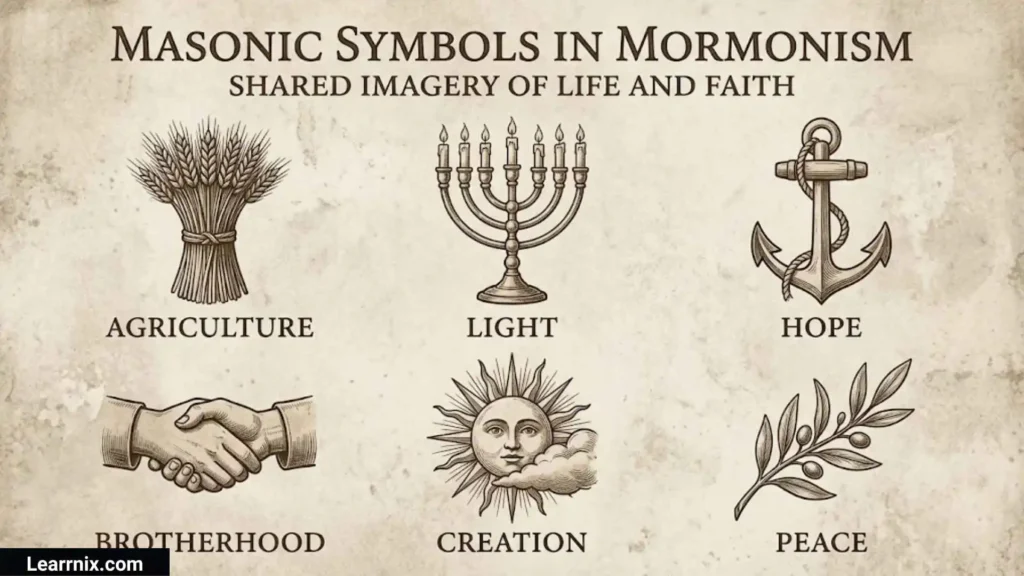
The relationship between Freemasonry and Mormonism is especially associated with Nauvoo in the 1840s. It remains an area of interest for people studying religious history, ceremonial traditions, and the development of temple worship.
Joseph Smith became a Master Mason on March 16, 1842, according to historical records. The first Nauvoo endowment ceremony took place on May 4, 1842. These dates establish a close historical sequence, although chronology alone cannot explain every similarity between the traditions.
Are Mormon And Masonic Symbols The Same?
No. Freemasonry is a fraternal organization, whereas the Church of Jesus Christ of Latter-day Saints is a religious institution with its own scriptures, theology, and temple ordinances.
| Feature | Freemasonry | Latter-Day Saint Tradition |
| Main purpose | Fraternal fellowship and moral instruction | Religious worship, covenants, and spiritual ordinances |
| Square And Compass | Recognizable emblem of the fraternity | Not the defining emblem of LDS temple worship |
| Temple References | Often include symbolic references to Solomon’s Temple | Refer to sacred religious buildings and ordinances |
| Religious Foundation | Requirements vary by Masonic jurisdiction | Based on Latter-day Saint scripture and doctrine |
How To Research The Historical Relationship
Readers can compare primary documents, scholarly histories, and official historical accounts. The Joseph Smith Papers project provides records of the Nauvoo lodge and the events surrounding Smith’s Masonic membership, while academic studies discuss different interpretations of the relationship between Freemasonry and LDS temple ceremonies.
It is best to distinguish what historical documents establish from what researchers infer. This approach makes it possible to study similarities without treating the two traditions as interchangeable.
Masonic Symbols Images Tattoos
Masonic symbols appear in tattoos, jewelry, illustrations, rings, and decorative artwork. People may choose them because of family traditions, personal beliefs, historical interests, or an association with Freemasonry.
Popular Masonic Tattoo Designs
Square And Compass: Often selected to represent honesty, discipline, fairness, or a personal connection to the fraternity.
Square And Compass With G: Adds the letter commonly associated with God or geometry in many Masonic traditions.
All-Seeing Eye: Can represent divine watchfulness or spiritual awareness. It also appears in non-Masonic religious and artistic settings.
Pillars: May refer to biblical temple architecture, strength, stability, or historical symbolism.
Rough And Perfect Ashlars: Represent the process of personal development, from an unfinished state toward greater refinement.
How To Choose A Masonic Symbol Tattoo
Before choosing a design, research its traditional meaning and the context in which it is used. Some emblems are closely associated with membership in Freemasonry, so wearing one may lead others to assume you belong to the organization.
Consider the size and detail of the artwork, too. A simple geometric design may remain clear at a small size, while an intricate emblem with lettering may need more space.
Can You Copy Masonic Symbols As Text?
There is no single standard Unicode character that reproduces the complete square-and-compass emblem in all its variations. The ordinary letter G can be copied, but it does not include the surrounding tools.
For an accurate tattoo or illustration, use a verified reference image or carefully prepared vector design. Text-based approximations can look different across fonts and devices, so they are not ideal for permanent artwork.
FAQs About Masonic Symbols
What is the most famous Masonic symbol?
The square and compass is the most recognizable Masonic emblem. It traditionally represents fairness, self-discipline, and responsible conduct, while the letter G in some versions refers to God or geometry.
What does the all-seeing eye mean in Freemasonry?
In Masonic settings, the all-seeing eye can symbolize divine watchfulness and the idea that a person’s actions are accountable to a higher power. The eye also appears in religious art outside Freemasonry.
Are Masonic symbols found on the one-dollar bill?
The reverse of the US one-dollar bill features the Eye of Providence above an unfinished pyramid as part of the Great Seal. The seal was adopted in 1782, and the imagery should not automatically be interpreted as exclusively Masonic.
Did Freemasons design Washington, DC?
There is documented Masonic involvement in the US Capitol’s 1793 cornerstone ceremony, led by George Washington. However, this does not establish that the entire city was designed according to Masonic principles.
Why do people connect Freemasonry with Mormon temples?
The connection is largely associated with Joseph Smith’s Masonic membership in 1842 and the introduction of early Latter-day Saint endowment ceremonies shortly afterward. Historians continue to examine the similarities and differences between these traditions.
Conclusion
Masonic symbols communicate ideas about honesty, self-control, equality, craftsmanship, and personal improvement. The square and compass, letter G, plumb rule, level, and rough and perfect ashlars are among the most recognizable examples. Their meanings depend on the particular Masonic tradition and the context in which they appear.
The connections between Masonic imagery, American currency, Washington, DC, and Mormonism demonstrate why historical context matters. Some relationships are supported by records, while other claims rely on visual similarities or speculation. Understanding the difference helps readers interpret these symbols more accurately.
Whether you are researching Masonic symbols for education, history, or a tattoo design, begin with the symbol’s traditional meaning and look for reliable evidence about its origin. A careful approach reveals the history behind the imagery without assuming that every eye, pillar, or geometric shape carries a Masonic message.

I am Michael Carter, an educational content creator who believes that knowledge has the power to transform lives.
I create resources focused on modern education, digital learning, and building essential skills for the future.
I love helping readers discover simple and effective ways to improve their learning journey.
Books by Michael Carter:
- Modern Education for Tomorrow’s World
- Learning Skills for Future Success
 Charlotte Anderson