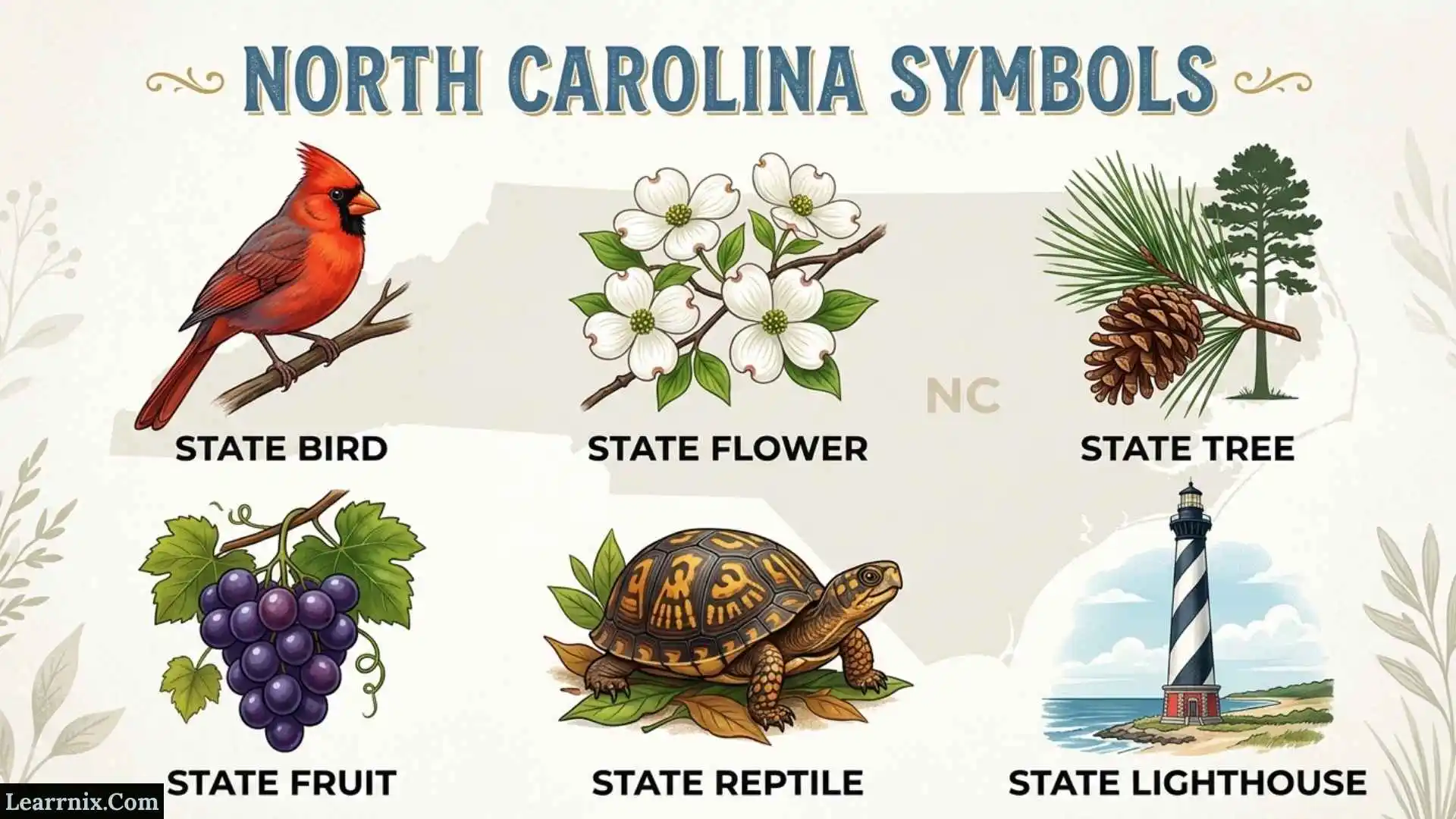
If you are searching for North Carolina symbols, you may want a quick list of the state’s bird, flower, tree, animal, flag, motto, and other official emblems. But the topic goes much deeper than a simple worksheet answer.
North Carolina has officially recognized symbols connected to its wildlife, forests, mountains, coast, geology, agriculture, food traditions, arts, history, and culture. Some are familiar statewide, such as the cardinal, dogwood, pine, and Plott Hound. Others, including the Moravian cookie, Moravian star, megalodon fossil, eastern tiger swallowtail, and Southern Appalachian brook trout, are less widely known.
This guide provides a detailed, search-intent-focused overview of North Carolina’s official symbols and other official designations. You will find a quick answer, a master reference table, explanations of the major symbols, common mistakes to avoid, and a simple method for checking whether a North Carolina symbol is truly official.
Quick Answer: What Are the Official Symbols of North Carolina?
North Carolina’s best-known official symbols include the dogwood as the state flower, cardinal as the state bird, pine as the state tree, Scotch bonnet as the state shell, gray squirrel as the state mammal, channel bass (red drum) as the state saltwater fish, honeybee as the state insect, emerald as the state precious stone, turtle as the state reptile, granite as the state rock, and Plott Hound as the state dog.
The state also has many other official designations, including symbols related to wildlife, food, culture, festivals, history, and recreation.
Key Takeaways
- North Carolina has far more official symbols than the bird, flower, and tree commonly taught in elementary school.
- Most official symbols are established by the North Carolina General Assembly.
- The exact legal wording sometimes differs from the name people use in everyday conversation.
- A famous North Carolina icon is not automatically an official state symbol.
- The best way to verify a designation is to check the current North Carolina General Statutes.
Complete North Carolina Symbols Reference Table
The following table brings together the major official symbols and selected official designations found in North Carolina’s state statutes.
| Official category | North Carolina designation |
| State flag | North Carolina State Flag |
| State motto | Esse Quam Videri |
| State colors | Red and blue |
| State flower | Dogwood |
| State bird | Cardinal |
| State tree | Pine |
| Tree emblem | Longleaf pine |
| State shell | Scotch bonnet |
| State mammal | Gray squirrel |
| State saltwater fish | Channel bass (red drum) |
| State insect | Honeybee |
| State precious stone | Emerald |
| State reptile | Turtle |
| Turtle emblem | Eastern box turtle |
| State rock | Granite |
| State beverage | Milk |
| State language | English |
| State dog | Plott Hound |
| State tartan | Carolina Tartan |
| State vegetable | Sweet potato |
| State fruit | Scuppernong grape |
| State red berry | Strawberry |
| State blue berry | Blueberry |
| State wildflower | Carolina lily |
| State carnivorous plant | Venus flytrap |
| Official state dances | Clogging and shagging |
| State freshwater trout | Southern Appalachian strain of brook trout |
| State horse | Colonial Spanish Mustang |
| State mineral | Gold |
| State sport | Stock car racing |
| State butterfly | Eastern tiger swallowtail |
| State fossil | Fossilized teeth of the megalodon shark |
| State frog | Pine barrens tree frog |
| State salamander | Marbled salamander |
| State marsupial | Virginia opossum |
| State folk art | Whirligigs created by Vollis Simpson |
| State art medium | Clay |
| Official state cookie | Moravian cookie |
| Official state star | Moravian star |
| Official state television show | The Andy Griffith Show |
| State saltwater reptile | Loggerhead sea turtle |
Chapter 145 also contains many official adoptions beyond traditional state symbols, including festivals, museums, cultural institutions, and other state-recognized designations. The distinction matters: an item may be officially recognized by state law without being what most people would call a traditional “state symbol.”
Also Check This Post: 113+ Emoji Symbols Meaning: A Complete Guide to Every Emoji
What Makes Something an Official North Carolina Symbol?
An official state symbol is generally a plant, animal, object, tradition, cultural feature, or other designation that has been formally recognized through state law.
North Carolina’s General Assembly has adopted symbols over many decades. The dogwood became the official state flower in 1941, while other designations were added much later as lawmakers recognized more aspects of the state’s natural and cultural identity.
Traditional Symbols vs. Other Official Adoptions
A useful distinction is:
| Traditional state symbol | Other official adoption |
| Usually represents the state’s identity | May recognize a place, event, institution, or tradition |
| Examples include the bird, flower, rock, and dog | Examples can include festivals and museums |
| Often used in school lessons and state fact sheets | Often reflects a specific cultural or historical connection |
| Commonly applies statewide | May recognize a specific event or organization |
Both types can be official under North Carolina law, but they serve different purposes.
This distinction prevents a common research error: treating every item listed in Chapter 145 as the same type of symbol.
How Does North Carolina Choose a New Symbol?
A new designation generally requires legislation.
A proposal can be introduced in the General Assembly. If it passes through the legislative process and becomes law, the designation can be added to the state’s statutes.
This explains why North Carolina’s list has expanded over time. The state has moved beyond traditional categories such as flower and bird to recognize cultural symbols, wildlife, food traditions, and other parts of North Carolina life.
North Carolina’s Most Important Traditional Symbols
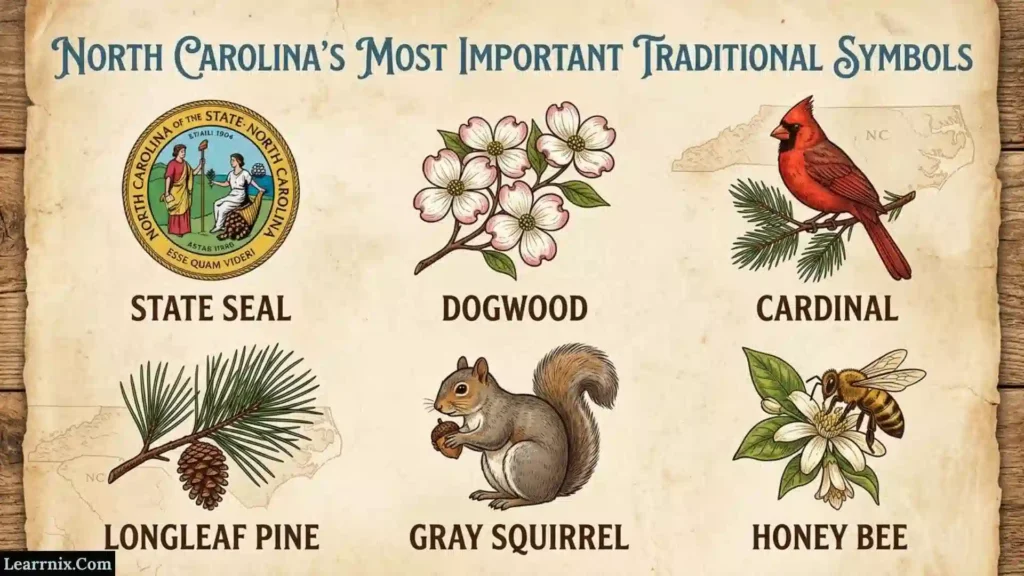
For most students and general readers, these are the symbols most likely to appear in school projects, quizzes, and basic state-reference guides.
State Flower: Dogwood
The dogwood is North Carolina’s official state flower.
The General Assembly adopted the dogwood in 1941, making it one of the state’s earliest officially recognized natural symbols.
Dogwood trees are known for their striking spring displays. Their presence across much of North Carolina makes the flower a natural representation of the state’s landscape.
For a school project, it is useful to explain not only the answer but also its meaning:
North Carolina’s state flower is the dogwood because it represents a familiar and distinctive part of the state’s natural environment.
State Bird: Cardinal
The cardinal became North Carolina’s official state bird in 1943.
The bird is easy to recognize, particularly because of the bright red plumage of adult males. Cardinals are also familiar in neighborhoods, forests, gardens, and parks.
One important fact to remember is that the cardinal is not unique to North Carolina. Several other states also recognize it as their official state bird.
That makes it a good example of why “official” does not necessarily mean “found only in one state.”
State Tree: Pine and the Longleaf Pine
North Carolina law identifies the pine as the official state tree. It also specifically designates the longleaf pine (Pinus palustris) as the emblem representing the trees of North Carolina.
This distinction is important.
Correct: The pine is the state tree, and the longleaf pine is the emblem representing North Carolina’s trees.
Less precise: The longleaf pine is simply the state tree.
The longleaf pine also has a strong connection to North Carolina’s history. Pine forests supported industries that produced naval stores such as tar, pitch, and turpentine, helping shape the historical background of the state’s “Tar Heel” identity.
State Shell: Scotch Bonnet
The Scotch bonnet is North Carolina’s official state shell.
This symbol represents the state’s Atlantic coastline and marine environment.
North Carolina’s geography stretches from the Appalachian Mountains to the Atlantic Ocean. The Scotch bonnet is therefore an important reminder that the state’s identity is not defined by a single landscape.
State Mammal: Gray Squirrel
The gray squirrel (Sciurus carolinensis) is North Carolina’s official state mammal.
It is a familiar animal in forests, parks, suburban neighborhoods, and other wooded areas.
The gray squirrel is a practical example of how state symbols often represent species that residents can actually encounter in daily life.
State Saltwater Fish: Channel Bass or Red Drum
North Carolina law identifies the channel bass (red drum) as the official state saltwater fish.
This is one of the most common naming mistakes in articles and school assignments.
Both names are useful, but the most precise form is:
Channel bass (red drum)
Using both names helps readers understand that “red drum” is the commonly recognized name associated with the official statutory designation.
North Carolina’s Wildlife Symbols
North Carolina’s official wildlife designations reflect the state’s forests, rivers, mountains, wetlands, and coastal habitats.
State Insect: Honeybee
The honeybee is North Carolina’s official state insect.
The choice connects naturally with agriculture and pollination.
For students, this symbol can also serve as a bridge to a broader science lesson about how pollinators interact with flowering plants and food production.
State Reptile: Turtle and the Eastern Box Turtle
North Carolina law adopts the turtle as the official state reptile and designates the eastern box turtle as the emblem representing turtles inhabiting North Carolina.
Again, the legal wording matters.
A simple reference answer may say that the eastern box turtle is North Carolina’s state reptile, but a more precise explanation recognizes the distinction used in the statute.
State Freshwater Trout: Southern Appalachian Brook Trout
The official state freshwater trout is the Southern Appalachian strain of brook trout (Salvelinus fontinalis).
This symbol represents the cold-water mountain streams of western North Carolina.
It also balances the state’s saltwater identity. North Carolina has both an official saltwater fish and an official freshwater trout because its geography includes major coastal and mountain ecosystems.
State Horse: Colonial Spanish Mustang
The Colonial Spanish Mustang is North Carolina’s official state horse.
The designation recognizes a breed associated with the state’s coastal history.
Unlike the gray squirrel or cardinal, this symbol connects wildlife and animal history with the human story of North Carolina’s coastal communities.
State Butterfly: Eastern Tiger Swallowtail
The eastern tiger swallowtail (Papilio glaucus) is North Carolina’s official state butterfly.
Its recognizable yellow-and-black pattern makes it one of the easier state symbols for children and beginning naturalists to identify.
State Frog, Salamander, and Marsupial
North Carolina has also formally recognized:
- Pine barrens tree frog as the state frog.
- Marbled salamander as the state salamander.
- Virginia opossum as the state marsupial.
These designations highlight the diversity of the state’s amphibians and mammals.
State Saltwater Reptile: Loggerhead Sea Turtle
The loggerhead sea turtle (Caretta caretta) is recognized as North Carolina’s official state saltwater reptile.
This designation complements the state’s land-based reptile symbolism by recognizing an animal associated with North Carolina’s coastal environment.
North Carolina’s Plant, Food, and Agricultural Symbols
North Carolina’s official symbols also reflect farming, native plants, and regional food traditions.
State Vegetable: Sweet Potato
The sweet potato is North Carolina’s official state vegetable.
This designation reflects the long-standing importance of agriculture to the state.
It is also a useful example of why state symbols can represent economic and cultural history rather than only wildlife or scenery.
State Fruit and Berries
North Carolina recognizes:
- Scuppernong grape as the state fruit.
- Strawberry as the state red berry.
- Blueberry as the state blueberry.
These designations show how detailed state symbolism can become. Instead of stopping at one “official fruit,” North Carolina’s statutes recognize multiple agricultural categories.
State Wildflower: Carolina Lily
The Carolina lily is the official state wildflower.
It adds another layer to the state’s botanical identity alongside the dogwood and pine.
This is also a useful reminder that state flower and state wildflower are separate categories.
State Carnivorous Plant: Venus Flytrap
The Venus flytrap is North Carolina’s official state carnivorous plant.
It is one of the state’s most distinctive botanical symbols because the plant is strongly associated with the coastal plain of North Carolina.
For readers, this symbol demonstrates how state designations can highlight unusual parts of a region’s natural heritage.
State Beverage: Milk
Milk is North Carolina’s official state beverage.
The designation reflects the importance of agriculture and dairy production to the state.
Official State Cookie: Moravian Cookie
The Moravian cookie is recognized as North Carolina’s official state cookie.
The symbol connects state identity with Moravian cultural heritage, particularly the historical influence of Moravian communities in North Carolina.
North Carolina’s Geology and Fossil Symbols
The state’s mountains, mineral resources, and prehistoric past are also represented through official designations.
State Precious Stone: Emerald
The emerald is North Carolina’s official state precious stone.
The North Carolina Department of Natural and Cultural Resources notes that emerald is a variety of the mineral beryl and connects the stone to the state’s mountain geology.
State Rock: Granite
Granite is North Carolina’s official state rock.
Do not confuse this designation with the state precious stone.
- State rock: Granite
- State precious stone: Emerald
- State mineral: Gold
Each represents a different category.
State Mineral: Gold
Gold (Aurum) is North Carolina’s official state mineral.
This distinction gives students and writers a useful three-part comparison:
| Category | Symbol |
| Precious stone | Emerald |
| Rock | Granite |
| Mineral | Gold |
State Fossil: Fossilized Megalodon Teeth
North Carolina’s official state fossil is the fossilized teeth of the megalodon shark.
The precise wording matters.
The official symbol is not simply “the megalodon.” It is specifically the fossilized teeth of the megalodon shark.
This is an excellent example of why checking the actual statute is better than copying a shortened answer from an unsourced website.
Also Check This Post: 93+ Adinkra Symbols and Meanings: Powerful Symbols
North Carolina’s Cultural and Historical Symbols
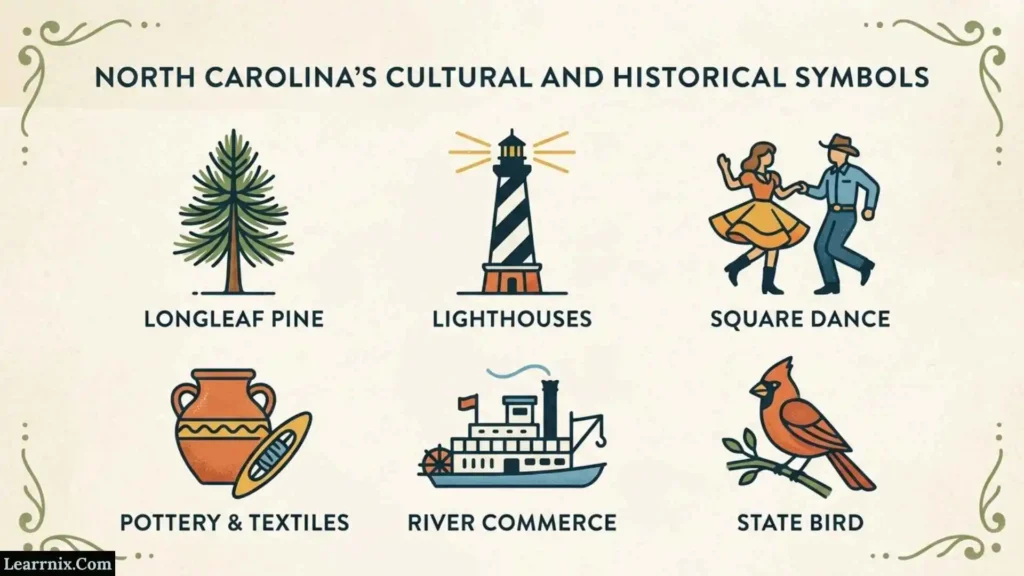
Not every state symbol comes from nature. Several represent art, history, traditions, and cultural identity.
State Motto: Esse Quam Videri
North Carolina’s official motto is Esse Quam Videri, a Latin phrase meaning “To be rather than to seem.”
The motto is addressed in the state’s statutes covering the flag, motto, and colors.
The idea behind the phrase is simple: genuine character is more valuable than merely creating an appearance.
For example, a person who quietly does honest work is “being,” while someone who only tries to appear successful without substance is focused on “seeming.”
That makes the motto more than a phrase to memorize. It expresses an ideal about authenticity.
State Dog: Plott Hound
The Plott Hound is North Carolina’s official state dog.
The breed has strong historical connections to western North Carolina and represents the state’s hunting and mountain traditions.
State Historical Boat: Shad Boat
The Shad Boat is North Carolina’s official state historical boat.
The North Carolina Department of Natural and Cultural Resources explains that shad boats were used by coastal fishermen, connecting the symbol to the state’s maritime heritage.
State Tartan: Carolina Tartan
The Carolina Tartan is North Carolina’s official state tartan.
A tartan is a patterned textile design traditionally associated with Scottish culture. Its recognition reflects part of North Carolina’s cultural heritage.
Official State Dances
North Carolina officially recognizes clogging and shagging as state dances.
These two traditions represent different sides of the state’s cultural geography and history.
- Clogging is strongly associated with Appalachian and mountain traditions.
- Shagging is associated with the Carolina coast.
Together, they show how North Carolina’s cultural identity changes from the mountains to the coast.
State Folk Art and State Art Medium
North Carolina recognizes:
- Whirligigs created by Vollis Simpson as the official state folk art.
- Clay as the official state art medium.
These symbols recognize the importance of folk creativity and pottery traditions in North Carolina.
Official State Star: Moravian Star
The Moravian star is North Carolina’s official state star.
Like the Moravian cookie, it reflects the historical influence of Moravian culture within the state.
Official State Television Show
North Carolina has also officially recognized The Andy Griffith Show as its state television show.
This designation demonstrates how modern popular culture can also become part of official state identity.
The North Carolina State Flag, Colors, and Identity
The state flag is one of North Carolina’s most important official symbols.
The design includes a blue union containing a white star, the letters N and C, and two historical dates: May 20, 1775, and April 12, 1776. The fly of the flag includes a red bar above a white bar.
Why Are the Dates Important?
The dates connect the state flag to North Carolina’s Revolutionary-era history.
They are not decorative details. They were intentionally included as part of the official design.
When studying the flag, remember that it contains both:
- A visual state identity through its colors and initials.
- Historical references through its dates.
What Are North Carolina’s State Colors?
North Carolina officially recognizes red and blue as its state colors.
These colors are closely connected to the visual design of the state flag and are part of the broader identity established through state law. Chapter 144 covers the state flag, official governmental flags, motto, and colors.
Official Symbols vs. Famous North Carolina Icons
One of the most useful things to understand when researching this topic is that famous does not always mean official.
A food, animal, landmark, or cultural tradition may be strongly associated with North Carolina without having a specific statutory designation.
How to Tell the Difference
Ask three questions:
Question 1: Is the item listed in a current North Carolina statute?
↓
Yes: It may be an official state symbol or other official adoption.
No or unsure: Continue checking authoritative state sources.
↓
Question 2: Does the law identify a specific official category?
Examples include state bird, state mineral, official state cookie, or state historical boat.
↓
Question 3: Is the source current?
Use the latest available statutory information rather than relying on an old infographic or copied list.
This approach is especially important for writers and publishers because new designations can be added through legislation.
Common Mistakes When Writing About North Carolina Symbols
A well-researched article should avoid several common errors.
Mistake 1: Calling Every Official Adoption a Traditional State Symbol
Chapter 145 includes both traditional symbols and other official designations.
For example, a state bird and a state festival may both be officially recognized, but they serve different purposes.
The best approach is to explain this distinction rather than presenting everything as if it were the same type of symbol.
Mistake 2: Using an Incomplete List
Many websites list only:
- State bird
- State flower
- State tree
- State mammal
That may be enough for a basic worksheet, but it does not fully satisfy readers searching for a complete guide.
North Carolina’s official designations extend much further into wildlife, geology, agriculture, arts, culture, and history.
Mistake 3: Ignoring Exact Legal Wording
Several symbols require careful wording.
For example:
State tree: Pine
Tree emblem: Longleaf pine
State reptile: Turtle
Turtle emblem: Eastern box turtle
State saltwater fish: Channel bass (red drum)
State fossil: Fossilized teeth of the megalodon shark
Using precise wording improves accuracy.
Mistake 4: Confusing Categories
Do not mix up:
- Emerald, the state precious stone.
- Granite, the state rock.
- Gold, the state mineral.
The same principle applies to the state flower and state wildflower, or the state reptile and state saltwater reptile.
Mistake 5: Copying an Old List Without Checking for Updates
State designations can change.
For example, the longleaf pine’s current statutory wording reflects a 2023 amendment, and later legislative proposals and enactments have continued to expand the list of official designations.
For publishers, the safest practice is to check the current statute before updating or republishing a reference article.
How to Research North Carolina Symbols Correctly
If you are preparing a school project, article, quiz, or educational resource, use this process.
Step 1: Start With the Official Category
Search for the exact category you need.
For example:
- State bird
- State flower
- State fossil
- State dog
- State vegetable
This is more accurate than searching only for a general phrase.
Step 2: Check the North Carolina General Statutes
The General Assembly organizes the state’s symbols and other official adoptions in Chapter 145. The flag, motto, and colors are covered in Chapter 144.
Step 3: Record the Exact Name
Write the designation as accurately as possible.
For example:
Better: “Channel bass (red drum) is North Carolina’s official state saltwater fish.”
Too vague: “Red drum is North Carolina’s state fish.”
Step 4: Add Context
A strong school project or article should answer at least one of these questions:
- Why does the symbol represent North Carolina?
- What part of the state’s geography or history does it reflect?
- When was it officially adopted?
- What common mistakes do people make about it?
This turns a basic list into useful educational content.
Step 5: Check for Updates Before Publishing
State symbols are a type of information that can become outdated.
Before publishing an article, check the current General Assembly pages and confirm whether new legislation has changed the list.
How to Remember North Carolina Symbols More Easily
Trying to memorize dozens of symbols as separate facts can be difficult. A better method is to group them by theme.
Nature and Wildlife
- Cardinal
- Gray squirrel
- Honeybee
- Eastern tiger swallowtail
- Pine barrens tree frog
- Marbled salamander
- Virginia opossum
- Loggerhead sea turtle
Plants and Agriculture
- Dogwood
- Pine
- Longleaf pine
- Carolina lily
- Venus flytrap
- Sweet potato
- Scuppernong grape
- Strawberry
- Blueberry
Water and Coastal Life
- Scotch bonnet
- Channel bass
- Southern Appalachian brook trout
- Shad Boat
- Loggerhead sea turtle
Geology and Prehistory
- Emerald
- Granite
- Gold
- Megalodon fossil teeth
Culture and Identity
- Plott Hound
- Carolina Tartan
- Clogging
- Shagging
- Vollis Simpson’s whirligigs
- Clay
- Moravian cookie
- Moravian star
- The Andy Griffith Show
This method helps readers understand the symbols as part of a larger story rather than as unrelated trivia.
Why North Carolina Has So Many Symbols
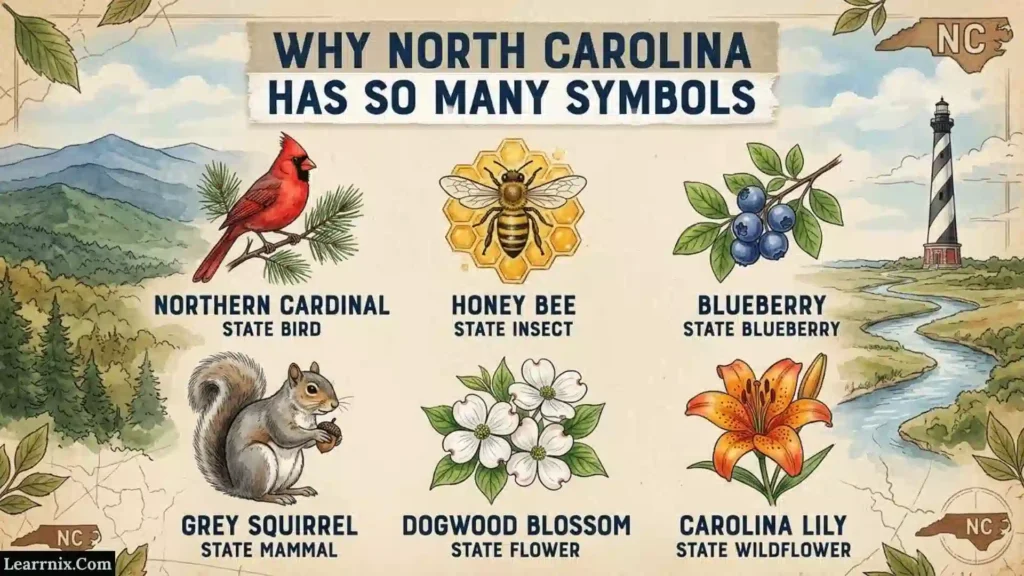
North Carolina has a diverse geography and history.
The state includes:
- Appalachian mountain landscapes.
- Forests and rivers.
- Agricultural regions.
- Piedmont communities.
- Coastal plains.
- Barrier islands and Atlantic waters.
It also has distinct cultural traditions shaped by Indigenous peoples, European settlement, agriculture, industry, military history, music, art, and regional communities.
A single symbol could never represent all of these influences.
That is why the state’s official designations range from a cardinal and dogwood to a Shad Boat, Moravian cookie, gold, clay, and stock car racing. The collection is, in many ways, a compact introduction to North Carolina itself.
Frequently Asked Questions About North Carolina Symbols
What is the most famous symbol of North Carolina?
There is no single official “most famous” symbol. However, the state flag, cardinal, dogwood, pine, and Plott Hound are among the symbols most commonly associated with North Carolina.
For school assignments, the cardinal and dogwood are often among the first symbols students learn.
What is North Carolina’s state bird?
The cardinal is North Carolina’s official state bird.
What is North Carolina’s state flower?
The dogwood is North Carolina’s official state flower.
What is the North Carolina state tree?
The pine is the official state tree. The longleaf pine is specifically designated as the emblem representing North Carolina’s trees.
What is North Carolina’s state animal?
The term “state animal” can be misleading because North Carolina has several animal-related designations.
The gray squirrel is the state mammal, while the Plott Hound is the state dog, the Colonial Spanish Mustang is the state horse, and other wildlife categories have their own official designations.
What is North Carolina’s state dog?
The Plott Hound is North Carolina’s official state dog.
What is North Carolina’s state reptile?
State law adopts the turtle as the official state reptile and designates the eastern box turtle as the emblem representing turtles inhabiting North Carolina.
What is North Carolina’s state fish?
The channel bass (red drum) is the official state saltwater fish. The Southern Appalachian strain of brook trout is the official state freshwater trout.
What is North Carolina’s state gemstone?
The official state precious stone is the emerald.
What is North Carolina’s state rock?
Granite is North Carolina’s official state rock.
What is North Carolina’s state mineral?
Gold (Aurum) is the official state mineral.
What is North Carolina’s state motto?
North Carolina’s official motto is Esse Quam Videri, meaning “To be rather than to seem.” The motto is addressed in Chapter 144 of the state’s statutes.
What is North Carolina’s newest official symbol?
The answer can change as the General Assembly adopts new legislation. Recent statutory additions and legislative materials have included designations such as the Moravian cookie, Moravian star, state television show, and state saltwater reptile. For the most accurate answer, check the current version of Chapter 145 rather than relying on an older static list.
Who decides North Carolina’s official state symbols?
The North Carolina General Assembly establishes official state symbols and other designations through legislation.
Are all famous North Carolina icons official state symbols?
No. An item can be culturally important or strongly associated with North Carolina without having an official statutory designation.
Always verify the claim through a current state government or legislative source.
Conclusion
North Carolina symbols tell a much larger story than a basic list of state facts.
The dogwood, cardinal, pine, Scotch bonnet, gray squirrel, emerald, granite, Plott Hound, and Shad Boat represent only part of the state’s identity. Other official designations recognize mountain streams, coastal wildlife, agriculture, geology, folk art, traditional dances, food heritage, and popular culture.
The most important lesson for students, writers, and researchers is to use current official sources and precise wording. North Carolina’s list has grown over time, and some legal categories are more specific than the simplified answers found on older websites.
If you only need a quick answer, start with the reference table. If you are writing a school report or publishing an article, go one step further: identify the official category, use the exact statutory name, explain why the symbol matters, and verify the information against the latest North Carolina General Assembly records.
Also Check This Post: 75+ Architectural Symbols: How to Understand Design Drawings

I am Michael Carter, an educational content creator who believes that knowledge has the power to transform lives.
I create resources focused on modern education, digital learning, and building essential skills for the future.
I love helping readers discover simple and effective ways to improve their learning journey.
Books by Michael Carter:
- Modern Education for Tomorrow’s World
- Learning Skills for Future Success
 Charlotte Anderson