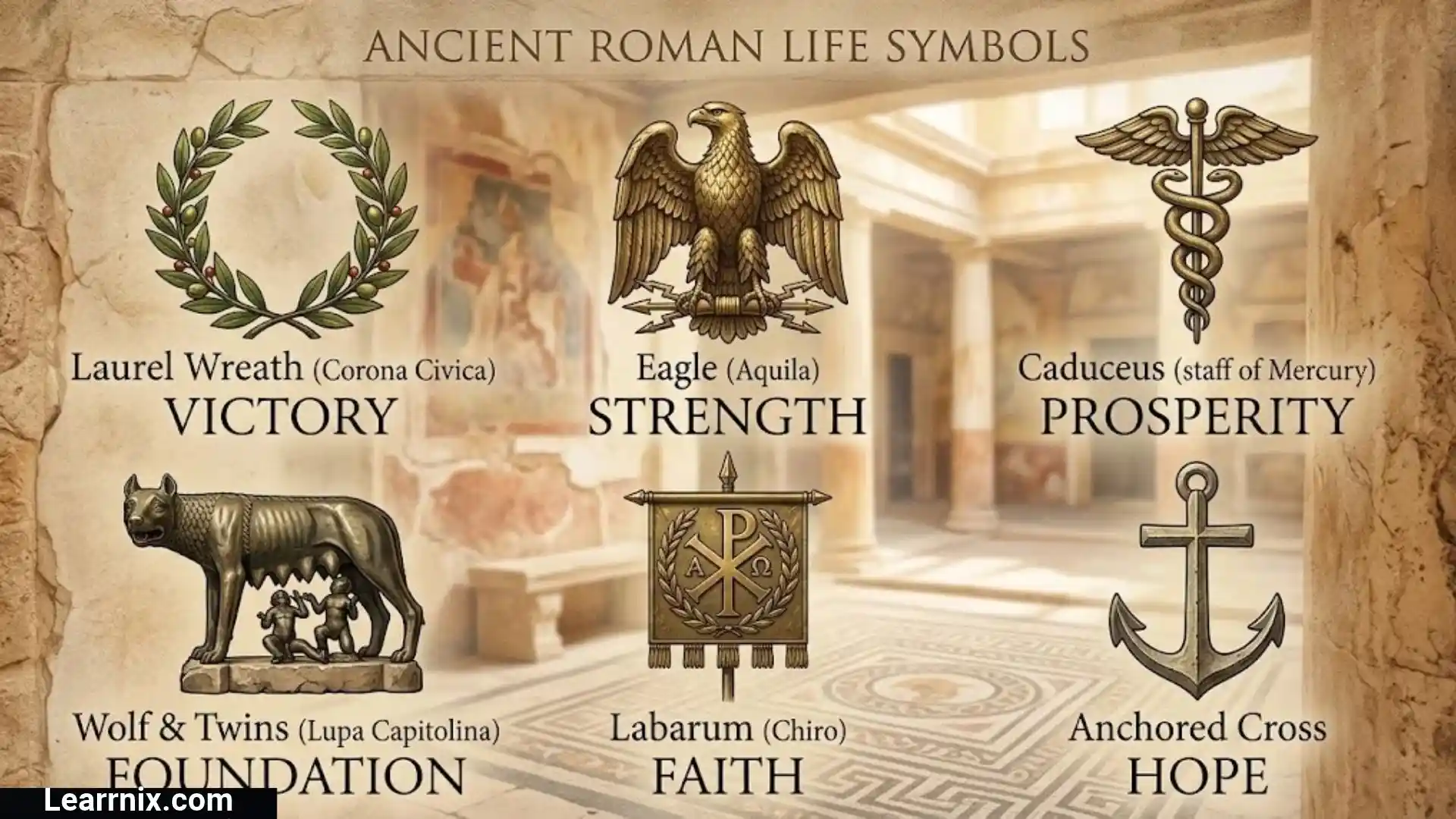
Roman symbols connect ancient history with modern writing, art, science, and design. Some represent the authority of Rome, military victories, or Roman gods, while others are letters used to write numbers. Their meanings depend on the historical context and how they are used today.
If you are searching for Roman symbols to copy and paste, exploring ancient Roman symbols, or looking for symbols of strength and power, this guide covers the main categories. It also explains Roman numeral letters, Greek connections, scientific notation, and Roman-inspired tattoo ideas.
You will find practical examples throughout the article, including recognizable symbols, their meanings, and Unicode characters you can use in digital text. The goal is to help you distinguish authentic historical symbols from modern decorative characters.
Roman Symbols and Meanings
Roman symbols represented important ideas in government, religion, warfare, and public life. Some were physical objects, such as military standards, while others were inscriptions or letters with specific meanings.
| Symbol | Name | Meaning |
| SPQR | Roman civic abbreviation | The Senate and People of Rome |
| 🦅 | Eagle | Military honor and authority |
| 🌿 | Laurel wreath | Victory and achievement |
| Fasces | Bound rods, sometimes with an axe | Magistrates’ authority |
| I | Roman numeral | One |
| V | Roman numeral | Five |
| X | Roman numeral | Ten |
| ⚖ | Scales | Justice and balance in modern symbolism |
| 🔱 | Trident | Associated with Neptune in Roman mythology |
| ♀ | Venus symbol | Associated with Venus and the modern female sex symbol |
| ♂ | Mars symbol | Associated with Mars and the modern male sex symbol |
Not every item in the table is an ancient Roman text character. SPQR and Roman numerals have direct historical connections to Roman writing, while emoji are modern digital representations. The eagle and laurel wreath are historical motifs that continue to appear in modern artwork.
What Does SPQR Mean?
SPQR stands for Senatus Populusque Romanus, commonly translated as “The Senate and People of Rome.” It represented the Roman state and appeared on public inscriptions, monuments, and official objects.
Today, SPQR is one of the most recognizable abbreviations associated with ancient Rome. It is useful for historical projects, Roman-themed designs, and educational material.
Ancient Roman Symbols
Ancient Roman symbols developed through religion, government, military life, and public ceremonies. Rome also adopted and adapted cultural traditions from neighboring peoples, including the Etruscans and Greeks.
Some of the best-known examples include:
- The Aquila: The eagle standard associated with a Roman legion. It represented the unit’s identity and honor.
- The Laurel Wreath: A symbol associated with victory, achievement, and public recognition.
- The Fasces: A bundle of rods, sometimes with an axe, representing the authority of Roman magistrates.
- Janus: A Roman god of beginnings and transitions, often depicted with two faces.
- The She-Wolf: Associated with the legendary story of Romulus and Remus, the traditional founders of Rome.
- The Cornucopia: A symbol of abundance and prosperity in Roman art.
These symbols appeared in different settings, including coins, monuments, sculptures, and religious objects. Their meanings were not always identical across every period or context.
How to Identify Historical Roman Symbols
Consider the original object, inscription, or artwork before deciding what a symbol means. A design reproduced on a modern website may simplify an ancient image or combine several historical elements.
For historical accuracy, identify the symbol by its documented name and explain its original purpose rather than relying only on a modern interpretation.
Old Roman Symbols
Old Roman symbols include historical inscriptions, numeral letters, monetary signs, and other characters used in ancient Roman life. Some survive in familiar forms, while others are preserved in specialist historical and Unicode collections.
| Symbol | Meaning or Use |
| SPQR | Roman civic identity |
| I | One |
| V | Five |
| X | Ten |
| L | Fifty |
| C | One hundred |
| D | Five hundred |
| M | One thousand |
| 𐆖 | Roman denarius sign |
| 𐆗 | Roman quinarius sign |
| 𐆘 | Roman sestertius sign |
| 𐆙 | Roman dupondius sign |
| 𐆚 | Roman as sign |
The monetary characters are historical Unicode symbols associated with Roman coins. They may not display correctly in every font or application, so check compatibility before using them in a publication.
Roman inscriptions also used abbreviations for names, offices, and public honors. These shortened forms helped communicate information on monuments, coins, and other objects where space was limited.
Famous Roman Symbols
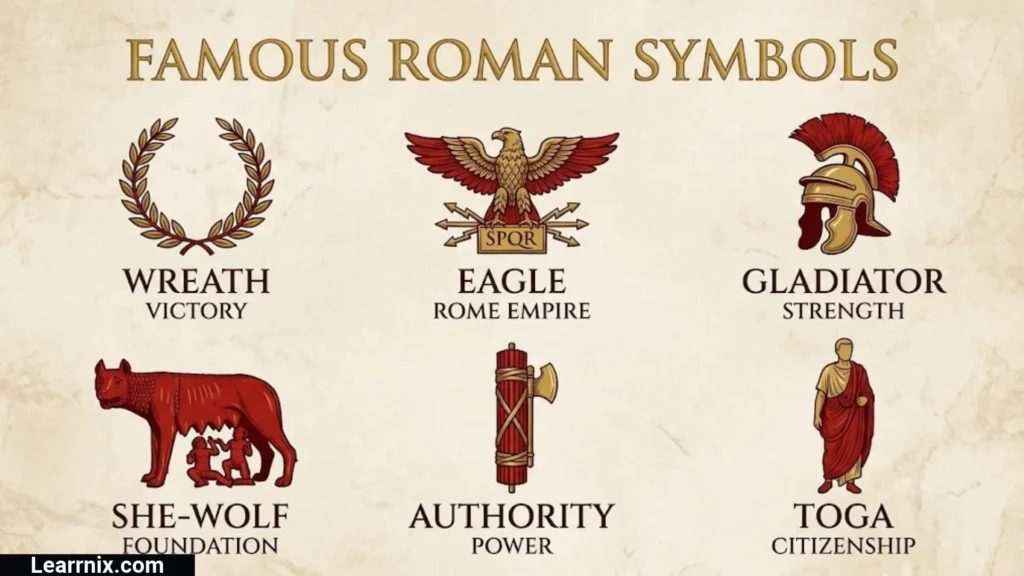
Several Roman symbols remain widely recognized because of their associations with the Roman state, military achievements, and public monuments.
The Roman Eagle: The eagle, or aquila, was an important legionary standard. It is now commonly used in Roman-inspired designs to suggest leadership, courage, and military history.
SPQR: This abbreviation expressed the civic identity of Rome. It remains a recognizable reference to the ancient city and its political traditions.
The Laurel Wreath: Laurel was associated with victory and distinction. Modern designs often use wreaths for awards, achievements, and commemorative artwork.
The Fasces: This symbol represented the authority of certain Roman magistrates. It later acquired additional political associations, so its meaning can be sensitive in modern contexts.
The Triumphal Arch: Roman triumphal arches were monuments commemorating victories and important achievements. They are architectural structures rather than text symbols, but they remain powerful visual references to Roman history.
These symbols are useful for educational projects, classical artwork, and history-themed designs. Their original meanings should be distinguished from modern interpretations.
Roman Symbols Letters
Roman symbol letters can refer to the Latin alphabet, Roman numeral letters, or special Unicode characters designed to represent Roman numerals.
Roman Numeral Letters
The standard Roman numeral system uses seven letters.
| Letter | Value | Example |
| I | 1 | II = 2 |
| V | 5 | VI = 6 |
| X | 10 | XII = 12 |
| L | 50 | LX = 60 |
| C | 100 | CC = 200 |
| D | 500 | DC = 600 |
| M | 1,000 | MM = 2,000 |
Roman numerals combine these letters to represent numbers. Subtractive forms include IV for four, IX for nine, XL for forty, and CM for nine hundred.
Roman Alphabet Letters
The Latin alphabet used by the Romans is the historical ancestor of the alphabet used in modern English. You can copy these letters for Roman-inspired headings, names, and designs.
A B C D E F G H I J K L M N O P Q R S T U V W X Y Z
Remember that only I, V, X, L, C, D, and M are used in the standard Roman numeral system. The other Latin letters are not standard Roman numeral symbols.
Roman Symbols Physics
Roman symbols in physics can refer to Latin letters used in equations, Roman numerals in scientific labels, or symbols associated with physical quantities. They should not be confused with Greek letters, which are also common in scientific notation.
| Symbol | Common Use |
| I | Electric current |
| V | Voltage or the unit symbol for volt |
| m | Mass |
| C | Capacitance or a constant, depending on context |
| T | Temperature or period, depending on context |
| Δ | Change in a quantity |
| Ω | The unit symbol for the ohm |
| μ | The Greek letter mu, used for several scientific quantities |
Capitalization matters in scientific writing. For example, m and M may represent different quantities, and V used for voltage is distinct from a numeral’s value in a Roman number.
The symbols Δ, Ω, and μ are Greek letters, not Roman letters. They are included here because people searching for Roman symbols in physics may also be looking for scientific characters to copy.
Roman Symbols of War
Roman military symbols helped identify units, express loyalty, and communicate authority. Military objects often carried meanings beyond their practical use on the battlefield.
- Aquila: The eagle standard of a Roman legion, closely associated with military honor.
- Signum: A military standard used to identify a unit.
- Vexillum: A banner or flag associated with particular military units.
- Gladius: The Roman short sword, associated with Roman soldiers and combat.
- Scutum: The Roman shield, used for defense.
- Laurel Wreath: A symbol of victory and honor.
- SPQR: The civic abbreviation associated with the Roman state.
The eagle standard was especially important to a legion’s identity. Military standards helped soldiers recognize their unit and maintain formation.
For modern Roman-inspired designs, eagles, shields, swords, and banners can suggest military history. However, they are not all formal Roman symbols in the same sense as SPQR or the aquila.
Roman Symbols for Gods
Roman gods were often identified through objects, animals, and visual attributes. Many Roman deities had counterparts in Greek mythology, but their traditions were not always identical.
| Roman God | Common Attribute | Association |
| Jupiter | Thunderbolt and eagle | Sky, thunder, and authority |
| Mars | Spear and shield | War and military protection |
| Neptune | Trident | Sea and water |
| Venus | Dove or mirror in artistic traditions | Love and beauty |
| Mercury | Winged sandals and caduceus | Commerce, travel, and messages |
| Minerva | Helmet and owl in later classical imagery | Wisdom and strategic skill |
| Diana | Bow and hunting equipment | Hunting and wilderness |
| Janus | Two faces | Beginnings and transitions |
These attributes usually appear in artworks, sculptures, and coins rather than as single Unicode characters. Modern characters such as ♀, ♂, and 🔱 can provide a visual reference, but they do not reproduce the full historical imagery of a Roman deity.
Roman Symbols of Strength
Roman symbols of strength often draw on military traditions, victory imagery, and ideas of authority. Their modern meanings may be broader than their original historical uses.
| Symbol | Common Association |
| 🦅 Eagle | Leadership and military honor |
| 🌿 Laurel wreath | Achievement and victory |
| 🛡 Shield | Protection and resilience |
| ⚔ Crossed swords | Combat and bravery |
| 🦁 Lion | Courage and power in broader classical symbolism |
| ⚡ Lightning bolt | Energy and force in modern designs |
| Fasces | Historical public authority |
An eagle may suit a design about leadership, while a shield can represent protection or resilience. A laurel wreath is often appropriate for celebrating an achievement.
Choose a symbol according to the message you want to communicate. Not every modern strength symbol originated in Rome, and the fasces has acquired political associations that deserve consideration before using it.
Roman Symbols of Power
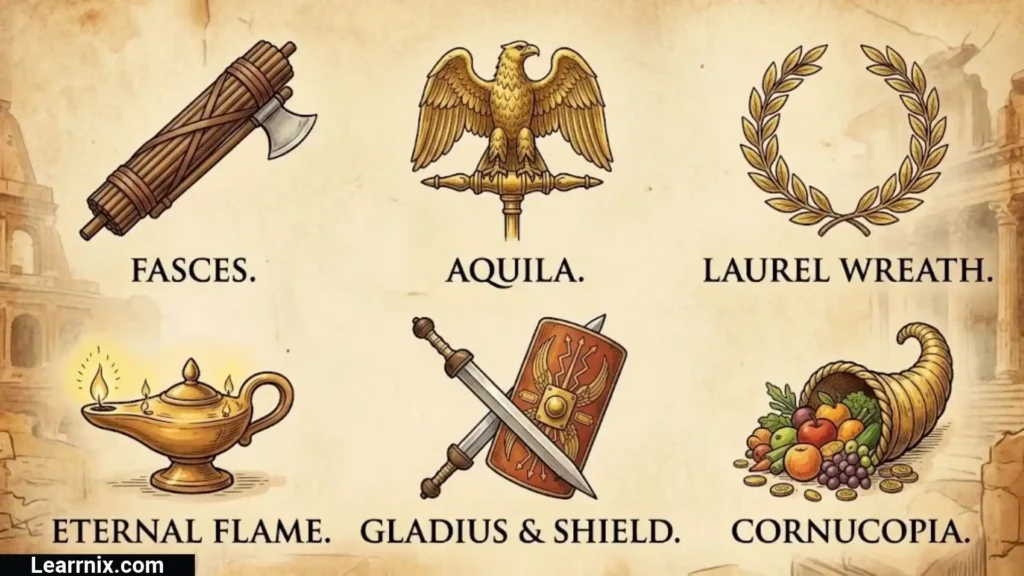
Roman power was communicated through government inscriptions, military standards, imperial portraits, and public architecture.
SPQR represented the Roman state and its civic identity. The Eagle was associated with Roman legions and became a familiar image of imperial authority. The Fasces represented the powers of certain magistrates, while the Laurel Wreath expressed victory and distinction.
Roman coins were also important. They often displayed rulers, deities, and political messages, allowing imperial imagery to circulate across the empire. Triumphal arches and public monuments commemorated victories and presented Rome as a powerful state.
For a modern design, SPQR provides a direct historical reference, while an eagle or laurel wreath can communicate leadership or achievement. Always consider the historical and political context of the chosen image.
Roman Symbols Tattoos
Roman-inspired tattoos are often chosen to express personal history, strength, achievement, remembrance, or an interest in ancient culture.
Popular options include:
- SPQR Tattoo: A reference to Roman civic identity and history.
- Eagle Tattoo: Often associated with leadership, courage, and military tradition.
- Laurel Wreath Tattoo: A design connected with victory and achievement.
- Roman Numeral Tattoo: A way to represent a birth date, anniversary, or memorial date.
- Classical Helmet Tattoo: A modern artistic reference to Roman soldiers and military history.
Roman Numeral Tattoo Examples
| Number | Roman Numeral |
| 4 | IV |
| 9 | IX |
| 14 | XIV |
| 21 | XXI |
| 50 | L |
| 100 | C |
| 2026 | MMXXVI |
Before getting a Roman numeral tattoo, verify the conversion carefully. For Latin phrases, check grammar and spelling as well. A design can look attractive while still containing an incorrect date or translation.
Roman-inspired tattoos do not need to be complex. A simple numeral, wreath, or historically grounded inscription can communicate a personal meaning clearly.
Simple Roman Symbols
Simple Roman symbols are useful for short headings, profile names, captions, and educational notes. Ordinary Roman numeral letters are generally easy to type and widely readable.
Here are some common forms:
| Symbol | Value |
| I | 1 |
| II | 2 |
| III | 3 |
| IV | 4 |
| V | 5 |
| VI | 6 |
| VII | 7 |
| VIII | 8 |
| IX | 9 |
| X | 10 |
| XI | 11 |
| XII | 12 |
Unicode also provides dedicated numeral characters, including Ⅰ, Ⅱ, Ⅲ, Ⅳ, Ⅴ, Ⅵ, Ⅶ, Ⅷ, Ⅸ, Ⅹ, Ⅺ, and Ⅻ. These may look slightly different from ordinary Latin letters.
For everyday writing, ordinary forms such as IV and XII are often more practical because they are easier to type and edit. Dedicated Unicode numeral characters can be useful for decorative layouts, but font support may vary.
Other simple decorative characters include ★, ⚖, ♀, ♂, and ☀. These are not all uniquely Roman, so describe them accurately when historical authenticity matters.
Greco Roman Symbols
Greco-Roman symbols reflect the cultural relationship between ancient Greece and Rome. Roman artists and writers adapted many Greek traditions, including mythological stories, artistic styles, and religious attributes.
| Symbol or Motif | Greek Association | Roman Association |
| Thunderbolt | Zeus | Jupiter |
| Trident | Poseidon | Neptune |
| Owl | Athena | Minerva |
| Laurel wreath | Victory and honor in Greek traditions | Victory and honor in Roman traditions |
| Caduceus | Hermes | Mercury |
These associations help explain why Greek and Roman art often shares familiar imagery. However, a shared attribute does not mean that every Greek and Roman religious tradition was identical.
For historically informed designs, identify the deity or cultural tradition you are referring to instead of treating every classical symbol as exclusively Roman.
Greek and Roman Symbols
Greek and Roman symbols overlap in mythology, mathematics, astronomy, and scientific notation, but they use different writing systems.
Greek letters include α, β, γ, Δ, θ, λ, π, μ, and Ω. Roman numerals use I, V, X, L, C, D, and M.
| Character | Name | Common Use |
| α | Alpha | Scientific variables |
| β | Beta | Scientific variables |
| Δ | Delta | Change or difference |
| θ | Theta | Angles |
| λ | Lambda | Wavelength in many scientific contexts |
| π | Pi | Circle mathematics |
| Ω | Omega | Greek letter; also the symbol for the ohm |
| I | Roman numeral one | Numbering |
| X | Roman numeral ten | Numbering |
| M | Roman numeral one thousand | Numbering |
Greek letters often represent variables or quantities in scientific formulas. Roman numerals are more commonly used for numbering chapters, monarchs, clock faces, and events.
When copying symbols, pay attention to letter case and shape. Greek Ω is not the same character as Latin O, and Roman numeral Ⅹ is not the same Unicode character as ordinary X, even though they can look similar.
Roman Symbols Copy and Paste
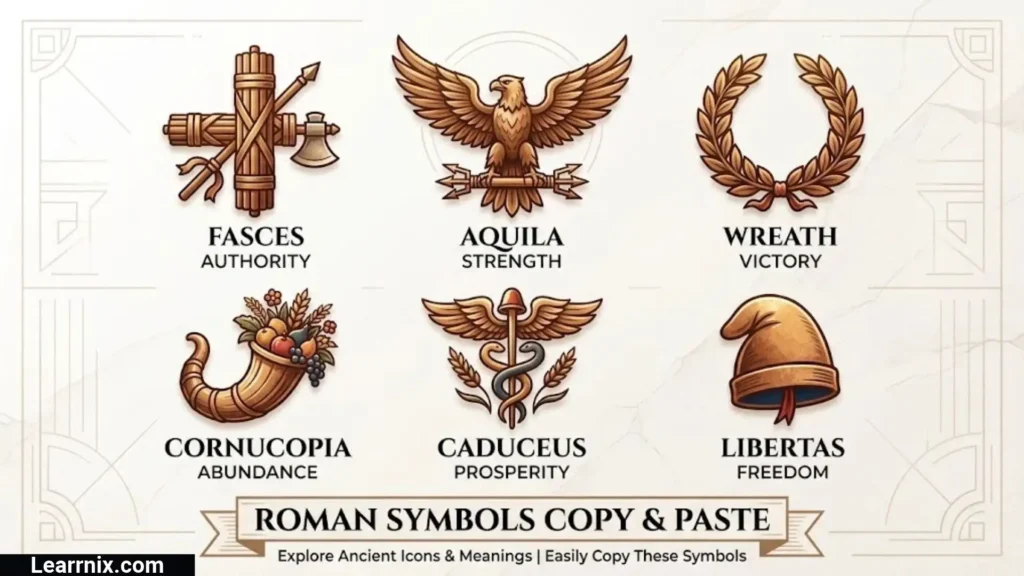
If you need Roman symbols for digital use, you can copy the characters below directly.
Roman numeral letters:
I V X L C D M
Roman numeral examples:
II III IV VI IX XII XIV XXI MMXXVI
Unicode Roman numerals:
Ⅰ Ⅱ Ⅲ Ⅳ Ⅴ Ⅵ Ⅶ Ⅷ Ⅸ Ⅹ Ⅺ Ⅻ
Roman-inspired decorative characters:
⚔ 🛡 ⚖ ★ ♀ ♂ ☀ 🔱
Roman historical abbreviation:
SPQR
The characters in these groups serve different purposes. Roman numeral letters represent numbers, SPQR is a historical abbreviation, and decorative characters are modern text symbols or emoji.
Tips for Using Roman Symbols
- Social media: Use numerals and decorative characters in captions or profile text, checking how they display on your device.
- School projects: Explain the symbol’s name and historical background.
- Websites: Provide a text description when a symbol conveys important information.
- Tattoos: Verify numerals and Latin phrases before making a permanent design.
- Scientific documents: Keep Greek letters distinct from Latin letters and preserve capitalization.
Unicode compatibility depends on the font, operating system, and application. If a symbol is essential to your content, test it in its intended location before publishing.
Frequently Asked Questions
What are the most famous Roman symbols?
The best-known Roman symbols include SPQR, the eagle, the laurel wreath, the fasces, and Roman numerals. They represent different aspects of Roman civic identity, military tradition, authority, and achievement.
What does SPQR mean in Roman history?
SPQR stands for Senatus Populusque Romanus, meaning “The Senate and People of Rome.” It was a civic abbreviation associated with the Roman state.
Which Roman symbols represent strength and power?
The eagle, laurel wreath, and military standards are associated with Roman honor and victory. The fasces represented the authority of certain magistrates, while shields are commonly used in modern designs to suggest protection.
Are Roman numerals and Roman symbols the same thing?
Roman numerals are one type of Roman symbol. They use seven letters to represent numbers, while other Roman symbols include inscriptions, religious attributes, military standards, and historical motifs.
Can I copy and paste Roman symbols into social media?
Yes. You can copy Roman numeral letters, dedicated Unicode numeral characters, and decorative symbols into many social media platforms. Their appearance may vary depending on the font and device.
Conclusion
Roman symbols provide a useful way to explore ancient Roman culture, military history, mythology, and writing. SPQR, the eagle, the laurel wreath, and Roman numerals are among the best-known examples, each with its own historical background and modern applications.
For tattoos, artwork, educational projects, or social media, choose symbols that match your intended meaning. Roman numerals work well for dates and numbering, while historical emblems can represent victory, authority, or military tradition. Greek and Roman symbols may share visual features, but their origins and uses are not always identical.
When copying a character, check its meaning and display before using it. Understanding the difference between an authentic historical emblem, a Roman numeral, a Greek letter, and a modern decorative symbol will help you use Roman symbols more accurately.

I am Michael Carter, an educational content creator who believes that knowledge has the power to transform lives.
I create resources focused on modern education, digital learning, and building essential skills for the future.
I love helping readers discover simple and effective ways to improve their learning journey.
Books by Michael Carter:
- Modern Education for Tomorrow’s World
- Learning Skills for Future Success
 Charlotte Anderson