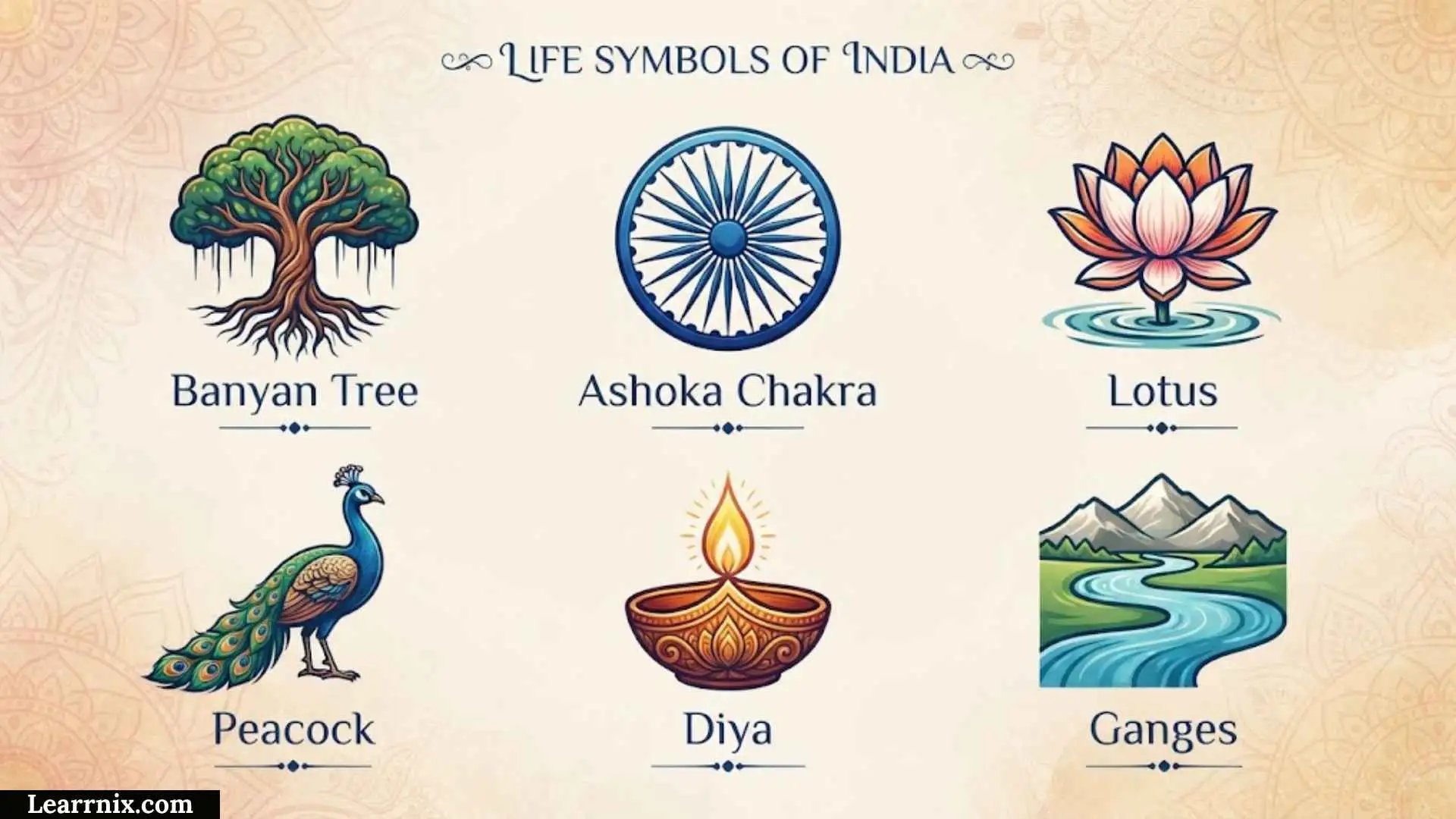
When people search for India symbols, they are usually looking for the official national symbols of India, their meanings, and the cultural icons that represent the country around the world. India has a wide range of symbols connected with its national identity, history, wildlife, plants, traditions, literature, and heritage.
The most important official symbols include the Indian National Flag, State Emblem, National Anthem, National Song, Bengal Tiger, Indian Peacock, Lotus, Banyan Tree, Mango, Ganges River Dolphin, and National Calendar. Alongside these official designations, cultural symbols such as the diya, Om, Namaste, yoga, and Taj Mahal are also strongly associated with India, although they should not automatically be described as official national symbols.
This guide explains the difference between these categories, the history and meaning behind major symbols, how they are used, common misconceptions, and the questions students and general readers commonly ask.
Quick Answer: What Are The Main India Symbols?
India symbols are official national emblems and widely recognized cultural representations connected with Indian identity.
Some of the major official national symbols are:
| India Symbol | Official Significance | What It Represents |
| National Flag | National Flag of India | National identity and pride |
| State Emblem | Lion Capital of Ashoka | State authority and national identity |
| National Anthem | Jana Gana Mana | National identity and unity |
| National Song | Vande Mataram | National heritage and freedom movement |
| National Animal | Bengal Tiger | Wildlife and natural heritage |
| National Bird | Indian Peacock | Natural and cultural heritage |
| National Flower | Lotus | Cultural and historical heritage |
| National Tree | Banyan | Longevity and continuity |
| National Fruit | Mango | Agricultural and cultural heritage |
| National Aquatic Animal | Ganges River Dolphin | River biodiversity and conservation |
| National Calendar | Saka Calendar | Official calendar system |
The Government of India’s National Portal groups national identity information separately from broader cultural representations, while the Ministry of Home Affairs provides official material concerning the National Flag, State Emblem, and National Anthem.
What Are India Symbols?
India symbols are objects, images, living species, words, traditions, or designs that communicate something about India’s identity and heritage.
However, the term India symbols can be used in two different ways.
Official National Symbols
An official national symbol has a recognized national status. Examples include the National Flag, State Emblem, National Anthem, national animal, national bird, national flower, and national tree.
These symbols are useful in government, education, national ceremonies, official publications, and public awareness.
Cultural Symbols Of India
A cultural symbol does not necessarily have an official national designation. It can become strongly associated with India because of history, religion, art, architecture, literature, tourism, or everyday traditions.
Examples include:
- Diya
- Om
- Namaste
- Yoga
- Taj Mahal
- Traditional Indian textiles
- Classical dance
- Indian festivals
- Rangoli
- Traditional architecture
This distinction is important because a symbol can be widely associated with India without being an officially designated national symbol.
National Flag Of India
The Indian National Flag, commonly known as the Tiranga, is one of the country’s most important official symbols.
It contains three horizontal bands:
- Saffron at the top
- White in the middle
- Green at the bottom
- A navy-blue Ashoka Chakra in the center of the white band
The Flag Code of India describes the National Flag as a symbol of national pride and provides rules and conventions governing its display. The Ministry of Home Affairs maintains the official Flag Code and related guidance.
What Do The Colors Of The Indian Flag Mean?
The colors of the Indian flag have commonly been explained in terms of values associated with India’s national identity.
Saffron is traditionally associated with courage and sacrifice.
White is associated with peace and truth.
Green is associated with fertility, growth, and the land.
The central Ashoka Chakra adds another important layer of meaning and connects the modern flag with India’s historical heritage.
Why Is The Indian Flag Important?
The flag appears during major national occasions, including Independence Day and Republic Day, and is used by government institutions and citizens in accordance with applicable rules.
Its importance goes beyond its visual design. The flag functions as a shared national symbol that can represent India regardless of region, language, or cultural background.
The Ministry of Home Affairs maintains the Flag Code of India and related national-honour provisions, making it the appropriate authoritative reference for questions about official flag display.
Ashoka Chakra: The Wheel On India’s Flag
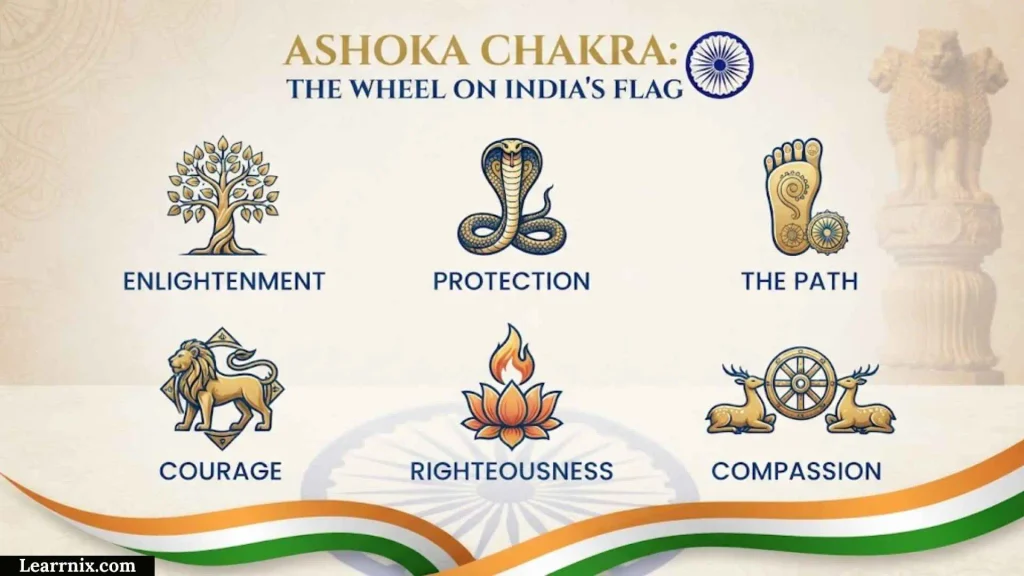
The Ashoka Chakra is the navy-blue wheel at the center of the Indian National Flag.
It contains 24 spokes and is based on the Dharma Chakra associated with the Buddhist heritage of Emperor Ashoka and the Lion Capital at Sarnath.
The wheel is important because it connects India’s modern national identity with its ancient historical traditions.
What Does The Ashoka Chakra Represent?
The wheel is commonly understood through ideas of dharma, movement, progress, and righteous conduct.
Its circular form also creates a strong visual contrast with the horizontal stripes of the flag.
A common mistake is to describe the Ashoka Chakra as a separate national flag. It is instead an important component of the National Flag.
State Emblem Of India
The State Emblem of India is adapted from the Lion Capital of Ashoka at Sarnath.
The emblem features lions and includes the words Satyameva Jayate, written in Devanagari.
The phrase means “Truth Alone Triumphs.”
The State Emblem has a formal government function and should not be confused with a general decorative logo representing India.
Why Is The State Emblem Important?
The emblem is used in official government contexts and represents the authority of the Indian state.
Its use is also regulated. The State Emblem of India (Prohibition of Improper Use) Act, 2005 addresses unauthorized and improper use, including uses that could create the impression of official government connection.
This is an important practical distinction: people may use many Indian cultural images decoratively, but the State Emblem has specific legal protections governing its use.
National Anthem Of India
India’s National Anthem is Jana Gana Mana, written by Rabindranath Tagore.
It is an important part of India’s national identity and is used on appropriate official and ceremonial occasions.
The Ministry of Home Affairs publishes official material concerning the National Anthem and National Song, including orders and guidance relating to their performance.
Why Is Jana Gana Mana Important?
The anthem is a national expression of identity rather than simply a patriotic song.
It is associated with national ceremonies, schools, public institutions, sporting events, and other occasions where the National Anthem is appropriately performed.
Readers should use official government guidance when they need precise information about ceremonial rules rather than relying on social-media summaries or informal lists.
National Song Of India
Vande Mataram, written by Bankim Chandra Chattopadhyay, is India’s National Song.
It has a particularly important place in the history of India’s independence movement.
The National Song and National Anthem are therefore related but distinct. They should not be treated as two names for the same work.
The Ministry of Home Affairs maintains official documents concerning the playing and singing of India’s National Song and National Anthem.
National Animal Of India: Bengal Tiger
The Bengal Tiger is India’s national animal.
The tiger is an important symbol of India’s wildlife and biodiversity. It is also a major conservation species because protecting tiger habitat can help protect wider forest ecosystems.
Government records explain that the tiger was adopted as India’s national animal in 1972, replacing the lion. The reasons included its wider distribution across India and the need for strong protection of the species.
Why Is The Tiger A Symbol Of India?
The tiger has long appeared in Indian art, historical representations, and cultural traditions.
As a national animal, however, its significance extends beyond cultural symbolism. It also represents India’s commitment to wildlife conservation.
Recent Government of India material continues to identify the Royal Bengal Tiger as the national animal and links it with India’s biodiversity and natural heritage.
National Bird Of India: Indian Peacock
The Indian Peacock, particularly the male peafowl, is India’s national bird.
Its distinctive plumage makes it one of the most recognizable birds associated with India.
The peacock has also appeared throughout Indian art, architecture, stories, and cultural traditions.
Why Is The Peacock A Symbol Of India?
The peacock combines natural beauty with cultural importance.
Its association with India is not simply based on its appearance. It has a longstanding presence in Indian cultural imagery, making it suitable as a national representation of the country’s natural and artistic heritage.
Indian government diplomatic material identifies the peacock as the national bird and describes its native presence and distinctive appearance.
National Flower Of India: Lotus
The lotus is India’s national flower.
Its scientific name is commonly given as Nelumbo nucifera. The lotus has deep roots in Indian art, mythology, literature, and cultural traditions.
Why Is The Lotus Important In India?
The lotus has a distinctive ability to grow in water and emerge above the surface as a prominent flower. This natural characteristic has contributed to its symbolic associations with purity and beauty.
Indian government publications describe the lotus as a sacred flower with a longstanding place in Indian art, mythology, and culture.
The lotus should also be understood within India’s diverse traditions rather than reduced to one single religious meaning.
National Tree Of India: Banyan
The banyan tree is India’s national tree.
Its unusual growth pattern helps explain its symbolic importance. Branches can produce aerial roots that eventually become additional supporting trunks, allowing one tree to spread over a large area.
What Does The Banyan Tree Represent?
The banyan’s longevity and expansive growth have made it a traditional symbol of endurance and continuity.
Its importance is also reflected in Indian cultural traditions. Government material has described the banyan as India’s national tree and connected it with ideas of longevity and enduring life.
National Fruit Of India: Mango
The mango is India’s national fruit.
Mango has been cultivated in the Indian subcontinent for a very long time and has become an important part of Indian agriculture, food, literature, and regional traditions.
Why Is Mango A Symbol Of India?
Mango represents more than a popular fruit. It connects agriculture with everyday culture.
Different regions of India are associated with different mango varieties, and mangoes are eaten fresh, preserved, pickled, dried, and used in drinks and desserts.
A Government of India agriculture backgrounder identifies mango as the national fruit and discusses its importance to Indian cultivation and agriculture.
National Aquatic Animal Of India: Ganges River Dolphin
The Ganges River Dolphin, also called the Gangetic river dolphin, is India’s national aquatic animal.
The species is associated with major river systems of the Indian subcontinent and is an important indicator of river ecosystem health.
Why Is The Ganges River Dolphin Important?
The dolphin was designated India’s National Aquatic Animal in 2009. Government sources continue to identify it in that role.
The species also receives strong legal and conservation attention. Government sources state that it is protected under Schedule I of the Wildlife Protection Act and that conservation programs focus on its habitat and river ecosystems.
This makes the dolphin an especially useful example of how a national symbol can also represent an environmental responsibility.
National River Of India: Ganga
The Ganga, or Ganges, is widely described in Indian government and educational material as India’s national river.
The river has played an important role in the development of settlements, agriculture, trade, culture, and religious traditions across northern India.
Its significance therefore extends beyond geography.
Why Is The Ganga Important To India?
The Ganga represents a combination of:
- Cultural heritage
- Religious traditions
- River ecosystems
- Agriculture
- Human settlements
- Historical civilization
- Environmental conservation
The Ganges River Dolphin is also closely connected with this river system, demonstrating how natural and cultural symbols can overlap.
National Calendar Of India
India’s National Calendar is based on the Saka Era.
The calendar uses Chaitra as its first month and is designed to correspond with the Gregorian calendar for official purposes.
Why Does India Have A National Calendar?
India has many regional calendars because of its linguistic, religious, and cultural diversity. The national calendar provides a standardized system for specified official purposes.
This does not mean that India’s many traditional calendars are replaced in everyday cultural or religious life.
That distinction is useful when researching Indian calendars: national calendar and regional or religious calendar are not necessarily the same thing.
The National Symbols information published by Indian diplomatic missions identifies the National Calendar as being based on the Saka Era, with Chaitra as its first month.
India Symbols And Their Meanings
The following table provides a quick reference for readers who want to understand the major symbols without reading every section.
| Symbol | Category | Main Association |
| Tiranga | Official national symbol | National identity and pride |
| Ashoka Chakra | Part of National Flag | Dharma and movement |
| Lion Capital | State Emblem | State authority |
| Satyameva Jayate | State Emblem motto | Truth |
| Jana Gana Mana | National Anthem | National identity |
| Vande Mataram | National Song | National heritage |
| Bengal Tiger | National Animal | Wildlife and biodiversity |
| Indian Peacock | National Bird | Natural and cultural heritage |
| Lotus | National Flower | Cultural heritage and symbolism |
| Banyan | National Tree | Longevity and continuity |
| Mango | National Fruit | Agriculture and culture |
| Ganges River Dolphin | National Aquatic Animal | River biodiversity |
| Ganga | National River | Civilization and cultural heritage |
| Saka Calendar | National Calendar | Official timekeeping |
Cultural Symbols Of India
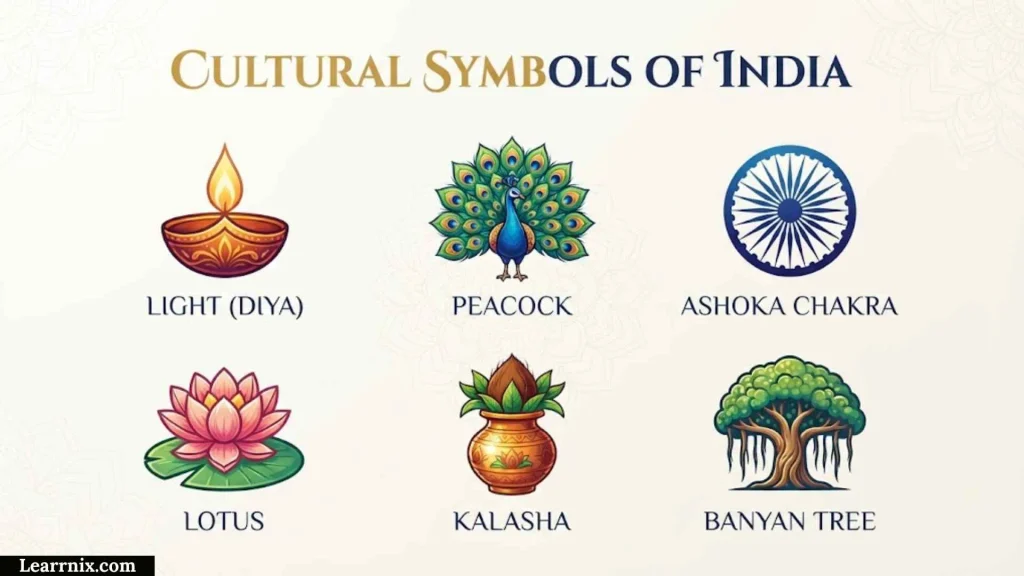
Official national symbols are only one part of the larger subject. India’s culture contains many additional symbols that people around the world recognize.
These should be described as cultural symbols or cultural representations, rather than automatically calling them official national symbols.
Diya
A diya is a traditional oil lamp commonly associated with light, celebration, knowledge, and auspicious occasions.
Diyas are especially visible during Diwali, when lamps are used in homes, temples, streets, and public celebrations.
Because of this widespread cultural association, the diya is often used in artwork representing Indian traditions.
Om
The Om symbol has an important role in several Indian spiritual traditions, particularly Hindu traditions.
It is associated with sacred sound and spiritual practice.
Because religious symbols have specific meanings within their traditions, explanations should avoid presenting Om as a generic official government symbol of India.
Namaste
Namaste is a traditional greeting commonly made by bringing the palms together.
The gesture can communicate respect, courtesy, greeting, or acknowledgment depending on context.
It has become internationally recognizable as an Indian cultural practice, but it is not an official national symbol like the National Flag or State Emblem.
Yoga
Yoga has historical roots in India and has become a global cultural practice.
Its association with India is strong because of its historical development within Indian philosophical and spiritual traditions.
Yoga is therefore an important cultural representation of India, but it should not be confused with an officially designated national emblem.
Taj Mahal
The Taj Mahal in Agra is one of the most recognizable monuments associated with India.
Its architecture, history, and tourism importance make it a frequent visual representation of the country.
However, the Taj Mahal is a monument and cultural heritage site, not India’s official national symbol.
This distinction is important for accurate educational content.
Official National Symbols Vs Cultural Symbols
One of the most important points when researching India symbols is understanding the difference between official designation and popular association.
| Example | Official National Symbol? | Why It Is Associated With India |
| Indian National Flag | Yes | Represents the nation |
| State Emblem | Yes | Official state identity |
| Bengal Tiger | Yes | National animal |
| Peacock | Yes | National bird |
| Lotus | Yes | National flower |
| Banyan | Yes | National tree |
| Mango | Yes | National fruit |
| Yoga | No | Deep Indian cultural and historical roots |
| Taj Mahal | No | Major Indian monument |
| Diya | No | Important cultural and festival tradition |
| Om | No | Important spiritual/religious symbol |
| Namaste | No | Traditional Indian greeting |
This classification prevents one of the most common mistakes in articles about Indian symbols: treating every famous Indian image as an official national designation.
Why Are National Symbols Important?
National symbols create recognizable points of connection between citizens, institutions, history, and the country as a whole.
They can serve several purposes.
National Identity
A national flag or emblem can represent the country in an immediate and recognizable way.
Education
Students learn national symbols as part of basic civic and cultural education. Symbols provide an accessible way to introduce India’s history, geography, biodiversity, and heritage.
Government And Public Institutions
The National Flag and State Emblem have formal uses in government and public life. Their use is subject to official rules and regulations.
Cultural Representation
Symbols such as the lotus, peacock, mango, and banyan connect national identity with India’s natural and cultural heritage.
Conservation
The tiger and Ganges River Dolphin show that national symbolism can also draw attention to biodiversity and environmental protection. Government conservation programs continue to identify these species as important conservation priorities.
Historical Background Of India’s National Symbols
India’s national symbols did not all emerge at the same moment.
Some have ancient historical roots, while others were formally adopted or designated after independence.
Ancient And Historical Roots
The Ashoka Chakra and Lion Capital connect modern India with the Mauryan period and the historical legacy of Emperor Ashoka.
The lotus, banyan, peacock, and other natural or cultural symbols also have long histories within Indian art, literature, mythology, and traditions.
The Independence Movement
National identity became particularly important during India’s independence movement.
Songs, flags, literature, public gatherings, and other forms of symbolism helped create a shared sense of national identity.
Vande Mataram, for example, became closely associated with the freedom movement and later received the status of National Song.
The Republic Of India
After independence and the establishment of the Republic, India formalized important national institutions and symbols.
The National Flag, State Emblem, National Anthem, and other national designations became part of the country’s modern civic identity.
The Ministry of Home Affairs remains a key official source for regulations and government material relating to the National Flag, State Emblem, and National Anthem.
Common Misconceptions About India Symbols
Is The Taj Mahal The National Symbol Of India?
No. The Taj Mahal is one of India’s most famous monuments and cultural representations, but it is not the State Emblem or National Flag.
Is The Lion India’s National Animal?
No. The Bengal Tiger is India’s national animal.
The confusion partly comes from the fact that lions appear in the State Emblem through the Lion Capital of Ashoka. Government information confirms that the tiger replaced the lion as the national animal in 1972.
Is The Lotus Only A Religious Symbol?
No. The lotus has religious and spiritual associations, but it also has broader cultural and historical significance and is officially India’s national flower.
Is Yoga India’s National Symbol?
Yoga is a major part of India’s cultural heritage and has global recognition, but it is not equivalent to an officially designated national symbol such as the National Flag or State Emblem.
Are The National Anthem And National Song The Same?
No.
Jana Gana Mana is the National Anthem, while Vande Mataram is the National Song. They have different historical backgrounds and official roles.
How To Identify An Official India Symbol
When you encounter a list of “Indian symbols” online, use this simple process before accepting every item as an official national symbol.
Step 1: Check The Official Designation
Ask whether an Indian government source actually identifies the item as a national symbol.
Step 2: Identify The Category
Determine whether the item is:
- National symbol
- State emblem
- National identity item
- Cultural symbol
- Religious symbol
- Historical monument
- Tourism icon
- Wildlife or environmental symbol
Step 3: Check The Original Source
For government-related symbols, prioritize sources such as the Ministry of Home Affairs and the National Portal of India.
Step 4: Separate Fact From Popular Usage
A symbol can be extremely popular without having an official designation.
For example, the Taj Mahal is unmistakably associated with India, but popularity does not automatically make something a national symbol.
A Simple Decision Guide For India Symbols
Are you looking for an official national symbol?
↓
Yes → Check government sources and national designations.
No → You may be looking for a cultural, historical, religious, or tourism symbol.
↓
Is the item a government emblem or flag?
Yes → Check official rules for its use.
No → Determine whether it represents Indian culture, history, nature, or heritage.
↓
Are you writing for school or academic purposes?
Yes → Use the official designation and source it accurately.
No → You can discuss broader cultural associations, but clearly label them as cultural rather than official symbols.
This simple distinction makes an India symbols article much more reliable.
How India Symbols Are Used In Education And Everyday Life
National symbols are frequently used in school lessons, quizzes, national celebrations, public ceremonies, educational posters, and cultural programs.
For example, a student learning about India’s national identity might connect:
Tiger → wildlife conservation
Lotus → national flower and cultural heritage
Peacock → national bird
Banyan → national tree
Mango → national fruit
Ashoka Chakra → National Flag
This approach is more useful than memorizing an isolated list because it explains why each symbol matters.
Practical Tips For Students Learning India Symbols
Students can make the topic easier by organizing symbols into categories instead of trying to memorize everything at once.
Learn Symbols By Category
Start with:
- National identity symbols
- Animals and birds
- Plants and food
- Rivers and aquatic life
- National songs and anthem
- Calendar and historical symbols
Remember The Most Commonly Asked Symbols First
For school quizzes, the frequently studied items usually include:
- National Flag
- State Emblem
- National Anthem
- National Song
- National Animal
- National Bird
- National Flower
- National Tree
- National Fruit
Avoid Memorizing Unverified Lists
Online lists sometimes mix official national symbols with famous monuments, religious icons, tourist attractions, and cultural practices.
Always check the category before memorizing the information.
India Symbols In Art, Design, And Media
Indian symbols are also frequently used in visual communication.
The National Flag may appear in educational or civic contexts, while animals, flowers, monuments, and cultural motifs are commonly used in tourism and artistic representations.
Designers and publishers should be especially careful with official government emblems. The State Emblem is legally protected against improper use, and its unauthorized use can create the false impression of government affiliation.
This makes the difference between a cultural image and an official state emblem important not only for students but also for businesses, designers, publishers, and organizations.
Key Takeaways About India Symbols
- India’s official national symbols represent national identity, history, culture, and natural heritage.
- The Tiranga is India’s National Flag.
- The Ashoka Chakra is the wheel at the center of the National Flag.
- The Lion Capital of Ashoka forms the basis of India’s State Emblem.
- Jana Gana Mana is India’s National Anthem.
- Vande Mataram is India’s National Song.
- The Bengal Tiger is India’s national animal.
- The Indian Peacock is the national bird.
- The Lotus is the national flower.
- The Banyan is the national tree.
- The Mango is the national fruit.
- The Ganges River Dolphin is India’s national aquatic animal.
- The Saka Calendar is India’s national calendar.
- Yoga, Namaste, Om, the diya, and the Taj Mahal are important cultural associations, but they should not automatically be presented as official national symbols.
- Government sources should be used when accuracy or official status matters.
Frequently Asked Questions About India Symbols
What Are The 10 Main Symbols Of India?
Ten commonly recognized official national symbols or national identity items include the National Flag, State Emblem, National Anthem, National Song, Bengal Tiger, Indian Peacock, Lotus, Banyan Tree, Mango, and Ganges River Dolphin.
The exact list can vary depending on how a source defines “national symbols,” so it is important to distinguish formal national designations from broader cultural representations.
What Is The Most Important Symbol Of India?
The National Flag is one of India’s most important national symbols because it directly represents the country and its national identity. The State Emblem is another major official symbol used by the Indian government.
What Is India’s National Symbol?
The State Emblem of India, adapted from the Lion Capital of Ashoka at Sarnath, is the country’s official state emblem. The National Flag is a separate and equally important national identity symbol.
What Is The National Animal Of India?
The Bengal Tiger is India’s national animal. It was adopted as the national animal in 1972.
What Is The National Bird Of India?
The Indian Peacock is India’s national bird. It is widely recognized for its distinctive plumage and longstanding cultural association with India.
What Is The National Flower Of India?
The lotus is India’s national flower. It has longstanding cultural and historical significance in India.
What Is The National Tree Of India?
The banyan tree is India’s national tree. Its long life and distinctive spreading growth have contributed to its symbolic importance.
What Is India’s National Fruit?
The mango is India’s national fruit. It has major agricultural, culinary, and cultural importance across the country.
What Is India’s National Aquatic Animal?
The Ganges River Dolphin is India’s national aquatic animal. It was designated in 2009 and remains an important focus of river and biodiversity conservation.
Is The Ganga A Symbol Of India?
Yes. The Ganga is widely recognized as India’s national river and has major cultural, historical, ecological, and economic importance.
Is The Taj Mahal An Official National Symbol?
No. The Taj Mahal is a major Indian monument and an internationally recognized representation of India’s heritage, but it is not the country’s official State Emblem or National Flag.
Why Does India Have So Many Cultural Symbols?
India has a long and diverse history involving many regions, languages, communities, artistic traditions, religions, and ecosystems. As a result, Indian identity is represented through many different cultural, historical, and natural symbols.
Editorial Note On India Symbols
For accuracy, this article separates official national designations from symbols that are culturally associated with India. Official information concerning the National Flag, State Emblem, and National Anthem should be checked against current Government of India material, particularly the Ministry of Home Affairs. The National Portal of India is another useful government reference for national identity information.
This distinction matters because popular websites often combine official symbols with monuments, religious imagery, festivals, and cultural practices under one heading.
References
- Ministry of Home Affairs, Government of India — National Flag, Emblem & Anthem: official information, Flag Code materials, State Emblem regulations, and National Anthem/Song documents.
- Flag Code of India, Ministry of Home Affairs: official rules and guidance concerning the Indian National Flag.
- National Portal of India — National Identity: Government of India information on national identity.
- Press Information Bureau, Government of India — Lion as a National Animal: historical explanation of the tiger’s adoption as India’s national animal in 1972.
- Press Information Bureau, Ministry of Environment, Forest and Climate Change — Conservation of Dolphin: information on the Ganges River Dolphin’s national status and conservation.
- Press Information Bureau, Government of India — Mango: The National Fruit of India: agricultural background on mango as India’s national fruit.
- Government of India publication — National Flower: information on the lotus and its cultural significance.
- Government of India diplomatic mission — National Symbols: reference information covering the peacock, lotus, banyan, mango, and Saka Calendar.
Conclusion
India symbols provide a useful way to understand the country’s national identity, history, natural heritage, and cultural diversity. The National Flag and State Emblem represent the modern Indian state, while the National Anthem and National Song connect national identity with India’s historical development.
The Bengal Tiger, Peacock, Lotus, Banyan, Mango, Ganges River Dolphin, and Ganga add natural and cultural dimensions to this identity. At the same time, cultural icons such as yoga, Namaste, Om, diyas, and the Taj Mahal show why India’s symbolic heritage is much broader than its official list of national designations.
The most important point is to distinguish official national symbols from broader cultural symbols. That distinction makes information about India more accurate, useful for students, and reliable for readers researching Indian history, culture, geography, and national identity.

I am Daniel Harper, an education enthusiast and writer who enjoys creating helpful content to make learning more accessible and engaging.
I focus on sharing knowledge about effective study methods, educational growth, and skills that help learners succeed in a changing world.
Through my writing, I aim to inspire students to explore new ideas and develop a passion for learning.
Books by Daniel Harper:
- The Path to Lifelong Learning
- Unlocking Your Learning Potential
 Michael Carter