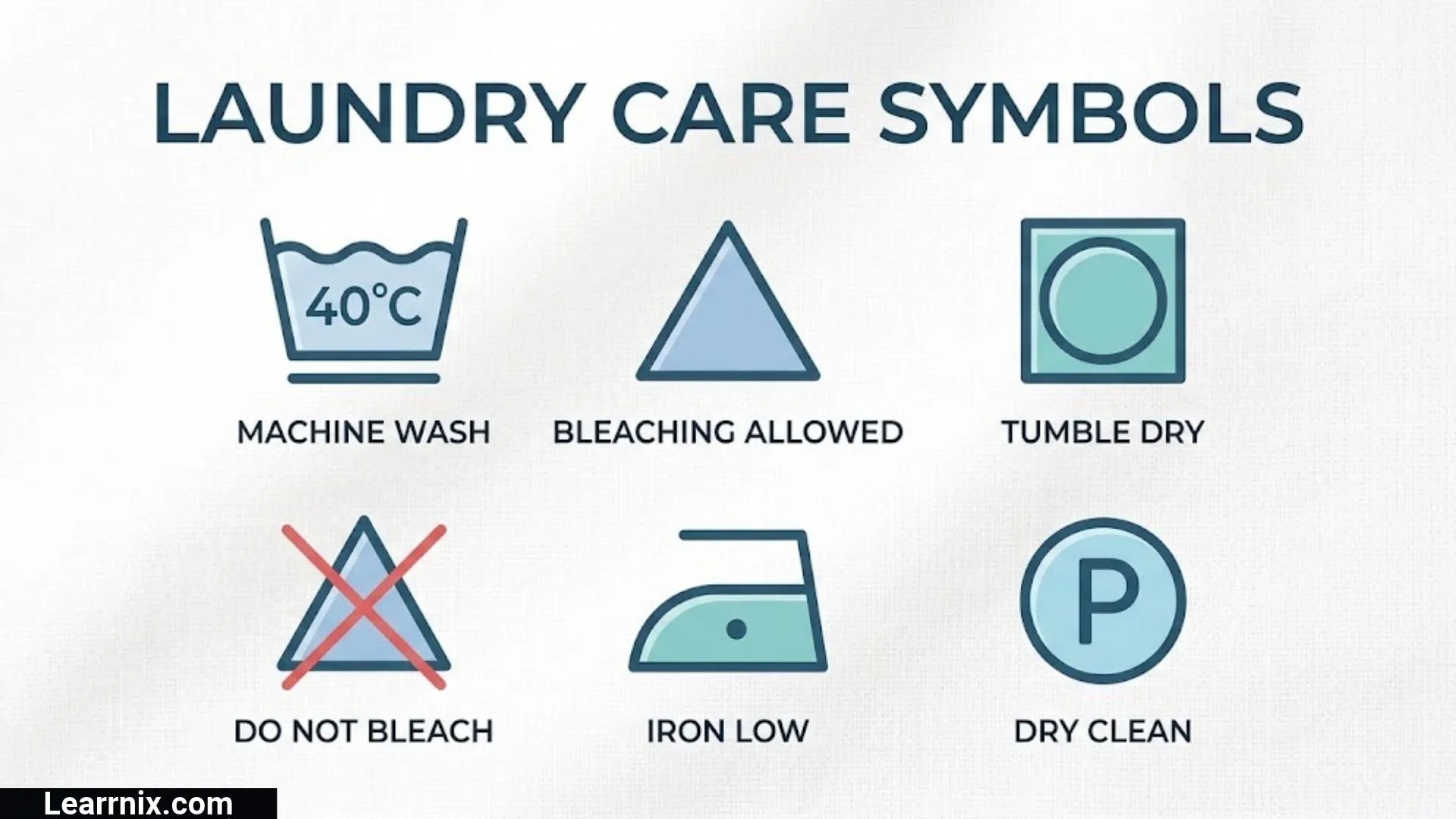
Laundry care symbols explain how to wash, dry, bleach, iron, and professionally clean your clothes. These small marks on clothing labels help you choose the right washing temperature, drying method, and heat setting. Understanding them can prevent common problems such as shrinking, fading, stretching, and damage to delicate fabrics.
This guide covers the most common laundry care symbols and meanings, including washing tub symbols, drying instructions, ironing marks, bleaching restrictions, and professional cleaning symbols. You will also learn how to interpret international care labels and understand Korean and Japanese laundry instructions.
If you need a quick laundry care symbols chart, an explanation of the circle with P, or a printable reference for your laundry room, this guide will help you make better decisions about clothing care.
Laundry Care Symbols Guide
Laundry care symbols are pictorial instructions printed on clothing labels. They tell you which cleaning methods are suitable for a garment and which treatments could damage it. Many labels follow the international ISO 3758 care-labelling system, although national systems and older labels may differ.
Most standard care labels use five main symbols:
- Washing tub: Explains washing temperature and washing method.
- Triangle: Indicates whether bleaching is permitted.
- Square: Provides tumble-drying or natural-drying instructions.
- Iron: Shows whether ironing is allowed and how much heat to use.
- Circle: Provides instructions for professional dry cleaning or wet cleaning.
Additional marks change the meaning of these basic symbols. A number inside a washing tub indicates the maximum washing temperature. Dots generally indicate heat levels for drying and ironing, while lines underneath certain symbols indicate a gentler process. A cross over a symbol means the indicated treatment is prohibited.
For example, a shirt may be machine-washable at 30°C but unsuitable for tumble drying. Another garment may allow low-temperature ironing but prohibit bleaching.
The best way to read a care label is to examine every symbol in sequence rather than looking at just one. This gives you a complete picture of how to clean and dry the garment safely.
Laundry Care Symbols And Meanings
The following table explains common laundry care symbols and the actions they recommend. Because many official laundry symbols are pictorial drawings rather than ordinary text characters, the table describes their visual appearance instead of substituting potentially misleading Unicode characters.
| Symbol Appearance | Meaning | Recommended Action |
| Tub with 30 | Maximum wash temperature of 30°C | Use a wash setting no hotter than 30°C |
| Tub with 40 | Maximum wash temperature of 40°C | Wash at or below 40°C |
| Tub with a hand | Hand washing | Wash gently by hand |
| Crossed-out tub | Do not wash | Follow other care instructions |
| Empty triangle | Bleaching permitted | Use a suitable bleach if needed |
| Triangle with diagonal lines | Oxygen or non-chlorine bleach only | Avoid chlorine bleach |
| Crossed-out triangle | Do not bleach | Use bleach-free products |
| Square with a circle | Tumble drying | Check the heat indicators |
| Crossed-out tumble-drying symbol | Do not tumble-dry | Choose a permitted alternative |
| Square with a horizontal line | Dry flat | Place the garment on a flat surface |
| Square with a vertical line | Line dry | Hang the garment to dry |
| Iron with one dot | Low-temperature ironing | Use low heat |
| Iron with two dots | Medium-temperature ironing | Use medium heat |
| Iron with three dots | High-temperature ironing | Use high heat only if permitted |
| Crossed-out iron | Do not iron | Avoid ironing |
| Circle with P | Professional dry cleaning under specified conditions | Give the garment to a professional cleaner |
| Circle with F | Professional dry cleaning using specified hydrocarbon solvents | Follow professional-care instructions |
| Circle with W | Professional wet cleaning | Consult a professional cleaner |
These descriptions cover common conventions, but the exact permitted process depends on the label system. Always follow the complete set of instructions, particularly when caring for delicate, expensive, or specially treated clothing.
Care Label Symbols And Meanings
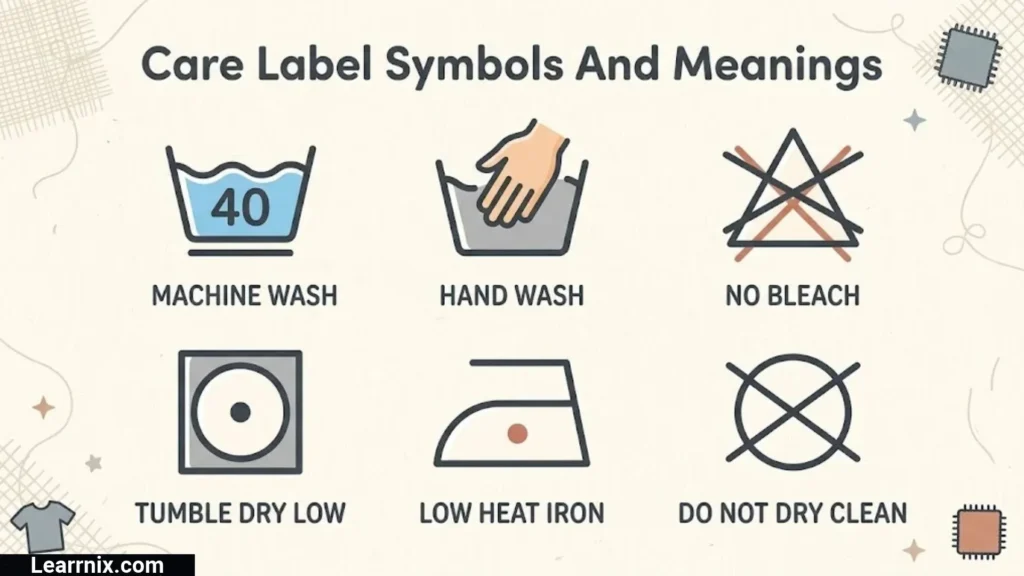
Care label symbols help you understand the treatment a garment can withstand without suffering irreversible damage. They account for more than the fabric itself. Dye, stitching, linings, buttons, prints, and protective finishes can also affect the correct cleaning method.
A typical label presents the care categories in this order:
- Washing
- Bleaching
- Drying
- Ironing
- Professional textile care
Not every garment needs all five categories. However, the absence of a symbol should not automatically be interpreted as permission to use any treatment.
How to read washing temperatures
A number inside the washing tub usually indicates the maximum washing temperature in degrees Celsius. A tub marked 30 means the garment should not be washed above 30°C. It does not mean that you must always wash it at exactly that temperature.
An underline beneath the tub indicates a gentler cycle, while two underlines generally indicate an extra-gentle cycle. These instructions are particularly useful for wool, delicate knits, and fabrics that can lose their shape.
Why fabric type matters
- Cotton: Often handles regular washing, but dark colors and printed designs may need cooler settings.
- Wool: May shrink or become felted when washed with excessive heat or agitation.
- Silk: Often requires gentle handling and careful drying.
- Polyester: Can be damaged or distorted by excessive heat.
- Elastane blends: May lose their stretch when exposed to unsuitable heat.
- Waterproof fabrics: May require specific detergents and special care to preserve their finish.
The care label should take priority over general assumptions about fabric. Two garments made from similar fibers may require different cleaning methods because their construction or finishes differ.
Laundry Care Symbols Chart
A laundry care symbols chart makes it easier to check instructions without reading a long explanation every time you do laundry. Use this quick reference to identify the main categories and understand their most common variations.
| Care Category | Symbol Description | Meaning |
| Washing | Tub with a number | Maximum washing temperature |
| Washing | Tub with one underline | Mild washing process |
| Washing | Tub with two underlines | Very mild washing process |
| Washing | Hand inside a tub | Hand wash |
| Bleaching | Empty triangle | Any permitted bleaching agent |
| Bleaching | Triangle with two diagonal lines | Oxygen bleach only |
| Bleaching | Crossed-out triangle | Do not bleach |
| Tumble Drying | Square with a circle | Tumble drying permitted |
| Tumble Drying | Circle with one dot inside a square | Low heat |
| Tumble Drying | Circle with two dots inside a square | Normal or medium heat, according to the applicable system |
| Tumble Drying | Crossed-out square with a circle | Do not tumble-dry |
| Natural Drying | Square with a horizontal line | Dry flat |
| Natural Drying | Square with a vertical line | Line dry |
| Natural Drying | Square with diagonal corner lines | Dry in the shade |
| Ironing | Iron with one dot | Low heat |
| Ironing | Iron with two dots | Medium heat |
| Ironing | Iron with three dots | High heat |
| Ironing | Crossed-out iron | Do not iron |
| Professional Care | Circle with P | Professional dry cleaning with specified solvents |
| Professional Care | Circle with F | Professional dry cleaning using specified hydrocarbon solvents |
| Professional Care | Circle with W | Professional wet cleaning |
| Professional Care | Crossed-out circle | Do not dry-clean |
Remember that the symbols describe the most intensive treatment permitted under the relevant care-label system. Choosing a gentler setting may be appropriate, provided it still cleans the garment effectively.
Laundry Drying Symbols
Drying symbols help you decide whether to use a tumble dryer, hang clothes on a line, or lay them flat. They are especially important for wool sweaters, delicate fabrics, stretch clothing, and garments that can shrink under excessive heat.
Tumble-Drying Symbols
A square containing a circle represents tumble drying. Dots inside the circle indicate the permitted heat level.
| Symbol Appearance | Meaning |
| Square containing a circle | Tumble drying is permitted |
| Circle with one dot inside a square | Low-heat tumble drying |
| Circle with two dots inside a square | Normal-heat tumble drying |
| Crossed-out square containing a circle | Do not tumble-dry |
Do not assume that every tumble dryer uses identical temperature settings. Follow the garment label and choose the appropriate cycle on your machine.
Natural-Drying Symbols
A square without a circle can indicate a natural drying method. Additional lines explain how the garment should be positioned.
- Horizontal line inside a square: Dry flat.
- Vertical line inside a square: Line dry.
- Curved line near the top of a square: Hang to dry.
- Diagonal lines in a square’s corner: Dry in the shade.
- Horizontal line combined with diagonal corner lines: Dry flat in the shade.
For example, a wool sweater marked for flat drying should be placed on a clean, flat surface instead of being hung while wet. The weight of the water can stretch its shape.
When drying clothes naturally, provide enough airflow and avoid direct sunlight if the label requires shade. Do not use a radiator or another direct heat source unless the care instructions permit it.
International Laundry Care Symbols
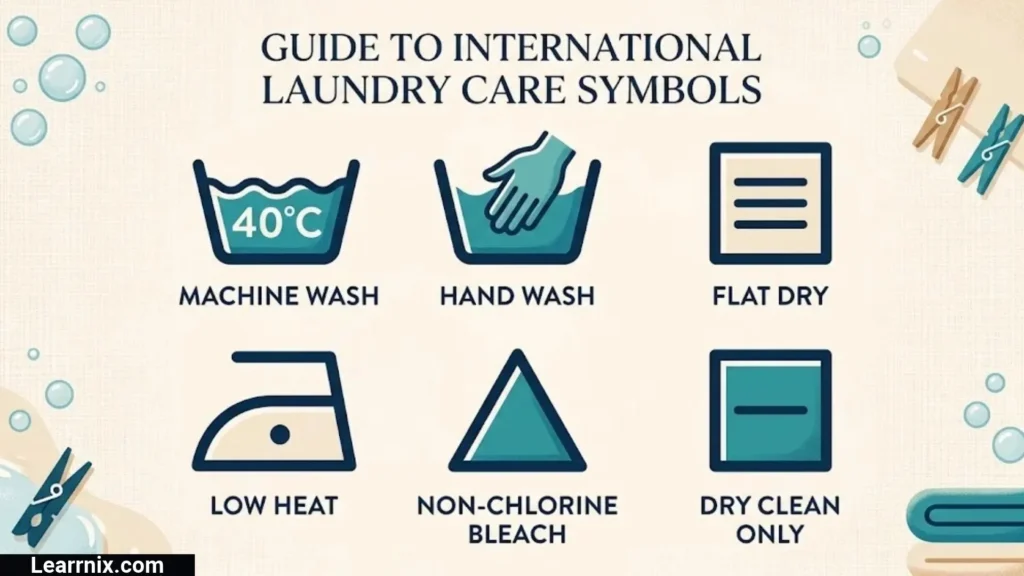
International laundry care symbols help consumers understand garment instructions across languages and markets. The ISO 3758:2023 standard describes a system of pictorial symbols for washing, bleaching, drying, ironing, and professional textile care.
Although many countries use similar symbols, not every clothing label is identical. Local requirements, older standards, and manufacturer-specific instructions can affect the appearance and interpretation of care labels.
The five basic shapes are generally easy to recognize:
- Tub: Washing instructions.
- Triangle: Bleaching instructions.
- Square: Drying instructions.
- Iron: Ironing instructions.
- Circle: Professional textile-care instructions.
Numbers inside washing tubs usually refer to maximum temperatures in Celsius. Dots in drying and ironing symbols indicate heat levels, while underlines can specify gentler treatment.
When shopping internationally, do not assume that a symbol is a Unicode character you can type or copy. Many official laundry marks are standardized illustrations printed on labels rather than ordinary text symbols.
If a label contains unfamiliar wording, translate the text while also checking the pictograms. For delicate garments, the complete instructions are more reliable than a single symbol viewed in isolation.
Universal Laundry Care Symbols
There is no guarantee that every clothing manufacturer worldwide uses precisely the same label system. Nevertheless, the five main care-symbol categories provide a practical starting point for understanding many garments.
You can remember their meanings with a simple rule:
- The tub tells you how to wash.
- The triangle tells you whether bleaching is allowed.
- The square tells you how to dry.
- The iron tells you how to press or iron.
- The circle tells you about professional cleaning.
Crosses, dots, numbers, and lines provide extra instructions. For instance, a crossed-out iron means ironing is prohibited, while a washing tub with two underlines indicates an extra-gentle process under common international conventions.
The term universal laundry care symbols is therefore best understood as a reference to widely recognized pictograms, not a claim that every country uses identical symbols in every situation.
If a label looks unfamiliar, compare its full design with a reliable care-symbol reference. Avoid guessing when an incorrect cleaning method could damage a garment.
What Do the Laundry Care Symbols Mean
Laundry care symbols tell you which cleaning treatments are suitable for a particular garment. Their meaning comes from the main shape and any additional marks.
A tub marked 30 indicates a maximum washing temperature of 30°C. A hand inside a tub means hand washing, and a crossed-out tub means the indicated washing process is not permitted.
A triangle concerns bleaching. An empty triangle commonly permits bleaching, while a crossed-out triangle prohibits it. A triangle with diagonal lines generally indicates that oxygen bleach is permitted but chlorine bleach is not.
A square describes drying. When it contains a circle, the instruction concerns tumble drying. Dots indicate the permitted heat level, and a cross over the symbol prohibits the process. Other square designs describe natural drying methods.
An iron symbol tells you whether ironing is allowed. One dot indicates low heat, two dots indicate medium heat, and three dots indicate high heat in common systems. A crossed-out iron means the garment should not be ironed.
A circle containing a letter provides information about professional textile care. The letter identifies a permitted cleaning process or solvent category under the relevant system.
The most important rule is to read all the symbols together. A garment may allow machine washing but require natural drying and prohibit high-temperature ironing.
Korean Laundry Care Symbols
Korean clothing labels may combine familiar laundry pictograms with Korean words describing washing, drying, and cleaning instructions. Learning a few common terms can make imported clothing easier to care for.
| Korean Term | English Meaning |
| 세탁 | Washing |
| 손세탁 | Hand washing |
| 물세탁 금지 | Do not wash with water |
| 표백 | Bleaching |
| 표백 금지 | Do not bleach |
| 건조 | Drying |
| 건조기 사용 금지 | Do not use a tumble dryer |
| 다림질 | Ironing |
| 드라이클리닝 | Dry cleaning |
| 그늘에 건조 | Dry in the shade |
| 평평하게 건조 | Dry flat |
These are common translations, and exact wording may vary between manufacturers. Some labels may use a pictogram instead of a written instruction.
When reading a Korean care label, identify the familiar shapes first. Then use the written instructions to clarify any restrictions that are not obvious from the symbols. Pay particular attention to tumble drying, ironing, and instructions prohibiting water washing.
Laundry Care Symbols Circle With P
The circle with P is a professional dry-cleaning symbol. It provides information to the cleaner about the permitted solvent category and cleaning process.
The letter P does not mean that you should add a particular product to your washing machine. It is intended for professional textile care.
Other professional-cleaning marks include:
| Symbol Appearance | Meaning |
| Circle with P | Professional dry cleaning using specified solvents |
| Circle with F | Professional dry cleaning using specified hydrocarbon solvents |
| Circle with W | Professional wet cleaning |
| Crossed-out circle | Do not dry-clean |
An underline beneath a professional-care symbol generally indicates a milder process. Two underlines indicate a very mild process under the relevant system.
When a garment has a circle with P, show the entire label to your cleaner. The surrounding marks may specify additional restrictions that affect how the garment should be treated.
Do not confuse a circle with P with a washing tub or a tumble-drying symbol. Each belongs to a different care category.
Japanese Laundry Care Symbols
Japanese clothing labels often combine care pictograms with Japanese text. Recognizing a few common terms can help you understand garments purchased from Japanese brands or retailers.
| Japanese Term | English Meaning |
| 洗濯 | Washing |
| 手洗い | Hand washing |
| 漂白 | Bleaching |
| 乾燥 | Drying |
| アイロン | Ironing |
| ドライクリーニング | Dry cleaning |
| 日陰 | Shade |
| 平干し | Dry flat |
| 洗濯不可 | Washing prohibited |
For example, 平干し refers to drying flat, which can be useful for garments that may stretch when hung. 手洗い indicates hand washing, while 洗濯不可 indicates that washing is not permitted.
Japan revised its clothing care-labelling system in 2016 to align more closely with international conventions. As a result, older garments may display different symbols from newer products.
When interpreting Japanese labels, check both the pictograms and the written instructions. If you are unsure about a restriction, avoid experimenting with a delicate garment until you have confirmed the correct treatment.
Free Printable Laundry Care Symbols Chart
A printable laundry care symbols chart provides a convenient reference when sorting clothes or checking unfamiliar labels. You can copy the table below into a document editor and print it for your laundry room.
Laundry Care Symbols Quick Reference
| Symbol Description | Care Instruction |
| Tub with a number | Wash at or below the stated temperature |
| Tub with a hand | Hand wash |
| Crossed-out tub | Do not wash |
| Empty triangle | Bleaching permitted |
| Triangle with diagonal lines | Oxygen bleach only |
| Crossed-out triangle | Do not bleach |
| Square with a circle | Tumble drying |
| Tumble-drying symbol with one dot | Low heat |
| Crossed-out tumble-drying symbol | Do not tumble-dry |
| Square with a horizontal line | Dry flat |
| Square with a vertical line | Line dry |
| Square with diagonal corner lines | Dry in the shade |
| Iron with one dot | Low heat |
| Iron with two dots | Medium heat |
| Iron with three dots | High heat |
| Crossed-out iron | Do not iron |
| Circle with P | Professional dry cleaning |
| Circle with F | Dry cleaning using specified hydrocarbon solvents |
| Circle with W | Professional wet cleaning |
| Crossed-out circle | Do not dry-clean |
How to Print the Chart
- Copy the chart into Microsoft Word, Google Docs, or another document editor.
- Add the heading “Laundry Care Symbols Cheat Sheet.”
- Choose a readable font and adjust the table width.
- Use landscape orientation if the table needs more space.
- Print the chart and keep it near your laundry supplies.
For a visual chart, use the actual care pictograms rather than substituting ordinary text characters. Laundry symbols are generally standardized illustrations, so text-only descriptions are useful references but are not exact visual replacements.
Laundry Care Symbols Meaning Washing Instructions
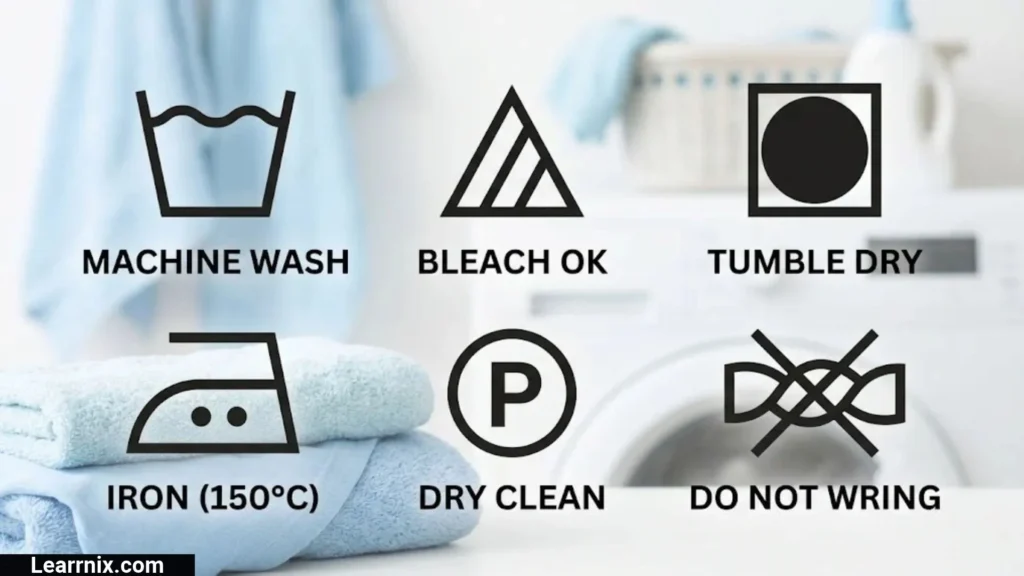
Washing symbols explain whether a garment can be machine-washed, needs hand washing, or should not be washed using the indicated process. Some also specify the maximum water temperature and the gentleness of the cycle.
Machine Washing Instructions
A number inside a washing tub usually indicates the maximum permitted temperature in degrees Celsius.
- 30°C: Wash at or below 30°C.
- 40°C: Wash at or below 40°C.
- 60°C: Wash at or below 60°C, if the label permits it.
These numbers indicate temperature limits rather than mandatory settings. A lower temperature may be suitable when the garment is not heavily soiled and the detergent works effectively at that setting.
Gentle Washing Instructions
One underline beneath a washing tub generally indicates a mild process with reduced mechanical action. Two underlines indicate an extra-gentle process.
Choose an appropriate delicate or wool cycle if your washing machine offers one. Avoid overloading the drum, as crowded garments may receive more friction and may not rinse properly.
Hand-Washing Instructions
A hand inside the tub indicates hand washing. Use water and detergent suitable for the garment, handle it gently, and avoid vigorous rubbing or twisting.
Some delicate fabrics can be damaged by prolonged soaking, so follow any additional instructions on the label.
Do Not Wash Instructions
A crossed-out washing tub means the garment should not undergo the indicated washing process. Check the remaining symbols for professional-care instructions rather than assuming that dry cleaning is automatically allowed.
When in doubt, seek advice before washing delicate, structured, or expensive clothing.
Standard Laundry Care Symbols Interpretation
Correct interpretation means understanding the main symbol and every mark that modifies it. This helps you avoid confusing washing restrictions with drying or ironing instructions.
Understand Crosses, Dots, and Lines
| Mark | Common Meaning |
| Cross over a symbol | The indicated treatment is prohibited |
| One dot | Low heat in applicable drying or ironing symbols |
| Two dots | Medium heat in applicable drying or ironing symbols |
| Three dots | Higher heat in applicable drying or ironing symbols |
| One underline | Mild process |
| Two underlines | Extra-gentle process |
| Number inside a washing tub | Maximum washing temperature |
These conventions apply within the relevant symbol categories. Do not assume that dots have exactly the same temperature meaning for every type of care symbol.
Common Laundry Care Mistakes
- Using high heat on a garment that permits only low-heat drying.
- Applying chlorine bleach when the label permits oxygen bleach only.
- Ignoring an instruction to dry flat.
- Ironing a garment marked with a crossed-out iron.
- Assuming a professional dry-cleaning symbol describes a home-washing method.
- Treating a maximum washing temperature as a required temperature.
- Ignoring written instructions such as “wash separately” or “wash inside out.”
A useful routine is to check the label before the first wash, separate garments according to their care needs, and choose a suitable cycle before adding detergent. If the label is missing or unreadable, consult the manufacturer’s care instructions where possible.
FAQs
What are the five main laundry care symbols?
The five main categories are washing, bleaching, drying, ironing, and professional textile care. Each uses a different pictorial shape to communicate the appropriate treatment.
What does a crossed-out triangle mean on a clothing label?
A crossed-out triangle means bleaching is not permitted. Avoid bleach products when cleaning the garment.
What does a circle with P mean on laundry care labels?
A circle with P indicates a professional dry-cleaning process using specified solvents. Take the garment to a professional cleaner who can interpret the complete label.
Can I wash clothes at a lower temperature than the symbol shows?
Yes, in general. The number inside a washing tub usually specifies the maximum permitted temperature. A cooler wash may be suitable depending on the fabric, detergent, and level of soiling.
Are laundry care symbols the same in every country?
Many countries use similar pictograms, but label systems and local requirements can differ. Imported clothing may also include written instructions in another language, so check the complete label before washing.
Conclusion
Laundry care symbols make clothing care easier by explaining how to wash, bleach, dry, iron, and professionally clean garments. Learning the five main categories helps you understand everyday clothing labels and choose appropriate cleaning methods.
Pay close attention to temperature numbers, dots, underlines, and crossed-out symbols. These small details can determine whether a garment needs a gentle wash, low-heat drying, or professional care. Korean and Japanese labels may also include written instructions that help clarify the recommended treatment.
Keep a laundry care symbols chart nearby for quick reference. When you encounter an unfamiliar symbol, check its meaning before cleaning the garment. Following the label can help preserve fabric quality, color, and shape for longer.

I am Charlotte Anderson, an education writer who is passionate about creating meaningful learning resources for students and lifelong learners.
I enjoy researching new educational approaches and sharing ideas that make studying easier and more effective.
Through my work, I aim to inspire curiosity, confidence, and a love for learning.
Books:
- The Complete Guide to Better Learning
- Building Skills for Academic Success
 Michael Carter