If you are searching for Adinkra symbols and meanings, you are likely looking for more than a simple list of African symbols. You may want to know what individual symbols mean, where Adinkra comes from, which symbols represent wisdom, strength, love, unity, freedom, or faith, and how these designs are traditionally used.
Adinkra is a visual-symbol tradition associated with Akan cultures of West Africa, particularly in Ghana. The symbols can communicate proverbs, values, beliefs, observations about life, and social ideas. They are strongly connected with Adinkra cloth, where carved stamps are used to apply designs to fabric. Museum collections also document Adinkra stamps made from carved gourd and traditional cloth produced in Ghana.
This guide explains the most important Adinkra symbols, their commonly documented meanings, the history and production of Adinkra cloth, how different symbols compare, common misconceptions, and how to choose an appropriate symbol for a specific message.
Quick Answer: What Are Adinkra Symbols?
Adinkra symbols are traditional Akan visual symbols used to express ideas, values, proverbs, beliefs, and observations about human life. They are especially associated with Ghana and the Asante cultural tradition.
Adinkra designs are not simply decorative shapes. Their names and visual forms can point to objects, plants, animals, tools, architectural features, or abstract ideas. The British Museum notes that Adinkra designs can have visual relationships to their names and may refer to objects such as a war horn, comb, sword, drum, ladder, or other familiar forms.
Why Do Adinkra Symbols Matter?
They matter because they turn cultural ideas into visual communication.
A single symbol can help communicate concepts such as:
- Wisdom
- Courage
- Patience
- Leadership
- Faith
- Freedom
- Unity
- Protection
- Reconciliation
- Learning
- Resilience
- Love
- Community
This makes Adinkra useful for understanding Akan art, textiles, history, language, philosophy, and cultural expression.
Are Adinkra Symbols All the Same?
No. Different symbols have different names and associations, and explanations can vary between sources or translations.
This is important because a one-word English definition does not always capture the full cultural idea behind an Akan term, proverb, or symbol.
For that reason, the meanings in this guide are presented as commonly documented interpretations, rather than claiming that every symbol has one fixed English translation.
Adinkra History and Cultural Background
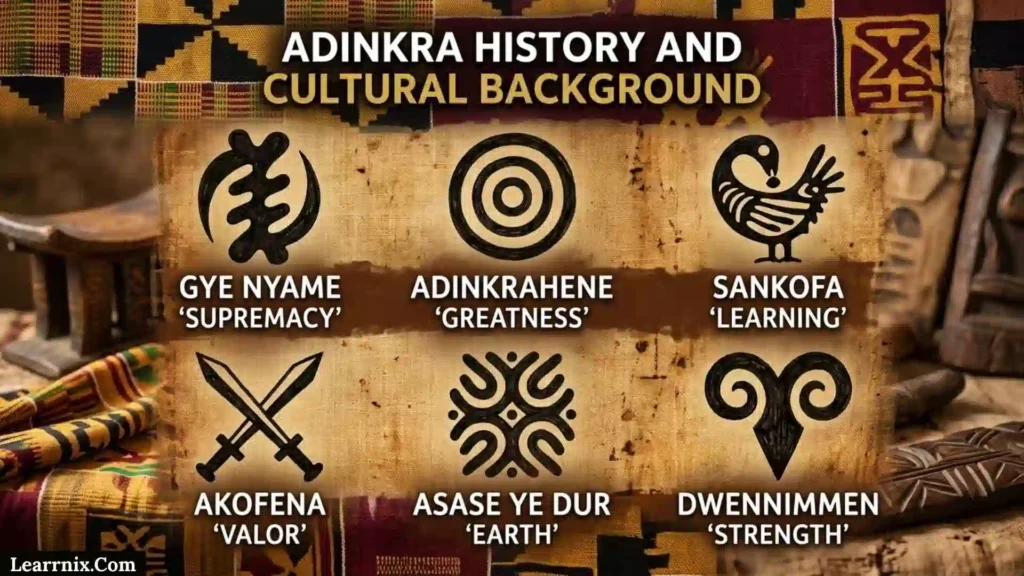
Adinkra is closely associated with Akan cultures of West Africa and has a particularly strong historical connection with Ghana and the Asante tradition.
The British Museum’s collections include Adinkra stamps identified as Asante and made in Ghana, including examples dating to the 19th and early 20th centuries.
Where Did Adinkra Originate?
The history of Adinkra is sometimes explained through an Asante tradition involving Nana Kofi Adinkra, associated in oral and educational accounts with the Gyaman kingdom.
The Boston University African Studies Center describes an Asante/Ashanti account in which Adinkra is associated with the idea of saying goodbye and connects the tradition with the Gyaman ruler Nana Kofi Adinkra. The same source explains that Adinkra cloth was historically associated with funerary use but later became appropriate for many different occasions.
Because this history includes oral tradition and later historical interpretation, it is better to describe the story as a traditional historical account rather than presenting every detail of the legend as an independently established fact.
What Does the Word Adinkra Mean?
Adinkra is commonly explained in relation to parting, separation, or saying goodbye.
The Boston University African Studies Center gives the Akan-language explanation “saying goodbye” when people part.
This association helps explain the historical connection between Adinkra cloth and funerary settings.
However, Adinkra should not be treated as exclusively funeral-related today. The British Museum documents lighter or “Sunday” Adinkra cloth associated with festive occasions and everyday wear, showing that the tradition developed beyond mourning contexts.
Adinkra and Akan Culture
Akan is a major language and cultural grouping in West Africa. The British Museum classifies Akan as a major language group and separately identifies Asante within the Akan cultural context.
This distinction matters when discussing Adinkra.
Calling Adinkra simply an “African symbol system” loses important cultural information. A more precise description is that Adinkra is associated with Akan cultural traditions, especially the Asante tradition in Ghana.
Also Check This Post: 67+ Care Instruction Symbols: Complete Washing and Drying Guide
How Adinkra Cloth Is Traditionally Made
The connection between Adinkra symbols and textiles is central to understanding the tradition.
A traditional Adinkra stamp can be carved from dried gourd or calabash. The British Museum has documented such stamps and describes examples made from gourd, wood, and cotton.
How the Stamps Work
The basic process involves creating a raised or carved design that can be used to apply dye to fabric.
Traditional production can involve:
- Preparing the cloth.
- Dividing the cloth into sections or fields.
- Preparing a carved stamp.
- Applying dye to the stamp.
- Pressing the stamp onto the cloth.
- Repeating the design to create a larger pattern.
- Combining different symbols or borders where appropriate.
The British Museum’s documentation describes cloth being divided into rectangular or square fields, with stamps repeatedly applied within those areas.
What Is the Traditional Adinkra Dye?
Traditional Adinkra production has involved a dark dye made from plant material.
The British Museum’s documentation describes a dye associated with the bark of the badie tree and notes that it was prepared with iron-rich material to produce a dark mixture used for stamping.
This production method is important because Adinkra is not simply a collection of isolated symbols. The symbol, cloth, stamping process, material, and cultural setting are all part of the tradition.
Adinkra Symbols and Meanings
The following symbols are among the best-known examples associated with Adinkra.
Because translations can vary, the descriptions below focus on meanings documented by museum and academic sources rather than treating every internet definition as definitive.
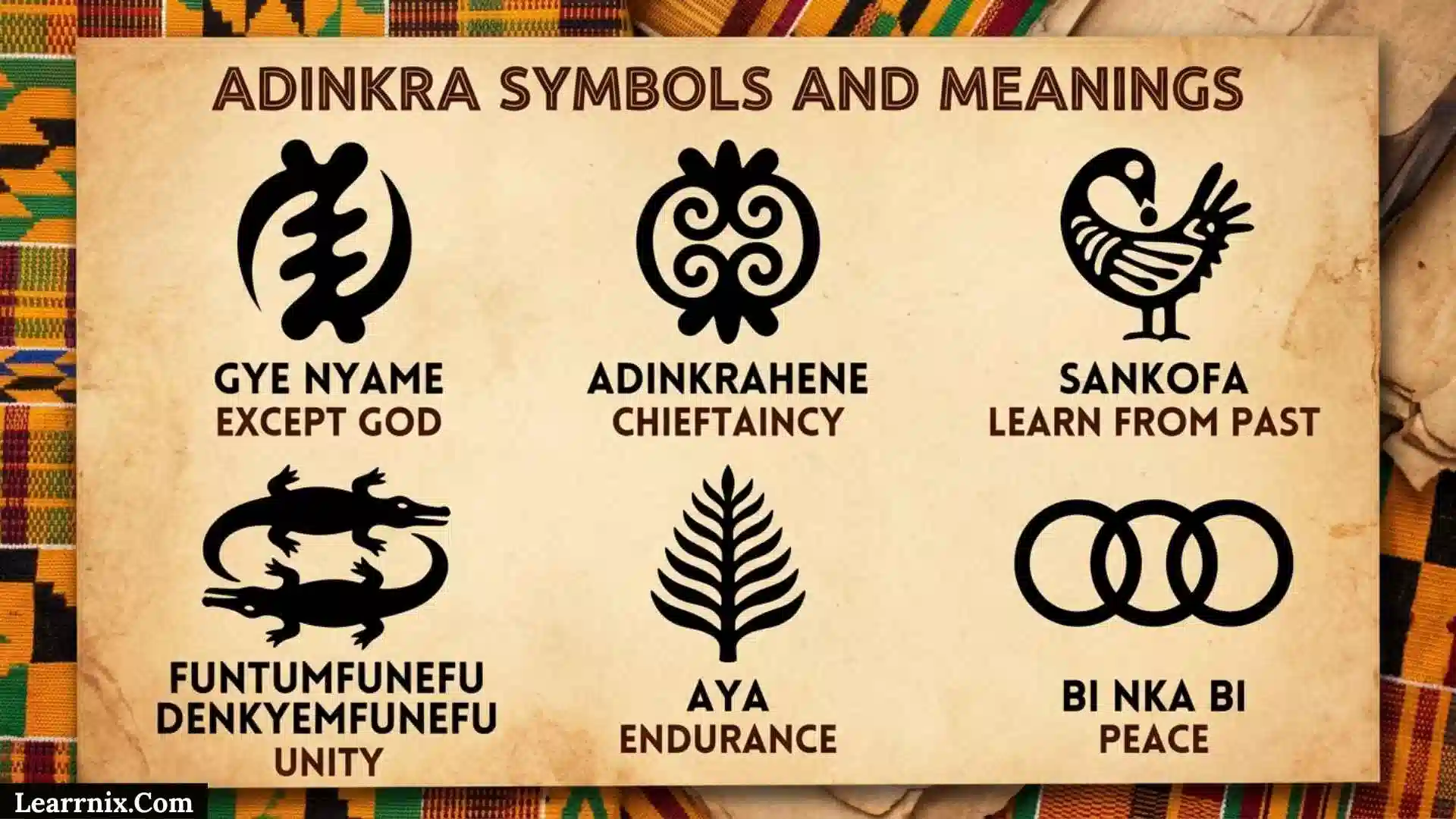
Gye Nyame Supremacy of God
Common meaning: Supremacy or greatness of God.
Gye Nyame is one of the most recognizable Adinkra symbols.
It is strongly associated with faith in God’s supreme power. The British Museum has documented the symbol on Ghanaian textile and identifies Gye Nyame with the supremacy of God.
What Does Gye Nyame Represent?
Gye Nyame can communicate ideas related to:
- Faith
- God’s supremacy
- Divine authority
- Spiritual dependence
- Humility before God
If someone is looking specifically for an Adinkra symbol connected with faith or divine power, Gye Nyame is one of the most relevant symbols to research.
Sankofa Learning From the Past
Common meaning: Returning to the past to retrieve valuable knowledge.
Sankofa is one of the most widely recognized Akan concepts internationally.
The idea encourages people to look backward when something valuable has been forgotten or left behind, so that knowledge from the past can help shape the future.
What Does Sankofa Teach?
Sankofa is commonly connected with:
- Learning from history
- Remembering one’s roots
- Recovering knowledge
- Cultural preservation
- Lifelong learning
- Improving the future through past lessons
The University at Buffalo’s Africana Studies program describes Sankofa in relation to lifelong learning and the pursuit of knowledge.
Why Is Sankofa Different From Simply “Remembering the Past”?
The important idea is not merely nostalgia.
Sankofa suggests that the past can contain something useful that should be recovered and applied.
For example, a student researching family history might use the idea of Sankofa to understand how earlier generations’ experiences can inform decisions today.
Adinkrahene King of Adinkra Symbols
Common meaning: Leadership, greatness, charisma, or excellence.
Adinkrahene is commonly translated as “King of Adinkra.”
The British Museum identifies the design as Adinkrahene in Twi and describes its concentric circles as representing an encompassing quality.
What Does Adinkrahene Represent?
It is commonly associated with:
- Leadership
- Greatness
- Charisma
- Influence
- Excellence
A useful way to understand it is as a symbol connected with leadership and prominence rather than simply physical power.
Dwennimmen Ram’s Horns
Common meaning: Strength combined with humility.
Dwennimmen, also written as Dwan Mmen in some museum documentation, refers to the horns of a ram.
The British Museum notes that the ram’s strength is associated with its heart rather than simply its horns.
Why Is Dwennimmen Important?
Its symbolism provides a useful lesson about balanced strength.
A person can be strong without being arrogant.
The concept can therefore be connected with:
- Strength
- Humility
- Character
- Self-control
- Responsible leadership
This makes Dwennimmen different from symbols that focus primarily on bravery or military power.
Duafe Wooden Comb
Common meaning: Beauty, care, cleanliness, and qualities associated with femininity.
Duafe is traditionally represented by a wooden comb.
The object itself provides an important clue to the symbolism: a comb is connected with grooming and personal care.
What Does Duafe Represent?
Common explanations associate it with ideas such as:
- Beauty
- Cleanliness
- Grooming
- Care
- Patience
- Feminine qualities
When using Duafe, it is important not to reduce its meaning to modern ideas of physical beauty. The broader cultural context includes character and care.
Akoben War Horn
Common meaning: Vigilance, readiness, and alertness.
Akoben refers to a war horn.
The British Museum identifies Akoben as a war horn and associates it with vigilance and wariness.
When Is Akoben a Useful Symbol?
Akoben fits messages about:
- Staying alert
- Preparing for challenges
- Responsibility
- Readiness
- Vigilance
For example, someone creating an educational poster about preparedness could find the concept more appropriate than a symbol specifically associated with physical courage.
Akofena — Crossed Swords
Common meaning: Courage, bravery, authority, and legitimate power.
Akofena is associated with swords.
The sword is a powerful image because it connects with authority, defense, warfare, and leadership.
What Does Akofena Represent?
It can communicate:
- Courage
- Bravery
- Heroism
- Authority
- Leadership
- Defense
If the intended message is specifically bravery, Akofena is generally a better conceptual match than choosing a symbol simply because its design looks powerful.
Aya — Fern
Common meaning: Endurance, resilience, and independence.
Aya is associated with the fern.
The fern’s ability to grow in challenging conditions provides the basis for its symbolic associations.
Why Choose Aya?
Aya can represent someone who has endured difficulties without giving up.
It is therefore particularly relevant to:
- Resilience
- Independence
- Perseverance
- Endurance
- Inner strength
This is different from Akofena. Akofena emphasizes courage and authority, while Aya is more closely associated with enduring difficulty.
Nyansapo — Wisdom Knot
Common meaning: Wisdom, intelligence, ingenuity, and patience.
Nyansapo is often called the wisdom knot.
The University at Buffalo identifies Nyansapo with wisdom, ingenuity, intelligence, and patience.
What Does Nyansapo Represent?
It can communicate:
- Wisdom
- Intelligence
- Patience
- Experience
- Cleverness
- Good judgment
- Problem-solving
For an education-related project, Nyansapo may be more appropriate than a symbol associated primarily with leadership.
Mate Masie — “What I Hear, I Keep”
Common meaning: Wisdom, knowledge, prudence, and understanding.
Mate Masie is another symbol connected with knowledge.
The University of Michigan’s African and African American Studies resource explains the phrase as “What I hear, I keep” and connects it with wisdom, knowledge, prudence, and understanding.
How Is Mate Masie Different From Nyansapo?
Both can relate to wisdom, but their emphasis can differ.
Nyansapo → wisdom, intelligence, ingenuity, patience.
Mate Masie → listening, understanding, retaining knowledge, and prudence.
That distinction can help when choosing a symbol for a particular message.
Nea Onnim No Sua A, Ohu — Learning Through Education
Common meaning: Someone who does not know can learn through education.
This proverb emphasizes continued learning.
The University of Michigan resource describes it as a symbol of knowledge, lifelong education, and the continued pursuit of knowledge.
Why Is This Symbol Relevant Today?
Its message fits modern education particularly well.
It can be connected with:
- School
- Learning
- Curiosity
- Self-improvement
- Lifelong education
- Intellectual growth
It also demonstrates an important point: Adinkra symbolism is not limited to simple one-word concepts. Some symbols express complete ideas or proverbs.
Mpatapo — Knot of Reconciliation
Common meaning: Reconciliation, peace-making, and conflict resolution.
Mpatapo represents the idea of bringing people together after disagreement.
What Does Mpatapo Teach?
It can represent:
- Peace
- Reconciliation
- Unity
- Forgiveness
- Conflict resolution
- Agreement
This makes it particularly useful for discussions about community relationships.
For example, if a community organization is creating educational material about resolving disagreements, Mpatapo communicates a more specific message than a generic “peace” symbol.
Fawohodie — Freedom
Common meaning: Freedom and independence.
Fawohodie is commonly associated with freedom.
The University at Buffalo identifies it as a symbol of freedom.
What Does Fawohodie Represent?
It can communicate:
- Freedom
- Independence
- Liberty
- Self-determination
- Emancipation
This makes it one of the symbols most directly relevant to the concept of personal or collective freedom.
Eban — Fence
Common meaning: Safety, security, protection, and love.
Eban represents a fence around a home.
The University of Michigan explains that a fenced home can symbolize separation and security for the family, with the symbolism extending to safety and security found in love.
What Does Eban Represent?
Eban can be associated with:
- Family
- Home
- Protection
- Security
- Safety
- Love
This makes it particularly useful when the intended message is about protecting the home rather than simply expressing romantic love.
Akoma — Heart
Common meaning: Patience, tolerance, endurance, and love.
Akoma is represented by the heart.
While a heart is commonly associated with love in many cultures, the Adinkra concept can extend into patience, tolerance, and endurance.
Why Is Akoma More Than a Love Symbol?
Strong relationships require more than affection.
Patience and tolerance are part of maintaining relationships through difficult periods.
That makes Akoma useful for messages about:
- Love
- Patience
- Tolerance
- Endurance
- Relationships
Osram Ne Nsoromma — Moon and Star
Common meaning: Faithfulness, relationship, and submission to God.
Osram Ne Nsoromma means “the moon and the stars.”
The British Museum identifies this symbol and explains its meaning in connection with submission to God and faithfulness.
What Does Osram Ne Nsoromma Represent?
Depending on the context in which it is discussed, it can relate to:
- Faithfulness
- Love
- Relationships
- Spiritual devotion
- Harmony
This is a good example of why online lists should not reduce every Adinkra symbol to a single English word.
Boa Me Na Me Mmoa Wo — Mutual Help
Common meaning: Cooperation and mutual assistance.
The phrase communicates a reciprocal idea: help me and let me help you.
What Does It Represent?
It can express:
- Cooperation
- Teamwork
- Community
- Mutual support
- Solidarity
- Reciprocity
This is particularly relevant when the intended message involves a group rather than an individual.
Nkyinkyim — Adaptability and Initiative
Common meaning: Adaptability, initiative, and the changing nature of life.
Nkyinkyim has a twisting or winding visual character.
Its form can be interpreted in relation to life’s changing circumstances.
What Does Nkyinkyim Teach?
It encourages ideas such as:
- Adaptability
- Initiative
- Flexibility
- Resilience
- Facing uncertainty
For someone looking for a symbol representing personal growth through change, Nkyinkyim may be more appropriate than a symbol focused specifically on strength.
Mmere Dane — Time Changes
Common meaning: Change and the passage of time.
Mmere Dane expresses the idea that circumstances change.
Why Does This Symbol Matter?
The concept can be useful when discussing:
- Change
- Transformation
- Time
- Growth
- Adaptation
- New circumstances
Its message can be especially meaningful when someone wants to express the idea that difficult or successful periods do not last forever.
Adinkra Symbols and Meanings: Comparison Table
| Adinkra symbol | Commonly associated meaning | Best fit for |
| Gye Nyame | Supremacy of God | Faith and spirituality |
| Sankofa | Learning from the past | History and knowledge |
| Adinkrahene | Leadership and greatness | Leadership |
| Dwennimmen | Strength with humility | Character and leadership |
| Duafe | Beauty, care, grooming | Care and feminine qualities |
| Akoben | Vigilance and readiness | Preparedness |
| Akofena | Courage and authority | Bravery |
| Aya | Endurance and independence | Resilience |
| Nyansapo | Wisdom and intelligence | Education and judgment |
| Mate Masie | Understanding and prudence | Listening and knowledge |
| Nea Onnim No Sua A, Ohu | Learning and education | Lifelong learning |
| Mpatapo | Reconciliation | Peace and conflict resolution |
| Fawohodie | Freedom | Independence |
| Eban | Security and protection | Family and home |
| Akoma | Patience and love | Relationships |
| Osram Ne Nsoromma | Faithfulness and spiritual meaning | Relationships and faith |
| Boa Me Na Me Mmoa Wo | Mutual assistance | Community and teamwork |
| Nkyinkyim | Adaptability | Change and resilience |
| Mmere Dane | Change over time | Transformation |
Also Check This Post: 83+ Lord of the Rings Symbols Explained: From Rings to Runes
Adinkra Symbols by Meaning
Searching for the desired message is often easier than trying to memorize dozens of symbol names.
Adinkra Symbols for Wisdom
The strongest options to research include:
- Nyansapo — wisdom, intelligence, patience, and ingenuity.
- Mate Masie — understanding, knowledge, listening, and prudence.
- Nea Onnim No Sua A, Ohu — education and lifelong learning.
- Sankofa — learning from the past.
The best choice depends on the exact message.
If you want wisdom, Nyansapo is a natural choice.
If you want to learn from history, Sankofa is more specific.
If you want education and lifelong learning, Nea Onnim No Sua A, Ohu is particularly relevant.
Adinkra Symbols for Strength
Consider:
- Dwennimmen for strength balanced with humility.
- Aya for endurance and resilience.
- Akofena for courage and authority.
- Akoben for preparedness and vigilance.
These should not be treated as interchangeable. Each communicates a different form of strength.
Adinkra Symbols for Love and Relationships
Relevant symbols include:
- Akoma — love, patience, tolerance, and endurance.
- Osram Ne Nsoromma — faithfulness and relationship-related symbolism.
- Eban — security and protection associated with home and love.
Choosing among them depends on whether your focus is affection, loyalty, family security, or endurance.
Adinkra Symbols for Family
Eban is particularly relevant to family protection and security.
If your message is about cooperation among relatives, a symbol connected with mutual support may be more appropriate.
This illustrates an important principle: “family” is not always the same message as “protection.”
Adinkra Symbols for Freedom
Fawohodie is the clearest symbol in this guide for the concept of freedom.
It can be relevant to themes of independence, liberty, emancipation, and self-determination.
Adinkra Symbols for Peace and Unity
For reconciliation:
Mpatapo
For mutual support:
Boa Me Na Me Mmoa Wo
For patience and tolerance:
Akoma
These provide different ways to express peaceful relationships.
How to Choose the Right Adinkra Symbol
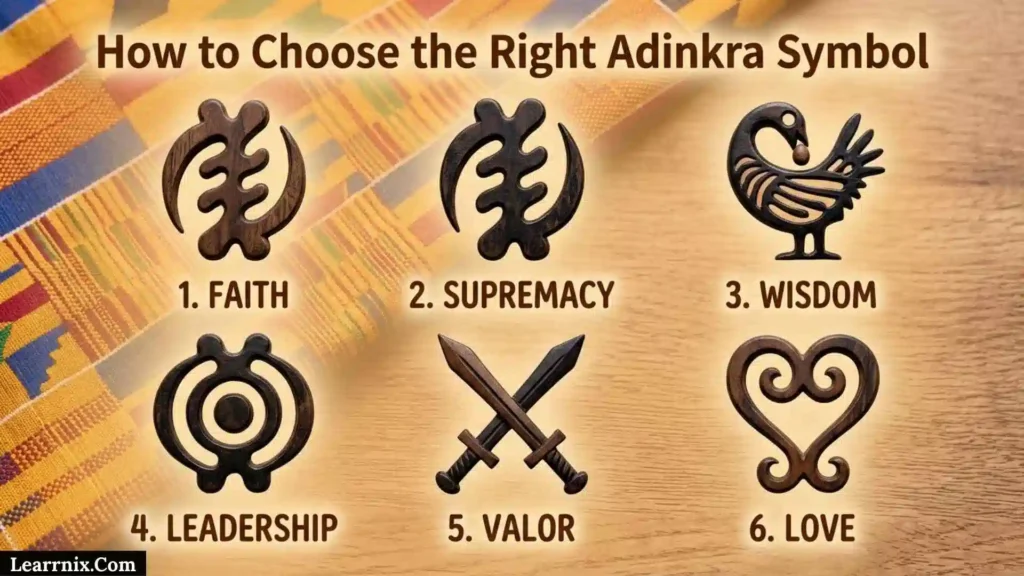
The most useful approach is to choose the meaning first and the design second.
Step 1: Define Your Exact Message
Ask yourself:
“What do I want this symbol to communicate?”
Do you mean:
- Courage?
- Physical strength?
- Emotional resilience?
- Wisdom?
- Education?
- Family protection?
- Romantic love?
- Freedom?
- Faith?
- Reconciliation?
Do not stop at a broad word if you can be more specific.
Step 2: Match the Meaning
Use the comparison table to identify symbols that fit your intended message.
Step 3: Check the Cultural Context
Look at more than one source.
Museum and university resources can be especially useful because they provide cultural context rather than merely reproducing symbol charts.
Step 4: Check the Original Name
Adinkra names may appear in different spellings when transliterated into English.
For example, museum documentation may use forms such as Dwan Mmen, while other educational resources may use Dwennimmen.
Different spellings do not automatically mean that the symbols are unrelated.
Step 5: Consider the Purpose
Ask where the symbol will appear:
- Educational project
- Clothing
- Jewelry
- Artwork
- Tattoo
- Logo
- Home decoration
- Memorial
- Cultural event
The context affects how the symbol may be understood.
A Simple Adinkra Symbol Decision Tree
Use this quick guide when you already know the message you want.
Do you want a symbol about faith?
↓ Yes
Gye Nyame → strongest match for God’s supremacy.
↓ No
Do you want to express learning from history?
↓ Yes
Sankofa → strongest match.
↓ No
Do you want wisdom or intelligence?
↓ Yes
Nyansapo → wisdom and intelligence.
↓ No
Do you want courage or bravery?
↓ Yes
Akofena → courage and authority.
↓ No
Do you want resilience or endurance?
↓ Yes
Aya → endurance and independence.
↓ No
Do you want strength with humility?
↓ Yes
Dwennimmen → strength balanced with humility.
↓ No
Do you want freedom?
↓ Yes
Fawohodie → freedom and independence.
↓ No
Do you want reconciliation?
↓ Yes
Mpatapo → peace-making and reconciliation.
↓ No
Do you want family protection?
↓ Yes
Eban → safety and security within the home.
This is more reliable than selecting a symbol based only on how attractive its shape looks.
Traditional and Modern Uses of Adinkra
Adinkra has changed in use over time while retaining its symbolic importance.
Adinkra Cloth and Ceremonial Use
Historical Adinkra cloth has strong associations with funerary and ceremonial contexts.
However, the British Museum specifically documents different forms of Adinkra cloth, including lighter “Sunday” cloth suitable for festive occasions and everyday wear.
This is an important correction to the common idea that all Adinkra cloth is funeral cloth.
Clothing and Fashion
Modern Adinkra designs appear on clothing and textiles.
The University of Oregon’s Ghana cultural resource notes that Adinkra symbols have entered popular culture and can appear on clothing and jewelry.
The symbols therefore function in both cultural and contemporary fashion contexts.
Jewelry and Personal Items
Individual symbols can be used on:
- Pendants
- Bracelets
- Rings
- Bags
- Decorative objects
The most meaningful use is one where the person understands the concept represented by the symbol.
Education and Public Culture
Universities and educational organizations use Adinkra symbols as tools for teaching culture, values, history, and community.
Boston University, for example, provides an educational activity using Adinkra symbols to explore cultural meanings and connect those ideas with students’ lives.
This shows that Adinkra is not only an art topic. It can also be used as a framework for teaching cultural values and visual communication.
Common Misconceptions About Adinkra Symbols
“Adinkra Symbols Are Just Decorative African Patterns”
This is incomplete.
Adinkra designs can be visually attractive, but their traditional role includes communicating ideas and cultural values.
“Every Adinkra Symbol Has One Exact English Translation”
Not necessarily.
A symbol’s name, proverb, cultural context, and English translation may not fit neatly into one word.
Museum documentation itself notes that the meanings of Adinkra designs have been a subject of controversy and interpretation.
“All Adinkra Is Funeral Clothing”
No.
Funerary use is historically important, but museum records also document lighter Adinkra cloth used for festive and everyday contexts.
“All African Symbols Are Adinkra”
No.
Africa contains many different cultures and symbolic traditions.
Adinkra belongs specifically to Akan cultural traditions and is strongly associated with Ghana and the Asante tradition.
“The Symbol’s Shape Is Its Entire Meaning”
Not necessarily.
A visual shape can relate to the name or object behind a symbol, but understanding the associated proverb, value, or cultural idea gives a much fuller interpretation.
The British Museum notes that Adinkra designs can relate visually to their names, including objects such as combs, swords, horns, and other familiar forms.
Common Mistakes When Using Adinkra Symbols
Choosing a Symbol Only Because It Looks Good
A beautiful design may communicate a completely different idea from the one you intended.
Better approach: Decide on the message first.
Copying a Random Meaning Chart
Many online charts repeat simplified meanings without cultural context.
Better approach: Compare museum, university, and scholarly resources.
Treating “African” as a Sufficient Cultural Label
Calling every Adinkra design an “African symbol” removes its specific Akan identity.
Better approach: Identify the tradition accurately as Akan/Adinkra where appropriate.
Ignoring Translation Variations
A symbol name can appear in different spellings.
Better approach: Check alternate spellings and the original cultural terminology before concluding that two names refer to different symbols.
Inventing a New Traditional Meaning
A modern artist may create a personal interpretation, but that should not be presented as the traditional meaning.
Better approach: Clearly distinguish between established cultural meaning and modern artistic interpretation.
How to Use Adinkra Symbols Respectfully
Cultural appreciation begins with accuracy.
Research the Symbol Before Using It
At minimum, check:
- Original name
- Meaning
- Cultural association
- Historical context
- Common variations in spelling
- Traditional use
Distinguish Traditional Meaning From Personal Meaning
It is perfectly possible to choose a symbol because it personally inspires you.
The important point is to avoid claiming that your personal interpretation is the traditional Akan meaning if it is not.
Be Especially Careful With Commercial Designs
If Adinkra imagery is being used for commercial branding, products, or mass-produced merchandise, cultural representation deserves additional thought.
A design can be legally usable in one context while still being culturally insensitive in another.
Give Proper Cultural Context
For educational or public-facing work, identify the tradition clearly.
Instead of simply saying:
“An African symbol for wisdom”
a more informative description is:
“An Akan Adinkra symbol associated with wisdom and intelligence.”
That small change provides substantially better cultural information.
Adinkra Symbols vs. Other African Symbol Systems
Adinkra should not be treated as a universal African writing system.
Adinkra vs. African Symbols
“Adinkra symbols” refers to a specific Akan visual tradition.
“African symbols” is a broad category that can include symbolic traditions from many different peoples across Africa.
Adinkra vs. Written Language
Adinkra symbols can communicate ideas, but they should not automatically be described as an alphabet or a direct replacement for written sentences.
Their function is better understood as visual communication through symbols, names, proverbs, values, and cultural associations.
Adinkra vs. Modern Logos
A modern logo may be designed primarily for brand recognition.
An Adinkra symbol carries cultural associations that existed independently of modern branding.
That distinction matters when adapting traditional symbols for contemporary design.
Why Adinkra Symbols Remain Relevant Today
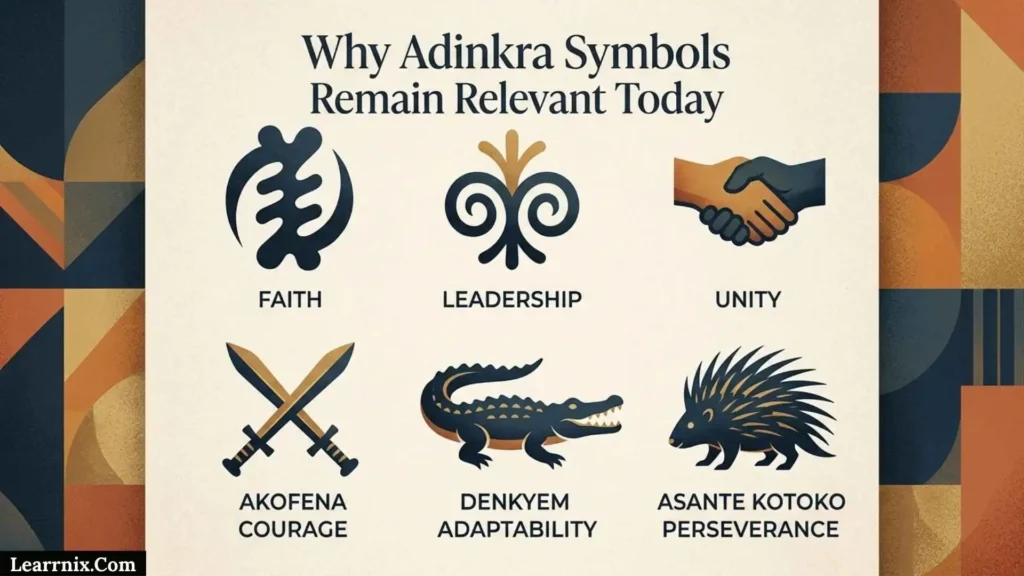
The continued interest in Adinkra is not difficult to understand.
Ideas such as wisdom, courage, family, freedom, resilience, faith, cooperation, and learning remain relevant across generations.
But their modern popularity should not erase their cultural origins.
The strongest way to appreciate Adinkra is to understand both sides:
Visual design + cultural meaning
A symbol becomes much more meaningful when the viewer knows the concept behind it.
Key Takeaways About Adinkra Symbols
Before choosing or using an Adinkra symbol, remember these points:
- Adinkra is strongly associated with Akan cultures of West Africa.
- Ghana, especially the Asante tradition, is central to its history.
- Adinkra symbols communicate ideas, values, proverbs, and cultural concepts.
- Traditional Adinkra cloth is produced using stamped designs.
- Many stamps are carved from gourd or calabash.
- Adinkra historically had important funerary uses but is not limited to funerals.
- Gye Nyame is associated with God’s supremacy.
- Sankofa emphasizes learning from the past.
- Nyansapo is associated with wisdom and intelligence.
- Akofena is associated with courage and authority.
- Aya is associated with endurance and resilience.
- Fawohodie represents freedom.
- Mpatapo represents reconciliation.
- Eban is associated with safety and protection.
- Akoma is associated with patience, tolerance, endurance, and love.
- Symbol meanings should be researched in cultural context.
- Different spellings and English translations can occur.
- Not every “African symbol” is an Adinkra symbol.
- Modern personal interpretations should not be presented as traditional meanings without evidence.
Frequently Asked Questions About Adinkra Symbols
What are Adinkra symbols and what do they mean?
Adinkra symbols are visual symbols associated with Akan cultures, particularly in Ghana. They communicate concepts such as wisdom, faith, courage, leadership, freedom, love, reconciliation, protection, and learning. Individual meanings depend on the symbol and its cultural context.
What is the most famous Adinkra symbol?
Gye Nyame is among the most widely recognized Adinkra symbols. It is associated with the supremacy or greatness of God and appears frequently in Ghanaian cultural and textile contexts.
What does Sankofa mean?
Sankofa expresses the idea of returning to the past to recover something valuable that can help guide the future. It is commonly connected with learning, history, cultural memory, and lifelong knowledge.
Which Adinkra symbol means wisdom?
Nyansapo is commonly associated with wisdom, intelligence, ingenuity, and patience. Mate Masie is also connected with understanding, knowledge, listening, and prudence.
Which Adinkra symbol represents strength?
Several symbols can relate to strength, but they emphasize different qualities. Dwennimmen connects strength with humility, while Aya emphasizes endurance and resilience.
What Adinkra symbol represents courage?
Akofena is associated with courage, bravery, authority, and the symbolism of swords.
What Adinkra symbol means freedom?
Fawohodie is commonly identified with freedom and independence.
What Adinkra symbol represents peace?
Mpatapo is associated with reconciliation and peace-making. It is particularly useful when the intended meaning involves resolving conflict rather than simply expressing peacefulness.
What Adinkra symbol represents family?
Eban is strongly associated with security and protection within the home. Its fence imagery connects with the idea of protecting the family from outside threats.
What Adinkra symbol represents love?
Akoma is associated with love as well as patience, tolerance, and endurance. Osram Ne Nsoromma can also relate to faithfulness and relationships.
Are Adinkra symbols religious?
Some have strong spiritual meanings, particularly symbols associated with God, but Adinkra as a whole covers much more than religion. It includes ideas about education, leadership, relationships, courage, community, peace, and everyday life.
Are Adinkra symbols only from Ghana?
Adinkra is strongly associated with Ghana and Akan cultural traditions, particularly the Asante tradition. Akan cultural communities also extend across the Ghana–Côte d’Ivoire region, so the history should not be reduced to modern national borders alone.
Can I use an Adinkra symbol for a tattoo?
A person can choose an Adinkra symbol for contemporary personal expression, but the symbol should be researched carefully first. The most important consideration is knowing its actual cultural meaning rather than selecting a design based only on appearance.
Why do Adinkra symbols have different spellings online?
Akan words can be transliterated or represented differently in English-language sources. Museum and educational resources may therefore use slightly different spellings. Checking the source and context is more reliable than assuming every spelling variation represents a different symbol.
Are Adinkra symbols a form of African writing?
They are better understood as a system of visual symbols associated with cultural ideas, proverbs, values, and messages rather than simply as an alphabet. Their role is broader and different from ordinary written language.
Conclusion
Adinkra symbols are a rich part of Akan cultural heritage and offer a visual way to communicate ideas about life, character, faith, relationships, leadership, knowledge, community, and change.
Symbols such as Gye Nyame, Sankofa, Adinkrahene, Dwennimmen, Akoben, Akofena, Aya, Nyansapo, Mpatapo, Fawohodie, Eban, and Akoma demonstrate how different objects, shapes, names, and proverbs can carry cultural meaning.
The most important lesson is that Adinkra symbols should be understood through context, not appearance alone. A symbol that looks like a good representation of strength may actually communicate humility, vigilance, wisdom, or another idea.
If you are choosing an Adinkra design for a tattoo, piece of jewelry, clothing, artwork, educational project, memorial, or modern design, begin with the message you want to communicate. Then verify the symbol’s name and meaning through reliable cultural, museum, or academic sources.
Adinkra remains valuable today because its central ideas continue to speak to modern life while preserving a connection to Akan history and cultural knowledge.
Also Check This Post: 87+ Subaru Dashboard Symbols and Meanings: What Do They Mean?

I am Michael Carter, an educational content creator who believes that knowledge has the power to transform lives.
I create resources focused on modern education, digital learning, and building essential skills for the future.
I love helping readers discover simple and effective ways to improve their learning journey.
Books by Michael Carter:
- Modern Education for Tomorrow’s World
- Learning Skills for Future Success
 Charlotte Anderson