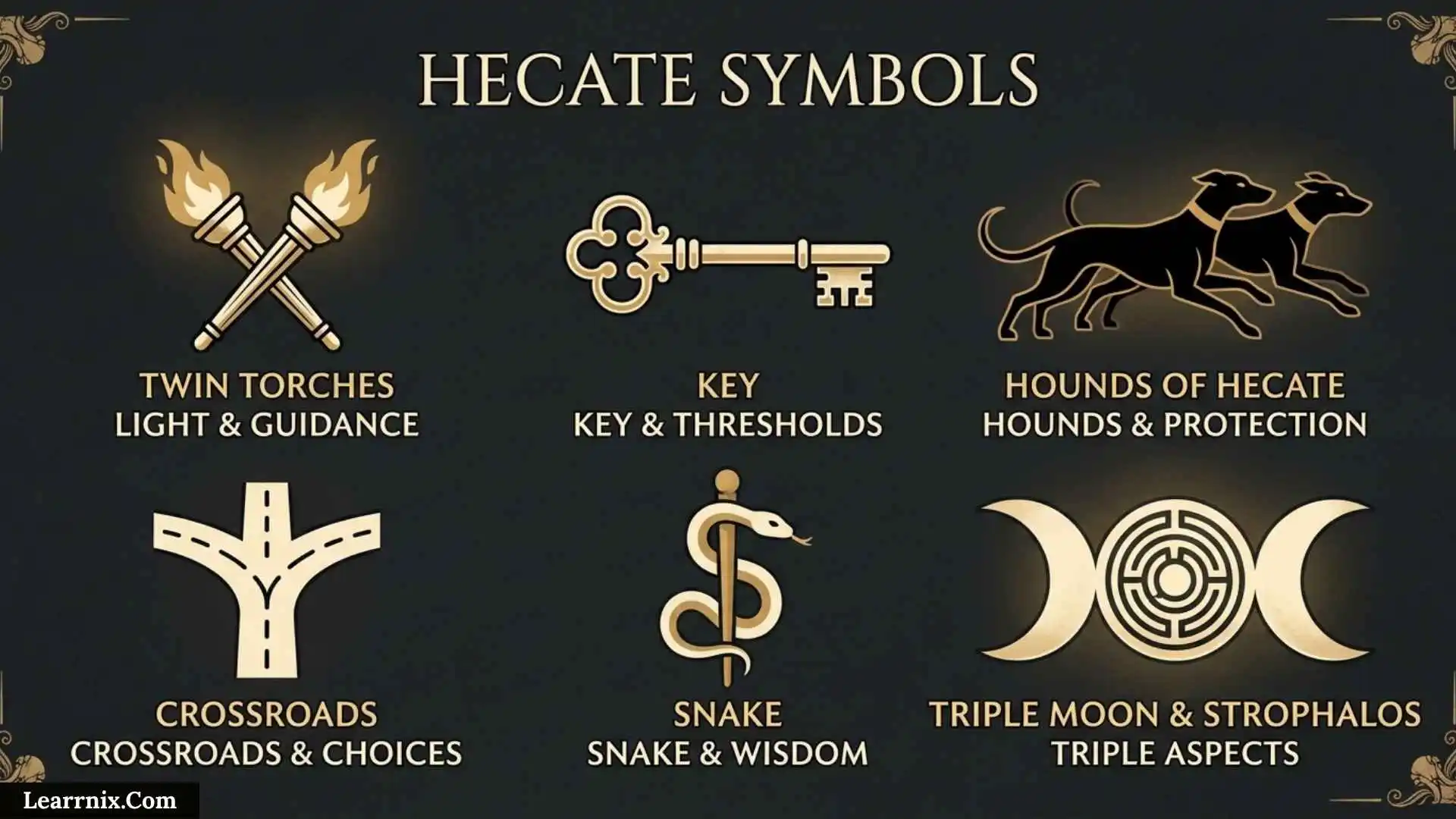
Hecate is associated with some of the most recognizable symbols in Greek mythology and ancient religion. Torches, keys, dogs, crossroads, serpents, and triple-bodied images are all commonly linked with her. Yet these associations do not all have the same historical evidence.
That distinction matters. A symbol may be well established in ancient Greek literature, art, or religious practice, while another may come mainly from later traditions or modern interpretations.
This guide explains the major symbols of Hecate, what they mean, how strongly they are supported by historical evidence, and how to use them accurately in school projects, academic writing, artwork, or general research.
Quick Answer: What Are Hecate’s Main Symbols?
The symbols most commonly associated with Hecate include:
- Torches — guidance, light in darkness, and her role as a guide.
- Keys — access, guardianship, thresholds, and liminal spaces.
- Dogs — guardianship and important religious associations with the goddess.
- Crossroads — boundaries, transitions, and places of choice.
- Triple or three-formed imagery — her connection with multiple directions and liminal spaces.
- Serpents — associations found in some artistic and magical traditions.
- The strophalos or “Hecate’s Wheel” — strongly associated with modern Hecate symbolism, but requiring careful historical context.
The safest approach is to separate well-attested ancient associations from later or modern symbolic traditions.
Key Takeaways
- Hecate was an important goddess in ancient Greek religion whose roles changed and expanded over time.
- Ancient evidence strongly connects her with themes such as guidance, boundaries, crossroads, protection, the night, spirits, and transitions.
- Torches, dogs, crossroads, and three-formed representations are among her best-known traditional associations.
- Keys are an important symbol in later Greek religious and literary tradition and reflect her role as a guardian of boundaries and access.
- The moon is widely associated with Hecate today, but the modern “Triple Goddess” framework should not automatically be treated as a direct description of ancient Greek religion.
- The best way to study Hecate is to ask when, where, and in which source a particular symbol appears.
Understanding Hecate Before Interpreting Her Symbols
Hecate, also spelled Hekate, was a goddess in ancient Greek religion whose character developed over many centuries. Her earliest major literary appearance is in Hesiod’s Theogony, where she is presented as a powerful goddess with honor and influence connected with the sky, earth, and sea. Later Greek and Roman traditions increasingly connected her with crossroads, the night, ghosts, magic, and the boundaries between different worlds.
This historical development explains why Hecate has so many symbols. There was not one fixed “symbol package” that remained unchanged throughout every period of Greek history. Instead, her imagery evolved.
An accurate guide should therefore distinguish between:
- Symbols clearly represented in ancient literature or art
- Symbols strongly associated with later Greek and Roman tradition
- Symbols found in magical or religious contexts
- Modern symbols and interpretations
That approach is especially important when researching Hecate for an essay, school project, historical artwork, tattoo design, novel, or mythology article.
The Most Important Symbols of Hecate
Torches: Light, Guidance, and the Search for Persephone
The torch is one of Hecate’s strongest and best-documented symbols.
In the Homeric Hymn to Demeter, Hecate appears with flaming torches and helps during the search for Persephone. Ancient artistic representations also frequently show her carrying paired torches.
The torches can be understood in several connected ways:
- Light during darkness
- Guidance through uncertain places
- Searching and finding
- Protection at night
- Movement between different realms
The symbolism is particularly meaningful because Hecate is associated with boundaries and transitions. Her torch does not simply represent “witchcraft.” In its ancient context, it can also represent guidance through darkness and the ability to move through uncertain or liminal spaces.
Practical example: If you are creating historically informed artwork about Hecate, a pair of torches is one of the safest and most recognizable choices.
Keys: Thresholds, Access, and Guardianship
Keys are another important symbol associated with Hecate.
Ancient and later religious traditions describe her as a key-bearer, and artistic evidence shows Hecate represented with a key among her attributes. The Orphic tradition includes an address to Hecate as a key-bearing figure, while surviving Greco-Roman reliefs also depict her with a key.
The key is often interpreted as representing:
- Access
- Guardianship
- Doorways
- Thresholds
- Movement between spaces
- The boundary between the known and unknown
A key should not automatically be interpreted as proof that Hecate was simply the “goddess of the underworld.” Her roles were broader and changed across traditions.
A more accurate interpretation is that the key fits her wider connection with thresholds, passage, guardianship, and boundaries.
Dogs: Guardians, Companions, and Ritual Associations
Dogs are strongly associated with Hecate in ancient and later sources.
Literary traditions connect her presence with the sound of barking or howling dogs, and ancient religious evidence also records dogs in rituals connected with her worship. Artistic representations can show Hecate accompanied by a dog.
The dog can therefore suggest:
- Guardianship
- Protection
- Awareness of approaching danger
- The boundary between ordinary and supernatural space
- Hecate’s connection with night and the dead
It is important not to romanticize or simplify ancient ritual practices. Historical references to animal sacrifice describe religious practices of particular times and places; they are not recommendations for modern behavior.
For a modern symbolic design, a dog can represent Hecate’s protective and boundary-crossing aspects without attempting to reproduce ancient rituals.
Crossroads: Choice, Boundaries, and Liminal Spaces
Crossroads are among Hecate’s most famous associations.
Ancient sources describe shrines and images of Hecate at roads, doorways, and crossing points. Her association with crossroads is closely connected with her role as a deity of boundaries and places “in between.”
A crossroads can symbolize:
- A decision
- A transition
- A boundary
- A meeting point
- Uncertainty
- Movement from one state to another
The deeper meaning is not merely “three roads equal three faces.” Hecate’s relationship with crossroads belongs to a larger religious pattern involving thresholds, entrances, roads, and protective images.
This makes the crossroads one of the most useful symbols for understanding Hecate as a liminal deity—a figure associated with places and moments that exist between established categories.
Triple-Formed Hecate
Hecate is often represented with three bodies or three faces facing different directions.
Ancient literary and archaeological evidence shows that triple-formed imagery became an important part of her iconography. Pausanias discusses the creation of joined three-form images, while surviving objects from the Roman period preserve elaborate triple representations.
Triple imagery may be understood in connection with:
- Multiple directions
- Crossroads
- Guardianship
- Different realms or spheres of activity
- The ability to face more than one direction
However, a common mistake is to assume that every ancient three-formed image represents the modern idea of the Maiden, Mother, and Crone.
That specific modern “Triple Goddess” framework should not automatically be projected backward onto ancient Greek religion. The ancient evidence for Hecate’s triple form has its own historical context.
Other Symbols Associated With Hecate
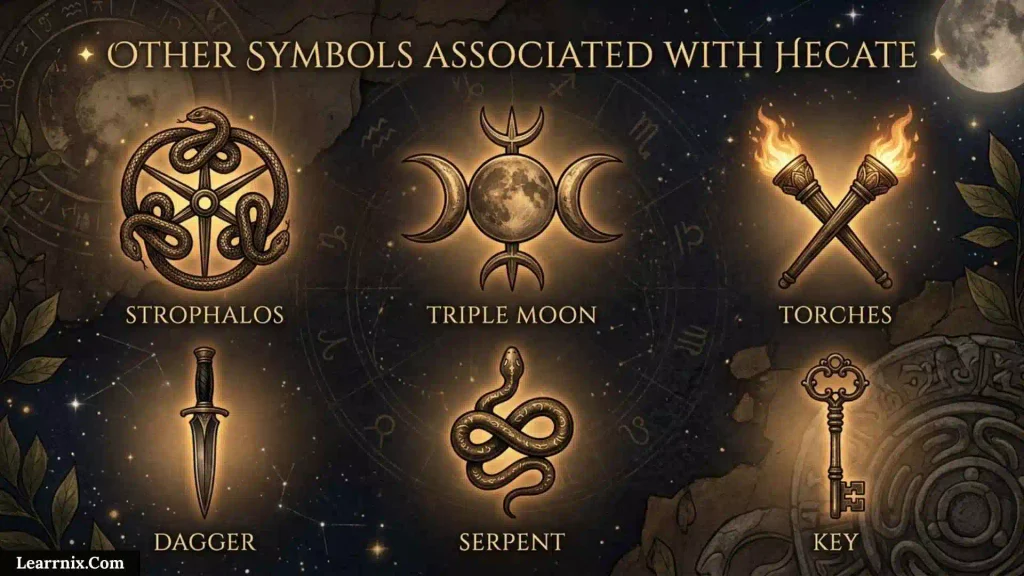
Serpents
Serpents appear among the attributes of some representations of Hecate.
For example, a Roman-period relief in the British Museum depicts triple-formed Hecate with several objects, including a serpent, while other surviving representations and magical traditions also connect serpentine imagery with her.
Possible symbolic connections include:
- Transformation
- Chthonic or earth-related powers
- Protection
- Ancient religious imagery
- Magical traditions
The evidence is more complex than for torches or crossroads. Therefore, when writing academically, it is better to say that serpents appear among Hecate’s known attributes in certain artistic and religious contexts rather than claiming that a snake was her single defining symbol.
Daggers and Other Ritual Attributes
Some surviving images of Hecate show her carrying objects such as daggers, whips, or other implements.
For example, museum objects depicting triple-formed Hecate preserve combinations of torches, daggers, keys, serpents, and other attributes.
These objects demonstrate an important point: Hecate’s iconography was not completely standardized.
The attributes could vary according to:
- Historical period
- Region
- Religious tradition
- Artistic convention
- The specific function being emphasized
For this reason, a historically accurate representation does not require every possible Hecate symbol at once.
The Moon
The moon is strongly associated with Hecate in many modern depictions.
Ancient and later traditions also connect Hecate with night and sometimes identify or associate her with lunar figures such as Selene and Artemis. However, scholars have debated how central lunar identity was to her earliest character.
Therefore, the most accurate description is:
Hecate developed important associations with night and lunar imagery, but reducing her entire ancient identity to that of a moon goddess oversimplifies her complex history.
For modern art or spiritual symbolism, a crescent or full moon may be appropriate. For strict historical reconstruction, however, torches, crossroads, and documented cult or artistic imagery may provide firmer evidence.
Hecate’s Wheel or Strophalos
The strophalos, often called “Hecate’s Wheel” in modern contexts, is one of the most recognizable symbols used in contemporary Hecate imagery.
However, this symbol requires special care.
Modern websites often present the wheel as though it were a universally established symbol used throughout ancient Greek worship of Hecate. The historical picture is more complicated.
For that reason, it is best to classify the strophalos separately:
| Symbol | Historical confidence | Best description |
| Torches | Very strong | Major ancient literary and artistic attribute |
| Crossroads | Very strong | Major cult and religious association |
| Dogs | Strong | Literary, ritual, and artistic association |
| Triple form | Strong | Important ancient and later iconography |
| Keys | Strong in later religious and artistic contexts | Symbol of access and guardianship |
| Serpents | Context-dependent | Appears in some artistic and magical representations |
| Moon | Important but historically complex | Ancient and later association, especially with night and identified goddesses |
| Hecate’s Wheel/Strophalos | Requires caution | Prominent in modern symbolism; historical claims should be sourced carefully |
The key lesson is simple: popularity in modern Hecate imagery is not automatically proof of widespread use in ancient Greek religion.
Hecate and the Meaning of Liminality
One of the best ways to understand Hecate’s symbols is through the idea of liminality.
A liminal space is a place, state, or moment that exists between established categories.
Examples include:
- A doorway between inside and outside
- A crossroads between different routes
- Twilight between day and night
- A journey between departure and arrival
- A transition between one stage of life and another
Hecate’s symbols repeatedly connect with these “in-between” spaces.
The key belongs to a threshold.
The torch provides light during uncertainty.
The crossroads represent multiple directions.
Dogs can function as guardians and warnings.
Her triple form faces different directions.
This pattern provides a useful framework for interpreting her iconography without reducing every symbol to “magic” or “witchcraft.”
Hecate, Magic, Ghosts, and the Underworld
Hecate is widely known today as a goddess of witchcraft and magic.
Ancient and later Greek traditions increasingly connected her with:
- Magic
- Spells
- Ghosts
- The dead
- Purification
- The night
- Crossroads
These associations are documented in literary and religious traditions, although Hecate’s earliest portrayal was broader than the modern stereotype of a “witch goddess.”
This historical development matters because it explains why symbols such as:
- Torches
- Dogs
- Keys
- Serpents
- Daggers
can appear together in later representations.
They reflect a complex goddess whose identity accumulated new associations over time.
Hecate Symbols: Ancient Evidence vs. Modern Interpretation
The following comparison helps readers use the right level of historical accuracy.
| Symbol or idea | Ancient evidence | Modern interpretation |
| Torches | Strongly documented | Guidance, illumination, spiritual direction |
| Crossroads | Strongly documented | Life choices and personal transformation |
| Dogs | Strongly documented | Protection and loyalty |
| Triple form | Strongly documented | Often linked with the modern Triple Goddess |
| Keys | Documented in religious and artistic traditions | Opening hidden knowledge or opportunities |
| Serpents | Appears in certain representations | Transformation and occult wisdom |
| Moon | Historically complex but associated in later traditions | Feminine power and lunar spirituality |
| Strophalos | Requires careful source evaluation | Widely used as Hecate’s modern sacred symbol |
This distinction is particularly useful for writers and artists.
A historical novel set in classical Athens should prioritize symbols supported by evidence from that period.
A modern fantasy novel can freely use later and contemporary interpretations, as long as it does not falsely claim that every detail comes directly from ancient Greece.
How to Choose the Right Hecate Symbol
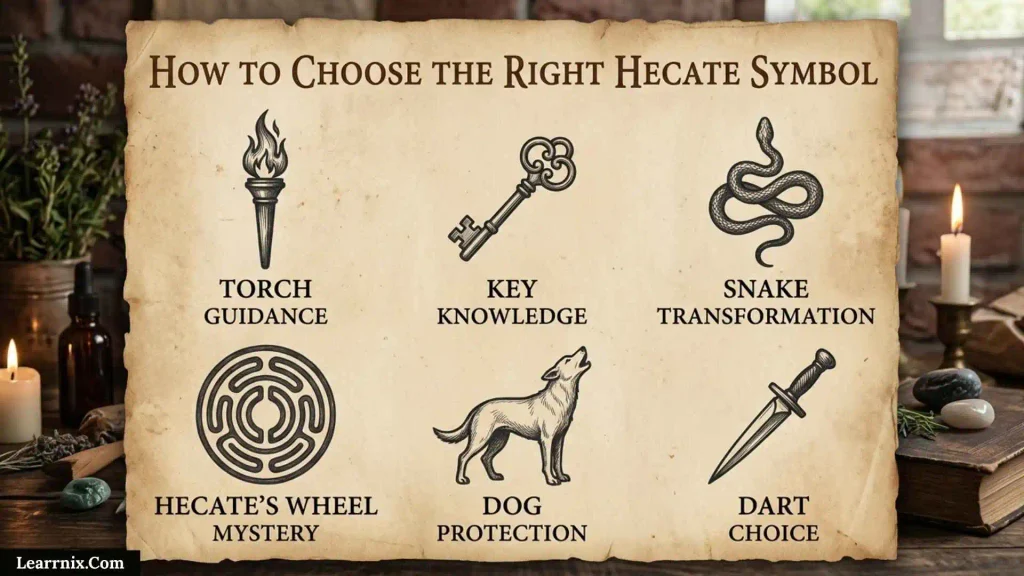
Use this simple decision guide.
Do you need historical accuracy?
↓
Yes
Choose symbols with strong ancient evidence:
- Torches
- Crossroads
- Dogs
- Triple-formed imagery
↓
Are you focusing on later Greek, Roman, or religious traditions?
Choose additional documented attributes such as:
- Keys
- Serpents
- Daggers
↓
Are you creating modern spiritual or artistic work?
You can also use:
- Moon imagery
- The strophalos
- Modern Triple Goddess symbolism
Recommendation: Clearly distinguish modern inspiration from claims about ancient Greek religious practice.
Practical Uses of Hecate Symbols
For a School Project
A balanced presentation could include:
- Hecate holding torches.
- A crossroads representing liminality.
- A dog representing her ancient associations.
- A triple-formed image showing her later iconography.
Add a short note explaining that Hecate’s identity changed across different periods.
For Academic Writing
Avoid unsupported statements such as:
“The moon, maiden, mother, and crone were always the main symbols of Hecate in ancient Greece.”
A more accurate approach is:
“Hecate developed associations with night, lunar imagery, crossroads, magic, and triple-formed iconography, although the evidence and importance of these associations vary by period and source.”
This type of wording shows historical awareness.
For Artwork or Design
If the goal is ancient Greek inspiration, a strong visual combination would be:
- Two torches
- A crossroads
- A dog
- A triple-facing or triple-bodied figure
If the goal is modern symbolic artwork, additional elements such as the moon or strophalos can be included.
The important distinction is between historical reconstruction and modern creative interpretation.
Common Mistakes When Discussing Hecate Symbols
Mistake 1: Treating All Symbols as Equally Ancient
A torch and a modern symbolic wheel should not automatically be presented as having identical historical status.
Always ask:
What is the earliest evidence for this association?
Mistake 2: Calling Hecate Only the Goddess of Witchcraft
Hecate’s character was broader than modern popular descriptions suggest.
Ancient traditions connect her with protection, boundaries, crossroads, guidance, the night, the dead, and other areas.
Mistake 3: Assuming Triple Form Means Maiden, Mother, and Crone
This is one of the most common modern interpretations.
Hecate’s ancient triple imagery should first be understood within its historical context, including crossroads and multiple directions, rather than automatically assigning it a modern three-stage goddess framework.
Mistake 4: Treating Every Snake as a Hecate Symbol
Serpents can be associated with Hecate, but they were also important in the symbolism of many other ancient deities and traditions.
Context matters.
Mistake 5: Ignoring Historical Periods
A symbol found in a Roman-period relief should not automatically be described as proof of how Hecate was represented in every earlier Greek period.
The date, location, and type of evidence should influence the interpretation.
An Expert Checklist for Researching Hecate
Before publishing or submitting content about Hecate, ask:
- What period does my source belong to?
- Is the evidence literary, archaeological, artistic, or modern?
- Does the source directly connect the symbol with Hecate?
- Am I confusing ancient Greek religion with modern spiritual practice?
- Am I presenting an interpretation as an established fact?
- Have I separated Hecate’s earliest roles from her later associations?
- Have I used primary sources or reputable museums and academic references where possible?
- Does my wording acknowledge uncertainty when the evidence is debated?
This approach improves accuracy and makes mythology content more trustworthy.
Why Hecate Has So Many Different Symbols
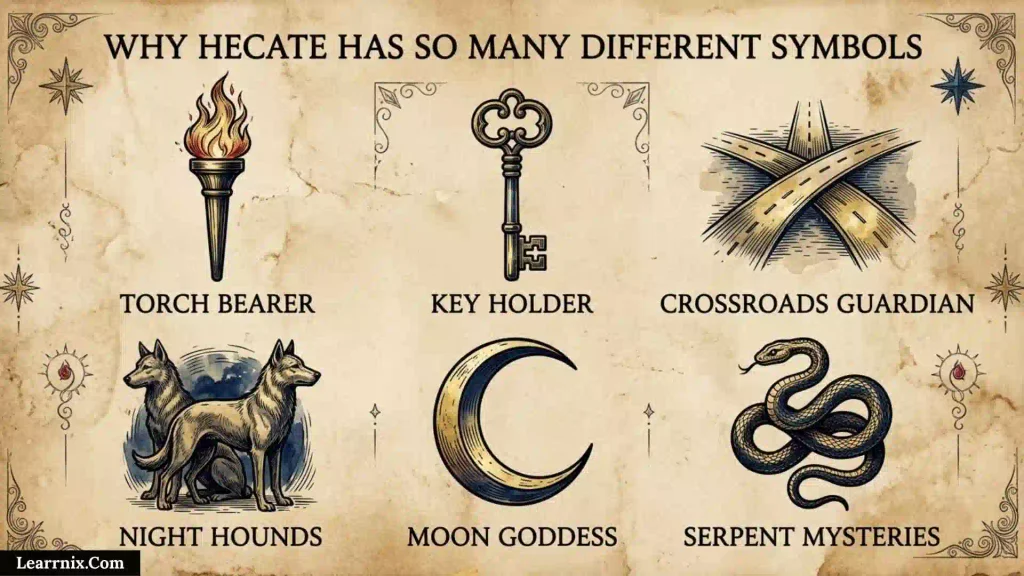
Hecate’s symbolism is diverse because her religious identity developed across different regions and historical periods.
Her earliest literary appearance presents a powerful and broadly honored goddess. Later traditions added or emphasized connections with crossroads, the night, ghosts, magic, and the underworld. Her artistic representation also developed from single-formed figures to famous triple-bodied images.
As a result, there is no need to force every symbol into one simple definition.
A torch may emphasize guidance.
A key may emphasize thresholds.
A dog may suggest guardianship and cult practice.
A crossroads may represent transition.
A triple form may emphasize multiple directions and aspects of her iconography.
Together, these images reveal why Hecate remains one of the most complex figures in Greek religious tradition.
Frequently Asked Questions About Hecate Symbols
What is Hecate’s main symbol?
There is no single symbol that fully represents every aspect of Hecate. However, torches are among her strongest and most consistently documented attributes in ancient literature and art. Crossroads, dogs, and triple-formed imagery are also major associations.
What do Hecate’s torches symbolize?
Hecate’s torches are connected with light, guidance, searching, and movement through darkness. They are particularly associated with her role in the story of Demeter and Persephone.
Why is Hecate associated with keys?
Keys fit Hecate’s role as a guardian of thresholds and access. Religious texts and surviving artistic representations show her as a key-bearing figure.
Why are dogs associated with Hecate?
Ancient and later sources associate Hecate with dogs through ritual practices, literary descriptions, and artistic imagery. Dogs can represent guardianship and her presence at the boundaries between ordinary and supernatural spaces.
Is Hecate a moon goddess?
Hecate has important associations with night and later lunar traditions, and she was sometimes identified with or connected to other goddesses such as Selene and Artemis. However, describing her only as a moon goddess oversimplifies the history of her cult and mythology.
What does the three-faced or triple Hecate represent?
Triple-formed imagery is an important part of Hecate’s ancient and later iconography. It is closely associated with multiple directions and crossroads, although individual interpretations can vary according to period and source.
Is Hecate’s Wheel an ancient Greek symbol?
The symbol commonly called Hecate’s Wheel or the strophalos is widely used in modern Hecate symbolism. Claims about its precise role and meaning in ancient Greek worship should be checked carefully against historical sources rather than assumed from its modern popularity.
What colors are associated with Hecate?
There is no single universally documented ancient color scheme for Hecate comparable to a modern branding system. Modern artwork often uses black, silver, gold, or dark blue to represent night, mystery, moonlight, or magic, but these are largely interpretive choices.
For historically informed work, it is better to research the specific artwork, period, or ritual tradition being represented.
What animals are associated with Hecate?
Dogs are among the strongest animal associations. Other animals and creatures appear in different literary, artistic, or later traditions, but they should be discussed according to the specific source rather than treated as a single universal list.
Which Hecate symbols are best for a historically accurate project?
The safest choices are:
- Paired torches
- Crossroads or threshold imagery
- Dogs
- Triple-formed Hecate
Keys can also be used when discussing documented later religious and artistic traditions.
Conclusion
Hecate’s symbols are more complex than a simple list of magical objects. Torches, keys, dogs, crossroads, serpents, and triple-formed imagery each reflect different aspects of her long and changing history.
The strongest ancient associations include her torches, crossroads, dogs, and three-formed representations. Keys and other attributes also appear in documented religious and artistic traditions, while symbols such as the moon and Hecate’s Wheel require more careful explanation because their meanings and historical status vary.
The best way to understand Hecate is to consider three questions:
- What symbol is being used?
- What historical source connects it with Hecate?
- Is the interpretation ancient, later, or modern?
That framework helps readers move beyond simplified mythology lists and understand Hecate as a complex goddess whose symbolism developed across centuries.

I am Daniel Harper, an education enthusiast and writer who enjoys creating helpful content to make learning more accessible and engaging.
I focus on sharing knowledge about effective study methods, educational growth, and skills that help learners succeed in a changing world.
Through my writing, I aim to inspire students to explore new ideas and develop a passion for learning.
Books by Daniel Harper:
- The Path to Lifelong Learning
- Unlocking Your Learning Potential
 Michael Carter
 Charlotte Anderson