Architectural symbols are design features, forms, patterns, spaces, materials, or decorative elements that communicate ideas beyond a building’s basic practical function. A dome can evoke the heavens, a monumental entrance can communicate authority, a carefully controlled beam of light can create a sacred atmosphere, and a symmetrical plan can express order or power.
But there is an important point that is often missed: architectural symbols do not have one universal dictionary of meanings. Their interpretation depends on culture, religion, historical period, building function, location, designer, patron, and audience.
This guide explains what architectural symbols are, how they developed, the major types found in religious and secular buildings, and how to interpret them without making unsupported assumptions. It also examines real examples including the Taj Mahal, Gothic cathedrals, and the Victorian Gothic and Art Deco ensembles of Mumbai.
If you are a student researching architecture, a designer looking for symbolism, a traveler trying to understand historic buildings, or simply curious about why buildings look the way they do, this article provides a practical framework for reading architecture as a form of visual communication.
Quick Answer: What Are Architectural Symbols?
Architectural symbols are physical or spatial features of a building that communicate cultural, religious, political, historical, philosophical, or emotional ideas.
They can include:
- Domes and towers
- Columns and arches
- Geometric shapes
- Religious imagery
- Sculptures
- Plants and animals
- Calligraphy and inscriptions
- Light and shadow
- Colors and materials
- Symmetry and proportion
- Building orientation
- Gardens and courtyards
- Monumental entrances
- Spatial transitions
- Repeated decorative motifs
A feature can have both a functional role and a symbolic role. For example, a dome may help create a large interior volume while also carrying religious or cultural associations.
The meaning should always be interpreted within its historical and cultural context.
Key Takeaways About Architectural Symbolism
Before examining individual symbols, these principles provide a useful foundation:
- A symbol does not always have one fixed meaning.
- The same architectural form can mean different things in different cultures.
- Function and symbolism can exist simultaneously.
- Religious architecture often uses symbolism through form, light, orientation, and decoration.
- Civic architecture can use scale and classical forms to communicate authority or permanence.
- Materials and colors can contribute to symbolic meaning.
- Geometry can communicate order, hierarchy, unity, or balance.
- Historical evidence is more reliable than guessing based only on appearance.
- The building’s purpose is one of the best starting points for interpretation.
- A complete interpretation considers the building as a whole rather than focusing on one decorative feature.
What Makes Something an Architectural Symbol?
An architectural element becomes symbolic when it communicates an idea beyond its immediate physical purpose.
Consider a column.
Structurally, it may support a roof or entablature. Architecturally, its proportions and ornament may identify a particular historical style. Symbolically, its appearance and context may evoke strength, order, tradition, authority, or permanence.
The same object therefore operates on several levels.
Architectural Element
An architectural element is a physical component of a building.
Examples include:
- Column
- Arch
- Window
- Door
- Staircase
- Dome
- Roof
- Wall
- Tower
Architectural Motif
A motif is a repeated visual theme or decorative pattern.
Examples include:
- Lotus flowers
- Leaves
- Stars
- Geometric patterns
- Vines
- Repeated arches
- Animal figures
Architectural Symbol
A symbol communicates an additional meaning or association.
For example, repeated plant motifs in a funerary building may contribute to ideas about paradise, life, renewal, or nature depending on the cultural context.
The distinction matters because not every decorative object is automatically a symbol with a specific intended meaning.
Architectural Symbols vs. Architectural Elements vs. Motifs
| Concept | Meaning | Example |
| Architectural element | Physical part of a building | Column |
| Architectural motif | Repeated visual theme | Lotus pattern |
| Architectural symbol | Feature carrying additional meaning | Dome associated with the heavens in a particular context |
| Architectural style | Broader system of design characteristics | Gothic architecture |
| Ornament | Decorative addition | Carved foliage |
| Iconography | System of recognizable images and meanings | Religious figures or sacred imagery |
Understanding these differences prevents a common mistake: treating every architectural detail as if it has a hidden symbolic message.
A Brief History of Architectural Symbolism
Symbolism in architecture is not a modern invention. People have used buildings to express beliefs, social organization, political authority, identity, and memory for thousands of years.
Ancient temples, palaces, tombs, monuments, churches, mosques, civic buildings, and memorials all demonstrate different approaches to symbolic design.
Over time, architects and builders inherited forms from earlier traditions and adapted them to new cultures and purposes.
Ancient and Classical Architecture
Ancient architecture often connected buildings with religion, political authority, mythology, and civic identity.
Classical architecture developed recognizable systems of proportion, columns, capitals, pediments, symmetry, and ornament. Later architects repeatedly reused these forms because they carried associations with the classical past.
This is one reason columns became especially common in later government and institutional architecture.
Their meaning was not simply structural. Their historical associations could also communicate tradition, order, permanence, and legitimacy.
Medieval Religious Architecture
Medieval religious architecture developed an especially rich symbolic vocabulary.
Gothic cathedrals combined structural engineering with vertical forms, pointed arches, large windows, stained glass, and carefully controlled light.
The physical construction system allowed architects to create spaces that were both technically ambitious and visually powerful. Research on Gothic architecture has specifically examined the relationship between structure, volume, natural light, and the symbolic role of light.
Islamic and Indo-Islamic Traditions
Islamic architecture developed across a vast geographic area, so there is no single universal Islamic architectural style.
Domes, courtyards, geometric ornament, calligraphy, arabesques, muqarnas, gardens, and other features appear in different combinations across regions and periods.
Indo-Islamic architecture also demonstrates how architectural traditions can merge and evolve. Official documentation about the Taj Mahal notes the synthesis of Islamic and indigenous Indian traditions, including vegetative decoration, inlay work, and the lotus dome and finial.
Modern and Contemporary Architecture
Symbolism did not disappear when modern architecture rejected much traditional ornament.
Modern buildings can communicate ideas through:
- Scale
- Materials
- Transparency
- Geometry
- Structural expression
- Light
- Landscape
- Circulation
- Sustainability
- Relationship to the surrounding city
A glass façade, for example, may be interpreted as openness or transparency in a particular institutional context, but it should not automatically be assigned that meaning without considering the building’s design intent.
Major Types of Architectural Symbols
Architectural symbolism can be organized into several broad categories.
Religious Symbols
Religious architecture frequently uses recognizable symbols, sacred geometry, orientation, light, inscriptions, and spatial hierarchy.
Examples include:
- Crosses
- Domes
- Minarets
- Religious inscriptions
- Sacred images
- Mandala-based layouts
- Ritual pathways
- Sanctuaries
- Altars
- Courtyards
The meaning depends strongly on the religious tradition.
A church, mosque, Hindu temple, Buddhist monument, or synagogue may use completely different architectural languages to create sacred space.
Geometric Symbols
Geometry is one of architecture’s most powerful visual tools.
Common forms include:
- Circle
- Square
- Triangle
- Hexagon
- Octagon
- Star patterns
- Grids
- Radial arrangements
- Symmetrical plans
Geometry can communicate order, balance, unity, hierarchy, or continuity, although the exact interpretation depends on context.
Political and Civic Symbols
Government buildings and monuments often use architectural forms to communicate institutional power and continuity.
Examples include:
- Monumental stairways
- Classical columns
- Domes
- Large portals
- Statues
- National emblems
- Inscriptions
- Symmetrical façades
Scale is especially important.
A building that is dramatically larger than its surroundings can create a sense of institutional importance before visitors even enter.
Cultural Symbols
Architecture can preserve cultural identity through:
- Local materials
- Traditional patterns
- Regional construction techniques
- Indigenous motifs
- Historical references
- Local climate adaptations
The UNESCO-listed Victorian Gothic and Art Deco ensembles of Mumbai provide a particularly useful example. UNESCO describes how Victorian Gothic architecture incorporated Indian elements such as balconies and verandas, while Mumbai’s Art Deco buildings blended Indian design with Art Deco imagery to form a distinctive Indo-Deco expression.
Natural Symbols
Nature-inspired architecture can include:
- Flowers
- Leaves
- Trees
- Vines
- Water
- Birds
- Animals
- Sun and stars
Plant motifs are particularly common in decorative architecture.
However, the presence of a flower does not automatically mean one specific thing. Its interpretation requires cultural and historical evidence.
Memorial Symbols
Memorial architecture often uses symbolism to represent:
- Memory
- Loss
- Sacrifice
- Permanence
- National identity
- Collective grief
- Hope
Empty spaces, names, water, stone, fire, pathways, and carefully framed views can all contribute to the experience.
Common Architectural Symbols and Their Possible Meanings
The following table is a useful starting point, not a universal dictionary.
| Architectural feature | Possible associations | Why context matters |
| Dome | Heaven, unity, grandeur, centrality | Religious and regional traditions differ |
| Column | Strength, order, permanence, tradition | Historical style and building function matter |
| Arch | Passage, monumentality, tradition | Arch type and historical setting change interpretation |
| Tower | Visibility, prominence, aspiration | Religious and civic uses differ |
| Spire | Vertical aspiration, religious association | Especially important in certain Christian traditions |
| Circle | Unity, continuity, wholeness | Meaning varies across cultures |
| Square | Stability, order, structure | Can also simply reflect practical planning |
| Light | Spirituality, knowledge, openness | Intended effect must be considered |
| Garden | Paradise, nature, leisure, order | Cultural traditions strongly influence meaning |
| Water | Purification, life, reflection, paradise | Context determines interpretation |
| Monumental entrance | Authority, transition, importance | Function and scale matter |
| Plant motif | Life, growth, paradise, fertility | Species and cultural tradition matter |
The Meaning of Columns in Architecture
Columns are among the most recognizable architectural features.
They can be structural, decorative, historical, or symbolic.
Why Columns Can Suggest Strength and Permanence
A large stone column visually communicates support. Even when modern construction no longer requires traditional columns in the same way, architects can retain them because of their historical associations.
Classical columns also carry stylistic information.
The Doric, Ionic, and Corinthian orders are visually distinct. Their later use can therefore connect a building with classical architectural traditions.
When Columns Do Not Have a Symbolic Meaning
It is a mistake to assume that every column represents authority or strength.
Sometimes a column is simply:
- Structurally necessary
- Decorative
- Historical
- Stylistic
- Used to maintain visual proportions
Good architectural interpretation separates evidence from assumption.
The Meaning of Arches
Arches have been used across many architectural cultures.
Their structural usefulness is one reason they became widespread, but their visual forms also became associated with particular architectural traditions.
Arches as Transitional Forms
A doorway or arch creates a physical transition from one space to another.
Because of this, entrances can acquire symbolic significance.
A monumental gateway can make the act of entering feel important, ceremonial, or controlled.
Why Arch Shape Matters
Different arch forms can provide clues about architectural history.
For example:
- Pointed arches are strongly associated with Gothic architecture.
- Rounded arches appear prominently in Roman and Roman-inspired traditions.
- Horseshoe arches are associated with particular Islamic and Moorish traditions.
But an architect can borrow an arch form from another tradition, so shape alone is not enough to establish meaning.
Domes as Architectural Symbols
The dome is one of the world’s most recognizable monumental forms.
Its circular or polygonal base rising toward a curved crown creates a strong visual focus.
What Can a Dome Represent?
Depending on the context, a dome may suggest:
- The heavens
- Centrality
- Unity
- Grandeur
- Spiritual elevation
- Authority
- Monumentality
The Danish Architecture Center identifies the dome among architectural forms that can carry symbolic meaning and emphasizes that symbolism should be analyzed through the building’s broader expression rather than isolated details.
Why Context Is Essential
A dome on a mosque, cathedral, parliament building, palace, or museum does not necessarily communicate the same idea.
The building’s function and cultural setting change the interpretation.
Towers, Spires, and Verticality
Vertical architecture naturally attracts attention.
Towers can make buildings visible across a city, while spires can create a strong upward visual movement.
Verticality in Gothic Architecture
Gothic architecture is characterized by vertical proportions, pointed arches, external buttressing, and large windows.
This combination allowed architects to create tall, light-filled interiors.
The symbolic interpretation of this vertical movement is particularly important in religious architecture, where upward direction can reinforce ideas of transcendence.
Light as an Architectural Symbol
Light is often overlooked because it is not a permanent physical object.
Yet architects can design buildings specifically to control how light enters, moves, reflects, and changes throughout the day.
Light in Gothic Cathedrals
Gothic churches used stained glass and large openings to create distinctive interior environments.
The Danish Architecture Center notes that colored stained-glass light in Gothic cathedrals was understood symbolically as heavenly light.
Academic research likewise examines the relationship between Gothic spatial form and natural light as a fundamental aspect of the architectural experience.
Light in Contemporary Architecture
Modern architecture can also use light symbolically.
A library may use daylight to create a feeling of openness and concentration. A memorial may use a narrow beam of light to focus attention on a specific object or space.
The meaning comes from the relationship between light, space, material, and human experience, not from brightness alone.
Geometry, Symmetry, and Proportion
Geometry is not merely decoration.
It can organize an entire building.
Symmetry
Symmetry creates balance between different parts of a composition.
It can suggest:
- Order
- Control
- Stability
- Harmony
- Hierarchy
The Taj Mahal provides a particularly strong example.
Its official architectural documentation describes strict geometry, bilateral symmetry along a central axis, hierarchical treatment of materials and colors, and carefully ordered forms as major principles of Shahjahani architecture.
Proportion
Proportion describes relationships between dimensions.
A building may feel calm or harmonious because its parts are carefully related to one another.
However, proportional systems should not automatically be interpreted as symbols. Sometimes proportion is primarily a design and structural strategy.
Color and Material as Symbols
Materials can communicate both physical and cultural qualities.
Stone
Stone can evoke:
- Permanence
- Weight
- History
- Durability
But stone can also simply be locally available or structurally appropriate.
Glass
Glass can create:
- Transparency
- Reflection
- Visual connection
- Natural light
Again, these are potential associations rather than universal meanings.
White and Red in the Taj Mahal
The Taj Mahal is an excellent case study because its materials are closely connected with the building’s overall symbolic program.
The official Taj Mahal website explains that the complex uses a hierarchy of red sandstone and white marble and discusses their symbolic significance within Mughal architectural traditions.
The Indian Ministry of Culture also describes the Taj Mahal as a 17th-century white-marble mausoleum combining Persian, Islamic, and Indian architectural traditions.
This is a good example of why symbolism should be studied through documented historical context rather than assumptions about color psychology.
Religious Architectural Symbols
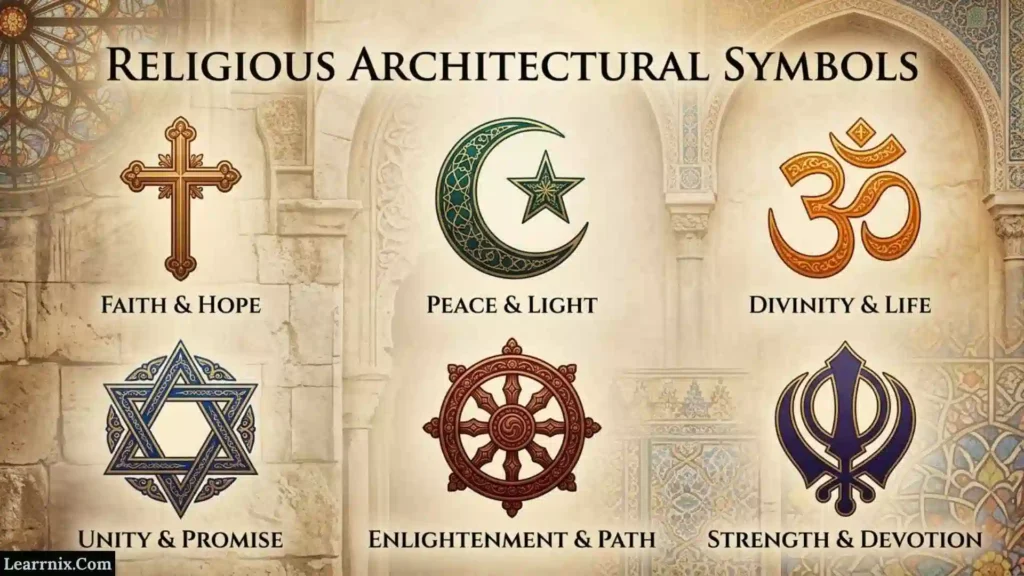
Religious buildings often provide the clearest examples of symbolic architecture because their spaces are designed to support belief, ritual, memory, and community.
Christian Architecture
Christian architectural symbolism can appear through:
- Cross-shaped plans
- Crosses
- Altars
- Sanctuaries
- Stained glass
- Verticality
- Spires
- Religious sculpture
- Biblical imagery
Research on sacred Christian architecture has also examined the spatial separation between ordinary and sacred areas and the symbolic role of vertical movement, domes, and light.
Islamic Architecture
Islamic architectural traditions frequently use:
- Geometric ornament
- Calligraphy
- Domes
- Courtyards
- Minarets
- Arabesques
- Repetition
- Gardens
- Muqarnas
These elements should not be treated as one standardized symbolic vocabulary because Islamic architecture developed across many cultures and centuries.
The Taj Mahal illustrates this complexity particularly well. Its official documentation describes the synthesis of Islamic architectural traditions with indigenous Indian forms and craftsmanship.
South Asian Sacred Architecture
South Asian architectural traditions contain extensive symbolic systems involving:
- Sacred geometry
- Lotus imagery
- Temple towers
- Mandala-based planning
- Sculptural narratives
- Ritual movement
- Cosmic concepts
Different religious traditions and regions use these features differently, so identifying the specific building tradition is essential before interpreting its symbolism.
Civic and Government Architecture
Symbolism is not limited to places of worship.
Courthouses, parliaments, capitol buildings, city halls, museums, libraries, and monuments can use architectural language to communicate institutional values.
Why Government Buildings Often Look Monumental
Large steps, tall columns, grand entrances, domes, and symmetrical façades can establish visual authority.
A visitor may interpret the building as important before reading its name.
This is an example of architecture communicating through scale and visual hierarchy.
Classical Architecture in Modern Institutions
Modern institutions sometimes borrow classical forms because those forms have accumulated historical associations with civic life, law, government, and public authority.
However, the meaning is not automatic. The architect’s design intent and the building’s historical context still matter.
Memorials and Architecture of Memory
Memorial architecture is designed around remembrance rather than ordinary daily use alone.
A memorial may communicate through:
- Names
- Absence
- Empty space
- Water
- Stone
- Fire
- Height
- Repetition
- Controlled movement
- Silence
Why Empty Space Can Become Symbolic
A completely empty area may seem like a lack of architecture.
In a memorial, however, the absence can be intentional.
The space may represent:
- Loss
- Absence
- Reflection
- Separation
- Memory
This is a useful reminder that symbolism can be created by what architecture deliberately leaves out.
Real-World Case Study: The Taj Mahal
The Taj Mahal is one of the strongest examples of architecture operating simultaneously as structure, landscape, ornament, political expression, and symbolic composition.
Symbolism Through the Entire Complex
Official Taj Mahal documentation explains that the complex was conceived in relation to the idea of a terrestrial representation of paradise and that symbolic meaning extends across architecture, decoration, materials, geometry, acoustics, and landscape.
This is important because the symbolism is not confined to the dome.
The gardens, materials, symmetry, decorative plants, water, inscriptions, spatial organization, and mausoleum work together.
What Makes the Taj Mahal an Important Example?
It demonstrates a major principle of architectural symbolism:
The meaning of a building often emerges from the relationship between many elements rather than from one isolated symbol.
The official history of the Taj Mahal also describes it as a synthesis of Persian and earlier Mughal traditions and notes the significance of its white marble and inlay work.
Real-World Case Study: Gothic Cathedrals
Gothic cathedrals demonstrate how engineering and symbolism can reinforce one another.
Structure Creates Symbolic Experience
Pointed arches, vaults, external buttresses, tall windows, and vertical proportions enabled architects to create enormous interiors with strong upward movement.
Loyola University Maryland’s architectural history resource identifies vertical proportions, pointed arches, external buttressing, and large stained-glass windows as characteristic Gothic features.
The result was not simply decorative.
Structural innovations helped create the visual and spatial conditions through which religious symbolism could be experienced.
Light Becomes Part of the Architecture
Gothic interiors are particularly important because light was not treated simply as illumination.
Research into Gothic architecture examines the relationship between natural light, volume, structure, and symbolic meaning.
This gives us another important lesson:
A symbol can emerge from an architectural experience rather than from a single object.
Real-World Case Study: Mumbai’s Victorian Gothic and Art Deco Architecture
Mumbai offers a different kind of architectural symbolism.
UNESCO describes the city’s Victorian Gothic and Art Deco ensembles as evidence of major phases of urban development and modernization. The buildings also demonstrate exchanges between European and Indian architectural ideas.
The Victorian Gothic buildings incorporated Indian elements such as balconies and verandas, while Art Deco buildings blended Indian design with Art Deco imagery.
What This Example Teaches
Architecture can symbolize cultural exchange and changing identity.
Instead of representing one isolated tradition, a building can contain evidence of multiple influences.
That makes architectural symbolism particularly valuable for understanding cities and societies.
How to Interpret Architectural Symbols Correctly
If you want to analyze a building yourself, use this framework.
Start With the Building’s Function
Ask:
What is this building for?
A mosque, courthouse, palace, memorial, railway station, museum, and private house will have different symbolic possibilities.
Identify the Historical Period
Find out:
- When was it designed?
- When was it constructed?
- Who commissioned it?
- Who designed it?
- What political or social conditions existed?
A symbol cannot be interpreted accurately without historical context.
Study the Whole Building
Look beyond individual ornaments.
Examine:
- Floor plan
- Entrance
- Circulation
- Height
- Light
- Materials
- Color
- Landscape
- Ornament
- Views
- Relationship with surrounding buildings
Look for Repetition
Repeated features may be more significant than isolated details.
If a particular geometric or plant motif appears throughout a building, it deserves closer examination.
Separate Evidence From Interpretation
Use three levels:
Documented meaning → Strong interpretation → Possible interpretation
For example:
- A historical source explicitly explains a symbol: documented meaning
- Several architectural features support an interpretation: strong interpretation
- A feature merely looks symbolic to a modern observer: possible interpretation
This distinction makes architectural analysis more credible.
A Practical Decision Tree for Reading a Building
Use this simple guide:
Do you want to understand an architectural symbol?
↓
First: Identify the building’s function.
↓
Is it religious?
→ Yes → Study its religious tradition, ritual function, orientation, sacred spaces, imagery, and historical sources.
→ No → Continue.
↓
Is it civic, governmental, or commemorative?
→ Yes → Examine scale, monumentality, national imagery, inscriptions, symmetry, and historical purpose.
→ No → Continue.
↓
Does it contain repeated cultural or decorative motifs?
→ Yes → Research their historical and regional context.
→ No → Continue.
↓
Does the building rely strongly on geometry, light, material, or spatial experience?
→ Yes → Analyze how those elements affect movement, attention, emotion, and meaning.
→ No → Avoid forcing a symbolic interpretation.
Final rule: If there is no reliable historical or contextual evidence, describe the interpretation as a possibility rather than a fact.
Common Misconceptions About Architectural Symbols
Every architectural feature has a hidden meaning
False.
Some features exist primarily because they are practical, structural, economical, climatic, or stylistic.
A dome always means heaven
Not necessarily.
A dome can have religious associations in some traditions, but it can also be used for civic, political, residential, or purely architectural reasons.
A color always has the same symbolic meaning
False.
Color symbolism varies substantially between cultures and historical periods.
Symmetry always means political power
Not necessarily.
Symmetry can result from structural logic, aesthetics, planning efficiency, tradition, or symbolic intent.
Ancient architects designed everything as a secret code
This is another common exaggeration.
Some architecture is highly symbolic, but interpreting every dimension or decorative feature as a hidden message without evidence can produce inaccurate conclusions.
Common Mistakes When Studying Architectural Symbolism
Mistake 1: Ignoring Culture
A symbol should not be interpreted using only modern Western assumptions.
Better approach: Research the building’s cultural and historical setting.
Mistake 2: Treating One Meaning as Universal
The same form can have different meanings.
Better approach: Identify the specific tradition before assigning symbolic significance.
Mistake 3: Ignoring Function
A structure may have a practical reason for its shape.
Better approach: Ask what the feature does physically before asking what it symbolizes.
Mistake 4: Overinterpreting Details
Not every ornament has a secret meaning.
Better approach: Look for repetition, historical evidence, documented intent, and relationships between elements.
Mistake 5: Studying the Building in Isolation
Architecture interacts with streets, gardens, landscapes, neighboring buildings, and public spaces.
Better approach: Study the complete architectural environment.
How Architects Can Use Symbolism Responsibly
Architectural symbolism can be powerful, but it should be used carefully.
Start With the Message
Before choosing a symbol, determine what the project needs to communicate.
For example:
- Community
- Heritage
- Innovation
- Memory
- Openness
- Spirituality
- Environmental responsibility
Choose Forms That Fit the Context
A symbol should make sense for the building’s location and users.
Borrowing a religious or cultural symbol without understanding its history can create confusion or disrespect.
Avoid Forced Symbolism
A building does not need dozens of obvious symbols.
Sometimes a single carefully integrated idea is more effective than excessive ornament.
Make Symbolism Work With Function
The strongest architectural symbolism often occurs when practical design and meaning support one another.
Light can illuminate a space while creating atmosphere.
A courtyard can improve ventilation while reinforcing cultural traditions.
A tower can serve as a landmark while expressing institutional identity.
Why Architectural Symbols Matter Today
Architectural symbolism remains relevant because buildings continue to shape how people understand places.
A city hall can communicate civic identity.
A museum can express cultural memory.
A university can represent knowledge and tradition.
A memorial can preserve collective memory.
A religious building can create an environment for worship and contemplation.
A corporate headquarters can communicate organizational identity.
In each case, architecture operates beyond basic shelter.
It becomes part of the visual language of society.
How to Research Architectural Symbols Without Spreading Myths
For serious research, use a source hierarchy.
Best Sources
Prefer:
- Official heritage organizations
- Government cultural institutions
- UNESCO documentation
- Universities
- Peer-reviewed academic research
- Museum and architectural institutions
- Primary historical documents
- Established architectural reference works
Be Careful With
- Unsourced blogs
- Social media posts
- Viral architectural facts
- Websites that provide no references
- Claims that every number has a mystical meaning
- Articles repeating the same interpretation without historical evidence
The goal is not to find the most interesting explanation. It is to find the explanation best supported by evidence.
A Professional Checklist for Architectural Symbol Analysis
Before publishing or presenting an interpretation, ask:
- Have I identified the building’s function?
- Do I know approximately when it was constructed?
- Have I identified its architectural tradition?
- Have I considered the local culture?
- Have I examined the complete building?
- Have I separated function from symbolism?
- Do reliable sources support the interpretation?
- Have I avoided presenting speculation as fact?
- Have I considered alternative interpretations?
- Have I explained why the symbol matters?
If most of these questions can be answered confidently, the interpretation is much more likely to be useful and academically responsible.
Architectural Symbols: A Simple Comparison
| Symbolic approach | Main focus | Typical examples | Best question to ask |
| Religious | Faith and sacred experience | Dome, cross, sacred geometry | What belief or ritual does the space support? |
| Political | Authority and identity | Monumental entrance, dome, columns | What institution or power does it represent? |
| Cultural | Heritage and identity | Local motifs, materials | What local tradition does it express? |
| Memorial | Memory and loss | Names, empty spaces, water | What is being remembered? |
| Natural | Life and environment | Plants, water, organic forms | Why was nature incorporated? |
| Geometric | Order and organization | Circles, grids, symmetry | How does geometry organize the experience? |
| Experiential | Emotion and perception | Light, height, darkness | What does the space make visitors experience? |
Frequently Asked Questions About Architectural Symbols
What is the simplest definition of an architectural symbol?
An architectural symbol is a building feature or design decision that communicates an idea beyond its practical function.
What are the most common architectural symbols?
Common examples include domes, arches, columns, towers, crosses, geometric patterns, religious imagery, plants, water, monumental entrances, inscriptions, and controlled light.
What does a dome symbolize in architecture?
A dome can symbolize heaven, unity, centrality, grandeur, or spiritual elevation in particular contexts. However, it does not have one universal meaning.
What do columns symbolize?
Columns can suggest strength, stability, order, permanence, tradition, and authority, particularly when used in architectural traditions where these associations are historically established.
Why is symmetry important in architecture?
Symmetry can create visual balance, order, hierarchy, and harmony. It may also have symbolic associations, but symmetry is often simultaneously an aesthetic and organizational strategy.
Can architecture communicate without decoration?
Yes. Architecture can communicate through scale, space, light, circulation, proportion, materials, orientation, and relationships between buildings.
Are architectural symbols the same in every culture?
No. Symbolic meanings vary between cultures, religions, historical periods, and societies.
How are religious symbols used in architecture?
They can appear through building plans, sacred imagery, inscriptions, geometric patterns, orientation, light, spatial hierarchy, domes, towers, sanctuaries, and ritual pathways.
Why is the Taj Mahal considered an important example of architectural symbolism?
Its symbolism operates across the entire complex rather than being limited to one feature. Its geometry, symmetry, materials, garden design, decoration, acoustics, and spatial organization contribute to its overall symbolic program.
What can Gothic architecture teach us about symbolism?
Gothic architecture demonstrates how structure, height, light, windows, and spatial experience can work together. Pointed arches and structural systems helped create tall, luminous interiors associated with the religious experience of Gothic cathedrals.
Can modern buildings have architectural symbols?
Yes. Modern and contemporary buildings can use materials, structure, light, geometry, landscape, circulation, and cultural references to communicate identity and values.
How can I tell whether an architectural interpretation is reliable?
Look for historical evidence, architectural scholarship, official heritage documentation, and statements from designers or original sources. Avoid presenting an attractive interpretation as fact when there is no supporting evidence.
Key Takeaways
Architectural symbolism is best understood as a relationship between form, function, culture, history, and meaning.
The most important lessons are:
- Architectural symbols communicate ideas beyond practical function.
- No symbol has a universal meaning in every culture.
- Context is more important than appearance alone.
- Function and symbolism often work together.
- Religious architecture provides many strong examples of symbolic design.
- Civic buildings can use architecture to express authority and identity.
- Geometry, light, material, landscape, and spatial experience can all become symbolic.
- The Taj Mahal demonstrates how many architectural elements can combine into one symbolic program.
- Gothic cathedrals show how engineering, light, height, and religious experience can reinforce each other.
- Mumbai’s architectural heritage demonstrates how buildings can express cultural exchange and historical change.
- Reliable interpretation requires evidence rather than guesswork.
- The best analysis considers the entire building and its surrounding context.
Conclusion
Architectural symbols turn buildings into more than functional structures. They allow architecture to communicate ideas about faith, power, identity, memory, culture, nature, history, and human experience.
A dome, column, arch, tower, geometric pattern, garden, material, or beam of light may carry meaning, but that meaning should never be assumed automatically. The strongest interpretations consider who built the structure, why it was built, where it was built, when it was built, how it functions, and how its individual elements work together.
The Taj Mahal shows how geometry, gardens, materials, decoration, and spatial organization can form a unified symbolic program. Gothic cathedrals demonstrate how structure and light can shape a spiritual experience. Mumbai’s Victorian Gothic and Art Deco ensembles show how architecture can record cultural exchange and urban transformation.
For students, researchers, architects, and curious travelers, the most useful approach is therefore not to memorize a fixed list of meanings. Instead, learn to read architecture through evidence, context, function, history, and experience.
That approach produces a deeper understanding of buildings and avoids the common mistake of turning architectural history into a collection of unsupported myths.

I am Daniel Harper, an education enthusiast and writer who enjoys creating helpful content to make learning more accessible and engaging.
I focus on sharing knowledge about effective study methods, educational growth, and skills that help learners succeed in a changing world.
Through my writing, I aim to inspire students to explore new ideas and develop a passion for learning.
Books by Daniel Harper:
- The Path to Lifelong Learning
- Unlocking Your Learning Potential
 Michael Carter
 Charlotte Anderson