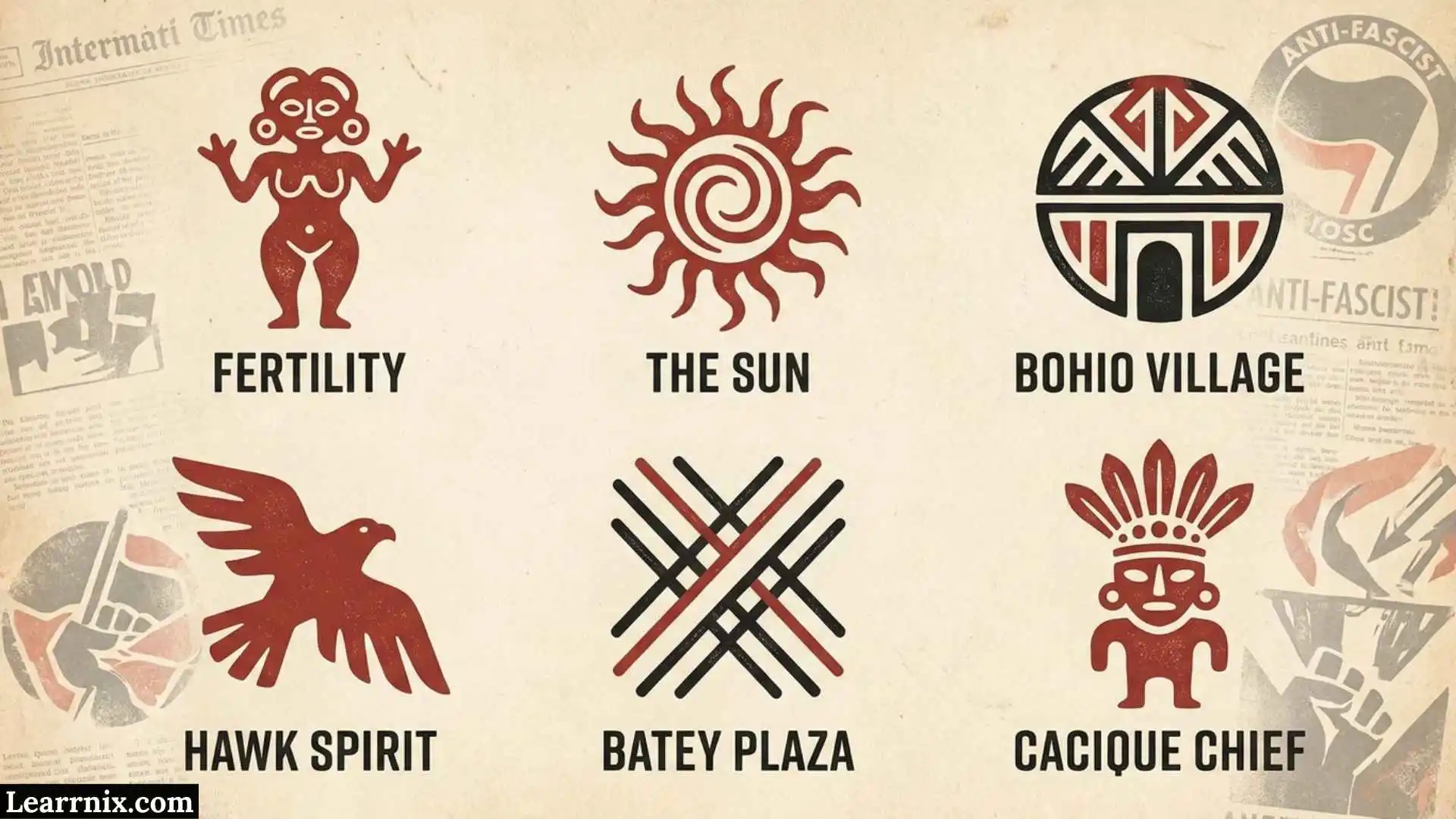
If you are searching for Taíno symbols and meanings, you may be looking for the meaning behind a Taíno tattoo, a three-pointed stone, a zemí figure, an animal design, or another Indigenous Caribbean motif. The important thing to know is that Taíno symbolism is not a simple dictionary of shapes with one fixed meaning.
Taíno visual culture developed within a complex world of spirituality, ancestors, agriculture, nature, ceremony, leadership, and community life. Objects such as zemí or cemí figures, three-pointed stones, guaíza, ceremonial collars, and other carvings could carry religious, social, and political significance.
There is also an important difference between historically documented Taíno imagery and modern designs described online as “Taíno symbols.” Some modern interpretations are inspired by archaeological art but do not have a directly documented ancient meaning.
This guide explains the best-documented Taíno symbols and motifs, their historical context, what scholars and museums say about their meanings, common misconceptions, and how to research or choose Taíno-inspired imagery responsibly.
Quick Answer: What Do Taíno Symbols Mean?
Taíno symbols and motifs are visual expressions connected with spiritual forces, ancestors, nature, agriculture, ceremony, leadership, and Indigenous Caribbean culture. The most important concept is zemí (also spelled cemí), which refers to an immaterial spiritual and vital force associated with deities and ancestors rather than simply one particular carved object.
Here is a quick comparison of major Taíno objects and motifs:
| Taíno symbol or object | Commonly associated meaning or context | How certain is the interpretation? |
| Zemí / cemí | Spiritual force associated with deities and ancestors | Well documented |
| Three-pointed stone / trigonolito | Zemí traditions, cassava, spiritual power, fertility and landscape | Strong evidence, but individual meanings vary |
| Guaíza | Zemí imagery and possible spiritual or ancestral associations | Object-specific |
| Crouching human figures | Zemí, ritual and spiritual power | Well documented in specific objects |
| Animal figures | Mythological beings and spiritual forces | Depends on the animal and object |
| Ceremonial collars / yokes | Leadership, regalia, ceremony and political authority | Strong evidence |
| Duho | Leadership, ceremony and social authority | Strong evidence |
| Cohoba-related imagery | Ritual communication with spiritual forces | Strong evidence |
| Geometric designs | Decorative and possibly symbolic forms | Often uncertain |
| Modern Taíno-inspired sun imagery | Heritage, nature and Indigenous identity | Often a modern interpretation |
The most important rule is simple: the meaning of a Taíno object should be interpreted from its archaeological and cultural context, not from its shape alone.
Understanding Taíno Culture Before Interpreting Its Symbols
Taíno peoples were diverse Indigenous societies of the Caribbean, particularly associated with the Greater Antilles before European colonization. Their material culture included carved stone, wood, shell, bone, ceramics, ornaments, ceremonial objects, and other forms of artistic expression.
Taíno art cannot be separated neatly from religion and social organization.
The Metropolitan Museum of Art explains that Taíno creative expression was intertwined with spirituality, ceremony, and political power. Zemí forces could be associated with deities and ancestors, while ceremonial objects could also communicate the status of leaders.
That context explains why many Taíno objects combine:
- Human and animal features
- Unusual facial expressions
- Crouching bodies
- Geometric forms
- Three-pointed shapes
- Highly polished stone
- Ritual vessels
- Jewelry and ornaments
- Natural imagery
These were not simply decorative patterns. In many cases, the objects participated in a larger system of belief and ceremony.
Why Context Matters When Reading Taíno Imagery
Imagine finding a three-sided stone shape on a modern website. Someone may label it “the Taíno symbol of fertility.”
That statement may sound convincing, but it leaves out an important question:
Which archaeological object are we talking about?
Museums identify many three-pointed stones as zemí-related objects and explain their connections with cassava and spiritual forces, but that does not mean every modern triangle represents exactly the same concept.
For historical accuracy, always separate:
Object → archaeological context → documented interpretation → modern interpretation
That four-step approach prevents many common mistakes.
The Zemí or Cemí: The Central Concept in Taíno Symbolism
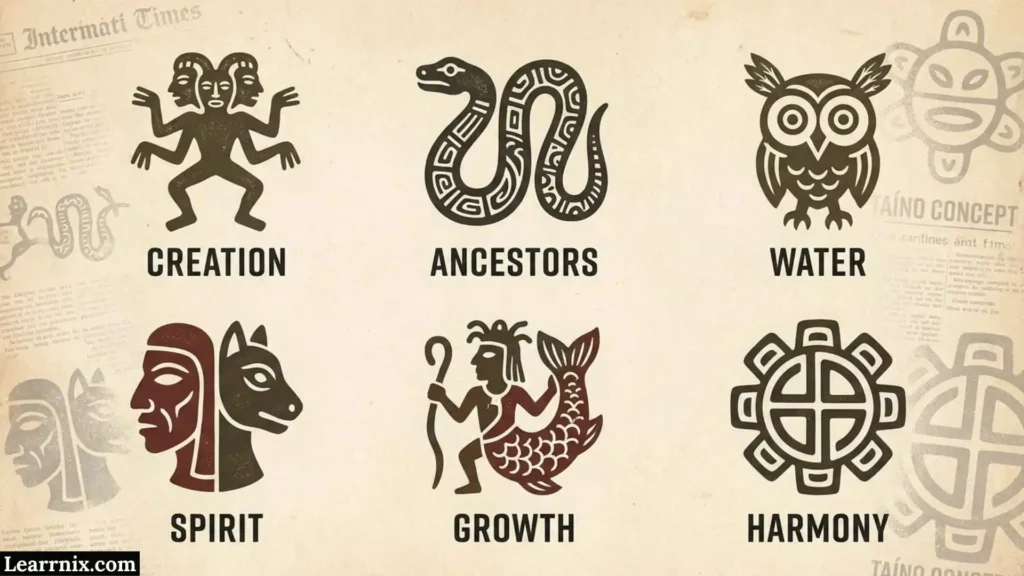
The zemí, also spelled cemí, is arguably the most important term to understand when discussing Taíno symbols.
The word does not simply mean “statue,” “god,” or “symbol.” The Metropolitan Museum describes zemí as an immaterial, spiritual, and vital force pertaining to deities and ancestors. Physical objects could represent or embody these forces.
This distinction is crucial.
A carved stone figure may be called a zemí figure, but the spiritual concept of zemí is broader than the physical sculpture itself.
What Could a Zemí Represent?
Depending on the particular object and historical context, zemí traditions could be associated with:
- Deities
- Ancestors
- Spiritual power
- Protection
- Ritual activity
- Fertility
- Agriculture
- Leadership
- Healing
- Communication with supernatural forces
Not every zemí had exactly the same function.
For example, The Met documents a stone zemí figure that was likely used as a stand during ceremonies involving cohoba, while other zemí forms were worn as pendants or used as other ritual objects.
Why the Zemí Is Often Misunderstood
Modern websites sometimes use “zemí” as if it were the name of one specific ancient symbol.
A more accurate explanation is:
Zemí describes a spiritual concept and also appears in the names of physical objects that embodied or represented spiritual forces.
That difference makes the history much easier to understand.
Three-Pointed Stones and Trigonolitos
The three-pointed stone, commonly called a trigonolito, is one of the most recognizable forms of Taíno material culture.
The Metropolitan Museum has examples dated approximately 900–1600 CE and explains that these portable sculptures were associated with Taíno sacred concepts such as zemí, ceremony, and rulership. The museum also notes historical descriptions connecting three-pointed stones with yucca or cassava, a staple Caribbean crop.
Princeton University Art Museum likewise documents three-pointed cemí objects and their historical association with cassava and potent spiritual forces.
What Does the Three-Pointed Symbol Mean?
Possible associations include:
- Cassava or yuca
- Agriculture
- Fertility
- Spiritual power
- Zemí forces
- Landscape
- Ceremony
- Social or political authority
The safest wording is “associated with”, rather than claiming that every three-pointed stone had one exact meaning.
Different examples have different shapes, faces, surface decorations, and archaeological contexts.
Why Cassava Matters
Cassava was an important food crop in the Caribbean, so its appearance in discussions of three-pointed stones is significant.
The connection between the objects and cassava was recorded by Spanish chroniclers and is discussed in modern museum research.
This provides an example of how agriculture and spirituality could overlap in Taíno culture.
Human Figures and Zemí Faces
Human-like figures appear frequently in Taíno stone objects.
Some have:
- Large or widened eyes
- Open mouths
- Crouched bodies
- Skeletal or emaciated features
- Enlarged heads
- Unusual facial expressions
These features can appear strange to modern viewers, but they often make more sense when viewed in their ritual context.
The Met describes one zemí figure whose emaciated appearance may represent fasting, while its widened eyes may relate to the effects of cohoba ritual.
Why Are Some Taíno Faces So Unusual?
The answer is not necessarily that Taíno artists were simply creating “scary faces.”
Certain facial and bodily features may communicate altered states, spiritual power, ritual activity, or supernatural identity.
However, interpretation must remain object-specific. A particular face should not automatically be assigned one universal meaning.
Guaíza: Masks, Faces, and Spiritual Identity
Guaíza is another term encountered in Taíno art.
The Metropolitan Museum has a stone object from Puerto Rico identified as a possible guaíza. It features a rounded head and zemí-like facial features.
Guaíza imagery is especially important because it demonstrates how faces could operate within Taíno spiritual and artistic traditions.
What Does Guaíza Mean?
Interpretations of guaíza should be tied to the individual object and its cultural context.
Modern explanations often associate guaíza imagery with:
- Spiritual identity
- Ancestors
- The soul
- Protection
- Ceremonial identity
Rather than treating guaíza as a simple “symbol of the soul,” it is more accurate to explain that guaíza objects form part of a broader Taíno visual and spiritual tradition involving zemí imagery.
Animal Symbols in Taíno Art
Animals are an important part of Taíno artistic imagery.
Animal forms could appear in:
- Zemí sculptures
- Pendants
- Ceremonial objects
- Stone carvings
- Other forms of material culture
The Met notes that three-pointed stones can include anthropomorphic and zoomorphic imagery, demonstrating that human and animal forms could be integrated into these sacred objects.
Why Were Animals Important?
Animals could represent more than the physical creature itself.
They might participate in:
- Mythological narratives
- Spiritual identities
- Relationships with nature
- Supernatural imagery
- Transformation
- Ritual symbolism
This means it is risky to say that every animal had one universal “Taíno meaning.”
Frog, Bird, Owl, and Other Animal Imagery
Modern websites often assign fixed meanings to individual animals, such as:
- Frog = rain
- Owl = death
- Bird = freedom
- Turtle = longevity
Some of these associations may have cultural or interpretive support in particular contexts, but they should not automatically be treated as universal Taíno definitions.
The stronger approach is to identify the archaeological object and then examine what researchers say about it.
That distinction is one of the most important ways to separate historical Taíno research from modern symbol lists.
Ceremonial Collars and Stone Yokes
Not all Taíno symbolism comes from small carvings.
Large stone objects such as ceremonial collars and yokes were also connected with social and political authority.
The Metropolitan Museum explains that stone collars were likely part of regalia that affirmed and projected the political power of caciques, or Taíno chiefs, during public and private ceremonies.
What Did These Objects Represent?
Their associations can include:
- Leadership
- Authority
- Social status
- Ceremony
- Political power
- Association with zemí forces
The objects were difficult to produce and appear to have had considerable importance.
The Met notes that some stone collars were probably commissioned by newly installed caciques and that archaeological evidence suggests production around Caguana in Puerto Rico or nearby areas.
This is a useful reminder that Taíno symbolism was not limited to religion. Political authority and spiritual authority could overlap.
The Duho and Taíno Leadership
The duho was a low ceremonial seat associated with important Taíno leaders.
A duho was more than ordinary furniture. It could function within ceremonial and political settings.
The object therefore provides another example of a physical item communicating status and authority.
What Does the Duho Symbolize?
When interpreted symbolically, the duho can represent:
- Leadership
- Authority
- Ceremony
- Social rank
- Political identity
It is more accurate to call these associations of the object than to claim that “duho is the Taíno symbol for leadership.”
That wording matters because a duho was a real ceremonial object with a function, not simply an abstract logo.
Cohoba and Ritual Symbolism
The cohoba ceremony is essential for understanding certain Taíno objects.
The Metropolitan Museum documents a zemí figure that was likely used as a stand during ceremonies involving cohoba. The ritual substance was placed on the top of the figure, and participants inhaled it through snuff tubes.
This context helps explain why some zemí figures have unusual bodies and facial expressions.
What Does Cohoba Imagery Represent?
Cohoba-related imagery can be connected with:
- Ritual
- Spiritual communication
- Religious specialists
- Political leaders
- Altered states of consciousness
- Communication with spiritual forces
This is a much richer interpretation than simply calling a particular face a “Taíno spiritual symbol.”
Taíno Symbols, Nature, and the Environment
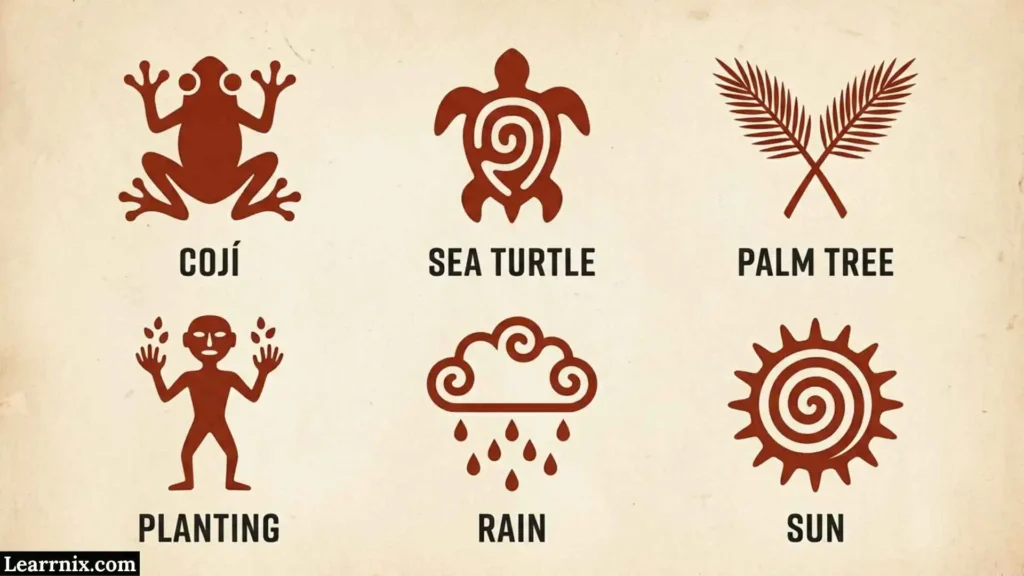
Nature was deeply important in Taíno religious thought.
Taíno spiritual traditions included relationships among:
- Humans
- Animals
- Plants
- Stones
- Trees
- Water
- Agricultural crops
- Ancestors
- Spiritual forces
The concept of zemí itself helps demonstrate this relationship because spiritual forces could be connected with deities and ancestors and expressed through physical objects.
Why Natural Materials Matter
Taíno artists worked with materials such as:
- Stone
- Wood
- Shell
- Bone
- Ceramic materials
The choice of material could affect the object’s physical appearance, durability, and use.
A stone carving was not necessarily just a picture carved into stone. Its material existence could be part of the object’s power, use, or social value.
Taíno Symbols and Agriculture
Agriculture is particularly important when discussing three-pointed stones.
Cassava, or yuca, was a staple crop in the Caribbean. Historical accounts connected three-pointed stones with cassava, and modern museum research continues to discuss that relationship.
This creates a useful interpretive connection:
Cassava → agriculture → fertility → spiritual forces → community survival
That does not prove that every three-pointed object meant “fertility,” but it shows why agriculture can be relevant when interpreting these objects.
Taíno Symbols and Ancestors
Ancestor relationships are another important part of Taíno symbolism.
The Met describes zemí as a spiritual and vital force associated with deities and ancestors.
This means that some Taíno objects can be understood within a broader system of remembrance and spiritual relationships.
For modern audiences, ancestral imagery may therefore be used to express:
- Family heritage
- Indigenous ancestry
- Memory
- Cultural identity
- Spiritual connection
But modern personal meaning should be clearly distinguished from what can be demonstrated about the original historical object.
Taíno Symbols: Documented Meaning vs. Modern Interpretation
This distinction is one of the most important parts of researching Taíno symbols.
| Type | Example | What We Can Say |
| Documented historical function | Zemí used as a ritual stand | Strong evidence |
| Archaeological interpretation | Three-pointed stones associated with cassava | Supported, but not exhaustive |
| Scholarly interpretation | Certain imagery connected with spiritual forces | Depends on evidence |
| Modern cultural interpretation | A Taíno-inspired sun used for heritage | Meaning may be contemporary |
| Internet symbol claim | “This shape always means protection” | Needs verification |
A responsible article should never turn a modern interpretation into an ancient fact.
Why Modern Designs Can Be Confusing
You may find a symbol online described as:
“Ancient Taíno symbol of strength.”
But unless the design can be traced to a documented artifact or reliable scholarly source, the claim should be treated cautiously.
Modern artists can create beautiful Taíno-inspired designs. That does not make them historically inaccurate or meaningless.
It simply means they should be labeled modern Taíno-inspired artwork, rather than automatically presented as an unchanged ancient symbol.
A Historical Timeline of Taíno Symbolism
Understanding the timeline helps explain why interpretations can be complicated.
Before European Contact
Taíno societies developed rich material cultures involving ceramics, stone sculpture, ornaments, ceremonial objects, and sacred imagery.
Fifteenth Century
European contact dramatically changed Caribbean societies. Historical descriptions of Taíno beliefs were recorded by Europeans, but those accounts were written from outside the culture and must therefore be used carefully.
Sixteenth Century
Spanish chroniclers recorded aspects of Taíno religion and material culture. Princeton University Art Museum notes that these accounts were produced within a colonial context that included attempts to suppress Indigenous religious practices.
Nineteenth and Twentieth Centuries
Collectors, museums, archaeologists, and researchers increasingly documented surviving Taíno objects.
Today
Taíno imagery continues to appear in museums, scholarship, contemporary art, tattoos, jewelry, public culture, and discussions of Caribbean Indigenous heritage.
This history explains why a modern symbol may combine ancient visual inspiration with contemporary cultural meaning.
Common Misconceptions About Taíno Symbols
Every Taíno Symbol Has One Fixed Meaning
This is probably the biggest mistake.
Archaeological interpretation is often more complicated than an online list suggests.
A single object can have religious, political, social, and ceremonial dimensions.
The Zemí Is One Specific Shape
No.
Zemí is a spiritual concept, while physical zemí objects can take different forms. The Met documents zemí figures, pendants, and other objects with different appearances and functions.
Every Triangle Is a Taíno Symbol
No.
A three-pointed archaeological object can have a specific Taíno context, but a random triangle found in modern artwork is not automatically Taíno.
Every Sun Design Is an Ancient Taíno Sun Symbol
Not necessarily.
Some modern sun imagery is inspired by Taíno visual culture, but a specific archaeological source should be identified before claiming an ancient meaning.
Modern Taíno-Inspired Art Is Fake
This is also too simplistic.
Modern artists can legitimately reinterpret Indigenous visual traditions.
The key is to distinguish:
Ancient artifact → modern adaptation
rather than pretending the two are exactly the same.
Online Tattoo Lists Are Reliable Historical Sources
Not automatically.
Pinterest, social media, tattoo websites, and unsourced blogs can be useful for discovering designs, but they are not substitutes for archaeological or museum documentation.
Common Mistakes When Researching Taíno Symbols
Avoid these mistakes if you are writing about Taíno culture or choosing a design.
Mistake 1: Treating a Modern Graphic as an Ancient Artifact
Always look for the original archaeological object.
Mistake 2: Giving Every Shape a Simple Translation
Not every spiral, line, triangle, or circle has a documented dictionary-style meaning.
Mistake 3: Ignoring Historical Context
A symbol should be interpreted within the society that created and used it.
Mistake 4: Confusing Personal Meaning With Historical Meaning
You can choose a symbol to represent family or heritage. That personal interpretation does not necessarily mean the ancient Taíno used it for the same purpose.
Mistake 5: Using Only One Source
Museum records, archaeological publications, university collections, and scholarly resources provide stronger evidence when used together.
How to Verify Whether a Taíno Symbol Is Authentic
If you discover a design online and want to know whether it is historically Taíno, follow this checklist.
- Find the original image or object.
- Identify the museum or archaeological collection.
- Check the object’s culture designation.
- Look for its approximate date.
- Check its geographical origin.
- Read the museum’s description of its function.
- Look for scholarly references.
- Separate documented facts from modern interpretations.
- Avoid websites that give elaborate meanings without sources.
- Do not assume a geometric shape is ancient simply because it looks Indigenous.
The Metropolitan Museum, for example, provides object numbers, dates, materials, geographic information, and curatorial descriptions for its Taíno objects.
Choosing a Taíno Symbol for a Tattoo
Taíno-inspired tattoos can carry personal meaning connected with ancestry, Caribbean heritage, spirituality, family, or cultural identity.
If you are choosing one, start with the meaning you want to express.
If You Want to Represent Spirituality
Research a documented zemí figure and learn about its actual historical context.
If You Want to Represent Agriculture or Fertility
Investigate three-pointed stones and their documented connection with cassava and zemí traditions.
If You Want to Represent Leadership
Research ceremonial objects such as stone collars, yokes, or duhos.
If You Want to Represent Ancestry
Look into zemí and guaíza imagery while distinguishing historical interpretations from your personal meaning.
If You Want a Simple Geometric Design
Find an actual archaeological example before assuming that a modern geometric graphic is an ancient Taíno symbol.
Decision Guide: Which Taíno Symbol Should You Choose?
Do you want a historically documented spiritual object?
↓
Choose a documented zemí/cemí design.
Do you want a design connected with cassava and agricultural traditions?
↓
Research three-pointed stones.
Do you want imagery connected with leadership?
↓
Explore duhos and ceremonial stone regalia.
Do you want an ancestral or spiritual face?
↓
Research guaíza and zemí imagery.
Do you simply want a modern Caribbean Indigenous design?
↓
A contemporary Taíno-inspired artwork may be appropriate, but label it as modern rather than ancient.
Practical Checklist for Using Taíno-Inspired Artwork
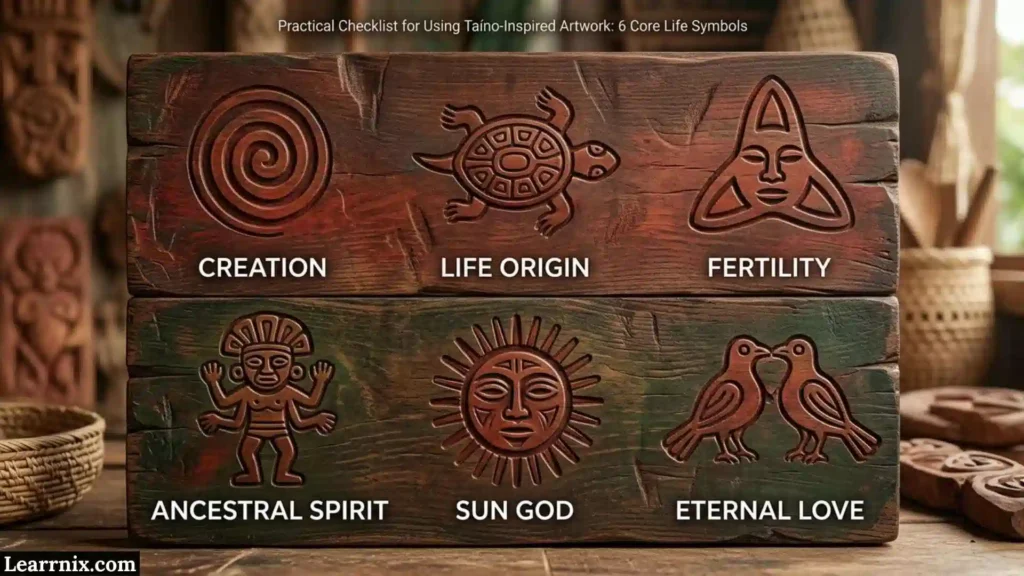
Before using a design for a tattoo, logo, article, product, or artwork, ask:
- Is the design based on an actual archaeological object?
- Can I identify where the original object is held?
- Is its date known?
- Is its geographical origin documented?
- Does a museum explain its meaning or function?
- Am I confusing modern interpretation with ancient evidence?
- Am I using a symbol respectfully?
- Have I avoided claiming a meaning that cannot be verified?
This approach is especially useful for commercial or public-facing projects because it prevents historical claims from becoming more definite than the evidence allows.
Frequently Asked Questions About Taíno Symbols and Meanings
What is the most important Taíno symbol?
Zemí or cemí is one of the most important concepts in Taíno religious symbolism. It refers to a spiritual and vital force associated with deities and ancestors, while physical objects could embody or represent those forces.
What does the Taíno three-pointed symbol mean?
Three-pointed stones, or trigonolitos, are associated with zemí traditions and have documented connections with cassava or yucca. Their meanings can also relate to spirituality, agriculture, fertility, landscape, ceremony, and rulership depending on the object.
What is a zemí?
A zemí is not simply a statue or symbol. The term refers to an immaterial spiritual and vital force associated with deities and ancestors. Physical zemí objects could represent or embody such forces.
What does a Taíno zemí figure represent?
A particular zemí figure may represent or embody a spiritual force and can be associated with ancestors, deities, ceremony, or ritual activity. Some were used as stands during cohoba ceremonies.
What does a Taíno three-pointed stone represent?
Three-pointed stones are associated with zemí traditions and cassava. Researchers have also discussed their relationships with fertility, agriculture, landscape, ceremony, and political authority. The exact meaning varies between objects.
What does a Taíno face symbolize?
A Taíno face can be part of a zemí, guaíza, pendant, or another object. It may have spiritual, ancestral, or ceremonial significance, but the meaning should be determined from the specific artifact rather than from facial features alone.
What does the Taíno sun symbol mean?
There is no single universal ancient “Taíno sun symbol” with one confirmed meaning. Modern Taíno-inspired sun imagery can represent nature, life, heritage, or Indigenous identity, but individual archaeological designs require their own context.
Are Taíno symbols still used today?
Yes. Taíno-inspired imagery appears in contemporary Caribbean art, jewelry, tattoos, cultural projects, education, museums, and Indigenous heritage discussions. Modern uses can reinterpret archaeological designs rather than reproduce their original meanings exactly.
Are all symbols marketed as Taíno historically authentic?
No. Some are based on real archaeological objects, while others are modern creations or interpretations. Always look for a museum, archaeological, or scholarly source supporting the claim.
Can I use a Taíno symbol as a tattoo?
Yes, but research the design first. If historical accuracy matters to you, choose a design that can be traced to a documented archaeological object and learn its context before using it.
What is the difference between a Taíno symbol and a Taíno artifact?
A symbol is a visual representation that communicates an idea, while an artifact is a physical object made or used by people. A Taíno artifact can contain symbolic imagery, but not every design found online is an archaeological artifact.
Key Takeaways
- Taíno symbols and meanings are closely connected with spirituality, ancestors, agriculture, nature, ceremony, and leadership.
- Zemí/cemí is a central Taíno spiritual concept associated with deities and ancestors.
- Three-pointed stones, or trigonolitos, are important Taíno objects associated with zemí traditions and cassava.
- Guaíza objects contain important zemí-related visual features and should be interpreted according to their individual archaeological context.
- Human and animal imagery can form part of Taíno spiritual and mythological traditions.
- Ceremonial collars, yokes, and duhos demonstrate the relationship between symbolism, ceremony, leadership, and political authority.
- Cohoba-related objects provide evidence of ritual practices and communication with spiritual forces.
- Not every modern geometric, spiral, triangle, or sun design is an ancient Taíno symbol.
- Historical meaning and modern cultural meaning should be clearly separated.
- Museum collections are much stronger sources for verification than unsourced social-media symbol lists.
- The best way to understand a Taíno design is to study its object, date, location, material, archaeological context, and documented interpretation.
Conclusion
Taíno symbols and meanings are best understood as part of a larger Indigenous Caribbean system in which spirituality, ancestors, nature, agriculture, ceremony, and political authority were closely connected.
The zemí or cemí is central to that understanding. It was not simply a single symbol or statue but a concept involving spiritual and vital forces associated with deities and ancestors. Physical zemí objects could take many forms, including human figures, pendants, and three-pointed stones.
Three-pointed stones provide another important example. Their archaeological record and historical descriptions connect them with cassava and spiritual traditions, but their exact meaning should not be reduced to one modern definition.
The same principle applies to animal figures, faces, guaíza, ceremonial collars, yokes, duhos, and geometric designs.
If you are researching Taíno symbolism for a tattoo, artwork, school project, cultural article, jewelry design, or personal heritage, the most reliable method is to start with a documented archaeological object and then investigate what museums and scholars actually say about it.
The most important lesson is simple: do not judge a Taíno symbol by its shape alone. Its meaning becomes clearer when you understand its historical period, material, archaeological context, ceremonial function, and relationship to Taíno spiritual and social life.
Also Check This Post: 69+ Symbols of Family: Powerful Designs and Their Meanings

I am Charlotte Anderson, an education writer who is passionate about creating meaningful learning resources for students and lifelong learners.
I enjoy researching new educational approaches and sharing ideas that make studying easier and more effective.
Through my work, I aim to inspire curiosity, confidence, and a love for learning.
Books:
- The Complete Guide to Better Learning
- Building Skills for Academic Success
 Michael Carter