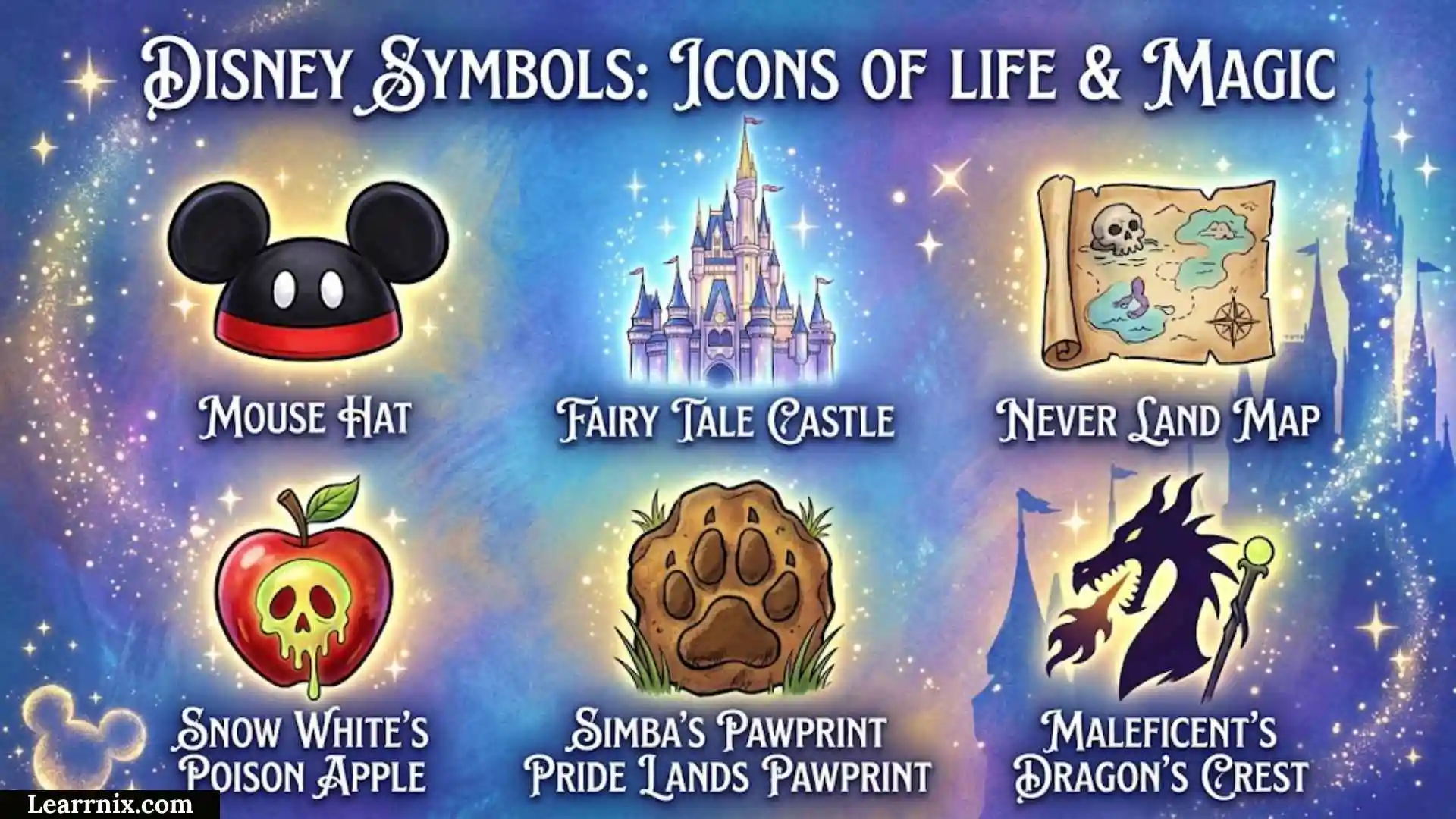
When people search for Disney symbols, they may be looking for very different things: the meaning of the Mickey Mouse symbol, famous Disney icons, Hidden Mickeys, Disney Princess symbols, the Disney logo, or symbols connected with Disney movies and theme parks. The challenge is that there is no single official list containing every image that people casually call a “Disney symbol.”
Disney symbolism works on several levels. Some images identify the Disney brand, while others represent a character, film, theme park, attraction, story, or fan tradition. Mickey Mouse is a strong example because the character itself became deeply connected with the Disney identity, while the familiar three-circle Mickey shape can also function as a visual Easter egg.
This guide explains the most recognizable Disney symbols, where they came from, what they represent, how they are used in movies and Disney Parks, and how to distinguish official branding from broader Disney-associated imagery. It also covers Hidden Mickeys, character objects, Disney Princess symbolism, common misconceptions, trademark considerations, and a practical way to identify an unfamiliar Disney symbol.
Quick Answer: What Are Disney Symbols?
Disney symbols are recognizable visual elements associated with Disney, its characters, stories, parks, brands, or entertainment properties. They can include logos, character silhouettes, objects, landmarks, colors, costumes, emblems, and hidden designs.
Some of the best-known examples include:
- Mickey Mouse
- The Mickey Mouse head silhouette
- Mickey ears
- The Disney wordmark
- Cinderella Castle
- Hidden Mickeys
- Disney Princess imagery
- Character-specific objects
- Disney villain imagery
- Disney Parks icons
- Film-specific visual motifs
The important distinction is that not every Disney-associated image is a corporate logo. A castle, character object, or Hidden Mickey may be a symbol in the broader cultural sense without being the company’s primary brand mark.
Key Takeaways About Disney Symbols
The easiest way to understand Disney symbolism is to separate it into different functions.
- Brand symbols help identify Disney as a company or entertainment brand.
- Character symbols represent recognizable characters such as Mickey Mouse.
- Story symbols represent objects, themes, or ideas from individual films.
- Park symbols identify Disney destinations, attractions, or experiences.
- Hidden symbols such as Hidden Mickeys reward guests for paying attention to environmental details.
- Fan symbols may be inspired by Disney without being official Disney branding.
- Legal status matters: an image can be recognizable without being interchangeable with a company’s official trademark or logo.
This distinction prevents one of the most common mistakes: treating every familiar Disney image as if it serves the same purpose.
How Disney Symbols Developed Over Time
Disney symbols developed alongside the company’s animation, characters, films, merchandising, television, and theme parks.
Mickey Mouse is central to this history. Disney’s official history explains that Walt Disney and animator Ub Iwerks developed Mickey after the loss of the rights to Oswald the Lucky Rabbit. Mickey’s major debut came with Steamboat Willie in 1928.
The character soon moved beyond animated shorts. Disney’s history records early Mickey merchandising, including dolls, books, dishes, toothbrushes, radios, and other products.
That expansion mattered because a character could now operate as more than a movie figure. Mickey became a recognizable visual identity across entertainment and consumer products.
Disney Parks later added another layer. Disneyland opened in 1955, creating a physical environment where characters, castles, attractions, signs, costumes, and environmental details could reinforce Disney’s visual identity.
From Character to Cultural Icon
Mickey’s importance is particularly clear in Disney’s own historical discussion of the character. The Walt Disney Company describes Mickey as more than a mascot, noting his role as a symbol and a recognizable “everyman” figure.
This explains why the Mickey image can communicate Disney without displaying the word “Disney.”
The symbol works through recognition. People who already know Mickey can often identify the character from a simplified silhouette, ears, colors, or familiar visual features.
Why Disney Uses Repeated Visual Elements
Repeated imagery creates consistency.
A guest might encounter Mickey in an animated film, then see Mickey merchandise, a Mickey-shaped detail at a theme park, and a Mickey-themed attraction. These separate experiences reinforce the same visual association.
The result is a connected visual language rather than a collection of unrelated images.
Mickey Mouse as the Most Recognizable Disney Symbol
Mickey Mouse is the clearest starting point when discussing Disney symbols.
His circular head, large round ears, distinctive face, gloves, and classic costume have become highly recognizable. Even a simplified Mickey silhouette can suggest Disney to an audience familiar with the character.
The Walt Disney Company notes that Mickey and Minnie debuted in Steamboat Willie on November 18, 1928, and describes Mickey as one of the company’s defining icons.
What Does the Mickey Mouse Symbol Represent?
Mickey can represent several ideas at once:
- Disney’s animation heritage
- Childhood entertainment
- Character storytelling
- Disney Parks
- Disney merchandise
- Nostalgia
- Family entertainment
- The broader Disney brand
The exact meaning depends on context.
A Mickey image on a movie poster identifies a character. A Mickey figure at a Disney Park can represent the guest experience. A Mickey-shaped design on merchandise may function primarily as a recognizable Disney character reference.
Why the Mickey Silhouette Works So Well
The Mickey head is visually simple enough to be recognized without detailed artwork.
Its basic arrangement consists of a large circular head with two smaller circular ears. That simplicity makes it adaptable to many surfaces and sizes.
This is an important branding lesson: recognition does not always require complexity.
A symbol becomes powerful when audiences can identify it quickly and consistently.
Mickey Ears as a Disney Symbol
Mickey ears are closely connected with Disney Parks and the wider Disney fan experience.
Visitors frequently encounter ear hats and headbands at Disney destinations, and the shape has become a recognizable way for guests to display their enthusiasm for Disney.
Disney’s legal records have also documented longstanding use of Mickey Mouse and mouse-ear marks in commerce. A USPTO Trademark Trial and Appeal Board filing describes Disney’s use of Mickey Mouse imagery and mouse-ear marks across entertainment and merchandise.
Why Mickey Ears Have Cultural Meaning
Mickey ears can communicate several things without words:
- “I am visiting Disney.”
- “I am a Disney fan.”
- “This is a Disney-themed occasion.”
- “This experience is connected to Mickey Mouse.”
The meaning comes from repeated public use rather than from the shape alone.
A pair of round ears outside a Disney context may simply be decorative. At a Disney Park, the same shape has an obvious cultural association.
The Disney Wordmark
The Disney wordmark is different from Mickey Mouse.
Mickey is a character, while the wordmark directly identifies the Disney brand.
The stylized Disney script has become one of the company’s most recognizable visual identifiers. It appears across Disney entertainment, parks, products, and other official communications.
Brand Symbol vs. Character Symbol
This distinction is useful when researching Disney symbols.
| Element | What It Primarily Represents | Typical Context |
| Disney wordmark | The Disney brand | Corporate and entertainment branding |
| Mickey Mouse | A character and Disney icon | Films, parks, merchandise |
| Mickey silhouette | Character recognition | Merchandise, graphics, environmental design |
| Mickey ears | Disney/Mickey fan identity | Parks, accessories, merchandise |
| Cinderella Castle | Disney Parks/fantasy experience | Theme parks and promotional imagery |
| Hidden Mickey | Discovery and Disney fandom | Parks and selected Disney environments |
| Glass slipper | Cinderella’s story | Film and character-themed imagery |
A symbol can overlap categories, but this framework helps explain its primary function.
Cinderella Castle as a Disney Parks Symbol
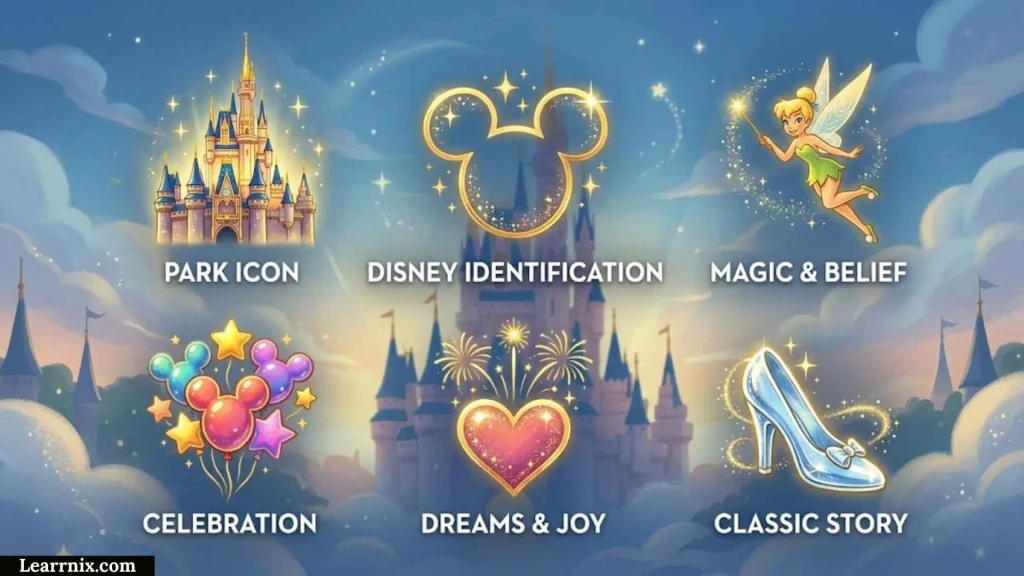
Cinderella Castle is one of the strongest visual symbols associated with Disney theme parks.
It is particularly connected with Magic Kingdom at Walt Disney World Resort, where it functions as a central landmark.
The castle communicates more than a physical building. Its visual language suggests fantasy, fairy tales, royalty, imagination, and the transition from ordinary surroundings into a themed environment.
Why the Castle Became So Important
A large central landmark gives a theme park a visual focal point.
Guests can photograph it, use it as a meeting reference, see it in promotional material, and associate it with the destination itself.
That makes the castle a place symbol as much as an architectural feature.
It also demonstrates why Disney symbols are not limited to characters. A building can become symbolic when millions of people associate its appearance with a particular experience.
Hidden Mickeys: Disney’s Famous Hidden Symbol
Hidden Mickeys are among the most interesting Disney symbols because they turn recognition into a game.
D23, Disney’s official fan and historical site, explains that Hidden Mickeys began as inside jokes among Disney Imagineers in the 1980s. Mickey silhouettes were incorporated into some Disney Park attractions, and guests began actively searching for them.
What Does a Hidden Mickey Look Like?
The classic Hidden Mickey often resembles three circles:
- One large circle for the head
- Two smaller circles for the ears
However, not every three-circle arrangement is necessarily intentional.
D23 specifically notes that guests sometimes identified ordinary design patterns as Hidden Mickeys even when the shape was simply a coincidence.
That detail is important because it prevents a common research mistake: assuming every possible Mickey shape was deliberately planted.
Why Hidden Mickeys Are Important
Hidden Mickeys add another layer to the Disney experience.
Instead of simply looking at an attraction, guests are encouraged to examine:
- Walls
- Floors
- Furniture
- Decorations
- Landscaping
- Patterns
- Attraction interiors
- Background details
Disney describes Mickey & Minnie’s Runaway Railway as containing numerous hidden Mickeys, showing how the tradition remains part of modern Disney attraction design.
Hidden Mickeys Are an Example of Interactive Symbolism
This is one of the more interesting aspects of Disney design.
Most symbols simply communicate something to the viewer. A Hidden Mickey asks the viewer to find something.
That turns symbolism into participation.
A guest who discovers a Hidden Mickey experiences a small reward: recognition, surprise, and the feeling of having noticed something that another visitor may have missed.
Disney Princess Symbols and Story Objects
Disney Princess characters are often associated with objects that immediately recall their stories.
These objects can function as visual shorthand.
Examples include:
- Cinderella’s glass slipper
- The magic lamp from Aladdin
- The rose from Beauty and the Beast
- Snow White’s apple
- Ariel’s underwater imagery and objects
- Rapunzel’s long hair and lantern imagery
These are not all equivalent in official branding terms. Their importance comes from their relationship with individual stories.
Why Story Objects Become Symbols
A strong story object often appears at a memorable moment.
When audiences repeatedly see the object connected with the same character, the object begins to trigger the larger narrative.
For example, a glass slipper does not need Cinderella’s face beside it for many viewers to understand the reference.
This is an example of narrative compression: a small visual cue can represent a much larger story.
Disney Villain Symbols and Visual Identity
Disney villains also use symbolic design.
A villain’s colors, costume, silhouette, setting, or signature object may communicate personality before the character speaks.
Think of how visual design can signal:
- Power
- Danger
- Jealousy
- Deception
- Vanity
- Fear
- Magic
- Control
The symbol is not always one particular object. Sometimes the entire visual design becomes the symbol.
Why Villain Design Is So Memorable
Villain imagery often uses strong contrast.
A distinctive silhouette, unusual costume, dramatic color palette, or signature prop makes the character easier to recognize.
This is especially useful in animation, where visual storytelling can communicate character traits without relying entirely on dialogue.
Disney Animal Symbols and Character Imagery
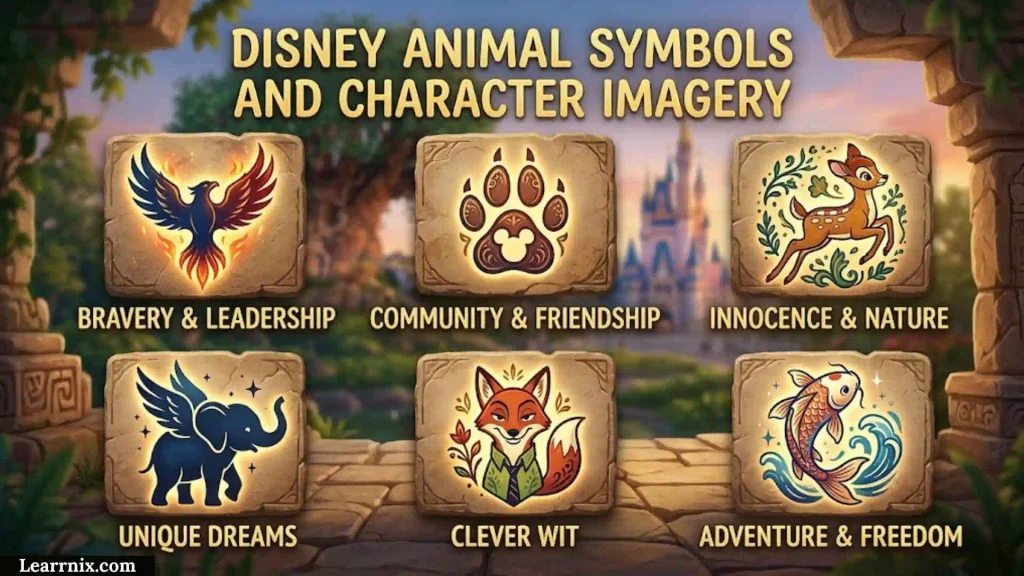
Animals are central to many Disney stories, from Mickey Mouse and Donald Duck to Simba, Bambi, Dumbo, and many others.
An animal character can represent different ideas depending on the story.
For example:
- Simba’s story involves family, identity, responsibility, and returning to one’s place.
- Bambi’s story is closely connected with growth, nature, family, and loss.
- Dumbo’s story explores difference, confidence, family, and overcoming limitations.
The key lesson is that Disney animal symbolism should be interpreted through the individual story, not through a universal dictionary of animal meanings.
Disney Symbols in Movies and Storytelling
Disney symbolism becomes especially interesting when symbols are used inside stories.
An object, color, location, or visual pattern may appear repeatedly to reinforce an idea.
A character may begin with a certain visual identity and later change as the story develops. A particular object may become important because of its emotional connection to a character.
Common Forms of Disney Story Symbolism
Disney films can use:
- Objects
- Colors
- Costumes
- Animals
- Weather
- Locations
- Lighting
- Repeated visual patterns
- Character silhouettes
- Music-related imagery
Not every repeated detail is necessarily a deliberate symbol. Good analysis should distinguish between documented creative intent and an interpretation made by viewers.
Disney Symbols at Theme Parks
Disney Parks expand symbolism from the screen into physical space.
Guests can encounter Disney imagery on:
- Park entrances
- Attraction signs
- Buildings
- Restaurants
- Resort interiors
- Costumes
- Transportation
- Merchandise
- Maps
- Decorations
Disney’s official Parks material provides examples of how Mickey is integrated into attraction and guest experiences. For example, Mickey’s House at Disneyland’s Mickey’s Toontown is designed around Mickey’s character history and includes references to his cartoon world.
Why Environmental Symbols Matter
Environmental symbolism creates consistency.
A guest may not consciously analyze every design detail, but repeated shapes, characters, colors, and references can make the environment feel connected.
This is one reason Disney Parks can feel like an extension of Disney storytelling rather than a collection of unrelated rides.
Disney Symbols and Merchandise
Disney’s early history shows how quickly characters became merchandise symbols. Disney records that Mickey’s likeness appeared on products such as dolls, books, dishes, toothbrushes, radios, and figurines during the early years of the character’s popularity.
Today, recognizable Disney imagery can appear on many types of licensed products.
A product does not always need a full character illustration. A silhouette, castle, ears, or story object may communicate the Disney connection through a much smaller visual element.
Why Minimal Disney Symbols Work on Products
Small symbols are useful on products because they can remain recognizable without dominating the design.
For example, a subtle Mickey silhouette on an accessory can communicate Disney fandom without displaying a large character portrait.
This is one reason simple symbols often have more practical value than highly detailed illustrations.
Disney Symbols, Logos, Trademarks, and Copyright
This is an area where readers should be careful.
The words symbol, logo, trademark, and copyright do not mean the same thing.
A symbol describes how people recognize or interpret an image. A trademark is a legal form of brand protection associated with particular goods or services. Copyright protects qualifying creative expression.
Disney has longstanding trademark rights associated with Mickey Mouse and related marks. USPTO records include Disney trademark proceedings involving the MICKEY MOUSE mark and mouse-ear marks.
Why This Distinction Matters
Suppose someone creates a Mickey-inspired graphic for a personal project.
Calling it a “Disney symbol” does not answer the legal question of whether the person has permission to use it commercially.
For commercial use, merchandise, logos, advertising, or business branding, the appropriate trademark and copyright rules should be checked for the specific use and jurisdiction.
This article is informational rather than legal advice.
Official Disney Symbols vs. Fan-Created Symbols
The internet contains thousands of Disney-inspired graphics, fan illustrations, tattoos, crafts, memes, and designs.
Not all of them are official.
When researching a symbol, ask:
- Was it published by Disney?
- Is it associated with an official Disney property?
- Is it used by Disney Parks or another Disney business?
- Is it documented by an authoritative Disney source?
- Is it instead a fan interpretation?
This distinction becomes especially important when a social media post claims that a particular design is an “official Disney symbol.”
Common Misconceptions About Disney Symbols
Every Three-Circle Shape Is a Hidden Mickey
No. D23 specifically notes that fans sometimes mistake ordinary design arrangements for Hidden Mickeys.
Every Disney Symbol Is a Logo
No. Logos are only one category. Characters, story objects, park landmarks, and hidden details can function symbolically without being corporate logos.
Mickey Mouse Only Represents One Thing
Mickey can represent a character, Disney history, animation, theme parks, merchandise, nostalgia, and the broader Disney identity depending on context.
Every Symbol Has an Official Meaning
Not necessarily. Some interpretations come from fans or critics rather than documented Disney statements.
A Disney-Inspired Image Is Automatically Official
No. Fan-created content can look highly professional while having no official connection to Disney.
A Symbol Has the Same Meaning Everywhere
Context matters. A Mickey image in a film, a theme park, a clothing product, and a fan drawing can serve different purposes.
Common Mistakes When Researching Disney Symbols
The following mistakes can lead to inaccurate articles, social posts, or educational material.
Mistake 1: Treating Fan Theories as Official Facts
Online communities often develop interesting interpretations. Unless Disney or a reliable historical source confirms a claim, present it as an interpretation rather than an established fact.
Mistake 2: Confusing a Character Symbol With a Brand Logo
Mickey Mouse is both a character and a major Disney icon, but that does not mean every Mickey image should simply be described as “the Disney logo.”
Mistake 3: Ignoring Historical Context
A symbol may have changed in appearance or function over decades. Disney’s history demonstrates how Mickey expanded from animation into merchandising, television, and theme parks.
Mistake 4: Assuming Every Hidden Mickey Is Intentional
Three-circle patterns can occur accidentally. D23’s own explanation warns against treating every coincidence as a confirmed Hidden Mickey.
Mistake 5: Ignoring Legal Context
A symbol can be recognizable and still be protected intellectual property. Commercial users should research the relevant rights instead of assuming that public familiarity means unrestricted use.
How to Identify an Unfamiliar Disney Symbol
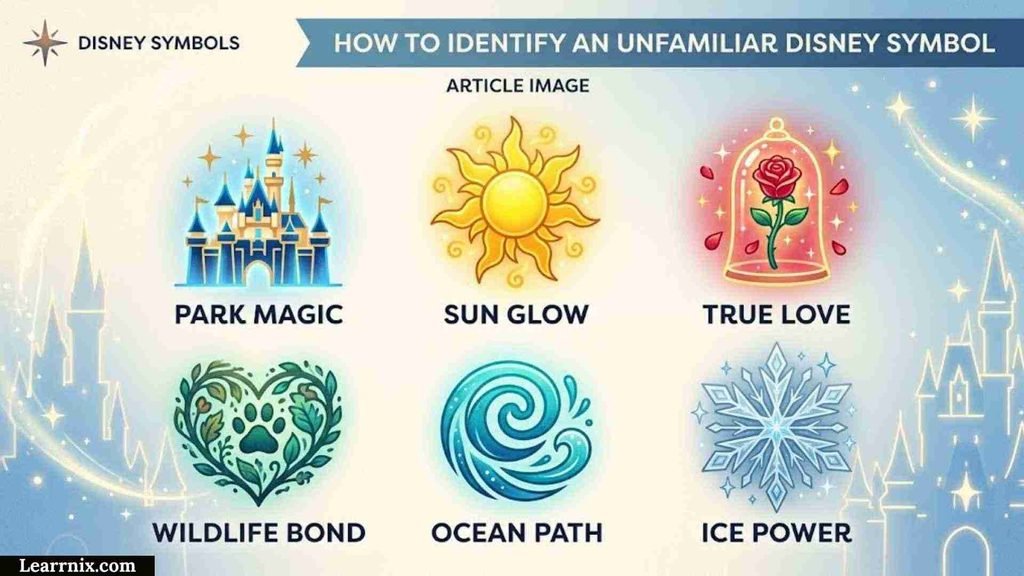
Use this practical six-step process when you see an image and want to know what it represents.
Step 1: Describe What You See
Start with the visual facts.
Is it:
- A character?
- A castle?
- A logo?
- An animal?
- An object?
- A pattern?
- A three-circle shape?
Do not assign a meaning before describing the image itself.
Step 2: Identify the Context
Where did you find it?
A Disney Park, movie, licensed product, official website, or fan community can provide very different clues.
Step 3: Connect It to a Character or Story
If it resembles an object, ask which Disney character or film is associated with it.
Step 4: Check Official Sources
Use Disney’s official websites, Disney Parks resources, D23, the Walt Disney Archives, or appropriate government trademark resources where relevant.
Step 5: Check the Date
Historical Disney imagery can differ from modern branding. Establishing when an image was used can prevent incorrect identification.
Step 6: Separate Fact From Interpretation
If a source confirms that a design is a Hidden Mickey, you can state that directly. If fans merely believe an image resembles Mickey, explain that distinction.
A Simple Decision Tree for Disney Symbols
Does the image contain the Disney wordmark?
→ Yes: It is likely being used as a Disney brand identifier.
→ No: Continue.
Does it clearly depict Mickey Mouse or his familiar silhouette?
→ Yes: It is likely a Mickey Mouse character symbol or Mickey-related mark.
→ No: Continue.
Is it a castle or major Disney Parks landmark?
→ Yes: It may represent a Disney Parks location or experience.
→ No: Continue.
Is it an object strongly linked to one movie or character?
→ Yes: Treat it as a story or character symbol.
→ No: Continue.
Does it appear as a subtle Mickey-shaped design inside a Disney environment?
→ Yes: Investigate whether it is a documented Hidden Mickey.
→ No: Check whether the image is official Disney material, licensed content, historical imagery, or fan-created work.
This framework is more reliable than identifying an image based solely on its appearance.
A Practical Checklist for Researching Disney Symbols
Before publishing information about a Disney symbol, check the following:
- Identify the symbol accurately.
- Determine whether it is official or fan-created.
- Identify the associated character, film, park, or brand.
- Check the historical context.
- Verify unusual claims with authoritative sources.
- Do not present fan theories as official facts.
- Distinguish symbols from logos.
- Consider trademark and copyright issues for commercial uses.
- Cite important factual claims.
- Explain why the symbol matters rather than simply naming it.
Frequently Asked Questions About Disney Symbols
What is the most famous Disney symbol?
Mickey Mouse is one of the most recognizable symbols associated with Disney. The Walt Disney Company describes Mickey as a major icon whose history dates to his 1928 debut with Steamboat Willie.
What does the Mickey Mouse symbol represent?
Depending on context, Mickey can represent the character himself, Disney’s animation history, Disney Parks, family entertainment, merchandising, nostalgia, or the wider Disney identity.
What are the three circles associated with Disney?
The three-circle arrangement is commonly associated with Mickey Mouse’s head and ears. When deliberately incorporated into a Disney environment, it may be a Hidden Mickey. However, not every three-circle arrangement is intentional.
What is a Hidden Mickey?
A Hidden Mickey is a Mickey-shaped design incorporated into a Disney environment or other Disney-related setting, often as a discovery element for guests. D23 traces the tradition to Imagineers’ inside jokes in the 1980s.
Why are Hidden Mickeys used at Disney Parks?
They encourage guests to observe their surroundings and discover details that might otherwise be overlooked. This turns visual design into an interactive part of the park experience.
What does Cinderella Castle symbolize?
Cinderella Castle is strongly associated with Disney Parks and communicates ideas of fantasy, fairy tales, imagination, and the themed park experience.
Are Disney symbols the same as Disney logos?
No. A logo is a formal brand identifier. “Disney symbol” is a broader phrase that can include characters, objects, landmarks, hidden details, and other recognizable imagery.
What objects symbolize Disney Princess characters?
Objects associated with specific stories can act as character symbols. Examples include Cinderella’s glass slipper, Snow White’s apple, and the rose associated with Beauty and the Beast. These are story-related symbols rather than interchangeable Disney corporate logos.
Are Hidden Mickeys found in Disney movies too?
Yes. D23 has documented Hidden Mickey appearances in Disney animated films, including background designs, costumes, and other visual details.
Are all Disney symbols protected by trademark?
Not necessarily in the same way. Trademark, copyright, and other intellectual-property rights apply differently depending on the specific work, mark, use, and jurisdiction. Disney has longstanding trademark rights involving Mickey Mouse and related marks, so commercial users should seek appropriate legal guidance.
Can I use a Disney symbol for my business logo?
You should not assume that you can. A recognizable Disney character, logo, or mark may be protected by intellectual-property rights. Commercial use should be reviewed under the applicable trademark and copyright rules before publication.
Where can I verify information about Disney symbols?
For historical information, D23 and the Walt Disney Archives are useful starting points. For current Disney Parks information, official Disney Parks resources are preferable. For U.S. trademark questions, the United States Patent and Trademark Office is an authoritative source.
Final Thoughts on Disney Symbols
Disney symbols form a visual language that connects a company, its characters, stories, parks, products, and audience memories.
Mickey Mouse is perhaps the clearest example. His image developed from an animated character into a broader cultural icon, appearing across films, merchandise, television, theme parks, and other Disney experiences.
Other symbols serve different purposes. Cinderella Castle represents the Disney Parks experience. Mickey ears can signal Disney fandom. Character objects can compress an entire story into one visual cue. Hidden Mickeys turn visual recognition into a discovery game.
The most important lesson is that not every recognizable Disney image is the same kind of symbol. Some are brand identifiers, some are characters, some are story elements, some are park landmarks, and some are fan-created interpretations.
When researching a Disney symbol, look at its source, context, history, intended use, and audience interpretation. That approach produces a much more accurate understanding than simply labeling every familiar image a “Disney logo.”

I am Daniel Harper, an education enthusiast and writer who enjoys creating helpful content to make learning more accessible and engaging.
I focus on sharing knowledge about effective study methods, educational growth, and skills that help learners succeed in a changing world.
Through my writing, I aim to inspire students to explore new ideas and develop a passion for learning.
Books by Daniel Harper:
- The Path to Lifelong Learning
- Unlocking Your Learning Potential
 Charlotte Anderson
 Michael Carter