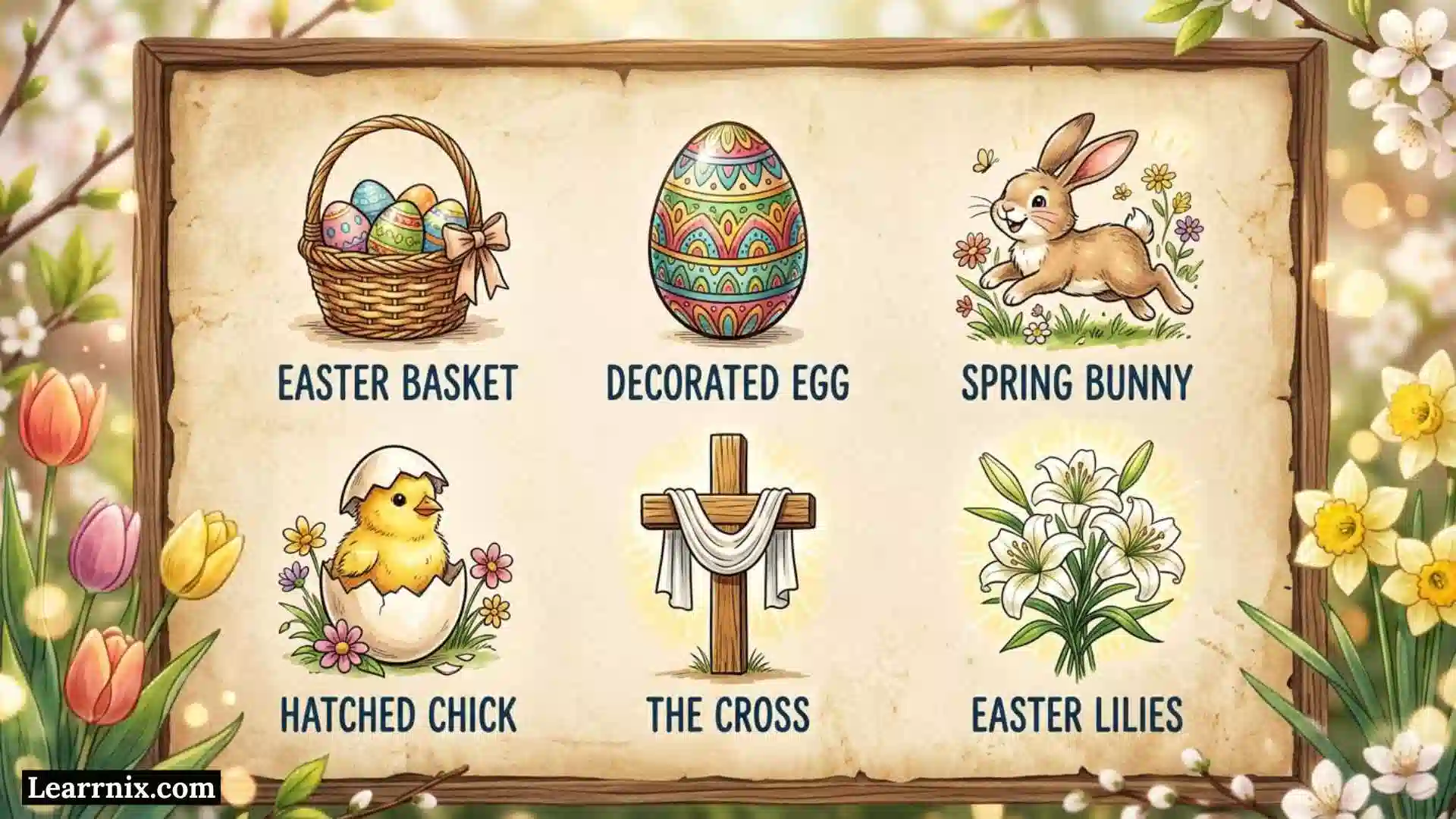
If you are searching for Easter symbols and their meanings, the most important ones are the cross, empty tomb, Easter egg, Easter lily, lamb, palm branch, Easter candle, sunrise, butterfly, Easter bunny, chick, and hot cross bun. But these symbols do not all come from the same source.
Some are closely connected to the Christian story of Jesus’ crucifixion and resurrection. Others developed later through Christian traditions, European customs, seasonal celebrations, and family practices. Understanding that difference makes Easter symbolism much easier to explain accurately.
This guide explores the meaning, history, Christian significance, cultural background, and practical use of the most common Easter symbols. It also explains which symbols are biblical, which are traditional, and which are mainly secular.
Quick Answer: What Are the Main Easter Symbols?
The most recognized Easter symbols include the cross, empty tomb, Easter egg, Easter lily, lamb, palm branch, Easter candle, sunrise, butterfly, Easter bunny, chick, basket, and hot cross bun.
| Symbol | Common Meaning | Type of Tradition |
| Cross | Sacrifice, crucifixion, faith | Christian |
| Empty tomb | Resurrection and victory over death | Biblical Christian |
| Easter egg | New life and renewal | Christian/cultural |
| Easter lily | Purity, hope, resurrection | Christian tradition |
| Lamb | Sacrifice and Christ as Lamb of God | Christian |
| Palm branch | Jesus’ entry into Jerusalem | Biblical Christian |
| Easter candle | Light, Christ, hope, resurrection | Christian/liturgical |
| Sunrise | Resurrection and new beginning | Christian tradition |
| Butterfly | Transformation and new life | Devotional symbolism |
| Easter bunny | Spring, fertility, new life | Cultural |
| Chick | Birth and renewal | Cultural |
| Hot cross bun | Christ’s crucifixion | Christian food tradition |
| Easter basket | Celebration and giving | Cultural |
The empty tomb and cross have the strongest direct connection to the central Christian Easter story. The Church of England describes Easter as the celebration of Jesus’ death and resurrection and specifically connects the empty tomb with the belief that Christ rose from the dead.
Also Check This Post: 69+ Symbols of Family: Powerful Designs and Their Meanings
Why Are Symbols Important at Easter?
Easter is centered on the Christian belief that Jesus Christ died and rose again. Symbols help people communicate this message visually without needing a long explanation.
A cross can represent Christ’s crucifixion. An empty tomb can represent resurrection. An egg can suggest new life, while a sunrise can represent hope emerging after darkness.
This makes Easter symbolism useful in:
- Church services
- Religious education
- Children’s lessons
- Easter cards
- Home decorations
- Christian artwork
- School projects
- Family celebrations
- Seasonal displays
The symbols also show how religious traditions develop over time. Some objects began as direct religious references, while others became associated with Easter through later cultural practices.
The Cross Represents Christ’s Sacrifice and Crucifixion
The cross is one of the most important symbols in Christianity and has a central place in Easter observance.
Easter cannot be understood separately from the events of Holy Week. Good Friday remembers Jesus’ crucifixion, while Easter celebrates the resurrection. The cross therefore represents the suffering and sacrifice that precede the celebration of new life.
What Does the Easter Cross Mean?
The cross can symbolize:
- Jesus’ crucifixion
- Sacrifice
- Redemption
- Christian faith
- Salvation
- God’s love
- Hope following suffering
For a Christian Easter display, a cross is often the clearest symbol when the intended message is specifically about Christ rather than spring or general renewal.
Cross vs. Empty Cross
Different Christian traditions use crosses in different ways. Some include a representation of Jesus’ body, while others use an empty cross.
An empty cross can visually emphasize that the crucifixion was not the end of the Christian story. The message moves from death toward resurrection and hope.
The Empty Tomb Represents the Resurrection
The empty tomb is arguably the most direct Easter symbol because it represents the central event Christians celebrate on Easter Sunday.
The Gospel accounts describe Jesus’ followers discovering that the stone had been removed and that his body was no longer in the tomb. For example, John describes Mary Magdalene arriving at the tomb and seeing that the stone had been removed.
Luke similarly describes the women arriving at dawn and finding the stone rolled away and the tomb without Jesus’ body.
What Does the Empty Tomb Symbolize?
It can represent:
- Resurrection
- Victory over death
- Hope
- Eternal life
- New life
- God’s power
- The fulfillment of Christian faith
This makes the empty tomb particularly appropriate for church artwork, Easter sermons, religious lessons, and Christian greeting cards.
Easter Eggs Symbolize New Life and Renewal
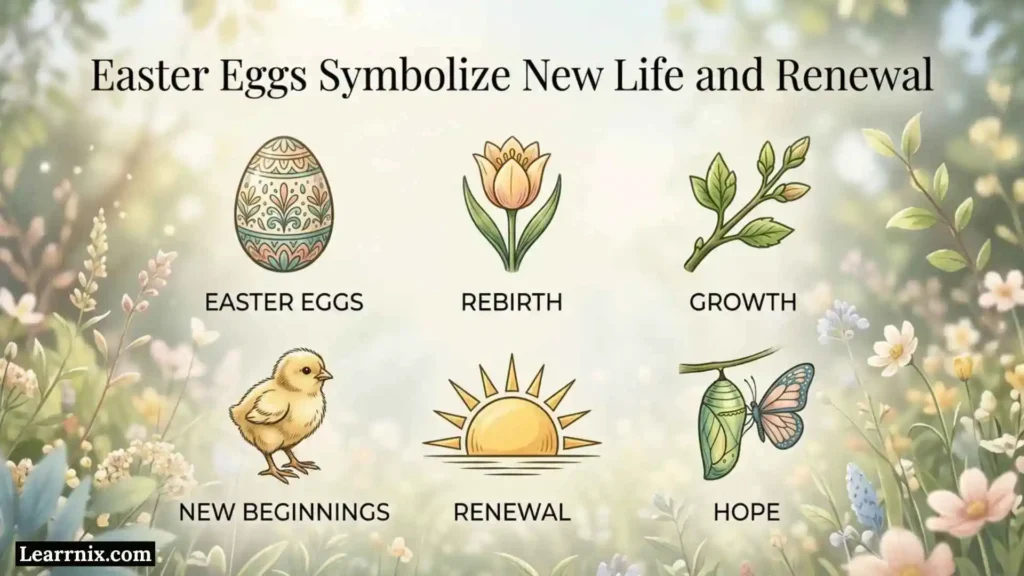
The Easter egg is one of the most recognizable symbols of Easter.
Eggs naturally suggest birth and new life because a living creature can emerge from an apparently closed shell. Christian traditions later gave Easter eggs additional meanings connected with resurrection and new life.
The Church of England notes that Christians commonly associate Easter eggs with new life and that some traditions compare the egg to the stone that covered Jesus’ tomb.
How Did Easter Egg Traditions Develop?
Egg decorating has a long history in European Easter traditions. The Smithsonian documents decorated Easter eggs, including Polish pisanka and Ukrainian pysanka, as traditions that combine natural and geometric designs with Christian symbolism. These eggs are exchanged at Easter and symbolize new life.
Historical evidence also shows that Europeans were coloring Easter eggs centuries ago. The Smithsonian’s National Museum of Natural History notes that European records place Easter egg coloring as early as the 13th century.
Do Easter Egg Colors Have Universal Meanings?
No. Color meanings can vary by country, denomination, and artistic tradition.
Common modern associations include:
- White: purity and peace
- Red: sacrifice or Christ’s blood in some traditions
- Gold: glory
- Green: life and renewal
- Pastel colors: spring and celebration
These should be treated as cultural or traditional interpretations, not as a universal Christian color code.
The Easter Lily Represents Purity and New Life
The Easter lily is a familiar flower in many Western Easter celebrations.
Its white petals are commonly associated with purity, while its growth from a bulb provides a natural metaphor for life emerging from apparent lifelessness.
Why Are Lilies Used at Easter?
The flower fits several major Easter themes:
- Purity
- Hope
- Renewal
- Beauty
- New life
- Resurrection
Churches often use flowers during Easter because the change from the quieter atmosphere of Lent to the celebration of Easter can be expressed visually through flowers, light, and brighter decorations. The Church of England notes that some churches decorate with flowers on Easter Sunday as part of the celebration of new life.
The Easter lily is therefore best described as an established Christian tradition, rather than a symbol directly commanded or defined in the Bible.
The Lamb Represents Sacrifice and Christ
The lamb has deep religious meaning in Christianity.
Christian language describes Jesus as the Lamb of God, making the lamb an important image of sacrifice, innocence, and redemption. It also connects Easter with the historical setting of Passover.
What Does the Easter Lamb Mean?
The lamb can represent:
- Jesus Christ
- Sacrifice
- Innocence
- Redemption
- Passover
- Faith
- New life
This is why lamb imagery appears in Christian artwork and why lamb dishes became Easter foods in some cultures.
Why Is the Lamb Connected With Passover?
The events surrounding Jesus’ death occurred during the period of Passover. This creates an important historical and theological connection between Jewish Passover traditions and Christian interpretations of Christ’s death.
It is therefore more accurate to explain the lamb as a symbol with both biblical and historical religious context, rather than simply calling it a generic Easter decoration.
Palm Branches Connect Easter With Palm Sunday
Palm branches are strongly associated with Palm Sunday, which begins Holy Week in many Christian traditions.
The Gospel of John describes a crowd taking palm branches and going out to welcome Jesus as he entered Jerusalem.
What Do Palm Branches Symbolize?
They can represent:
- Welcome
- Honor
- Victory
- Jesus’ entry into Jerusalem
- The beginning of Holy Week
- Recognition of Jesus as king
The Church of England notes that churches remember this event with palm branches, palm-leaf crosses, and processions.
This is an important distinction: Palm branches are specifically linked with Palm Sunday rather than Easter Sunday alone, although they form part of the wider Easter season.
The Easter Candle Represents Light and Hope
The Easter candle, often called the Paschal candle in Western Christian traditions, represents light and is used in Easter worship.
A candle shining in darkness provides a natural image of:
- Christ
- Resurrection
- Hope
- Light
- Life
- Victory over darkness
The symbolism becomes especially powerful during an Easter Vigil, when darkness and light can be used as part of the worship setting.
Why Is Light Important at Easter?
The image of light after darkness closely matches the emotional movement of Holy Week:
Suffering → Death → Darkness → Resurrection → Hope
That makes the candle more than decoration. In liturgical settings, it can become part of a structured religious act.
Sunrise Represents Resurrection and New Beginnings
The Easter sunrise is another powerful symbol.
The resurrection accounts describe Jesus’ followers going to the tomb early in the morning or at dawn. Luke describes the women arriving at the tomb at daybreak, while Mark places their arrival early after sunrise.
What Does the Sunrise Symbolize?
An Easter sunrise can represent:
- Resurrection
- Hope
- New beginnings
- Light after darkness
- Renewal
- Joy
This is why some churches hold Easter sunrise or dawn services.
The symbolism is easy to understand even for someone unfamiliar with Christian theology: a new day begins after a period of darkness.
The Butterfly Represents Transformation and New Life
The butterfly is commonly used in Christian artwork and Easter lessons as a metaphor for transformation.
Its life cycle provides a simple visual sequence:
Caterpillar → Chrysalis → Butterfly
People can use this transformation to illustrate ideas such as:
Old life → Transformation → New life
The butterfly is not one of the primary biblical Easter symbols, so it should be described as a devotional or symbolic comparison rather than as a biblical object associated directly with Jesus’ resurrection.
The Easter Bunny Is a Cultural Symbol
The Easter bunny is perhaps the clearest example of a popular Easter symbol that is not part of the biblical resurrection story.
The Bible does not describe an Easter bunny.
Instead, the rabbit became associated with Easter through European cultural traditions and later became a major part of modern Easter celebrations.
What Does the Bunny Represent?
It is commonly connected with:
- Spring
- Fertility
- Birth
- New life
- Childhood
- Celebration
This makes the bunny suitable for children’s Easter events and secular decorations, but it should not be presented as a biblical Christian symbol.
Easter Chicks Represent Birth and Renewal
The Easter chick is another popular seasonal symbol.
A chick emerging from an egg creates a straightforward visual representation of birth and new life.
Its meaning is therefore closely related to the egg:
Egg → Hatching → Birth → New Life
Chicks are especially common in children’s crafts, greeting cards, decorations, and Easter baskets.
Like the bunny, the chick belongs mainly to the cultural and seasonal side of Easter.
Hot Cross Buns Connect Food With Christian Symbolism
A hot cross bun is a sweet bun marked with a cross on top.
The cross provides the religious meaning, connecting the food with Jesus’ crucifixion and especially with Good Friday traditions.
This is a useful example of how Christian symbolism can become part of everyday life. A symbol does not always appear in a church painting or religious object; it can also appear in food and family traditions.
Also Check This Post: 63+ Anti Fascist Symbols: Meanings, History, and Modern Uses
Easter Baskets Symbolize Celebration and Giving
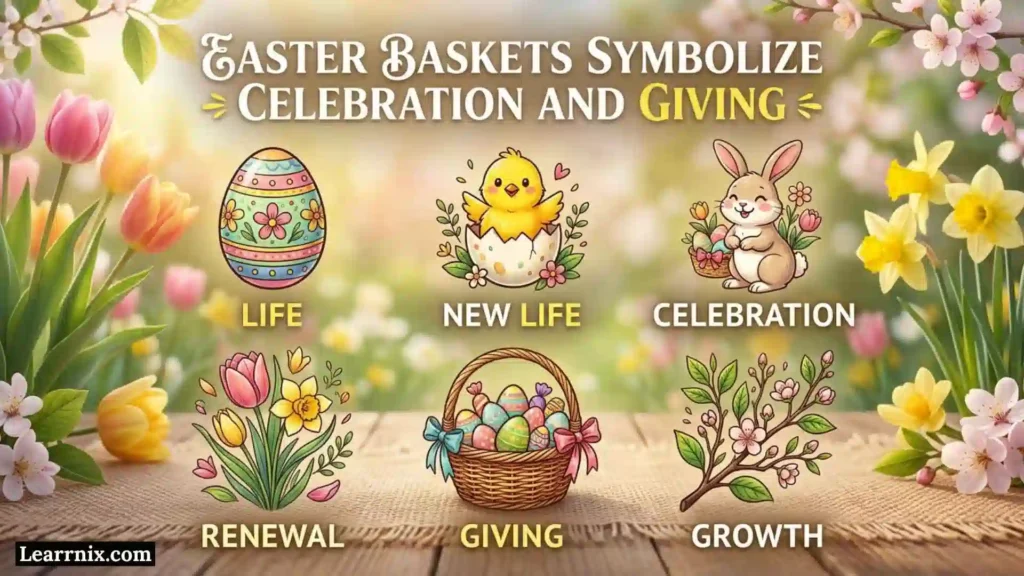
An Easter basket is primarily a cultural tradition.
Modern baskets may contain:
- Decorated eggs
- Chocolate
- Candy
- Toys
- Flowers
- Small gifts
The basket can suggest generosity, family celebration, abundance, and giving.
Its meaning is different from the empty tomb or cross. It does not directly represent a central event in the Gospel accounts.
Christian Easter Symbols vs. Secular Easter Symbols
One of the most useful ways to understand Easter is to separate religious symbols from cultural symbols.
| Mainly Christian | Mainly Cultural or Seasonal |
| Cross | Easter bunny |
| Empty tomb | Easter basket |
| Resurrection | Chocolate eggs |
| Palm branches | Easter chick |
| Lamb of God | Candy |
| Easter candle | Egg hunt |
| Holy Week | Spring flowers |
| Sunrise worship | Decorative gifts |
There is also a middle category. Eggs, lilies, lambs, and sunrise imagery can carry both religious and cultural meanings depending on how they are used.
This distinction prevents a common mistake: assuming that every familiar Easter object has the same historical or biblical status.
Are All Easter Symbols Found in the Bible?
No.
The Bible directly provides the foundation for symbols and events such as:
- Jesus’ crucifixion
- The cross
- The empty tomb
- Resurrection
- Palm branches
- The events of Holy Week
Other symbols developed later through Christian practice and cultural traditions.
For example, the Church of England explicitly discusses eggs as Easter symbols of new life, while the biblical resurrection narratives themselves focus on the tomb, the stone, the witnesses, and the risen Jesus.
This distinction is important when writing educational content or teaching children about Easter.
Common Misconceptions About Easter Symbols
The Easter Bunny Is a Biblical Symbol
It is not. The bunny is a later cultural tradition.
Easter Eggs Appear in the Resurrection Story
They do not. Their association with Easter developed through later traditions.
Every Easter Flower Has a Fixed Christian Meaning
Not necessarily. Flower meanings can vary between cultures and traditions.
Palm Branches Are Only Easter Sunday Symbols
Palm branches are specifically associated with Palm Sunday, the beginning of Holy Week.
Every Symbol Has One Historical Origin
This is also incorrect. Many traditions developed gradually and may have multiple influences.
How to Choose the Right Easter Symbol
The best symbol depends on the message you want to communicate.
For Christ’s Sacrifice
Choose the cross or lamb.
For Resurrection
Choose the empty tomb or Easter egg.
For Hope and Renewal
Choose the sunrise, lily, candle, or butterfly.
For Palm Sunday
Choose the palm branch.
For a Children’s Easter Event
Choose the egg, bunny, chick, or basket.
For a Spring-Themed Design
Choose flowers, eggs, chicks, or rabbits.
This approach is useful for teachers, churches, designers, parents, bloggers, and anyone creating Easter content.
Easter Symbol Decision Guide
What message should your symbol communicate?
↓
Jesus’ sacrifice
→ Cross or lamb
↓
Resurrection
→ Empty tomb or egg
↓
Hope and light
→ Candle or sunrise
↓
Renewal and transformation
→ Lily or butterfly
↓
Palm Sunday
→ Palm branch
↓
Family celebration
→ Bunny, chick, basket, or decorated egg
A Practical Checklist for Using Easter Symbols
Before describing or publishing an Easter symbol, check:
- Is it biblical, Christian traditional, or secular?
- Does its meaning vary by culture?
- Am I confusing Palm Sunday with Easter Sunday?
- Am I presenting a later tradition as biblical?
- Does the symbol fit my intended audience?
- Is the historical claim supported by a reliable source?
- Does the symbol communicate the message clearly?
- If teaching children, have I explained the difference between religious and cultural traditions?
This simple checklist can improve both accuracy and clarity.
Frequently Asked Questions About Easter Symbols
What is the most important symbol of Easter?
The cross and empty tomb are among the most important Christian Easter symbols. The cross represents Christ’s crucifixion, while the empty tomb represents the resurrection.
What does the Easter egg symbolize?
The Easter egg commonly represents new life and renewal. Christian tradition has also connected the egg with the resurrection and, in some interpretations, with the stone at Jesus’ tomb.
What does the Easter bunny symbolize?
The Easter bunny is mainly a cultural symbol associated with spring, fertility, birth, and new life. It is not a character from the biblical Easter story.
What does the Easter lily mean?
The Easter lily is commonly associated with purity, hope, renewal, and resurrection in Christian tradition.
What does the lamb symbolize at Easter?
The lamb can represent Jesus Christ, sacrifice, innocence, redemption, and Passover.
What do palm branches mean?
Palm branches commemorate Jesus’ entry into Jerusalem and are especially associated with Palm Sunday.
What does the Easter candle represent?
The Easter or Paschal candle represents light, Christ, hope, resurrection, and new life in Christian worship.
Is the butterfly a Christian Easter symbol?
The butterfly is commonly used as a Christian metaphor for transformation and new life, but it is not a primary biblical Easter symbol.
Are Easter eggs pagan?
That answer is more complicated than a simple yes or no. Eggs have existed as symbols of life and fertility in different cultures, while Christian Easter traditions gave eggs additional meanings connected with new life and resurrection. The documented history of decorated Easter eggs also includes longstanding Christian European traditions.
Which Easter symbols are directly connected to the Bible?
The strongest biblical connections include the cross, crucifixion, empty tomb, resurrection, and palm branches. Other familiar symbols developed through later Christian or cultural traditions.
Key Takeaways
- The cross represents Christ’s crucifixion and sacrifice.
- The empty tomb represents the resurrection.
- Easter eggs symbolize new life and renewal.
- Easter lilies are associated with purity, hope, and resurrection.
- The lamb connects Easter with sacrifice, Christ, and Passover.
- Palm branches commemorate Jesus’ entry into Jerusalem.
- The Easter candle represents light and hope.
- Sunrise provides a powerful image of resurrection and a new beginning.
- Butterflies symbolize transformation in Christian devotional imagery.
- The Easter bunny and chick are mainly cultural symbols of spring and new life.
- Hot cross buns use the cross to connect food with Christian remembrance.
- Not every Easter symbol is found in the Bible.
- Easter symbolism combines Christian theology, biblical events, church traditions, European customs, seasonal imagery, and modern family celebrations.
Conclusion
Easter symbols tell a larger story than decorations alone. The cross points to Christ’s sacrifice, the empty tomb points to resurrection, and the palm branch connects Easter with Jesus’ entry into Jerusalem. Eggs, lilies, candles, lambs, and sunrise imagery add ideas of new life, purity, hope, light, sacrifice, and renewal.
At the same time, symbols such as the Easter bunny, chick, basket, and chocolate egg belong mainly to cultural and family traditions.
The most accurate way to understand Easter symbolism is therefore to ask what the symbol represents, where its tradition comes from, and whether its meaning is biblical, Christian, cultural, or seasonal. That distinction provides a clearer and more trustworthy picture of why these symbols remain important in Easter celebrations around the world.
Also Check This Post: 70+ Taino Symbols and Meanings: Common Symbols and Their Uses

I am Daniel Harper, an education enthusiast and writer who enjoys creating helpful content to make learning more accessible and engaging.
I focus on sharing knowledge about effective study methods, educational growth, and skills that help learners succeed in a changing world.
Through my writing, I aim to inspire students to explore new ideas and develop a passion for learning.
Books by Daniel Harper:
- The Path to Lifelong Learning
- Unlocking Your Learning Potential
 Michael Carter
 Charlotte Anderson