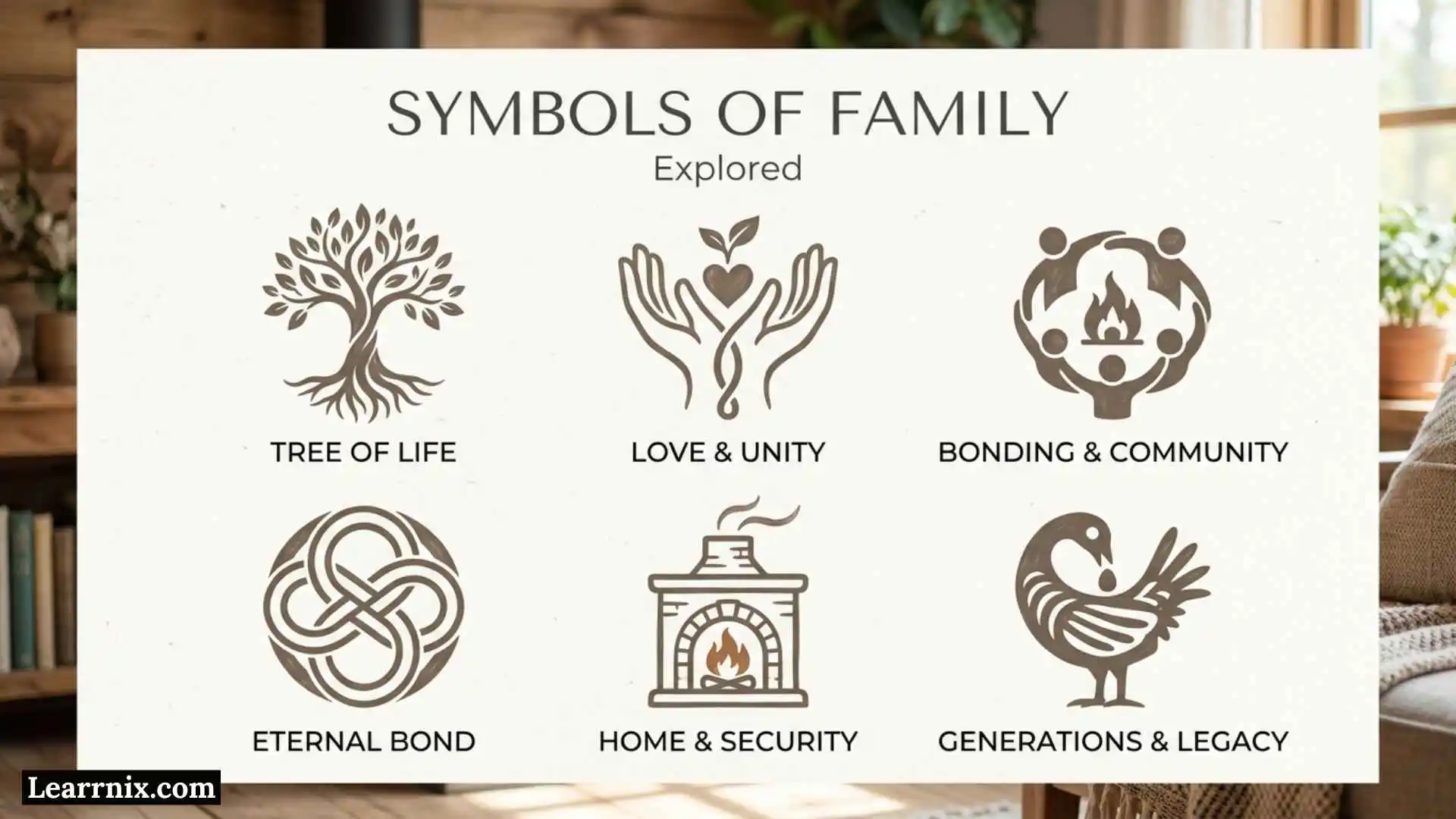
When people search for symbols of family, they may be looking for a symbol that represents love, unity, ancestry, protection, family heritage, parents and children, or an everlasting connection. The important thing to understand is that there is no single universal symbol that officially represents family. Different symbols communicate different aspects of family life.
The family tree is one of the clearest symbols of ancestry and generations. A heart represents love, a circle can represent unity, roots suggest heritage, and a house represents home and security. Other designs, such as the Tree of Life, infinity symbol, joined hands, interlocking rings, animals, and personalized family emblems, can express more specific meanings.
If you are choosing a symbol for a tattoo, necklace, family gift, wall art, logo, memorial, or personal project, the best choice depends on the message you want it to communicate.
This guide explains the most meaningful family symbols, their common interpretations, historical context, practical uses, common misconceptions, and how to create a symbol that feels personal rather than generic.
Quick Answer: What Is the Symbol of Family?
There is no single universal symbol of family.
The family tree is one of the most recognizable symbols because it can represent ancestors, parents, children, and future generations. However, other symbols may be more appropriate depending on the specific meaning you want.
| Family Symbol | Common Meaning | Best Use |
| Family tree | Ancestry and generations | Genealogy and family history |
| Tree of Life | Growth and connection | Tattoos and jewelry |
| Heart | Love and affection | Family love |
| Circle | Unity and wholeness | Minimalist designs |
| Roots | Heritage and origins | Ancestry |
| House | Home and security | Family décor |
| Joined hands | Care and support | Parents and children |
| Interlocking rings | Connection and commitment | Family bonds |
| Infinity symbol | Lasting connection | Tattoos and jewelry |
| Nest | Nurturing and protection | Parents and children |
| Shield | Protection and strength | Family emblems |
| Elephant | Social bonds and protection | Animal designs |
| Wolf | Loyalty and belonging | Modern symbolic artwork |
If you want one straightforward choice, the family tree is usually the clearest symbol for family because it directly connects the ideas of roots, generations, relationships, and legacy.
What Do Symbols of Family Represent?
Family symbols turn emotional or historical ideas into visual forms. They can represent biological relatives, but family symbolism can also apply to adoptive families, blended families, chosen families, close friends, and other meaningful relationships.
Common meanings include:
- Love
- Unity
- Loyalty
- Protection
- Belonging
- Ancestry
- Heritage
- Family roots
- Growth
- Continuity
- Home
- Parenting
- Support
- Generational connection
- Family identity
- Shared memories
The meaning changes according to the symbol.
For example, a tree emphasizes roots, growth, and generations, while a heart focuses primarily on love and affection. A house communicates home and security, whereas joined hands suggest support and care.
This is why the most useful question is not simply, “What is the symbol of family?”
A better question is:
“Which part of the family do I want my symbol to represent?”
The Most Meaningful Symbols of Family
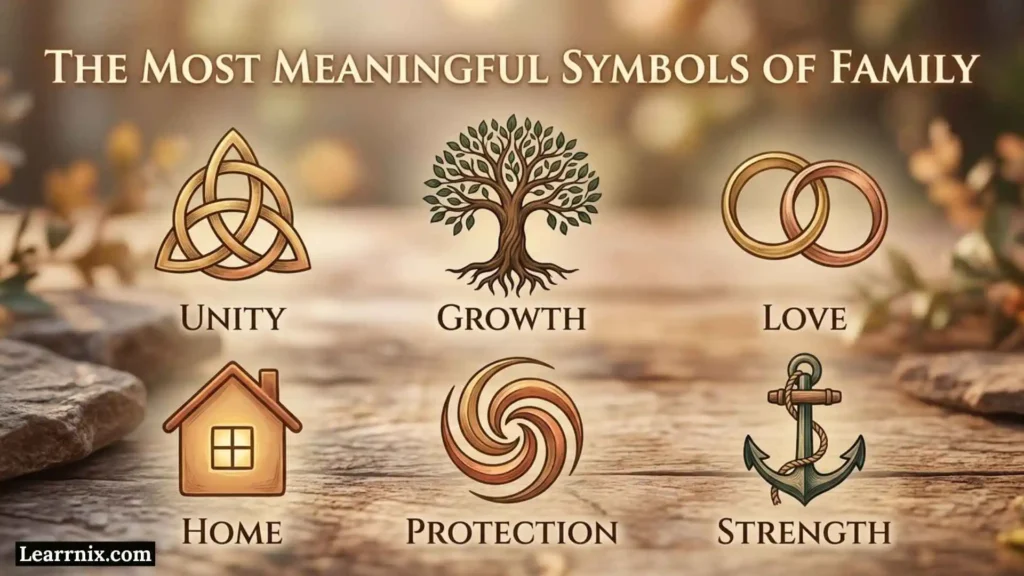
1. Family Tree
The family tree is probably the most direct visual representation of family relationships.
Its structure provides an easy metaphor for generations. Roots can represent ancestors, the trunk can represent a shared foundation, and branches can represent different family lines.
A family tree can symbolize:
- Ancestry
- Family history
- Generations
- Heritage
- Family roots
- Growth
- Legacy
- Continuity
It is especially useful for genealogy because real names, dates, and relationships can be added to the design.
Best for: people who want to represent ancestors, grandparents, parents, children, grandchildren, or family history.
2. Tree of Life
The Tree of Life is closely associated with ideas of growth, connection, roots, and continuity.
It can represent:
- Life
- Growth
- Strength
- Connection
- Roots
- Continuity
- Interdependence
- Generations
It is popular in tattoos, necklaces, artwork, and family gifts because it can communicate family connection without displaying a detailed genealogy.
However, its meaning is broader than family alone. In different cultural and religious contexts, the Tree of Life can carry additional meanings.
Best for: someone who wants a family symbol with broader ideas of growth and connection.
3. Heart
The heart is one of the simplest choices when the main message is family love.
It can symbolize:
- Love
- Affection
- Care
- Compassion
- Emotional connection
- Devotion
One heart can represent the whole family, while multiple hearts can represent individual family members.
A heart can also be combined with names, initials, dates, flowers, or a tree to create a more personal design.
Best for: expressing emotional love and affection.
4. Circle
A circle is a simple symbol of unity and togetherness.
Its continuous shape can suggest:
- Wholeness
- Unity
- Continuity
- Belonging
- Connection
Because it is visually simple, a circle works especially well for minimalist tattoos, jewelry, family logos, and modern artwork.
Best for: people who want a simple and understated symbol.
5. Roots
Roots are particularly powerful when the intended meaning is family heritage and ancestry.
They can represent:
- Ancestors
- Family origins
- Heritage
- Stability
- History
- Foundation
- Cultural identity
When combined with a tree, roots can represent the past while branches represent the future.
A useful way to remember the symbolism is:
Roots represent where a family comes from; branches represent how the family continues to grow.
6. House
A house is a natural symbol of home and family security.
It can represent:
- Safety
- Shelter
- Stability
- Belonging
- Childhood
- Family memories
- Home
A house becomes especially meaningful when it represents an actual family home, childhood residence, or place where important memories were created.
7. Joined Hands
Joined hands represent care and support within a family.
They can symbolize:
- Trust
- Protection
- Guidance
- Support
- Parenting
- Partnership
- Togetherness
A parent holding a child’s hand is particularly effective when the intended message is parental love and guidance.
8. Interlocking Rings
Interlocking rings symbolize separate individuals who remain connected.
They can represent:
- Unity
- Commitment
- Family bonds
- Partnership
- Connection
- Continuity
Unlike a family tree, rings do not show genealogy. Their main message is that people remain connected despite being individual members of the family.
9. Infinity Symbol
The infinity symbol is commonly used in modern family designs to suggest a relationship that continues without an end.
It can represent:
- Endless love
- Lifelong connection
- Continuity
- An enduring bond
- Unbreakable relationships
It is particularly suitable for bracelets, necklaces, tattoos, and minimalist designs.
10. Nest
A nest is an especially meaningful symbol for parents and children.
It can represent:
- Home
- Nurturing
- Protection
- Parenting
- Childhood
- Safety
- Growth
A nest with young birds creates a clear visual idea of parents protecting and raising the next generation.
11. Shield
A shield can represent the protective role that family members sometimes play for one another.
It may symbolize:
- Protection
- Strength
- Security
- Responsibility
- Courage
- Family identity
A personalized shield can include initials, dates, meaningful objects, or an original family motto.
It is important, however, not to confuse a modern decorative shield with historically documented heraldry.
12. Animal Family Symbols
Animals are frequently used in modern family artwork because their social or protective characteristics can serve as metaphors for family relationships.
Common examples include:
- Elephant families
- Lions with cubs
- Bears with cubs
- Birds with chicks
- Parent-and-child deer
- Wolf imagery
These designs can communicate protection, loyalty, parenting, strength, or belonging.
Their symbolic meaning should be treated as a metaphor, rather than assuming that every animal has one universal meaning across all cultures.
Symbols of Family Based on Meaning
Choosing a symbol based on its intended message is more useful than simply choosing the most popular design.
Symbols That Represent Family Love
Consider:
- Heart
- Linked hearts
- Joined hands
- Parent-and-child imagery
- Infinity symbol
Best simple choice: Heart.
Symbols That Represent Family Unity
Consider:
- Circle
- Interlocking rings
- Joined hands
- Braided designs
- Interwoven patterns
Best minimalist choice: Circle.
Symbols That Represent Family Roots
Consider:
- Family tree
- Roots
- Tree of Life
- Genealogy chart
Best choice: Family tree.
Symbols That Represent Family Protection
Consider:
- Shield
- House
- Bear
- Lion
- Elephant
- Parent-and-child imagery
Best abstract choice: Shield.
Symbols That Represent Family Growth
Consider:
- Tree
- Branches
- Seed
- Flowers
- Nest
Best choice: Tree.
Family Tree, Tree of Life, and Family Crest: What Is the Difference?
These three concepts are often confused.
| Feature | Family Tree | Tree of Life | Coat of Arms |
| Main idea | Family relationships | Growth and connection | Heraldic identity |
| Shows genealogy | Yes | Usually symbolically | Not necessarily |
| Represents ancestors | Strongly | Sometimes | May, depending on documented lineage |
| Requires family research | Helpful | No | Important for historical claims |
| Suitable for tattoos | Yes | Yes | Yes |
| Universal family symbol | No | No | No |
A family tree primarily represents genealogy.
A Tree of Life has broader meanings involving life, growth, connection, and continuity.
A coat of arms belongs to the historical tradition of heraldry and should not be treated as simply another decorative family symbol.
Family Crest vs. Coat of Arms
One of the most common mistakes in family symbolism is using crest and coat of arms as though they are exact synonyms.
Traditionally, a crest is one component of a complete heraldic achievement. A coat of arms refers to the armorial design associated with a particular person, family, institution, or other entitled body.
Does every surname have a family crest?
No.
Sharing a surname does not automatically mean that everyone with that surname is entitled to the same coat of arms.
This is important when researching family heritage. Commercial websites sometimes sell products featuring a surname alongside a heraldic design, but the existence of such a product does not prove that the design belongs to your particular family line.
If historical authenticity matters, genealogy should come first.
Historical and Cultural Context of Family Symbols
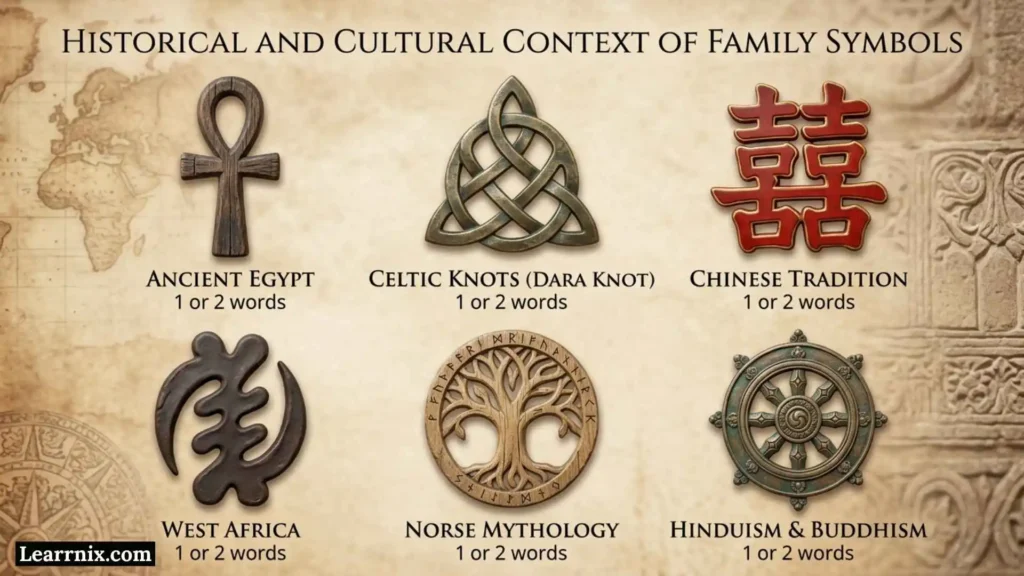
Family symbolism is found across cultures, but meanings are not universal.
Some symbols have documented historical uses, while others have acquired family-related meanings through modern design and popular culture.
For example, the tree is an understandable metaphor for roots, growth, and generations. However, that does not mean every tree design is an ancient official symbol of family.
The same distinction applies to Celtic-inspired knots, infinity symbols, animal imagery, and modern family logos.
It is helpful to separate three types of meaning:
Historical meaning: what the symbol meant in a documented historical setting.
Modern meaning: how people commonly interpret it today.
Personal meaning: what the symbol means to a particular family.
A modern symbol can be deeply meaningful without having an ancient origin.
How to Choose the Right Family Symbol
Step 1: Identify the Main Message
Ask yourself:
- Do I want to show family love?
- Do I want to honor my ancestors?
- Do I want to represent my children?
- Do I want to show family unity?
- Do I want to symbolize protection?
- Do I want to celebrate heritage?
- Do I want to remember someone?
- Do I want to represent my chosen family?
Step 2: Choose the Symbol Type
Choose from categories such as:
- Nature
- Animals
- Geometry
- Human figures
- Architecture
- Typography
- Heraldry
- Personalized designs
Step 3: Add Personal Details
A generic symbol can become much more meaningful by adding:
- Names
- Initials
- Birth dates
- Birth flowers
- Birthstones
- Important locations
- Family objects
- Meaningful animals
- Family mottos
Step 4: Check Historical Claims
If a design is described as:
- Ancient
- Celtic
- Norse
- Heraldic
- Religious
- Official
- Traditional
do not automatically assume the claim is accurate.
If history matters to your project, verify the original context before using the symbol.
Decision Guide: Which Family Symbol Should You Choose?
Use this simple guide to find the best option quickly.
Do you want to represent ancestry?
→ Choose a family tree or roots.
Do you want to represent love?
→ Choose a heart.
Do you want to represent unity?
→ Choose a circle or interlocking rings.
Do you want to represent protection?
→ Choose a shield, house, or protective animal.
Do you want to represent parents and children?
→ Choose joined hands, a nest, or parent-and-child imagery.
Do you want to represent generations?
→ Choose a family tree or Tree of Life.
Do you want to represent heritage?
→ Research your genealogy and documented heraldry.
Do you want something completely unique?
→ Create an original family emblem.
Family Symbols for Tattoos
Family symbols work well as tattoos because they can preserve an important relationship or memory in a compact design.
Popular choices include:
- Family tree
- Tree of Life
- Heart
- Birth flowers
- Children’s initials
- Important dates
- Infinity symbol
- Parent-and-child silhouettes
- Animal families
- Family motto
- Personalized emblem
How to Make a Family Tattoo More Personal
Instead of copying a generic design, combine symbols that have a direct connection to your family.
For example:
Tree + birth flowers + initials
can represent ancestry and individual family members.
House + location + date
can represent home and an important family memory.
Mountain + initials + date
can represent a shared place or experience.
This approach creates a design based on your family’s story rather than a generic symbol.
Family Symbols for Jewelry and Gifts
Small symbols are particularly effective for jewelry.
Popular options include:
- Tree of Life pendants
- Heart necklaces
- Initial charms
- Birthstone jewelry
- Engraved rings
- Interlocking circles
- Lockets
For family gifts, consider:
- Family tree artwork
- Personalized wall art
- Family name signs
- Family reunion items
- Memorial artwork
- Family photo displays
A personalized gift is usually more meaningful when the chosen symbol has a clear connection to the recipient’s family.
Symbols for Parents, Children, Siblings, and Generations
Parents and Children
Good choices include:
- Joined hands
- Parent-and-child silhouettes
- Nest
- Tree with young branches
- Adult animal with its young
- Heart surrounding a smaller heart
These designs emphasize protection, nurturing, and growth.
Siblings
Sibling designs can include:
- Matching circles
- Shared initials
- Linked hearts
- Stars
- Branches from one tree
- Matching animals
- A shared childhood location
The designs do not need to be identical. Related symbols can represent the same family bond while allowing each person to have an individual design.
Multiple Generations
For grandparents, parents, children, and grandchildren, the family tree is usually the most practical symbol because it can visually show relationships across generations.
Symbols for Chosen Family
Family does not always mean biological relatives.
Chosen family may include close friends, adoptive families, caregivers, mentors, or other people who provide lasting love and support.
For chosen family, useful symbols include:
- Circles
- Joined hands
- Linked hearts
- Interwoven designs
- Personalized emblems
The central idea is belonging, care, trust, and connection.
How to Create Your Own Family Symbol
You do not have to use an established symbol.
An original family emblem can sometimes be more meaningful because it is based on your family’s own story.
Start with five questions:
- What place is important to our family?
- What object reminds us of home?
- What value defines our family?
- What plant or animal has personal meaning?
- What memory should future generations remember?
Then combine two or three answers.
For example:
Tree + mountain + initials
= roots + meaningful place + family identity.
House + flower + date
= home + loved one + important memory.
Circle + names + family motto
= unity + identity + shared values.
This kind of original symbol does not need an ancient history to be meaningful.
Common Mistakes When Choosing a Family Symbol
Mistake 1: Assuming There Is One Universal Family Symbol
There is no single official symbol recognized by every culture as the symbol of family.
Mistake 2: Believing Every Online Symbol Has an Ancient Meaning
Symbolism websites sometimes repeat interpretations without explaining where those meanings came from.
If historical accuracy matters, verify the claim.
Mistake 3: Assuming a Surname Automatically Has a Coat of Arms
A shared surname does not prove that everyone with that surname belongs to the same heraldic lineage.
Mistake 4: Confusing a Crest With a Coat of Arms
A crest is traditionally one part of a heraldic achievement, not simply another term for the entire coat of arms.
Mistake 5: Choosing Appearance Before Meaning
A beautiful symbol is not necessarily the right family symbol.
Decide what you want the design to communicate first.
Mistake 6: Ignoring Cultural Context
A symbol connected to a particular culture should be understood within that culture instead of being reduced to a generic internet definition.
Family Symbol Selection Checklist
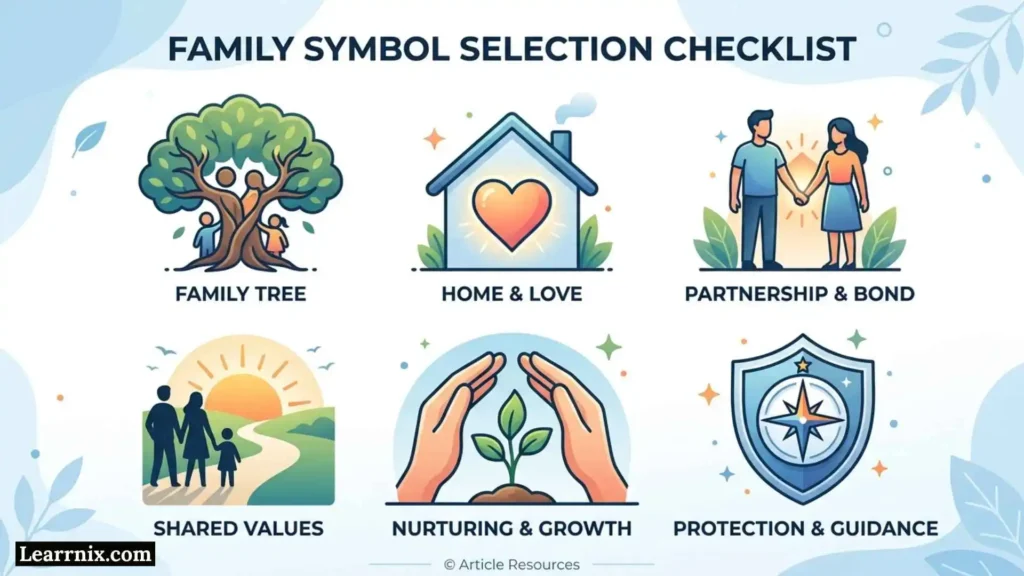
Before finalizing a family symbol, ask:
- Does the symbol represent the meaning I actually want?
- Can my family members understand why I chose it?
- Is the design connected to a real family memory?
- If I am claiming historical meaning, have I verified it?
- If I am using heraldry, have I researched my family lineage?
- Is the design simple enough for its intended use?
- Will it still make sense years from now?
- Am I using a cultural symbol respectfully?
- Could personal details make it more meaningful?
If you can answer “yes” to most of these questions, your choice is likely to be more meaningful than simply selecting the most popular family symbol.
Frequently Asked Questions About Symbols of Family
What is the most common symbol of family?
The family tree is one of the most recognizable symbols of family because it represents ancestry, relationships, generations, and family continuity.
What is the universal symbol of family?
There is no single universal official symbol of family. Different cultures and individuals use different symbols to express family love, unity, ancestry, and belonging.
What symbol represents family love?
The heart is the simplest and most widely understood symbol of family love and affection.
What symbol represents family unity?
A circle, interlocking rings, joined hands, or an interwoven design can represent family unity and connection.
What symbol represents family roots?
Roots and family trees are strong symbols of ancestry, heritage, origins, and previous generations.
What symbol represents family protection?
A shield, house, bear, lion, elephant, or parent-and-child design can represent protection and security.
What is the best family symbol for a tattoo?
It depends on the intended meaning. Choose a family tree for ancestry, a heart for love, a circle for unity, or a personalized emblem for a unique family story.
Is the Tree of Life a symbol of family?
It can be used as a family symbol because its roots and branches naturally suggest connection, growth, and generations. However, the Tree of Life has broader meanings in different cultural contexts.
Is a Celtic knot a symbol of family?
Celtic-inspired knots are often used in modern designs to represent connection and continuity. However, specific claims that a particular knot is an ancient universal “family symbol” should be treated carefully and verified.
Does every surname have a family crest?
No. Having a particular surname does not automatically mean that you have a right to a particular coat of arms.
Is a family crest the same as a coat of arms?
No. Traditionally, a crest is one component of a heraldic achievement, while a coat of arms refers to the broader armorial design.
Can I create my own family symbol?
Yes. An original symbol can combine family names, initials, places, dates, flowers, animals, objects, and values that have genuine meaning to your family.
Can a family symbol represent a chosen family?
Yes. Family symbols can represent people connected through love, trust, care, and belonging, regardless of whether they are biologically related.
Conclusion
There is no single universal symbol of family, but many symbols can communicate different aspects of family life.
Choose a family tree when you want to represent ancestry, roots, and generations. Choose a heart for love and affection. Choose a circle or interlocking rings for unity. Choose roots for heritage and origins. A house can represent home and security, while joined hands or a nest can symbolize parenting and protection.
If your goal is historical family heritage, take time to research genealogy before using a supposed coat of arms or family crest. A surname alone does not prove that a particular heraldic design belongs to your family.
For tattoos, jewelry, gifts, and artwork, personal meaning may matter more than historical age. A family symbol based on a childhood home, favorite flower, meaningful place, family initials, or shared memory can be far more personal than a generic design.
Ultimately, the best family symbol is not necessarily the oldest, most expensive, or most popular one. It is the symbol that honestly represents your family’s love, connection, history, identity, and shared memories

I am Michael Carter, an educational content creator who believes that knowledge has the power to transform lives.
I create resources focused on modern education, digital learning, and building essential skills for the future.
I love helping readers discover simple and effective ways to improve their learning journey.
Books by Michael Carter:
- Modern Education for Tomorrow’s World
- Learning Skills for Future Success
 Charlotte Anderson