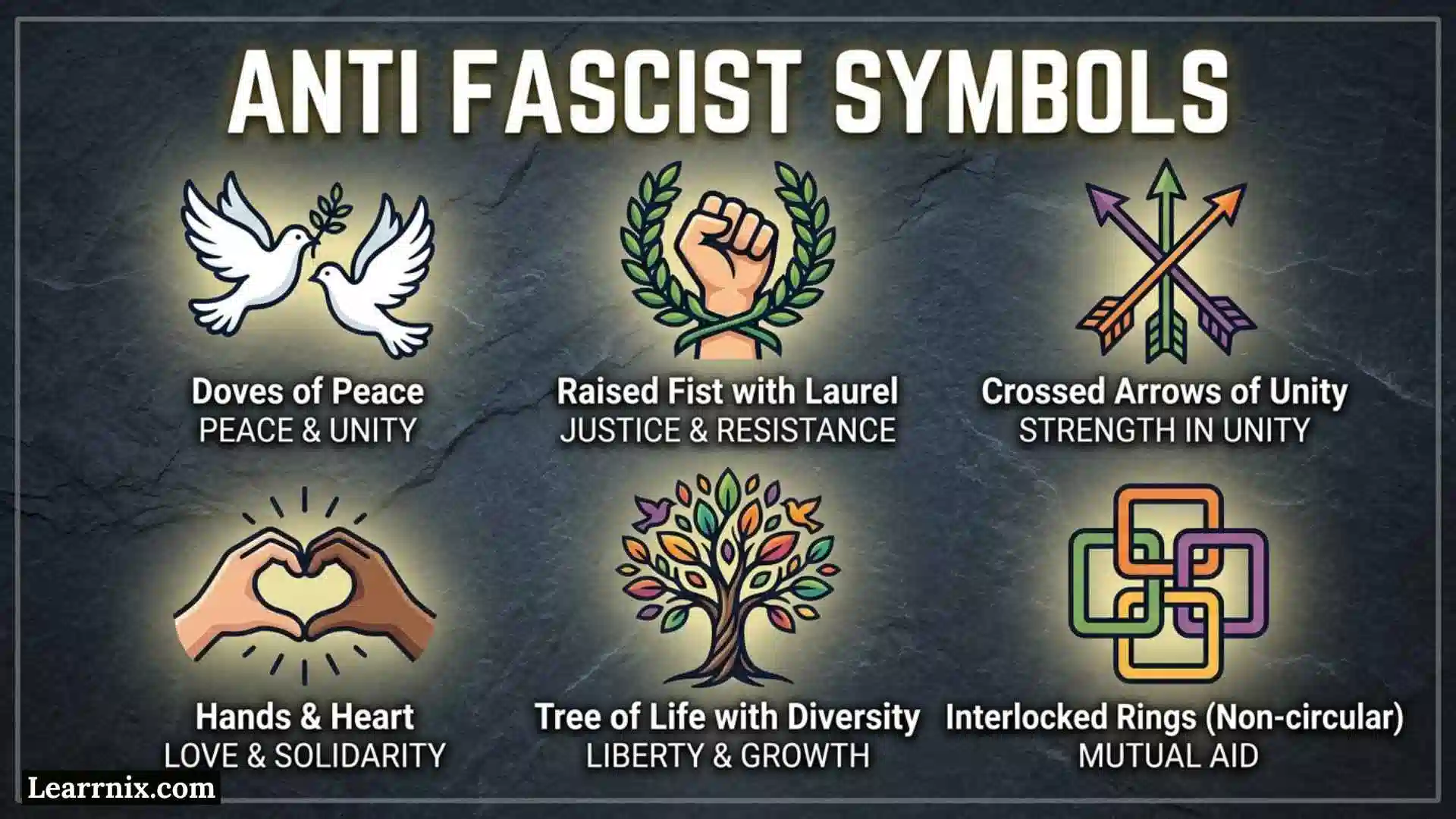
If you are searching for anti fascist symbols, you are likely trying to understand which signs, flags, emblems, and visual designs represent opposition to fascism, Nazism, authoritarianism, or far-right movements. The most important point is that there is no single universal anti-fascist symbol. Different organizations and historical movements have used different imagery, and some symbols have meanings that extend beyond anti-fascism.
Among the best-known examples are the two-flag Antifaschistische Aktion emblem, the Three Arrows associated with the Iron Front, and the raised fist, although the latter is a much broader symbol of resistance and solidarity.
Understanding the history behind these symbols matters. A symbol created in Germany in the early 1930s may have a very different original meaning from the one people attach to it today. This guide explains the major symbols, their origins, meanings, differences, modern uses, common misconceptions, and how to identify them accurately.
Quick Answer: What Are Anti Fascist Symbols?
Anti-fascist symbols are visual signs used to communicate opposition to fascism and, depending on the context, Nazism, political authoritarianism, racism, or other far-right movements.
There is no single official symbol shared by all anti-fascist movements.
| Symbol | Historical Association | Common Meaning Today |
| Two-flag Antifa emblem | Antifaschistische Aktion | Opposition to fascism |
| Three Arrows | Iron Front | Resistance to anti-democratic movements |
| Raised fist | Many resistance movements | Solidarity and resistance |
| Crossed-out Nazi imagery | Anti-Nazi campaigns | Rejection of Nazism |
| Red flag | Socialist and communist movements | Left-wing politics; meaning depends on context |
| Black flag | Anarchist traditions | Anarchism or anti-authoritarian politics |
| Circled A | Anarchist movement | Anarchism, sometimes used alongside anti-fascist imagery |
The key distinction is context. A symbol can appear at an anti-fascist demonstration without being exclusively an anti-fascist symbol.
The Two-Flag Antifaschistische Aktion Symbol
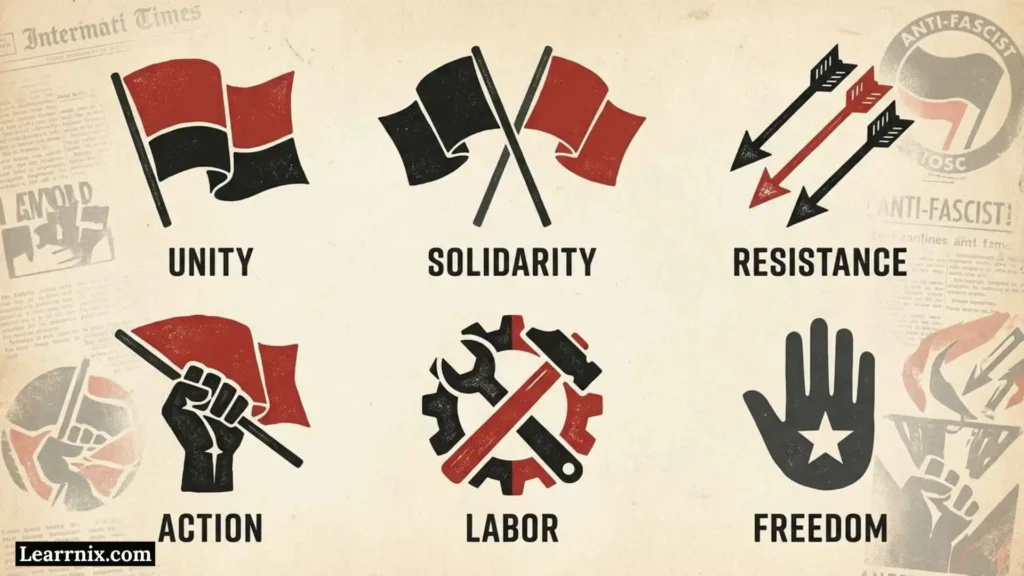
The two-flag emblem is one of the symbols most closely associated with Antifaschistische Aktion, often shortened to Antifa.
Its historical roots go back to Germany in 1932, when Antifaschistische Aktion used a recognizable emblem featuring two flags within a circular design. The Deutsches Historisches Museum identifies the symbol as having been designed by graphic artists Max Keilson and Max Gebhard.
The original historical design used two red flags. According to the JSTOR archival record from St. Lawrence University’s Richard F. Brush Art Gallery, the original flags represented cooperation between the Social Democratic Party (SPD) and Communist Party of Germany (KPD). Later versions, particularly from the 1980s onward, commonly used red and black flags.
What Does the Antifa Symbol Mean?
In its broadest modern sense, the emblem represents opposition to fascism.
However, its history is more specific than that simple definition suggests. The original organization existed within the political conflicts of late Weimar Germany, and later groups adopted and modified the imagery.
Modern versions can therefore communicate:
- Opposition to fascism
- Anti-Nazi politics
- Resistance to far-right movements
- Anti-racist activism
- Anti-authoritarian politics
- Political solidarity
The precise meaning depends on the group and context using it.
Is the Modern Antifa Logo the Same as the Original?
Not exactly.
The original 1932 design and modern versions are historically connected, but later movements changed the colors, surrounding circle, and presentation. JSTOR’s archival description notes that modern versions commonly show red and black flags, with the colors carrying socialist/communist and anarchist associations.
This is an important distinction because calling every modern version an unchanged historical emblem would oversimplify its development.
The Three Arrows of the Iron Front
The Three Arrows are another major symbol connected with anti-fascist history, but they originated from a different organization.
The Iron Front (Eiserne Front) was established in Germany in December 1931. It brought together the Social Democratic Party, free trade unions, workers’ sports organizations, and the Reichsbanner Schwarz-Rot-Gold in an effort to defend the Weimar Republic against growing anti-democratic forces.
Beginning in February 1932, the Iron Front used the Three Arrows as its unified symbol. The Deutsches Historisches Museum explains that the arrows could represent resistance to the three perceived threats of National Socialism, communism, and monarchism. They could also represent positive values such as activism, discipline, and unity.
Why Are the Three Arrows Important?
The Three Arrows demonstrate that anti-fascism was not historically one single political movement.
The Iron Front’s political position differed significantly from that of Communist organizations. Its purpose included defending the democratic republic against multiple anti-democratic threats.
That makes the Three Arrows different from the Antifaschistische Aktion emblem, even though both are now frequently discussed as anti-fascist symbols.
Antifaschistische Aktion vs. Iron Front
These two symbols are often confused because both emerged in Germany shortly before the Nazi seizure of power.
| Feature | Antifaschistische Aktion | Iron Front |
| Historical period | 1932 | 1931–1932 |
| Main symbol | Two flags | Three arrows |
| Political background | Communist-led anti-fascist organization | Social Democratic and trade-union coalition |
| Main historical purpose | Opposition to fascism | Defense of the Weimar Republic |
| Modern association | Antifa | Anti-fascist and democratic resistance |
The distinction is important for anyone writing about political history. Antifaschistische Aktion and the Iron Front were not simply two names for the same organization.
The Raised Fist as a Resistance Symbol
The raised fist is frequently seen in anti-fascist artwork, demonstrations, posters, and political movements.
But unlike the Antifaschistische Aktion emblem, the raised fist is not exclusively an anti-fascist symbol.
It has been used by many movements to communicate:
- Resistance
- Solidarity
- Strength
- Workers’ rights
- Anti-racism
- Political protest
- Social justice
This makes it a good example of why context matters when identifying symbols.
A raised fist appearing next to an Antifa emblem may communicate anti-fascist solidarity. The same raised fist appearing in a labor movement may primarily communicate workers’ solidarity.
The image alone does not always tell the entire story.
Crossed-Out Nazi and Fascist Imagery
Another straightforward form of anti-fascist symbolism is the use of a cross, slash, or prohibition mark over fascist or Nazi imagery.
The meaning is usually direct:
The symbol being crossed out is rejected.
The technique is especially useful in posters, educational material, demonstrations, and political artwork because viewers can understand the message without needing to know the entire history of the organization behind it.
The Iron Front’s Three Arrows are particularly significant in this respect because their visual form could be used to cross out opposing political symbols. The Deutsches Historisches Museum describes the arrows as a visual counter-design to the Nazi swastika.
Anti-Nazi Symbols vs. Anti-Fascist Symbols
These terms overlap, but they should not automatically be treated as identical.
Anti-Nazi Symbols
These specifically communicate opposition to Nazism, the ideology and political movement associated with Adolf Hitler’s National Socialist German Workers’ Party.
Examples can include imagery that crosses out or rejects Nazi symbols.
Anti-Fascist Symbols
These have a broader focus on opposition to fascism, which encompasses a wider historical category of authoritarian ultranationalist movements.
A symbol can therefore be:
- Specifically anti-Nazi
- Broadly anti-fascist
- Both anti-Nazi and anti-fascist
- Associated with a wider anti-authoritarian movement
The distinction becomes particularly important in historical writing.
Anti Fascist Symbols and Anarchist Symbols
Anarchist imagery frequently appears alongside anti-fascist symbols, but the two categories should not be confused.
The circled A, for example, is primarily an anarchist symbol.
It can appear in anti-fascist settings because some anti-fascist activists and groups have anarchist or autonomist political backgrounds. But the circled A itself does not mean “Antifa.”
The same applies to the black flag. It has a long association with anarchist politics and can appear alongside anti-fascist imagery.
Why Does Red and Black Appear in Antifa Imagery?
Modern Antifa designs frequently use red and black.
The colors can reflect different political traditions: red has long associations with socialist and communist movements, while black is strongly associated with anarchist traditions. JSTOR’s archival description specifically notes these associations in modern Antifa imagery.
That does not mean every red-and-black design is an Antifa symbol.
Colors alone are not enough to identify a political symbol.
Historical Background: Why These Symbols Emerged
The strongest historical roots of several well-known anti-fascist symbols are found in the political crisis of Weimar Germany.
During the early 1930s, political violence and conflict intensified as National Socialism gained support. The political environment included clashes among Nazis, communists, social democrats, monarchists, and other political groups.
The Deutsches Historisches Museum records severe political violence during the 1932 election period, including the Altona Bloody Sunday clashes in July 1932, when 18 people were killed.
Against this background, different political organizations created their own visual identities and symbols.
Antifaschistische Aktion in 1932
Antifaschistische Aktion emerged in 1932, and its famous emblem was designed by Max Keilson and Max Gebhard. The Deutsches Historisches Museum preserves a 1932 Antifaschistische Aktion poster, demonstrating the symbol’s historical use during the Weimar period.
The Iron Front in 1931
The Iron Front was founded in December 1931 as a coalition of organizations seeking to defend the democratic republic. Its Three Arrows became a standardized symbol during the 1932 election campaign.
These two histories show why it is inaccurate to describe all anti-fascist symbolism as originating from one movement.
How to Identify an Anti Fascist Symbol Correctly
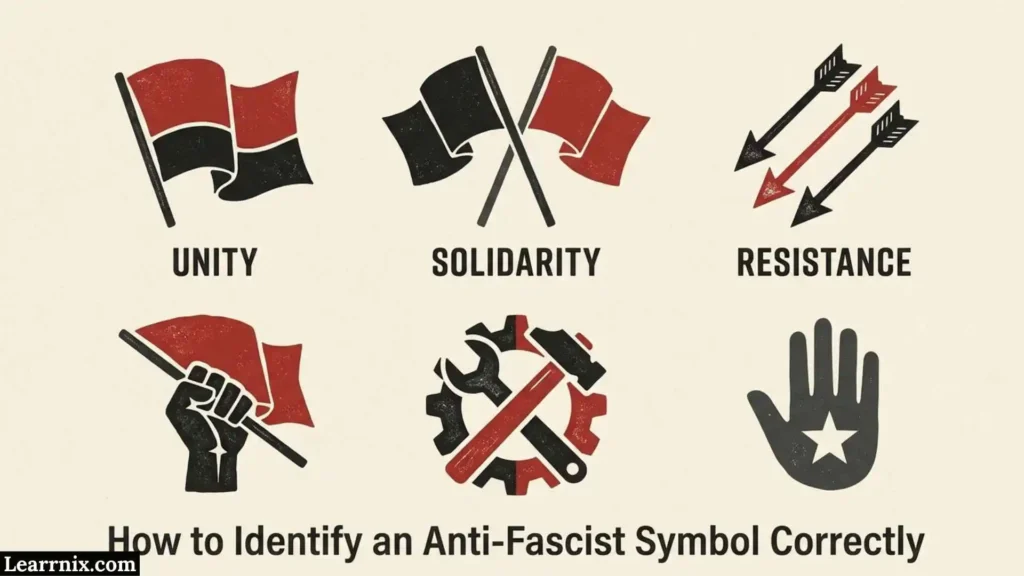
If you encounter an unfamiliar symbol, do not rely only on a list of images. Use a simple research process.
Step 1: Examine the Entire Design
Look at:
- Flags
- Arrows
- Letters
- Circles
- Colors
- Text
- Additional imagery
A single element may have many meanings.
Step 2: Find the Historical Period
Ask when the symbol appeared.
Was it associated with:
- Weimar Germany?
- World War II?
- Postwar Europe?
- The Cold War?
- Modern protest movements?
Dating a symbol can eliminate many incorrect interpretations.
Step 3: Identify the Organization
If you can connect a symbol to an organization, its meaning becomes much easier to establish.
For example:
Two flags → Antifaschistische Aktion
Three arrows → Iron Front
These connections are supported by historical museum and archival records.
Step 4: Compare Historical and Modern Meanings
A symbol may have changed after being adopted by later movements.
Always distinguish:
Original meaning → Later interpretation → Current use
That three-stage approach is one of the safest ways to research political symbolism.
Quick Decision Guide
Use this simple guide when identifying common imagery:
Do you see two flags inside a circular design?
→ It may be associated with Antifaschistische Aktion / Antifa.
Do you see three diagonal arrows?
→ It may be the Iron Front Three Arrows.
Do you see a raised fist?
→ It probably represents resistance or solidarity, but it is not exclusively anti-fascist.
Do you see a circled A?
→ It is primarily associated with anarchism.
Do you see Nazi imagery crossed out?
→ The design most likely communicates rejection of Nazism.
Do you see only red and black colors?
→ Do not identify it from color alone; examine the complete design and context.
Common Misconceptions About Anti Fascist Symbols
There Is One Official Anti-Fascist Symbol
There is no single universal emblem representing every anti-fascist organization or person.
Different movements have developed different visual languages.
Antifa Is One Centralized Organization
The term antifa is used in different countries and contexts for anti-fascist activism. Modern anti-fascist networks can be decentralized and politically diverse. The historical Antifaschistische Aktion organization should not automatically be treated as identical to every modern group using related imagery.
The Three Arrows Are the Original Antifa Logo
They are not.
The Three Arrows are associated with the Iron Front, while the two-flag emblem is associated with Antifaschistische Aktion.
Every Red-and-Black Symbol Means Antifa
Not necessarily.
Red and black have broader socialist, communist, anarchist, and political meanings.
Every Raised Fist Is Anti-Fascist
No.
The raised fist is a much broader resistance and solidarity symbol.
Political Symbols Always Have One Meaning
They do not.
Meaning depends on history, organization, geography, time period, and context.
How These Symbols Are Used Today
Anti-fascist imagery can appear in:
- History books
- Museum collections
- Educational materials
- Political posters
- Demonstrations
- Stickers
- Street art
- Clothing
- Tattoos
- Digital artwork
- Memorial projects
A modern use does not necessarily reproduce the original historical meaning exactly.
For example, contemporary Antifa imagery may adapt the original two-flag design to communicate opposition to racism, sexism, homophobia, environmental destruction, capitalism, or other political concerns. JSTOR’s archival collection documents several such adaptations.
Practical Tips for Using Historical Anti-Fascist Symbols
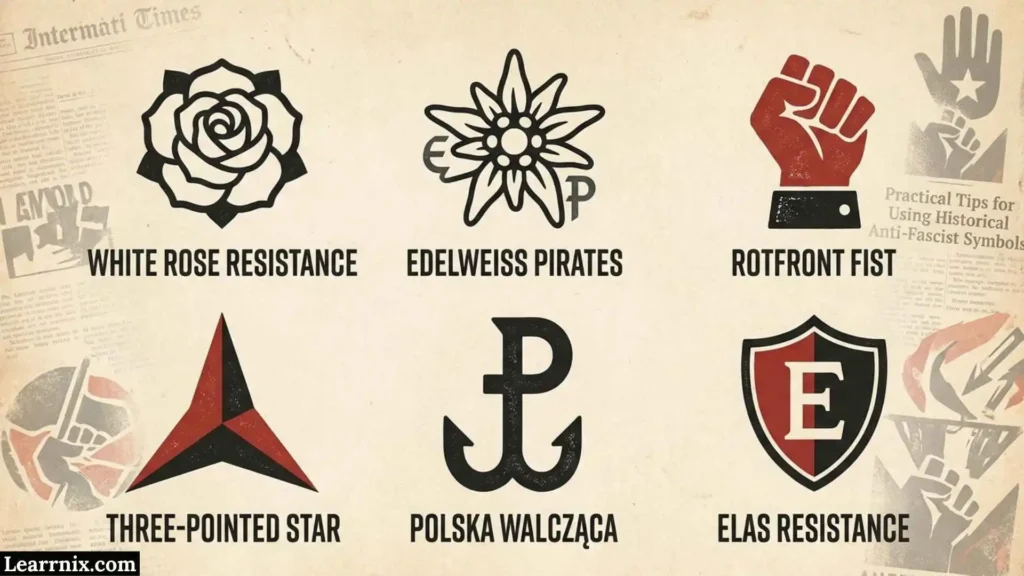
If you are researching or using one of these symbols for an article, school project, artwork, tattoo, or historical display, keep these principles in mind.
Verify the Origin
Do not repeat claims such as “this is an ancient anti-fascist symbol” without evidence.
Separate History From Modern Interpretation
Explain what the symbol originally meant and then explain how later groups use it.
Name the Organization
If a symbol belongs to a particular historical organization, naming that organization makes the explanation more precise.
Avoid Treating Colors as Definitions
Red, black, and other colors can have multiple political meanings.
Consider the Audience
A historical symbol in a museum may be educational, while the same symbol on a contemporary protest banner may communicate an active political position.
Anti Fascist Symbols Comparison Table
| Symbol | Origin | Main Historical Association | Exclusively Anti-Fascist? |
| Two-flag emblem | Germany, 1932 | Antifaschistische Aktion | Closely associated, but modern uses vary |
| Three Arrows | Germany, 1932 | Iron Front | No; historically broader |
| Raised fist | Multiple movements | Resistance and solidarity | No |
| Circled A | Modern anarchist tradition | Anarchism | No |
| Red flag | 19th–20th century labor movements | Socialism and communism | No |
| Black flag | Anarchist tradition | Anarchism and anti-authoritarianism | No |
| Crossed-out Nazi symbol | Anti-Nazi resistance and later campaigns | Rejection of Nazism | More specifically anti-Nazi |
Frequently Asked Questions About Anti Fascist Symbols
What is the most recognizable anti-fascist symbol?
The two-flag Antifaschistische Aktion emblem is among the most recognizable symbols associated with anti-fascist activism. Its historical roots date to Germany in 1932.
What do the Three Arrows symbolize?
The Three Arrows were the symbol of the Iron Front. They could represent resistance to National Socialism, communism, and monarchism, or broader values such as activism, discipline, and unity.
When was the Antifa symbol created?
The historical two-flag Antifaschistische Aktion design dates to 1932. The Deutsches Historisches Museum identifies Max Keilson and Max Gebhard as its designers.
Is the raised fist an anti-fascist symbol?
It can be used in anti-fascist contexts, but it is not exclusively anti-fascist. It has been used by many resistance, labor, civil-rights, and social movements.
Is the circled A an Antifa symbol?
The circled A is primarily an anarchist symbol. It can appear alongside anti-fascist imagery, but it should not automatically be identified as an Antifa emblem.
Are the Iron Front and Antifaschistische Aktion the same?
No. They were separate political formations with different backgrounds and organizations. The Iron Front was associated with Social Democrats, trade unions, workers’ organizations, and the Reichsbanner, while Antifaschistische Aktion was associated with the Communist Party of Germany.
Are anti-Nazi and anti-fascist symbols the same?
Not always. Anti-Nazi symbolism specifically targets Nazism, while anti-fascist symbolism can oppose fascism more broadly.
Why are red and black common in modern Antifa imagery?
Modern versions of the two-flag emblem commonly use red and black. These colors have associations with socialist/communist and anarchist traditions respectively.
Can one symbol have multiple political meanings?
Yes. Political symbolism changes over time and between groups. The surrounding text, organization, location, and historical period can all change how a symbol is understood.
How can I verify an unfamiliar anti-fascist symbol?
Start with reputable museum archives, university collections, historical organizations, and scholarly sources. Identify the symbol’s date, organization, original purpose, and later adaptations rather than relying on an unattributed image.
Key Takeaways
- There is no single universal anti-fascist symbol.
- The two-flag Antifaschistische Aktion Emblem originated in Germany in 1932.
- The Three Arrows were associated with the Iron Front and became its standardized symbol in 1932.
- Antifaschistische Aktion and the Iron Front were different historical organizations.
- The raised fist represents resistance and solidarity but is not exclusively anti-fascist.
- The circled A is primarily an anarchist symbol.
- Red and black can have several political meanings and should not be interpreted in isolation.
- Anti-Nazi symbolism specifically targets Nazism, while anti-fascist symbolism can have a broader scope.
- Historical meaning and modern usage are not always identical.
- The most reliable way to identify political symbolism is to examine its design, date, organization, historical context, and modern use.
Conclusion
Anti fascist symbols have different origins, meanings, and political histories. The two-flag Antifaschistische Aktion emblem is closely connected to anti-fascist organizing in Germany in 1932, while the Three Arrows came from the Iron Front’s effort to defend the Weimar Republic against multiple anti-democratic threats.
Other imagery, such as the raised fist, red flag, black flag, and circled A, can appear in anti-fascist settings but has broader meanings of its own.
The most important lesson is that a symbol should never be interpreted from its appearance alone. Its historical period, organization, colors, surrounding imagery, and modern context all matter.
For readers researching these symbols, the best approach is to distinguish original historical meaning from later interpretations and to rely on museum archives, academic collections, and other authoritative sources. That makes it possible to understand anti-fascist symbolism without reducing a complicated history to a simple list of images.

I am Daniel Harper, an education enthusiast and writer who enjoys creating helpful content to make learning more accessible and engaging.
I focus on sharing knowledge about effective study methods, educational growth, and skills that help learners succeed in a changing world.
Through my writing, I aim to inspire students to explore new ideas and develop a passion for learning.
Books by Daniel Harper:
- The Path to Lifelong Learning
- Unlocking Your Learning Potential
 Michael Carter
 Charlotte Anderson