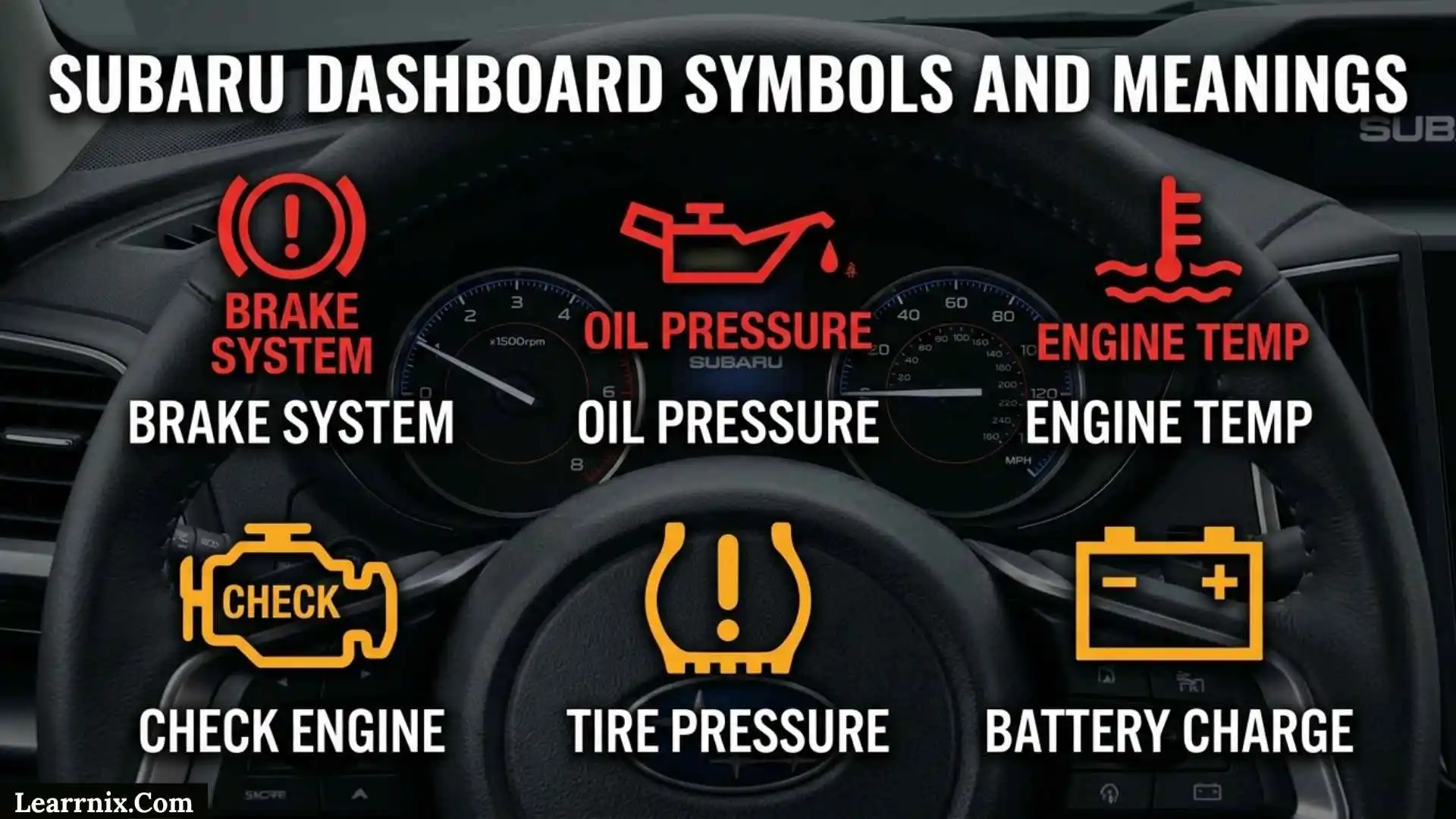
If a warning symbol appears on your Subaru dashboard, the first question is usually simple: What does this light mean, and do I need to stop driving?
The answer depends on the symbol, its color, whether it is flashing or steady, and the specific Subaru model and model year. Subaru vehicles use dashboard indicators for everything from low tire pressure and an open door to engine, brake, oil-pressure, airbag, charging, transmission, and stability-control problems.
This guide explains the most common Subaru dashboard symbols and meanings in plain English. It also explains which lights are urgent, which ones may allow you to continue driving, why several lights appear when you start the vehicle, common mistakes drivers make, and how to decide what to do when you see an unfamiliar symbol.
Because dashboard equipment varies between Subaru models, trims, and model years, your vehicle’s owner’s manual remains the final authority for a specific warning. Subaru’s manuals show that warning and indicator lights can differ according to the equipment installed in the vehicle.
Quick Answer: What Do Subaru Dashboard Lights Mean?
Subaru dashboard symbols generally fall into four broad color categories:
| Light color | General meaning | What you should do |
| Red | Serious warning or safety-related condition | Stop safely when the situation requires it and investigate |
| Yellow/Amber | Fault, caution, or maintenance-related warning | Check the cause and arrange service when necessary |
| Green | System or feature is operating | Usually informational |
| Blue | System status or operating condition | Usually informational |
Color is useful, but it is not enough by itself. A yellow warning can still represent an important fault, while a flashing warning can require a more urgent response than a steady light.
For example, Subaru specifically says a flashing Check Engine light requires the vehicle to be stopped as soon as safely possible and towed to a Subaru dealership. Subaru also says an oil-pressure warning indicates low or no engine oil pressure and requires the engine to be shut off as soon as safely possible.
The three things to check first
Whenever a Subaru dashboard symbol appears, ask:
- What does the symbol look like?
- What color is it?
- Is it steady or flashing?
Then check the owner’s manual for your exact Subaru.
Subaru Dashboard Symbols at a Glance
The following table provides a practical starting point for the most common Subaru warning and indicator lights.
| Subaru dashboard symbol | Typical color | Meaning | Driving urgency |
| Check Engine | Yellow/Amber | Engine or emissions-system fault | Depends on steady/flashing |
| Oil Pressure | Red | Low or no engine oil pressure | Stop safely |
| Engine Low Oil Level | Yellow/Amber | Engine oil level is too low | Check oil promptly |
| Battery/Charge | Red | Charging-system problem | Service immediately |
| Brake | Red | Brake-system or parking-brake warning | Check immediately |
| ABS | Yellow/Amber | ABS fault | Service promptly |
| Tire Pressure | Yellow/Amber | One or more tires may have low pressure | Check tires |
| SRS Airbag | Red/Amber depending on model | Airbag/restraint-system fault | Service promptly |
| Seat Belt | Red | Seat belt not fastened | Fasten belt |
| AT OIL TEMP | Red/Amber depending on model | Automatic/CVT transmission temperature warning | Reduce load/check manual |
| VDC/Traction | Yellow/Amber | Stability/traction system operating or fault | Depends on indicator behavior |
| AWD | Yellow/Amber | All-wheel-drive system warning | Check manual/service |
| Coolant Temperature | Blue/Red or model-specific | Coolant temperature/status | Red/overheating requires action |
| Low Fuel | Yellow/Amber | Fuel level is low | Refuel |
| Washer Fluid | Yellow/Amber | Washer fluid is low | Refill |
| Door Open | Red/Amber depending on model | Door or applicable panel is open | Close securely |
| High Beam | Blue | High beams are active | Normal indicator |
| Headlights | Green/Blue depending on system | Lighting system is active | Normal indicator |
This is a general guide, not a universal symbol chart for every Subaru. Subaru owner manuals include different combinations of warning and indicator lights depending on vehicle equipment.
Also Check This Post: 83+ Lord of the Rings Symbols Explained: From Rings to Runes
Red Subaru Dashboard Warning Lights
Red lights deserve special attention because they commonly indicate conditions that can affect vehicle safety or cause mechanical damage if ignored.
A red light does not automatically mean the vehicle must be abandoned immediately, but it should never be dismissed simply because the Subaru continues to drive normally.
Oil Pressure Warning Light
Symbol: Usually an oil can with a drop of oil.
Meaning: The engine may have low or no oil pressure.
This is one of the most important Subaru dashboard warnings. Oil pressure is necessary to circulate engine oil through the lubrication system. If pressure is too low, continued operation can cause serious engine damage.
Subaru’s warning-light guidance says that when the oil-pressure warning appears, the driver should stop as soon as safely possible, switch off the engine, and have the vehicle towed to a Subaru dealership.
What to do:
- Find a safe place to stop.
- Turn the engine off.
- Do not continue driving simply because the engine sounds normal.
- If appropriate for your model, check the oil level after parking safely.
- If the oil level is correct but the warning remains, professional diagnosis is needed.
Important distinction: An oil-pressure warning and a low-oil-level warning are not necessarily the same problem.
Battery or Charge Warning Light
Symbol: Battery-shaped icon.
Meaning: The vehicle’s charging system may not be working correctly.
The battery itself is not necessarily the only component involved. The charging system includes components that keep the electrical system supplied while the engine is running.
Subaru advises that a charge warning indicates the charging system is not working properly and should be checked or repaired immediately.
What to do:
- Reduce unnecessary electrical loads where practical.
- Avoid assuming the light will disappear on its own.
- Arrange professional inspection promptly.
- If the vehicle begins losing electrical power or shows other serious symptoms, stop safely and seek assistance.
Brake System Warning Light
Symbol: Often an exclamation mark inside a circle or a brake-related symbol.
Meaning: Depending on the Subaru model, the warning can relate to the parking brake, brake fluid, or another brake-system condition.
The exact meaning should be confirmed using the vehicle’s manual.
First check: Make sure the parking brake is fully released.
If the warning remains on after the parking brake is released, do not assume everything is fine.
Seek immediate assistance if:
- The brake pedal feels abnormal.
- Braking performance changes.
- Brake fluid appears to be leaking.
- The warning remains illuminated.
- Another brake-related warning appears at the same time.
A brake warning is not something to diagnose solely from the dashboard symbol.
Seat Belt Warning Light
Symbol: Person sitting with a seat belt.
Meaning: A seat belt is not properly fastened.
Subaru vehicles use seat-belt warnings and, on applicable vehicles, an audible reminder. Subaru owner documentation describes the warning as part of the vehicle’s safety reminder system.
What to do: Fasten the driver’s and passengers’ seat belts before continuing.
If the warning remains on even though everyone is buckled, check the owner’s manual because passenger detection systems and model-specific conditions can affect the warning.
SRS Airbag Warning Light
Symbol: A seated person with an airbag in front.
Meaning: The Supplemental Restraint System may have detected a problem.
This warning is particularly important because the SRS system can involve airbags and seat-belt pretensioners.
Subaru documentation states that if the SRS warning light comes on while driving or fails to turn off after the engine starts, the system may not be functioning properly and should be checked.
What to do: Arrange professional inspection promptly rather than repeatedly resetting the warning.
Yellow and Amber Subaru Warning Lights
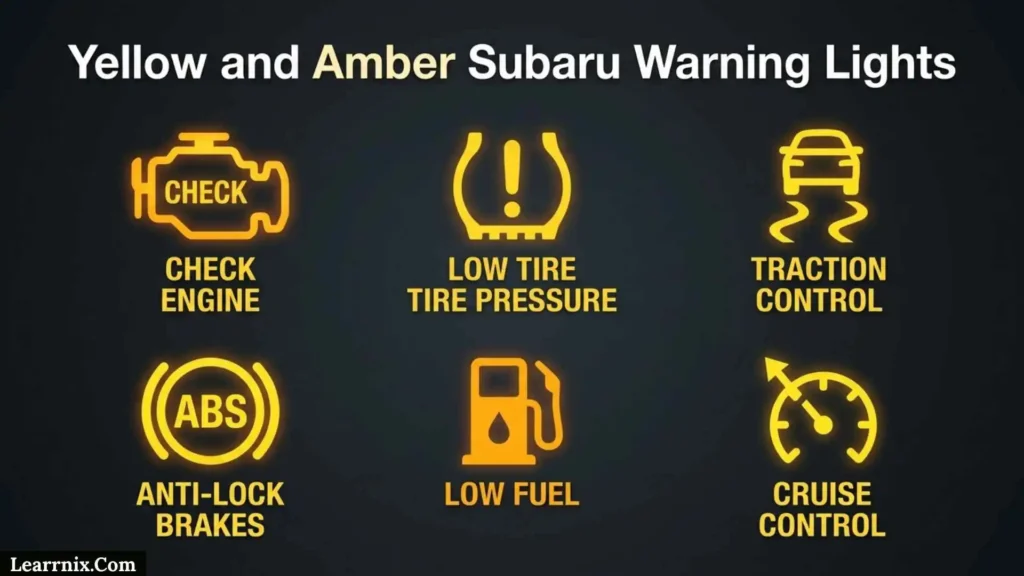
Yellow or amber indicators commonly mean caution, a detected fault, or a condition requiring attention.
They are not automatically harmless.
Check Engine Light
Symbol: Engine-shaped icon.
Official name: Check Engine warning light or malfunction indicator lamp.
This is one of the most searched Subaru dashboard warnings because it can have many possible causes.
Subaru Canada explains that the light can indicate an emissions-control problem. It may illuminate steadily in some situations, while a flashing light is treated as much more urgent.
Solid Check Engine Light
A steady Check Engine light does not necessarily mean the engine is about to fail.
Subaru notes that a solid warning can sometimes be associated with a loose or missing fuel cap, although the owner’s manual should be consulted for the particular vehicle.
What to do:
- Check whether the fuel cap is properly installed if your Subaru uses one.
- Pay attention to unusual noises, smells, vibration, or changes in performance.
- Arrange diagnostic testing if the light remains on.
Flashing Check Engine Light
A flashing Check Engine light is a different situation.
Subaru specifically advises drivers to stop as soon as safely possible and have the vehicle towed to the closest Subaru dealership.
Do not treat a flashing Check Engine light like a normal maintenance reminder.
ABS Warning Light
Symbol: “ABS” inside a circle.
Meaning: The anti-lock braking system has detected a fault.
ABS helps prevent wheel lock during hard braking. If the ABS warning remains illuminated, the ABS function may not be available even though conventional braking may still operate.
What to do:
- Drive cautiously if braking feels normal.
- Avoid aggressive braking.
- Arrange an inspection promptly.
- If the brake pedal feels abnormal or another brake warning appears, stop driving and seek assistance.
The exact behavior can vary by model, so consult the owner’s manual.
Tire Pressure Warning Light
Symbol: A tire-shaped outline with an exclamation mark.
Meaning: The tire-pressure monitoring system has detected a pressure issue.
This warning should not be ignored because incorrect tire pressure can affect handling, braking, tire wear, and efficiency.
What to do:
- Reduce speed if a tire appears damaged.
- Check all tires.
- Measure pressure with a reliable gauge.
- Inflate them to the pressure specified for your vehicle.
- Inspect for punctures or leaks.
- Follow the vehicle-specific instructions if the warning does not clear.
Do not use the tire’s appearance alone to determine whether pressure is correct.
VDC or Traction Control Warning
Subaru uses Vehicle Dynamics Control (VDC) for its electronic stability-control system on applicable vehicles.
The system can help maintain control when the vehicle detects conditions associated with loss of traction or stability.
Subaru explains that a VDC indicator can illuminate when the system has been deliberately switched off. If the indicator remains steadily illuminated or appears together with the Check Engine light, it may indicate a fault requiring professional inspection.
What if the VDC light flashes?
A flashing stability-control indicator can mean the system is actively intervening to help maintain traction.
That is different from a warning light that stays illuminated continuously.
Practical tip: If the road is slippery and the indicator flashes briefly while the vehicle remains controllable, the system may simply be doing its job.
AWD Warning Light
Symbol: AWD-related warning indicator.
Meaning: A problem may have been detected in the all-wheel-drive system.
Subaru manuals list AWD warning lights on applicable models.
Because AWD systems differ between models, the correct response depends on the exact Subaru and the circumstances.
What to do: Check the owner’s manual and have the system inspected if the warning remains.
AT OIL TEMP Warning Light
Symbol: “AT OIL TEMP” or a transmission-temperature symbol.
Meaning: On applicable automatic/CVT-equipped Subaru vehicles, the transmission fluid may be too hot.
Subaru documentation explains that illumination while driving can indicate excessive automatic transmission fluid temperature. Older Subaru manuals specifically advise avoiding steep grades or stop-and-go traffic when this warning appears.
A flashing transmission-related warning after starting can have a different meaning and may indicate a transmission-control problem.
Do not assume that every AT OIL TEMP warning has the same cause.
Engine Low Oil Level Warning
This warning should not be confused with the oil-pressure warning.
The low-oil-level warning indicates that the engine oil level has fallen below the acceptable range on applicable vehicles. Subaru’s guidance says to safely park on a level surface and check the oil, adding oil if necessary.
Key difference:
- Oil level warning: There may not be enough oil in the engine.
- Oil pressure warning: The lubrication system may not be maintaining adequate pressure.
The second situation is potentially much more urgent.
Green and Blue Subaru Dashboard Indicators
Not every dashboard symbol means something is broken.
Green and blue indicators commonly tell you that a feature is active or that the vehicle is in a particular operating state.
High Beam Indicator
Symbol: Blue headlamp.
Meaning: High-beam headlights are active.
This is normally a status indicator rather than a warning.
What to do: Switch to low beams when appropriate for traffic and road conditions.
Headlight and Lighting Indicators
Depending on the vehicle, Subaru may display indicators showing that headlights or other lighting functions are active.
These lights help the driver understand what the vehicle is doing rather than alerting the driver to a mechanical failure.
Coolant Temperature Indicator
Some Subaru models use a temperature indicator that can communicate coolant temperature status.
A cold-engine indicator and a high-temperature warning should not be interpreted the same way.
If the temperature warning indicates overheating, follow the owner’s manual instructions and stop safely when required.
Why Do Subaru Dashboard Lights Come On When Starting the Car?
Seeing several lights illuminate when you switch on the ignition does not automatically mean something is wrong.
Subaru owner manuals explain that several warning and indicator lights illuminate temporarily as part of a system or bulb check. They should then turn off after the check or after the engine starts, depending on the system.
This is useful because it gives the driver an opportunity to see whether the dashboard warning lamps are functioning.
When should you be concerned?
Pay attention when:
- A warning remains on after startup.
- A warning appears while driving.
- A warning begins flashing.
- Several warnings appear unexpectedly.
- The vehicle behaves differently at the same time.
A light that briefly appears during startup and then disappears is not necessarily the same situation as one that remains illuminated.
Can You Drive With a Subaru Warning Light On?
There is no universal yes-or-no answer.
The correct decision depends on the warning.
Stop or seek immediate assistance
Take a warning especially seriously when it involves:
- Oil pressure
- Serious brake-system problems
- Overheating
- A flashing Check Engine light
- Charging-system failure accompanied by other symptoms
- Any warning accompanied by unsafe vehicle behavior
Subaru specifically recommends stopping for an oil-pressure warning and for a flashing Check Engine warning.
Drive cautiously and arrange service
Some warnings may allow limited driving when the vehicle feels normal, but still require prompt inspection.
Examples can include:
- Solid Check Engine light
- ABS warning
- Tire-pressure warning
- Some stability-control warnings
- Some transmission warnings
The owner’s manual should determine the appropriate response.
Usually informational
Some indicators simply show that a feature is operating.
Examples include:
- High-beam indicator
- Certain headlight indicators
- Certain system-status indicators
Also Check This Post: 73+ Easter Symbols: Easy Symbols to Learn for Beginners
Subaru Dashboard Warning Light Decision Tree
Use this quick decision guide when you do not know what to do.
A dashboard symbol appears.
↓
Is it red?
→ Yes: Check the exact symbol immediately.
→ Oil pressure, serious brake, overheating, or another critical warning?
Stop safely and follow the owner’s manual.
→ No: Continue to the next question.
↓
Is the light flashing?
→ Yes: Treat it as more urgent than a steady warning. Check the manual and stop safely if the warning indicates a serious fault.
→ No: Continue.
↓
Is it yellow or amber?
→ Yes: Identify the system and arrange inspection or corrective action as required.
↓
Is it green or blue?
→ Usually: It is an operating/status indicator rather than a fault.
↓
Still unsure?
→ Check the owner’s manual for your exact Subaru model and year.
This decision tree is a starting point, not a substitute for the vehicle’s manufacturer instructions.
Subaru Dashboard Symbols by Problem Type
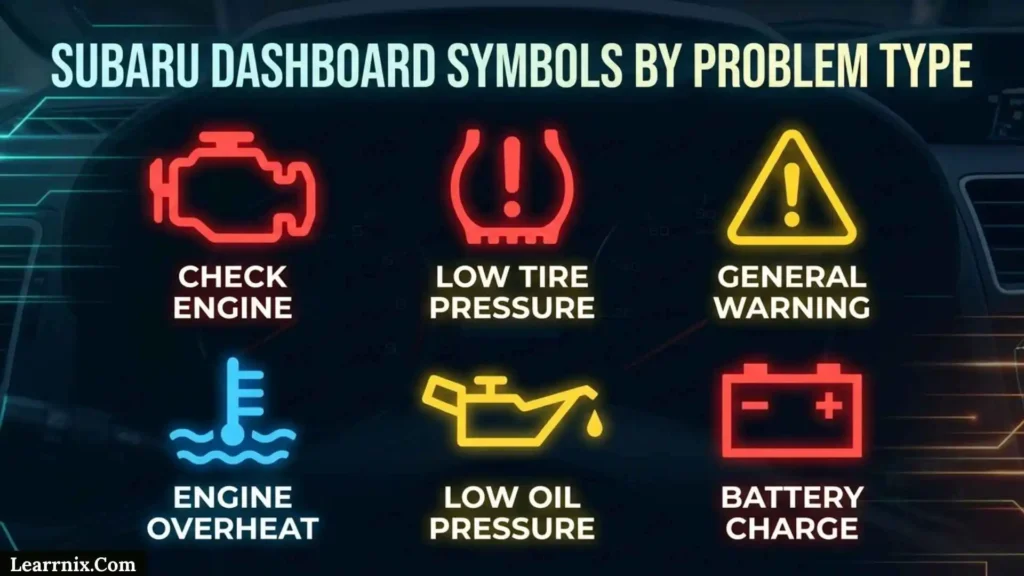
Another useful way to understand the dashboard is to group the symbols by the system involved.
Engine and emissions
Common indicators include:
- Check Engine
- Oil pressure
- Engine oil level
- Coolant temperature
These warnings can range from a service issue to a condition where continued driving could damage the engine.
Braking and chassis
Common indicators include:
- Brake warning
- ABS
- VDC/traction control
- AWD
These systems can affect stopping ability, stability, or traction.
Electrical system
The primary warning is the charge/battery light.
A charging-system problem can eventually affect the vehicle’s ability to continue operating.
Tires and wheels
The tire-pressure warning helps identify possible low tire pressure.
It should be followed by an actual pressure check rather than simply resetting the dashboard.
Occupant safety
These include:
- Seat-belt warning
- SRS airbag warning
- Passenger airbag indicators
Because these systems are related to occupant protection, persistent warnings deserve prompt attention.
Comfort and convenience
Examples include:
- Low fuel
- Washer fluid
- Door open
- Lighting indicators
These are generally less urgent mechanically, although an open door or similar condition should be corrected before driving.
Why Are Multiple Subaru Warning Lights On at the Same Time?
Several dashboard lights appearing together can be confusing.
It does not necessarily mean that every system has independently failed.
Modern vehicles share sensors, computers, electrical power, and communication networks. A problem in one area can cause other systems to disable themselves or display related warnings.
For example, Subaru explains that a VDC warning appearing together with the Check Engine light can indicate an underlying fault rather than simply a traction-control setting.
What should you do?
- Do not panic.
- Look for a red or flashing warning.
- Note every symbol that appeared.
- Pay attention to changes in braking, steering, engine performance, or temperature.
- Read the vehicle’s display message if available.
- Check the owner’s manual.
- Seek professional diagnosis when the warnings remain.
If your Subaru is equipped with compatible MySubaru Connected Services, Subaru says Diagnostic Alerts can notify the owner when a Check Engine or warning light appears and can provide information about the warning and whether service should be scheduled.
Common Subaru Dashboard Mistakes Drivers Make
Understanding the symbols is only half the job. Knowing what not to do is equally important.
Mistake 1: Assuming every yellow light is harmless
Yellow usually means caution, not “ignore me.”
A persistent ABS, Check Engine, tire-pressure, or transmission warning deserves attention.
Mistake 2: Continuing to drive with an oil-pressure warning
This is one of the most dangerous mistakes.
The vehicle may still move, but low oil pressure can indicate inadequate engine lubrication. Subaru explicitly advises shutting the engine off when the oil-pressure warning appears.
Mistake 3: Treating a flashing Check Engine light like a solid one
These situations are not equivalent.
Subaru’s guidance specifically calls for stopping and towing the vehicle when the Check Engine light flashes.
Mistake 4: Resetting a warning without finding the cause
Turning a warning off does not necessarily repair the problem.
A diagnostic system may illuminate the warning again when the underlying fault is detected.
Mistake 5: Guessing tire pressure by looking at the tire
A tire can be underinflated without looking obviously flat.
Use a pressure gauge and the pressure specification for your vehicle.
Mistake 6: Assuming every Subaru has the same dashboard
A Subaru Forester does not necessarily have exactly the same warning indicators as an Outback, Crosstrek, WRX, Legacy, BRZ, or Solterra.
Equipment and dashboard systems vary by model, trim, and year. Subaru itself advises checking the owner’s manual for vehicle-specific information.
Subaru Model Differences You Should Know
Dashboard symbols can change because Subaru offers different safety, powertrain, and convenience systems across its vehicles.
Outback and Legacy
Newer Outback and Legacy vehicles can include features such as Auto Start-Stop and Auto Vehicle Hold on selected models and trims. Subaru notes that these features and their dashboard icons vary by model and trim.
Forester and Crosstrek
Selected Forester and Crosstrek vehicles also use Auto Start-Stop technology, with Subaru noting that availability depends on model, year, transmission, and equipment.
WRX and performance-oriented models
Performance-oriented Subaru vehicles can have additional drive-mode or system indicators that are not found on every Subaru.
Solterra and electrified models
Electric and electrified Subaru vehicles use additional information related to battery and electric-drive systems.
For that reason, an online generic dashboard-symbol list should never replace the manual supplied for your vehicle.
What To Do If You Cannot Identify a Subaru Dashboard Symbol
Sometimes the symbol is unfamiliar because it belongs to a newer feature or a model-specific system.
Follow this process:
- Do not guess.
- Safely park if the warning is red, flashing, or accompanied by unusual vehicle behavior.
- Take note of the symbol’s shape and color.
- Read any text message displayed beside it.
- Check the owner’s manual.
- Look for the warning-light section rather than relying on a random dashboard-symbol chart.
- Contact a Subaru retailer or qualified technician if the meaning remains unclear.
If you have compatible MySubaru services, diagnostic alerts can also provide information about certain warning lights.
Practical Subaru Dashboard Warning-Light Checklist
Save this checklist for future reference.
When a light first appears
- Identify the symbol.
- Check the color.
- Determine whether it is flashing.
- Look for a message on the instrument display.
- Pay attention to unusual sounds, smells, vibration, or handling.
Before continuing to drive
- Check whether the warning is red.
- Check whether it is flashing.
- Confirm that brakes and steering feel normal.
- Check tire pressure if the tire-pressure warning is present.
- Check engine oil if the owner’s manual instructs you to do so.
- Consult the owner’s manual.
If the warning is serious
- Stop in a safe location.
- Turn off the engine when appropriate.
- Do not continue driving just to reach your destination.
- Contact roadside assistance or a qualified technician if necessary.
Real-World Examples: What Would You Do?
Understanding a dashboard symbol becomes easier when you apply it to everyday driving situations.
Example 1: Solid Check Engine light after refueling
You fill the tank and later notice a solid Check Engine light.
The vehicle is running normally.
Best approach: Check that the fuel cap is properly installed if your model uses one, monitor the vehicle, and arrange diagnosis if the warning remains. Subaru notes that a loose or missing fuel cap can be one possible cause of a solid Check Engine warning.
Example 2: Flashing Check Engine light while driving
You are driving on a highway and the Check Engine light begins flashing.
Best approach: Reduce risk, find a safe place to stop, and follow Subaru’s guidance to have the vehicle towed rather than continuing the journey.
Example 3: Oil-pressure warning appears
You are driving and the red oil-pressure symbol illuminates.
Best approach: Safely pull over and switch off the engine. Do not continue driving simply because the vehicle still runs. Subaru specifically treats this warning as requiring immediate action.
Example 4: Tire-pressure light appears
You notice the tire-pressure symbol but the car feels normal.
Best approach: Check all tire pressures as soon as safely possible. Do not assume that normal handling means the pressure is correct.
Example 5: VDC light flashes briefly on a wet road
The road is slippery and the VDC indicator flashes briefly while accelerating.
Best approach: A flashing stability-control indicator can mean the system is intervening to help maintain traction. Continue driving smoothly and avoid aggressive acceleration.
How to Find the Correct Subaru Owner’s Manual

The owner’s manual is the best source when you need the exact meaning of a symbol on your particular Subaru.
Look for information covering:
- Warning and indicator lights
- Instruments and controls
- Vehicle information display
- Safety systems
- Tire-pressure monitoring
- Engine and transmission warnings
- Model-specific equipment
Subaru’s technical-information library contains owner-manual documentation showing the warning-light systems used on different vehicles.
Why the exact model year matters
A symbol shown on a 2015 Subaru may not have exactly the same appearance, wording, or function on a 2026 model.
Even when two vehicles use a similar symbol, the underlying system can be different.
That is why the safest approach is:
Subaru model + model year + exact dashboard symbol + owner’s manual
rather than relying on a generic image alone.
Frequently Asked Questions
What does a red Subaru dashboard light mean?
A red dashboard light generally indicates a warning that deserves immediate attention. The exact action depends on the symbol. Oil-pressure and serious brake warnings, for example, can require stopping safely rather than continuing to drive. Subaru specifically advises stopping and shutting off the engine for an oil-pressure warning.
What does a yellow Subaru dashboard light mean?
A yellow or amber light generally indicates caution, a detected fault, or a condition that needs attention. Examples include the Check Engine, ABS, and tire-pressure warnings. The exact urgency depends on the symbol and whether the light is steady or flashing.
What does the Subaru check engine light mean?
The Check Engine light, also called the malfunction indicator lamp, indicates that the vehicle’s diagnostic system has detected a problem. Subaru says a solid light may sometimes be related to an emissions-control issue or even a loose/missing fuel cap, while a flashing light requires stopping as soon as safely possible and towing the vehicle.
Can I drive my Subaru with the Check Engine light on?
If the light is solid and the vehicle is operating normally, Subaru indicates that limited driving may be possible while the problem is addressed. A flashing Check Engine light is different: Subaru recommends stopping safely and having the vehicle towed.
What does the Subaru oil light mean?
The oil can symbol generally refers to engine oil pressure or, on some vehicles, an oil-related warning. If the oil-pressure warning appears while the engine is running, Subaru advises stopping safely and shutting off the engine.
What is the difference between low oil level and low oil pressure?
Low oil level means there may not be enough engine oil in the engine. Low oil pressure means the lubrication system may not be maintaining sufficient pressure. They are different conditions and should not be treated as interchangeable warnings.
What does the Subaru ABS light mean?
The ABS warning indicates a problem with the anti-lock braking system. The conventional brakes may still operate, depending on the fault, but the ABS function may not be available. The warning should be diagnosed rather than ignored.
What does the Subaru tire-pressure warning mean?
It generally indicates that the tire-pressure monitoring system has detected low pressure in one or more tires. Check all tire pressures using a gauge and compare them with the pressure specification for your vehicle.
Why are all the dashboard lights on when I start my Subaru?
Many warning and indicator lights briefly illuminate when the ignition is switched on as part of a system check. Subaru owner manuals describe this temporary illumination as a way to verify that the warning lamps operate correctly.
Why is my Subaru VDC light on?
A VDC-related light can mean that Vehicle Dynamics Control is operating, has been switched off, or has detected a fault, depending on the indicator and circumstances. Subaru says that a steadily illuminated VDC indicator, particularly when accompanied by the Check Engine light, can indicate a system problem.
What does AT OIL TEMP mean on a Subaru?
On applicable automatic or CVT Subaru vehicles, AT OIL TEMP indicates that transmission fluid temperature may be too high. Subaru documentation advises reducing transmission load and following the vehicle-specific instructions. A flashing transmission warning after startup can indicate a different problem.
Are Subaru dashboard symbols the same on every model?
No. Dashboard symbols vary according to model, model year, trim, transmission, safety equipment, and other features. Subaru’s own materials show different warning-light combinations across its vehicles.
What should I do if a Subaru warning light comes on while driving?
First identify the symbol and color. Then determine whether it is flashing. If it is a serious red warning, a flashing Check Engine light, or the vehicle is behaving abnormally, find a safe place to stop and follow the owner’s manual or seek assistance. For less urgent warnings, arrange appropriate inspection rather than ignoring them.
Can I reset a Subaru dashboard warning light myself?
Some warnings disappear after the underlying condition is corrected, while others may require a diagnostic procedure. Simply clearing a warning without finding its cause is not a reliable repair. Follow the instructions for your specific Subaru rather than using a generic reset procedure.
Final Takeaway
Understanding Subaru dashboard symbols and meanings is about more than memorizing a list of icons. The most useful skill is knowing how to judge urgency.
Start with the symbol and its color. Then ask whether the light is steady or flashing and whether the vehicle is showing any unusual behavior.
A flashing Check Engine light, oil-pressure warning, serious brake warning, overheating condition, or another critical warning should never be treated as an ordinary maintenance reminder. Subaru’s official guidance specifically calls for immediate action in several of these situations.
At the same time, not every illuminated symbol means something has failed. Many lights appear briefly during startup as part of the vehicle’s system check, while green and blue indicators commonly communicate that a feature is operating.
The most important rule is simple:
If you are unsure what a Subaru dashboard symbol means, use the owner’s manual for your exact model and model year rather than guessing.
That small step can help you distinguish between a normal operating indicator, a warning that needs service, and a problem where continuing to drive could put you or the vehicle at risk.
Also Check This Post: 67+ Care Instruction Symbols: Complete Washing and Drying Guide

I am Michael Carter, an educational content creator who believes that knowledge has the power to transform lives.
I create resources focused on modern education, digital learning, and building essential skills for the future.
I love helping readers discover simple and effective ways to improve their learning journey.
Books by Michael Carter:
- Modern Education for Tomorrow’s World
- Learning Skills for Future Success
 Charlotte Anderson