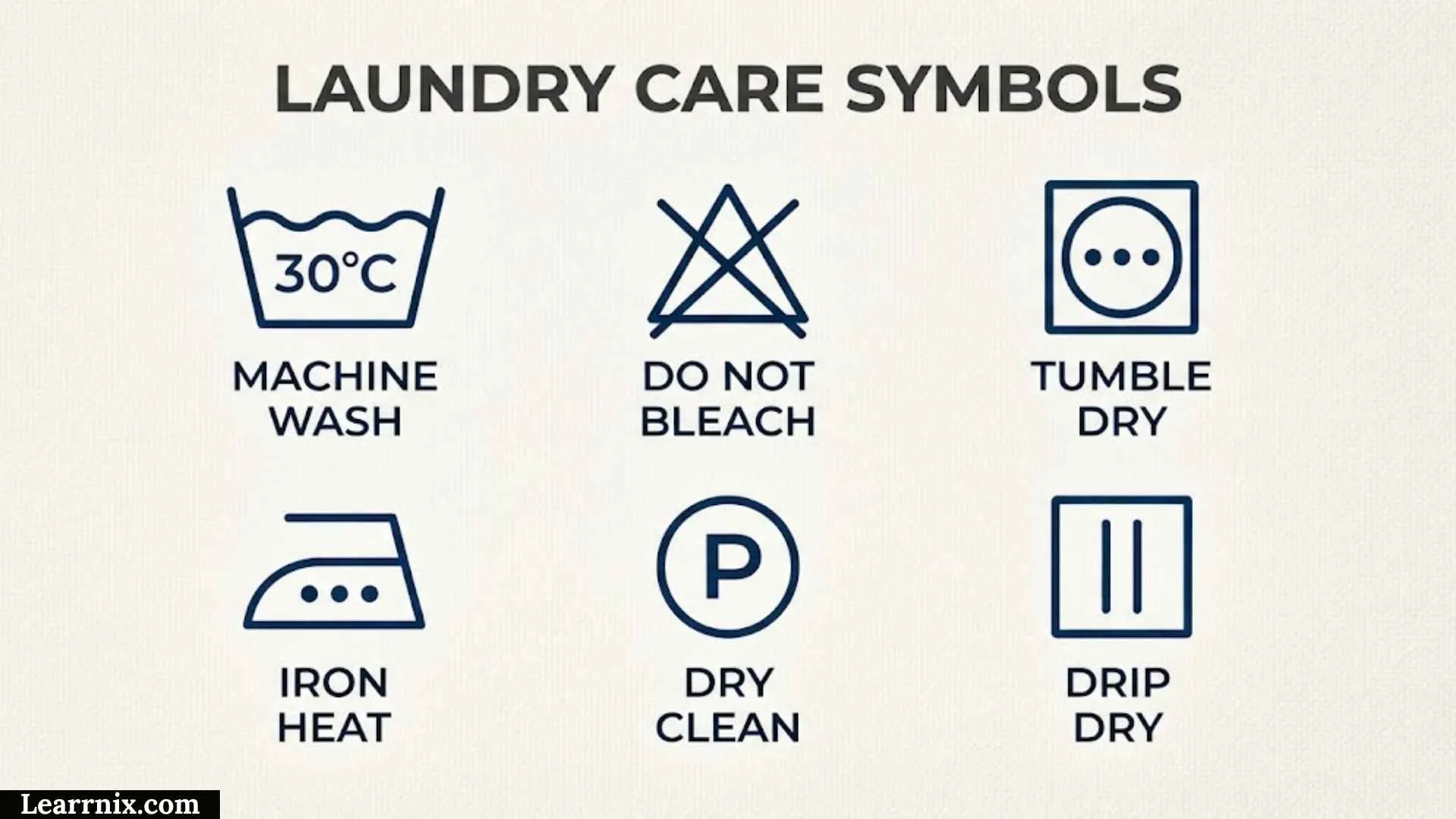
Laundry symbols are small care instructions found on clothing labels, towels, bedding, and other textile products. A washing tub, triangle, square, iron, or circle can tell you how an item should be washed, bleached, dried, ironed, or professionally cleaned. Learning these basic shapes can make clothing care much easier and help prevent accidental shrinking, fading, stretching, or fabric damage.
This complete guide to laundry symbols explains what the common symbols mean, how to read laundry tags, what the dots, lines, and crosses indicate, and how washing symbols differ from dryer, ironing, bleaching, and professional-cleaning symbols. It also covers international laundry symbols, UNIQLO care labels, Japanese laundry symbols, and practical examples you can use when doing laundry.
The goal is not to memorize dozens of complicated icons. Once you understand the main symbol categories and the modifiers used with them, most care labels become much easier to read. Keep this guide as a quick reference whenever you are unsure whether a garment can be machine washed, tumble dried, bleached, or ironed.
Laundry Symbols Chart
The easiest way to learn laundry symbols is to start with the five main care categories. The international care-label system uses graphical symbols to communicate the most severe treatment that can be applied without causing irreversible damage to the textile when the instructions are followed. ISO 3758:2023 covers washing, bleaching, drying, ironing, and professional textile care.
| Symbol Shape | Care Category | General Meaning |
| Tub | Washing | Instructions for washing the garment |
| Tub with hand | Hand washing | Wash by hand under the specified conditions |
| Crossed-out tub | Washing restriction | Do not wash |
| Triangle | Bleaching | Bleaching is permitted under the stated conditions |
| Crossed-out triangle | Bleaching restriction | Do not bleach |
| Square | Natural drying | Instructions for air or natural drying |
| Square with circle | Tumble drying | Instructions for a clothes dryer |
| Crossed-out square with circle | Drying restriction | Do not tumble dry |
| Iron | Ironing | Instructions for ironing |
| Crossed-out iron | Ironing restriction | Do not iron |
| Circle | Professional cleaning | Professional textile-cleaning instructions |
| Crossed-out circle | Cleaning restriction | Do not use the indicated professional cleaning process |
The main shape tells you the type of care. Additional marks then make the instruction more specific. Dots can communicate temperature levels, lines can indicate gentler treatment, and a cross generally means that the treatment should not be used.
One useful memory trick is simple: tub means wash, triangle means bleach, square means dry, iron means iron, and circle means professional cleaning.
List of Laundry Symbols and Meanings
Laundry symbols cover several different stages of garment care. Instead of treating every icon as a separate symbol to memorize, group them according to their basic shape.
Washing Symbols
- Tub — Washing instructions.
- Tub with hand — Hand washing.
- Tub with temperature indication — Maximum washing temperature or washing condition.
- Tub with one line underneath — Gentler washing treatment.
- Tub with two lines underneath — Very gentle washing treatment.
- Crossed-out tub — Do not wash.
The lines under a washing symbol matter. A garment may be washable but require a gentler cycle than ordinary machine washing.
Bleaching Symbols
- Triangle — Bleaching is allowed under the specified conditions.
- Triangle with diagonal lines — A restricted type of bleach, such as non-chlorine or oxygen-based bleaching, may be permitted depending on the applicable label system.
- Crossed-out triangle — Do not bleach.
Never assume that a white garment can automatically be treated with chlorine bleach. The care label determines what bleaching treatment is allowed.
Drying Symbols
- Square — Natural drying information.
- Square with circle — Tumble-drying information.
- Square with circle and dots — Tumble-drying temperature information.
- Crossed-out square with circle — Do not tumble dry.
Natural-drying symbols can also indicate methods such as line drying or flat drying, sometimes with additional marks specifying shade or other conditions.
Ironing Symbols
- Iron with one dot — Lower ironing temperature.
- Iron with two dots — Medium ironing temperature.
- Iron with three dots — Higher ironing temperature.
- Crossed-out iron — Do not iron.
The dots are useful because heat-sensitive materials can be damaged by excessive ironing temperatures.
Professional Cleaning Symbols
- Circle — Professional textile-care instructions.
- Circle containing letters — Information about the professional cleaning process.
- Crossed-out circle — Do not use the indicated professional cleaning treatment.
These symbols are particularly useful for garments that should not be treated like ordinary washable clothing.
What Do the Laundry Symbols Mean
Laundry symbols communicate care instructions through simple graphical shapes rather than long written directions. This makes them useful across languages and countries.
The five major symbols answer five different questions:
- Can I wash it? Look at the tub.
- Can I bleach it? Look at the triangle.
- How should I dry it? Look at the square.
- Can I iron it? Look at the iron.
- Does it require professional cleaning? Look at the circle.
The extra details tell you how carefully the treatment needs to be performed.
For example, a crossed-out symbol is a clear restriction. A washing symbol with lines underneath indicates a gentler process. Dots in relevant symbols communicate temperature levels.
This system is designed to give the consumer practical care information without requiring the label to contain a lengthy explanation. ISO describes its care-labelling system as a set of graphical symbols intended to communicate textile-care information and prevent irreversible damage during care.
Laundry Symbols on Tags
Laundry symbols on tags are normally found together in a care-label sequence. Depending on the clothing item and manufacturer, the label may also contain the fiber composition, garment size, country information, and other product details.
When you find a care label, do not focus on only the first symbol. Read the complete sequence.
For example, a garment may have instructions covering:
- Maximum washing temperature
- Washing intensity
- Bleaching
- Tumble drying
- Natural drying
- Ironing
- Professional cleaning
A common mistake is to see the washing symbol and immediately put the garment into a normal cycle. The washing symbol may contain additional lines or temperature information that changes the recommended treatment.
The same applies to drying. A garment can be washable but still be unsuitable for tumble drying. Always read each category before choosing a complete laundry routine.
Laundry Symbols on Clothes
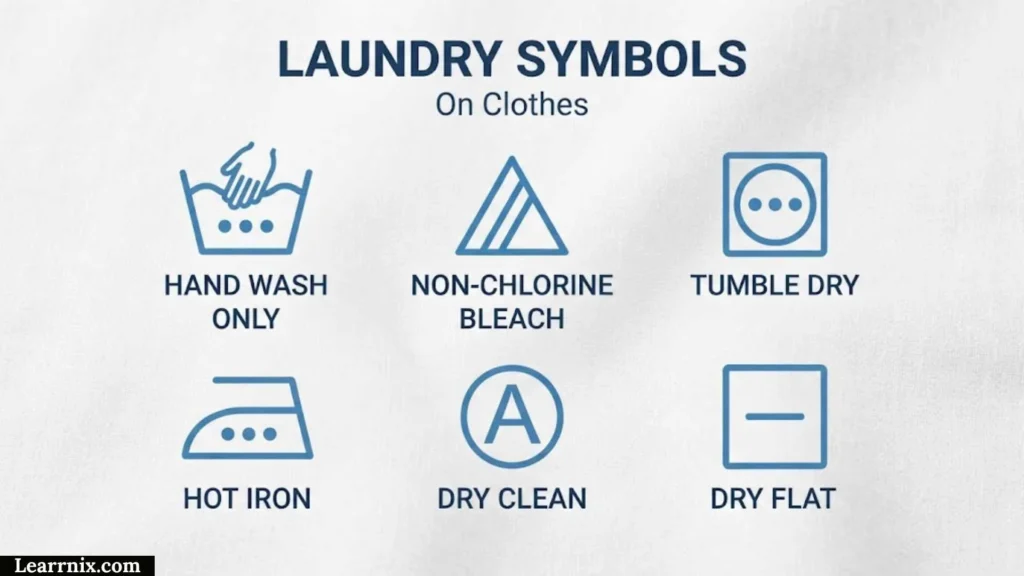
Laundry symbols on clothes help protect the garment from inappropriate washing, drying, bleaching, and ironing. They are especially useful for clothing made from delicate materials or garments containing special finishes, prints, elastic fibers, or decorative details.
Before washing a new garment, check its care label if you are unsure about:
- Machine washing
- Hand washing
- Water temperature
- Bleaching
- Tumble drying
- Air drying
- Ironing
- Dry cleaning
It is also useful to separate garments according to color and fabric needs. For example, dark clothing can transfer color when wet, while some delicate garments can lose their shape if washed too aggressively.
UNIQLO similarly recommends checking the individual product care label because different products can require different care methods. Its general guidance includes separating dark-colored products, using a laundry net for garments that wrinkle easily, and following the recommended drying method on the label.
How To Read Laundry Symbols
Reading laundry symbols is much easier when you follow the same process every time.
Step 1: Find The Main Shape
First identify the symbol category:
- Tub = washing
- Triangle = bleaching
- Square = drying
- Iron = ironing
- Circle = professional cleaning
Do not worry about the smaller details until you know the main category.
Step 2: Look For A Cross
A cross through a symbol generally means that treatment should not be used.
Examples include:
- Crossed-out tub — Do not wash.
- Crossed-out triangle — Do not bleach.
- Crossed-out square with circle — Do not tumble dry.
- Crossed-out iron — Do not iron.
- Crossed-out circle — Do not use the indicated professional cleaning process.
Step 3: Check The Dots
Dots are commonly used to communicate temperature levels. In ironing and tumble-drying symbols, the number of dots helps identify the permitted heat level.
More dots generally indicate a higher temperature level within the applicable symbol system.
Step 4: Check Lines
Lines underneath a symbol can indicate a gentler process. In washing symbols, one or more lines can reduce the intensity of the treatment.
Do not ignore these lines. A normal wash and a very gentle wash are not interchangeable instructions.
Step 5: Read The Entire Sequence
Finally, consider all of the symbols together. A garment might be machine washable but unsuitable for tumble drying and require low-temperature ironing.
That complete sequence gives you a much safer picture of how the item should be treated.
International Laundry Symbols
International laundry symbols are graphical textile-care instructions designed to communicate information across languages. ISO 3758:2023 is the current international standard for care labelling using symbols. It covers domestic washing, bleaching, drying, and ironing as well as professional dry and wet cleaning.
The international system is useful because the basic visual categories remain recognizable even when the written language on the label changes.
For example, a tub represents washing regardless of whether the rest of the garment label is written in English, Japanese, French, German, or another language.
The system does not mean that every garment will contain every possible symbol. Manufacturers select the care information relevant to the product.
It is also worth remembering that care symbols are graphical instructions, not necessarily ordinary Unicode text characters. A visually similar emoji or text character should not automatically be treated as an official laundry-care symbol.
Universal Laundry Symbols
Laundry symbols are often called universal because their graphical system is designed to communicate care information without depending on a particular language. However, it is more accurate to think of them as standardized or internationally recognized care symbols rather than assuming that every symbol is identical everywhere.
The basic categories are easy to remember:
| Shape | Meaning |
| Tub | Washing |
| Triangle | Bleaching |
| Square | Drying |
| Iron | Ironing |
| Circle | Professional cleaning |
Modifiers make the instructions more precise. A cross can prohibit an action, dots can communicate temperature, and lines can indicate a gentler process.
This combination of shapes and modifiers allows a small care label to communicate a surprisingly large amount of information.
What Are the Laundry Symbols
The laundry symbols are a standardized set of graphical care marks used to tell consumers how textile products should be treated.
They can be divided into five major groups:
Washing
Washing symbols tell you whether the garment can be washed and, where applicable, the temperature and intensity of the washing process.
Bleaching
Bleaching symbols tell you whether bleaching is permitted and whether restrictions apply to the type of bleach.
Drying
Drying symbols cover tumble drying and natural drying methods. A square with a circle is associated with tumble drying, while other square-based designs can describe natural drying.
Ironing
Iron symbols tell you whether ironing is permitted and the appropriate heat level.
Professional Cleaning
Circle symbols provide information for professional dry or wet cleaning processes.
Together, these categories form the core of modern textile-care labelling.
Dryer Laundry Symbols
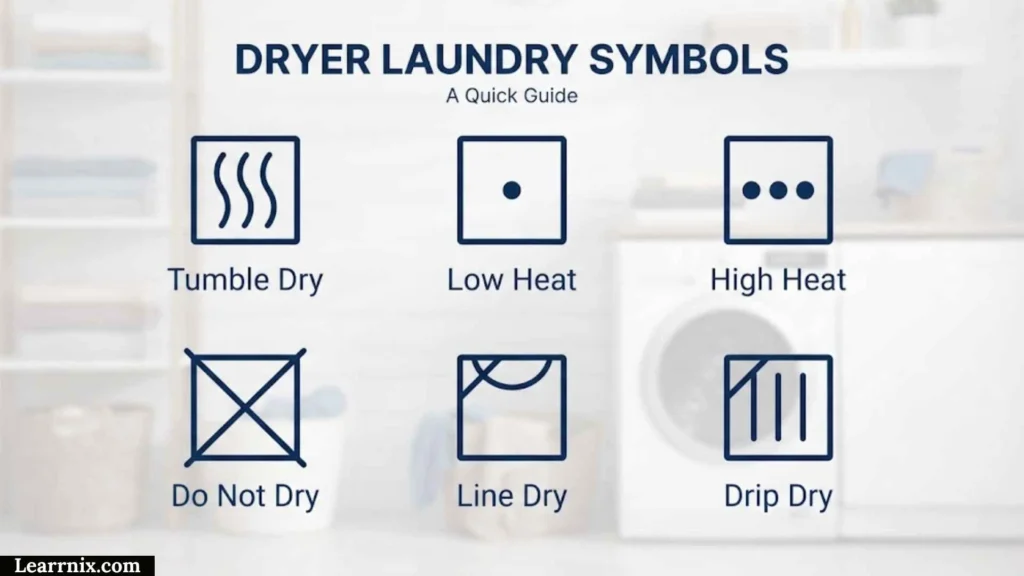
Dryer laundry symbols are particularly important because high heat and mechanical movement can affect certain fabrics.
The basic tumble-drying symbol is a square containing a circle. Additional dots communicate the permitted temperature level.
Common interpretations include:
- Square with circle — Tumble drying is allowed according to the specified conditions.
- Square with circle and one dot — Use a lower temperature.
- Square with circle and two dots — A higher temperature level is permitted than with one dot.
- Crossed-out square with circle — Do not tumble dry.
Some labels may use other marks to provide additional drying information. Natural-drying symbols are separate from tumble-drying symbols.
UNIQLO’s care-label guidance provides examples such as normal tumble drying with a maximum exhaust temperature of 80°C, low tumble drying with a maximum of 60°C, and a separate symbol for do not tumble dry.
If a garment says do not tumble dry, do not assume that using a short or low-temperature dryer cycle makes it acceptable. Instead, follow the natural-drying instructions provided on the label.
Printable Laundry Symbols
A printable laundry symbols reference can be useful for families, shared laundry rooms, dormitories, or anyone who frequently forgets what the basic shapes mean.
Quick Laundry Reference
| Symbol Category | Remember This |
| Tub | Wash |
| Tub with hand | Hand wash |
| Crossed tub | Do not wash |
| Triangle | Bleach instructions |
| Crossed triangle | Do not bleach |
| Square | Natural drying |
| Square with circle | Tumble drying |
| Crossed square with circle | Do not tumble dry |
| Iron | Ironing |
| Crossed iron | Do not iron |
| Circle | Professional cleaning |
| Crossed circle | Do not use the indicated professional cleaning process |
For printing, it is better to use accurate graphical care symbols from a trusted textile-care source instead of replacing them with random Unicode characters or emojis. Not every standardized laundry symbol has a one-to-one Unicode text character.
You can also keep the five basic shapes in a notes app or print this short reminder:
Tub → Wash
Triangle → Bleach
Square → Dry
Iron → Iron
Circle → Professional Clean
This is enough to identify the basic category before you examine the smaller details.
UNIQLO Laundry Symbols
UNIQLO uses care-label symbols to provide product-specific washing, bleaching, drying, ironing, and professional-cleaning instructions. The company recommends checking the product care label before washing because different products can require different care methods.
UNIQLO’s official care information includes examples of machine-washing instructions, hand washing, do-not-wash instructions, bleaching restrictions, tumble drying, natural drying, ironing, dry cleaning, and professional wet cleaning.
The location of the care label can also vary by garment. UNIQLO says its labels can be found inside the left pocket of outerwear, on the lower-left inside area of many tops, near the left pocket of bottoms, or printed directly on innerwear.
UNIQLO also recommends practical care habits such as dissolving detergent before applying it to clothing, separating dark-colored products, using a laundry net for garments that may lose their shape, and drying in the shade when appropriate.
One important point is that general brand guidance should not replace the care label on a particular garment. If the individual product label gives specific instructions, follow those instructions.
Japanese Laundry Symbols
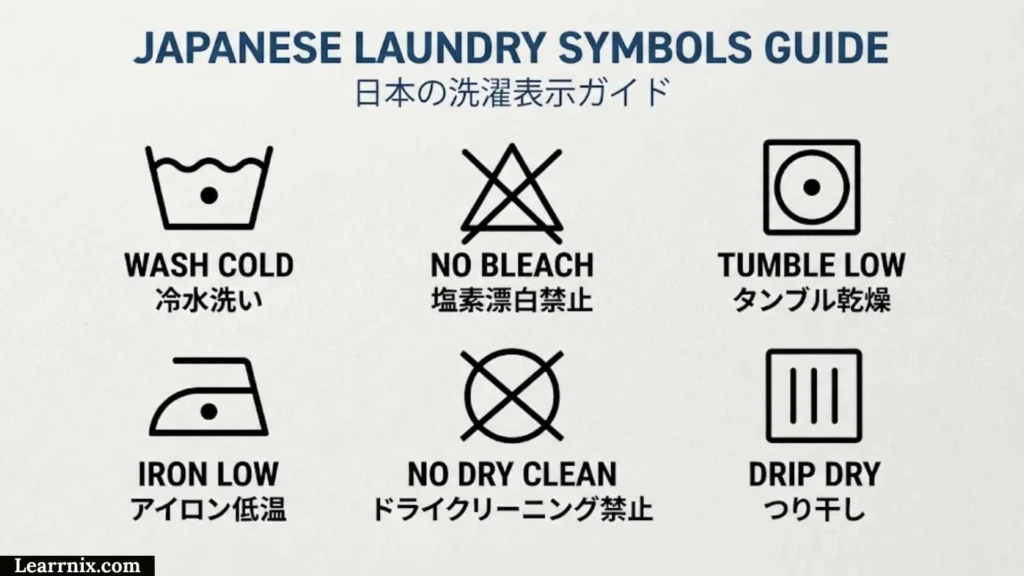
Japanese laundry symbols are used on textile products in Japan and are designed to communicate care instructions through graphical marks. Japan’s textile-care standard has been aligned with the international approach.
Japan’s Ministry of Economy, Trade and Industry explains that JIS L 0001 was revised in 2024 to align with ISO 3758, helping make care symbols on textile products consistent domestically and internationally.
This means shoppers may encounter familiar care-symbol shapes on Japanese clothing even when the written information around them is in Japanese.
When reading a Japanese clothing label, identify the graphical symbols first:
- Find the washing symbol.
- Check the temperature or treatment restrictions.
- Look for bleaching instructions.
- Check the drying method.
- Check ironing instructions.
- Look for professional-cleaning information.
Japanese labels can also contain written details about the product, materials, or other handling instructions. The symbols and written information should be considered together.
For people buying Japanese clothing online or while traveling, understanding the basic symbol system can make care instructions much easier to follow.
FAQ
What does a circle mean on a laundry label?
A circle is used for professional textile-cleaning instructions. Letters or additional marks inside the circle can provide information about the cleaning process. A crossed-out circle indicates that the indicated professional cleaning treatment should not be used.
What does a square with a circle mean on clothes?
A square containing a circle is the symbol category for tumble drying. Dots inside the circle provide additional temperature information, while a crossed-out version means the garment should not be tumble dried.
What does one line under a washing symbol mean?
A line underneath a washing symbol indicates a gentler washing process than the basic version of the symbol. Additional lines can indicate an even gentler treatment.
Can laundry symbols be copied and pasted?
Most official laundry-care symbols are graphical care marks rather than ordinary Unicode text characters. Because of this, a similar-looking emoji or Unicode symbol should not be assumed to represent the official care instruction.
Why should I check the care label before washing clothes?
The care label gives product-specific instructions for washing, bleaching, drying, ironing, and professional cleaning. Following it can help reduce the risk of fabric damage, color problems, shrinkage, or loss of shape.
Conclusion
Laundry symbols make clothing-care instructions easier to understand by replacing lengthy directions with recognizable graphical shapes. The tub, triangle, square, iron, and circle form the foundation of the system, while crosses, dots, lines, and other details provide more specific instructions.
The most useful approach is to read the entire care label rather than focusing on one symbol. A garment may be washable but unsuitable for tumble drying, or it may allow ironing only at a lower temperature. Understanding these differences can make everyday laundry much easier.
Once you learn the basic categories, international, Japanese, and brand-specific care labels become less intimidating. Keep a simple laundry symbols chart nearby when needed, follow the individual garment’s instructions, and use the label as your main guide for protecting your clothes.

I am Daniel Harper, an education enthusiast and writer who enjoys creating helpful content to make learning more accessible and engaging.
I focus on sharing knowledge about effective study methods, educational growth, and skills that help learners succeed in a changing world.
Through my writing, I aim to inspire students to explore new ideas and develop a passion for learning.
Books by Daniel Harper:
- The Path to Lifelong Learning
- Unlocking Your Learning Potential
 Michael Carter
 Charlotte Anderson