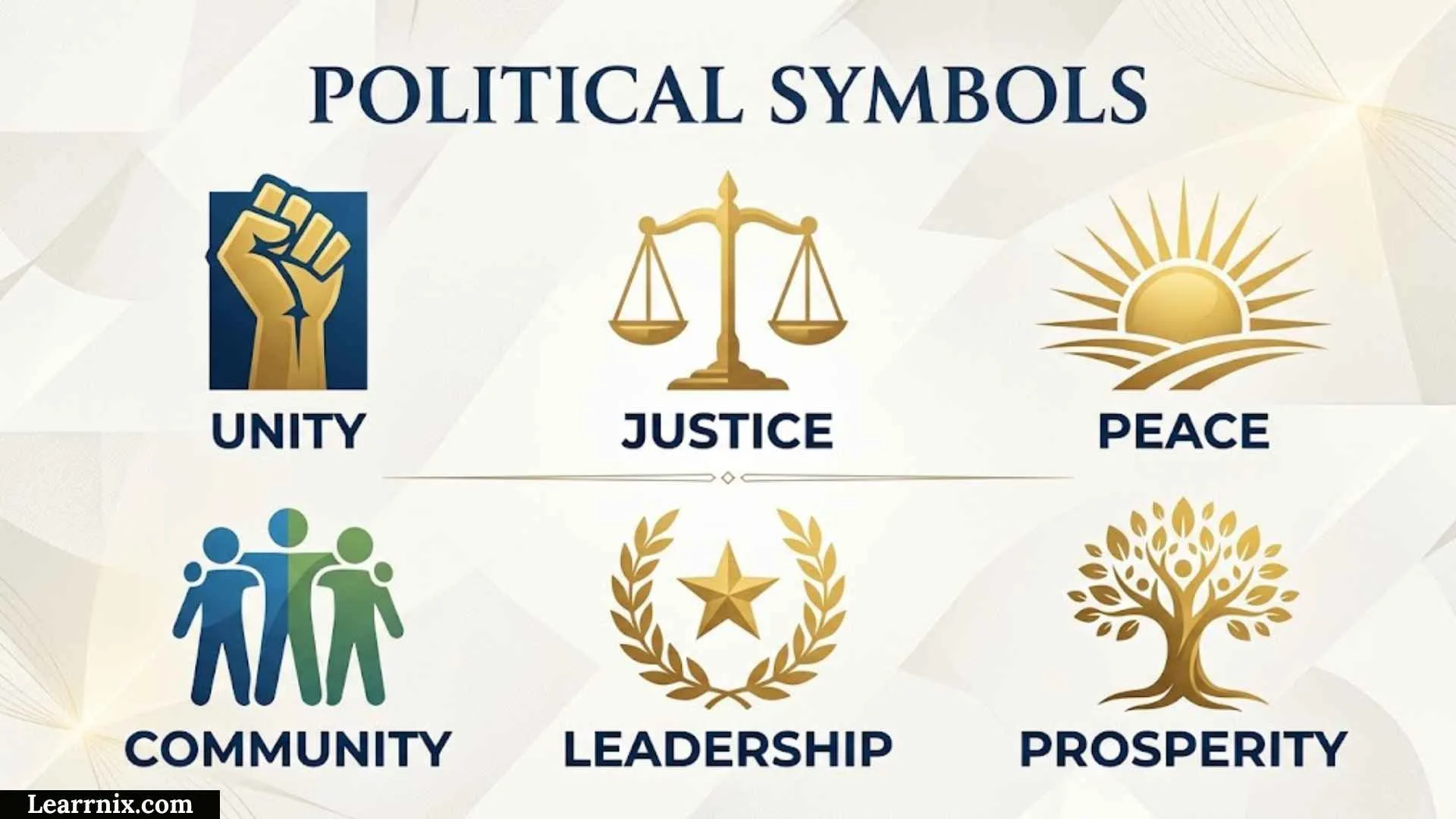
Political symbols are everywhere in public life. They appear on election ballots, flags, party logos, campaign posters, protest signs, clothing, websites, social media profiles, and government documents. A simple color, animal, emblem, or image can help people recognize a political party, movement, nation, or cause almost instantly.
But what exactly makes something a political symbol, and why do these symbols matter?
A political symbol is a visual, verbal, or recognizable sign associated with a political idea, organization, movement, candidate, ideology, or national identity. Its meaning comes from the context in which people use it. The same color, animal, or image can carry very different political meanings in different countries or historical periods.
This guide explains the major types of political symbols, how they developed, why parties and movements use them, how symbols influence political identity, and how to interpret them without making common mistakes. It also looks at elections, protests, national symbols, political colors, digital media, and the difference between a symbol’s intended meaning and the meaning audiences assign to it.
Quick Answer: What Are Political Symbols?
Political symbols are signs or images used to represent political organizations, ideas, movements, candidates, nations, or causes. Common examples include party logos, flags, colors, animals, emblems, campaign graphics, slogans, and protest symbols.
Their main functions are to:
- Identify a political group or candidate
- Communicate an idea quickly
- Build group identity
- Create emotional associations
- Make political messages easier to recognize
- Distinguish one organization from another
- Express support or opposition
- Connect present-day politics with historical events or traditions
Political symbols should always be interpreted in context. A symbol does not automatically have one universal political meaning.
Key Takeaways About Political Symbols
Before looking at individual examples, several principles make political symbolism easier to understand.
- Context matters: The meaning of a symbol depends on its country, culture, history, and political use.
- Symbols are not always party logos: Flags, colors, gestures, monuments, animals, slogans, and objects can also become political symbols.
- Meaning can change: A symbol may acquire new associations as political movements and societies evolve.
- One symbol can have several meanings: Different groups may interpret the same image differently.
- Election symbols can have a practical purpose: In some electoral systems, recognizable symbols help voters identify candidates or parties on ballots.
- National and political symbols can overlap: A national flag, for example, can be used in both civic and political contexts.
- Visual simplicity matters: Symbols that are easy to recognize can work effectively across posters, clothing, ballots, and digital screens.
What Makes Something a Political Symbol?
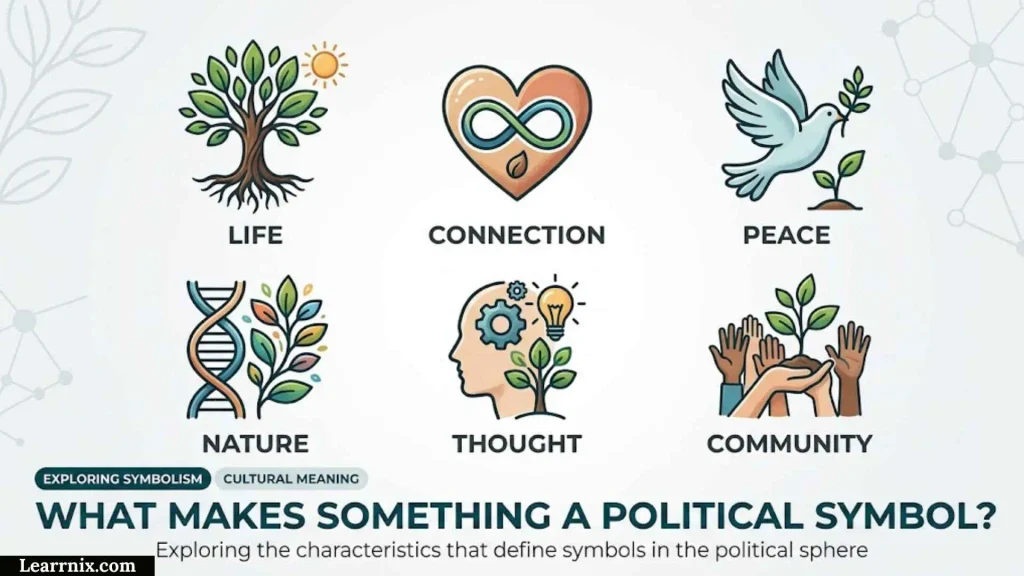
A political symbol becomes meaningful when a community connects it with a political identity, idea, organization, or cause.
That connection can develop deliberately or naturally. A political party might intentionally create a logo and choose specific colors. In another case, supporters may gradually adopt an object, image, or gesture until it becomes strongly associated with a movement.
The important point is that a political symbol is not defined only by its appearance. Its meaning comes from the relationship between the symbol, its users, its audience, and its historical context.
Visual Symbols
Visual symbols are the most familiar form. They include:
- Party logos
- Flags
- Emblems
- Badges
- Animals
- Plants
- Stars and other shapes
- Portraits
- Historical images
- Campaign graphics
For example, Elections Canada maintains official information about registered political parties and displays their registered logos, demonstrating how party identity can be formally connected to visual marks. [1]
Verbal and Text-Based Symbols
Political symbolism is not limited to pictures. Words and phrases can also become symbolic.
A short slogan may become closely associated with a political campaign. A particular phrase can summarize a movement’s goals and become recognizable even when the organization’s full name is not shown.
Hashtags can serve a similar function in digital politics. Once a phrase becomes strongly connected with a movement or political event, it can operate as a recognizable marker of participation.
Symbolic Gestures and Actions
Gestures can also acquire political meaning.
A gesture may begin as an ordinary action but become associated with a particular movement after repeated use in rallies, photographs, videos, or online discussions.
This demonstrates an important principle: political symbolism is created through shared interpretation, not simply through graphic design.
Major Types of Political Symbols
Political symbols take different forms depending on their purpose and setting. Understanding these categories makes it easier to analyze political communication.
Political Party Symbols
Political parties often use a logo, emblem, color scheme, animal, object, or other visual identifier to distinguish themselves from competitors.
Party symbols are particularly useful during elections because voters need to distinguish among multiple candidates and political organizations.
In some countries, party symbols are more than branding. They can play a practical role in helping voters identify candidates on ballots. Elections Canada has documented how party logos and symbols are used in different electoral systems, including India’s use of candidate and party symbols on electronic voting materials. [2]
A party symbol may appear on:
- Ballots
- Campaign posters
- Flags
- Clothing
- Websites
- Social media
- Television advertisements
- Merchandise
- Rally materials
The strongest symbols are usually recognizable without requiring a long explanation.
National Symbols
National symbols represent a country, its people, history, or shared identity. Common examples include:
- National flags
- National emblems
- Coats of arms
- National animals
- National birds
- National monuments
- Anthems
- Historic documents
National symbols can become political when political actors use them to communicate ideas about citizenship, patriotism, national unity, independence, or political legitimacy.
For example, the U.S. government explains the meanings attached to the American flag’s stars and stripes and identifies the bald eagle and Great Seal as important national symbols. [3]
This shows why national symbols should not automatically be treated as party symbols. Their broader meaning may extend beyond a particular political organization.
Political Flags
Flags are especially powerful because they can be recognized from a distance and displayed by large groups.
A political flag may represent:
- A political party
- A revolutionary movement
- A social movement
- A campaign
- A regional identity
- A historical cause
- A national or independence movement
The meaning of a flag depends on who displays it and where it appears. The same flag can have a ceremonial, cultural, national, or explicitly political function depending on the situation.
Political Colors
Colors can become strongly associated with political organizations and movements.
A party may consistently use a particular color across its logo, clothing, posters, website, and campaign materials. Eventually, the color itself may become a shortcut for recognizing the organization.
However, assuming that a color has one universal political meaning is a common mistake. Color associations vary by country, culture, party history, and political period.
The surrounding design is therefore important. A color should be interpreted together with the logo, text, imagery, and context in which it appears.
Animals as Political Symbols
Animals are frequently used because people naturally associate them with particular qualities.
Depending on cultural context, an animal may suggest:
- Strength
- Courage
- Freedom
- Wisdom
- Speed
- Loyalty
- Resilience
- National identity
An animal symbol is not automatically meaningful in the same way everywhere. Its political interpretation comes from the organization or community that adopts it.
Historical Symbols
Some political symbols originate from important historical events, leaders, movements, revolutions, independence struggles, or social conflicts.
Historical symbolism can be powerful because it connects present-day political messages with memories of the past.
It can also be controversial. Two communities may remember the same historical event differently, causing the associated symbol to produce very different reactions.
Why Do Political Parties and Movements Use Symbols?
Political symbols solve a communication problem: politics can be complicated, but recognition needs to happen quickly.
A party may have a long name, a detailed policy platform, and dozens of policy positions. A symbol can provide a simple visual identifier that audiences recognize repeatedly.
Recognition and Memorability
A recognizable symbol helps people identify a political organization across different media.
A voter might see a logo on a poster, then encounter the same logo on a ballot, and later see it again on social media. Repetition strengthens recognition.
Group Identity
Symbols can also create a sense of belonging.
Supporters who display the same flag, color, badge, or logo demonstrate that they identify with a wider political community.
This is particularly visible at rallies and demonstrations, where many individual people become visually connected through shared symbols.
Emotional Communication
Political symbols can communicate emotions as well as information.
A national flag may evoke patriotism. A historical emblem may evoke memories of a political struggle. A movement’s color may remind supporters of a campaign or social cause.
The emotional response is not necessarily identical for every person. Political experience strongly influences interpretation.
Political Symbols in Elections
Elections provide one of the clearest examples of the practical value of political symbols.
Campaigns need to differentiate candidates and parties quickly. Visual identifiers can help voters recognize the organization they support.
This becomes particularly important in electoral systems where party or candidate symbols appear directly on voting materials.
Why Ballot Symbols Can Matter
A ballot needs to communicate information clearly within limited space. Names, party affiliations, logos, photographs, and symbols can all serve as identifiers depending on the electoral system.
Elections Canada has published comparative information showing that India uses candidate and party symbols on electronic voting materials and that these symbols have historically served as an important way for voters to identify choices. [2]
The lesson is broader than one country: political symbols can function as practical identification tools, not merely as advertising.
Political Symbols at Polling Places
Political symbolism can also be restricted around voting locations to protect electoral neutrality.
For example, Elections Canada states that partisan material, including party or candidate names, logos, designs, colors, and other political designations, can be prohibited within polling places under Canadian federal election rules. [4]
This illustrates an important distinction: a symbol may be perfectly legitimate in a campaign environment but restricted in a controlled electoral setting.
Always check the election authority’s rules for the specific country or election rather than assuming the same restrictions apply everywhere.
Political Symbols in Protests and Social Movements
Protests often rely heavily on symbolism because large groups need ways to communicate a shared message.
A protest sign may contain a slogan, image, color, flag, or combination of symbols. Participants can then communicate their political position without explaining it individually to every observer.
Why Symbols Work Well at Protests
Symbols are useful in public demonstrations because they are:
- Visible from a distance
- Easy to reproduce
- Easy to photograph
- Easy to share online
- Capable of creating group identity
- Often understandable without lengthy text
A repeated symbol can also become the visual identity of a movement.
Symbols Can Unite and Divide
The same symbolic power that creates solidarity can also create disagreement.
A symbol may make supporters feel connected while causing opponents to associate it with a controversial political position or historical event.
Therefore, a neutral-looking visual description is not always enough to explain political symbolism. The social meaning behind the image matters.
Political Symbols and National Identity
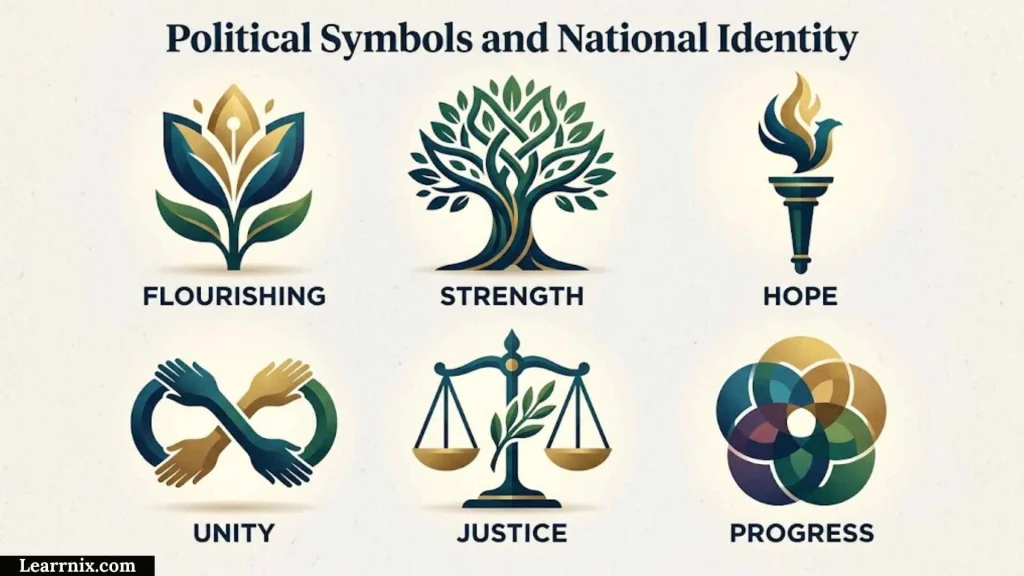
National identity and political identity sometimes overlap.
A flag may represent the country as a whole, but political parties may also use the same flag to communicate patriotism or national priorities.
This creates an important analytical question:
Is the symbol being used to represent the nation, or is it being used to promote a particular political message about the nation?
The answer depends on context.
For example, a flag displayed during a national ceremony may primarily have civic meaning. The same flag placed beside a candidate’s campaign slogan may be functioning as part of a political message.
Political Symbols in Digital Media
Social media has transformed political symbolism.
A political symbol no longer needs to be physically printed on a flag or poster. It can appear as:
- A profile picture
- A hashtag
- An emoji
- A campaign graphic
- A meme
- A short video
- A digital badge
- A customized image
Digital platforms also allow ordinary supporters to reproduce and modify symbols quickly.
Why Digital Symbols Spread Quickly
Online political symbols are easy to copy and share. A single graphic can appear in thousands of posts without requiring a traditional printing campaign.
This creates both opportunities and challenges.
A symbol can reach new audiences rapidly, but its meaning can also change when users alter the image, remove its original context, or combine it with satire.
For researchers and readers, this means that the source and date of a political image can be just as important as the image itself.
Political Symbols vs. National Symbols
These terms are related but should not be treated as identical.
| Feature | Political Symbol | National Symbol |
| Main purpose | Represents a political group, idea, movement, or cause | Represents a nation or national identity |
| Common examples | Party logos, campaign colors, movement symbols | Flags, national emblems, anthems |
| Typical users | Parties, candidates, movements, supporters | Governments, institutions, citizens |
| Meaning | Often linked to a particular political position | Usually broader and connected to national identity |
| Can overlap? | Yes | Yes |
The distinction becomes especially important when a political campaign uses national imagery.
How to Interpret a Political Symbol Correctly
If you encounter an unfamiliar political symbol, avoid guessing its meaning from appearance alone.
Use this practical framework:
Step 1: Identify Who Uses It
Look for the political party, candidate, organization, movement, or community associated with the symbol.
Step 2: Check Where It Appears
A symbol on a ballot has a different context from the same image on a protest sign or historical monument.
Step 3: Establish the Time Period
Political meanings change. A symbol used today may not mean exactly what it meant decades ago.
Step 4: Look for Official Context
If the symbol belongs to a political party, election authority, government, or recognized organization, check its official materials when available.
Step 5: Compare Multiple Interpretations
Do not rely on one social media post or anonymous website. Compare reputable historical, academic, governmental, or organizational sources.
Step 6: Separate Intended Meaning From Public Reaction
Ask two different questions:
- What did the creator or organization intend the symbol to represent?
- How did different audiences interpret it?
These answers may not be identical.
A Simple Decision Guide for Identifying Political Symbols
Use this quick decision tree when you encounter an unfamiliar symbol:
Is it connected to a country?
→ Yes: Investigate whether it is a national flag, emblem, anthem, monument, or other national symbol.
→ No: Continue.
Is it associated with a political party or candidate?
→ Yes: Treat it as a party or campaign symbol and check official election or party sources.
→ No: Continue.
Is it used repeatedly by a protest or social movement?
→ Yes: Research the movement’s history and stated goals.
→ No: Continue.
Is it an old or historical image?
→ Yes: Check its historical period before assigning a modern political meaning.
→ No: Look at the surrounding text, imagery, source, date, and audience before interpreting it.
This approach reduces the risk of confusing a cultural, national, historical, or political symbol.
Common Misconceptions About Political Symbols
Every Political Color Has One Universal Meaning
This is false. Political color meanings differ across countries and political traditions.
A Symbol Always Has the Same Meaning
Symbols can change meaning over time and can be interpreted differently by different groups.
National Symbols Are Always Politically Neutral
National symbols often have broad civic meaning, but political actors can use them within political messages.
A Party Logo Is the Only Type of Political Symbol
Political symbolism includes much more than logos. Flags, gestures, colors, slogans, historical objects, animals, and digital graphics can all become political symbols.
You Can Understand a Symbol Without Knowing Its History
Historical context is often essential. An image that seems simple today may carry associations created by earlier events.
Common Mistakes When Researching Political Symbols
Readers often make several mistakes when trying to identify or explain political symbolism.
Mistake 1: Judging by appearance alone.
A symbol may look obvious but have a specialized meaning in a particular culture.
Mistake 2: Ignoring the date.
Political symbols can evolve significantly over time.
Mistake 3: Treating social media as the final authority.
Viral posts can remove symbols from their original context or provide inaccurate explanations.
Mistake 4: Confusing national and partisan use.
A national flag does not automatically represent a particular party.
Mistake 5: Assuming one country’s meaning applies everywhere.
Political symbolism is highly dependent on geography and political history.
Best Practices for Studying Political Symbols
For accurate research, use a combination of visual, historical, and institutional evidence.
Start With Primary or Official Sources
When possible, check the official website of the relevant election authority, government institution, political party, or organization.
For example, Elections Canada provides official information about registered political parties and election-related rules. [1][4]
Use Historical Sources for Older Symbols
For historical symbols, university collections, libraries, museums, government archives, and reputable academic publications can provide better context than modern social media posts.
Check More Than One Source
A good explanation should distinguish between established facts and interpretation.
If a symbol’s meaning is disputed, acknowledge that disagreement rather than presenting one interpretation as universally accepted.
Why Simple Political Symbols Are Often Effective
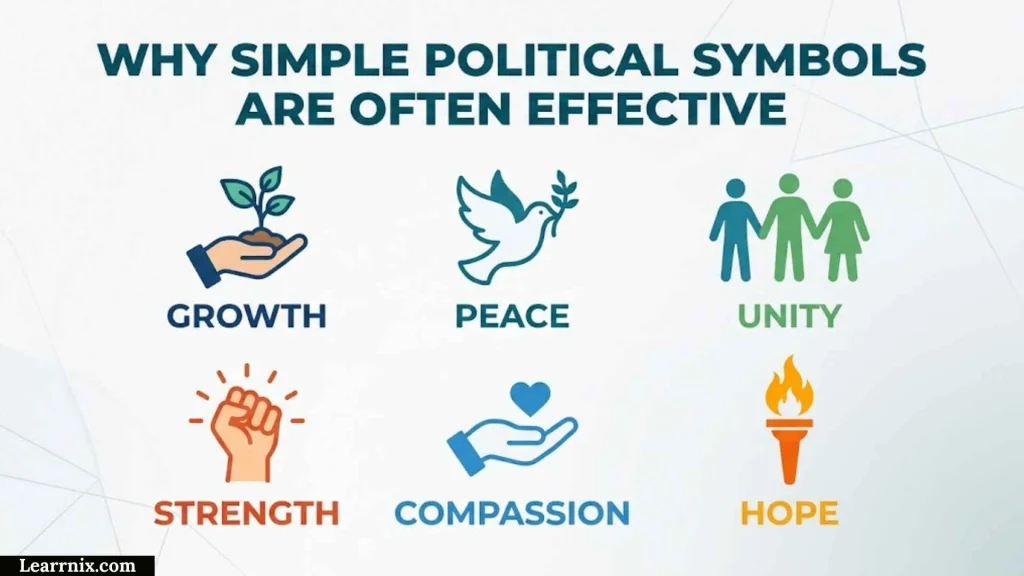
The most useful political symbols are often easy to recognize at different sizes.
A symbol may need to work on:
- A large banner
- A small ballot
- A mobile screen
- A social media profile
- A printed leaflet
- Clothing
- Television graphics
This creates a practical design challenge. A highly detailed image may look impressive on a large poster but become difficult to recognize when reduced to a small size.
The same principle applies to political communication more broadly: recognition often depends on consistency.
An Important Editorial Note About Political Symbolism
Political symbols can be emotionally charged. A responsible explanation should avoid presenting one group’s interpretation as an unquestionable fact when historical or cultural disagreement exists.
Readers should also distinguish between describing a symbol and endorsing the political position associated with it.
For controversial symbols, the strongest approach is to provide historical context, identify who uses the symbol, explain documented meanings, and clearly separate established facts from interpretation.
Frequently Asked Questions About Political Symbols
What is the main purpose of political symbols?
The main purpose is to communicate political identity, affiliation, or ideas quickly. Symbols can help people recognize parties, movements, candidates, nations, and causes while also creating a sense of shared identity.
What are the most common political symbols?
Common examples include party logos, flags, colors, animals, emblems, slogans, gestures, campaign graphics, and historical images. Their meanings depend on the political and cultural context.
Why are political symbols important during elections?
They help distinguish candidates and parties. In some electoral systems, symbols are also used directly on voting materials, giving voters a practical visual identifier.
Can a national flag be a political symbol?
Yes, depending on how it is used. A national flag can have civic or national meaning, but it can also be incorporated into a political campaign or movement’s messaging.
Why do political parties use colors?
Colors provide quick visual recognition and help create consistent campaign identities. However, a particular color does not have one universal political meaning.
Can political symbols change meaning?
Yes. Political symbols can acquire new associations as political movements, historical events, and public attitudes change.
Why are political symbols used in protests?
They help large groups communicate shared ideas quickly. A common flag, image, color, or slogan can create visual unity and make a movement easier to recognize.
Are political symbols the same in every country?
No. Political symbolism is strongly influenced by local history, culture, language, elections, and political traditions.
How can I identify an unfamiliar political symbol?
Start by identifying who uses it, where it appears, and when it was used. Then check official organizational sources and reliable historical or academic references. Avoid relying on a single social media post.
Can the same symbol represent different political ideas?
Yes. A symbol can have different meanings across countries, political groups, generations, and historical periods. Context is essential.
Final Thoughts
Political symbols provide a visual language for politics. They allow parties, candidates, movements, governments, and communities to communicate identity and ideas without relying entirely on long explanations.
Their influence comes from more than appearance. A flag, color, logo, animal, gesture, slogan, or historical image becomes politically meaningful through repeated use and shared interpretation.
The most reliable way to understand political symbols is therefore to look beyond the image itself. Ask who uses it, where it appears, when it became important, what it represents, and how different audiences interpret it.
For voters, students, researchers, journalists, and anyone interested in political communication, this approach provides a more accurate way to understand the symbols that appear throughout elections, public demonstrations, national life, and digital media.

I am Charlotte Anderson, an education writer who is passionate about creating meaningful learning resources for students and lifelong learners.
I enjoy researching new educational approaches and sharing ideas that make studying easier and more effective.
Through my work, I aim to inspire curiosity, confidence, and a love for learning.
Books:
- The Complete Guide to Better Learning
- Building Skills for Academic Success
 Michael Carter
 Daniel Harper