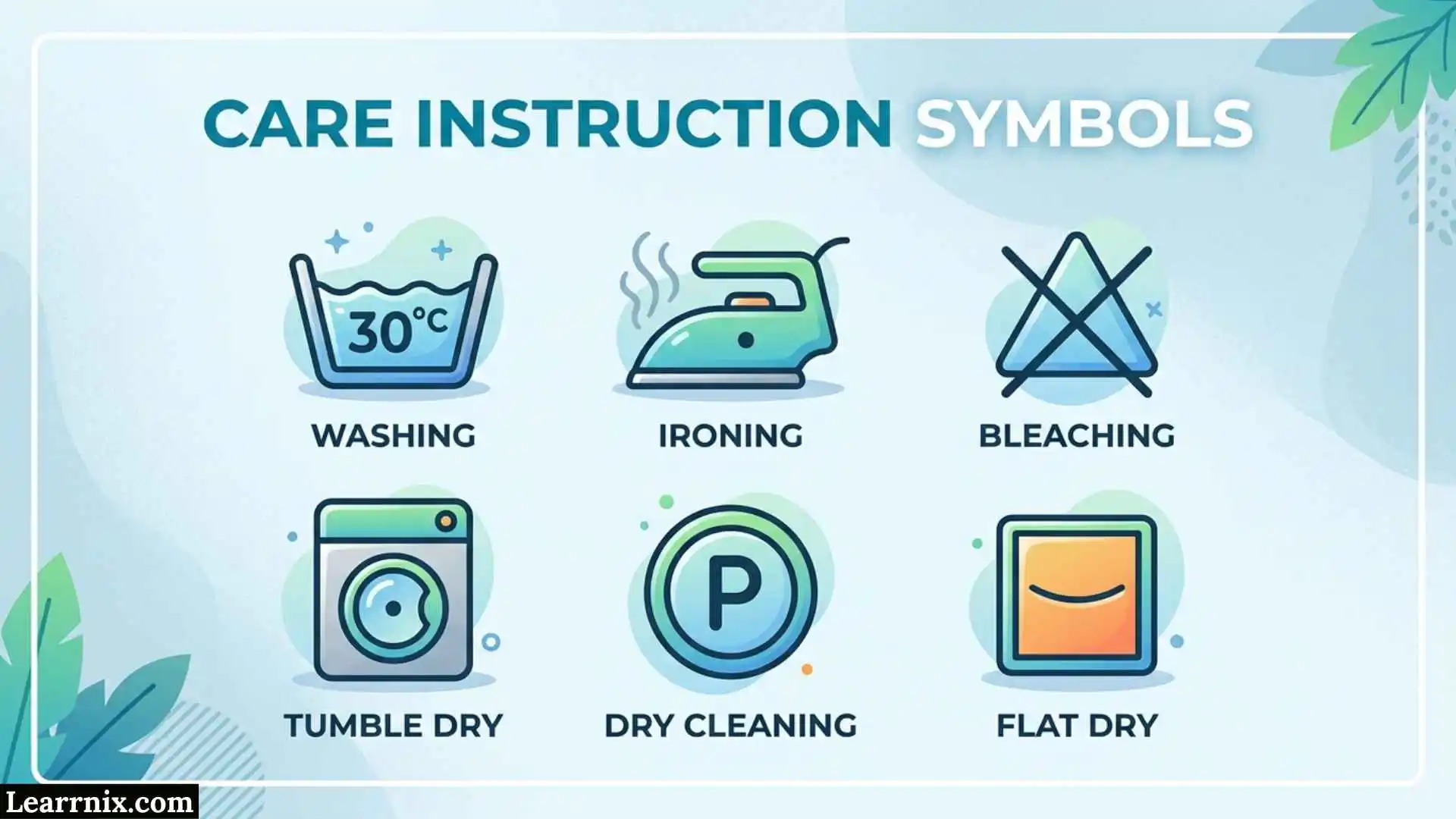
If you have ever looked at a clothing label and wondered what the tiny tub, triangle, square, iron, or circle means, care instruction symbols are the answer. These symbols provide a standardized visual guide for washing, bleaching, drying, ironing, and professional textile care.
Understanding them can help you avoid common laundry mistakes such as shrinking clothes, damaging prints, fading colors, stretching delicate fabrics, or using too much heat. More importantly, the symbols are not based simply on whether a garment is cotton, wool, polyester, or another fiber. They are intended to describe the appropriate treatment for the finished textile article, including its dyes, finishes, fasteners, decorations, and other components.
The international standard ISO 3758:2023 establishes a system of graphic textile-care symbols and describes the most severe treatments that should not cause irreversible damage when the textile is properly cared for. It covers washing, bleaching, drying, ironing, and professional dry and wet cleaning.
This complete guide explains what every major care symbol means, how to read dots and lines, how to interpret a crossed-out symbol, how the system differs from fabric labels, what has changed in ISO 3758:2023, common mistakes to avoid, and how manufacturers and consumers should use care instructions.
Quick Answer: What Do Care Instruction Symbols Mean?
Care instruction symbols are visual icons printed on textile care labels to tell you how a garment or other textile should be treated.
The five basic categories are:
| Symbol | Care category | What it tells you |
| Washtub | Washing | Whether and how the textile can be washed |
| Triangle | Bleaching | Whether bleach can be used |
| Square | Drying | How the textile should be dried |
| Iron | Ironing | Whether and how it can be ironed |
| Circle | Professional care | Professional cleaning requirements |
The symbols become more specific through numbers, dots, lines, and crosses.
For example:
- A number inside a washing tub indicates the maximum washing temperature.
- Lines underneath a washing symbol indicate gentler mechanical treatment.
- Dots can indicate heat levels.
- A crossed-out symbol means the represented treatment should not be used.
GINETEX explains that care symbols communicate the maximum permitted treatment, while milder treatments and lower temperatures are permitted.
The easiest way to remember the five symbols
Tub = Wash
Triangle = Bleach
Square = Dry
Iron = Iron
Circle = Professional Care
Once these five shapes are familiar, even complicated clothing labels become much easier to understand.
Also Check This Post: 73+ Easter Symbols: Easy Symbols to Learn for Beginners
What Are Care Instruction Symbols?
Care instruction symbols are standardized pictograms used to communicate textile-care information without depending entirely on written language.
A label might need to be understood by consumers in different countries and languages. Symbols provide a compact way to communicate the recommended treatment.
The system covers more than just the textile’s fiber content. GINETEX explains that care symbols take into account critical aspects of the finished article, including coloring, finishing, accessories such as buttons and zippers, and applications.
This explains why two garments made from the same fiber can have different care instructions.
For example, two cotton shirts may both contain 100% cotton, but one could have:
- A printed design
- A special finish
- A particular dye
- Decorative attachments
- A lining
- A different construction
Their care requirements may therefore be different.
Why Are These Symbols Important?
The purpose of care labeling is to reduce guesswork.
A consumer should be able to look at a label and determine:
- Whether the garment can be washed
- How hot the water can be
- Whether bleach is permitted
- Whether tumble drying is allowed
- How the garment should be dried naturally
- Whether ironing is permitted
- What ironing temperature is appropriate
- Whether professional cleaning is permitted
Care labeling is also important for businesses. In the United States, the Federal Trade Commission’s Care Labeling Rule requires covered manufacturers and importers to provide regular care instructions and requires the information to be accurate and supported by a reasonable basis.
The Five Main Care Instruction Symbols Explained
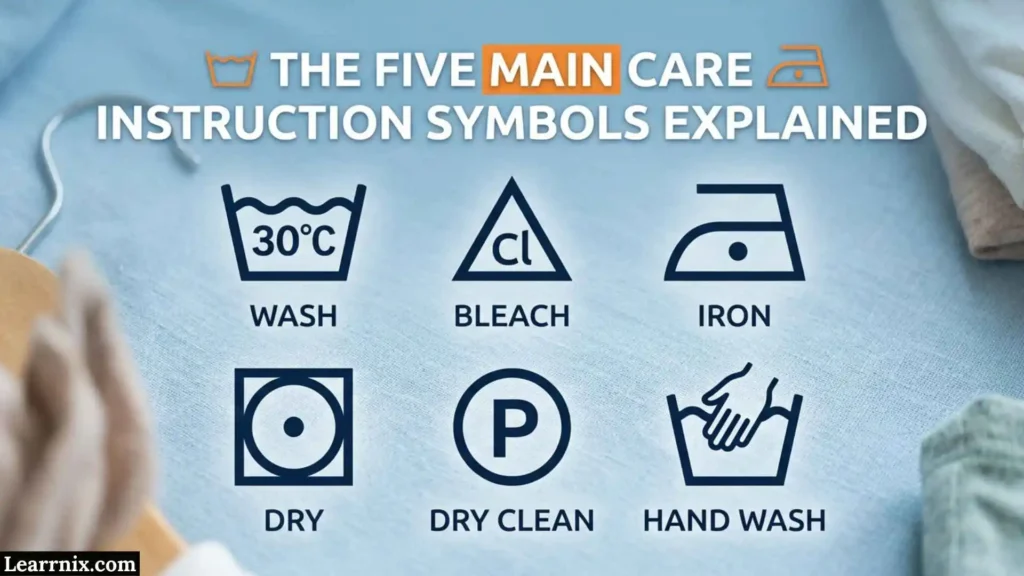
The complete care sequence traditionally follows this order:
Washing → Bleaching → Drying → Ironing → Professional Textile Care
GINETEX states that the full sequence is used to provide complete care information.
Let’s examine each category in detail.
1. Washing Symbols: Understanding the Washtub
The washtub is the symbol for domestic washing.
It tells you whether the garment can be washed and, when applicable, provides information about temperature and mechanical action.
What Does a Number Inside the Washing Tub Mean?
A number inside the tub indicates the maximum washing temperature in degrees Celsius.
Common examples include:
| Symbol information | Meaning |
| 30°C | Wash at no more than 30°C |
| 40°C | Wash at no more than 40°C |
| 60°C | Wash at no more than 60°C |
| 95°C | Wash at no more than 95°C |
The number should be understood as a maximum, not necessarily a temperature you must use every time.
For example, if the label permits 40°C and the garment is only lightly soiled, a lower-temperature wash may be suitable. GINETEX specifically states that milder treatments and lower temperatures than those indicated are permitted.
What Does a Plain Washing Tub Mean?
A plain tub without a special restriction generally indicates that the article can be washed using the appropriate normal washing process, subject to any temperature marking.
The absence of a temperature number does not mean that every temperature is automatically safe. Always interpret the complete symbol according to the applicable labeling system.
What Do Lines Under the Washing Symbol Mean?
Lines underneath the washing tub indicate reduced mechanical action.
| Lines | General meaning |
| No line | Normal process |
| One line | Mild process |
| Two lines | Very mild process |
The distinction is important for delicate textiles.
A very mild cycle does not simply mean “use cold water.” The machine’s mechanical action also matters.
GINETEX provides specific care information for very mild washing, including machine-washable wool articles.
What Does the Hand-Wash Symbol Mean?
A hand inside the tub means hand wash.
For hand-wash garments:
- Follow the specified water temperature.
- Dissolve detergent properly.
- Place the garment gently into the water.
- Avoid aggressive rubbing.
- Do not twist or wring forcefully.
- Rinse carefully.
- Remove excess water gently.
- Reshape the garment when appropriate.
- Follow the label’s drying instructions.
GINETEX’s detailed guidance for hand washing recommends careful agitation and specifically warns against rubbing, pulling, and wringing sensitive articles.
What Does a Crossed-Out Washing Tub Mean?
A crossed-out tub means:
Do not wash.
Do not put the item into a normal washing machine simply because it appears durable.
A garment with this symbol may require professional care or another treatment indicated elsewhere on the label.
2. Bleaching Symbols: What the Triangle Means
The triangle represents bleaching.
There are several important versions of this symbol.
Empty Triangle
An empty triangle generally indicates that bleaching is permitted according to the applicable care system.
However, you should still follow the product instructions for any bleaching agent you use.
Triangle With Diagonal Lines
A triangle containing two diagonal lines indicates that oxygen/non-chlorine bleaching is permitted.
It does not mean that every type of bleach is suitable.
This distinction is especially important because chlorine bleach can cause unwanted changes in some dyed or finished textiles.
Crossed-Out Triangle
A crossed-out triangle means:
Do not bleach.
If the garment has this symbol, do not add bleach just because a stain is difficult to remove.
Instead, use an appropriate stain-removal method that does not conflict with the care label.
3. Drying Symbols: How to Read the Square
The square represents drying.
Unlike the washing tub, the square does not automatically mean tumble drying. Its internal markings tell you what kind of drying is appropriate.
Square With a Circle: Tumble Drying
A circle inside a square means that tumble drying is permitted.
Dots inside the circle indicate the permitted heat level.
The important distinction is:
Square = drying category
Circle inside square = tumble drying
What Do Dots Inside the Dryer Symbol Mean?
Dots indicate the drying temperature or heat level.
Generally:
- One dot = lower heat
- Two dots = higher heat category
Always interpret the dots together with the tumble-drying symbol.
Crossed-Out Tumble-Drying Symbol
A crossed-out square containing a circle means:
Do not tumble dry.
This is one of the most frequently overlooked instructions.
A garment can be completely washable but still be unsuitable for a tumble dryer.
Natural Drying Symbols
A square without a circle can provide natural-drying instructions.
Depending on the markings, the label can indicate:
- Line drying
- Drip drying
- Flat drying
- Drip-flat drying
- Drying in the shade
These differences can matter for garments that lose their shape when hung while wet.
For example, a sweater intended to dry flat should not automatically be hung on a clothesline or hanger.
4. Ironing Symbols: Understanding the Iron Icon
The iron symbol tells you whether the garment can be ironed and, when dots are present, how much heat can be applied.
One-Dot Iron
One dot represents a low-temperature ironing category.
This is generally associated with textiles that are more sensitive to heat.
Two-Dot Iron
Two dots indicate a medium-temperature category.
Three-Dot Iron
Three dots indicate a higher-temperature category.
The exact temperatures should be interpreted according to the relevant care-label standard rather than by guessing from the fabric name.
Crossed-Out Iron
A crossed-out iron means:
Do not iron.
This instruction can be particularly important for garments containing:
- Heat-sensitive synthetic materials
- Printed designs
- Coatings
- Decorative applications
- Special finishes
Applying excessive heat can cause irreversible changes.
What Does an Iron Without Steam Symbol Mean?
The latest international standard, ISO 3758:2023, includes a new symbol for ironing without steam. ISO describes the 2023 edition as the fourth edition of the standard, replacing ISO 3758:2012.
This is a useful update for anyone using older care-symbol charts because newer labels may contain instructions that older charts do not explain.
5. Professional Cleaning Symbols: Understanding the Circle
The circle represents professional textile care.
It can relate to professional dry cleaning and wet cleaning.
Why Are Letters Inside Professional-Care Symbols?
Letters or other markings inside the circle can provide information intended for professional cleaners.
They can identify the cleaning process or materials that are permitted.
Consumers should not interpret these markings as instructions to recreate professional cleaning at home.
Crossed-Out Circle
A crossed-out professional-care symbol means that the indicated professional treatment should not be used.
If another cleaning method is listed, follow that method instead.
What Do Dots Mean on Care Instruction Symbols?
Dots usually indicate temperature or heat level, but their meaning depends on the symbol.
For example:
| Dots appear in | They generally relate to |
| Washing symbol | Washing-temperature category where applicable through the standard’s markings |
| Tumble-dry symbol | Drying heat |
| Iron symbol | Ironing heat |
The safest method is to identify the main symbol first and then interpret the dots.
Do not assume that one dot always represents exactly the same temperature across every care category.
What Do Lines Mean on Clothing Care Symbols?
Lines often indicate that a milder treatment is required.
For washing:
- One line = mild mechanical action
- Two lines = very mild mechanical action
However, lines can have different meanings depending on where they appear.
For example, natural-drying symbols use lines to communicate different drying methods.
This is why it is important to interpret the entire pictogram rather than memorizing isolated marks.
What Does a Crossed-Out Care Symbol Mean?
A cross is one of the easiest symbols to understand.
It means:
Do not use the treatment represented by the symbol.
| Crossed-out symbol | Instruction |
| Washtub | Do not wash |
| Triangle | Do not bleach |
| Tumble-dryer symbol | Do not tumble dry |
| Iron | Do not iron |
| Professional-care circle | Do not use the indicated professional treatment |
The cross should never be ignored because the rest of the label looks simple.
How to Read a Complete Care Label Step by Step
Instead of trying to memorize every possible combination, use a systematic approach.
Step 1: Find the Washing Symbol
Start with the washtub.
Ask:
Can this garment be washed?
If yes, check the temperature and any lines.
Step 2: Check the Washing Temperature
Look inside the tub for a temperature number.
Treat it as the maximum permitted washing temperature.
Step 3: Check Mechanical Action
Look underneath the tub.
One or two lines can mean that you need a mild or very mild cycle.
Step 4: Check Bleaching
Move to the triangle.
Determine whether:
- Bleaching is permitted
- Only oxygen/non-chlorine bleaching is permitted
- Bleaching is prohibited
Step 5: Check Drying
Look at the square.
Determine whether the garment should be:
- Tumble dried
- Line dried
- Drip dried
- Dried flat
- Dried in the shade
Step 6: Check Ironing
Look at the iron.
Check for dots or a prohibition mark.
Step 7: Check Professional Care
Finally, look for the circle and any additional markings.
Care Instruction Symbols Decision Tree
Use this quick decision guide when you are unsure how to care for an item.
Can I wash it?
↓ Yes
Check the temperature.
↓ One line
Use a mild cycle.
↓ Two lines
Use a very mild cycle.
↓ Hand symbol
Hand wash.
↓ Crossed tub
Do not wash.
Can I bleach it?
↓ Empty triangle
Bleaching permitted.
↓ Striped triangle
Use only permitted oxygen/non-chlorine bleach.
↓ Crossed triangle
Do not bleach.
Can I tumble dry it?
↓ Square + circle
Check the dots for heat level.
↓ Crossed square + circle
Do not tumble dry.
Can I iron it?
↓ Iron + dots
Use the indicated temperature category.
↓ Crossed iron
Do not iron.
Does it require professional care?
↓ Circle
Read any additional markings and use an appropriate professional cleaner.
Why the Care Label Is More Important Than the Fabric Name
A common misconception is:
“It’s cotton, so I can wash it like any other cotton garment.”
That is not reliable.
Fiber content tells you what the textile contains. The care label tells you how the finished article has been tested or specified for care.
A cotton garment can contain:
- Printed graphics
- Decorative stitching
- Metal accessories
- Special finishes
- Different dyes
- Blended components
- Coatings
These can affect the appropriate treatment.
ISO’s care-labeling system is designed around the textile article and the treatments that should not cause irreversible damage.
Practical Rule
Use the fiber label to understand what the garment is made from. Use the care label to understand how that specific garment should be treated.
Why Care Labels Give Maximum Treatments
Another important point is that a care label generally tells you the maximum permitted treatment.
Suppose the label says:
40°C
That does not mean:
“Always wash at 40°C.”
It means:
“Do not exceed the indicated treatment.”
GINETEX explicitly states that milder treatments and lower temperatures than those shown on the label are permitted.
Example
A cotton shirt is labeled for a maximum 40°C wash.
If it has only been worn for a few hours and is lightly soiled, a cooler wash may be enough.
For heavily soiled clothing, you can consider the maximum permitted treatment when appropriate.
The goal is not to use the strongest possible treatment every time. It is to clean the textile without exceeding its care limits.
Common Mistakes People Make With Care Symbols
Understanding the symbols is useful, but applying them incorrectly can still damage clothing.
Mistake 1: Treating the Maximum Temperature as Mandatory
If the label says 40°C, you do not necessarily need to wash at exactly 40°C.
A lower suitable temperature is generally allowed.
Mistake 2: Assuming All Bleach Is the Same
A striped triangle has a different meaning from an empty triangle.
If only oxygen/non-chlorine bleaching is permitted, chlorine bleach should not be substituted.
Mistake 3: Ignoring the Drying Symbol
Many people check the washing instructions and immediately put the garment into the dryer.
That can be a mistake.
Always check the square.
Mistake 4: Using High Heat Because the Garment Looks Strong
Appearance is not a reliable indicator of heat resistance.
A thick garment can still contain a print, coating, adhesive, or other heat-sensitive component.
Mistake 5: Ignoring Lines Under the Washing Symbol
Two garments may both say 30°C, but one may have a bar underneath the tub.
That additional marking means the washing process needs to be gentler.
Mistake 6: Looking Only at the First Symbol
The washing symbol is only one part of the care sequence.
A garment can be washable but not tumble dryable.
It can also be washable and dryable but unsuitable for ironing.
How to Wash Delicate Clothing More Safely
Delicate garments require attention to more than water temperature.
Mechanical action, spinning, drying, and heat can all matter.
When the label indicates delicate or very mild treatment:
- Use the specified gentle cycle.
- Do not overload the machine.
- Use a suitable detergent.
- Avoid unnecessary aggressive agitation.
- Avoid forceful wringing.
- Follow the specified drying method.
- Dry flat when the label requires it.
- Avoid ironing when prohibited.
GINETEX’s detailed guidance for sensitive textiles emphasizes reduced mechanical treatment and, for some very mild cycles, substantially reducing the quantity of laundry in the machine.
What If a Care Label Is Missing or Unreadable?
A missing label creates uncertainty.
Do not automatically assume that a garment is safe to wash at a standard temperature.
Try these steps:
- Check the manufacturer’s website or product documentation.
- Look for the original product listing.
- Identify the fiber content.
- Consider whether the garment has prints, coatings, embellishments, or special finishes.
- Choose a conservative treatment if the material is well understood.
- Use a professional cleaner for expensive or unusually delicate garments.
The more valuable or complicated the garment, the less sensible it is to experiment.
Real-Life Examples of Reading Care Symbols
Example 1: Everyday Cotton T-Shirt
Imagine the label indicates:
40°C wash → do not bleach → tumble dry permitted → two-dot iron
The practical instructions are:
- Wash at a maximum of 40°C.
- Do not bleach.
- Tumble dry according to the permitted heat category.
- Iron using the two-dot temperature category.
The important point is that you should not stop after seeing “40°C.” The remaining symbols complete the care instructions.
Example 2: Wool Sweater
Imagine the label indicates:
Hand wash → do not bleach → dry flat
The correct approach is to:
- Hand wash according to the specified temperature.
- Avoid bleach.
- Dry the sweater flat.
The drying instruction is especially important because hanging a wet sweater can affect its shape.
Example 3: Printed Hoodie
Suppose a hoodie is made from cotton but contains a large printed design.
The fiber alone does not tell you whether high heat or aggressive drying is appropriate.
The care label should determine the permitted washing, drying, and ironing treatment.
Example 4: Formal Jacket
A formal jacket may contain a professional-care symbol with additional markings.
In this situation, do not assume that because the outer fabric appears washable, the entire garment is suitable for a household washing machine.
The label applies to the finished article.
Care Symbols and Different Types of Clothing
Different garments create different care challenges.
T-Shirts
Check:
- Wash temperature
- Bleaching
- Tumble drying
- Ironing
Printed shirts may need special attention to heat.
Wool Sweaters
Pay particular attention to:
- Hand washing
- Very mild washing
- Dry-flat instructions
- Heat restrictions
Jeans
Do not assume all denim can tolerate identical washing and drying.
Dye treatments and finishes can change the appropriate care method.
Suits and Formalwear
Professional cleaning instructions are especially important for structured garments.
Towels and Bedding
These often have straightforward washing and drying instructions, but the label still determines the appropriate maximum treatment.
Also Check This Post: 70+ Taino Symbols and Meanings: Common Symbols and Their Uses
Are Care Instruction Symbols the Same Worldwide?
There is an international system, but national regulations and labeling practices can differ.
ISO 3758:2023 is the current international standard for textile care labeling using symbols. It replaced ISO 3758:2012.
The United States has its own Federal Trade Commission Care Labeling Rule under 16 CFR Part 423. The FTC requires covered manufacturers and importers to provide regular care instructions and to have a reasonable basis for the information supplied.
Therefore, a company selling clothing internationally should not assume that complying with one country’s labeling requirements automatically satisfies every other market.
What Is ISO 3758:2023?
ISO 3758:2023 — Textiles — Care labelling code using symbols is the fourth edition of the international standard.
It was published in December 2023 and replaced the 2012 edition. ISO says the standard establishes a system of graphic symbols for textile articles and covers domestic washing, bleaching, drying, ironing, and professional dry and wet cleaning.
What Changed in the 2023 Revision?
The revised standard introduced or updated several aspects of the system.
Among the changes are:
- A new symbol for hand washing at ambient temperature
- A new symbol for ironing without steam
- New professional-cleaning solvents
- Graphical changes to certain symbols
- Additional examples for symbol use
This is why older care-symbol charts may not completely represent the current international standard.
Care Labeling Requirements for Manufacturers and Retailers
Care symbols are not only a consumer convenience.
They can also be part of legal and commercial product requirements.
In the United States, the FTC Care Labeling Rule requires covered manufacturers and importers to provide regular care instructions for textile wearing apparel and certain piece goods. The FTC also states that care instructions must accurately describe appropriate care procedures.
Manufacturers must have a reasonable basis for their care information. The FTC describes acceptable forms of support, including reliable testing, technical literature, industry expertise, past experience, and other reliable evidence.
Why Testing Matters
A manufacturer should not simply choose a care symbol because it “sounds right.”
The instructions need to be supported by evidence that the garment can tolerate the prescribed care process.
This is especially important when a product combines multiple components.
For example, a garment may have:
- Main fabric
- Lining
- Thread
- Buttons
- Zippers
- Prints
- Adhesives
- Coatings
The complete product must be considered.
Are Care Symbols Protected?
Businesses should be careful when reproducing textile-care symbols commercially.
GINETEX states that its five care symbols are protected trademarks in many countries and that commercial use may require a special license agreement. It also emphasizes that licensed users must use the symbols correctly.
This is different from a consumer simply reading the symbols on a shirt.
If you are designing labels for a clothing brand, check the intellectual-property and labeling requirements applicable to your market before reproducing care icons.
Care Symbols Do Not Guarantee Perfect Cleaning
An important misconception is that following the care label guarantees that every stain will disappear.
It does not.
GINETEX explains that care labeling provides information intended to prevent damage from the indicated treatments, but it does not guarantee removal of every type of dirt or stain.
Think of it this way:
Care label = safe treatment guidance
It does not mean:
Care label = guaranteed stain removal.
This distinction becomes important when dealing with oil, ink, dye transfer, grease, paint, or old stains.
Care Instruction Symbols vs. Written Instructions
Some labels use symbols alone, while others combine symbols with words.
Both approaches can provide useful information, but written warnings may be important when a particular process could cause damage.
The FTC allows appropriate symbols in addition to required terminology and provides conditions under which symbols can be used without words.
For consumers, this means you should read both the symbols and any written warning.
Never ignore a sentence such as:
- “Do not iron decoration.”
- “Wash separately.”
- “Do not use chlorine bleach.”
- “Professional dry clean only.”
The written instruction may add information that the basic pictogram does not communicate by itself.
How to Choose a Laundry Setting From the Label
When the label gives you a maximum temperature and a cycle restriction, use both.
For example:
40°C + one bar
does not simply mean:
“40°C wash.”
It means you should select a washing process that stays within the indicated temperature and provides the required mild mechanical treatment.
This is why modern washing machines often include settings such as:
- Delicate
- Gentle
- Wool
- Hand wash
- Easy-care
- Normal cotton
The correct program depends on the garment and the care label.
Best Practices for Using Care Instruction Symbols
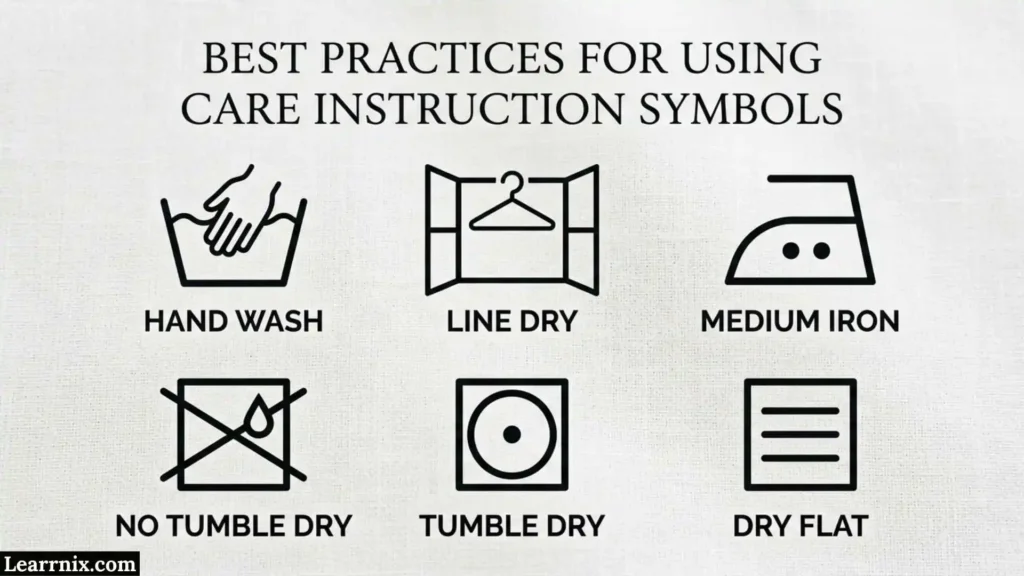
Read the Label Before the First Wash
Do not wait until the garment has already shrunk or faded.
Check the label when you purchase the item.
Check All Five Categories
Even if you only want to know whether something can be washed, glance at drying and ironing too.
Follow the Most Restrictive Instruction
If one part of the label prohibits a treatment, do not override it because another part seems permissive.
Use Lower Heat When Appropriate
If a lower heat setting provides adequate cleaning or drying, it can be a sensible choice.
Avoid Guessing With Expensive Garments
Professional cleaning can be cheaper than replacing a damaged suit, coat, dress, or specialty textile.
Keep Labels Legible
For garments you wash repeatedly, make sure the care label remains readable. The information is useful throughout the item’s life.
A Practical Laundry Checklist
Before washing an unfamiliar garment, ask:
- What does the washing symbol say?
- What is the maximum wash temperature?
- Are there one or two lines under the tub?
- Is hand washing required?
- Is washing prohibited?
- Can the garment be bleached?
- Is only non-chlorine/oxygen bleach permitted?
- Can it be tumble dried?
- What drying temperature is permitted?
- Does it need to dry flat or in the shade?
- Can it be ironed?
- What ironing temperature is allowed?
- Is steam restricted?
- Is professional cleaning required?
- Are there written warnings in addition to the symbols?
This takes only a few seconds once you know what to look for.
Complete Care Instruction Symbols Cheat Sheet
| Symbol feature | Meaning | Practical action |
| Washtub | Washing | Check temperature and cycle |
| Number in tub | Maximum wash temperature | Do not exceed it |
| One bar under tub | Mild washing | Reduce mechanical action |
| Two bars under tub | Very mild washing | Use very gentle treatment |
| Hand in tub | Hand wash | Wash gently by hand |
| Crossed tub | Do not wash | Avoid domestic washing |
| Empty triangle | Bleaching permitted | Follow applicable bleach instructions |
| Striped triangle | Oxygen/non-chlorine bleach | Do not use chlorine bleach |
| Crossed triangle | Do not bleach | Avoid bleach |
| Square | Drying | Check internal markings |
| Circle inside square | Tumble drying | Check heat dots |
| Crossed tumble symbol | Do not tumble dry | Use another permitted method |
| Lines in square | Natural drying | Follow the indicated method |
| Iron | Ironing | Check dots or restrictions |
| One dot | Low ironing heat | Use low temperature |
| Two dots | Medium ironing heat | Use medium temperature |
| Three dots | Higher ironing heat | Use the permitted higher category |
| Crossed iron | Do not iron | Avoid ironing |
| Circle | Professional care | Follow professional-care instructions |
| Letter inside circle | Professional process | Intended primarily for cleaner |
| Crossed circle | Professional treatment prohibited | Avoid indicated treatment |
The exact interpretation should always be based on the complete symbol and applicable labeling standard.
Frequently Asked Questions About Care Instruction Symbols
What are care instruction symbols?
Care instruction symbols are pictograms on textile labels that explain how an item should be washed, bleached, dried, ironed, or professionally cleaned.
What are the five basic clothing care symbols?
The five basic categories are represented by the washtub, triangle, square, iron, and circle. They correspond to washing, bleaching, drying, ironing, and professional textile care.
What does 30°C mean on a care label?
A 30°C number inside a washing tub indicates a maximum washing temperature of 30°C.
What does a tub with one line underneath mean?
It indicates a mild washing process with reduced mechanical action.
What does a tub with two lines underneath mean?
It indicates a very mild washing process and is intended for more sensitive textiles.
What does a hand inside the washing tub mean?
It means the item should be hand washed according to the indicated conditions.
What does a crossed-out triangle mean?
It means do not bleach the garment.
What does a triangle with two diagonal lines mean?
It indicates that oxygen/non-chlorine bleaching is permitted rather than chlorine bleaching.
What does a square with a circle mean?
It means tumble drying is permitted. Dots inside the circle indicate the applicable drying heat level.
What does a crossed-out dryer symbol mean?
It means the garment should not be tumble dried.
What does an iron with one dot mean?
It indicates a low ironing-temperature category.
What does a crossed-out iron mean?
It means the garment should not be ironed.
What does a circle mean on a clothing label?
A circle represents professional textile care. Additional markings can provide instructions for the professional cleaner.
Can I wash clothing at a lower temperature than the label?
Generally, yes. Care-label systems communicate maximum permitted treatments, and GINETEX states that milder treatments and lower temperatures are permitted.
Does the fabric label tell me how to wash the garment?
Not necessarily. Fiber content identifies what the textile is made from, while the care label provides treatment instructions for the finished article.
Can I ignore care symbols if my washing machine has a gentle setting?
No. A generic gentle cycle may not match the specific requirements of the garment. Check the complete care label first.
Are care symbols universal?
There is an international ISO system, but national regulations and labeling practices can differ. ISO 3758:2023 is the current international standard, while countries such as the United States also have specific legal care-labeling requirements.
What is the latest ISO standard for care instruction symbols?
The current international standard is ISO 3758:2023 — Textiles — Care labelling code using symbols. It is the fourth edition and replaced ISO 3758:2012.
Do care labels guarantee that stains will be removed?
No. They communicate appropriate treatment and are intended to help prevent irreversible damage, but they do not guarantee removal of every stain or type of dirt.
Why do two garments made from the same material have different care instructions?
The finished garments may differ in dyes, finishes, construction, decorations, fasteners, coatings, or other components. Care instructions are based on the complete textile article rather than fiber content alone.
Final Takeaway
Learning care instruction symbols does not require memorizing dozens of complicated icons. Start with the five basic shapes:
Washtub = washing
Triangle = bleaching
Square = drying
Iron = ironing
Circle = professional textile care
Then look for the details.
Numbers tell you the maximum washing temperature.
Dots communicate heat levels where applicable.
Lines can indicate gentler treatment.
Crossed-out symbols tell you what not to do.
The most important habit is to read the entire care label, not just the first symbol. A garment may tolerate washing but not tumble drying, or it may tolerate drying but not ironing. The complete sequence provides the information needed to care for the finished textile properly.
The current international reference is ISO 3758:2023, while national requirements can apply in individual markets.
For everyday consumers, understanding these symbols reduces laundry guesswork and helps avoid preventable damage. For clothing manufacturers and retailers, accurate care information is also an important part of responsible product labeling.
Also Check This Post: 83+ Lord of the Rings Symbols Explained: From Rings to Runes

I am Daniel Harper, an education enthusiast and writer who enjoys creating helpful content to make learning more accessible and engaging.
I focus on sharing knowledge about effective study methods, educational growth, and skills that help learners succeed in a changing world.
Through my writing, I aim to inspire students to explore new ideas and develop a passion for learning.
Books by Daniel Harper:
- The Path to Lifelong Learning
- Unlocking Your Learning Potential
 Michael Carter
 Charlotte Anderson