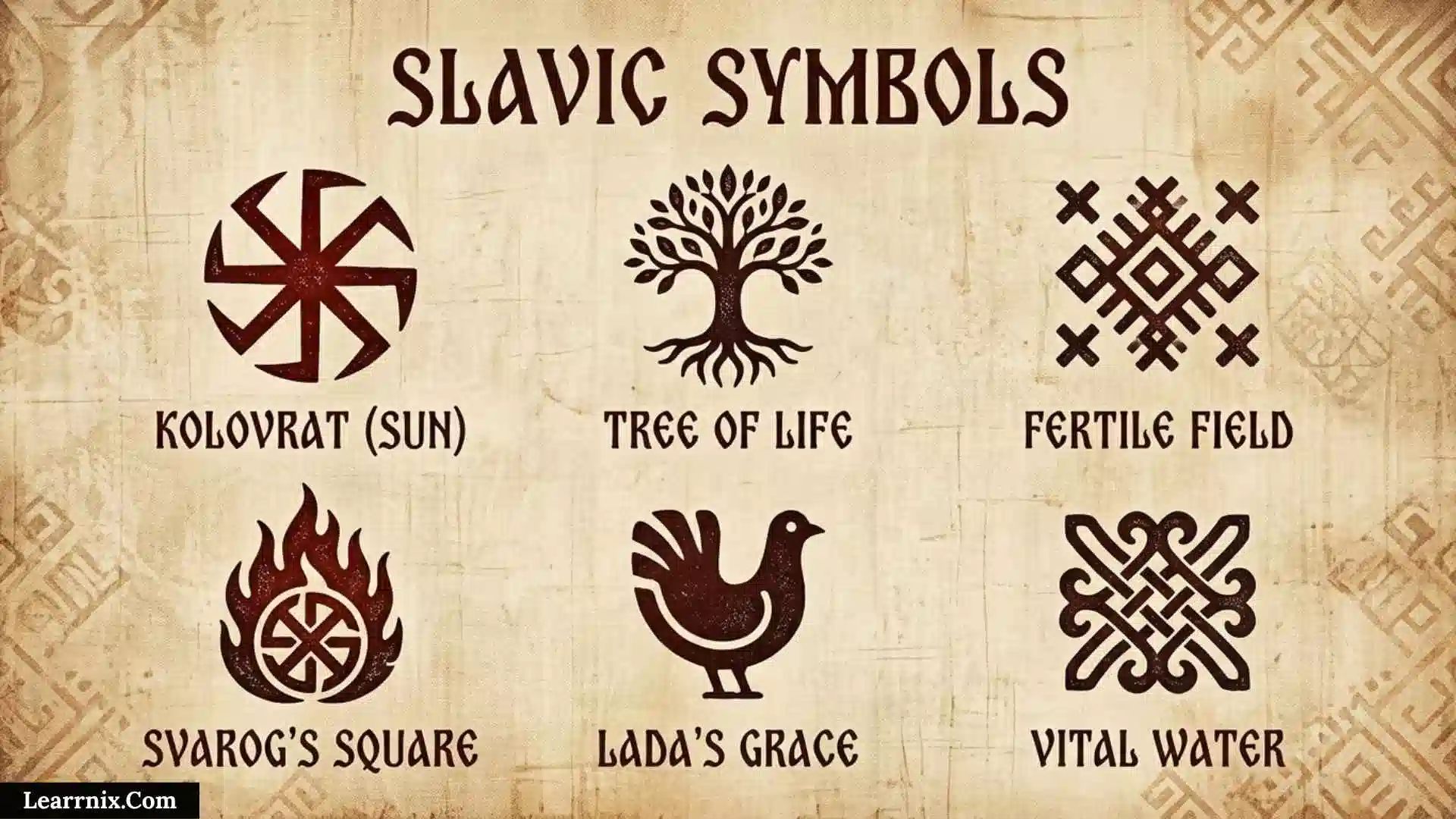
Slavic symbols are visual motifs, religious signs, folk patterns, and cultural images associated with the diverse peoples and traditions of Eastern, Western, and Southern Europe. They can represent nature, protection, fertility, thunder, the sun, family, prosperity, spiritual beliefs, and ideas about the structure of the universe.
However, there is an important historical point to understand: there is no single, universally accepted list of ancient Slavic symbols with fixed meanings. Slavic cultures covered a large geographic area and changed significantly over many centuries. Much of what is known about pre-Christian Slavic religion comes from limited written records, archaeology, folklore, linguistics, and later ethnographic traditions.
Some symbols frequently described online as “ancient Slavic symbols” are actually modern reconstructions or symbols whose meanings were assigned much later. The modern eight-spoked kolovrat, for example, has a complicated history and should not automatically be presented as an unchanged ancient Slavic religious emblem.
This guide explains the most important Slavic symbols, what they are associated with, what the historical evidence actually supports, and how to distinguish ancient evidence from modern interpretations.
What Are Slavic Symbols?
Slavic symbols are signs, motifs, objects, and visual patterns connected with Slavic mythology, traditional culture, folklore, religious practices, textiles, art, architecture, and modern cultural identity.
The word “Slavic” covers numerous peoples and regions, including East Slavs, West Slavs, and South Slavs. Their traditions were never completely identical.
For that reason, a symbol found in Russian folklore should not automatically be treated as a universal symbol of Polish, Serbian, Ukrainian, Czech, Bulgarian, Slovak, Croatian, Slovenian, or Belarusian culture.
Main Categories of Slavic Symbols
Slavic symbolism can broadly be divided into several categories:
| Category | Common examples | Typical associations |
| Religious symbols | Perun-related motifs, sacred objects | Thunder, protection, divine power |
| Solar motifs | Wheels, circles, rotating designs | Sun, cycles, vitality |
| Nature symbols | Oak, earth, water, animals | Fertility, strength, life |
| Textile motifs | Embroidery, geometric patterns | Identity, protection, fertility |
| Mythological symbols | Attributes associated with deities | Gods, spirits, cosmic forces |
| Archaeological motifs | Idol figures, carved designs | Religion and social beliefs |
| Modern reconstructed symbols | Kolovrat and other revived signs | Modern pagan or cultural identity |
The meaning of any particular symbol depends on region, historical period, source, and context.
Why Slavic Symbols Are Difficult to Interpret
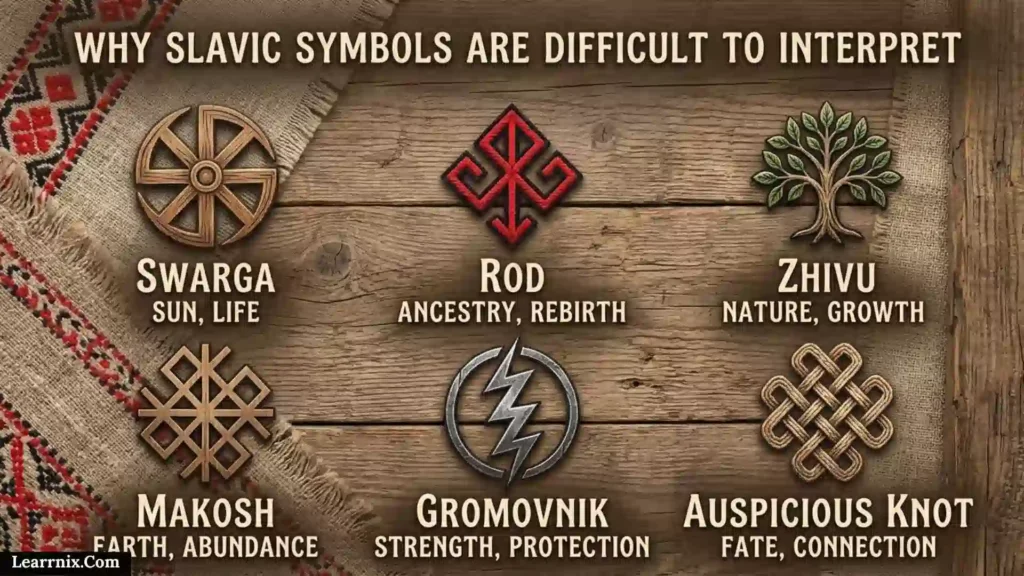
One of the biggest mistakes in online articles about Slavic symbolism is treating mythology as if it were preserved in a complete ancient symbol dictionary.
It was not.
Evidence for early Slavic religion is fragmented. Written sources are relatively limited, and some accounts were written by Christian authors who opposed the older religious practices. Archaeological discoveries provide valuable evidence, but interpreting an object does not always reveal exactly what its original creators believed.
Slavic Culture Was Not One Culture
Slavic-speaking communities spread across a huge area of Europe.
This created substantial regional differences in:
- religious traditions
- folklore
- clothing
- embroidery
- architecture
- mythology
- seasonal festivals
- artistic motifs
- relationships with neighboring cultures
Therefore, a more accurate approach is to say that a particular motif is East Slavic, West Slavic, South Slavic, Polish, Ukrainian, Russian, Bulgarian, Serbian, or another regional tradition when the evidence allows that distinction.
Ancient Evidence and Modern Reconstruction Are Different
A symbol can be meaningful today without having had the same meaning hundreds or thousands of years ago.
Modern Slavic Native Faith communities have revived, renamed, and reinterpreted a number of archaeological or folk motifs. A recent Cambridge overview notes that during the 1990s some archaeological symbols were adapted for new religious uses and given specific names and meanings that are not necessarily obvious from their archaeological context.
This distinction is essential when researching Slavic symbols.
The Kolovrat: Meaning, History, and Controversy
The kolovrat is probably the most widely recognized modern symbol associated with Slavic paganism.
It is usually shown as a rotating, multi-armed design resembling a swastika or solar wheel.
But its history is more complicated than many websites suggest.
What Does the Kolovrat Mean?
In modern Slavic pagan and cultural contexts, the kolovrat is commonly associated with:
- the sun
- movement
- cycles
- life
- cosmic order
- renewal
- Slavic identity
However, the specific modern eight-spoked kolovrat should not automatically be described as a universally documented ancient Slavic symbol.
Bellingcat’s monitoring glossary explains that while the symbol draws on historical pagan sun motifs found across Eastern Europe, the particular eight-spoked form became popularized in the early 1990s, including through Russian neo-Nazi Alexey Dobrovolsky.
Why Context Matters
The kolovrat is used in different environments.
It may appear in:
- modern pagan communities
- cultural artwork
- historical reenactment
- jewelry
- tattoos
- nationalist movements
- far-right and extremist environments
Because of this, the symbol cannot be interpreted correctly without considering who is using it and where it appears.
Bellingcat specifically warns that the symbol can occur in both non-hateful pagan contexts and extremist contexts.
Practical takeaway: seeing a kolovrat does not automatically prove extremist intent, but its modern political history means context should always be considered.
Perun Symbols and Their Meanings
Perun is one of the best-attested gods in Slavic historical sources.
He is associated primarily with:
- thunder
- lightning
- storms
- warfare
- justice
- strength
- protection
- oak trees
The Russian Primary Chronicle records Perun among the gods associated with the religious reforms of Prince Vladimir, while earlier Byzantine evidence also refers to a Slavic thunder deity.
The Oak as a Perun Association
The oak has a strong connection with Perun in Slavic religious interpretation.
This association makes sense within the broader Indo-European context in which thunder gods, mountains, forests, and oak trees frequently appear together.
Historical sources also connect Perun with weapons such as the axe and arrow, as well as with thunder and lightning.
Thunder and Lightning Motifs
Modern discussions of Slavic symbolism often connect wheel-like, axe-like, or lightning-shaped motifs with Perun.
Some of these associations are supported by folklore and comparative mythology, while others are modern reconstructions.
Therefore, it is better to describe a particular motif as “associated with Perun in modern Slavic interpretation” unless there is strong evidence proving that the exact design was historically used for that purpose.
Veles or Volos Symbols and Meanings
Veles, also known as Volos in some East Slavic sources, is another important figure in Slavic mythology.
He is commonly connected with:
- cattle
- wealth
- the underworld
- magic
- oaths
- poetry
- animals
- the earth
Historical evidence for Veles/Volos is different from the evidence for Perun, and later folklore adds layers of interpretation.
Serpent and Animal Associations
Modern interpretations frequently connect Veles with serpents, dragons, bears, cattle, and other animals.
These associations come from broader mythological patterns and later folklore rather than from a single universally documented ancient “Veles symbol.”
This is an important distinction because online symbol lists often present one modern sign as if it were an archaeological certainty.
Mokosh Symbols and Meanings
Mokosh is especially important because she is the only clearly female deity named in the list of Vladimir’s 980 pantheon.
She is commonly associated with:
- women
- fertility
- moisture
- spinning
- weaving
- household work
- marriage
- childbirth
- protection
Historical sources and later folklore connect Mokosh with spinning and textile work.
Spinning and Textile Symbolism
Because of these associations, modern Slavic symbolism frequently connects Mokosh with:
- thread
- yarn
- spinning
- weaving
- women’s crafts
- embroidered patterns
But not every Slavic embroidery pattern should be labeled a “symbol of Mokosh.”
Textile traditions developed across different regions and periods, and their meanings can vary considerably.
Solar Symbols in Slavic Tradition
Solar imagery is one of the most important themes in discussions of Slavic symbolism.
Common solar forms include:
- circles
- wheels
- radial designs
- rotating motifs
- spirals
- star-like geometric patterns
- sun-like embroidery
These designs can communicate ideas such as:
- light
- warmth
- seasonal cycles
- life
- fertility
- renewal
- movement
Why Solar Symbols Need Careful Interpretation
A circular or rotating motif does not automatically prove that an object represents the ancient Slavic sun.
Similar geometric designs occur across many European and Eurasian cultures.
For this reason, researchers normally consider the complete archaeological or ethnographic context rather than interpreting a symbol based only on its shape.
The Zbruch Idol and Cosmic Symbolism
The Zbruch Idol, sometimes called the Zbruch Sviatovid or Światowid, is one of the most famous objects associated with discussions of ancient Slavic religion.
The stone sculpture was discovered in the Zbruch River in 1848 and is now associated with the Archaeological Museum in Kraków. The surviving sculpture is approximately 257 cm high and has four sides with multiple levels of figurative representations.
What Does the Zbruch Idol Represent?
The conventional interpretation divides the monument into three horizontal zones representing different levels of the cosmos.
The museum describes the upper section as containing a four-headed deity associated with objects such as a horn, ring, sword, and horse. The middle section has human figures, while a lower figure has traditionally been interpreted as connected with the underworld.
This makes the Zbruch Idol especially important when discussing:
- cosmic order
- multiple worlds
- divine power
- fertility and prosperity
- social and religious symbolism
Why the Zbruch Idol Is Controversial
The traditional interpretation is not universally accepted.
A scholarly article published in Slavia Antiqua argues that the monument may instead be a much later Cuman/Turkic sculpture from the late 13th or early 14th century.
The Kraków Archaeological Museum itself has explored the question of whether the monument is genuinely ancient, a later creation, or something that has been reinterpreted over time.
This uncertainty is valuable information rather than a weakness. A responsible article should tell readers when archaeological interpretation is disputed instead of presenting one theory as proven fact.
Slavic Embroidery Symbols and Traditional Patterns
Embroidery is one of the richest areas for understanding Slavic visual culture.
Traditional clothing and household textiles often contain:
- diamonds
- crosses
- zigzags
- circles
- flowers
- plants
- birds
- geometric borders
- repeated symmetrical designs
These motifs can carry meanings connected with identity, nature, family, fertility, protection, or social status.
Why Embroidery Meanings Vary
It is tempting to create a simple dictionary such as:
diamond = fertility
circle = sun
tree = life
bird = freedom
But real traditional symbolism is usually more complicated.
A motif can change meaning according to:
- geographic region
- garment type
- age of the wearer
- ritual context
- historical period
- color
- placement
- surrounding motifs
Research into traditional ornamental systems also treats embroidery as a communicative form in which motifs can express cultural identity and multiple layers of meaning.
Slavic Embroidery and Modern Design
Today, Slavic-inspired embroidery appears in:
- fashion
- home decoration
- tattoos
- wedding designs
- digital graphics
- jewelry
- logos
- cultural festivals
When using these motifs commercially, it is better to identify their actual regional origin rather than labeling every Eastern European pattern simply “ancient Slavic.”
Nature Symbols in Slavic Culture
Nature is central to traditional Slavic folklore.
Important natural elements include:
- forests
- rivers
- springs
- earth
- oak trees
- animals
- birds
- the sun
- moon
- fire
- water
These elements could have religious, practical, seasonal, or folkloric significance.
Oak Trees
Oak trees are strongly associated with Perun and thunder-god traditions.
They can therefore symbolize:
- strength
- endurance
- protection
- divine power
- connection with nature
Earth and Fertility
Earth symbolism is also important in Slavic folklore.
Earth can represent:
- fertility
- motherhood
- nourishment
- life
- death
- renewal
- agricultural abundance
But earth symbolism should not automatically be assigned to one deity or one universal ancient symbol.
Animal Symbols in Slavic Tradition
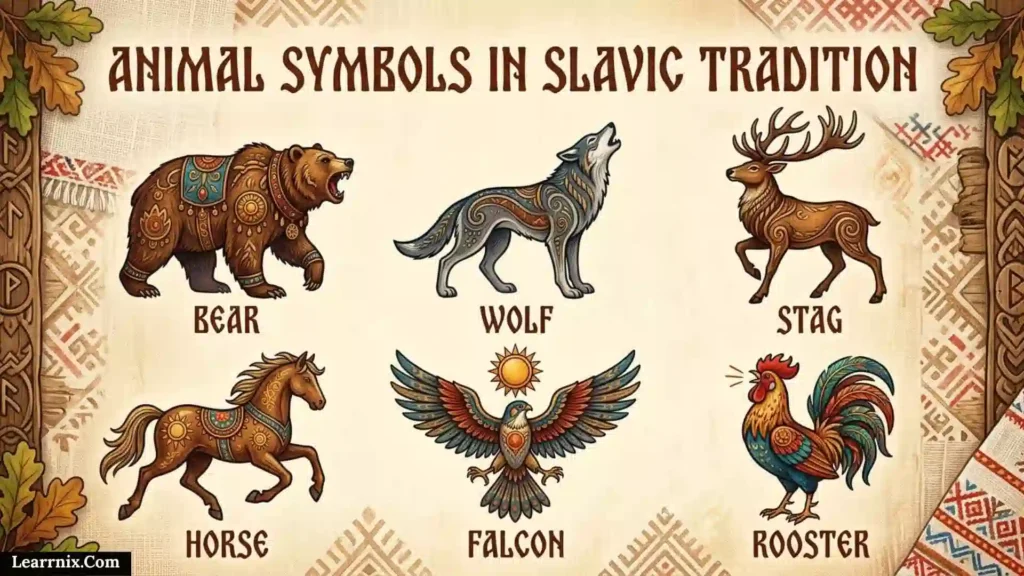
Animals appear frequently in Slavic mythology and folklore.
Horses
Horses can appear in religious and archaeological contexts and may be associated with:
- warriors
- movement
- status
- divine power
- prosperity
The horse is also one of the recognizable objects depicted on the Zbruch Idol.
Serpents and Dragons
Serpent and dragon imagery often appears in discussions of Slavic mythology.
They can be associated with:
- the underworld
- water
- chaos
- dangerous supernatural forces
- transformation
However, these meanings are not identical in every Slavic tradition.
Bears
The bear is an important animal in northern and Eastern European folklore and can symbolize:
- strength
- wilderness
- masculinity
- supernatural power
Its connection with particular gods should be treated as a folkloric association rather than automatically as an ancient religious emblem.
Slavic Symbols and Christianity
The arrival and spread of Christianity did not simply erase every earlier Slavic tradition.
Instead, some older beliefs and motifs survived through adaptation, folklore, festivals, household traditions, and associations with Christian saints.
For example, historical scholarship has identified connections between Perun traditions and Saint Elijah, while Mokosh traditions have been associated with Saint Paraskeva in later East Slavic religious culture.
Why Christian Context Matters
A traditional motif appearing on a Christian-era object does not automatically mean that the object is pagan.
People can preserve older artistic patterns while changing their religious interpretation.
This is why statements such as “this symbol is pagan because it appears on old embroidery” are often too simplistic.
Ancient Slavic Symbols vs Modern Slavic Symbols
One of the most useful ways to understand this topic is to divide symbols into historical and modern categories.
| Type | What it means |
| Historically attested | Supported by written, archaeological, or ethnographic evidence |
| Folk tradition | Preserved through later cultural practices |
| Scholarly reconstruction | Developed by researchers from multiple types of evidence |
| Modern pagan | Used by contemporary Slavic religious movements |
| Modern nationalist | Used to express ethnic or national identity |
| Extremist use | Adopted by some far-right or neo-Nazi groups |
| Commercial/cultural | Used in modern art, fashion, jewelry, or design |
A symbol can move from one category to another over time.
The meaning of the symbol therefore depends on both history and present-day context.
Common Misconceptions About Slavic Symbols
“Every Slavic Symbol Is Ancient”
False.
Some symbols are modern creations, modern reconstructions, or substantially modern reinterpretations.
The kolovrat is an especially important example.
“All Slavic People Used the Same Symbols”
False.
Slavic cultures developed across different regions and historical periods.
A symbol from Ukrainian embroidery cannot automatically be treated as a universal symbol used by all Slavic peoples.
“A Swastika-Like Symbol Is Automatically Nazi”
Not necessarily.
Swastika-like geometric motifs have extremely old histories in many cultures and existed long before modern Nazi ideology.
At the same time, some modern versions have been adopted by extremist groups.
The correct interpretation depends on the specific design and context.
“The Zbruch Idol Definitely Proves Ancient Slavic Paganism”
That conclusion is too strong.
The traditional interpretation identifies it as a Slavic religious monument, but scholars have proposed alternative explanations, including a later Cuman/Turkic origin.
“Every Embroidery Pattern Has One Fixed Meaning”
Not necessarily.
Traditional textile symbolism can be regional, contextual, and historically changeable.
How to Identify the Meaning of a Slavic Symbol
If you encounter an unfamiliar symbol, use this simple decision process.
Step 1: Identify the Design
Ask:
- Is it geometric?
- Is it an animal?
- Is it a plant?
- Is it a weapon?
- Is it a religious figure?
- Is it a wheel or solar motif?
- Is it an embroidery pattern?
Step 2: Identify the Region
Determine whether the symbol comes from:
- Russia
- Ukraine
- Belarus
- Poland
- Czechia
- Slovakia
- Serbia
- Croatia
- Slovenia
- Bulgaria
- another Slavic region
Step 3: Establish the Historical Period
Ask whether the object is:
- prehistoric
- early medieval
- medieval
- early modern
- 19th century
- 20th century
- contemporary
This can completely change the interpretation.
Step 4: Check the Source
The strongest evidence usually comes from:
- archaeological museums
- academic publications
- historical documents
- ethnographic collections
- university research
- reputable reference works
Avoid relying on an anonymous “ancient symbol dictionary” as the only source.
Step 5: Consider Modern Usage
If the symbol is associated with modern paganism, nationalism, or extremist movements, investigate its current use separately from its historical origins.
How Slavic Symbols Are Used Today
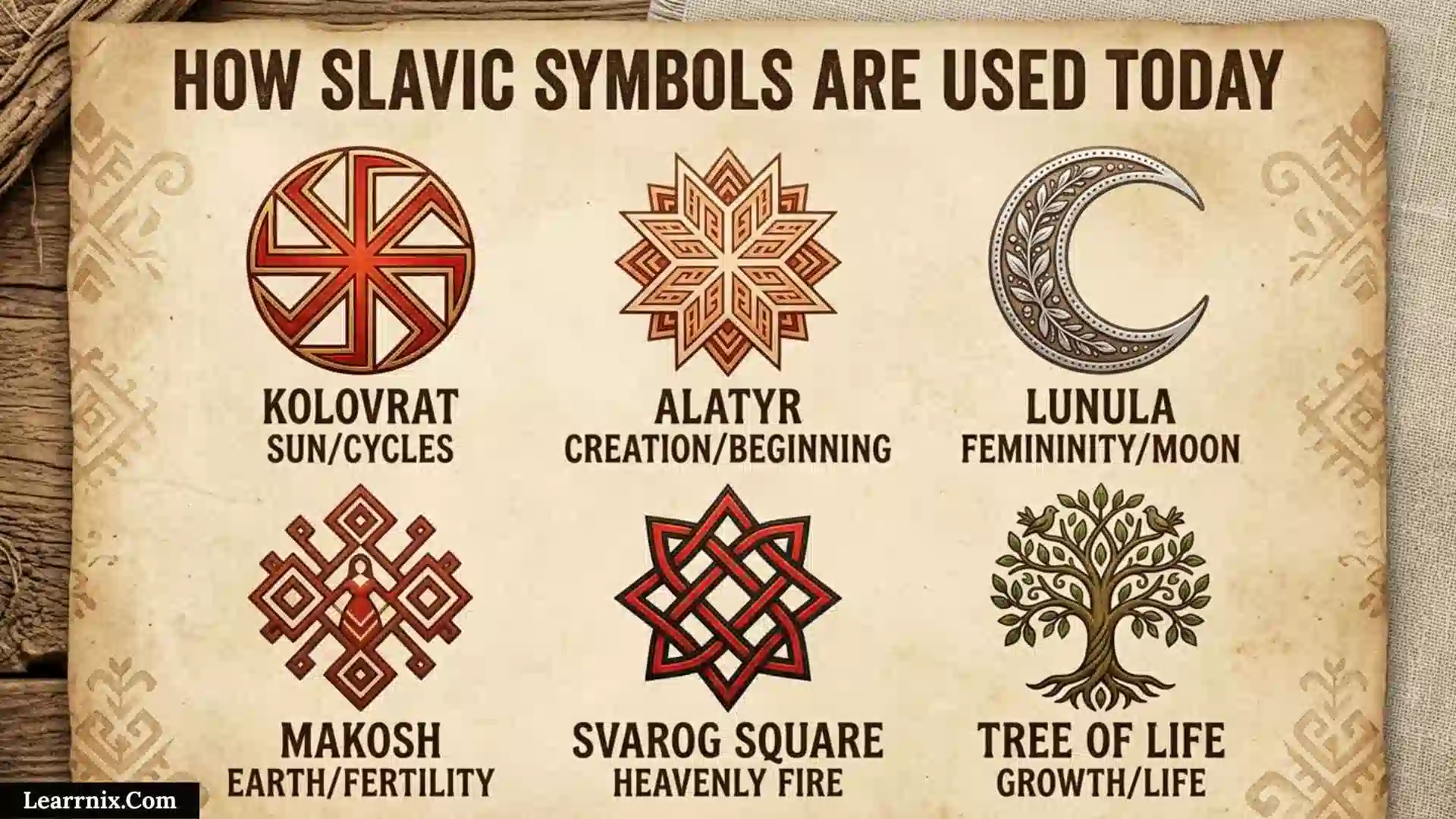
Slavic symbols remain popular in contemporary culture.
They appear in:
- jewelry
- tattoos
- clothing
- home decoration
- graphic design
- video games
- fantasy artwork
- historical reenactment
- religious practices
- cultural festivals
- social media
Jewelry and Tattoos
Modern users may choose Slavic symbols because they want to express:
- ancestry
- nature
- strength
- protection
- spirituality
- family
- cultural identity
Before using a symbol permanently, however, it is worth checking its modern associations.
This is especially important for symbols that have been adopted by extremist organizations.
Art and Graphic Design
Slavic motifs can work effectively in:
- logos
- book covers
- posters
- clothing
- cultural branding
- architectural ornament
- digital illustrations
For historically inspired designs, accuracy improves when the designer identifies a specific regional tradition rather than combining unrelated motifs into a generic “Slavic” style.
A Practical Guide to Choosing a Slavic Symbol
| If you want to represent… | Consider researching… |
| Strength | Perun and oak associations |
| Nature | Earth, trees, animals, seasonal motifs |
| Women and traditional crafts | Mokosh and textile traditions |
| Sun and cycles | Historical solar and wheel motifs |
| Wealth and prosperity | Horn, fertility, and agricultural symbolism |
| Cultural identity | Regional embroidery and folk art |
| Ancient mythology | Historically attested deities and archaeological evidence |
| Modern pagan identity | Contemporary Slavic Native Faith symbolism |
| Family heritage | Regional folk motifs from the relevant ancestry |
| A tattoo | Historical meaning plus modern political associations |
The best choice depends on whether your goal is historical accuracy, cultural identity, modern spirituality, or visual design.
How to Avoid Misusing Slavic Symbols
Before publishing, tattooing, selling, or displaying a Slavic symbol, ask:
- Is the symbol historically documented?
- Is its meaning supported by reliable evidence?
- Is it regional rather than universal?
- Is the design modern?
- Does it have extremist associations?
- Am I confusing mythology with archaeology?
- Am I presenting a scholarly theory as an established fact?
- Could the symbol have a different meaning in another Slavic culture?
This checklist prevents many common errors.
Frequently Asked Questions About Slavic Symbols
What is the most famous Slavic symbol?
The kolovrat is probably the most recognizable modern symbol associated with Slavic pagan identity. However, its modern history is complicated, and the specific eight-spoked design should not automatically be treated as an unchanged ancient Slavic symbol.
What does the Slavic kolovrat symbolize?
In modern Slavic pagan contexts, it is commonly associated with the sun, cycles, movement, renewal, and Slavic identity. Its historical origins and exact ancient meaning are more complicated than many popular websites suggest.
Is the kolovrat a Nazi symbol?
The kolovrat has been used by some neo-Nazi and far-right groups, particularly in Eastern Europe. However, it is also used in non-extremist pagan and cultural contexts. Context is therefore essential.
What is the Slavic symbol for strength?
Perun-related symbolism is often used to represent strength because Perun is associated with thunder, lightning, warfare, justice, and divine power. The oak is also strongly connected with Perun in historical and folkloric sources.
What does Mokosh symbolize?
Mokosh is associated with women, spinning, weaving, moisture, fertility, household work, marriage, and life-giving forces. She is the only female deity explicitly named in Vladimir’s 980 Kievan pantheon.
What does the Slavic sun symbol mean?
Solar motifs can represent light, warmth, life, fertility, seasonal cycles, and renewal. However, not every circular or rotating design is necessarily an ancient Slavic sun symbol.
What does the oak symbolize in Slavic mythology?
The oak is strongly associated with Perun and can therefore represent strength, thunder, protection, endurance, and divine power.
What is the Zbruch Idol?
The Zbruch Idol is a four-sided stone sculpture discovered in the Zbruch River in 1848. It has traditionally been interpreted as an important representation of Slavic religious cosmology, although its date and cultural origin remain subjects of scholarly debate.
Are Slavic symbols still used today?
Yes. They appear in modern pagan religion, cultural identity, art, fashion, tattoos, jewelry, reenactment, literature, gaming, and graphic design. Some symbols also have nationalist or extremist associations, so modern context matters.
Are Slavic symbols the same as Norse symbols?
No. Slavic and Norse cultures interacted historically, but they developed different religious traditions and symbolic systems. Similar motifs may appear because different cultures can independently use common images such as wheels, trees, animals, weapons, and solar forms.
Conclusion
Slavic symbols form a large and complicated subject rather than a simple collection of ancient signs with fixed meanings.
The strongest historical evidence connects figures such as Perun and Mokosh with documented Slavic religious traditions, while archaeological objects such as the Zbruch Idol provide important but sometimes disputed evidence about early religious symbolism. Solar motifs, oak trees, animals, embroidery, geometric patterns, and natural imagery also play major roles in Slavic cultural traditions.
The most important lesson is to separate historical evidence from modern interpretation.
Some symbols genuinely have ancient or medieval evidence behind them. Others are reconstructed from folklore or archaeology. Still others became prominent only in modern Slavic pagan movements. The kolovrat demonstrates why this distinction matters: its modern eight-spoked form has a relatively recent history and has been used in both non-extremist and extremist contexts.
For readers researching Slavic symbols for education, genealogy, tattoos, jewelry, art, writing, or cultural design, the safest approach is to identify the region, period, source, and modern context before assigning a meaning.
That approach produces a much more accurate understanding of Slavic symbolism and avoids turning uncertain interpretations into historical facts.

I am Michael Carter, an educational content creator who believes that knowledge has the power to transform lives.
I create resources focused on modern education, digital learning, and building essential skills for the future.
I love helping readers discover simple and effective ways to improve their learning journey.
Books by Michael Carter:
- Modern Education for Tomorrow’s World
- Learning Skills for Future Success
 Charlotte Anderson