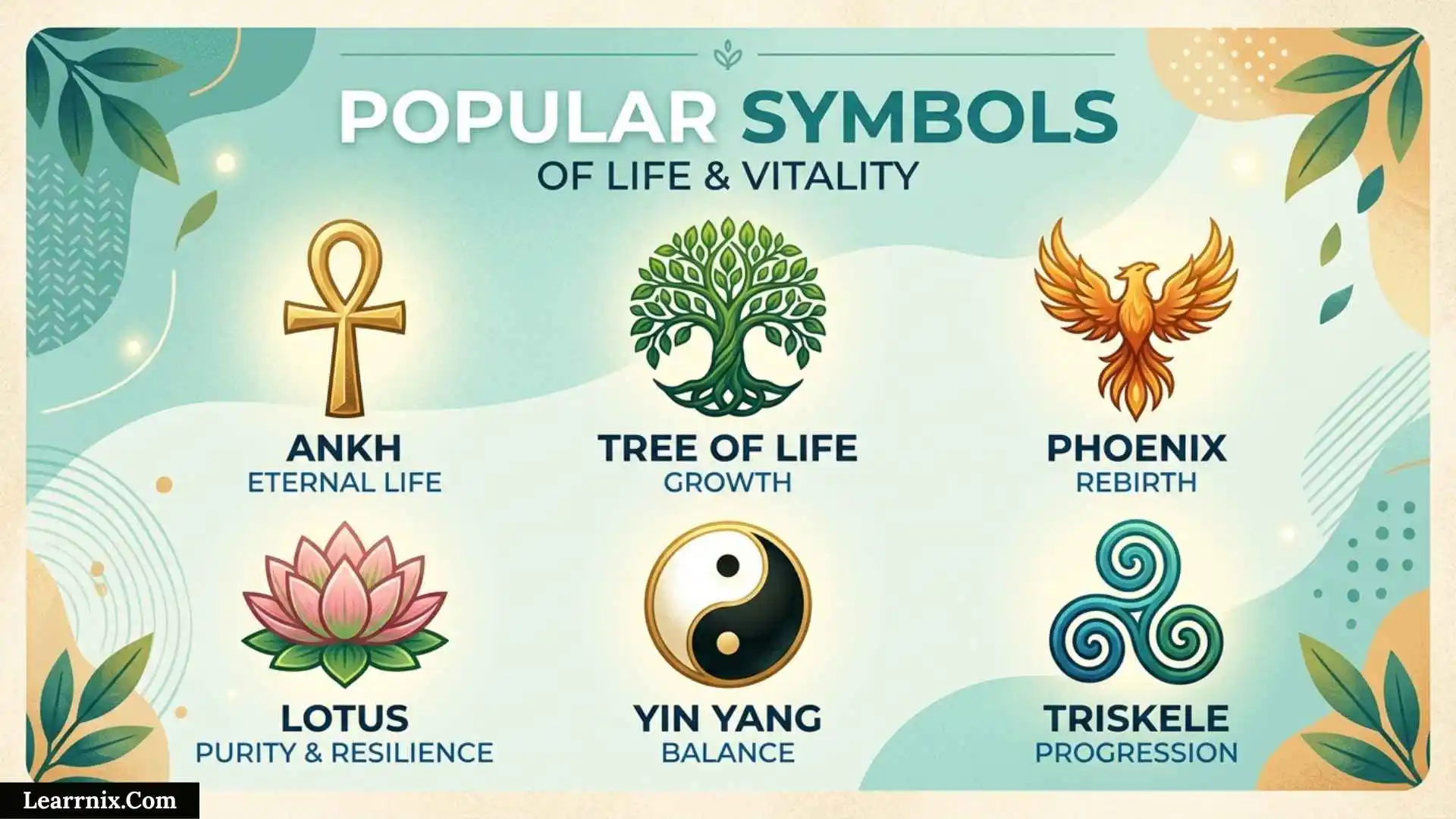
Symbols help people communicate ideas without using many words. A heart can suggest love, an olive branch can suggest peace, a shield can suggest protection, and an anchor can suggest hope. But understanding popular symbols is more than memorizing a list of pictures and meanings. A symbol can change meaning across cultures, religions, historical periods, and modern contexts.
This guide explains the most widely recognized symbols and what they commonly represent. It also looks at their origins, cultural meanings, modern uses, common misunderstandings, and how to choose the right symbol for a tattoo, logo, jewelry, artwork, architecture, religious design, or personal project.
Quick Answer: What Are Popular Symbols?
Popular symbols are recognizable signs, images, objects, shapes, or designs that represent an idea, identity, belief, emotion, or concept beyond their literal appearance.
Common examples include:
- Heart — love and affection
- Dove — peace and reconciliation
- Olive branch — peace and agreement
- Cross — Christianity and Christian faith
- Yin-yang — complementary forces and balance
- Om — sacred sound and spiritual traditions in Hinduism
- Ankh — life in ancient Egyptian culture
- Lotus — renewal, rebirth, and spiritual associations in several traditions
- Anchor — hope, stability, and endurance
- Shield — protection and defense
- Infinity symbol — endlessness or continuity
- Tree of Life — life, creation, growth, or interconnectedness depending on tradition
- Star of David — Jewish identity and tradition
- Peace symbol — peace and nuclear disarmament
- Skull — mortality, death, danger, or remembrance depending on context
The important point is that a symbol’s meaning depends on context. The same image may communicate something different in another culture or historical period.
Why Symbols Matter in Everyday Life
Symbols are powerful because they compress information into a visual form.
A road sign, religious emblem, company logo, national flag, emoji, architectural ornament, or family crest can communicate information almost instantly.
Symbols Make Complex Ideas Easier to Recognize
A symbol can represent an abstract concept that would otherwise require a sentence or paragraph.
For example, a shield physically protects a person, so it naturally works as a visual metaphor for security. An arrow physically points toward a direction, making it useful for representing movement or progress.
This relationship between an object’s physical qualities and its symbolic meaning is one reason some symbols remain recognizable for generations.
Symbols Build Identity and Belonging
Groups often use symbols to show identity.
Examples include:
- Religious communities using sacred signs
- Nations using flags and emblems
- Universities using seals and mascots
- Organizations using logos
- Social movements using recognizable signs
- Sports teams using distinctive imagery
- Families using heraldic designs
A symbol can therefore communicate not only an idea but also who someone identifies with.
Symbols Also Work Differently Across Cultures
There is no universal dictionary in which every symbol has exactly one meaning.
A color, animal, number, flower, or shape can have different associations in different societies. Even when two cultures use the same image, the reason for using it may be different.
This is why historical and cultural context matters when researching symbolism.
Popular Symbols and Their Meanings
The following table provides a quick reference before exploring individual symbols in greater detail.
| Symbol | Common meaning | Important context |
| Heart | Love, affection | Strong modern emotional association |
| Dove | Peace, purity, reconciliation | Religious and cultural meanings vary |
| Olive branch | Peace, reconciliation | Ancient Mediterranean associations |
| Peace symbol | Peace, nuclear disarmament | Created in 1958 for the British anti-nuclear movement |
| Cross | Christianity | Also has older non-Christian uses as a geometric form |
| Yin-yang | Complementarity, balance | Rooted in Chinese philosophical traditions |
| Om | Sacred sound, spirituality | Important in Hindu traditions and also used in Buddhism and Jainism |
| Ankh | Life | Ancient Egyptian symbol |
| Lotus | Rebirth, renewal, spirituality | Meanings vary across Asian and Egyptian traditions |
| Tree of Life | Life, growth, creation, connection | Appears in many unrelated cultural traditions |
| Anchor | Hope, stability | Maritime and Christian associations |
| Shield | Protection, defense | Common metaphor in heraldry and modern design |
| Infinity | Endlessness, continuity | Originated in mathematics before becoming a popular cultural symbol |
| Star | Guidance, identity, aspiration | Meaning changes according to star form and context |
| Skull | Death, mortality, warning | Also used for remembrance and cultural celebrations |
| Lion | Strength, courage, authority | Common in heraldry and institutional imagery |
| Eagle | Power, freedom, vision | Frequently used in national and heraldic symbolism |
| Butterfly | Transformation, change | Often used as a modern metaphor for personal transformation |
| Rainbow | Hope, renewal, diversity | Meaning varies strongly by cultural and social context |
Popular Symbols of Love and Relationships
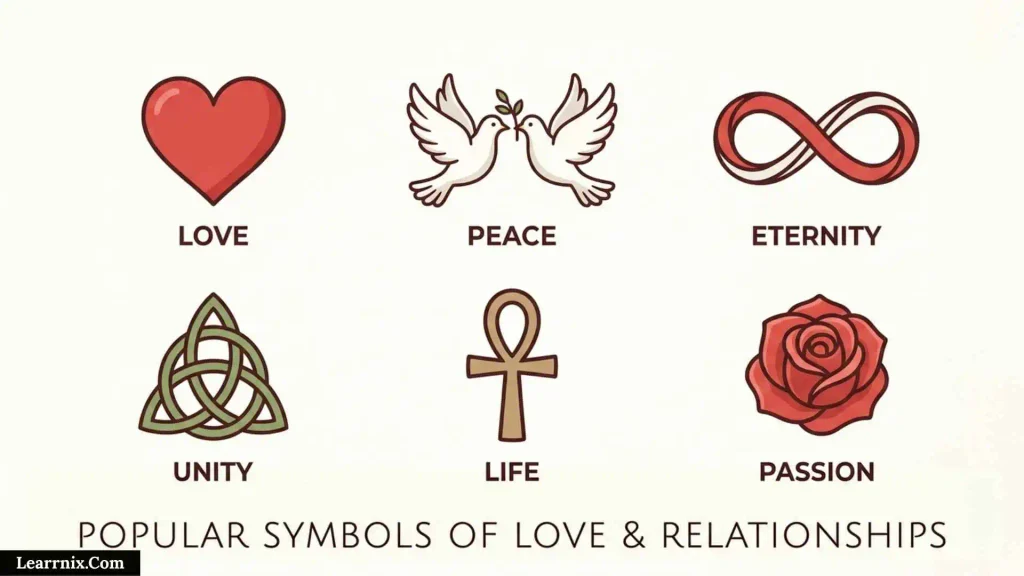
Love is one of the most common themes represented through visual symbols. Some are ancient, while others became popular through modern art, literature, advertising, and social customs.
Heart Symbol
The heart is probably the clearest modern visual shorthand for love and affection.
It appears on:
- Valentine’s Day cards
- Wedding stationery
- Jewelry
- Clothing
- Tattoos
- Social media
- Greeting cards
- Product packaging
- Digital communication
The familiar heart shape does not accurately reproduce the human anatomical heart. Its importance comes from cultural convention rather than biological accuracy.
A heart can also communicate different kinds of affection. Depending on the setting, it may represent romantic love, friendship, compassion, family affection, or emotional support.
Rose
The rose is strongly associated with romantic love, particularly the red rose.
Roses are also used in memorials, weddings, religious artwork, poetry, literature, and political symbolism. Therefore, the meaning of a rose cannot always be reduced to romance.
Color, arrangement, surrounding imagery, and occasion can change its interpretation.
Wedding Rings
Interlocking or paired rings often represent commitment, partnership, marriage, and continuity.
Their circular form is especially useful symbolically because a circle has no obvious beginning or end. That visual quality makes it suitable for ideas such as permanence and continuity.
Popular Symbols of Peace
Peace symbolism is particularly rich because different symbols emerged in different historical settings.
Dove
The dove is one of the best-known images associated with peace.
Its symbolism has strong religious and cultural roots. In Christianity, for example, the dove can also represent the Holy Spirit, so its meaning is broader than simply “peace.”
A white dove is especially common in modern artwork, ceremonies, posters, and peace-themed designs.
Olive Branch
The olive branch is another longstanding symbol associated with peace and reconciliation.
Its meaning developed within Mediterranean cultural traditions where the olive tree had major practical, economic, religious, and cultural importance.
Today, an olive branch can communicate:
- Peace
- Reconciliation
- Agreement
- Truce
- Diplomacy
- Nonviolence
It works especially well when the intended message is making peace rather than simply avoiding conflict.
The Modern Peace Symbol
The familiar circle-and-lines peace symbol has a much more recent origin than many people assume.
Gerald Holtom designed it in 1958 for Britain’s nuclear disarmament movement. The design incorporated semaphore representations of the letters N and D, standing for “Nuclear Disarmament.” The symbol was used during the 1958 Aldermaston protest march and later became much more broadly associated with peace.
This is a useful example of how a symbol can begin with a very specific political meaning and later acquire a much wider cultural meaning.
Popular Religious Symbols
Religious symbols require special care because they are not merely decorative marks. They may represent beliefs, sacred stories, communities, rituals, and theological ideas.
Cross
The cross is one of the central symbols of Christianity and is associated with the crucifixion of Jesus Christ.
There are many forms of Christian cross, including Latin and Greek crosses. A crucifix additionally depicts the body of Christ.
The cross itself is also a much older geometric form that appeared in different cultures before Christianity. Therefore, seeing a cross-shaped mark in an ancient object does not automatically prove that the object was Christian.
This distinction is important when interpreting archaeological objects.
Star of David
The six-pointed Star of David, or Magen David, is strongly associated with Jewish identity in the modern world.
Its historical development is more complicated than the idea that it has always been the universal symbol of Judaism. The six-pointed form existed in different settings before becoming especially prominent as a Jewish symbol.
This illustrates a broader rule in symbolism: modern identity does not always reveal ancient origin.
Om
The Om or Aum symbol is strongly connected with Hindu religious and philosophical traditions.
It is associated with sacred sound, meditation, spiritual practice, and philosophical ideas concerning ultimate reality.
Om is also found in Buddhist and Jain contexts. Its use should therefore be understood within the specific religious tradition rather than treated as a generic “spiritual” decoration.
Yin-Yang
The yin-yang symbol is associated with Chinese philosophical traditions and is commonly used to express complementary aspects of reality.
It is often misunderstood as meaning “good versus evil.” That is too simple.
The familiar black-and-white design emphasizes relationships such as:
- Complementarity
- Interdependence
- Dynamic change
- Balance
- Mutual relationship
The small contrasting dots are also important to the traditional visual concept: each side contains something of the other.
Ancient Symbols With Strong Modern Recognition
Some of today’s most recognizable symbols have roots in ancient civilizations.
Ankh
The ankh is an ancient Egyptian hieroglyph associated with life.
The British Museum identifies the ankh as a symbol of life and documents its appearance in Egyptian objects and representations, including funerary material.
Its modern popularity comes from:
- Ancient Egyptian-inspired jewelry
- Tattoos
- Fashion
- Film and television
- Historical artwork
- Museum exhibitions
- Modern spiritual movements
The safest historical interpretation is simply that the ankh was associated with life, rather than assigning every modern spiritual meaning to ancient Egyptians.
Lotus
The lotus is another symbol with a long history, but its meaning differs between cultures.
In ancient Egypt, the water lily was associated with the sun, rebirth, and rejuvenation because the flower opens during the day and closes at night. The Metropolitan Museum of Art documents this symbolism in ancient Egyptian objects.
In South Asian religious traditions, lotus imagery has other important associations, including purity and spiritual development.
Therefore, “lotus means rebirth” can be useful as a general description, but the full interpretation depends on the cultural setting.
Scarab
The scarab is another important ancient Egyptian image.
Ancient Egyptian representations connected the scarab with Khepri, a deity associated with the rising sun and regeneration. The British Museum describes Khepri’s relationship with transformation and rebirth.
This makes scarab imagery especially relevant when discussing:
- Rebirth
- Transformation
- Renewal
- Resurrection
- Ancient Egyptian religion
Popular Symbols of Protection
Protection symbols appear in religion, folklore, architecture, jewelry, military traditions, and modern branding.
Shield
The shield is one of the easiest symbols to understand because its physical function already communicates its symbolic meaning.
It commonly represents:
- Protection
- Security
- Defense
- Strength
- Guardianship
- Safety
This is why shields are common in:
- Police and security logos
- Cybersecurity branding
- Insurance companies
- Sports teams
- Family crests
- Government emblems
Eye Symbols
Eye imagery has been used in many cultures with different meanings.
An eye may suggest:
- Protection
- Watchfulness
- Knowledge
- Divine observation
- Awareness
However, different eye symbols should not automatically be treated as the same tradition. The Eye of Horus, the so-called evil eye, and modern “all-seeing eye” imagery have distinct histories.
Hamsa
The Hamsa is a hand-shaped symbol found in Jewish, Muslim, and broader Middle Eastern and North African cultural contexts.
It is commonly associated with protection, particularly protection from the evil eye.
Because the symbol crosses cultural and religious boundaries, its interpretation depends on the community and setting in which it appears.
Popular Symbols of Hope and Renewal
Hope is often represented through images of light, growth, stability, or new beginnings.
Anchor
The anchor commonly represents stability, security, endurance, and hope.
Its physical purpose provides the foundation for the metaphor: an anchor holds something in place even when water and weather are unstable.
The anchor also developed an important early Christian symbolic association with hope.
It can be an effective symbol when the intended message is not simply “hope” but remaining steady during difficult circumstances.
Sunrise
A sunrise naturally suggests:
- New beginnings
- Renewal
- Hope
- Another opportunity
- Light after darkness
Unlike some religious symbols, the sunrise is easy to understand without specialist knowledge, which makes it common in motivational artwork and modern branding.
Butterfly
The butterfly is widely used as a metaphor for transformation because it visibly changes through different stages of its life cycle.
Modern symbolic meanings often include:
- Personal growth
- Transformation
- Freedom
- New beginnings
- Change
These meanings are largely metaphorical and should not be presented as one universal ancient definition.
Popular Symbols of Strength and Courage
Many strength symbols come from animals, weapons, natural features, or objects associated with power.
Lion
The lion commonly represents:
- Strength
- Courage
- Leadership
- Royal authority
- Protection
Lion imagery appears widely in heraldry, monuments, institutional emblems, sports logos, and architecture.
Eagle
The eagle is frequently associated with:
- Freedom
- Power
- Vision
- Authority
- Independence
Its meaning can become particularly political when it appears on a national emblem or government seal.
A useful research principle is to distinguish general animal symbolism from the specific meaning assigned by a particular nation or organization.
Mountain
Mountains often symbolize:
- Strength
- Stability
- Achievement
- Endurance
- Challenge
- Spiritual ascent
A mountain can also represent a goal. The higher the summit, the more naturally the image lends itself to ideas of overcoming difficulty.
Popular Symbols of Family, Life, and Connection
Some symbols are especially useful when the intended message concerns family, ancestry, community, or the connection between generations.
Tree of Life
The Tree of Life is not one single symbol belonging to one culture. Tree imagery representing life, creation, fertility, ancestry, or connection appears in many cultural traditions.
The Smithsonian notes that the Tree of Life motif appears in cultures around the world and can symbolize creation and relationships between people and nature.
Other museum collections show different versions of the motif. In ancient Near Eastern art, for example, sacred-tree imagery could be associated with life, fertility, kingship, protection, or prosperity.
For a modern family design, the Tree of Life can therefore work well as a symbol of:
- Family roots
- Ancestry
- Growth
- Generations
- Connection
- Continuity
But its exact historical meaning should be identified from the specific tradition being referenced.
Interlocking Circles
Interlocking circles can communicate:
- Partnership
- Family connection
- Unity
- Cooperation
- Continuity
They are especially useful in modern logos and relationship-themed designs because the meaning can be understood without belonging to one specific religion.
Popular Symbols of Freedom and Independence
Freedom symbolism often uses physical images of release, movement, or open space.
Broken Chains
Broken chains are a direct metaphor for freedom.
They can represent liberation from:
- Oppression
- Captivity
- Slavery
- Restrictions
- Political control
- Personal limitations
The symbol is especially powerful in historical and political artwork because the broken physical object directly represents the removal of restraint.
Wings
Wings often represent:
- Freedom
- Flight
- Ambition
- Spirituality
- Escape
- Personal growth
Their meaning comes largely from the human association between flight and freedom.
Open Bird
A bird flying through an open sky can communicate independence and liberation without requiring a specific cultural tradition.
This makes bird imagery particularly common in contemporary tattoos, posters, personal logos, and motivational designs.
Popular Symbols of Death and Mortality
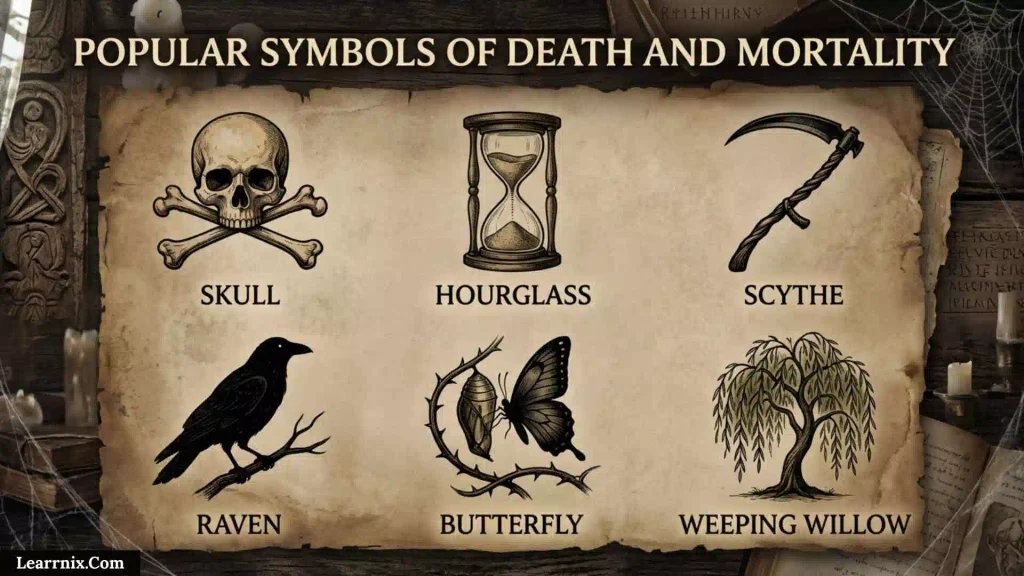
Symbols connected with death are not necessarily negative. They can also communicate remembrance, mortality, transformation, or the temporary nature of life.
Skull
The skull is widely understood as a symbol of death and mortality.
It may also communicate:
- Danger
- Warning
- Rebellion
- Mortality
- Remembrance
- Transformation
Its meaning can change dramatically according to context.
A skull on a hazardous-material warning sign has a different purpose from a decorated skull used during Día de los Muertos celebrations.
Hourglass
An hourglass can represent:
- Passing time
- Mortality
- Limited opportunity
- Aging
- The temporary nature of life
It is especially effective when the message concerns time rather than death itself.
Symbols of Wisdom, Knowledge, and Guidance
Some symbols are associated with knowledge because of their relationship with learning, observation, or mythology.
Owl
The owl is widely used in modern Western culture as a symbol of wisdom.
It appears in:
- School logos
- University mascots
- Educational illustrations
- Children’s books
- Academic branding
However, owl symbolism differs across cultures and historical periods. The modern association with wisdom should not automatically be projected onto every ancient representation of an owl.
Light
Light is one of the most flexible symbols of knowledge.
It can represent:
- Understanding
- Truth
- Hope
- Spiritual revelation
- Education
- Guidance
This is why phrases such as “light of knowledge” work across many forms of writing and visual communication.
Symbols of Transformation and Change
Transformation symbols are especially popular in tattoos, jewelry, personal branding, and self-development artwork.
Phoenix
The phoenix is commonly associated with:
- Rebirth
- Renewal
- Rising after destruction
- Transformation
- Resilience
The modern idea of a phoenix “rising from the ashes” has become a powerful metaphor for recovery and reinvention.
However, different phoenix traditions developed across different cultures and historical periods. A modern phoenix design should not automatically be described as having one single ancient origin.
Snake
Snake symbolism is especially complex.
A snake can represent:
- Renewal
- Transformation
- Healing
- Danger
- Wisdom
- Fertility
- Death
Its ability to shed its skin makes it an obvious metaphor for renewal. Yet religious and cultural traditions may give snakes very different meanings.
This is a strong example of why symbol interpretation should never rely on a single-word definition.
Symbols in Architecture, Art, and Design
Symbols are not limited to jewelry or tattoos. They are deeply connected to architecture and visual design.
Architects may use:
- Circles for unity or continuity
- Vertical forms for aspiration
- Arches for tradition or strength
- Crosses for Christian identity
- Floral patterns for growth and beauty
- Geometric patterns for order
- Trees for life and connection
- Light for spiritual or symbolic emphasis
The meaning of an architectural symbol should be studied alongside the building’s purpose, designer, historical period, religion, geographic setting, and surrounding decorative program.
Why Context Is Essential in Architecture
A geometric shape does not automatically have a religious meaning.
For example, a circle may be used simply because it provides structural or visual balance. A star may be decorative rather than theological. A floral pattern may be artistic rather than symbolic.
The safest interpretation comes from evidence about the building rather than assumptions based only on the shape.
How Symbol Meanings Change Over Time
One of the most important facts about symbolism is that meanings evolve.
A symbol may move through several stages:
Original use → cultural adoption → reinterpretation → popularization → modern meaning
The peace symbol is an excellent example. It began as a nuclear-disarmament design and later became a broader symbol of peace and anti-war movements.
The Tree of Life provides another example. Related tree imagery occurs across many cultures, but individual traditions attach different meanings to it.
This means an accurate symbol article should distinguish between:
- Original documented meaning
- Later cultural interpretation
- Modern popular meaning
- Commercial use
- Personal interpretation
Ancient Symbol vs. Modern Symbol: What Is the Difference?
A symbol can look ancient without actually being ancient.
Modern artists, designers, religious movements, political groups, and popular culture frequently reuse older visual elements.
How to Tell Whether a Symbol Is Historically Ancient
Ask these questions:
- Is there archaeological evidence?
- Is the symbol documented in historical texts?
- Does a museum hold dated examples?
- Can the design be traced to a specific culture?
- Is its claimed meaning supported by researchers?
- Does the modern design actually match historical examples?
- Was the modern interpretation created recently?
This approach prevents a common mistake: treating an attractive modern “symbol meaning” graphic as historical evidence.
Common Misconceptions About Popular Symbols
Every Symbol Has One Universal Meaning
False.
Meanings depend on culture, time, religion, location, and context.
A Symbol Must Be Ancient to Be Meaningful
False.
The modern peace symbol is a relatively recent creation, yet it became internationally recognizable. The University of Bradford and Nobel Peace Center document its 1958 origin.
Every Ancient Symbol Has a Hidden Spiritual Meaning
Not necessarily.
Some marks were decorative, functional, linguistic, political, or identifying rather than mystical.
Modern Meanings Always Match Historical Meanings
They do not.
A modern audience may attach a new meaning to a symbol that had a different purpose in its original setting.
Similar Shapes Always Have the Same Origin
A cross, star, circle, spiral, or triangle can appear independently in different cultures.
Visual similarity alone does not prove historical connection.
How to Research a Symbol Before Using It
If you are considering a symbol for a tattoo, logo, building, product, religious design, family emblem, or public artwork, use a simple research process.
Step 1: Identify the Exact Symbol
Do not search only for “star” or “eye.”
Identify:
- Shape
- Number of points
- Orientation
- Colors
- Surrounding elements
- Text
- Cultural setting
Step 2: Find Its Historical Context
Look for museum collections, academic publications, university resources, heritage institutions, and established reference works.
Step 3: Separate Evidence From Popular Interpretation
A social-media graphic may tell you what a symbol is said to mean. A museum or scholarly source can help establish what it meant in a particular historical setting.
Step 4: Check Modern Associations
A symbol may have acquired new political, religious, commercial, or controversial meanings.
Research its contemporary use before displaying it publicly.
Step 5: Consider Your Audience
Ask whether your intended audience is likely to understand the symbol as you intend.
If misunderstanding could cause harm or offense, add explanatory text or choose a clearer symbol.
A Decision Guide for Choosing the Right Symbol
Use this quick decision tree when selecting a symbol.
What idea do you want to communicate?
Love or affection?
→ Heart, rose, interlocking rings
Peace or reconciliation?
→ Dove, olive branch, peace symbol
Protection or safety?
→ Shield, Hamsa, protective eye imagery
Hope or stability?
→ Anchor, sunrise, light
Strength or courage?
→ Lion, eagle, mountain, oak
Freedom?
→ Broken chains, wings, flying bird
Family or ancestry?
→ Tree of Life, roots, interlocking circles
Spiritual identity?
→ Use a symbol from the relevant religious tradition and verify its meaning within that tradition
Transformation?
→ Butterfly, phoenix, snake
Mortality or remembrance?
→ Skull, hourglass, memorial imagery
This approach is better than choosing a symbol simply because it looks attractive.
Best Practices for Using Symbols in Design
Keep the Intended Meaning Clear
If your audience must understand the symbol immediately, choose a widely recognized design.
A shield is usually clearer for “security” than an obscure historical emblem.
Respect Sacred Symbols
Do not assume that a religious symbol is merely decoration.
Research its use, pronunciation if relevant, cultural context, and significance to the community that uses it.
Avoid Overloading One Design
Combining too many symbolic elements can make a design difficult to understand.
If a logo contains a heart, eagle, lion, sun, moon, tree, cross, crown, and infinity symbol, the audience may not know which idea matters most.
Consider Cultural Interpretation
A symbol intended for an international audience should be tested across cultures.
What looks positive in one region may have a different or even negative association elsewhere.
Preserve Historical Accuracy
If the design is presented as “ancient,” verify that the specific form actually has historical evidence.
This is particularly important for museum-style artwork, educational content, architecture, and heritage projects.
Common Mistakes When Choosing Popular Symbols
Choosing a Symbol Only Because It Looks Good
Visual appeal is not enough if the symbol has an important cultural meaning.
Copying a Symbol From a Random Meaning List
Many online symbol lists simplify complicated histories.
Use reputable cultural institutions and scholarly sources when accuracy matters.
Confusing a Modern Symbol With an Ancient One
The peace symbol demonstrates that powerful symbols can be modern inventions.
Ignoring Religious Context
A sacred symbol can have meanings that are much deeper than its appearance suggests.
Assuming the Same Symbol Means the Same Thing Everywhere
Always consider geographic and cultural context.
Popular Symbols in Modern Branding
Businesses use symbols because they can communicate brand values quickly.
A company focused on security might use a shield. A healthcare organization might use a cross or another medical symbol. A technology company may use abstract geometric forms to suggest innovation.
But branding introduces another layer: trademark identity.
A symbol can have both a cultural meaning and a commercial meaning.
For example, a simple geometric mark may be associated with a company because that company has used it consistently, even though the underlying shape has existed for centuries.
This is why professional logo research should consider both symbolism and brand distinctiveness.
Popular Symbols in Tattoos and Jewelry
Symbols are especially common in personal designs because they allow people to communicate identity or values without words.
Before choosing one, consider:
- Historical meaning
- Cultural ownership or association
- Religious significance
- Modern political meaning
- Placement
- Size
- Whether the design will remain recognizable
- Whether the intended meaning is clear to others
A symbol that means “hope” to one person may look like a completely different symbol to another person. Adding complementary elements can make the intended message clearer.
Popular Symbols in Digital Communication
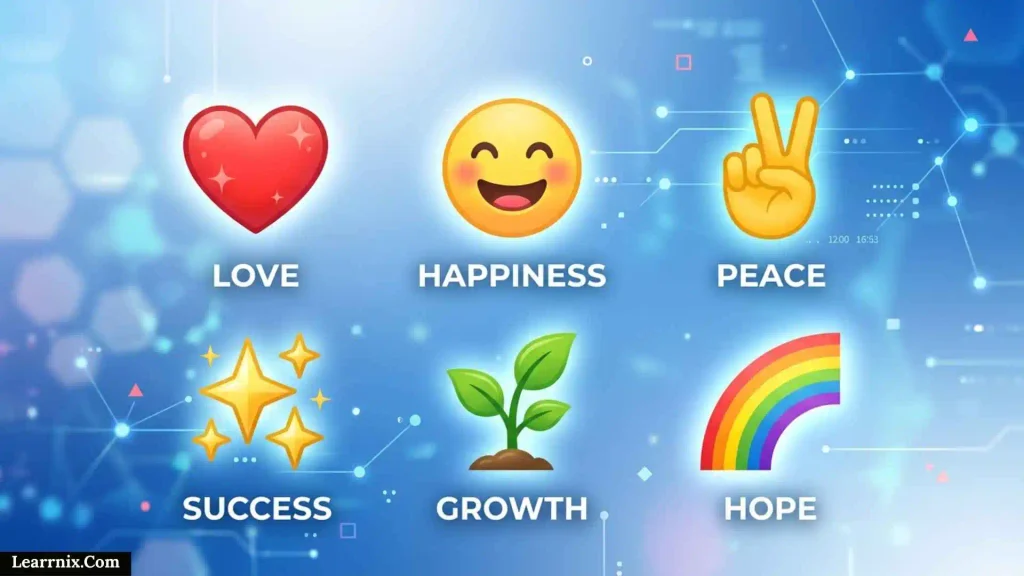
Modern communication has created a new category of symbols: emojis, icons, reaction symbols, and interface signs.
A heart emoji, warning triangle, check mark, arrow, magnifying glass, home icon, and share symbol all communicate information quickly.
Digital symbols differ from traditional cultural symbols because their meanings are often standardized by software interfaces or widely shared conventions.
However, even emojis can develop different meanings in different online communities.
Frequently Asked Questions About Popular Symbols
What are the most popular symbols and their meanings?
Some widely recognized examples include the heart for love, dove and olive branch for peace, shield for protection, lion for strength, anchor for hope, broken chains for freedom, infinity symbol for endlessness, ankh for life in ancient Egyptian culture, and Tree of Life imagery for life or connection in various traditions.
What is the most universally recognized symbol?
There is no scientifically established single “most recognized” symbol across every population. Recognition depends on culture, language, education, age, and context. It is better to describe symbols as widely recognized than to claim one is universally understood.
What are popular symbols of love?
The heart and rose are among the most common. Wedding rings, Cupid, doves, and infinity imagery are also widely associated with love and commitment.
What symbol represents peace?
The dove, olive branch, and modern peace symbol are common choices. The modern circle-and-lines peace symbol specifically originated in the British nuclear-disarmament movement in 1958 before becoming a broader peace symbol.
What symbol represents protection?
A shield is one of the clearest modern symbols of protection. The Hamsa and certain eye symbols also have protective associations in particular cultural and religious traditions.
What are popular symbols of strength?
The lion, eagle, bear, mountain, oak tree, sword, and bull are commonly used to express strength, courage, authority, or endurance.
What symbol represents hope?
The anchor is a traditional choice for hope and stability. Sunrise, light, stars, and new-growth imagery can also communicate hope and renewal.
What symbol represents family?
The Tree of Life is a popular modern choice for family and ancestry because tree imagery can express roots, generations, growth, and connection. However, Tree of Life traditions have different meanings and histories, so the specific cultural version should be researched.
Are popular symbols always ancient?
No. Some are ancient, some are medieval or early modern, and others are very recent. The modern peace symbol, for example, was created in 1958.
Can one symbol have multiple meanings?
Yes. This is extremely common. A snake, star, eye, tree, bird, or cross can have different meanings depending on the culture, historical period, surrounding imagery, and intended use.
How do I know whether a symbol’s meaning is historically accurate?
Look for evidence from museums, universities, archaeological research, historical documents, and reputable cultural institutions. A strong source should connect the symbol to a particular place, period, object, or tradition rather than simply listing a modern definition.
What is the difference between a symbol and an icon?
An icon often resembles the thing it represents or functions as a recognizable visual identifier. A symbol can be more abstract and represent an idea or concept through cultural convention.
The distinction is not always rigid, and the terms are sometimes used interchangeably.
Why do symbols change meaning?
Meanings change through cultural exchange, religion, political movements, migration, art, advertising, popular culture, and social media. A symbol may keep an older meaning while gaining a new one.
Should I use a religious symbol as a decorative design?
It depends on the symbol and your purpose. If it is sacred to a religious community, research its significance before using it. Respectful use requires more than knowing a one-word definition.
Conclusion
Popular symbols are powerful because they allow people to communicate ideas through visual shorthand. A heart can express love, a dove can suggest peace, a shield can communicate protection, an anchor can represent hope, and a Tree of Life can express connection and growth.
But the most useful way to study symbols is not to memorize a fixed list of meanings. Ask where the symbol came from, who used it, when it was used, and what it meant in that specific context.
Some meanings are well documented. Others are modern interpretations. Some symbols have changed dramatically over time, while others have retained important cultural or religious associations.
If you are researching symbols for education, a tattoo, jewelry, branding, architecture, artwork, a family design, or personal expression, historical context makes the difference between a superficial symbol list and a genuinely useful understanding of visual language.

I am Michael Carter, an educational content creator who believes that knowledge has the power to transform lives.
I create resources focused on modern education, digital learning, and building essential skills for the future.
I love helping readers discover simple and effective ways to improve their learning journey.
Books by Michael Carter:
- Modern Education for Tomorrow’s World
- Learning Skills for Future Success
 Charlotte Anderson