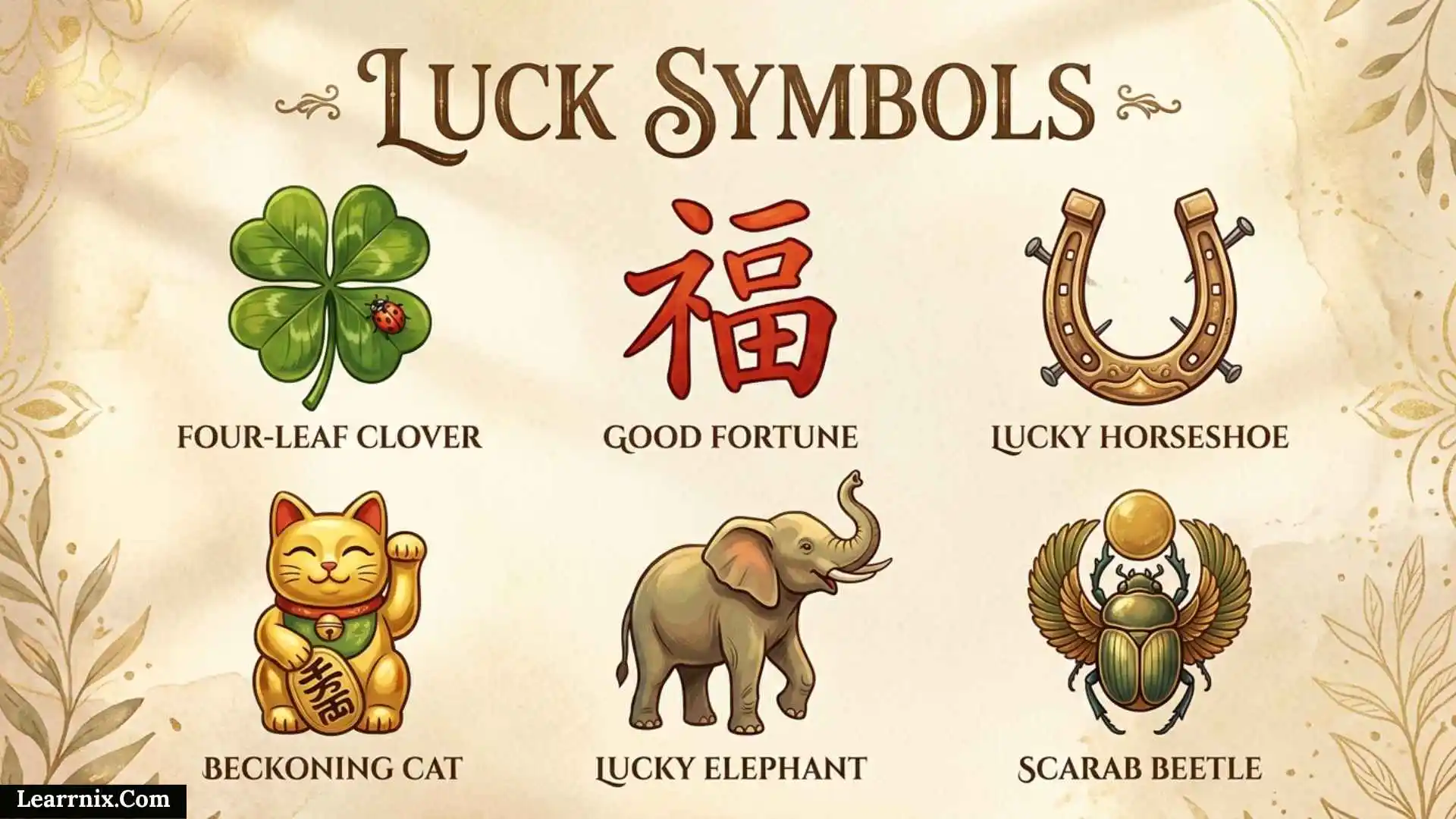
Luck symbols appear in almost every part of the world. A four-leaf clover can represent good fortune, a horseshoe may symbolize protection, a Japanese maneki-neko is associated with prosperity, and certain numbers can carry powerful cultural meanings. But there is no single symbol that means “luck” everywhere.
The meaning of a lucky symbol depends on culture, history, religion, folklore, personal belief, and context. Some symbols are meant to attract good fortune, while others are primarily protective charms designed to keep misfortune away.
This guide explains what luck symbols are, where popular examples come from, what they mean, how different cultures use them, and how to choose a symbol for jewelry, tattoos, gifts, homes, businesses, or personal decoration. It also separates cultural symbolism from claims that a charm can literally control future events.
Quick Answer: What Are Luck Symbols?
A luck symbol is an object, image, animal, plant, number, color, or design that a culture or community associates with good fortune, prosperity, protection, success, happiness, or favorable outcomes.
Common examples include:
- Four-leaf clover — good luck and fortune
- Horseshoe — luck and protection
- Maneki-neko — prosperity and commercial good fortune
- Lucky numbers — fortune in particular cultural traditions
- Lucky coins — wealth and abundance
- Ladybug — good fortune in some European traditions
- Acorn — strength, growth, and protection in some folklore
- Elephant — strength, wisdom, prosperity, or good fortune in certain cultural contexts
- Nazar or evil-eye amulet — primarily protection rather than simply “luck”
- Daruma — determination, wishes, and achieving goals in Japanese tradition
There is no scientifically proven object that can guarantee luck. The cultural and psychological meaning of a charm can still be important, especially when it represents hope, confidence, tradition, or a personal goal. National Geographic has documented good-luck and protective charms across cultures and notes that there is no evidence that the objects themselves have supernatural power.
What Makes Something a Symbol of Luck?
A lucky symbol does not become meaningful simply because it looks unusual. Its meaning normally develops through a combination of tradition, storytelling, historical use, cultural associations, and repetition over time.
Symbols Turn Abstract Ideas Into Something Visible
Luck is an abstract idea. You cannot see “good fortune” itself, so cultures use physical things to represent it.
A coin can represent wealth. A growing plant can represent abundance. A rare four-leaf clover can represent an unexpected opportunity.
This makes symbols easy to remember and pass from one generation to another.
Luck and Protection Are Not Exactly the Same
A major distinction is often overlooked: a lucky symbol and a protective symbol can overlap, but they are not identical.
A symbol associated with luck may represent attracting favorable circumstances. A protective charm may instead be intended to ward off harm, evil, jealousy, or misfortune.
For example, the four-leaf clover is commonly described as a good-luck symbol, while the evil eye or nazar is more accurately understood as a protective tradition. National Geographic describes apotropaic objects as symbols intended to ward off harmful forces.
This distinction matters when researching a symbol because calling every charm a “good luck symbol” can erase its original cultural meaning.
The Most Popular Luck Symbols and What They Mean
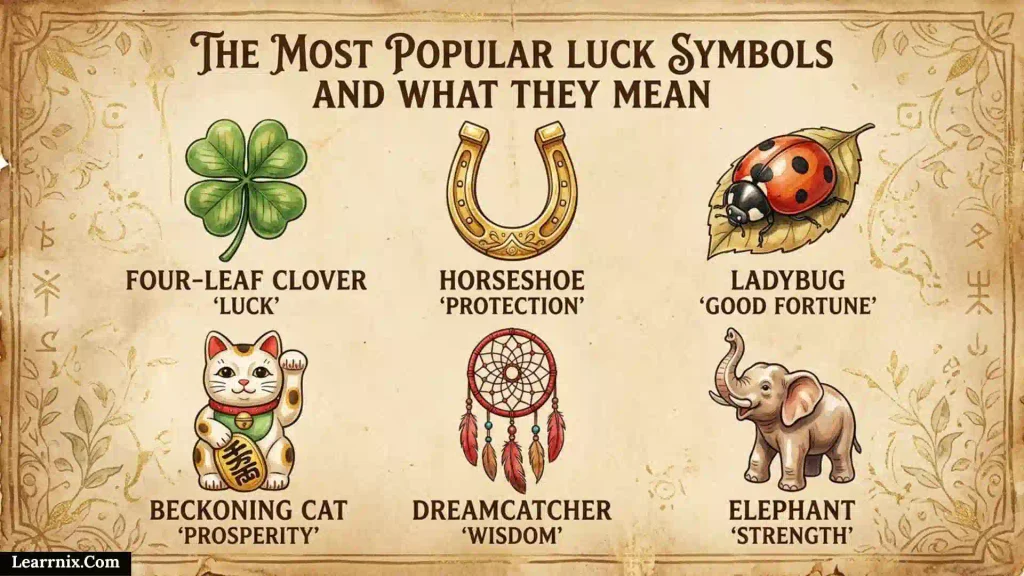
Different symbols have different histories. Some are strongly documented, while others have origins that are uncertain or disputed.
Four-Leaf Clover
The four-leaf clover is one of the most recognizable symbols of good luck in Western popular culture.
Its appeal comes partly from rarity. Ordinary clover generally has three leaves, so finding a four-leaf version feels like discovering something unusual.
The New York Public Library notes that four-leaf clovers have long been considered lucky because they are relatively rare compared with three-leaf clovers. Historical meanings attached to lucky symbols are not always certain, however, and some traditional explanations are disputed or have been lost over time.
A four-leaf clover is commonly associated with:
- Good fortune
- Hope
- Opportunity
- Happiness
- Rare discoveries
- Positive outcomes
Practical example: Someone starting a new job might wear a four-leaf clover necklace as a personal reminder to stay hopeful and confident.
Horseshoe
The horseshoe is another familiar Western good-luck symbol.
Horseshoes have been connected with protection and fortune in European-derived folklore. They are often displayed above doors or entrances.
The direction of the horseshoe is sometimes debated. Some traditions display it with the opening facing upward, suggesting that it can “hold” good luck. Other traditions use a downward-facing horseshoe, with the idea that luck is released toward people passing underneath.
There is no single worldwide rule that determines the correct direction.
The horseshoe can represent:
- Good fortune
- Protection
- Strength
- Security
- Keeping misfortune away
Historical sources also caution against treating popular explanations as certain. The New York Public Library notes that the origins and meanings of some traditional lucky motifs are unclear or disputed.
Maneki-Neko
The maneki-neko, or Japanese beckoning cat, is one of the world’s most recognizable prosperity symbols.
It is often seen at the entrance of restaurants, shops, and businesses. The raised paw is a beckoning gesture, not simply a Western-style wave.
The Japan National Tourism Organization describes maneki-neko as cat ornaments believed to bring commercial prosperity.
Different versions can carry different traditional associations. Japan’s tourism authority explains that a raised left paw is traditionally associated with welcoming people, while a raised right paw is associated with wealth and prosperity.
The symbol is especially useful when discussing business luck because its traditional setting is closely connected with attracting customers and prosperity.
Lucky Numbers
Numbers can become luck symbols when a culture gives them a special association.
The important point is that numbers are not universally lucky or unlucky.
For example, seven is widely regarded as fortunate in several Western traditions. Eight has a particularly strong association with luck in Chinese cultural contexts. National Geographic has described eight as a symbol of luck in China.
This means that a person choosing a lucky number should first consider the cultural context.
A number that feels fortunate to one person may have little meaning to another.
Lucky Coins
Coins are natural symbols of wealth because they directly represent money and material resources.
Lucky coins may appear in:
- Jewelry
- Gift decorations
- Home displays
- Business décor
- Traditional celebrations
- Collectibles
Their symbolic meaning commonly includes:
- Wealth
- Prosperity
- Financial security
- Abundance
- Success
A coin does not have to be treated as a supernatural object to have meaning. It can simply serve as a visual reminder of a financial goal.
Ladybug
Ladybugs are associated with good fortune in some European folklore.
Their positive reputation may also have practical roots. Ladybugs eat many plant pests, making them beneficial to gardeners and farmers.
As a result, the insect can symbolize:
- Good fortune
- Protection
- Nature
- Positive change
- Happiness
Its meaning is not universal, so it is better to describe the ladybug as a culturally associated lucky symbol rather than a worldwide symbol of fortune.
Rabbit’s Foot
The rabbit’s foot became a well-known good-luck charm in Western folk traditions.
It has historically been carried as a personal talisman, although explanations of its origins vary and have been shaped by several cultural traditions.
Today, its strongest association is with:
- Personal luck
- Fortune
- Protection
- A traditional charm
Because its history is more complicated than the simple modern phrase “lucky rabbit’s foot” suggests, it is best treated as a folklore symbol rather than assigning it one definitive ancient origin.
Acorn
The acorn is a less obvious but interesting traditional symbol.
Because the oak is associated with strength and longevity, its seed can represent potential, growth, endurance, and protection.
An acorn can therefore work particularly well as a symbolic design for someone beginning a new stage of life.
It represents an important idea: small beginnings can lead to something much larger.
Elephant
Elephants have rich symbolic meanings across different cultures.
Depending on the tradition, they can represent:
- Strength
- Wisdom
- Stability
- Longevity
- Prosperity
- Overcoming obstacles
However, “elephant = luck” is too broad. The elephant’s meaning changes significantly according to religious and cultural context.
National Geographic documents elephant imagery among creatures associated with fortune in different parts of the world.
Daruma
The Daruma doll is a Japanese symbol associated with determination, wishes, and achieving goals.
Its traditional use offers an especially useful lesson about lucky symbols: the object is not simply about passively waiting for good fortune.
According to the Japan National Tourism Organization, people beginning new endeavors and students preparing for exams may use Daruma dolls. A person makes a wish and fills in one eye, then fills in the other when the goal is achieved.
This makes Daruma particularly meaningful as a symbol of:
- Determination
- Goal setting
- Persistence
- Hope
- Achievement
Luck Symbols by Culture
There is no universal dictionary of luck. The same object can mean different things in different societies.
Irish and Western Luck Traditions
The four-leaf clover is strongly associated with good luck in modern Western culture.
However, an important misconception should be avoided: the four-leaf clover and the shamrock are not simply the same symbol.
National Geographic notes that the shamrock associated with St. Patrick’s traditional legend is a three-leaf clover. The four-leaf clover became a separate good-luck symbol.
Historical American New Year’s postcards also frequently featured four-leaf clovers, horseshoes, pigs, and mushrooms. The New York Public Library explains that many of these motifs reflected European traditions, particularly German and Scandinavian influences.
Japanese Luck Symbols
Japan has several traditions involving good fortune, wishes, protection, and prosperity.
The maneki-neko is particularly associated with commercial prosperity, while Daruma is linked with wishes and persistence.
Japanese traditions show why “luck” should not always be treated as a passive concept. Some lucky objects are connected with effort, intention, prayer, goals, or relationships.
Chinese Luck Traditions
Chinese culture contains an extensive system of auspicious symbolism.
Numbers, colors, animals, objects, words, and decorative motifs can carry favorable meanings.
The number eight is one of the clearest examples. It is widely associated with luck in China.
This cultural context also explains why simply copying a “Chinese lucky symbol” list from the internet can be misleading. Meaning often depends on pronunciation, historical associations, festival traditions, placement, and context.
Mediterranean and Middle Eastern Traditions
Protective symbols such as the evil eye and hamsa are important examples of traditions that are often grouped under the broad label of “luck symbols.”
Their primary function can be protection from harmful forces or the evil eye, rather than attracting wealth or success.
National Geographic describes the evil eye as an ancient concept and discusses evil-eye charms used across Mediterranean and Middle Eastern regions.
This is a good example of why cultural accuracy matters.
Good Luck Symbols vs. Protective Symbols vs. Prosperity Symbols
These categories overlap, but they are useful when choosing a symbol.
| Type | Main purpose | Examples |
| Good-luck symbol | Represents favorable fortune | Four-leaf clover |
| Protective symbol | Represents defense against harm or misfortune | Nazar, horseshoe |
| Prosperity symbol | Represents wealth or commercial success | Maneki-neko, lucky coins |
| Goal symbol | Represents achievement and persistence | Daruma |
| Growth symbol | Represents development and potential | Acorn |
| Cultural symbol | Carries broader historical or community meaning | Shamrock |
The best choice depends on what you want the symbol to communicate.
Do Luck Symbols Actually Work?
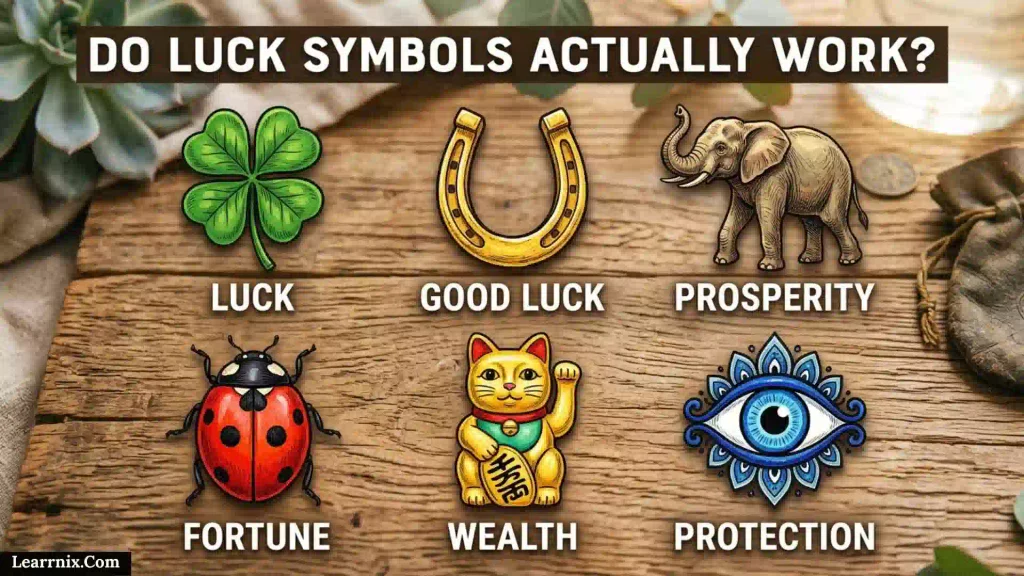
There is no reliable scientific evidence that a charm can magically control future events.
A horseshoe cannot guarantee that you will get a promotion. A four-leaf clover cannot guarantee that you will win a competition. A lucky number cannot mathematically force an outcome.
However, this does not mean lucky objects are meaningless.
The Psychological Side of Lucky Charms
People often turn to charms during uncertain situations.
Athletes, performers, students, travelers, and people beginning major life changes may use familiar objects as sources of comfort.
National Geographic reports research discussed by psychologist Richard Wiseman in which people performed better with favorite lucky charms, with the proposed explanation that the charms could reduce anxiety and improve confidence.
The important distinction is:
A charm may influence how a person feels and behaves without possessing supernatural control over the outcome.
That is a much more useful way to understand lucky objects.
How Luck Symbols Are Used in Everyday Life
Lucky symbols are not limited to folklore museums or old traditions. They remain part of modern design and personal expression.
Jewelry
A lucky symbol can be worn as:
- A necklace
- Bracelet
- Ring
- Pendant
- Charm
- Keychain
Jewelry is especially suitable when the symbol has personal meaning because it stays close to the wearer.
Home Décor
People may place symbolic objects near:
- Front doors
- Workspaces
- Offices
- Living rooms
- Shelves
- Study areas
A home decoration can function as a reminder of a goal or family tradition without requiring a belief in supernatural luck.
Business Décor
Businesses often use prosperity-related imagery because it communicates ideas such as:
- Welcoming customers
- Growth
- Success
- Abundance
- Positive energy
The maneki-neko is one of the clearest examples. Japan’s official tourism site notes its association with commercial prosperity.
Tattoos
A lucky tattoo is usually more personal than a decorative charm.
Someone might choose:
- Four-leaf clover for fortune
- Horseshoe for protection
- Number for personal significance
- Elephant for strength
- Acorn for growth
- Daruma for persistence
Before getting a culturally significant symbol permanently tattooed, research its original meaning rather than relying on a generic social-media graphic.
How to Choose the Right Luck Symbol
Choosing a symbol becomes easier when you start with the meaning, not the appearance.
Decision Guide
What do you want the symbol to represent?
↓
Good fortune and opportunity
→ Consider a four-leaf clover.
Protection and safety
→ Research a culturally appropriate protective symbol such as a horseshoe or nazar.
Business and prosperity
→ Consider maneki-neko or another tradition-specific prosperity symbol.
Persistence toward a goal
→ Consider Daruma.
Growth and a new beginning
→ Consider an acorn or another growth-based symbol.
Personal meaning
→ Choose a number, animal, object, or family symbol connected to your own story.
This approach is better than choosing a symbol simply because a website calls it “the luckiest symbol.”
Common Mistakes When Using Luck Symbols
Understanding symbolism also means knowing what to avoid.
Treating Every Symbol as Universal
A symbol’s meaning can change between cultures.
Better approach: Identify its cultural origin before assigning a meaning.
Confusing Protection With Luck
A protective amulet may not primarily represent attracting good fortune.
Better approach: Explain whether the symbol traditionally protects, attracts prosperity, represents hope, or serves another purpose.
Assuming Popular Stories Are Historical Facts
Many lucky symbols have legends attached to them. A legend can be culturally important without being historically proven.
Better approach: Use language such as “tradition holds,” “one legend says,” or “is commonly associated with” when the historical evidence is uncertain.
Ignoring Sacred or Religious Context
Some symbols have meanings that go far beyond luck.
Better approach: Learn the broader cultural or religious context before using a symbol commercially or permanently.
Believing a Charm Replaces Action
A symbol can remind you of a goal, but it should not replace practical effort.
A Daruma is a good illustration: its traditional use connects wishes with persistence and eventual achievement.
How to Use Luck Symbols Respectfully
A simple checklist can prevent many mistakes.
Before using a cultural luck symbol, ask:
- Where did it originate?
- What did it originally represent?
- Is it a lucky symbol, protective symbol, religious symbol, or several at once?
- Does its meaning change depending on color or position?
- Am I relying on a legend or documented history?
- Could the symbol be sacred to a particular community?
- Am I representing the culture accurately?
This is especially important for businesses, tattoos, educational content, product designs, and marketing.
Are Lucky Symbols Superstitions?
They can be connected to superstition, but the two concepts are not identical.
A symbol can simply represent an idea.
For example, someone might wear a four-leaf clover because it reminds them to stay optimistic. Another person may believe the clover itself has supernatural power.
The first use is symbolic. The second is a form of supernatural or superstitious belief.
This distinction allows people to appreciate cultural traditions without making unsupported claims about how the universe works.
What Is the Most Universal Luck Symbol?
There is no single universal symbol of luck.
Different cultures developed their own objects, animals, numbers, rituals, and charms. National Geographic’s survey of good-luck traditions includes four-leaf clovers, Japanese beckoning cats, Egyptian scarabs, elephants, protective eyes, horses, and other culturally specific examples.
What is universal is not one particular object. It is the human tendency to use symbols when dealing with uncertainty, hope, danger, opportunity, and the desire for a positive future.
Which Luck Symbol Is Best for a New Beginning?
The answer depends on what kind of new beginning you mean.
For general good fortune, a four-leaf clover is a simple choice.
For a personal goal that requires persistence, Daruma is especially meaningful because its traditional use connects wishes with achievement.
For business growth, the maneki-neko is strongly associated with commercial prosperity.
For growth and potential, an acorn provides a more subtle metaphor: a small seed can represent the beginning of something much larger.
Luck Symbols for Gifts
A lucky symbol can make a thoughtful gift when its meaning matches the recipient.
For a New Job
Choose a symbol associated with:
- Opportunity
- Confidence
- Success
- Prosperity
A four-leaf clover or appropriate prosperity symbol can work well.
For a New Business
A maneki-neko is particularly recognizable as a symbol of commercial prosperity in Japanese tradition.
For a Student
A Daruma can represent determination toward a goal, particularly in Japanese cultural contexts.
For Someone Traveling
A protective charm may be more appropriate than a generic luck symbol if the intention is safety.
For a Wedding or New Home
Choose symbols associated with happiness, prosperity, protection, or a positive future, while considering the family’s cultural traditions.
Luck Symbols in Modern Design and Branding
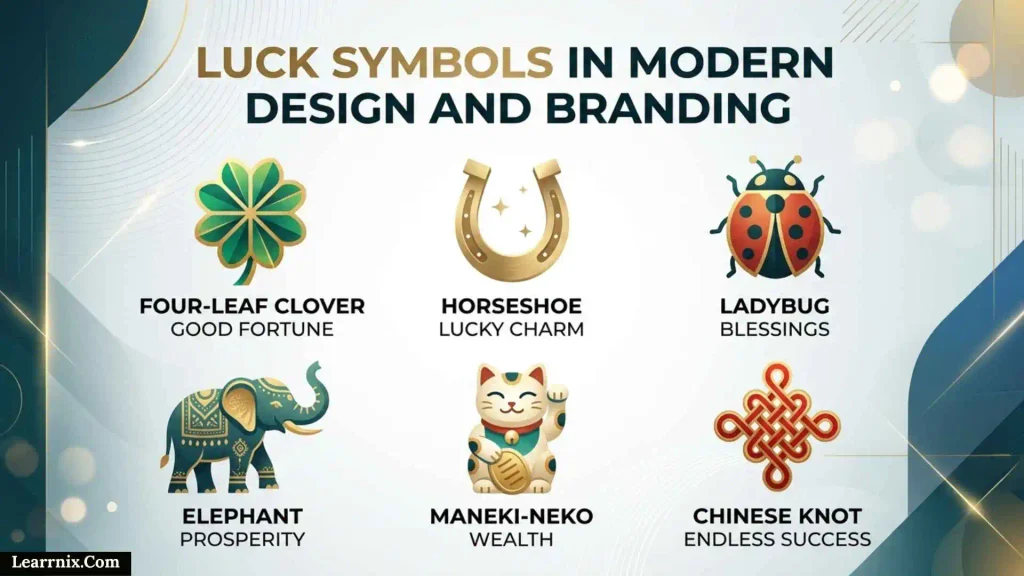
Symbolism is also useful in graphic design.
A designer can communicate an idea quickly through a recognizable visual:
- Clover → luck
- Coin → wealth
- Rising sun → new beginnings
- Acorn → growth
- Horse → strength or freedom
- Lucky cat → prosperity
- Star → hope or achievement
But designers should avoid assuming that an icon has the same meaning everywhere.
For international branding, cultural research is especially important. A symbol that communicates prosperity to one audience may be neutral or confusing to another.
Frequently Asked Questions About Luck Symbols
What are the most common luck symbols?
Commonly recognized examples include the four-leaf clover, horseshoe, maneki-neko, lucky coins, certain numbers, ladybug, rabbit’s foot, elephant imagery, acorn, and Daruma. Their meanings vary by culture and historical context.
What is the strongest symbol of good luck?
There is no objectively strongest luck symbol. The four-leaf clover is one of the most recognizable in Western popular culture, while other cultures have their own important symbols.
What is the symbol for good fortune?
The answer depends on the culture. Four-leaf clovers commonly represent good fortune in Western traditions, while maneki-neko is associated with prosperity in Japan.
What symbolizes wealth and prosperity?
Maneki-neko, lucky coins, and certain culturally specific numbers and auspicious motifs can represent wealth or prosperity. Maneki-neko is particularly associated with commercial prosperity.
What number is considered lucky?
There is no universal lucky number. Seven is widely treated as lucky in several traditions, while eight has a particularly strong association with luck in Chinese cultural contexts.
Is the four-leaf clover the same as a shamrock?
No. A shamrock traditionally has three leaves and is strongly associated with Irish culture and St. Patrick. The four-leaf clover became a separate symbol of good luck.
Is Maneki-Neko Chinese or Japanese?
Maneki-neko is Japanese. It is sometimes incorrectly called a Chinese lucky cat because it is widely displayed in Chinese and other Asian businesses, but its origins are Japanese.
What does a Maneki-Neko symbolize?
Maneki-neko is commonly associated with welcoming people, good fortune, wealth, and commercial prosperity. The meaning can also vary according to which paw is raised and other features of the figurine.
What does a Daruma symbolize?
Daruma is associated with wishes, determination, and achieving goals. A traditional practice involves filling in one eye when making a wish and the other after the goal is achieved.
Do lucky charms really bring luck?
There is no reliable evidence that lucky charms have supernatural power to control events. They can still have cultural and psychological value, including serving as reminders of hope, confidence, or personal goals.
Can a luck symbol have more than one meaning?
Yes. A symbol can represent luck, protection, prosperity, strength, hope, or another concept depending on its culture and context.
Is the evil eye a luck symbol?
It is more accurately described as a protective symbol or amulet. Its traditional purpose is commonly associated with protecting against the evil eye or harmful forces rather than simply attracting good luck.
What is a good luck symbol for a business?
A maneki-neko is a strong culturally specific example because it is traditionally associated with commercial prosperity and welcoming customers.
Key Takeaways About Luck Symbols
The most important lessons are simple:
- Luck symbols represent ideas such as fortune, prosperity, protection, hope, or success.
- There is no universal lucky symbol.
- Cultural context changes symbolic meaning.
- Four-leaf clovers are strongly associated with good luck in Western popular culture.
- Horseshoes are commonly associated with fortune and protection.
- Maneki-neko is a Japanese symbol connected with commercial prosperity.
- Daruma represents wishes, persistence, and achieving goals.
- Lucky numbers vary between cultures.
- Protective symbols should not automatically be labeled as luck symbols.
- Legends and historical facts are not always the same thing.
- There is no reliable scientific evidence that charms can magically control outcomes.
- A symbol can still have real emotional, cultural, and psychological meaning.
Conclusion
Luck symbols tell a larger story about how people deal with uncertainty and hope. A four-leaf clover, horseshoe, lucky cat, coin, number, or Daruma can carry centuries of cultural meaning while also becoming part of modern jewelry, décor, gifts, tattoos, and branding.
The most useful way to understand these symbols is not to ask which object is magically luckiest. Instead, ask what the symbol represents, where that meaning came from, and whether it matches the purpose for which you want to use it.
That approach makes luck symbolism more than a list of charms. It turns it into a study of culture, history, psychology, design, tradition, and human hope.

I am Daniel Harper, an education enthusiast and writer who enjoys creating helpful content to make learning more accessible and engaging.
I focus on sharing knowledge about effective study methods, educational growth, and skills that help learners succeed in a changing world.
Through my writing, I aim to inspire students to explore new ideas and develop a passion for learning.
Books by Daniel Harper:
- The Path to Lifelong Learning
- Unlocking Your Learning Potential
 Michael Carter
 Charlotte Anderson