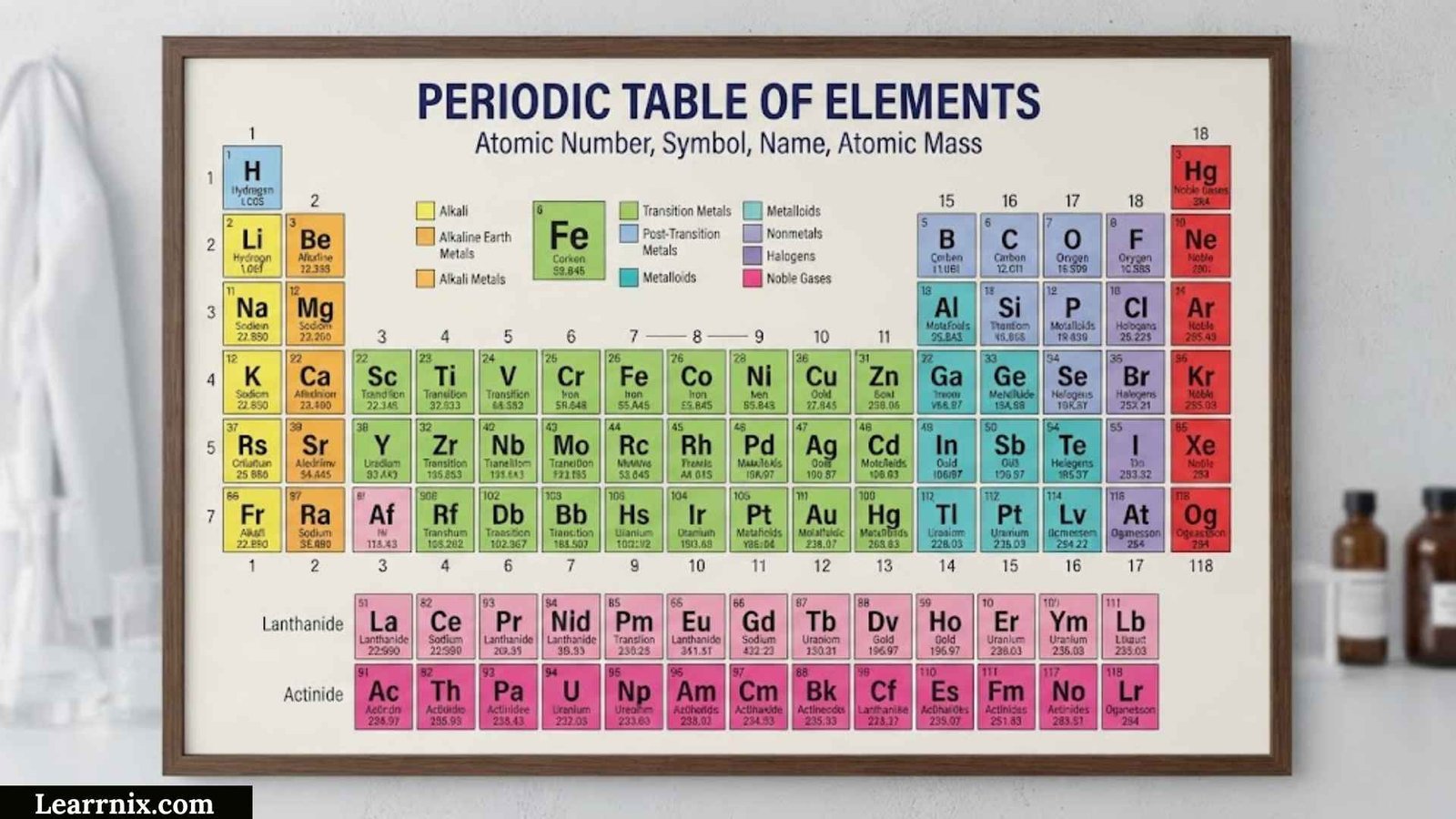
The periodic table of elements with names and symbols is a quick way to identify all 118 officially recognized chemical elements. Every element has a unique atomic number and standardized symbol, while its position in the table shows useful relationships with other elements.
This guide covers the information people commonly search for, including element names and symbols, atomic masses, elements 1 to 30, the complete list from 1 to 118, element 50, printable references, and the structure of a full-size periodic table. The values and naming conventions are based on established IUPAC references.
If you are studying chemistry, preparing notes, checking an unfamiliar chemical symbol, or looking for a convenient copy-and-reference list, the tables below make the information easy to scan. You will also find explanations of atomic number, atomic mass, groups, periods, and some of the unusual symbols that do not closely resemble their English element names.
Periodic Table Of Elements With Names And Symbols And Atomic Mass
A periodic table normally identifies an element by its atomic number, symbol, name, and atomic weight or mass information. The atomic number tells you the number of protons in the nucleus, while the chemical symbol is the standardized short form of the element’s name.
Atomic mass is slightly different from atomic number. For elements with naturally occurring isotopes, the standard atomic weight reflects their characteristic isotopic composition. For elements without a characteristic natural isotopic abundance, periodic tables may show a mass number in square brackets for a representative isotope instead. IUPAC uses this convention for many radioactive elements.
Here are the first 30 elements with their approximate atomic masses:
| No. | Element | Symbol | Approx. Atomic Mass |
| 1 | Hydrogen | H | 1.008 |
| 2 | Helium | He | 4.003 |
| 3 | Lithium | Li | 6.94 |
| 4 | Beryllium | Be | 9.012 |
| 5 | Boron | B | 10.81 |
| 6 | Carbon | C | 12.011 |
| 7 | Nitrogen | N | 14.007 |
| 8 | Oxygen | O | 15.999 |
| 9 | Fluorine | F | 18.998 |
| 10 | Neon | Ne | 20.180 |
| 11 | Sodium | Na | 22.990 |
| 12 | Magnesium | Mg | 24.305 |
| 13 | Aluminium | Al | 26.982 |
| 14 | Silicon | Si | 28.085 |
| 15 | Phosphorus | P | 30.974 |
| 16 | Sulfur | S | 32.06 |
| 17 | Chlorine | Cl | 35.45 |
| 18 | Argon | Ar | 39.95 |
| 19 | Potassium | K | 39.098 |
| 20 | Calcium | Ca | 40.078 |
| 21 | Scandium | Sc | 44.956 |
| 22 | Titanium | Ti | 47.867 |
| 23 | Vanadium | V | 50.942 |
| 24 | Chromium | Cr | 51.996 |
| 25 | Manganese | Mn | 54.938 |
| 26 | Iron | Fe | 55.845 |
| 27 | Cobalt | Co | 58.933 |
| 28 | Nickel | Ni | 58.693 |
| 29 | Copper | Cu | 63.546 |
| 30 | Zinc | Zn | 65.38 |
Atomic weights can sometimes be expressed with uncertainty or ranges because natural isotopic abundances can vary. Therefore, different educational periodic tables may show slightly different rounded values while still representing the same element accurately.
A useful distinction is that the atomic number never changes for a particular element, but the mass of an individual atom can vary because of isotopes. For example, every carbon atom has six protons, but carbon exists as different isotopes with different numbers of neutrons.
Periodic Table Of Elements With Names And Symbols Printable
A printable periodic table is useful for students who need a physical reference while studying chemical formulas, periodic trends, groups, periods, or element properties. A practical printable version should show enough information to identify an element without making each cell too crowded.
A basic printable table usually contains:
- Atomic number
- Element symbol
- Element name
- Atomic mass
- Group and period position
- Element category or color coding, if included
For a simple black-and-white study sheet, the most important information is the atomic number, name, and symbol. A detailed classroom chart can additionally include atomic mass, electron configuration, oxidation states, or element categories.
How To Read A Printable Periodic Table
Suppose a box contains:
26 — Fe — Iron — 55.845
The number 26 is the atomic number. Fe is the chemical symbol, Iron is the element name, and 55.845 is its standard atomic weight shown in a rounded educational format.
The placement of the box also provides information. Iron is located in period 4 and group 8, among the transition metals.
For printing, landscape orientation is often convenient because the complete periodic table spans 18 groups horizontally. Larger paper sizes can make small element names easier to read. IUPAC provides periodic-table versions in printable PDF formats, including letter-size, A4, and A3 versions.
Periodic Table Of Elements With Names And Symbols 1 To 30
The first 30 elements are commonly learned early in chemistry because they introduce several important patterns in the periodic table. They include common nonmetals such as oxygen and nitrogen, reactive metals such as sodium and potassium, and transition metals such as iron, copper, and zinc.
| No. | Element | Symbol | Common Category |
| 1 | Hydrogen | H | Nonmetal |
| 2 | Helium | He | Noble gas |
| 3 | Lithium | Li | Alkali metal |
| 4 | Beryllium | Be | Alkaline earth metal |
| 5 | Boron | B | Metalloid |
| 6 | Carbon | C | Nonmetal |
| 7 | Nitrogen | N | Nonmetal |
| 8 | Oxygen | O | Nonmetal |
| 9 | Fluorine | F | Halogen |
| 10 | Neon | Ne | Noble gas |
| 11 | Sodium | Na | Alkali metal |
| 12 | Magnesium | Mg | Alkaline earth metal |
| 13 | Aluminium | Al | Post-transition metal |
| 14 | Silicon | Si | Metalloid |
| 15 | Phosphorus | P | Nonmetal |
| 16 | Sulfur | S | Nonmetal |
| 17 | Chlorine | Cl | Halogen |
| 18 | Argon | Ar | Noble gas |
| 19 | Potassium | K | Alkali metal |
| 20 | Calcium | Ca | Alkaline earth metal |
| 21 | Scandium | Sc | Transition metal |
| 22 | Titanium | Ti | Transition metal |
| 23 | Vanadium | V | Transition metal |
| 24 | Chromium | Cr | Transition metal |
| 25 | Manganese | Mn | Transition metal |
| 26 | Iron | Fe | Transition metal |
| 27 | Cobalt | Co | Transition metal |
| 28 | Nickel | Ni | Transition metal |
| 29 | Copper | Cu | Transition metal |
| 30 | Zinc | Zn | Transition metal |
One useful thing to notice is the change in element type as you move across a period. The first three periods contain several nonmetals and metalloids, while the fourth period introduces a long series of transition metals.
The symbols are also worth learning separately. Some are straightforward, such as C for carbon and O for oxygen. Others require memorization because they come from older or Latin-derived names.
Elements Name 1 To 118 With Symbol
The complete periodic table currently contains 118 named elements. IUPAC recognizes the names and symbols through element 118, with the final four elements of the seventh period named nihonium (Nh), moscovium (Mc), tennessine (Ts), and oganesson (Og).
Here is the complete list in atomic-number order:
| No. | Element | Symbol | No. | Element | Symbol |
| 1 | Hydrogen | H | 60 | Neodymium | Nd |
| 2 | Helium | He | 61 | Promethium | Pm |
| 3 | Lithium | Li | 62 | Samarium | Sm |
| 4 | Beryllium | Be | 63 | Europium | Eu |
| 5 | Boron | B | 64 | Gadolinium | Gd |
| 6 | Carbon | C | 65 | Terbium | Tb |
| 7 | Nitrogen | N | 66 | Dysprosium | Dy |
| 8 | Oxygen | O | 67 | Holmium | Ho |
| 9 | Fluorine | F | 68 | Erbium | Er |
| 10 | Neon | Ne | 69 | Thulium | Tm |
| 11 | Sodium | Na | 70 | Ytterbium | Yb |
| 12 | Magnesium | Mg | 71 | Lutetium | Lu |
| 13 | Aluminium | Al | 72 | Hafnium | Hf |
| 14 | Silicon | Si | 73 | Tantalum | Ta |
| 15 | Phosphorus | P | 74 | Tungsten | W |
| 16 | Sulfur | S | 75 | Rhenium | Re |
| 17 | Chlorine | Cl | 76 | Osmium | Os |
| 18 | Argon | Ar | 77 | Iridium | Ir |
| 19 | Potassium | K | 78 | Platinum | Pt |
| 20 | Calcium | Ca | 79 | Gold | Au |
| 21 | Scandium | Sc | 80 | Mercury | Hg |
| 22 | Titanium | Ti | 81 | Thallium | Tl |
| 23 | Vanadium | V | 82 | Lead | Pb |
| 24 | Chromium | Cr | 83 | Bismuth | Bi |
| 25 | Manganese | Mn | 84 | Polonium | Po |
| 26 | Iron | Fe | 85 | Astatine | At |
| 27 | Cobalt | Co | 86 | Radon | Rn |
| 28 | Nickel | Ni | 87 | Francium | Fr |
| 29 | Copper | Cu | 88 | Radium | Ra |
| 30 | Zinc | Zn | 89 | Actinium | Ac |
| 31 | Gallium | Ga | 90 | Thorium | Th |
| 32 | Germanium | Ge | 91 | Protactinium | Pa |
| 33 | Arsenic | As | 92 | Uranium | U |
| 34 | Selenium | Se | 93 | Neptunium | Np |
| 35 | Bromine | Br | 94 | Plutonium | Pu |
| 36 | Krypton | Kr | 95 | Americium | Am |
| 37 | Rubidium | Rb | 96 | Curium | Cm |
| 38 | Strontium | Sr | 97 | Berkelium | Bk |
| 39 | Yttrium | Y | 98 | Californium | Cf |
| 40 | Zirconium | Zr | 99 | Einsteinium | Es |
| 41 | Niobium | Nb | 100 | Fermium | Fm |
| 42 | Molybdenum | Mo | 101 | Mendelevium | Md |
| 43 | Technetium | Tc | 102 | Nobelium | No |
| 44 | Ruthenium | Ru | 103 | Lawrencium | Lr |
| 45 | Rhodium | Rh | 104 | Rutherfordium | Rf |
| 46 | Palladium | Pd | 105 | Dubnium | Db |
| 47 | Silver | Ag | 106 | Seaborgium | Sg |
| 48 | Cadmium | Cd | 107 | Bohrium | Bh |
| 49 | Indium | In | 108 | Hassium | Hs |
| 50 | Tin | Sn | 109 | Meitnerium | Mt |
| 51 | Antimony | Sb | 110 | Darmstadtium | Ds |
| 52 | Tellurium | Te | 111 | Roentgenium | Rg |
| 53 | Iodine | I | 112 | Copernicium | Cn |
| 54 | Xenon | Xe | 113 | Nihonium | Nh |
| 55 | Caesium | Cs | 114 | Flerovium | Fl |
| 56 | Barium | Ba | 115 | Moscovium | Mc |
| 57 | Lanthanum | La | 116 | Livermorium | Lv |
| 58 | Cerium | Ce | 117 | Tennessine | Ts |
| 59 | Praseodymium | Pr | 118 | Oganesson | Og |
The symbols follow an important capitalization rule: the first letter is uppercase and a second letter, if present, is lowercase. Thus, Co means cobalt, while CO is not the chemical symbol for cobalt. Likewise, Ca means calcium, whereas C and Al represent carbon and aluminium.
Why Some Symbols Look Different From Their Names
Several familiar elements have symbols derived from Latin or historical names. Examples include:
- Na — Sodium, from natrium
- K — Potassium, from kalium
- Fe — Iron, from ferrum
- Cu — Copper, from cuprum
- Ag — Silver, from argentum
- Sn — Tin, from stannum
- Sb — Antimony, from stibium
- Au — Gold, from aurum
- Hg — Mercury, from hydrargyrum
- Pb — Lead, from plumbum
- W — Tungsten, associated with the name wolfram
These historical symbols explain why simply shortening the English element name does not always work.
Periodic Table Of Elements With Names And Symbols 50
The phrase “periodic table of elements with names and symbols 50” can refer either to the first 50 elements or specifically to element number 50. Both interpretations are useful.
Element number 50 is tin, represented by the symbol Sn. Its standard atomic weight is approximately 118.710.
| Property | Tin |
| Atomic Number | 50 |
| Name | Tin |
| Symbol | Sn |
| Approx. Atomic Weight | 118.710 |
| Category | Post-transition metal |
| Period | 5 |
| Group | 14 |
If you mean the first 50 elements, the final section of that sequence is:
41 — Niobium (Nb)
42 — Molybdenum (Mo)
43 — Technetium (Tc)
44 — Ruthenium (Ru)
45 — Rhodium (Rh)
46 — Palladium (Pd)
47 — Silver (Ag)
48 — Cadmium (Cd)
49 — Indium (In)
50 — Tin (Sn)
Technetium is especially interesting because it has no stable isotopes. This is why some periodic tables do not give it a conventional standard atomic weight in the same way they do for stable elements. IUPAC tables use bracketed mass numbers for many elements without characteristic natural isotopic abundance.
Full Size Periodic Table Of Elements With Names And Symbols
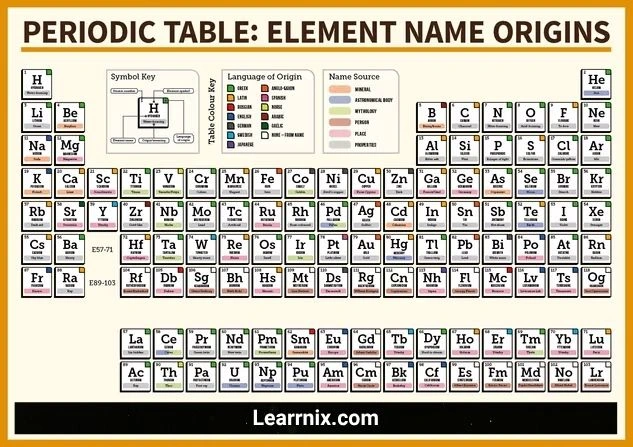
A full-size periodic table shows the relationships among all 118 elements rather than presenting them simply as a numbered list. Its familiar shape comes from arranging elements according to increasing atomic number while placing elements with related electron structures into the same groups.
The modern periodic table has 18 groups and 7 periods. The two rows commonly displayed underneath the main table contain the lanthanide and actinide series, which fit into periods 6 and 7.
Understanding Groups And Periods
A group is a vertical column. Elements within many groups share important chemical characteristics because of related outer-electron arrangements.
A period is a horizontal row. Moving across a period generally corresponds to increasing atomic number and changing electron structure.
Some major regions are:
- Group 1: Alkali metals, with hydrogen treated separately because its chemistry differs from the metals below it.
- Group 2: Alkaline earth metals.
- Groups 3–12: Transition metals.
- Groups 13–16: A mixture of metals, metalloids, and nonmetals.
- Group 17: Halogens.
- Group 18: Noble gases.
- Lanthanides: Elements 57–71.
- Actinides: Elements 89–103.
The full table also makes periodic trends easier to understand. Atomic radius, ionization energy, electronegativity, and metallic character show recognizable patterns across rows and down columns.
Symbols To Remember
Some element symbols appear particularly often in chemistry:
| Symbol | Element | Why It Is Useful To Know |
| H | Hydrogen | Common in acids, water, and organic compounds |
| C | Carbon | Central to organic chemistry |
| O | Oxygen | Common in oxides and biological compounds |
| N | Nitrogen | Important in proteins and many compounds |
| Na | Sodium | Common in ionic compounds |
| Cl | Chlorine | Found in chloride compounds |
| Fe | Iron | Important transition metal |
| Cu | Copper | Common metal and conductor |
| Ag | Silver | Precious metal with symbol from Latin |
| Au | Gold | Precious metal with historical symbol |
| Hg | Mercury | Symbol comes from historical naming |
| Pb | Lead | Historical Latin-based symbol |
| U | Uranium | Important radioactive element |
These symbols are text characters, so they can be copied directly into notes, study guides, documents, and messages. However, chemical notation is case-sensitive in practice: changing capitalization can change the meaning.
How To Use A Full-Size Table For Studying
Instead of trying to memorize all 118 elements at once, learn the table in groups. Start with the first 20 elements, then learn common transition-metal symbols and finally move into the less frequently encountered elements.
A useful study method is to cover the names and test yourself from the symbols. For example:
Fe → Iron
Cu → Copper
Ag → Silver
Au → Gold
Sn → Tin
Then reverse the exercise by looking at the name and recalling its symbol.
You can also learn elements by periodic-table family. Memorizing the noble gases together, for example, makes it easier to recognize helium, neon, argon, krypton, xenon, radon, and oganesson as members of the same group.
For a detailed reference, IUPAC’s periodic-table resources provide downloadable versions and explain how atomic-weight information is presented, including bracketed values for elements without characteristic terrestrial isotopic abundance.
FAQ
How many elements are currently on the periodic table?
There are 118 officially named and recognized chemical elements, numbered from hydrogen at 1 to oganesson at 118.
What is the easiest way to memorize element symbols?
Start with the first 20 elements, then focus on commonly used symbols and symbols derived from Latin names. Repeatedly testing yourself in both directions name to symbol and symbol to name can make memorization easier.
What is the difference between atomic number and atomic mass?
Atomic number identifies an element by its number of protons. Atomic mass or standard atomic weight relates to the mass of its atoms and, for naturally occurring elements, reflects isotope abundances.
Why does gold have the symbol Au?
Gold uses Au, which comes from the Latin name aurum. Several other elements also have historical symbols that do not directly match their modern English names.
Are all 118 elements found naturally on Earth?
No. Some elements are highly radioactive and do not occur naturally in significant quantities, while several of the heaviest elements are produced artificially. Periodic-table references distinguish these elements from those with characteristic natural isotopic abundances.
Conclusion
The periodic table of elements with names and symbols provides a compact system for identifying every recognized chemical element. Atomic numbers, symbols, names, atomic weights, groups, and periods each provide different pieces of information that help explain how elements are organized.
For quick revision, the lists of elements 1 to 30 and 1 to 50 are useful starting points, while the complete 1-to-118 table provides a broader reference. Learning unusual symbols such as Na, K, Fe, Cu, Ag, Au, Sn, and Pb is especially helpful because their letters are based on historical names rather than simple English abbreviations.
A full-size or printable periodic table can remain useful long after basic memorization. It allows students and chemistry learners to check symbols, compare element families, recognize periodic trends, and understand where an element belongs. Keeping a reliable table nearby makes chemical notation much easier to read and use.

I am Daniel Harper, an education enthusiast and writer who enjoys creating helpful content to make learning more accessible and engaging.
I focus on sharing knowledge about effective study methods, educational growth, and skills that help learners succeed in a changing world.
Through my writing, I aim to inspire students to explore new ideas and develop a passion for learning.
Books by Daniel Harper:
- The Path to Lifelong Learning
- Unlocking Your Learning Potential
 Michael Carter
 Charlotte Anderson