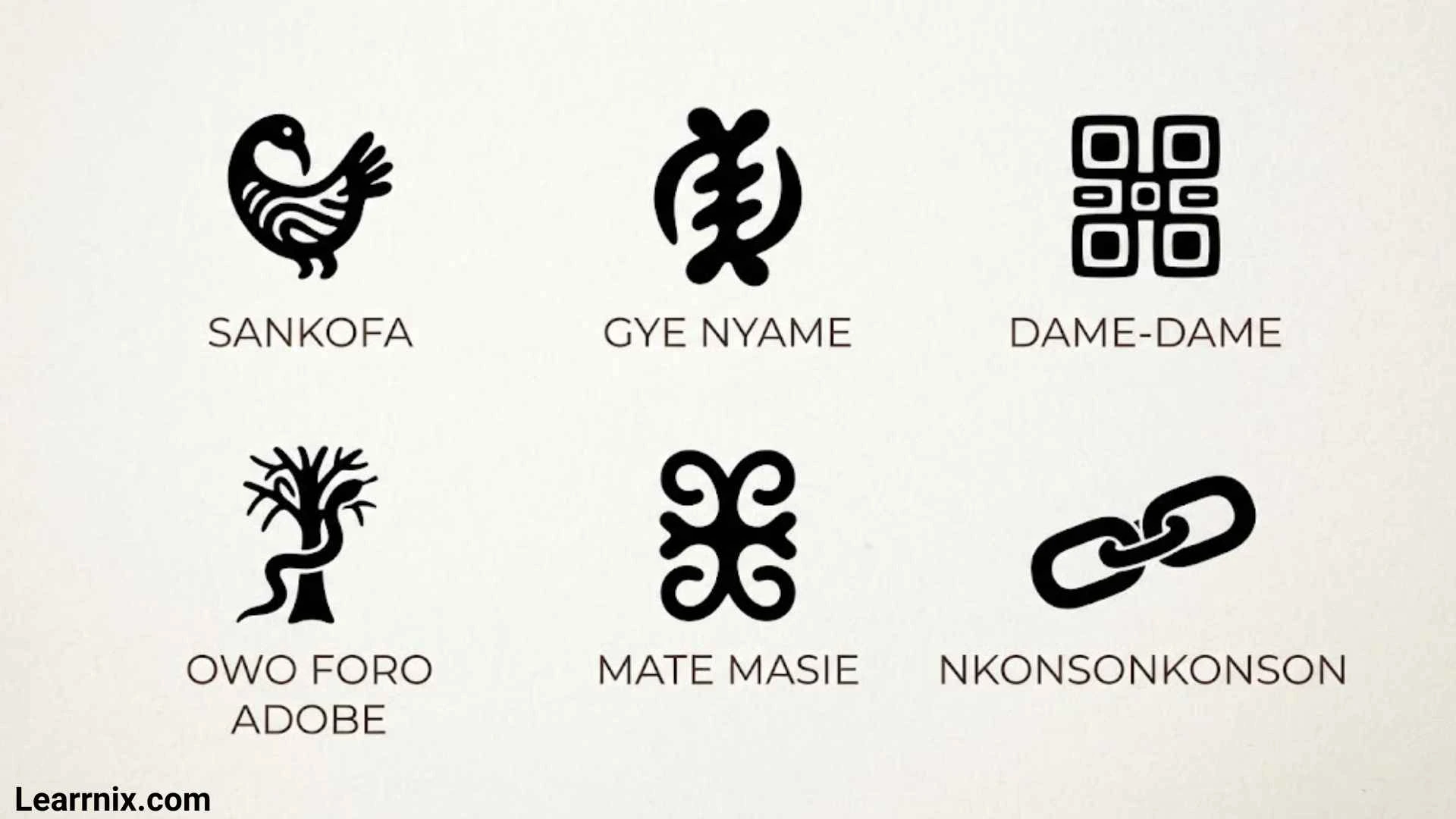
Adinkra symbols are meaningful visual designs associated with Akan culture, especially the Asante tradition of Ghana. They are used to express ideas, values, proverbs, beliefs, and lessons through recognizable shapes and motifs. From Sankofa and Gye Nyame to symbols connected with wisdom, freedom, leadership, and resilience, each design can communicate a deeper message.
People search for Adinkra symbols for many reasons. Some want to understand their historical meaning, while others are looking for Ghanaian symbols for tattoos, architecture, clothing, artwork, logos, or digital designs. Understanding the cultural background is important because Adinkra is more than a collection of attractive geometric patterns.
This guide covers the meaning and origin of Adinkra symbols, their connection with Ghana and the Akan people, famous designs such as Sankofa and Gye Nyame, their use in architecture and tattoos, and practical information about Adinkra symbols for digital and copy-and-paste use. Historical museum collections show that Adinkra designs have been used as visual texts and on textiles, royal objects, and other forms of Akan art.
What Are Adinkra Symbols
Adinkra symbols are visual motifs traditionally associated with the Akan peoples of West Africa, particularly the Asante cultural tradition in present-day Ghana. Rather than functioning as an alphabet in which each character represents a sound, Adinkra designs generally communicate concepts, values, proverbs, and ideas.
The designs can be understood as part of a larger Akan tradition in which visual art and spoken expression work together. Proverbs have historically been an important source of imagery in Akan art, and symbolic designs can reinforce ideas expressed verbally.
Adinkra cloth is one of the best-known forms of this visual tradition. Traditional cloth can contain repeated motifs arranged into fields or sections. The British Museum notes that Adinkra cloth is associated with the practice of stamping motifs onto dyed fabric, with individual designs often having visual relationships to their names and associated concepts.
This means an Adinkra symbol should not be viewed simply as decoration. Its shape, name, proverb, cultural setting, and use can all contribute to its interpretation.
Adinkra Symbols Origin
The origin of Adinkra is rooted in Akan cultural history in West Africa, especially the Asante tradition of Ghana. Its development is closely connected with textiles, visual communication, proverbs, royal culture, and ceremonial life.
Adinkra cloths are historically important because their compositions can function as visual texts. The Metropolitan Museum of Art describes Adinkra cloth as reflecting relationships between the living and ancestors, the present and the future, and worldly and spiritual concerns.
The historical record also shows that Adinkra symbolism was not limited to cloth. Akan artists used symbolic imagery across different materials, while proverbs provided inspiration for many forms of visual art. For example, the Sankofa motif appears in Akan brass gold weights dating to the 18th and 19th centuries.
There are many popular stories about the exact beginning of Adinkra and the origin of particular designs. Some are based on oral traditions, while others are modern explanations. It is therefore better to avoid claiming that every symbol has one precisely documented inventor or date.
Ghanaian Adinkra Symbols
Ghanaian Adinkra symbols form an important part of the country’s cultural and artistic heritage. They are particularly associated with Akan communities and the Asante tradition.
Traditional and contemporary uses include:
- Adinkra cloth
- Cultural clothing
- Jewelry
- Wall decoration
- Public art
- Educational materials
- Architecture
- Graphic design
- Tattoos
- Ceremonial objects
- Modern fashion
Adinkra textiles can contain multiple designs in a single composition. The Metropolitan Museum has examples of Asante-Akan Adinkra cloth from Ghana featuring several stamped patterns arranged within a structured grid.
Modern Ghanaian textile production also continues to use recognizable Adinkra motifs. British Museum collections, for example, include Ghanaian printed cloth featuring Gye Nyame and other designs.
The continued use of these symbols demonstrates that Adinkra is not only a historical subject. It remains relevant in contemporary Ghanaian visual culture.
African Adinkra Symbols
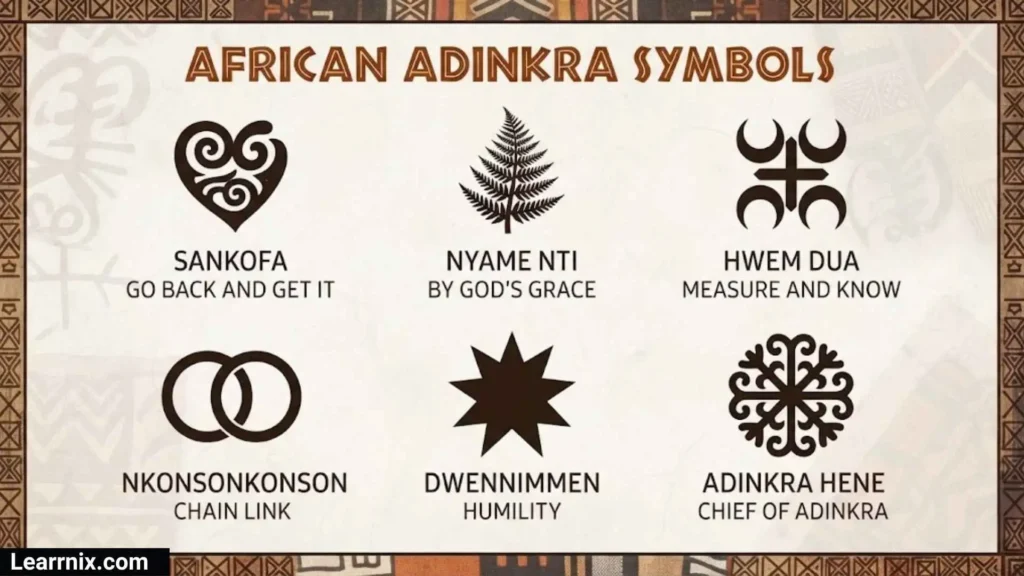
The phrase “African Adinkra symbols” is common in online searches, but it is important to understand what it means. Adinkra is an African symbolic tradition, but it does not represent all African symbols.
Africa contains many distinct cultural and symbolic traditions. Egyptian hieroglyphs, Ethiopian writing systems, Yoruba artistic traditions, Akan Adinkra, and other visual systems have different histories and cultural contexts.
Adinkra is most accurately associated with the Akan peoples of West Africa, especially Ghana. The British Museum identifies Akan as a major language group in West Africa and has extensive collections of Akan objects from Ghana.
Calling every African geometric or decorative design an Adinkra symbol can therefore create confusion. Authentic Adinkra research should identify the Akan connection and, when possible, the particular name and cultural context of the motif.
Akan Adinkra Symbols
Akan Adinkra symbols are part of the wider cultural traditions of the Akan peoples. Akan communities include several related groups, with the Asante playing a particularly important role in the historical development and visibility of Adinkra.
Akan visual culture places significant value on proverbs and verbal expression. This connection helps explain why many Adinkra designs represent concepts rather than simply depicting physical objects. The Met notes that proverbs are a source of imagery for many forms of Akan visual art.
Some Akan Adinkra designs are relatively literal. A motif may visually relate to an object, animal, tool, architectural feature, or ceremonial item. Others are abstract and communicate a broader philosophical idea.
This combination makes Adinkra especially interesting as a symbolic system. A design can be visually simple while carrying a much larger cultural message.
Adinkra Symbols And Meanings
Adinkra symbols are commonly associated with ideas such as wisdom, spirituality, leadership, freedom, resilience, peace, and learning from experience. Their meanings are often connected with Akan names and proverbs.
Here are several widely recognized examples:
| Symbol Name | Common Meaning Or Association |
| Sankofa | Learning from the past and retrieving useful knowledge |
| Gye Nyame | Supremacy or power of God |
| Adinkrahene | Greatness, leadership, and charisma |
| Akoben | Vigilance, alertness, and preparedness |
| Aya | Endurance, independence, and resourcefulness |
| Fawohodie | Freedom and independence |
| Mpatapo | Reconciliation and peacemaking |
| Duafe | Beauty, care, and desirable qualities |
| Nyame Dua | Divine presence or protection |
| Mframadan | Fortitude and resilience |
| Mate Masie | Wisdom, knowledge, and understanding |
| Nkyim | Adaptability and initiative |
These meanings should be treated as commonly associated interpretations rather than universal one-word translations. Historical sources demonstrate that the meaning of Adinkra designs has sometimes been debated, and symbols can have relationships to objects, names, proverbs, and cultural concepts.
For that reason, the cultural context is just as important as the short definition.
Adinkra Symbols List
A practical Adinkra symbols list can help readers quickly compare popular motifs and their associated concepts.
Popular Adinkra Symbols
- Sankofa — learning from hindsight and the value of the past.
- Gye Nyame — dependence on or supremacy of God.
- Adinkrahene — leadership, greatness, and charisma.
- Akoben — vigilance and readiness.
- Aya — endurance and independence.
- Fawohodie — freedom and independence.
- Mpatapo — reconciliation and peaceful resolution.
- Duafe — beauty, care, and femininity.
- Nyame Dua — divine presence and sacred protection.
- Mate Masie — knowledge, wisdom, and understanding.
- Nkyim — adaptability and resourcefulness.
- Mframadan — strength and fortitude.
- Nyame Nti — faith or dependence on God.
Some traditional names can have different English spellings or slightly different explanations depending on the source. That is normal when dealing with cultural terms translated from Akan languages.
The British Museum, for example, identifies Adinkrahene as representing greatness, charisma, or leadership and Akoben as representing vigilance and wariness in one documented Adinkra cloth.
Adinkra Symbols Sankofa
Sankofa is one of the most famous Adinkra symbols. Its best-known form is a bird turning its head backward toward its body, sometimes depicted reaching behind itself.
The concept is commonly associated with learning from the past. The Metropolitan Museum explains the Akan term through the ideas of returning, going, seeking, and taking, and connects Sankofa with the importance of the past to the present.
The Sankofa idea can be summarized simply:
Look back → retrieve useful knowledge → move forward.
The symbol does not suggest that a person should live in the past. Instead, it emphasizes that history and previous experience can provide lessons needed for better decisions.
Sankofa has also appeared in historical Akan objects. An Akan brass gold weight in the Met collection, dated to the 18th–19th century, depicts the familiar bird with its head turned backward and connects the motif with an Akan proverb about learning from hindsight.
Today, Sankofa is frequently used in education, cultural identity, historical projects, artwork, jewelry, tattoos, and community initiatives.
Adinkra Symbols In Architecture
Adinkra symbolism can also be connected with architecture and decorative structures. Traditional Akan buildings, particularly shrine architecture, provide examples of visual motifs being incorporated into built environments.
Adinkra-inspired architectural designs can communicate identity while also creating repeating geometric patterns. Modern applications may include:
- Building facades
- Decorative walls
- Cultural centers
- Museums
- Interior panels
- Gates and entrances
- Public monuments
- Educational buildings
The British Museum notes that Adinkra designs can be geometric or figurative and may relate visually to objects, plants, animals, architecture, and ceremonial forms.
Modern architecture often adapts these motifs rather than reproducing a historical design exactly. This distinction matters because a contemporary building decorated with an Adinkra-inspired pattern should not automatically be treated as evidence of traditional architectural usage.
Adinkra Symbols Tattoo
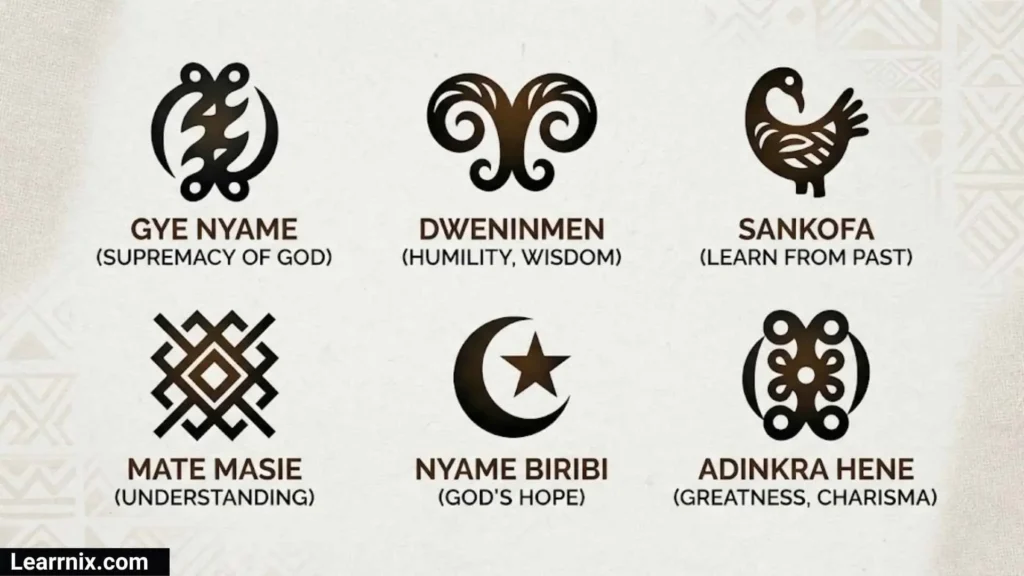
Adinkra tattoos have become popular because the symbols can represent personal values in a compact visual form. Someone might choose Sankofa to represent learning from experience, Gye Nyame for spirituality, or Aya for resilience and independence.
Popular choices include:
- Sankofa — reflection and learning from the past.
- Gye Nyame — faith and divine supremacy.
- Aya — endurance and independence.
- Fawohodie — freedom.
- Mpatapo — reconciliation.
- Akoben — vigilance and preparedness.
A tattoo should be selected with care because an Adinkra motif can have cultural significance beyond its appearance. It is useful to verify the original design, name, and meaning before permanently reproducing it.
It is also worth checking whether a tattoo artist has accurately reproduced the traditional form. Online versions may be simplified, stretched, mirrored, combined with other designs, or incorrectly labeled.
Adinkra Symbols Copy Paste
One of the biggest misconceptions about Adinkra symbols is that every traditional motif has an official Unicode character.
That is not generally the case.
Most traditional Adinkra designs are graphical motifs rather than individual Unicode characters. Unicode contains many symbols, but that does not mean a visually similar Unicode character is officially an Adinkra symbol.
For example, ☊ is a Unicode character representing the ascending node. Although its shape can sometimes be mistaken for other designs, it should not be labeled as the official Unicode Sankofa symbol.
For copy-and-paste use, the safest options are:
- Copy a verified Adinkra image or SVG.
- Use a properly licensed Adinkra font.
- Insert the design as an image in a graphic editor.
- Use a symbol library that clearly identifies the source.
- Avoid assigning random Unicode characters to traditional motifs.
This is especially important for websites and social media because a copied text character may look different across fonts and devices. A graphic file gives much greater control over the appearance of a traditional motif.
Adinkra Symbols Origin
The history of Adinkra is closely tied to Akan visual culture, especially the Asante tradition in Ghana. Adinkra cloth provides some of the clearest evidence of how the designs were used as a visual language.
Traditional production involved applying motifs to cloth. The British Museum describes carved stamps made from dried calabash and the use of a dark dye in the stamping process. Cloth could be divided into fields, with individual designs repeated in rows.
The history also extends beyond textiles. Akan visual art includes symbolic motifs on brass gold weights, royal staffs, ornaments, and other objects. The Met’s collections demonstrate the close relationship between Akan proverbs and visual imagery.
This broader history explains why Adinkra should be studied as a cultural visual system rather than simply as a modern collection of icons.
Adinkra Symbols Meanings
The meaning of an Adinkra symbol often becomes clearer when its name and associated proverb are considered together.
For example, Sankofa is connected with recovering something valuable from the past. Akoben is associated with a war horn and the idea of vigilance. Gye Nyame expresses a religious concept concerning God. Adinkrahene communicates ideas of leadership and greatness. These are different types of messages, showing the range of concepts represented through Adinkra.
Adinkra meanings can broadly be grouped into several themes:
- Spirituality: Gye Nyame and Nyame-related motifs.
- Wisdom: Mate Masie and learning-related symbols.
- Leadership: Adinkrahene and related royal imagery.
- Freedom: Fawohodie.
- Resilience: Aya and Mframadan.
- Peace: Mpatapo.
- Experience: Sankofa.
- Preparedness: Akoben.
This thematic approach makes it easier to understand why different symbols are selected for clothing, artwork, tattoos, architecture, and personal designs.
Adinkra Symbols Ghana
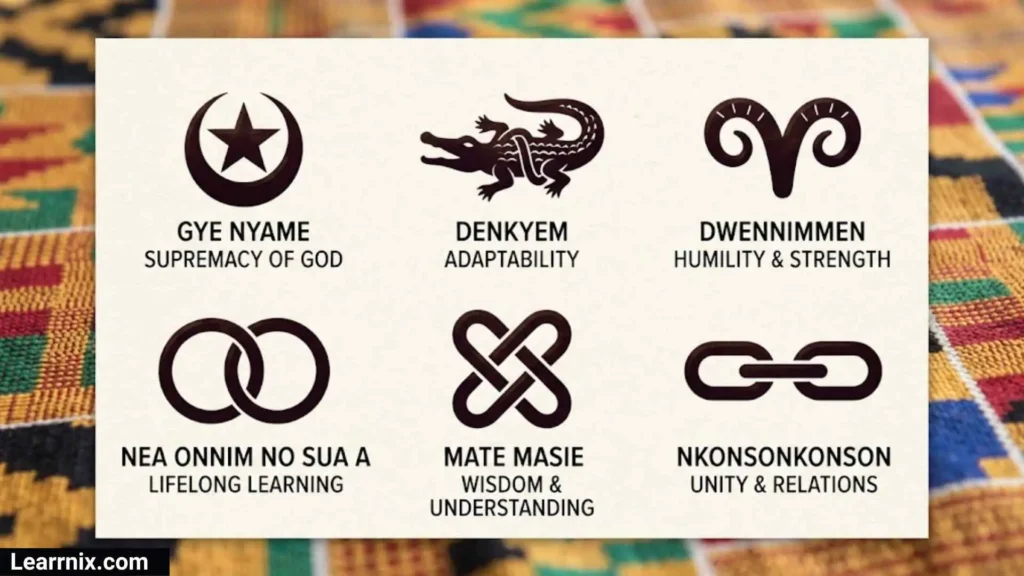
Adinkra symbols have become strongly associated with Ghana internationally. Their presence in Ghanaian textiles, art, education, cultural institutions, fashion, and design has helped make them recognizable beyond West Africa.
Historical examples demonstrate that the tradition has deep roots. The Met holds Adinkra textiles made by Asante-Akan artists in Ghana, while British Museum collections contain Adinkra cloth produced in Accra and other Ghanaian contexts.
The designs are also connected with Ghana’s wider Akan heritage. They can appear alongside other cultural forms such as kente, royal regalia, goldwork, and proverbial imagery, although these traditions should not be treated as identical.
For anyone researching Ghanaian symbols, Adinkra is therefore an important subject, but it is only one part of Ghana’s much broader cultural heritage.
Adinkra Symbols Gye Nyame
Gye Nyame is among the most recognizable Adinkra symbols. The name is commonly translated in relation to the phrase “except God” and is widely associated with the supremacy or power of God.
The symbol has a distinctive abstract shape and appears frequently in Ghanaian textiles and contemporary designs. The British Museum identifies the motif as Gye Nyame and gives its meaning as the supremacy of God in examples of Ghanaian printed cloth.
Gye Nyame can be seen in:
- Clothing
- Jewelry
- Wall art
- Graphic design
- Tattoos
- Cultural publications
- Decorative objects
- Modern architecture
Its widespread use has also produced many simplified versions online. When using Gye Nyame for a tattoo, logo, artwork, or cultural project, it is better to compare the design with a reliable museum or cultural source rather than copying an unknown graphic.
Frequently Asked Questions
What is the most famous Adinkra symbol?
Gye Nyame and Sankofa are among the most widely recognized Adinkra symbols. Gye Nyame is associated with the supremacy of God, while Sankofa represents the value of learning from the past.
Are Adinkra symbols from Ghana?
Yes. Adinkra is strongly associated with Akan communities in Ghana, particularly the Asante tradition. Historical museum collections contain Adinkra textiles and other objects identified with Ghana and Asante-Akan artists.
What does Sankofa mean in Adinkra?
Sankofa is commonly understood as the idea of returning to retrieve valuable knowledge from the past. Its bird design looks backward, reinforcing the concept of using hindsight to inform the present and future.
What does Gye Nyame mean?
Gye Nyame is commonly associated with the supremacy or power of God. It is one of the most recognizable Adinkra motifs and appears frequently in Ghanaian textiles and contemporary visual culture.
Can Adinkra symbols be used as Unicode characters?
Most traditional Adinkra motifs do not have individual official Unicode characters. They are generally better represented as images, vector graphics, or appropriately licensed fonts rather than by assigning unrelated Unicode characters to them.
Conclusion
Adinkra symbols are a distinctive part of Akan visual culture and have a particularly strong connection with Ghana and the Asante tradition. Their meanings cover subjects such as spirituality, wisdom, leadership, freedom, resilience, peace, vigilance, and learning from experience.
Symbols such as Sankofa and Gye Nyame have become internationally recognizable, but their importance comes from the cultural ideas behind their forms. Historical textiles, gold weights, royal objects, and other Akan artworks show that symbolic visual communication has played an important role in Akan artistic traditions.
If you want to use an Adinkra design for a tattoo, website, clothing, architecture, or digital artwork, research the specific motif before using it. The most accurate approach is to verify its name, cultural association, meaning, and visual form instead of relying on an unlabeled copy-and-paste graphic or treating a similar Unicode character as an official Adinkra symbol.

I am Charlotte Anderson, an education writer who is passionate about creating meaningful learning resources for students and lifelong learners.
I enjoy researching new educational approaches and sharing ideas that make studying easier and more effective.
Through my work, I aim to inspire curiosity, confidence, and a love for learning.
Books:
- The Complete Guide to Better Learning
- Building Skills for Academic Success
 Michael Carter