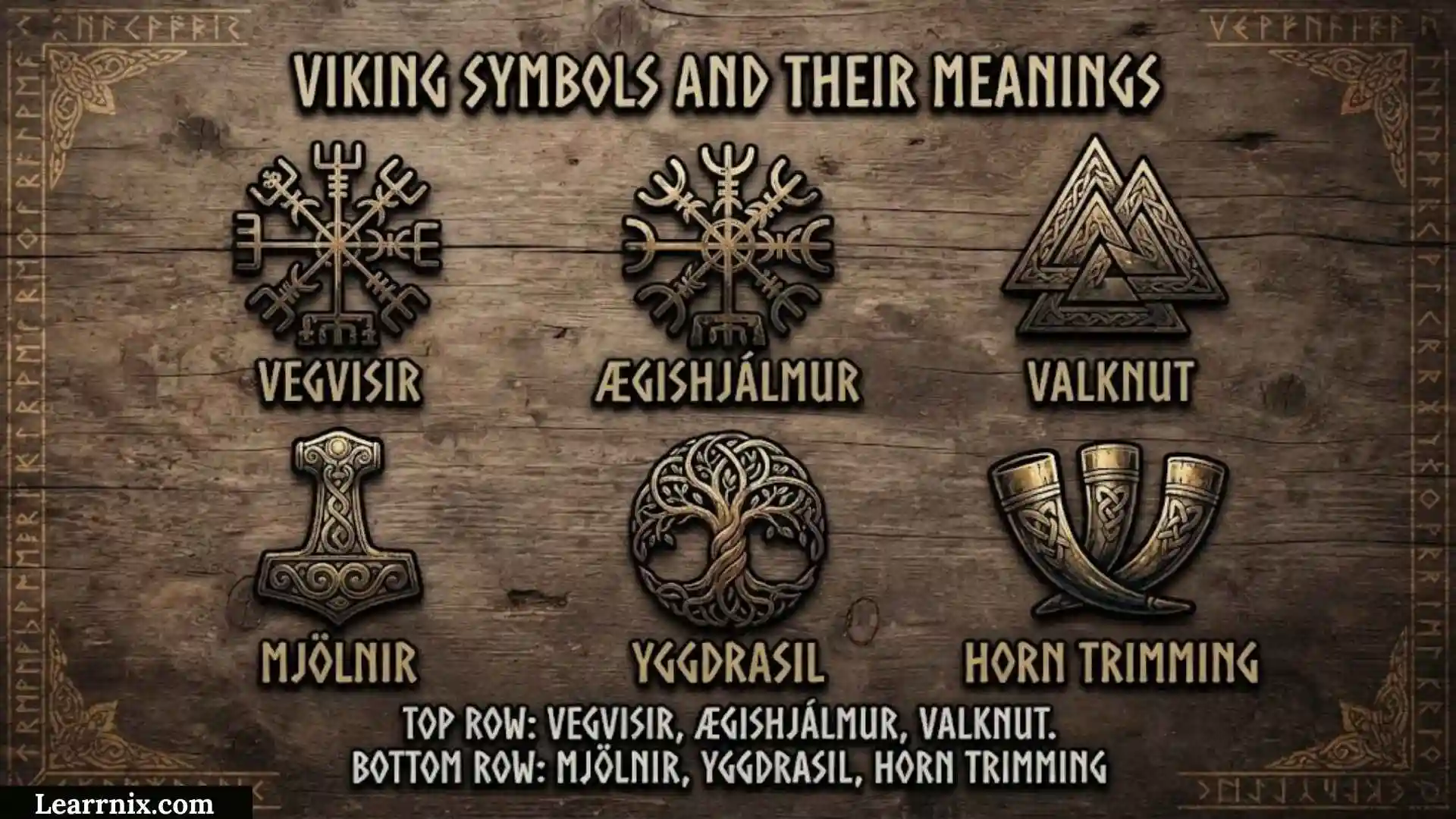
Viking symbols continue to attract interest because they connect ancient Scandinavian history with mythology, warfare, protection, family, travel, and spirituality. From Thor’s hammer and Norse runes to the valknut and Viking Age artwork, these symbols can have very different meanings depending on their historical context.
People often search for Viking symbols for tattoos, love, strength, protection, or personal identity. However, not every design sold online as a “Viking symbol” actually comes from the Viking Age. Some are authentic archaeological motifs, while others are later Scandinavian or modern creations inspired by Norse culture.
This guide explores Viking symbols and meanings in detail, including real Viking symbols, Old Norse and Nordic symbols, Danish examples, warrior designs, tattoo ideas, artifacts, and Christian imagery. It also explains which meanings are historically supported and which popular interpretations should be treated as modern rather than ancient.
Viking Symbols And Meanings
There was never one official list of Viking symbols used by every Scandinavian person. Viking Age society included different communities, beliefs, artistic traditions, and regional customs. Archaeological objects, rune stones, jewelry, weapons, graves, and artwork give us evidence of the symbols and motifs people actually used.
Some of the best-known examples include:
| Symbol | Common Association | Historical Context |
| Mjölnir (Thor’s hammer) | Thor, strength, protection | Found as Viking Age pendants and amulets |
| Valknut | Odin, death, warriors, afterlife | Appears on some Viking Age monuments and objects, although its exact meaning is debated |
| Runes | Writing, names, messages, memorials | Used throughout Scandinavia before and during the Viking Age |
| Ravens | Odin, knowledge, observation | Associated with Odin through Huginn and Muninn |
| Valkyries | Warriors, battle, fate | Found in Norse mythology and Viking Age imagery |
| Ships | Travel, trade, warfare, status | A major part of Scandinavian life and artwork |
| Serpents and dragons | Mythology, animals, power | Common in Scandinavian decorative art |
Mjölnir is one of the strongest examples of a historically documented Viking Age symbol. Thor was an important Norse god associated with thunder, strength, protection, and other aspects of life. Archaeological discoveries show that hammer-shaped pendants were worn during the Viking Age.
Runes were different from religious emblems because they were primarily a writing system. The Swedish History Museum explains that runes had been used in Scandinavia for centuries before the Viking Age and that the common Viking Age runic alphabet contained 16 characters.
The valknut is another widely recognized motif. It appears on several Viking Age objects and monuments, but researchers cannot establish one universally accepted meaning. Therefore, interpretations involving Odin, death, or the afterlife should be presented as interpretations rather than absolute definitions.
Real Viking Symbols
When people search for real Viking symbols, they usually want designs that have genuine archaeological or historical connections to the Viking Age. This is an important distinction because many popular Nordic symbols found on modern websites are much newer.
The Viking Age is generally placed around the late eighth to 11th centuries, although exact dates vary by historical tradition. The Swedish History Museum uses approximately AD 750–1100 for its Viking World exhibition.
Mjölnir
Thor’s hammer is one of the clearest examples of a real Viking Age religious object. Hammer pendants have been discovered in Scandinavia, showing that the image was actually used rather than being a modern invention.
Runes
Runes are unquestionably authentic Scandinavian symbols, although they are letters rather than one single religious emblem. They were carved into wood, stone, bone, metal, weapons, jewelry, and other objects.
Valknut
The valknut appears in Viking Age art and is often connected by modern audiences with Odin, warriors, death, or Valhalla. Its exact original meaning remains uncertain.
Valkyrie Imagery
Female figures interpreted as Valkyries appear in Viking Age archaeological material. They are connected with Norse ideas about warriors and battle.
Rune Stones
Rune stones are among the most important surviving examples of Viking Age writing and visual culture. Danish rune stones commonly commemorated deceased people and their achievements.
A useful rule is to separate evidence that a symbol existed from claims about exactly what it meant. Archaeology can prove the first without always proving the second.
Old Norse Viking Symbols
Old Norse Viking symbols are closely connected with the mythology, writing, religion, and artistic traditions of medieval Scandinavia. Mjölnir, runes, Valkyrie imagery, ravens, ships, animals, and interlaced designs are among the motifs most often associated with the period.
Runes are particularly important. The word “futhark” comes from the first six characters of the runic sequence. Earlier runic systems contained more characters, while the common Viking Age system was reduced to 16.
For copy-and-paste use, some Unicode rune characters include:
ᚠ ᚢ ᚦ ᚱ ᚲ ᚺ ᚾ ᛁ ᛅ ᛋ ᛏ ᛒ ᛘ ᛚ ᛦ
These characters should not be treated as decorative symbols with universal meanings. They represent historical runic characters, and their pronunciation or linguistic value depends on the specific rune row and language.
For a Viking-inspired tattoo or username, choosing the correct runic alphabet matters. Elder Futhark is frequently used in modern designs, but Younger Futhark was the primary Scandinavian runic system during much of the Viking Age.
Nordic Viking Symbols
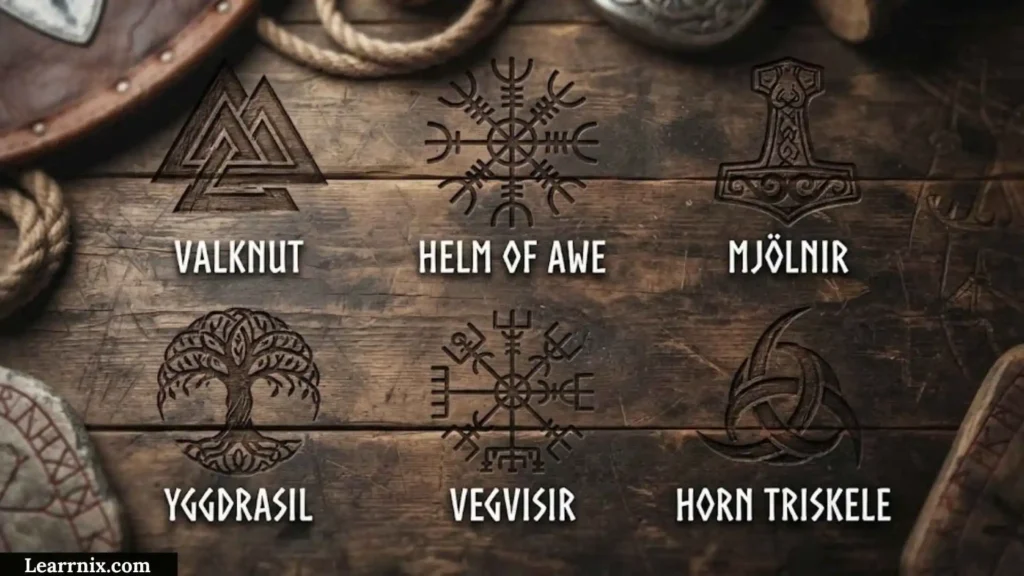
Nordic Viking symbols cover traditions from several Scandinavian regions, including Denmark, Sweden, and Norway. The term “Nordic” is therefore broader than “Danish Viking.”
Common Nordic-inspired motifs include:
- Mjölnir — Thor’s hammer and a strong symbol of Thor.
- Valknut — a historically attested interlocking motif with debated meaning.
- Runes — letters used for writing and inscriptions.
- Ravens — linked with Odin and his two ravens.
- Valkyries — female figures associated with warriors and battle.
- Ships — connected with travel, trade, exploration, and warfare.
- Serpents and dragons — recurring elements in Scandinavian art.
- Animal interlace — a distinctive feature of several Viking Age artistic styles.
Modern Nordic artwork often combines several of these elements into one design. That can create attractive artwork, but the combined design may be modern even when each individual motif has an ancient background.
Viking Symbols And Artifacts Guide
Artifacts provide some of the strongest evidence for understanding Viking symbols. Instead of relying only on modern interpretations, researchers can study objects recovered from graves, settlements, hoards, monuments, and ritual locations.
Jewelry And Amulets
Jewelry includes some of the clearest examples of personal religious imagery. Thor’s hammer pendants are particularly important because they demonstrate that hammer-shaped religious objects were physically worn.
Rune Stones
Rune stones were often raised in memory of deceased people and could record family relationships, journeys, achievements, and social status. Denmark has around 250 known Viking Age rune stones, while Sweden has thousands of runic inscriptions.
Thor’s Hammer Pendants
Small hammer-shaped pendants are among the most recognizable Viking Age religious artifacts. They are particularly useful when researching protection-themed Viking jewelry.
Valkyrie Pendants
Valkyrie-related jewelry provides evidence of warrior mythology in material culture. These objects can help explain why Valkyrie imagery remains popular in modern Viking artwork.
Weapons And Shields
Weapons found in Viking Age graves can tell us about warfare, social identity, and status. However, a sword or axe should not automatically be labeled as a specific religious “symbol.”
Ships
Ships were essential to Viking trade, travel, warfare, and exploration. As a result, ship imagery has a strong historical connection with Viking life even when it is not a specific religious emblem.
Runes On Everyday Objects
Runes were not limited to monumental stones. They could appear on combs, weapons, wood, bone, and personal possessions. The Swedish History Museum notes that runes were used for practical communication as well as memorial inscriptions.
Animal Art
Viking Age decorative art frequently incorporated animals, serpents, birds, and intertwined forms. Their exact meanings can vary according to the object and archaeological context.
Runic objects are especially valuable because they combine symbols with actual historical text. Some inscriptions are memorials, while others record names, journeys, ownership, or other messages.
Danish Viking Symbols
Danish Viking symbols are particularly important because Denmark preserves major evidence from the Viking Age, including rune stones, religious artifacts, jewelry, and the monuments at Jelling.
The Jelling Stone is one of the most famous Danish Viking Age monuments. Harald Bluetooth’s large Jelling Stone commemorates his parents and describes his achievements while also presenting Christianity as an important part of his rule.
Danish rune stones provide another major source. The National Museum of Denmark explains that most Danish rune stones were raised between approximately AD 975 and 1025, with the tradition becoming widespread after Harald Bluetooth’s large Jelling monument.
Other Danish examples include:
- Thor’s hammer pendants
- Rune stones
- Christian crosses
- Valkyrie-related jewelry
- Animal ornament
- Interlaced Scandinavian artwork
- Viking ship imagery
Danish Viking symbolism is especially useful for readers who want regional accuracy instead of treating every Scandinavian design as interchangeable.
Viking Symbols For Love
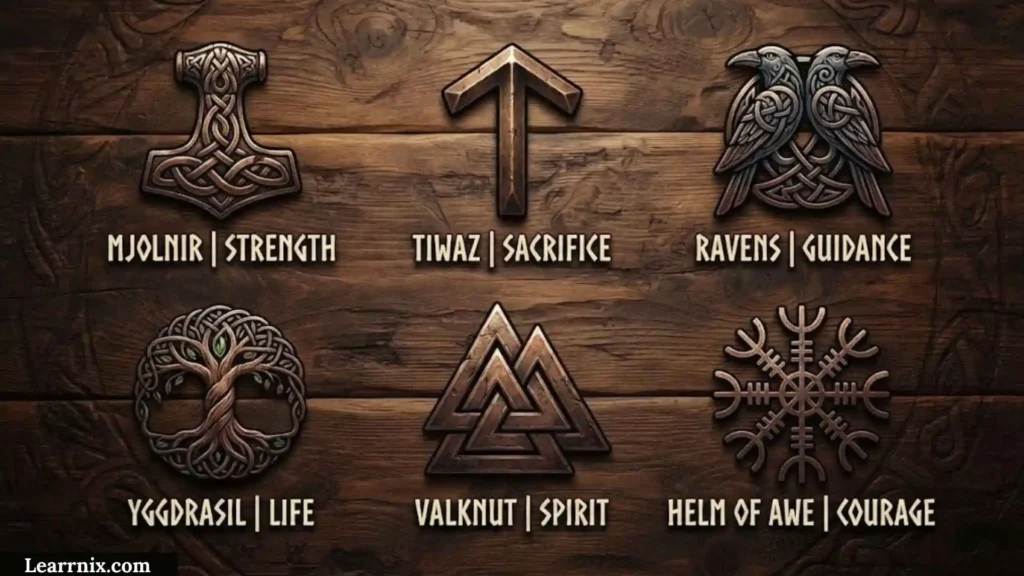
There was no single ancient Viking symbol that universally meant “romantic love” in the same way that the modern heart is commonly understood.
For Norse mythology, Freyja is particularly relevant because she was associated with love, fertility, beauty, and also war. Archaeological evidence includes a Viking Age pendant interpreted as depicting Freyja.
For a modern Viking-inspired love design, people may use:
- Freyja imagery — love, fertility, beauty, and feminine power.
- Interwoven knotwork — a modern representation of connection.
- Runic names — useful for personalized designs when correctly translated.
- Paired ravens or animals — a modern artistic representation of partnership.
- Viking-inspired jewelry — particularly hammer or pendant designs.
It is worth being careful with claims about “Viking love runes.” Runes certainly existed, but the idea that specific rune combinations were universal Viking love charms is much less certain. The National Museum of Denmark notes that ideas about runic magic developed through different periods and that much evidence comes from later literary traditions.
Viking Symbols For Protection
Protection is one of the most common modern reasons people choose Viking symbols.
Mjölnir is especially suitable for this theme because Thor was a powerful Norse deity and hammer pendants are historically documented Viking Age artifacts. Thor’s hammer could therefore provide a stronger historical foundation for a protection-themed design than a symbol with no Viking Age evidence.
Other options include:
- Mjölnir — Thor and protective strength.
- Shield imagery — defense and warrior identity.
- Valkyrie imagery — battle and warrior mythology.
- Odin imagery — mythology connected with warriors, wisdom, and death.
- Runic inscriptions — personalized words or names.
One important distinction concerns symbols such as Vegvísir and the Ægishjálmur. These are extremely popular in modern Nordic designs, but they should not simply be described as confirmed Viking Age symbols. Their surviving documentary traditions are considerably later.
Berserker Viking Symbols
Berserkers are strongly associated with Viking warrior culture in Old Norse literature, but there is no universally proven archaeological emblem that can accurately be called “the berserker symbol.”
Modern berserker designs commonly feature:
- Bears
- Wolves
- Shields
- Axes
- Swords
- Ravens
- Odin imagery
- Runes
The bear is especially common because modern explanations connect the term berserkr with bear-related interpretations. However, this does not establish that Viking berserkers used a standard bear emblem.
The broader warrior context is historically supported. Archaeologists have found weapons, hunting equipment, and horse gear in some Viking Age male graves, although most men were not professional warriors. The Swedish History Museum emphasizes that ordinary Viking Age men were commonly farmers and family providers, while warfare was especially important to aristocratic and warrior groups.
Warrior Viking Symbols Tattoos
Warrior Viking tattoos usually combine mythology, weapons, animals, runes, and Scandinavian artwork. A historically inspired design can include one central motif instead of mixing every popular Viking symbol together.
Popular Warrior Tattoo Ideas
Mjölnir tattoo: Suitable for a Thor-centered design involving strength and protection.
Valkyrie tattoo: A strong choice for themes involving warriors, battle, and Norse mythology.
Odin and ravens: Useful for designs focused on Odin, wisdom, battle, and mythology.
Viking ship tattoo: Represents Scandinavian seafaring, travel, exploration, and adventure.
Shield and weapon tattoo: Creates a straightforward warrior aesthetic, although the individual weapon should not automatically be treated as a religious emblem.
Rune tattoo: Can be personalized with a name or historically appropriate word.
Before using runes permanently, check the spelling and the chosen rune system. Modern online “Viking alphabets” frequently mix different historical periods.
Strength Warrior Viking Symbols Tattoos
Strength-themed Viking tattoos often use Thor, warriors, animals, shields, and weapons. Among these, Mjölnir has a particularly strong connection with Thor, a major Norse deity known for his power and combat against giants.
A strength-focused design can use:
- Mjölnir — physical power and Thor.
- Bear imagery — modern berserker-inspired strength.
- Wolf imagery — warrior and mythological associations.
- Shield — defense and resilience.
- Sword or axe — combat and warrior identity.
- Odin imagery — wisdom, authority, and battle.
- Runes — personalized words such as a correctly translated name or concept.
For a clean tattoo, one primary symbol usually makes the design easier to understand. A small Mjölnir, rune inscription, shield, or animal motif can communicate the desired theme without creating a confusing mixture of unrelated symbols.
Christian Viking Symbols
Christian symbols became increasingly visible in Scandinavia during the later Viking Age as conversion progressed. The process was gradual and varied by region rather than happening at one exact moment.
The most obvious Christian Viking symbol is the cross (✝). Denmark’s Jelling monuments are especially important because Harald Bluetooth’s large Jelling Stone includes Christ imagery and describes the Christianization of the Danes.
Interestingly, Viking Age religious transition did not always involve an immediate replacement of older symbols. Archaeological evidence shows objects combining or placing Christian and Norse imagery in close proximity.
This makes designs featuring a cross with Scandinavian ornament historically interesting. However, a modern Christian-Viking tattoo should be described as inspired by the conversion period rather than as a standard symbol used by all Vikings.
Viking Symbols Tattoos
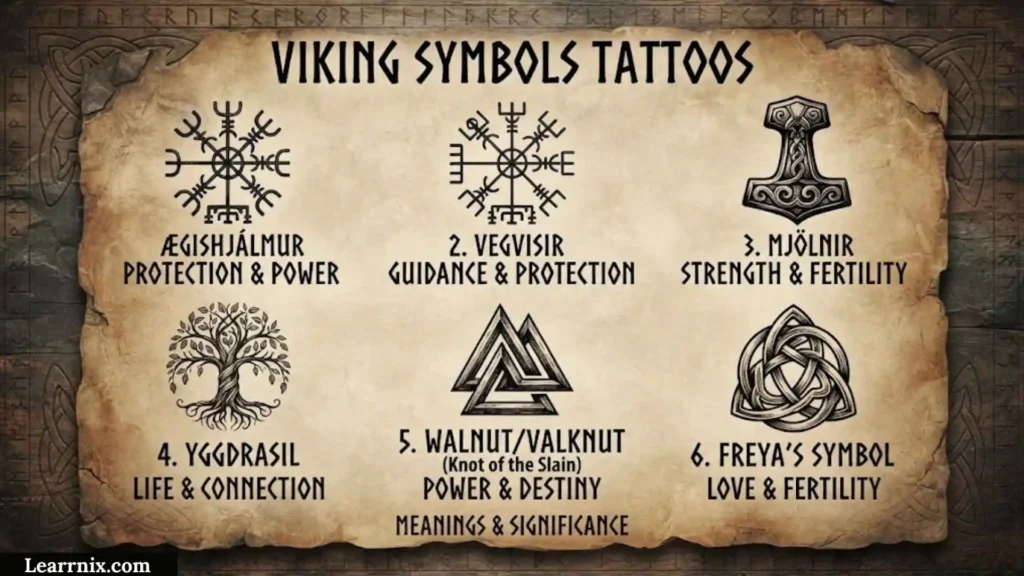
Viking tattoos are often chosen because they combine strong visual shapes with mythology and historical meaning. The most useful approach is to decide what the tattoo should communicate before choosing the design.
For protection, Mjölnir is historically grounded.
For warrior identity, Valkyrie imagery, shields, weapons, and Odin-related motifs can work.
For strength, Thor and Mjölnir provide a clear mythological connection.
For personal identity, a correctly researched runic inscription can be more meaningful than copying a random rune symbol.
For Danish heritage or history, Jelling-inspired ornament and Danish rune stones offer a regional connection.
For a historically accurate tattoo, always check whether the symbol is actually Viking Age, whether its meaning is documented, and whether the runes belong to the correct period.
Frequently Asked Questions
What is the most famous Viking symbol?
Mjölnir, or Thor’s hammer, is one of the most recognizable Viking Age symbols. Hammer pendants have been found archaeologically in Scandinavia, giving the symbol a strong historical connection to the period.
What Viking symbol represents strength?
Mjölnir is commonly associated with strength because it belongs to Thor, a powerful deity in Norse mythology. It also has the advantage of being represented by actual Viking Age archaeological finds.
Is the valknut a real Viking symbol?
Yes, the valknut is a historically attested motif found in Viking Age contexts. However, its exact original meaning remains uncertain, so modern claims that assign it one definite meaning should be treated carefully.
Were runes used as Viking symbols?
Runes were primarily a writing system rather than one single symbolic emblem. They were used for names, messages, memorials, and other inscriptions, and the common Viking Age runic alphabet had 16 characters.
Is Vegvísir an authentic Viking symbol?
Vegvísir is popular in modern Nordic artwork, but it should not be described as a confirmed Viking Age symbol. Its surviving written evidence belongs to much later Icelandic traditions.
Conclusion
Viking symbols combine mythology, writing, art, religion, warfare, travel, and personal identity. Mjölnir, runes, valknut, Valkyrie imagery, rune stones, ships, and Scandinavian animal ornament all provide different ways to explore Viking Age culture.
The biggest difference between a historically accurate Viking symbol and a modern Nordic design is the evidence behind it. Some motifs are supported by archaeological objects, while others became popular centuries later. Even when a symbol is genuinely ancient, its exact meaning may remain uncertain.
For tattoos, artwork, social media, usernames, jewelry, and copy-and-paste designs, Viking-inspired symbols can be highly effective when their history is understood first. Choosing the right symbol, rune system, and meaning helps create a design that is both attractive and more historically responsible.

I am Charlotte Anderson, an education writer who is passionate about creating meaningful learning resources for students and lifelong learners.
I enjoy researching new educational approaches and sharing ideas that make studying easier and more effective.
Through my work, I aim to inspire curiosity, confidence, and a love for learning.
Books:
- The Complete Guide to Better Learning
- Building Skills for Academic Success
 Michael Carter