If you are searching for MTG mana symbols, you probably want to know what the symbols on Magic: The Gathering cards mean, how to pay them, and why symbols such as {C}, {X}, hybrid mana, Phyrexian mana, and {S} work differently.
The short answer is simple: mana symbols tell you what mana or payment is required to cast a spell or activate an ability, or what mana an effect produces. The five basic colored mana symbols are {W} for white, {U} for blue, {B} for black, {R} for red, and {G} for green. Numbers such as {2} represent generic mana costs, while {C} specifically represents one colorless mana. Wizards of the Coast’s beginner guide explains that generic mana costs are shown as numbers and that players generate mana by tapping lands or using other mana-producing effects.
But the system goes much deeper than the five basic symbols. Magic also uses generic, colorless, hybrid, monocolored hybrid, Phyrexian, snow, and variable {X} symbols, among others.
This guide explains what each symbol means, how to read a mana cost, the difference between mana and mana symbols, how symbols affect card color and Commander color identity, common mistakes, and practical examples for deck building and gameplay.
Quick Answer: What Do MTG Mana Symbols Mean?
MTG mana symbols are shorthand used on Magic: The Gathering cards to describe mana costs, mana production, and other payment requirements.
The core symbols are:
| Symbol | Meaning |
| {W} | One white mana |
| {U} | One blue mana |
| {B} | One black mana |
| {R} | One red mana |
| {G} | One green mana |
| {C} | One colorless mana |
| {1}, {2}, {3} | Generic mana costs |
| {X} | Variable amount |
| {0} | Zero mana |
| {W/U} | One white or one blue mana |
| {2/G} | One green mana or two mana |
| Phyrexian symbol | Appropriate colored mana or 2 life |
| {S} | One mana from a snow source |
The most important beginner distinction is this:
Generic mana is a type of cost. Colorless mana is a type of mana.
So {2} does not mean “two colorless mana.” It means you need to pay two mana toward a generic cost. By contrast, {C} specifically requires one colorless mana.
That distinction is central to understanding modern Magic.
What Are Mana Symbols in MTG?
Mana symbols are the visual language Magic uses to communicate how spells and abilities interact with mana.
You will find them in several places on cards:
- The mana cost in the upper-right corner
- Activated abilities
- Triggered or static abilities that produce or require mana
- Some reminder text
- Effects that refer to mana spent
- Certain special mechanics
Wizards of the Coast describes a card’s mana cost as a set of numbers and symbols representing the mana needed to cast the spell. Generic portions can be paid with mana of any color.
For example, imagine a spell with this cost:
{2}{U}
You need three mana total:
- Two generic mana
- One blue mana
You could pay it with:
{U}{U}{U}
or:
{U}{R}{G}
or:
{U}{C}{C}
The important requirement is that one mana must satisfy the blue {U} symbol. The other two can satisfy the generic {2} portion.
Mana Symbols vs. Mana Types
This distinction causes a lot of confusion.
A mana symbol is the written representation used on a card or in rules discussions.
A mana type describes the mana itself.
The five colored mana types are:
- White
- Blue
- Black
- Red
- Green
Colorless is also a type of mana, but it is not one of Magic’s five colors.
Generic mana is different. It describes a cost requirement, not a sixth type of mana.
For example:
- {G} is a green mana symbol.
- {C} is a colorless mana symbol.
- {3} is a generic mana symbol.
- A Forest produces {G}.
- A spell costing {3} has a generic cost.
Understanding this difference makes many later rules much easier.
The Five Basic MTG Mana Symbols
Magic’s basic color system has five colors:
White, Blue, Black, Red, and Green.
Each color has its own mana symbol and basic land.
| Color | Symbol | Basic Land |
| White | {W} | Plains |
| Blue | {U} | Island |
| Black | {B} | Swamp |
| Red | {R} | Mountain |
| Green | {G} | Forest |
These five colors form the foundation of Magic’s mana system.
White Mana Symbol: {W}
{W} represents one white mana.
White is commonly associated with:
- Small and efficient creatures
- Creature tokens
- Board-wide buffs
- Removal
- Protection
- Life gain
- Rules and restrictions
- Cooperative strategies
A spell costing:
{2}{W}
requires three mana total, including at least one white mana.
A Plains normally produces {W}, making it one of the primary ways a player generates white mana.
Blue Mana Symbol: {U}
{U} represents one blue mana.
Magic uses U for blue because B is already used for black.
Blue is commonly associated with:
- Card draw
- Countermagic
- Flying
- Bounce effects
- Library manipulation
- Tempo
- Spells and instants
- Information and control
A spell costing:
{1}{U}{U}
requires three mana, of which two must be blue.
An Island is the basic land associated with blue mana.
Black Mana Symbol: {B}
{B} represents one black mana.
Black commonly interacts with:
- The graveyard
- Creature destruction
- Discard
- Sacrifice
- Life loss
- Reanimation
- Demons and other powerful creatures
- Effects that exchange life or resources for power
For example:
{3}{B}
requires four mana total, including one black mana.
A Swamp normally produces {B}.
Red Mana Symbol: {R}
{R} represents one red mana.
Red is commonly associated with:
- Direct damage
- Aggressive creatures
- Haste
- Temporary mana
- Artifact destruction
- Combat tricks
- Impulsive card access
- Fast, high-pressure strategies
A spell costing:
{R}{R}
requires two red mana.
A Mountain normally produces {R}.
Green Mana Symbol: {G}
{G} represents one green mana.
Green commonly interacts with:
- Creature growth
- Large creatures
- Mana acceleration
- Land development
- +1/+1 counters
- Creature-based strategies
- Naturalization effects
- Ramp
A spell costing:
{2}{G}
requires three mana total, including one green mana.
A Forest normally produces {G}.
What Does a Number Mean in an MTG Mana Cost?
A number such as {1}, {2}, {3}, or {6} represents a generic mana cost.
Generic mana can generally be paid with mana of any type.
For example:
{4}
means you need four mana.
You could potentially pay it with:
- Four white mana
- Four blue mana
- Four red mana
- Four green mana
- Four colorless mana
- A mixture of those types
The number does not mean that you need four colorless mana.
Wizards of the Coast specifically explains that generic mana is represented by a number and that mana of any color can be used to pay the generic portion of a cost.
Example: Reading {3}{R}
Consider:
{3}{R}
The cost contains two different requirements:
- {3} = three generic mana
- {R} = one red mana
The total cost is four mana.
A legal payment could be:
{R}{R}{R}{R}
because three red mana can pay the generic portion and one red mana pays {R}.
Another legal payment could be:
{U}{G}{C}{R}
because {U}, {G}, and {C} can cover the generic {3}, while {R} satisfies the red requirement.
Generic Mana vs. Colorless Mana
This is the most important mana-symbol distinction for many new players.
What Is Generic Mana?
Generic mana is represented by numbers:
{1}, {2}, {3}, {4}, and so on.
It tells you how much mana must be spent, not what color that mana must be.
For example:
{5}
means pay five mana toward a generic cost.
What Is Colorless Mana?
Colorless mana is represented by:
{C}
One {C} means the payment must include one colorless mana.
Colorless mana can pay generic costs, but colored mana cannot normally substitute for {C}.
For example:
{2}{C}
requires:
- Two mana to satisfy the generic portion
- One specifically colorless mana
So the cost is three mana total, but at least one of that mana must be colorless.
Generic vs. Colorless Comparison
| Symbol | What it represents | Can colored mana pay it? | Requires colorless mana? |
| {1} | One generic mana | Yes | No |
| {2} | Two generic mana | Yes | No |
| {C} | One colorless mana | No | Yes |
| {2}{C} | Two generic + one colorless | Generic portion: yes | Yes, for {C} |
A useful memory trick is:
A number tells you how much. {C} tells you what kind of mana.
Why Does {C} Exist?
Historically, Magic used overlapping visual conventions for generic costs and colorless mana. As the game developed, this became increasingly confusing because a number could represent either a generic cost or colorless mana depending on context.
Wizards of the Coast has explained that the dedicated {C} symbol was introduced to remove that ambiguity and make colorless-mana requirements explicit.
That change is an important part of the history of MTG mana symbols.
How to Read a Complete Mana Cost
Reading a mana cost becomes easy when you separate it into individual symbols.
Suppose a card costs:
{2}{W}{W}
Break it down:
- {2} requires two generic mana.
- {W} requires one white mana.
- {W} requires another white mana.
The total is four mana, with at least two white mana required.
You could pay:
{W}{W}{W}{W}
or:
{W}{W}{U}{C}
but not:
{U}{U}{R}{C}
because that payment contains no white mana.
Example With Three Colors
Suppose a spell costs:
{1}{W}{U}{B}
You need four mana total:
- One generic
- One white
- One blue
- One black
The generic portion can be paid by any mana, but the three colored symbols each need their matching color.
One possible payment is:
{W}{U}{B}{G}
Here, the green mana pays the generic {1}.
This is why multicolor mana bases matter when casting spells with several colored requirements.
Mana Symbols in Card Text
Mana symbols do not only appear in the top-right corner of a card.
They can also appear in rules text.
For example, an ability might have a cost such as:
{2}, {T}: Draw a card.
Here:
- {2} is a generic activation cost.
- {T} means tap the permanent.
Another ability might say:
{T}: Add {G}.
In this case, {G} is not a cost. It tells you what mana the ability produces.
This gives mana symbols two major jobs:
- Showing what you must pay
- Showing what an effect produces
The surrounding card text tells you which role the symbol has.
Mana Symbols in Activated Abilities
Activated abilities usually use the format:
Cost: Effect
For example:
{2}{R}: This creature gets +1/+0 until end of turn.
The symbols before the colon are part of the ability’s activation cost.
This means you must pay the listed cost before the ability can be activated.
The same principle applies to abilities involving:
- Generic mana
- Colored mana
- Colorless mana
- Hybrid mana
- Phyrexian mana
- Snow mana
- Tap symbols
- Sacrifice costs
Not every symbol in an ability is a mana symbol. {T}, for example, is the tap symbol rather than a mana symbol.
Mana Value and Mana Symbols
Mana symbols also matter when determining a card’s mana value.
Mana value is based on the total numerical value of a card’s mana cost, regardless of the colors involved.
For example:
{2}{U}{U}
has a mana value of 4.
The two blue symbols do not make blue “worth more” than generic mana.
Why Mana Value Matters
Mana value appears in many mechanics and effects.
Cards may care whether something has:
- Mana value 1 or less
- Mana value 3
- Mana value 5 or greater
- A particular mana value compared with another object
The older term converted mana cost (CMC) was replaced by mana value in modern Magic terminology.
When reading older MTG articles, deck guides, or cards, you may therefore see both terms.
Hybrid Mana Symbols
Hybrid mana provides flexibility in how a cost is paid.
A two-color hybrid symbol looks conceptually like:
{W/U}
It can be paid with:
- One white mana, or
- One blue mana
Wizards of the Coast explains that hybrid mana symbols represent costs that can be paid using either of their two colors.
Common Hybrid Combinations
Examples include:
- {W/U} — white or blue
- {U/B} — blue or black
- {B/R} — black or red
- {R/G} — red or green
- {G/W} — green or white
A card with a hybrid symbol can therefore be easier to cast in decks containing either of its colors.
Hybrid Mana Does Not Mean “Pay Both”
This is a common mistake.
If a spell costs:
{2}{W/U}
you do not need both white and blue.
You need:
- Two generic mana
- Either one white or one blue mana
For example:
{2}{W}
or:
{2}{U}
can satisfy the cost.
Hybrid Mana and Card Color
Hybrid mana has an important rules consequence: the colors represented by a hybrid symbol are part of the card’s color identity and color considerations even if you choose to pay that symbol using only one of the colors.
Wizards of the Coast’s hybrid-mana rules notes explain that a card with a two-color hybrid symbol is both colors regardless of which color of mana was used to cast it.
That distinction matters in Commander and other situations where a card’s colors matter independently from how you paid its cost.
Monocolored Hybrid Mana
Monocolored hybrid mana looks like:
{2/G}
This can be paid using:
- One green mana, or
- Two mana of any type
Wizards of the Coast describes this as a monocolored hybrid symbol.
For example, if a card costs:
{2/G}
you can pay it with:
{G}
or:
{U}{R}
or:
{C}{C}
assuming those payments are otherwise legal.
This makes monocolored hybrid costs more flexible than they may appear at first glance.
Phyrexian Mana Symbols
Phyrexian mana symbols allow an alternative payment involving life.
A Phyrexian symbol associated with blue, for example, can be paid with:
- One blue mana, or
- Two life
The same concept applies to the other colored Phyrexian symbols.
Wizards of the Coast’s official release notes explain that Phyrexian mana symbols can be paid with one mana of the appropriate color or by paying 2 life. They also clarify that Phyrexian mana is not a separate type of mana that can be added to a mana pool.
Why Phyrexian Mana Is Powerful
Phyrexian mana creates a trade-off between:
Mana efficiency and life total.
Suppose you need to cast an important spell but do not have the required colored mana.
If its cost contains a Phyrexian symbol, you may have another option: pay life instead.
This can be especially meaningful in aggressive decks, combo strategies, or games where spending life is less dangerous than losing access to an important spell.
A Key Limitation
You cannot treat Phyrexian mana as a free resource.
If you choose the life-payment option, you are actually paying life as part of the cost.
You also cannot pay 2 life if you do not have enough life to pay that cost.
Snow Mana Symbol {S}
The snow mana symbol is:
{S}
It represents a requirement that can be paid with mana produced by a snow source.
This is an important point:
Snow is not a type of mana.
Wizards of the Coast explains that {S} is a snow mana symbol and that it can be paid using one mana produced by a snow source. That mana can itself be colored or colorless.
Example of Snow Mana
A snow ability could require:
{S}
You could satisfy it with mana produced by a snow source.
For example, a Snow-Covered Mountain can produce red mana, and that mana can pay a {S} requirement because it came from a snow source.
Is Snow a Sixth Color?
No.
Snow is a supertype, not a color.
It does not add another color to Magic’s color system.
This distinction is important because players sometimes assume that {S} works like {W}, {U}, {B}, {R}, or {G}. It does not.
The {X} Mana Symbol
{X} represents a variable value.
If a spell costs:
{X}{R}
you choose the value of X while casting the spell and pay that much generic mana plus one red mana.
For example:
- X = 1 → pay {1}{R}
- X = 3 → pay {3}{R}
- X = 6 → pay {6}{R}
The effect of the spell may then scale according to the value chosen.
Why X Spells Matter
X costs create flexibility.
Instead of being designed for only one point on the mana curve, an X spell can potentially remain useful at different stages of a game.
Early in the game, you might cast it for a small value.
Later, you may invest much more mana.
That flexibility is one reason X spells appear in many different strategies.
The {0} Mana Symbol
{0} means a cost of zero mana.
A cost of {0} is an actual mana cost of zero.
This is different from a card that simply has no mana cost.
That distinction can matter for rules interactions involving:
- Casting a spell
- Mana value
- Alternative costs
- Effects that modify costs
So although {0} looks simple, it should not automatically be treated as identical to a missing mana cost.
Other Symbols You May See Near Mana Symbols
Not every circular symbol on a Magic card is a mana symbol.
Some symbols represent other game actions or information.
For example:
- {T} = tap
- {Q} = untap
- Loyalty symbols = planeswalker abilities
- Power/toughness symbols = creature characteristics
- Set and rarity indicators = card identification information
This is why beginners should learn to identify the function of the symbol, not just its visual shape.
MTG Mana Symbols and Card Color
Mana symbols can affect a card’s color.
A simple example is:
{R}
A card with a red mana symbol in its mana cost is generally red.
A card with:
{W}{U}
is white and blue.
A card can therefore be:
- Monocolored
- Multicolored
- Colorless
The important point is that colorless is not a sixth color.
Magic’s five colors are:
- White
- Blue
- Black
- Red
- Green
Colorless exists separately from those five colors.
Why Card Color and Mana Payment Are Different
The way you pay for a spell does not necessarily determine the card’s color.
A hybrid spell is a good example.
A card with a {W/U} symbol can be paid for with white mana alone, blue mana alone, or an appropriate combination. Yet the card can still have both white and blue in its color identity.
This distinction becomes particularly important in Commander.
MTG Mana Symbols and Commander Color Identity
Mana symbols are extremely important when building a Commander deck.
Commander uses color identity to determine which cards are legal in a deck. Wizards of the Coast states that a card’s color identity can come from its color, casting cost, and mana symbols in its text, with the exact rules determining how the identity is established.
For example, suppose your commander has a blue-black color identity.
You generally cannot put a card with a green mana symbol contributing to its color identity into that deck.
Why the Rules Text Matters
One of the easiest Commander mistakes is checking only the mana cost.
Consider a card that has no green mana in its top-right mana cost but has a green mana symbol in its rules text.
That symbol can still matter for color identity.
This is why Commander deck-building tools check more than the mana-cost box.
Color Identity Is Not the Same as Card Color
These terms are related but not identical.
Card color describes what colors the card has.
Color identity is the set of colors that determines what cards can be used with a commander.
For Commander deck construction, the second concept is the important one.
Example: A Colorless Commander
Colorless commanders create another useful example.
A colorless commander can have a color identity with no colors. Commander rules allow colorless cards in the deck, but colored mana symbols can affect whether other cards are legal. Wizards of the Coast’s current Commander page explicitly notes that color identity can come from the casting cost and mana symbols in the card’s text.
Mana Symbols and Devotion
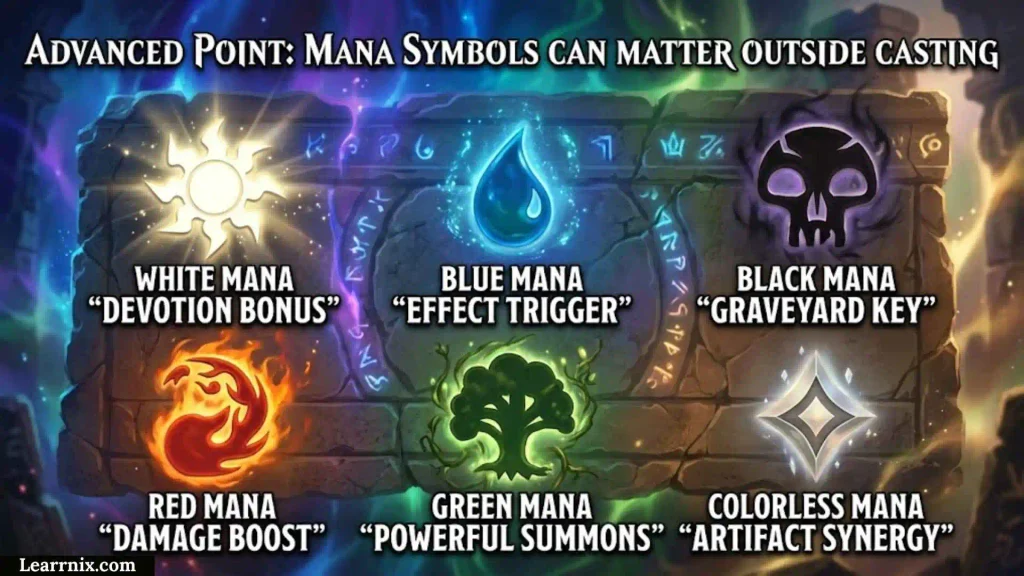
Mana symbols can also matter for mechanics such as devotion.
Devotion counts colored mana symbols in the mana costs of permanents you control.
For example, if a permanent’s mana cost contains two {G} symbols, those symbols contribute two green mana symbols toward devotion to green.
Wizards of the Coast’s rules notes distinguish these colored symbols from generic and colorless symbols. Hybrid, monocolored hybrid, and Phyrexian mana symbols can contribute to devotion to their associated colors.
This gives mana symbols another important role beyond simply determining what you pay.
Mana Symbols and Basic Lands
The five basic lands are closely connected to the five basic colored mana symbols.
| Basic Land | Normal Mana Produced | Symbol |
| Plains | White | {W} |
| Island | Blue | {U} |
| Swamp | Black | {B} |
| Mountain | Red | {R} |
| Forest | Green | {G} |
This is the foundation of a traditional mana base.
When you see:
{G}{G}
you immediately know that the deck needs access to green mana.
When you see:
{U}{U}
you know the deck needs reliable access to blue mana.
That is why colored mana requirements matter when building a deck’s land base.
How Mana Symbols Affect Deck Building
Mana symbols are not just something to memorize. They influence how you build and play a deck.
Suppose a deck contains many cards costing:
{U}{U}
and {B}{B}.
That deck needs reliable access to both blue and black mana.
If your mana base produces too little of either color, you may have cards stranded in your hand even when you have enough total lands.
Total Mana vs. Correct Mana
This creates an important deck-building principle:
Having enough lands is not the same as having the right mana.
Imagine you have four lands but only one produces blue mana.
You may technically have four mana available, but a spell costing {U}{U} still cannot be cast.
This is why colored mana symbols are valuable information when evaluating a deck’s mana base.
A Practical Example: Reading a Real Mana Cost
Consider a spell with:
{1}{R}{R}
At first glance, it may look like a three-mana spell.
That is true, but the colored requirement is important.
You need:
- Three total mana
- Two red mana
Possible payment:
{R}{R}{C}
Possible payment:
{R}{R}{G}
Not possible:
{R}{U}{C}
because there is only one red mana.
This is the kind of distinction that matters when deciding whether a card is easy or difficult to cast.
A Second Example: Generic and Colorless Together
Consider:
{4}{C}
This costs five mana total.
However, it does not simply mean “five generic mana.”
You must have:
- Four mana for {4}
- One specifically colorless mana for {C}
For example:
{W}{U}{B}{R}{C}
could satisfy the cost.
But:
{W}{U}{B}{R}{G}
would not satisfy {C} because none of those five mana is colorless.
This is one of the most useful examples to understand when learning modern colorless-mana costs.
A Third Example: Hybrid Mana
Consider:
{2}{W/U}
You need three mana total.
You can pay:
{2}{W}
or:
{2}{U}
The hybrid symbol does not require both colors.
If your deck produces both white and blue, the card is more flexible than a spell requiring a fixed {W} or {U}.
A Fourth Example: Phyrexian Mana
Imagine a spell contains one blue Phyrexian mana symbol.
If you have the required blue mana, you can spend it.
If you do not, the Phyrexian symbol may allow you to pay 2 life instead.
This creates an interesting strategic decision:
Do you spend your mana, or do you spend your life total?
That choice can change depending on the game state.
A Fifth Example: Snow Mana
Suppose an ability requires:
{S}
You cannot satisfy it simply because you have one mana available.
The mana must have been produced by a snow source.
A snow source can produce colored or colorless mana, and that mana can satisfy {S}.
This is why snow is about the source of the mana, not its color.
A Simple MTG Mana Symbol Decision Tree
When you see an unfamiliar mana symbol, use this quick decision process:
What does the symbol represent?
↓
Is it a color symbol?
↙ ↘
Yes No
↓ ↓
{W}{U}{B}{R}{G} Is it a number?
↙ ↘
Yes No
↓ ↓
Generic cost Is it {C}?
↙ ↘
Yes No
↓ ↓
Colorless Check for
mana X, S, hybrid,
or Phyrexian
For practical use, remember these four questions:
- Is this a colored symbol?
- Is this a generic number?
- Does it specifically require colorless mana?
- Does it offer an alternative payment or special requirement?
This method lets you decode most mana costs without memorizing every mechanic at once.
MTG Mana Symbol Cheat Sheet
| Symbol or Cost | Meaning | Key Point |
| {W} | White mana | Requires white |
| {U} | Blue mana | Requires blue |
| {B} | Black mana | Requires black |
| {R} | Red mana | Requires red |
| {G} | Green mana | Requires green |
| {C} | Colorless mana | Requires colorless |
| {1} | One generic mana | Any appropriate mana can pay it |
| {2} | Two generic mana | Any appropriate mana can pay it |
| {X} | Variable cost | Choose X while casting |
| {0} | Zero cost | Requires no mana for that part |
| {W/U} | White/blue hybrid | Pay with white or blue |
| {U/B} | Blue/black hybrid | Pay with blue or black |
| {2/G} | Monocolored hybrid | One green or two mana |
| Phyrexian symbol | Colored mana or 2 life | Alternative life payment |
| {S} | Snow requirement | Mana must come from a snow source |
Common MTG Mana Symbol Mistakes
Mistake 1: Calling {2} Two Colorless Mana
This is probably the most common beginner error.
{2} is a generic cost.
{C} is a colorless mana requirement.
They are not interchangeable concepts.
Mistake 2: Treating Colorless as a Sixth Color
Magic has five colors:
White, blue, black, red, and green.
Colorless is not a sixth color.
It is a separate characteristic and can also be a type of mana.
Mistake 3: Thinking Hybrid Mana Requires Both Colors
{W/U} means white or blue, not white plus blue.
You need one of the two colors.
Mistake 4: Assuming Phyrexian Mana Is Free
Phyrexian mana provides another payment method, but paying life is still a real cost.
Two life can be a major price in a close game.
Mistake 5: Ignoring Colored Symbols in Rules Text
For Commander color identity, mana symbols in the rules text can matter.
Checking only the top-right mana cost is not always enough.
Mistake 6: Treating Snow as a Color
Snow is not a color.
{S} refers to mana produced by a snow source.
Mistake 7: Confusing Mana Value With Casting Cost
Mana value is a numerical property derived from a card’s mana cost.
It is not simply another name for the exact payment you made.
For example, alternative payment methods do not necessarily change the card’s mana value.
Mistake 8: Assuming the Mana You Spend Determines a Card’s Color
Hybrid mana demonstrates why this is wrong.
A hybrid card can remain both colors even if you use only one color to pay its hybrid cost.
How to Learn MTG Mana Symbols Quickly
You do not need to memorize every unusual symbol before playing Magic.
Use this learning order.
Step 1: Learn the Five Colors
Memorize:
{W} {U} {B} {R} {G}
These appear throughout the game.
Step 2: Learn Generic Mana
Understand that:
{1}, {2}, {3}
are generic costs.
Step 3: Learn Colorless Mana
Then learn:
{C}
and, most importantly, why it is different from {2}.
Step 4: Learn Flexible Costs
Next, learn:
- Hybrid
- Monocolored hybrid
- Phyrexian
- X
Step 5: Learn Special Requirements
Finally, learn:
- Snow {S}
- Other set-specific or mechanic-specific costs
This sequence is easier than trying to memorize every symbol simultaneously.
Why MTG Mana Symbols Have Become More Complex
Magic’s mana system began with its five-color foundation and generic costs. Over time, new mechanics introduced additional ways to pay costs and additional reasons to distinguish different types of mana.
Hybrid mana allowed players to use one of two colors.
Phyrexian mana introduced life as an alternative payment.
Snow mana created costs tied to the source of mana.
Colorless mana eventually received its dedicated {C} symbol to remove the ambiguity between colorless mana and generic costs. Wizards of the Coast has discussed this development directly, including how earlier cards had used number-like symbols for both concepts.
The result is a system with more symbols but also much greater design flexibility.
Why This History Matters for Players
Knowing the history helps explain why some symbols seem unintuitive.
The game did not start with every modern symbol.
Instead, new mechanics created new needs:
Five colors → generic costs → specialized payment systems → dedicated colorless notation → more advanced cost structures.
That is why {C} and {2} can look conceptually related while representing different things.
Advanced Point: Paying a Cost vs. What a Card Is
One of the most useful concepts to understand is that the way you pay a cost and the identity of the card are separate questions.
For example:
- A hybrid cost gives you payment choices.
- A Phyrexian cost gives you a life-payment choice.
- A card’s color is not simply determined by the mana you happened to spend.
- Commander color identity is calculated using specific rules rather than the exact mana you used.
This matters whenever an effect asks:
- What color is this card?
- What is its color identity?
- What mana value does it have?
- How many colored mana symbols does it contain?
- What type of mana was spent?
These questions may sound similar, but they can have different answers.
Advanced Point: Colorless Mana Is Not Generic Mana
This deserves repeating because it causes so many rules errors.
Suppose you have:
{C}{C}
That means you need two colorless mana.
Having two Islands does not solve the problem merely because Islands produce mana.
They produce blue mana, not colorless mana.
Now compare that with:
{2}
Two blue mana from two Islands can pay the generic cost.
So:
{2} → blue mana can pay it.
{C} → blue mana cannot normally pay it.
This difference is fundamental when playing cards with dedicated colorless requirements.
Advanced Point: Mana Symbols Can Matter Outside Casting
Mana symbols can affect more than the immediate cost of a spell.
They can matter for:
- Card color
- Color identity
- Devotion
- Mana-value calculations
- Cost-reduction interactions
- Effects that care about colored mana symbols
- Effects that care about mana spent
- Deck-building restrictions
This is why learning the symbols is not merely a beginner exercise. Advanced players regularly need to understand exactly what a symbol represents and where it appears on a card.
Practical Deck-Building Checklist
When building a deck, check the mana symbols in your important spells.
Check Your Colored Requirements
Look for repeated costs such as:
- {U}{U}
- {B}{B}
- {R}{R}
- {G}{G}
- {W}{W}
These can require a more focused mana base than single-colored requirements.
Check Your Colorless Requirements
Look for:
- {C}
- {C}{C}
- Costs containing both generic and colorless requirements
These may require dedicated sources of colorless mana.
Check Your Special Costs
Look for:
- Hybrid symbols
- Phyrexian symbols
- Snow symbols
- X costs
These can change how flexible your mana base needs to be.
Check Commander Color Identity
If you’re building Commander, inspect both:
- The mana cost
- The rules text
Do not assume the large mana-cost box tells the entire color-identity story. Official Commander guidance specifically includes relevant mana symbols in a card’s text when determining color identity.
When Should You Care About Each Mana Symbol?
| Situation | Symbols to Pay Attention To |
| New player learning Magic | {W}{U}{B}{R}{G}, numbers |
| Building a normal deck | Colored and generic costs |
| Building a multicolor deck | Colored and hybrid costs |
| Building Commander | Colored symbols and color identity |
| Playing colorless cards | {C} |
| Playing snow strategies | {S} |
| Playing Phyrexian cards | Phyrexian symbols |
| Playing flexible spells | {X} |
| Studying card interactions | All relevant symbols |
This gives beginners a practical priority instead of making every symbol seem equally important.
Frequently Asked Questions About MTG Mana Symbols
What are the five MTG mana symbols?
The five colored mana symbols are {W} white, {U} blue, {B} black, {R} red, and {G} green. They correspond to Magic’s five colors.
What does {C} mean in MTG?
{C} means one colorless mana. It is different from a generic cost such as {1} or {2}. A {C} requirement specifically needs colorless mana.
Is {2} the same as two colorless mana?
No. {2} is a generic mana cost. It can generally be paid with two mana of any type. Two colorless mana can pay it, but two colorless mana are not required.
Can colorless mana pay generic mana costs?
Yes. Colorless mana can generally pay generic portions of a mana cost.
For example, {3} can be paid using {C}{C}{C}.
However, {C} itself requires colorless mana.
Why does MTG use U for blue?
Magic uses U for blue because B is already used for black. This avoids having two colors represented by the same letter.
Is colorless a color in Magic: The Gathering?
No. Colorless is not one of the five colors.
The five colors are:
- White
- Blue
- Black
- Red
- Green
Colorless exists separately from them.
What does a hybrid mana symbol mean?
A hybrid symbol such as {W/U} can be paid with either one white mana or one blue mana.
You do not need both colors.
What does {2/G} mean?
{2/G} is a monocolored hybrid symbol. It can be paid with either one green mana or two mana of any type.
What is Phyrexian mana?
Phyrexian mana allows a cost to be paid using the appropriate colored mana or, for the relevant Phyrexian symbol, by paying 2 life. It is not a separate type of mana.
What does {S} mean in MTG?
{S} is the snow mana symbol. It can be paid with one mana produced by a snow source. Snow itself is not a type of mana.
What does {X} mean in MTG?
{X} represents a variable amount. You choose the value of X while casting the spell or activating the ability and pay the corresponding amount.
Do mana symbols determine a card’s color?
Colored mana symbols are important in determining a card’s color, but color determination follows Magic’s rules and can also involve other characteristics such as a color indicator.
Do mana symbols matter for Commander?
Yes. Commander color identity can include a card’s color and relevant colored mana symbols in its mana cost and rules text. A card’s color identity determines whether it can be included in a particular Commander deck.
Do hybrid mana symbols matter for Commander?
Yes. Hybrid symbols represent both colors they contain for relevant color considerations. A hybrid card therefore cannot automatically be treated as belonging only to the color you used to pay for it.
Does the mana I use to cast a card change its color?
Normally, no. The payment method and the card’s color are separate concepts. Hybrid mana is a clear example: paying a hybrid cost with one color does not simply remove the other color from the card.
What is the difference between mana cost and mana value?
The mana cost is the collection of symbols and numbers printed on the card that represents its cost.
Mana value is the numerical value derived from that cost.
For example, {2}{U}{U} has a mana value of 4.
Can a Forest pay {2}?
Yes. A Forest normally produces one green mana, and green mana can generally pay a generic cost.
Can a Forest pay {C}?
No, not merely because it is a land that produces mana. A normal Forest produces green mana, while {C} requires colorless mana.
Can two Islands pay {2}?
Yes. Each Island can produce one blue mana, and those two blue mana can pay a generic {2} cost.
Can two Islands pay {C}{C}?
No. Islands normally produce blue mana, not colorless mana. You need sources that actually produce colorless mana.
Why are mana symbols important when building a deck?
They tell you what your deck needs to produce consistently. A deck full of {U}{U} and {B}{B} spells needs reliable access to blue and black mana, not simply a high total number of lands.
Are mana symbols only found in mana costs?
No. They can also appear in rules text, particularly in activated abilities and mana-producing effects. In Commander, relevant colored mana symbols in rules text can also affect color identity.
What is the easiest way to learn MTG mana symbols?
Start with the five colored symbols, then learn the difference between generic {2} and colorless {C}. After that, learn hybrid, Phyrexian, snow, and X costs.
MTG Mana Symbols: Final Checklist
Before you move on from mana symbols, make sure you can answer these questions:
- Can I identify {W}, {U}, {B}, {R}, and {G}?
- Do I know why blue uses {U}?
- Do I understand what {2} means?
- Do I know why {2} is not the same as {C}?
- Can I explain what colorless mana is?
- Can I recognize hybrid mana?
- Can I explain {2/G}?
- Do I understand Phyrexian mana?
- Do I know what {S} requires?
- Can I explain {X}?
- Do I understand mana value?
- Can I distinguish card color from color identity?
- Do I know why mana symbols in Commander matter?
- Can I read a multicolor mana cost and determine exactly what is required?
- Can I tell whether a symbol represents a cost or mana being produced?
If you can answer those questions, you have the foundation needed to read most MTG mana costs confidently.
Key Takeaways About MTG Mana Symbols
The most important points are:
- {W}, {U}, {B}, {R}, and {G} represent the five colored mana types.
- Numbers such as {2} represent generic costs.
- {C} specifically requires one colorless mana.
- Generic mana and colorless mana are not the same thing.
- Hybrid mana gives you a choice between colors.
- Monocolored hybrid mana can offer a one-mana-or-two-mana choice.
- Phyrexian mana can allow a colored payment to be replaced by 2 life.
- {S} requires mana from a snow source; snow is not a mana type.
- {X} represents a variable amount chosen during casting or activation.
- Mana symbols can matter for card color, mana value, devotion, and Commander color identity.
- The exact way you pay a cost does not automatically determine a card’s color.
- When building a deck, colored requirements can matter as much as the total amount of mana required.
Conclusion
MTG mana symbols are the shorthand language that connects cards, lands, costs, colors, and deck construction in Magic: The Gathering. Once you understand the basic five symbols, the rest of the system becomes much easier to decode.
Start with {W}, {U}, {B}, {R}, and {G}. Then master the most important distinction in the game: generic mana {2} is a cost that can generally be paid with any mana, while colorless {C} specifically requires colorless mana.
From there, hybrid, monocolored hybrid, Phyrexian, snow, and X symbols add different forms of flexibility or restrictions.
The deeper lesson is that a mana symbol does more than tell you how much a card costs. Symbols can affect how a spell is cast, what a card’s color is, how Commander color identity works, how devotion is calculated, and how you build a reliable mana base.
For unusual interactions, individual card text and the current Comprehensive Rules should take priority over general explanations. Wizards of the Coast describes the Comprehensive Rules as the reference for Magic’s detailed rules and corner cases.

I am Daniel Harper, an education enthusiast and writer who enjoys creating helpful content to make learning more accessible and engaging.
I focus on sharing knowledge about effective study methods, educational growth, and skills that help learners succeed in a changing world.
Through my writing, I aim to inspire students to explore new ideas and develop a passion for learning.
Books by Daniel Harper:
- The Path to Lifelong Learning
- Unlocking Your Learning Potential
 Michael Carter