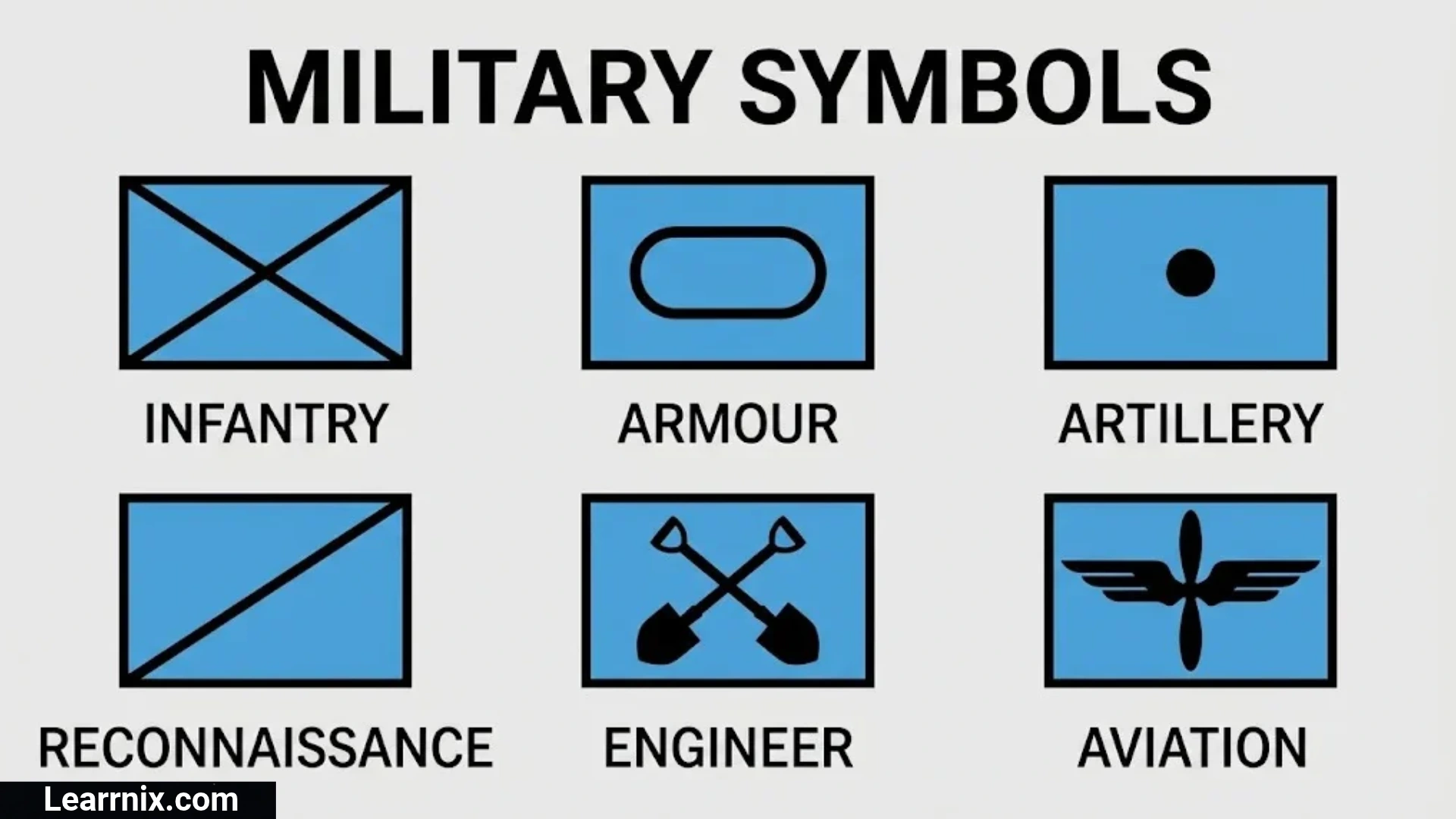
Military symbols are used to represent armies, military units, equipment, operations, ranks, and national identities. They help soldiers, historians, researchers, and military enthusiasts understand information quickly through recognizable signs, shapes, colors, and markings. Some symbols are used on tactical maps, while others appear on uniforms, flags, vehicles, badges, and military documents.
There are many different types of military symbols, and their meanings depend on the country, historical period, and military context. For example, NATO uses standardized tactical graphics, the US Army follows its own military symbology standards, and historical armies such as the Romans used distinctive eagles, banners, and other military emblems.
In this guide, you will discover military symbols and their meanings, military unit symbols, NATO and US military graphics, and symbols used by German, Ukrainian, and Roman armies. You will also learn how military symbols are organized, how to recognize common markings, and how to use military symbols in PowerPoint presentations.
Military Symbols And Their Meanings
Military symbols are visual signs that communicate information about armed forces, military organizations, equipment, and activities. They can represent a particular military branch, identify a unit, show its position on a map, or communicate its relationship with other forces.
The meaning of a military symbol depends on where and how it is used. A symbol displayed on a uniform may identify a soldier’s branch, while the same-looking graphic on a tactical map may represent a completely different military function.
Common Military Symbols And Their Meanings
Here are some recognizable military-related symbols and their general associations.
| Symbol | Name | Common Meaning |
| ★ | Star | Military rank, achievement, or distinction |
| ⚔ | Crossed swords | Combat, military service, or warfare |
| ⚓ | Anchor | Naval forces and maritime service |
| ✈ | Aircraft | Military aviation |
| 🎖 | Military medal | Honor and distinguished service |
| 🛡 | Shield | Defense and protection |
| 🦅 | Eagle | Strength, authority, and national identity |
| 🏅 | Medal | Recognition and achievement |
| ☠ | Skull and crossbones | Danger or historical military insignia |
| 🏴 | Flag | Identity, territory, or military affiliation |
These are general visual associations rather than a universal military code. For example, an eagle can represent different organizations depending on the country, while a star can indicate rank, achievement, or unit identity.
Military Map Symbol Colors
Colors are particularly important in modern tactical symbology.
| Color | Common Association |
| Blue | Friendly forces |
| Red | Hostile forces |
| Green | Neutral forces |
| Yellow | Unknown or pending identification |
These are common conventions in standardized military map displays. Their exact presentation can depend on the applicable standard and display system.
Military Symbols On Uniforms
Military uniforms contain badges, patches, shoulder insignia, qualification badges, and service emblems. These markings can identify a soldier’s branch, regiment, unit, qualifications, or achievements.
For example, crossed rifles are commonly associated with infantry, anchors with naval service, and wings with aviation. However, individual armed forces use their own designs and regulations.
Military Symbols And Graphics
Military symbols and graphics are visual tools used to communicate operational information. They are especially important when military personnel need to understand a complicated situation without reading lengthy descriptions.
Military graphics can represent physical objects, planned activities, boundaries, movement, and operational positions.
Main Types Of Military Graphics
| Graphic Category | Purpose |
| Unit symbols | Represent military formations and organizations |
| Equipment symbols | Identify tanks, aircraft, vehicles, and weapons |
| Installation symbols | Represent military facilities and locations |
| Control measures | Show boundaries, routes, and operational areas |
| Movement graphics | Indicate movement and direction |
| Operational graphics | Display planned or ongoing military activities |
Common Tactical Graphics
Some simple graphical signs are used to explain military concepts:
- → — Direction of movement.
- ⊕ — A symbol that may be used for a specific location or reference point depending on the legend.
- □ — A square, commonly associated with a friendly unit frame in certain standards.
- ◇ — A diamond, commonly associated with a hostile unit frame.
- ○ — A circle, which can represent equipment or other map features depending on the system.
- △ — A triangle, sometimes used for observation-related features in particular map conventions.
These simple shapes should not be treated as complete military symbols by themselves. Their meanings depend on the surrounding graphics, labels, and military standard.
Components Of A Military Graphic
A standardized military symbol may contain several components:
- Frame: The outer shape that communicates affiliation or object category.
- Icon: The central graphic that identifies the unit or equipment function.
- Color: Provides additional information, commonly about affiliation.
- Echelon marker: Indicates the size or organizational level of a military unit.
- Modifiers: Add details about capabilities, status, or other characteristics.
- Text information: Identifies the unit or provides additional details.
Modern military graphics are designed to work on digital displays as well as traditional printed or hand-drawn maps.
Military Symbols Army
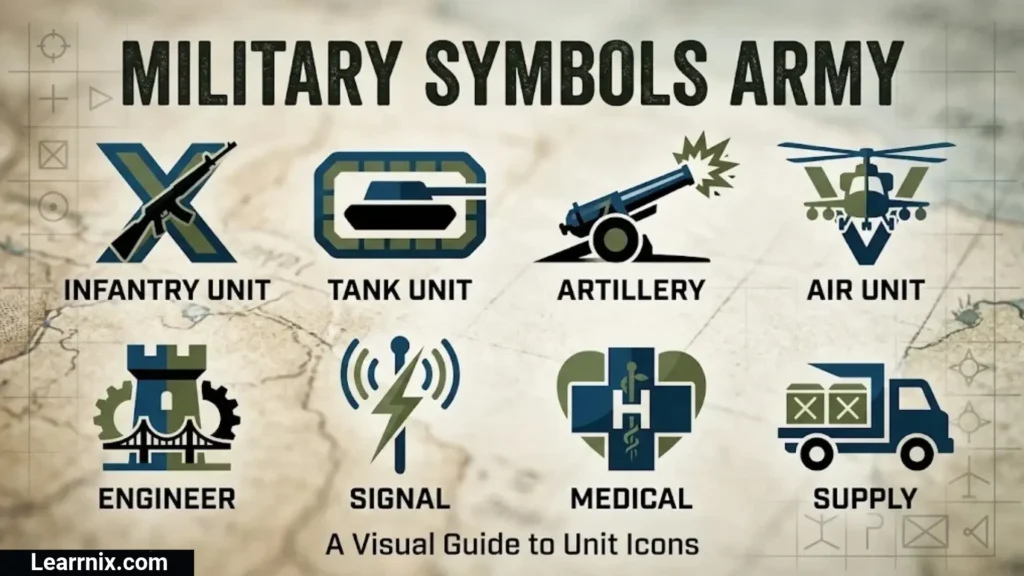
Army military symbols are used to identify land forces, military formations, weapons, vehicles, and operational activities. They help commanders and military personnel understand the organization and location of different units.
Army symbols appear on tactical maps, operational plans, situation reports, training materials, and military documents.
Common Army Symbol Categories
- Infantry symbols represent soldiers trained for ground combat.
- Armor symbols identify tank and armored vehicle formations.
- Artillery symbols represent units responsible for indirect fire support.
- Engineer symbols identify military engineering formations.
- Medical symbols indicate medical services and facilities.
- Signal symbols represent communication and information systems.
- Logistics symbols identify transportation, supply, and maintenance organizations.
- Aviation symbols represent army aviation units.
Army Unit Size Symbols
Military maps often use small graphic markers above a unit symbol to indicate its organizational size.
The following are common echelon markers in traditional military symbology:
| Military Level | Traditional Marker |
| Squad | • |
| Section | •• |
| Platoon | ••• |
| Company | I |
| Battalion | II |
| Regiment | III |
| Brigade | X |
| Division | XX |
| Corps | XXX |
| Army | XXXX |
These examples follow a commonly taught traditional notation. Modern digital standards also use more detailed symbol construction rules.
Why Army Symbols Matter
Army symbols make military information easier to organize and interpret. Instead of writing a complete unit description beside every map position, a standardized graphic can communicate its basic identity and organizational level.
They are also useful in military education, historical research, strategy discussions, and professional presentations.
Military Unit Symbols
Military unit symbols represent specific military organizations, from small groups of soldiers to large formations. They provide information about a unit’s function, organizational level, affiliation, and identification.
A military unit symbol is generally made by combining a basic function icon with a frame and additional information.
Types Of Military Unit Symbols
| Unit Type | General Representation |
| Infantry | Crossed-rifle or infantry-related icon |
| Armor | Tank or tracked-vehicle icon |
| Artillery | Artillery-related graphic |
| Engineer | Engineering-related icon |
| Reconnaissance | Reconnaissance-related graphic |
| Medical | Medical-service icon |
| Signal | Communication-related graphic |
| Aviation | Aircraft or aviation icon |
| Logistics | Supply and transportation graphic |
The exact icon depends on the standard being followed.
Military Unit Echelons
An echelon describes the organizational level of a military formation.
Common military echelons include:
- Squad
- Platoon
- Company
- Battalion
- Regiment
- Brigade
- Division
- Corps
- Army
- Army Group
Not every country uses exactly the same organizational structure. Some armed forces use regiments, while others organize many combat formations around brigades.
How To Read A Military Unit Symbol
A useful way to understand a modern tactical unit symbol is to examine it in stages.
First, identify the outer frame. It may indicate whether the represented force is friendly, hostile, neutral, or unknown.
Next, examine the main icon inside the frame. This identifies the military function, such as infantry, armor, or artillery.
Finally, look for markers above and around the symbol. These may identify the unit’s echelon, designation, status, or additional capabilities.
The US Army’s FM 1-02.2, published in January 2025, explains the construction and use of approved military symbols for land operations.
NATO Military Symbols
NATO military symbols are standardized graphical representations used by member countries and cooperating forces to communicate military information. Their purpose is to make tactical information easier to understand when different national armed forces work together.
The main NATO publication for this system is Allied Procedural Publication 6, commonly called APP-6.
What Is NATO APP-6?
APP-6 is a military symbology standard that provides rules for creating and displaying symbols used in joint military operations.
It covers several categories, including:
- Land military units
- Individual military personnel
- Military equipment
- Installations
- Maritime forces
- Air-related objects
- Space-related objects
- Control measures
- Operational activities
The standard uses a building-block approach. Different graphical elements are combined to communicate specific information.
NATO Military Symbol Frames
The outer frame is one of the most recognizable parts of NATO military symbology.
| Affiliation | Common Frame Shape | Common Display Color |
| Friendly | Rectangle | Blue |
| Hostile | Diamond | Red |
| Neutral | Square | Green |
| Unknown | Four-lobed shape | Yellow |
These shapes help users distinguish different affiliations even when the display uses limited colors.
NATO Military Unit Size Markers
NATO-style unit symbols also use echelon indicators to communicate organizational size.
Common examples include:
| Echelon | Traditional Marker |
| Platoon | ••• |
| Company | I |
| Battalion | II |
| Regiment | III |
| Brigade | X |
| Division | XX |
| Corps | XXX |
| Army | XXXX |
The complete symbol can contain additional information about the unit’s function and identity.
Why NATO Uses Standardized Symbols
Different countries have different languages, military traditions, and organizational structures. Standardized symbology provides a common visual language that reduces confusion during multinational operations.
It is also useful in military education, joint planning, simulation software, and operational map preparation.
US Military Symbols
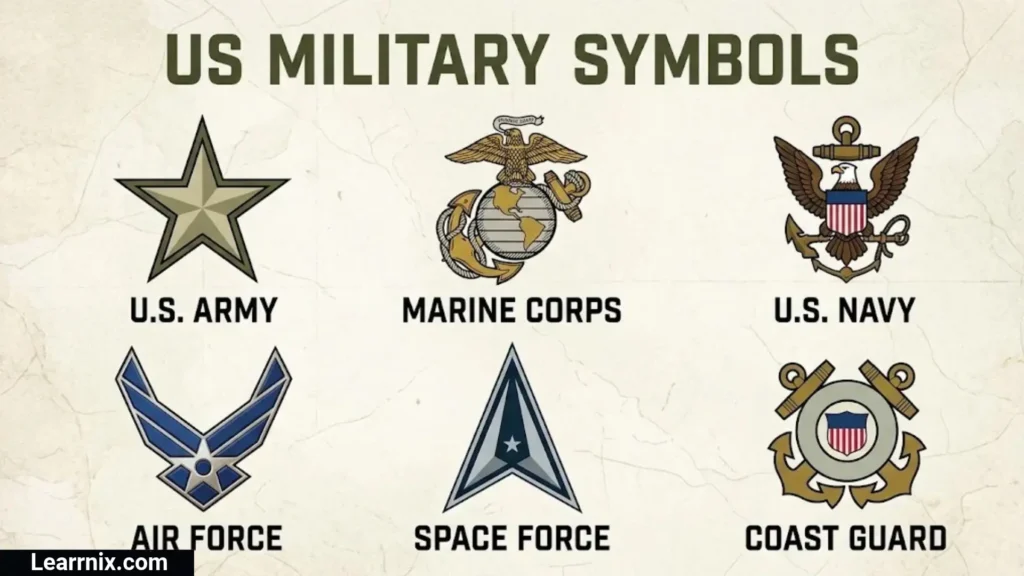
US military symbols are used by the United States Armed Forces to identify military units, equipment, installations, and operational activities.
The United States uses the MIL-STD-2525 standard for joint military symbology. The Department of Defense maintains this standard to establish consistent rules for displaying military information.
What Is MIL-STD-2525?
MIL-STD-2525 is the US joint military symbology standard. It provides rules for representing military objects and activities in digital systems, maps, and operational displays.
It includes symbols for:
- Army formations
- Navy units
- Air Force units
- Marine Corps organizations
- Space-related military elements
- Military equipment
- Installations
- Tactical control measures
The standard is closely aligned with NATO APP-6, although the publications have their own revision histories and implementation details.
US Military Branch Symbols
The United States has six major military services, each with its own identity and official insignia.
| Military Branch | Common Symbol Or Emblem |
| US Army | Army star |
| US Navy | Navy anchor and eagle |
| US Air Force | Air Force wings and star |
| US Marine Corps | Eagle, Globe, and Anchor |
| US Space Force | Delta symbol |
| US Coast Guard | Coast Guard shield and emblem |
These are branch identity emblems, not tactical map symbols. They identify the services rather than communicating the position or affiliation of a particular unit.
US Military Tactical Symbols
US tactical symbols communicate information such as:
- Unit type and function
- Military affiliation
- Unit size
- Unit designation
- Equipment identity
- Operational status
- Supporting or attached formations
The US Army’s FM 1-02.2 is an important reference for understanding land military symbols and their construction.
German Military Symbols
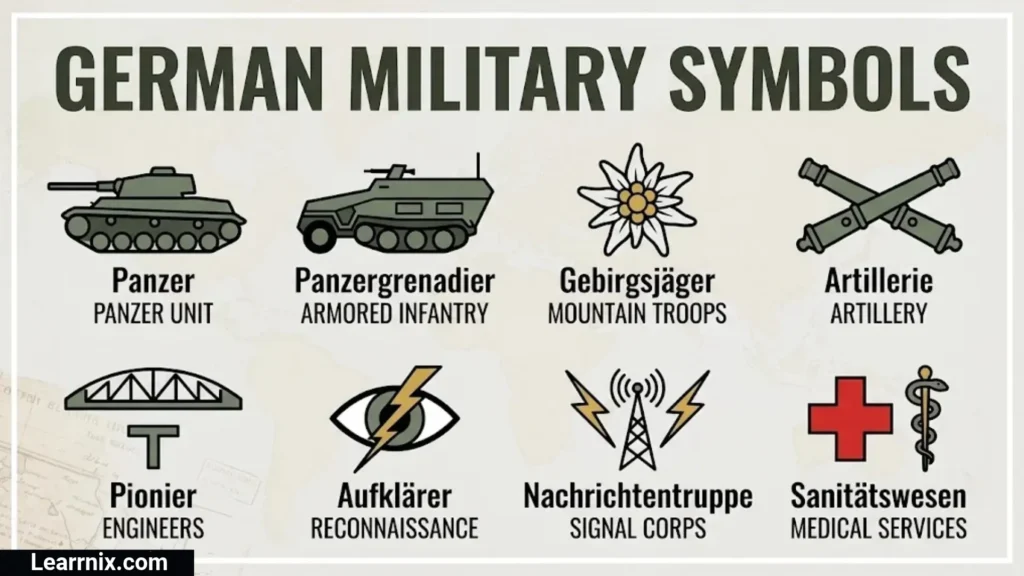
German military symbols have a long history, ranging from traditional national and regimental emblems to modern NATO-compatible tactical graphics.
The modern German armed forces, known as the Bundeswehr, use standardized military symbology to represent units, equipment, vehicles, and operational activities.
Bundeswehr Military Symbols
The Bundeswehr uses a structured system in which different graphical components are combined to create a complete military symbol.
These components include:
- Outer frames
- Main functional icons
- Unit-size indicators
- Text identifiers
- Additional graphic modifiers
- Colors representing affiliation
For example, an infantry unit and an armored unit can share the same basic frame while using different central icons to communicate their functions.
German Military Insignia
Some recognizable German military-related emblems include:
| Symbol | Name | Association |
| ✠ | Iron Cross | German military history and tradition |
| ★ | Star | Military rank or decoration |
| 🦅 | Eagle | German state and military identity |
| ⚔ | Crossed swords | Military service and combat traditions |
| ⚓ | Anchor | Naval service |
The Iron Cross has a long history in German military decorations and later became associated with the Bundeswehr’s visual identity.
Historical German Military Symbols
German military symbols from earlier historical periods should be distinguished from the insignia of the modern Bundeswehr.
During World War II, German forces used tactical markings to identify formations, vehicles, weapons, and support organizations. These systems included basic signs and supplementary markings, with many combinations used to convey organizational information.
Historical German military symbols may appear in military archives, old maps, museum collections, and historical documents. Their meanings should always be checked against the period and the relevant military reference.
American Military Symbols
American military symbols include official service emblems, historical military insignia, unit patches, rank decorations, and standardized tactical graphics.
Although American and US military symbols are often used interchangeably, this topic can cover a wider range of visual designs associated with American armed forces and military history.
Popular American Military Symbols
| Symbol | Common Association |
| ★ | Military rank and achievement |
| 🦅 | American national identity and strength |
| ⚓ | US Navy |
| ✈ | Military aviation |
| ⚔ | Combat and military service |
| 🛡 | Defense and protection |
| 🎖 | Military honors |
| ⚜ | Traditional military and organizational insignia |
These are general illustrations and associations, not official representations of every American military organization.
American Military Branch Emblems
Some of the most recognizable American military emblems include:
US Army: Its official star-based emblem represents the Army and its service traditions.
US Navy: Its traditional identity incorporates naval imagery, including the eagle and anchor.
US Air Force: Its official symbol features a stylized star and wings.
US Marine Corps: The Eagle, Globe, and Anchor is one of its best-known emblems.
US Space Force: Its delta-based emblem represents space operations and the service’s identity.
US Coast Guard: Its shield and distinctive service emblem identify the maritime security organization.
American Military Symbols In History
American military insignia have developed over different periods. Early military units used flags, colors, and identifying badges, while modern armed forces use regulated insignia, patches, and digital tactical symbols.
These designs are commonly studied in military history, genealogy, uniform identification, and historical collections.
Roman Military Symbols
Roman military symbols were important visual elements of the Roman army. They identified legions and smaller military formations, helped soldiers recognize their units, and represented loyalty, honor, and military authority.
Roman soldiers carried standards and banners into battle. Losing a standard was considered a serious disgrace because it represented the identity and reputation of the military formation.
Popular Roman Military Symbols And Meanings
| Symbol | Name | Meaning |
| 🦅 | Aquila | Eagle standard of a Roman legion |
| ⚑ | Vexillum | Military banner or standard |
| 🐉 | Draco | Dragon-shaped military standard |
| ✦ | Signum Decorations | Decorative elements on unit standards |
| SPQR | Senatus Populusque Romanus | The Senate and People of Rome |
| ☀ | Sun imagery | Religious and imperial associations in some contexts |
Aquila: The Roman Eagle
The Aquila was the famous eagle standard associated with a Roman legion. It represented the legion’s identity and was carried by a specially appointed standard-bearer known as an aquilifer.
The eagle became one of the strongest visual representations of Roman military power and loyalty.
Vexillum: The Roman Military Banner
A vexillum was a cloth banner attached to a horizontal crossbar on a pole. It was used by detachments and other military formations.
The banner could display identifying information, including a unit’s name or emblem.
Signum: The Unit Standard
The signum was a standard associated with a Roman military unit, particularly a century. It could contain decorative discs and other identifying elements.
Its purpose was practical as well as symbolic because soldiers could use it as a recognizable gathering point.
Draco: The Dragon Standard
The draco was a dragon-shaped military standard associated with Roman cavalry and later military formations.
It is especially interesting because it shows how Roman military identity used animal imagery to create distinctive visual signs.
SPQR
SPQR stands for Senatus Populusque Romanus, meaning the Senate and People of Rome.
It represented the Roman state and its political authority. The letters appeared in public inscriptions, official contexts, and Roman military-related imagery.
Roman standards and their historical meanings are documented in classical reference works and studies of Roman military organization.
Military Symbols PowerPoint
Military symbols PowerPoint presentations are useful for explaining military organizations, tactical graphics, historical insignia, and military equipment.
Teachers, students, researchers, and military enthusiasts can use these symbols to make presentations easier to understand.
Best Military Symbols For PowerPoint
Here are some commonly useful symbols for military-themed slides:
| Symbol | Suggested Presentation Topic |
| ★ | Military rank |
| ⚔ | Army and combat |
| ⚓ | Naval forces |
| ✈ | Air Force |
| 🛡 | Defense |
| 🦅 | Military history |
| 🎖 | Awards and decorations |
| 🏴 | Military flags |
| 🐉 | Historical military standards |
| SPQR | Roman military history |
How To Add Military Symbols In PowerPoint
Follow these simple steps:
- Open Microsoft PowerPoint.
- Select the slide where you want to insert a symbol.
- Choose the Insert menu.
- Select Symbol if the option is available in your version.
- Choose a suitable font and locate the required character.
- Select the symbol and insert it into your slide.
- Adjust its size, position, and color.
You can also copy a Unicode character from a symbol collection and paste it into a text box.
Tips For Professional Military Presentations
- Use consistent symbol sizes throughout the presentation.
- Choose readable colors and backgrounds.
- Add a legend when using tactical map graphics.
- Avoid mixing NATO and historical symbols without explaining the difference.
- Use official vector graphics when an accurate military emblem is required.
- Check that the selected font supports the characters you insert.
For formal military briefings, use the appropriate standardized tactical graphics rather than decorative emoji or approximate symbols.
Ukrainian Military Symbols
Ukrainian military symbols represent the country’s armed forces, national identity, military history, and resistance. They include official service emblems, national symbols, unit patches, and markings used in military contexts.
It is important to distinguish official Ukrainian military insignia from battlefield markings used by different forces during the Russia-Ukraine war.
Ukrainian National And Military Symbols
| Symbol | Name | Common Meaning |
| 🇺🇦 | Ukrainian Flag | National identity and independence |
| 🔱 | Tryzub | Ukrainian national emblem |
| ★ | Star | Military rank or achievement |
| ⚔ | Crossed Swords | Military service and combat |
| 🛡 | Shield | Defense and protection |
| 🦅 | Eagle | Strength and military identity in relevant insignia |
The Tryzub, also called the Ukrainian trident, is one of the country’s most recognizable national symbols. It appears in the official state emblem and is closely connected with Ukrainian historical identity.
Ukrainian Armed Forces Insignia
Ukrainian military insignia include official emblems, shoulder patches, rank markings, and unit-specific designs.
Different branches and formations can have their own distinctive visual identities. These markings help distinguish military organizations and communicate service affiliation.
Understanding Z, V, And Other Battlefield Markings
During Russia’s full-scale invasion of Ukraine in 2022, letters such as Z and V appeared on Russian military vehicles and equipment.
| Marking | Context |
| Z | Used on Russian military vehicles during the invasion |
| V | Also used as a Russian military vehicle marking |
| O | Reported in some early battlefield identification systems |
| X | Reported in some Russian force identification markings |
The precise meaning of these markings has varied, and no single explanation applies to every vehicle or situation.
Important distinction: Z and V are not official Ukrainian military symbols. They became widely recognized as markings associated with Russian forces during the invasion of Ukraine.
Ukrainian military identity should instead be understood through official national emblems, Armed Forces insignia, and unit-specific markings.
Frequently Asked Questions About Military Symbols
What are the most common military symbols?
Some common military symbols include stars, crossed swords, anchors, eagles, shields, aircraft graphics, and military medals. Their meanings depend on the country and the context in which they appear.
What do military symbols on maps mean?
Military map symbols represent units, equipment, installations, and operational activities. Their frames, colors, icons, and additional markings communicate information about military affiliation, function, and organizational size.
What is the difference between NATO and US military symbols?
NATO uses the APP-6 military symbology standard, while the United States uses MIL-STD-2525. Both systems share many conventions and are designed to support consistent military communication, but they have separate standards and revisions.
What does the eagle symbolize in military history?
The eagle commonly represents strength, authority, courage, and national identity. In ancient Rome, the Aquila was the distinctive eagle standard associated with a legion.
Can I use military symbols in PowerPoint presentations?
Yes. You can use supported Unicode characters, military emblems, and properly sourced tactical graphics in PowerPoint. For professional presentations, make sure each symbol is accurate and include a legend when its meaning may not be obvious.
Conclusion
Military symbols provide a visual way to understand armed forces, military organizations, equipment, and historical traditions. From simple stars and shields to detailed tactical graphics, these signs communicate information that would otherwise require lengthy explanations.
Different countries and military organizations have developed their own systems. NATO APP-6 and US MIL-STD-2525 provide standardized tactical symbology, while German, American, Ukrainian, and Roman military traditions have distinctive emblems and historical markings.
Understanding the difference between tactical symbols, national emblems, military insignia, and historical standards makes it easier to recognize their actual meanings. Always consider the country, historical period, and context before identifying a military symbol.

I am Charlotte Anderson, an education writer who is passionate about creating meaningful learning resources for students and lifelong learners.
I enjoy researching new educational approaches and sharing ideas that make studying easier and more effective.
Through my work, I aim to inspire curiosity, confidence, and a love for learning.
Books:
- The Complete Guide to Better Learning
- Building Skills for Academic Success
 Daniel Harper
 Michael Carter