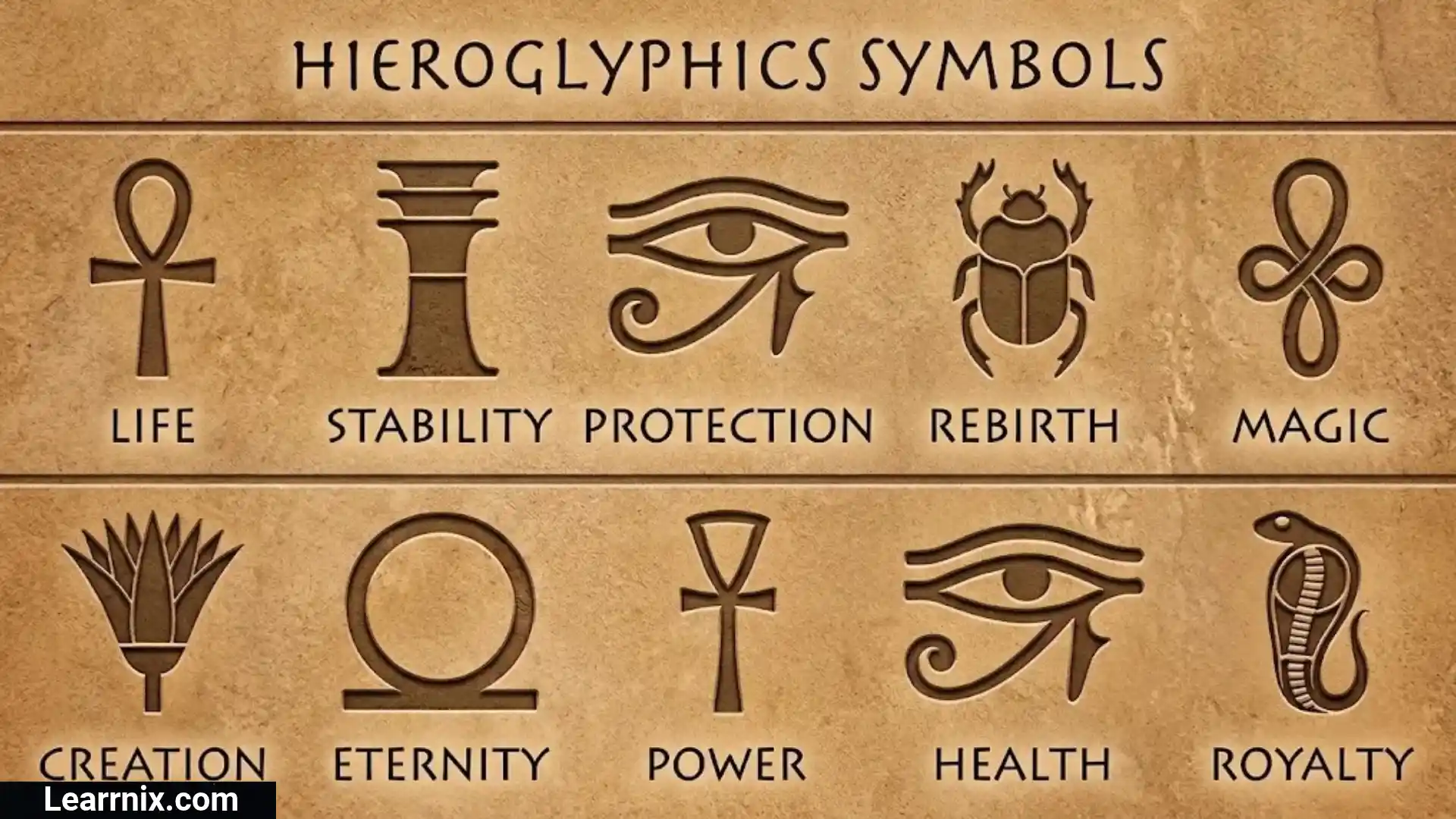
Hieroglyphics symbols are among the most recognizable forms of ancient writing. These fascinating characters were used to communicate ideas, record historical events, honor gods, and preserve important messages. Many people search for hieroglyphics symbols to understand their meanings, explore ancient Egyptian culture, or copy decorative characters for names, bios, and creative projects.
Ancient Egyptian hieroglyphs include pictures of people, animals, plants, objects, and other familiar things. However, these symbols were more than simple drawings. Some represented sounds, others expressed complete words or ideas, and certain signs helped explain the meaning of nearby characters. This combination made hieroglyphic writing a complex communication system.
In this guide, you will discover hieroglyphics symbols and their meanings, copy-and-paste Egyptian characters, the ancient Egyptian alphabet, and how hieroglyphic writing worked. You will also explore Maya, Aztec, Native American, Greek, and fictional alien symbols, along with their differences, translations, and historical importance.
Hieroglyphics Symbols and Meanings
Egyptian hieroglyphics were a writing system used in ancient Egypt for religious inscriptions, royal monuments, tombs, and official records. The symbols represented different sounds, objects, actions, and ideas.
Here are some recognizable Egyptian hieroglyphics symbols and their commonly associated meanings:
| Symbol | Name or Description | Meaning or Association |
| 𓂀 | Eye of Horus | Protection, healing, and restoration |
| 𓋹 | Ankh | Life and eternal existence |
| 𓆣 | Scarab beetle | Rebirth and transformation |
| 𓇳 | Sun disk | Sun and solar power |
| 𓊖 | Settlement sign | Town or inhabited place |
| 𓈖 | Water ripple | Water and the sound n |
| 𓃭 | Lion | Strength and power |
| 𓅃 | Falcon | Associated with divine power and Horus |
| 𓉐 | House sign | House or building |
| 𓏏 | Bread loaf | Bread and the sound t |
The meanings of Egyptian signs depend on how they are used. For example, a bird character might represent a particular sound, a word, or an idea within a larger inscription.
Three important categories help explain Egyptian hieroglyphics:
- Phonograms: Signs representing one or more sounds.
- Logograms: Signs representing complete words or objects.
- Determinatives: Signs that help identify the meaning of a word without necessarily being pronounced.
This is why one hieroglyph cannot always be translated using a single English word.
Hieroglyphics Symbols Copy Paste
If you want Egyptian hieroglyphics symbols for social media, messages, usernames, or creative designs, you can copy the Unicode characters below.
Popular Egyptian Symbols
𓂀 𓋹 𓆣 𓇳 𓊖
Egyptian Animal Symbols
𓃠 𓃭 𓅃 𓅆 𓆓 𓆗
Egyptian Nature and Object Symbols
𓈖 𓇋 𓊹 𓉐 𓏏 𓎛
Decorative Egyptian Symbol Combinations
𓂀 𓋹 𓂀
𓇳 𓆣 𓇳
𓋹 𓊹 𓋹
𓅃 𓇳 𓅃
To copy a symbol, select the character, press Ctrl + C on Windows or Command + C on Mac, and paste it wherever you want using Ctrl + V or Command + V.
Where Can You Use These Symbols?
- Instagram and TikTok bios.
- WhatsApp and other messaging applications.
- Decorative usernames and profile names.
- Digital artwork and creative designs.
- Educational notes about ancient Egypt.
- Personal collections of historical symbols.
Remember that these are actual Unicode characters, not pictures. Their appearance may differ depending on the device, operating system, font, and application.
Egyptian Symbols Text
Egyptian symbols text refers to hieroglyphic characters displayed digitally instead of being drawn or written by hand. Unicode makes it possible to represent many ancient Egyptian signs as individual text characters.
Here are some examples of Egyptian symbols that you can use in digital text:
| Egyptian Text | Description |
| 𓂀 | Eye symbol |
| 𓋹 | Ankh or life symbol |
| 𓆣 | Scarab beetle |
| 𓇳 | Sun disk |
| 𓈖 | Water ripple |
| 𓃭 | Lion |
| 𓅃 | Falcon |
| 𓉐 | House |
| 𓏏 | Bread loaf |
Egyptian symbols text is useful for creating decorative messages and exploring ancient writing. However, placing several attractive characters together does not automatically create a meaningful ancient Egyptian sentence.
For accurate writing, you need to understand the sounds, word signs, and grammatical context of the original language.
Egyptian Hieroglyphs Alphabet A to Z
One common question is whether ancient Egyptian hieroglyphs had an alphabet from A to Z like modern English.
The answer is slightly complicated. Ancient Egyptian writing included signs that represented individual consonant sounds, making it possible to represent many words using sound-based characters. However, the complete writing system was not simply a 26-letter English alphabet.
Egyptologists commonly identify 24 traditional single-consonant signs, although the exact transliteration system includes additional distinctions.
Here is a simplified sound reference:
| English Reference | Egyptian Transliteration |
| A | ꜣ or ỉ, depending on the intended sound |
| B | b |
| C | No single equivalent |
| D | d |
| E | No direct equivalent |
| F | f |
| G | g |
| H | h or ḥ |
| I | ỉ or y, depending on context |
| J | No direct equivalent |
| K | k |
| L | No regular native equivalent in classical Egyptian |
| M | m |
| N | n |
| O | No direct equivalent |
| P | p |
| Q | q |
| R | r |
| S | s |
| T | t |
| U | w |
| V | No direct equivalent |
| W | w |
| X | No single equivalent |
| Y | y |
| Z | No single equivalent |
This table is only an approximate English reference, not an official ancient Egyptian alphabet.
Egyptian words were generally written using consonants. Egyptologists insert vowels when needed to make words easier to pronounce in modern academic discussion.
The Gardiner sign list is another important reference. It organizes hieroglyphs into categories such as humans, animals, plants, buildings, and objects.
Hieroglyphics Keyboard
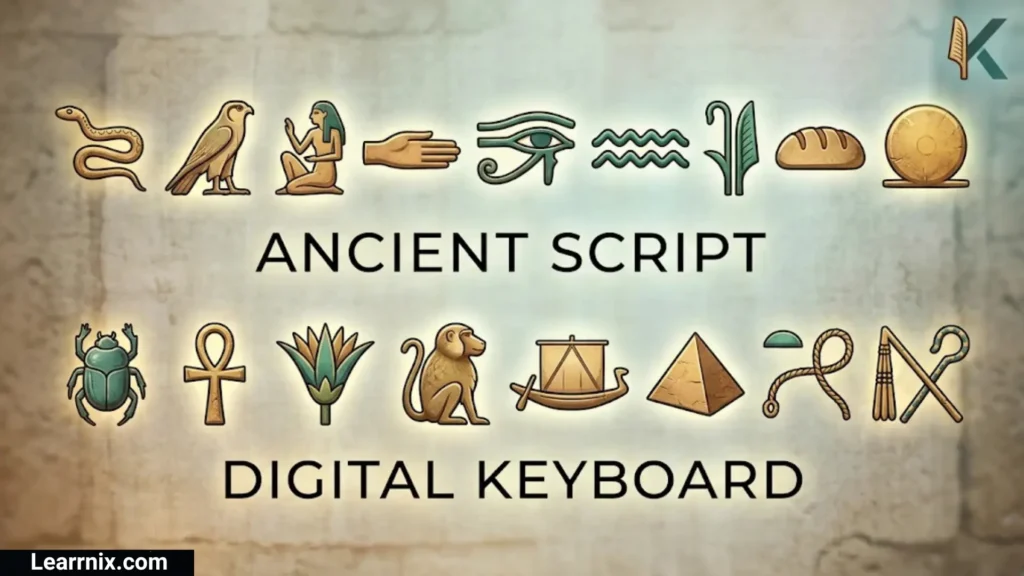
A hieroglyphics keyboard allows users to enter ancient Egyptian characters on a digital device. However, most standard keyboards do not include dedicated keys for every hieroglyph.
There are several ways to type these symbols.
1. Copy and Paste
The easiest option is to copy characters from a collection of Egyptian Unicode symbols and paste them into your document or message.
2. Use Unicode Character Input
Every encoded Egyptian hieroglyph has its own Unicode code point. For example:
- 𓂀 — U+13080
- 𓋹 — U+13133
- 𓈖 — U+13316
- 𓏏 — U+133CF
These codes identify the characters, although the method for entering them depends on your operating system and software.
3. Use a Specialized Hieroglyphic Font or Editor
Some specialist applications provide Egyptian hieroglyphic keyboards, sign selectors, and tools for arranging characters into traditional writing groups.
Important Keyboard Tip: If a character appears as an empty square or question mark, your device or application may not support the required character or font. Try another application or a font with Egyptian hieroglyph support.
Hieroglyphics Words
Ancient Egyptian words were created by combining different types of hieroglyphic signs. Some characters represented sounds, while others represented complete words or helped clarify their meanings.
Here are a few useful Egyptian words and their conventional transliterations:
| Egyptian Word | Meaning |
| Ankh | Life |
| Per | House |
| Ren | Name |
| Ra | Sun or the solar deity |
| Neter | God or divine being |
| Kemet | The Black Land, a name for Egypt |
| Ka | A spiritual life force |
| Ba | An aspect of the individual or personality |
These words are often encountered in discussions about ancient Egyptian religion and culture.
For example, the word ankh is associated with life and is represented by the familiar ☥-shaped symbol, commonly called the ankh.
The word per means house and can be represented by a house-plan hieroglyph.
A complete ancient Egyptian word may include phonetic signs, a word sign, and a determinative. The determinative provides additional information about the word’s category.
Egyptian Symbols Text Translator
An Egyptian symbols text translator is a tool designed to convert modern text into hieroglyphic-style writing or help users understand existing Egyptian signs.
However, there is an important difference between converting English letters into decorative symbols and translating actual ancient Egyptian language.
A simple English-to-hieroglyph converter usually substitutes English letters with approximate sound signs. This can create a decorative representation of a name, but it does not necessarily produce correct ancient Egyptian grammar or vocabulary.
How to Use a Text Translator
- Enter the name or word you want to convert.
- Select the desired transliteration method.
- Review the suggested hieroglyphic characters.
- Check whether the characters represent sounds or actual Egyptian words.
- Copy the result into your preferred application.
For example, someone converting a modern name might use phonetic approximations rather than translating its original meaning.
For serious historical or educational work, consult Egyptian transliteration references and sign dictionaries. A genuine translation requires knowledge of the original language, grammar, and context.
Ancient Egypt Hieroglyphics Symbols
Ancient Egyptian hieroglyphics developed over thousands of years and became one of the most recognizable writing systems in human history.
They appeared on temple walls, royal tombs, statues, monuments, coffins, papyrus documents, and other objects.
Some signs represented everyday objects, while others were connected with Egyptian mythology, religion, and royal authority.
Important Ancient Egyptian Symbols
- Ankh (𓋹): Associated with life, vitality, and eternal existence.
- Eye of Horus (𓂀): Connected with protection, healing, and restoration.
- Scarab (𓆣): Associated with the sun’s movement, renewal, and rebirth.
- Djed Pillar (𓊽): Symbolized stability and was associated with Osiris.
- Was Scepter (𓌀): Associated with authority and power.
- Shen Ring (𓍶): Represented protection and eternity.
- Lotus: Associated with creation, renewal, and the sun.
- Feather of Ma’at: Represented truth, justice, and cosmic balance.
An important feature of Egyptian writing was its reading direction. Hieroglyphic inscriptions could be written from right to left, left to right, or vertically.
You can often identify the reading direction by looking at the faces of human and animal characters. They generally face toward the beginning of the line.
Native American Hieroglyphics Symbols
Native American hieroglyphics is a broad search term rather than the name of one universal writing system.
Indigenous communities across North America developed different visual communication traditions. These included pictographs, petroglyphs, painted records, and symbolic designs.
Some examples of commonly discussed visual symbols include:
| Symbol or Motif | Common Cultural Associations |
| Turtle | Earth, creation, and longevity in some traditions |
| Eagle | Vision, strength, and spiritual significance |
| Bear | Strength, protection, and healing in some traditions |
| Sun | Life, warmth, and renewal |
| Spiral | Movement, cycles, or journeys in some contexts |
| Thunderbird | Powerful spiritual being in several Indigenous traditions |
The meanings of these designs vary between nations and communities. A symbol used by one Indigenous culture may have a completely different interpretation elsewhere.
It is also important to distinguish between petroglyphs, which are images carved or pecked into rock, and pictographs, which are painted or drawn.
Unlike ancient Egyptian hieroglyphics, these traditions cannot be combined into one alphabet or universal translation system.
Alien Hieroglyphics Symbols
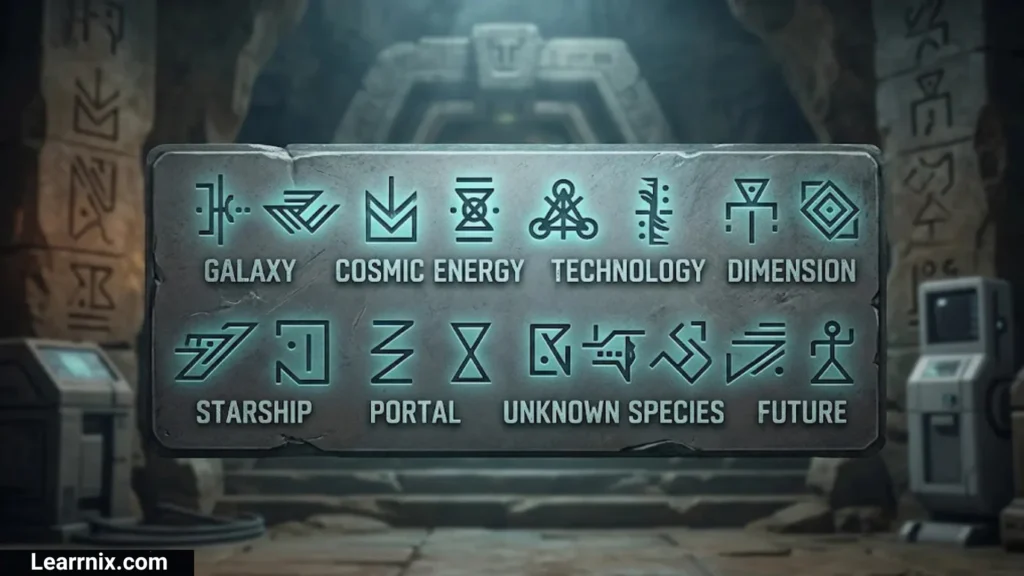
Alien hieroglyphics symbols are fictional characters designed to represent imaginary extraterrestrial languages, civilizations, or communication systems.
They are popular in science fiction, fantasy games, movies, artwork, and creative projects.
Unlike historical Egyptian writing, there is no scientifically established universal alien alphabet. Their meanings depend on the fictional world or the creator’s design.
Common design ideas include:
- Geometric circles representing planets or energy.
- Triangular patterns representing technology or structures.
- Spiral shapes suggesting movement or transformation.
- Repeated lines representing fictional sounds.
- Star-like characters representing space or celestial objects.
You can use these decorative ideas to create fictional messages, game usernames, artwork, and science-fiction stories.
However, fictional alien glyphs should not be presented as authentic historical writing or scientifically verified extraterrestrial language.
Aztec Hieroglyphics Symbols
Aztec writing used pictorial signs, conventional symbols, and other visual elements to communicate information. These were especially important in painted manuscripts known as codices.
Aztec visual communication included images representing people, places, objects, dates, events, and historical relationships.
Some recognizable Aztec symbols and motifs include:
| Symbol or Motif | Association |
| Sun | Time, cosmic order, and solar power |
| Eagle | Military strength and important cultural associations |
| Jaguar | Power, warriors, and elite status |
| Feathered Serpent | Quetzalcoatl and religious traditions |
| Calendar signs | Days, dates, and cycles |
| Skull | Death and religious symbolism |
Aztec writing was different from Egyptian hieroglyphics. It relied heavily on pictorial conventions and contextual interpretation rather than using the same combination of phonograms, logograms, and determinatives found in Egyptian writing.
Many Aztec codices recorded historical events, tribute payments, religious information, and genealogies.
These visual records provide valuable information about the society, beliefs, and political organization of the Aztec world.
Hieroglyphics Symbols Translation
Translating hieroglyphics requires more than matching a picture with an English word. The reader must understand the function of each sign and how the characters work together.
Ancient Egyptian writing used three major sign functions:
Phonetic Signs: These represent sounds, usually consonants. Some signs represent one sound, while others represent combinations of two or three consonants.
Word Signs: These characters represent complete words or concepts. For example, a house sign can represent the word for house.
Determinatives: These signs appear at the end of words and help explain their meaning. They are generally not pronounced.
For example, a word relating to movement might include phonetic signs followed by a determinative showing walking legs.
Another important feature is that hieroglyphic characters could be arranged in compact groups called quadrats. Their placement was carefully organized for readability and visual balance.
A reliable translation should consider the entire inscription, the historical period, and the language being used. Translating one isolated character without context can lead to incorrect results.
Mayan Hieroglyphics Symbols
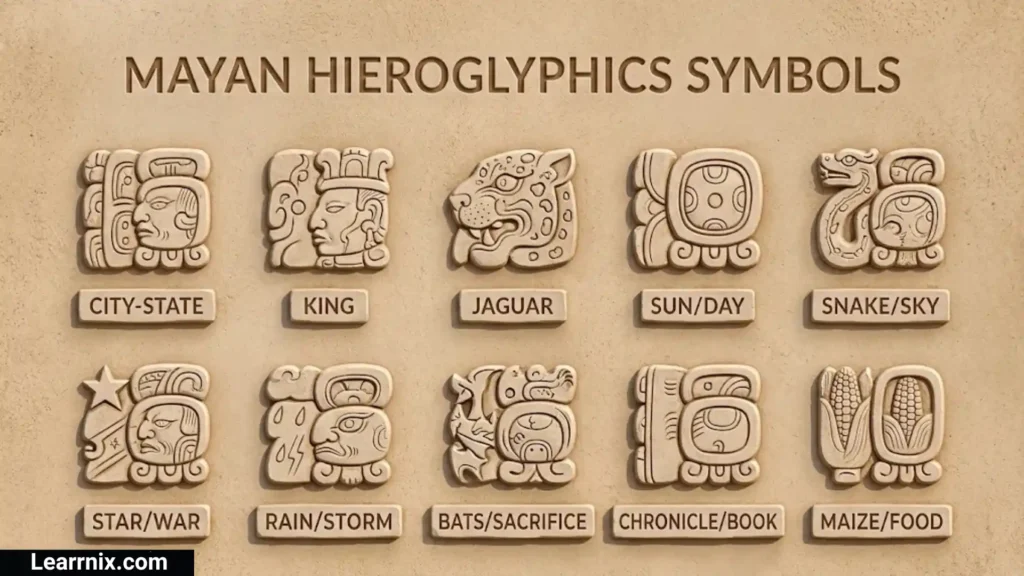
Mayan hieroglyphics belonged to the ancient Maya civilization of Mesoamerica. They were used to record royal histories, religious events, dates, astronomical information, and important ceremonies.
The Maya writing system was a sophisticated logosyllabic system. This means that it combined logograms representing complete words with syllabic signs representing sounds.
Maya inscriptions appeared on stone monuments, pottery, buildings, and painted manuscripts.
Common Mayan Glyph Subjects
- Rulers and royal names.
- Animals and mythological beings.
- Calendar dates and numbers.
- Gods and supernatural figures.
- Ceremonies and religious events.
- Places and historical locations.
Maya hieroglyphic writing often used groups of signs arranged in blocks. These blocks were commonly read in paired columns, moving from left to right and then downward.
Unlike English, which uses 26 letters to form words, Maya writing used a much larger collection of signs with different functions.
Modern researchers have deciphered a substantial portion of Maya inscriptions, although some signs and passages remain uncertain.
Greek Hieroglyphics Symbols
The expression Greek hieroglyphics symbols is sometimes used by people searching for ancient Greek decorative characters or mysterious writing systems.
However, ancient Greek civilization did not use an Egyptian-style hieroglyphic writing system as its standard alphabetic script.
Greek writing developed through an alphabetic system adapted from the Phoenician alphabet. It eventually became the basis of the modern Greek alphabet.
Here are some recognizable Greek letters:
| Symbol | Name | Sound or Use |
| Α α | Alpha | A |
| Β β | Beta | B |
| Γ γ | Gamma | G |
| Δ δ | Delta | D |
| Ε ε | Epsilon | E |
| Θ θ | Theta | Th |
| Λ λ | Lambda | L |
| Π π | Pi | P |
| Σ σ | Sigma | S |
| Ω ω | Omega | Long O in ancient Greek |
Ancient Greece also had earlier writing systems, including Linear A and Linear B. Linear B was used to record an early form of Greek, while Linear A remains undeciphered.
These systems are historically different from Egyptian hieroglyphics, even though they are sometimes grouped together in searches about ancient symbols.
Mayan Hieroglyphics Symbols and Meanings
Mayan hieroglyphics symbols have different meanings depending on whether they represent words, syllables, dates, or religious concepts.
The Maya used these signs to preserve important information about rulers, ceremonies, mythology, and their understanding of time.
Here are some important categories:
| Glyph Category | Meaning or Purpose |
| Sun-related glyphs | Solar cycles and celestial events |
| Jaguar imagery | Power, authority, and supernatural associations |
| Maize imagery | Agriculture, food, and creation traditions |
| Serpent imagery | Divine beings and religious symbolism |
| Calendar signs | Dates and timekeeping |
| Ruler glyphs | Royal names and titles |
| Number signs | Mathematical and calendrical information |
Maya number symbols are particularly interesting. Their numerical system used dots, bars, and a shell-shaped zero sign.
For example:
- A dot represents 1.
- A bar represents 5.
- A shell-shaped sign represents 0.
This system was important for recording dates and performing calculations.
Maya glyphs were also used to record the names and achievements of kings. Many surviving inscriptions describe royal accessions, victories, family relationships, and religious ceremonies.
One important distinction is that Maya symbols are not simply decorative pictures. They form part of a complex writing system that represents language through both words and sounds.
FAQ
Are hieroglyphics symbols letters or pictures?
Egyptian hieroglyphics include both picture-based signs and sound-based characters. Some represent individual consonants, others represent complete words, and some clarify the meaning of nearby words.
Can I write my name in Egyptian hieroglyphics?
Yes. You can represent your name using approximate Egyptian phonetic signs. However, this is usually a modern phonetic conversion rather than a direct translation into ancient Egyptian.
How many symbols are in the Egyptian hieroglyphics alphabet?
There is no fixed 26-letter Egyptian alphabet. The traditional system includes approximately 24 commonly recognized single-consonant signs, alongside hundreds of additional signs with different functions.
Can I copy and paste Egyptian hieroglyphics on my phone?
Yes. You can copy Unicode Egyptian hieroglyphs and paste them into supported applications. If a symbol appears as a box, your device or application may lack suitable font support.
What is the difference between Egyptian and Mayan hieroglyphics?
Egyptian and Mayan writing systems developed independently. Both used word-based and sound-based signs, but they had different languages, character structures, reading conventions, and cultural purposes.
Conclusion
Hieroglyphics symbols provide a fascinating look into how ancient civilizations recorded their languages, beliefs, histories, and traditions. Egyptian hieroglyphics are especially interesting because their characters could represent sounds, complete words, and additional information about meaning.
From the ankh and Eye of Horus to Maya calendar signs and Aztec pictorial designs, different cultures developed unique ways to communicate through symbols. Understanding their differences helps prevent confusion between historical writing systems and decorative characters.
You can copy Egyptian Unicode symbols for creative projects, explore their meanings, and learn about ancient writing. For accurate translations, remember that individual signs must be understood within their original language and historical context.

I am Michael Carter, an educational content creator who believes that knowledge has the power to transform lives.
I create resources focused on modern education, digital learning, and building essential skills for the future.
I love helping readers discover simple and effective ways to improve their learning journey.
Books by Michael Carter:
- Modern Education for Tomorrow’s World
- Learning Skills for Future Success
 Charlotte Anderson
 Daniel Harper