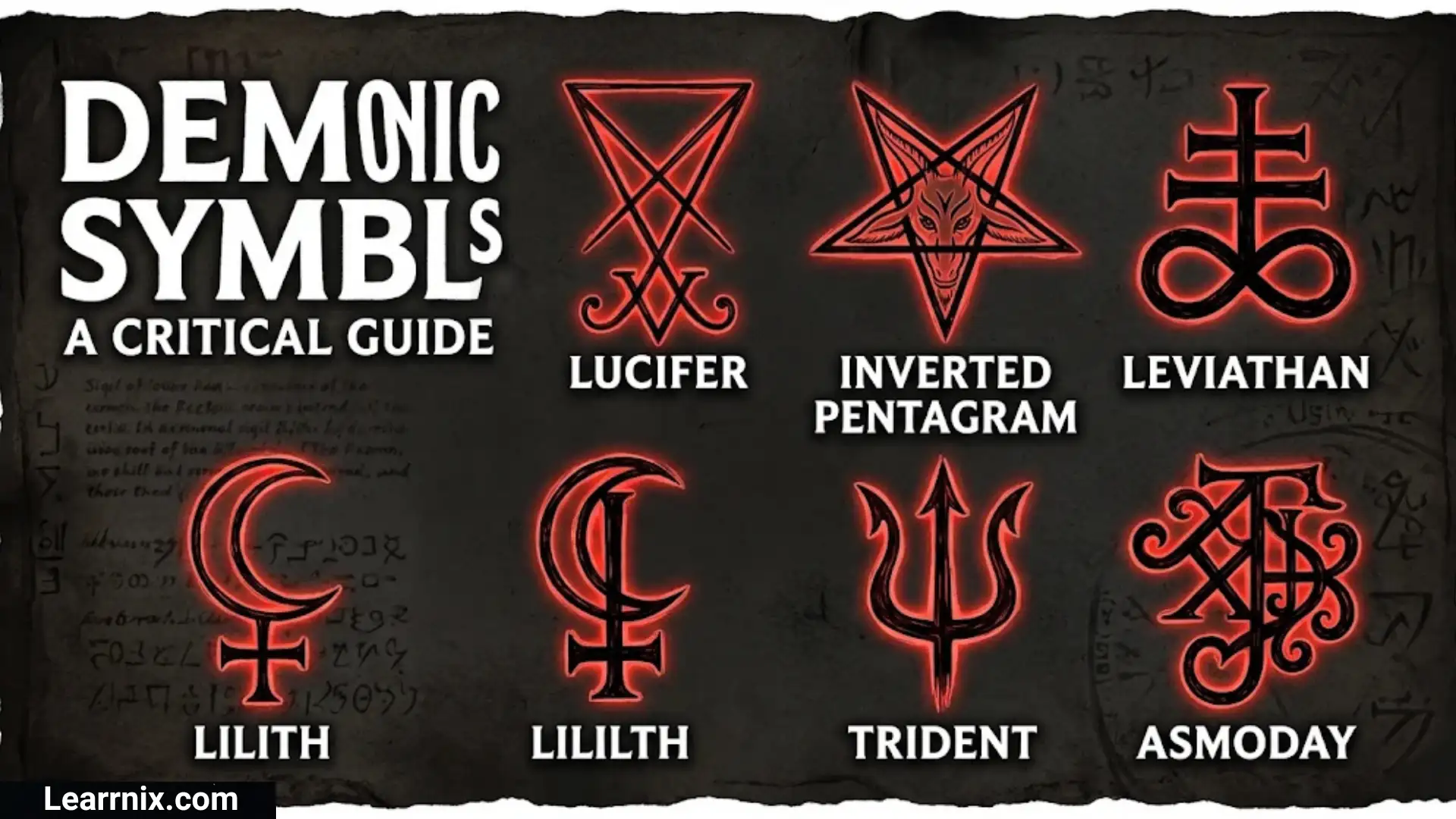
Demonic symbols have attracted attention for centuries because of their connections with ancient mythology, demonology, supernatural beliefs, folklore, and mysterious traditions. These symbols include unusual markings, geometric shapes, sigils, stars, crosses, and images associated with demons or other supernatural beings. Their meanings can change depending on their historical background, religious tradition, and modern interpretation.
People search for demonic symbols for different reasons. Some want to understand their meanings and origins, while others are interested in dark-themed tattoos, gothic artwork, gaming usernames, social media bios, and decorative text. Popular examples include the inverted pentagram, Baphomet imagery, Lucifer’s sigil, Leviathan Cross, and the number 666.
This article explores demonic symbols, their names, meanings, ancient origins, and different uses. You will also find collections of dark-themed Unicode characters, information about demonology, and explanations of symbols discussed in popular culture, including Ice Spice, Beyoncé, Minions and Monsters, and Dungeons & Dragons.
What Are Demonic Symbols?
Demonic symbols are signs, drawings, markings, and visual designs associated with demons, evil spirits, supernatural entities, occult traditions, or fictional representations of darkness.
The word demonic generally describes something connected with demons. Different cultures and religious traditions have their own beliefs about these beings. Some describe demons as evil spirits, while others present them as supernatural creatures, tempters, or powerful mythological figures.
Demonic symbols appear in several different contexts:
- Religion: Symbols and descriptions connected with spiritual conflict, temptation, and evil.
- Demonology: Names, markings, and sigils associated with specific supernatural entities.
- Occult Traditions: Geometric designs and magical markings found in historical manuscripts.
- Mythology: Images connected with underworld creatures, spirits, and supernatural beings.
- Entertainment: Fictional symbols used in horror movies, video games, music, and fantasy stories.
- Gothic Artwork: Dark decorative designs featuring skulls, horns, crosses, and mysterious shapes.
One important distinction is that not every dark-looking symbol is demonic. Some symbols have protective, religious, or spiritual meanings in their original traditions. Their appearance and interpretation may also change over time.
Demonic Symbols and Meanings
Demonic symbols have different meanings depending on their historical and cultural backgrounds. Some are connected with religious literature, others with occult traditions, and many are modern artistic interpretations.
Here are some recognizable symbols associated with dark, supernatural, and occult themes.
| Symbol | Name | Common Meaning or Association |
| ⛧ | Inverted Pentagram | Modern satanic and occult imagery |
| ⛤ | Pentagram | Protection, spirituality, and magical traditions |
| ☠ | Skull and Crossbones | Death, danger, and mortality |
| 666 | Number of the Beast | Biblical apocalyptic symbolism |
| ♱ | Cross Variant | Religious and decorative symbolism |
| † | Dagger Cross | Christian and decorative contexts |
| ☽ | Crescent Moon | Lunar and mystical symbolism |
| ☾ | Moon Symbol | Night and lunar imagery |
| ★ | Five-Pointed Star | Spiritual and decorative symbolism |
| ♄ | Saturn Symbol | Astrology and planetary associations |
| ⚝ | Star Symbol | Decorative and mystical artwork |
| ✟ | Cross Variant | Christian and decorative symbolism |
Important Demonic Symbol Meanings
Inverted Pentagram (⛧): This symbol is widely associated with modern satanic imagery. Its downward-pointing shape is commonly used in occult-inspired artwork.
Pentagram (⛤): A five-pointed star that has appeared in different spiritual and magical traditions. It is not automatically demonic.
Number 666: Known as the Number of the Beast in the Book of Revelation. It is associated with apocalyptic imagery and has become a recognizable symbol in horror and popular culture.
Skull (☠): Represents death, danger, mortality, and sometimes rebellion. It is frequently used in gothic and dark artwork.
Crescent Moon (☽): Represents lunar imagery and has different meanings across cultures and spiritual traditions.
Understanding these differences helps prevent confusion between historical symbols and modern interpretations.
Demonic Symbols Names
Many symbols and figures associated with demonology have specific names. Some refer to supernatural entities, while others describe geometric designs or markings found in occult literature.
Here are some well-known names:
| Name | Description |
| Baphomet | A symbolic horned figure associated with modern occult imagery |
| Lucifer | A figure associated with the fallen angel tradition in Christianity |
| Leviathan | A biblical sea creature later connected with demonological traditions |
| Beelzebub | A supernatural figure associated with evil in religious literature |
| Asmodeus | A demonological figure appearing in religious and literary traditions |
| Belial | A figure associated with wickedness and evil |
| Lilith | A figure from Jewish folklore and later supernatural mythology |
| Abaddon | A name associated with destruction and the abyss |
| Astaroth | A figure described in historical demonological writings |
| Pazuzu | An ancient Mesopotamian supernatural figure |
Famous Sigil Names
A sigil is a specially designed marking or symbol. Some historical occult traditions associate individual sigils with particular spirits.
- Sigil of Lucifer: A geometric design associated with Lucifer in certain modern occult traditions.
- Sigil of Asmodeus: A marking associated with Asmodeus in some occult references.
- Goetic Sigils: Individual designs associated with spirits described in the Ars Goetia.
- Leviathan Cross: A double-cross design associated with modern satanic imagery.
These designs should not be confused with ordinary Unicode characters. Many sigils are detailed illustrations that require an image rather than a single text character.
Ancient Demonic Symbols
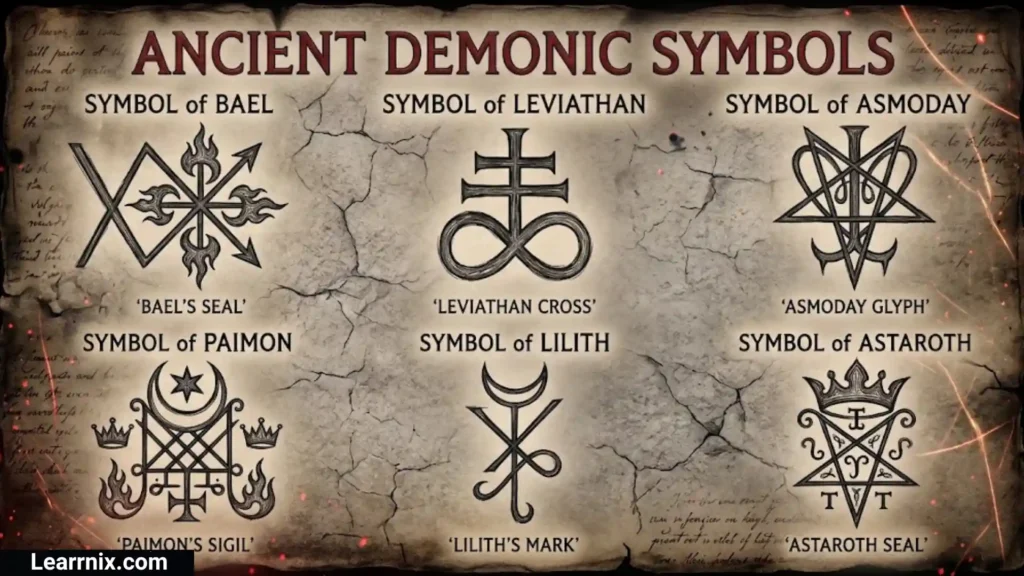
Ancient demonic imagery comes from different civilizations, including Mesopotamia, Egypt, Greece, and medieval Europe.
However, the original meanings of these figures were not always the same as their modern interpretations. Some beings considered dangerous were also associated with protection or other supernatural roles.
Mesopotamian Demonic Symbols
Ancient Mesopotamian cultures described several supernatural beings in their mythology and religious beliefs.
One well-known figure was Pazuzu, a frightening wind demon associated with harmful winds. Interestingly, representations of Pazuzu were also used for protection against other dangerous supernatural forces.
Lamashtu was another supernatural figure associated with threats to pregnant women and infants in Mesopotamian beliefs.
These examples show that ancient supernatural figures could have complicated roles rather than representing simple ideas of good and evil.
Ancient Egyptian Demonic Symbols
Ancient Egyptian mythology included supernatural creatures associated with death, judgment, and the afterlife.
One famous example is Ammit, a creature with features of a crocodile, lion, and hippopotamus. According to Egyptian mythology, Ammit consumed the hearts of people who failed the judgment of the dead.
Other supernatural figures appeared in Egyptian religious texts and illustrations. Their meanings were connected with the Egyptian understanding of death and the afterlife.
Ancient Greek Supernatural Symbols
Greek mythology included many beings connected with the underworld and supernatural worlds.
Some notable figures include:
- Hades: God associated with the underworld.
- Hecate: Goddess associated with magic, crossroads, and the night.
- Erinyes: Supernatural beings associated with punishment and vengeance.
- Cerberus: The three-headed dog guarding the entrance to the underworld.
These figures are not all demons. Their association with the underworld has sometimes influenced later dark and demonic artwork.
Medieval Demonological Symbols
During medieval and Renaissance periods, European manuscripts included detailed illustrations, spirit descriptions, and magical diagrams.
The Lesser Key of Solomon became particularly well known for its descriptions of spirits and their individual seals.
These historical manuscripts influenced many modern occult illustrations and fantasy-inspired symbol designs.
Demonic Symbols Tattoos
Demonic symbol tattoos are popular among people who enjoy gothic aesthetics, dark artwork, mythology, horror themes, and supernatural-inspired designs.
Some people choose these tattoos because of their appearance, while others associate them with rebellion, mystery, transformation, personal strength, or fantasy mythology.
Popular Demonic Tattoo Designs
| Tattoo Design | Common Association |
| Inverted Pentagram | Modern occult imagery |
| Baphomet Head | Horned supernatural figure |
| Leviathan Cross | Modern satanic symbolism |
| Lucifer Sigil | Occult-inspired geometric design |
| 666 | Biblical Number of the Beast |
| Horned Skull | Death and gothic artwork |
| Demon Eyes | Supernatural and horror imagery |
| Fallen Angel Wings | Rebellion and mythology |
| Dark Serpent | Mystery and danger |
| Gothic Cross | Religious and dark decorative styles |
Small Demonic Tattoo Ideas
Small designs are suitable for people who prefer minimal artwork.
Some ideas include:
- A tiny inverted pentagram.
- A small horned skull.
- A simple geometric sigil.
- A miniature dark star.
- A small crescent moon.
- A minimalist supernatural eye.
Large Demonic Tattoo Ideas
Large tattoos provide more room for detailed illustrations. Popular options include Baphomet portraits, fallen angel figures, demonic creatures, skull compositions, and detailed fantasy-inspired artwork.
Best Tattoo Placement Ideas
| Body Part | Suitable Design |
| Wrist | Small sigil |
| Hand | Minimal symbol |
| Forearm | Geometric artwork |
| Neck | Small dark design |
| Chest | Large supernatural illustration |
| Back | Detailed demon artwork |
| Finger | Tiny decorative marking |
Before selecting a design, research its original meaning. A symbol may have religious or cultural associations that differ from its modern tattoo interpretation.
Demonic Symbols Copy and Paste
If you want dark-themed symbols for your social media profiles, messages, gaming usernames, or decorative text, this collection provides several Unicode characters.
These are real text characters, not all official demonic symbols. Their dark or supernatural appearance comes from their common use in decorative designs.
Dark and Occult-Inspired Symbols
⛧
Symbol
⛤
Symbol
☠
Symbol
♱
Symbol
✞
Symbol
✟
Symbol
†
Symbol
‡
Symbol
★
Symbol
☆
Symbol
☽
Symbol
☾
Symbol
⚝
Symbol
✦
Symbol
✧
Symbol
♄
Symbol
These characters can be selected and copied individually.
Demonic Text Combinations
⛧ Dark Style ⛧
☠ DEMON ☠
♱ FALLEN ANGEL ♱
★ LUCIFER ★
⛤ DARK SOUL ⛤
☽ SHADOW ☾
𖤐 NIGHTMARE 𖤐
Demonic Username Ideas
Here are some dark-themed username ideas for gaming profiles and social media:
- ⛧DarkSoul⛧
- 666Shadow
- DemonKing
- DarkAngel𖤐
- ☠NightWalker
- LuciferX
- FallenSoul
- ShadowLord
- BlackSerpent
- GothicSpirit
- NightDemon
- DevilEyes
Unicode Compatibility
Most common characters can be displayed in modern browsers and applications, but their appearance may vary depending on the operating system, font, and platform.
Some unusual characters may appear as empty squares if a device does not support them. Decorative combinations may also be restricted by certain gaming platforms or username systems.
Ice Spice Demonic Symbols
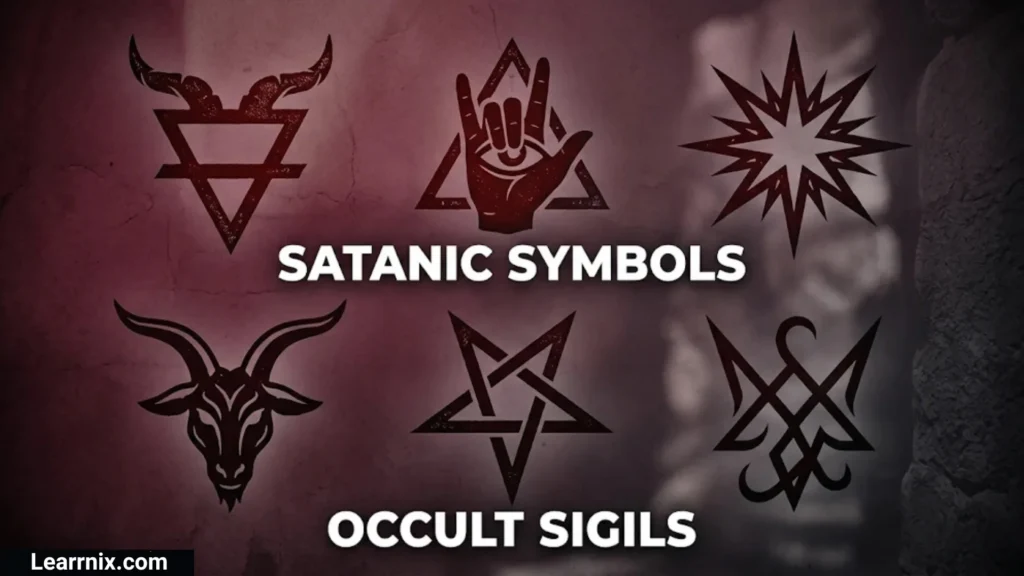
Ice Spice became the subject of online discussions about alleged demonic symbolism after appearing at Super Bowl LVIII in February 2024.
Some social media users shared images of her hand gestures and jewelry, claiming they represented satanic or occult symbols. These interpretations spread through posts, short videos, and online discussions.
One frequently discussed gesture was the sign of the horns:
- 🤘 Sign of the Horns: Commonly associated with rock and heavy metal music.
- Inverted Cross: Often associated with satanic imagery in popular culture, although it also has a historical Christian meaning.
- Hand Gestures: Their meanings depend on cultural and social context.
An important detail is that the necklace discussed in connection with Ice Spice’s Super Bowl appearance was identified as a regular cross rather than an inverted cross.
It is also important to distinguish online speculation from verified information. A hand gesture, necklace, or fashion accessory cannot establish someone’s religious beliefs or involvement in occult practices.
Demonic Symbols Hand
Hand gestures are sometimes associated with demonic imagery because they appear in horror movies, metal music, gothic artwork, and supernatural-themed entertainment.
However, a gesture can have different meanings depending on the person, culture, and situation.
Common Hand Gestures and Their Meanings
| Gesture | Common Name | Meaning |
| 🤘 | Sign of the Horns | Rock and metal culture |
| ✌️ | Peace Sign | Peace or victory |
| 👌 | OK Sign | Approval or agreement |
| 🖕 | Middle Finger | Insult or disrespect |
| 🫰 | Finger Heart | Affection or appreciation |
Is the Devil Horns Hand Sign Demonic?
The sign of the horns is one of the most recognizable gestures associated with heavy metal music.
It is often used by musicians and fans during concerts. Some people interpret it as a devil-related gesture because of its resemblance to horns.
However, the gesture has other cultural uses and is not automatically a sign of demon worship.
Why Do People Associate Hand Gestures With Demons?
There are several reasons:
- Horror movies use dramatic gestures to represent supernatural characters.
- Music performances sometimes include dark visual themes.
- Photographs can remove gestures from their original context.
- Social media posts can spread misleading interpretations.
- Similar hand positions may have different meanings in different cultures.
The meaning of a gesture should always be considered in context.
Minions and Monsters Demonic Symbols
Minions and monsters are popular elements in animated entertainment, fantasy stories, video games, and supernatural artwork.
The phrase “Minions and Monsters” may refer to fictional characters or a specific entertainment context. It does not identify one universal historical collection of demonic symbols.
However, monster-themed artwork often uses visual elements associated with demons and supernatural creatures.
Common Monster and Demon Symbols
- Horns: Often represent powerful or frightening supernatural creatures.
- Red Eyes: Commonly used to create a mysterious or threatening appearance.
- Skulls: Associated with death, danger, and mortality.
- Dark Runes: Decorative markings used to suggest ancient magic.
- Claws: Represent aggression and monstrous features.
- Black Wings: Often used in fictional representations of demons and fallen angels.
- Flames: Frequently associated with destruction and supernatural powers.
Demonic Imagery in Animated Entertainment
Animated films and games often use exaggerated designs to make monsters look memorable. Sharp teeth, unusual eyes, horns, and strange markings help distinguish supernatural characters from ordinary ones.
These features are artistic choices rather than proof that a character represents an authentic historical demon.
If you are researching a particular Minions and Monsters character or symbol, its exact meaning depends on the specific game, film, or artwork.
Demonic Symbols and Their Meanings
Different supernatural figures and symbols appear throughout religious literature, folklore, and demonological traditions.
Understanding their individual backgrounds makes it easier to distinguish between ancient mythology and modern interpretations.
Famous Demonic Figures and Their Associations
| Figure | Traditional Meaning or Association |
| Lucifer | Fallen angel in Christian interpretations |
| Beelzebub | Figure associated with evil and demonic traditions |
| Asmodeus | Demonological figure associated with desire and temptation |
| Leviathan | Biblical sea monster later associated with demonology |
| Belial | Associated with wickedness and lawlessness |
| Abaddon | Associated with destruction and the abyss |
| Astaroth | Figure described in historical demonological writings |
| Lilith | Figure from Jewish folklore and later mythology |
| Pazuzu | Mesopotamian wind demon |
| Baphomet | Horned symbolic figure associated with modern occult imagery |
Difference Between Demons and Demonic Symbols
A demon is a supernatural figure or entity in a particular religious or mythological tradition. A demonic symbol is a visual representation, marking, or design associated with that figure or its broader mythology.
For example, Lucifer is a figure, while the Sigil of Lucifer is a specific geometric design associated with him in certain occult traditions.
Similarly, Baphomet is a symbolic figure rather than a standard Unicode character.
This distinction is useful when researching demon names, symbol meanings, and historical illustrations.
Demonology Demonic Symbols
Demonology is the study or classification of demons and supernatural entities in religious, historical, and occult traditions.
Historical demonological texts describe different spirits, their characteristics, names, and sometimes individual symbols or seals.
One well-known source is the Ars Goetia, a section of the Lesser Key of Solomon. It describes 72 spirits and includes individual seals associated with them.
Popular Figures in Demonology
Bael: One of the spirits described in Ars Goetia.
Paimon: A spirit described in historical demonological literature and later popularized in modern horror entertainment.
Asmodeus: A supernatural figure appearing in different religious and literary traditions.
Astaroth: A figure included in historical demonological classifications.
Buer: A spirit described in Ars Goetia.
Marchosias: A spirit traditionally described with animal-like characteristics.
Valefor: Another spirit included in the Ars Goetia.
Orcus: A name associated with the underworld and later demonological and fantasy traditions.
What Are Goetic Sigils?
Goetic sigils are individual geometric markings associated with spirits described in the Ars Goetia.
They usually consist of connected lines, curves, circles, and other shapes. Each design is traditionally associated with a particular spirit.
Unlike ordinary Unicode symbols, Goetic sigils are generally too detailed to represent accurately with one standard keyboard character.
Historical Versus Modern Demonology
Historical demonology developed through religious writings, folklore, and magical manuscripts. Modern entertainment often changes these descriptions to create fictional characters and dramatic stories.
Therefore, a symbol used in a video game or horror movie should not automatically be treated as a historical demonological marking.
Beyonce Demonic Symbols
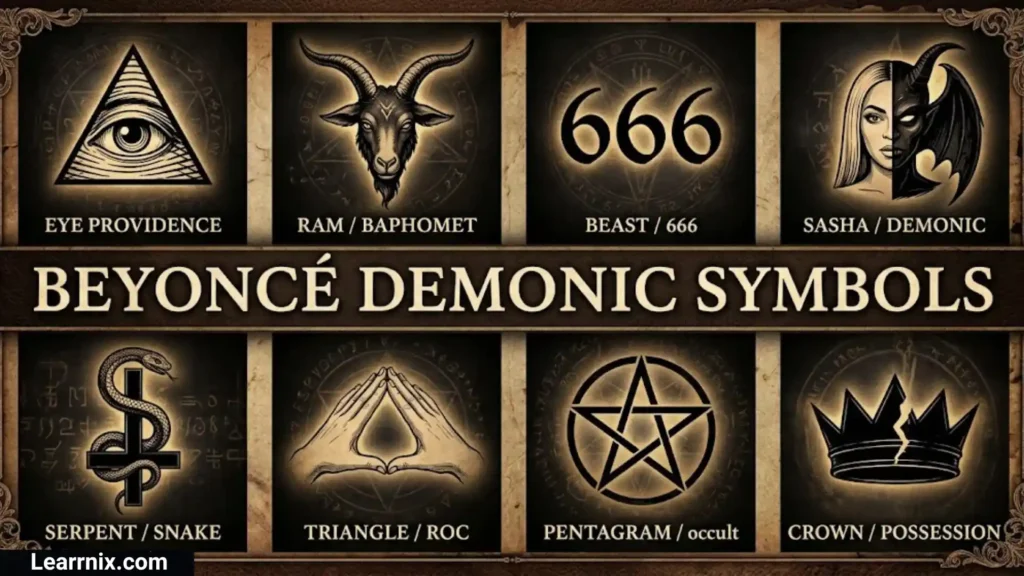
Beyoncé has been the subject of online discussions about alleged Illuminati symbols, occult imagery, and demonic signs.
These discussions usually focus on her stage performances, music videos, clothing, hand gestures, and dramatic visual designs.
Some common claims involve:
- Triangle Gestures: Sometimes connected with Illuminati conspiracy theories.
- Eye Imagery: Frequently interpreted online as a secret-society reference.
- Dark Costumes: Used in artistic performances to create dramatic visual effects.
- Occult-Inspired Designs: Sometimes included in music videos and stage productions.
- Hand Gestures: Often interpreted differently by viewers.
Are Beyoncé’s Symbols Really Demonic?
There is no reliable evidence that these visual elements prove Beyoncé follows demonology or participates in satanic practices.
Triangles, eyes, stars, and dramatic costumes are widely used in fashion, photography, performance art, and entertainment.
Online conspiracy theories sometimes assign supernatural meanings to ordinary artistic elements without supporting evidence.
The best approach is to understand these designs in their artistic context rather than treating speculation as established fact.
Demonic Symbols D&D
Dungeons & Dragons, commonly called D&D, is a fantasy role-playing game featuring demons, devils, magical creatures, supernatural powers, and fictional worlds.
Demonic symbols in D&D belong mainly to its fantasy universe. They are designed to represent fictional creatures, factions, magical forces, and supernatural locations.
Popular Demon-Related Characters in D&D
| Character | Description |
| Demogorgon | A powerful demon prince associated with monstrous imagery |
| Orcus | A demon lord connected with undeath and necromancy |
| Graz’zt | A demon prince associated with temptation and power |
| Baphomet | A horned demon prince associated with beasts and labyrinths |
| Yeenoghu | A demon lord associated with gnolls |
| Lolth | A powerful deity associated with drow and demon-related lore |
Common D&D Demonic Symbol Designs
Fantasy artwork often uses different visual elements to represent demons.
- Horned Skulls: Represent powerful demonic creatures.
- Dark Runes: Suggest ancient magical forces.
- Red Eyes: Create a supernatural appearance.
- Black Wings: Represent demonic or monstrous characters.
- Flaming Symbols: Often suggest destructive magical energy.
- Twisted Circles: Used in fictional magical portals and summoning designs.
How D&D Demonic Symbols Are Used
D&D players and Dungeon Masters may use fictional symbols in several ways:
- Character Design: Creating a demon-inspired character or villain.
- Campaign Artwork: Decorating maps, books, and fantasy locations.
- Worldbuilding: Giving fictional organizations or supernatural groups their own markings.
- Gaming Accessories: Creating custom designs for character sheets and tabletop decorations.
- Storytelling: Representing magical powers, ancient curses, or supernatural enemies.
The exact appearance and meaning of these designs can differ between editions, campaign settings, and individual fantasy artwork.
Frequently Asked Questions
What is the most recognizable demonic symbol?
The inverted pentagram is among the most recognizable symbols associated with modern satanic and occult imagery. Its interpretation depends on its historical and cultural context.
What does 666 mean in demonic symbolism?
The number 666 is known as the Number of the Beast in the Book of Revelation. It is commonly associated with evil, apocalyptic imagery, and popular horror themes.
Are all pentagrams demonic?
No. Pentagrams have appeared in several religious, spiritual, and magical traditions. They have also been used as protective symbols, so their meanings are not always demonic.
Can I use demonic symbols in my username?
Yes. You can use supported Unicode characters and decorative text combinations in gaming usernames, social media bios, and messages. However, some platforms restrict unusual characters.
What is the difference between a demon sigil and a regular symbol?
A regular symbol can represent an idea, object, or concept, while a demon sigil is a specific marking traditionally associated with a supernatural entity in certain demonological or occult traditions.
Conclusion
Demonic symbols have different origins and interpretations across ancient mythology, religious literature, demonology, folklore, and modern entertainment. Some recognizable examples include the inverted pentagram, Lucifer’s sigil, the Leviathan Cross, skull imagery, and the Number of the Beast. However, their meanings should always be understood through their original backgrounds.
If you are interested in dark-themed artwork, tattoos, usernames, or decorative text, learning the names and meanings of these symbols can help you choose appropriate designs. Unicode characters also provide a convenient way to add mysterious and gothic elements to digital content.
Remember that not every unusual sign, hand gesture, or artistic design represents something demonic. Historical context, cultural traditions, and reliable information are much more useful than assumptions based on appearance alone.

I am Michael Carter, an educational content creator who believes that knowledge has the power to transform lives.
I create resources focused on modern education, digital learning, and building essential skills for the future.
I love helping readers discover simple and effective ways to improve their learning journey.
Books by Michael Carter:
- Modern Education for Tomorrow’s World
- Learning Skills for Future Success
 Daniel Harper