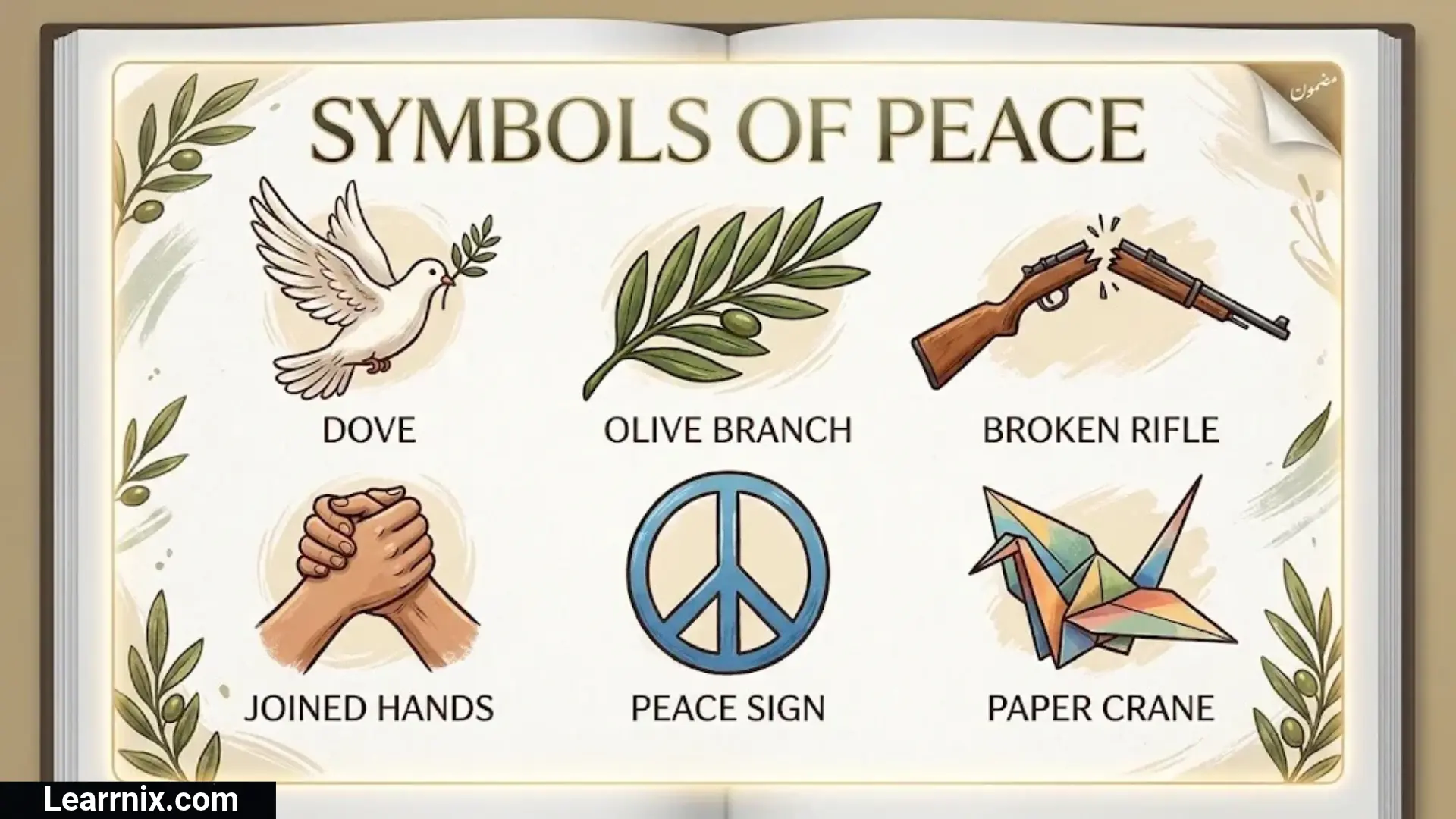
Peace is one of the most meaningful ideas shared by people around the world. It represents freedom from conflict, kindness, love, safety, respect, and harmony between individuals and communities. Different cultures have developed unique signs and symbols to express these values, from the familiar white dove and olive branch to ancient religious emblems and traditional Japanese characters.
Symbols of peace can communicate powerful messages without using words. Some represent peaceful relationships and unity, while others are connected to spiritual beliefs, strength, hope, and forgiveness. The white dove, ☮ peace sign, lotus flower, and Japanese origami crane are just a few examples that have become meaningful across different cultures.
In this guide, you will discover popular symbols of peace, their names, meanings, and historical backgrounds. You will also find ancient, biblical, Christian, Buddhist, Japanese, and Indian peace symbols, along with useful text characters you can copy and use in messages, social media posts, artwork, and personal designs.
Symbols of Peace Meaning
Symbols of peace are images, objects, signs, or characters that represent peaceful living and the absence of violence or conflict. They can communicate ideas such as friendship, compassion, forgiveness, cooperation, and understanding.
Although some peace symbols are recognized internationally, others have special meanings within particular religions, countries, and traditions.
Here are some common meanings associated with peace symbols:
| Meaning | What It Represents |
| Peace | Freedom from war, violence, and conflict |
| Love | Care, affection, and kindness toward others |
| Harmony | Living together without unnecessary conflict |
| Unity | People joining together for a common purpose |
| Hope | Belief in a better and more peaceful future |
| Forgiveness | Letting go of anger and resentment |
| Strength | Having the courage to choose peace over violence |
| Freedom | Living without oppression and fear |
| Compassion | Understanding and helping others |
For example, a white dove often communicates peace and hope, while an olive branch represents reconciliation and the desire to end disagreements.
The meaning of a symbol can also change depending on its cultural or historical background. A symbol that represents spiritual harmony in one tradition may have a different meaning in another.
What Are Symbols of Peace
Symbols of peace are visual representations used to express nonviolence, friendship, unity, and peaceful relationships. They can appear in religious artwork, national movements, historical monuments, flags, jewelry, tattoos, and everyday communication.
Some symbols are internationally recognized, while others are connected to particular communities.
The most familiar examples include:
- ☮ — Peace sign, associated with nuclear disarmament and antiwar movements.
- 🕊 — Dove, representing peace, hope, and reconciliation.
- 🕊️ — White dove emoji, commonly used to express peaceful intentions.
- 🫒 — Olive, associated with the traditional olive branch and peace.
- ☯ — Yin-yang, representing balance between complementary forces.
- 🪷 — Lotus, associated with spiritual purity and peaceful development.
- ॐ — Om, a sacred Hindu syllable associated with spiritual practice.
- ⚖ — Balance scale, sometimes used to represent justice and fair treatment.
These symbols are used in different ways. Someone might add a dove to a social media post about peace, choose a lotus for a meditation design, or use the peace sign in a message supporting nonviolence.
10 Symbols of Peace With Names
Many symbols have become recognizable representations of peace. The following ten examples cover different historical, cultural, and spiritual traditions.
| Symbol | Name | Meaning |
| ☮ | Peace Sign | Nonviolence and opposition to war |
| 🕊 | Dove | Peace, hope, and reconciliation |
| 🫒 | Olive Branch | Peace and the end of conflict |
| ☯ | Yin-Yang | Balance and harmony |
| 🪷 | Lotus Flower | Spiritual purity and peaceful growth |
| 🏳 | White Flag | Surrender or a request for a ceasefire |
| 🔔 | Peace Bell | International cooperation and peace |
| 千羽鶴 | Origami Crane | Hope, healing, and peace in Japanese tradition |
| ✌ | V Sign | Victory or peace, depending on context |
| 🕉 | Om | Spiritual unity and sacred consciousness |
A closer look at popular examples:
- Peace Sign (☮): A modern symbol associated with antiwar movements, nuclear disarmament, and peaceful protest.
- Dove (🕊): A widely recognized bird representing hope, gentleness, and reconciliation.
- Olive Branch (🫒): An ancient image of peace and the desire to end hostility.
- Yin-Yang (☯): Represents complementary forces and the balance needed for harmony.
- Lotus Flower (🪷): Represents spiritual development, purity, and calmness in several Asian traditions.
- White Flag (🏳): A traditional signal of surrender or a request to communicate without fighting.
- Peace Bell (🔔): Associated with international peace efforts and cooperation.
- Origami Crane (千羽鶴): A Japanese symbol of hope, healing, and wishes for peace.
- V Sign (✌): Can represent victory or peace, depending on the situation and how it is displayed.
- Om (🕉): A sacred sound and symbol in Hindu traditions, associated with spiritual practice.
These examples show that peace can be represented through nature, religious traditions, historical objects, and modern movements.
Symbols of Peace and Strength
Peace and strength are closely connected because maintaining peace often requires courage, patience, and self-control. Some symbols communicate the idea that true strength comes from protecting others rather than creating conflict.
Here are several symbols associated with peace and strength:
| Symbol | Name | Meaning |
| 🕊 | Dove | Gentle strength and peaceful intentions |
| ☮ | Peace Sign | Commitment to nonviolence |
| 🦁 | Lion | Courage and protective strength |
| 🌳 | Tree | Stability, growth, and resilience |
| 🪷 | Lotus | Strength through difficult circumstances |
| 🛡 | Shield | Protection and safety |
| ☯ | Yin-Yang | Balance between opposing forces |
The lotus is particularly meaningful in this context. It grows in muddy water but produces a beautiful flower, making it a powerful metaphor for remaining strong and peaceful during difficult times.
A shield can also represent peace because protection and security help create conditions in which people can live without fear.
These symbols are suitable for artwork, inspirational messages, personal designs, and tattoos expressing inner strength and peaceful values.
Symbols of Peace and Love
Love and peace often appear together because caring relationships can encourage understanding, forgiveness, and cooperation.
Some symbols represent both emotions, while others focus more strongly on affection or peaceful relationships.
| Symbol | Name | Meaning |
| ♥ | Heart | Love and compassion |
| ♡ | Outline Heart | Gentle affection and kindness |
| 🕊 | Dove | Peace and loving intentions |
| 🌸 | Cherry Blossom | Beauty and appreciation of life |
| 🪷 | Lotus Flower | Compassion and spiritual growth |
| 🤝 | Handshake | Friendship and mutual understanding |
| ☮ | Peace Sign | Love expressed through nonviolence |
The heart is one of the most recognizable symbols of love. When combined with a dove or peace sign, it can communicate a message of kindness and peaceful relationships.
For example:
- ♥☮ — Love and peace.
- 🕊♡ — Peaceful love.
- ☮♥ — A message supporting peace through kindness.
- 🌸🕊 — Hope, beauty, and peaceful living.
You can use these combinations in text messages, social media captions, greeting cards, and decorative designs.
Ancient Symbols of Peace
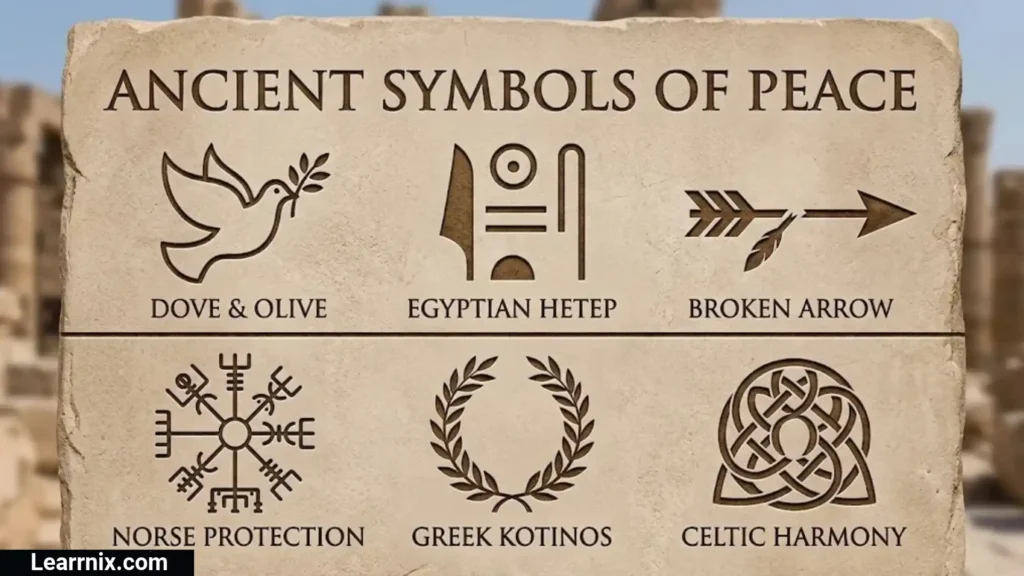
Ancient civilizations used natural objects, religious emblems, and artistic representations to communicate peaceful intentions. Some of these symbols are still recognized today.
Olive Branch
The olive branch has one of the oldest associations with peace in Mediterranean traditions. In ancient Greek culture, olive branches were connected with Athena, victory, and sacred ceremonies.
Over time, the branch became a widely recognized sign of reconciliation and peaceful intentions.
Dove
Doves were associated with divine figures and sacred traditions in the ancient Mediterranean world. In Greek mythology, the bird was connected with Aphrodite, the goddess of love.
Its gentle appearance and later religious associations helped establish its connection with peace.
Palm Branch
Palm branches appeared in ancient ceremonies and were associated with victory, honor, and celebration. In some contexts, they became signs of peaceful triumph rather than military aggression.
Laurel Wreath
The laurel wreath was used in ancient Greece and Rome to honor achievement and victory. Although it primarily represents accomplishment, it can also communicate the idea of peaceful success.
Yin-Yang
The yin-yang symbol comes from Chinese philosophical traditions. It illustrates the relationship between complementary forces, such as light and darkness.
Its central idea of balance makes it relevant to discussions of harmony and peaceful coexistence.
Ancient symbols did not always have exactly the same meanings they carry today. Their interpretation developed through religion, philosophy, cultural traditions, and historical events.
Symbols of Peace in the Bible
Peace is an important theme throughout the Bible. It is associated with God’s promises, forgiveness, reconciliation, spiritual comfort, and relationships between people.
Several biblical stories and images have become closely connected with peace.
Dove With an Olive Leaf
One of the strongest biblical examples appears in Genesis 8:11. After the flood, Noah sends out a dove, which returns carrying a freshly picked olive leaf.
This event becomes a sign that the floodwaters are receding and that life is beginning again. The dove and olive leaf are now widely recognized as symbols of hope and peace.
Rainbow
In Genesis 9:12–17, God establishes the rainbow as a sign of the covenant with Noah and every living creature.
The rainbow represents God’s promise never again to destroy all life through a flood. It is therefore associated with hope, reassurance, and divine faithfulness.
Olive Branch
The olive leaf brought back by Noah’s dove became an important image of restoration and a new beginning. Its peaceful meaning is strongly connected with this biblical story.
Lamb
The lamb appears throughout biblical imagery as a symbol of innocence, sacrifice, and gentleness. In Christian interpretation, the Lamb of God also carries a deeper spiritual meaning connected with Jesus Christ.
The Word Shalom
Shalom (שָׁלוֹם) is a Hebrew word commonly translated as peace. However, its meaning can extend beyond the absence of conflict to include well-being, completeness, and wholeness.
Together, these biblical images communicate peace as a condition of hope, restoration, faith, and a right relationship with God and others.
Symbols of Peace and Harmony
Harmony means living or working together in a balanced and respectful way. Peace focuses on the absence of conflict, while harmony also emphasizes positive relationships and cooperation.
Several symbols communicate these related ideas.
- ☯ — Yin-Yang: Represents complementary forces working in balance.
- 🪷 — Lotus: Represents spiritual calmness and personal development.
- 🌈 — Rainbow: Often associated with hope, diversity, and peaceful coexistence.
- 🌳 — Tree: Represents stability, growth, and connection.
- ⚖ — Balance Scale: Represents fairness, justice, and equal treatment.
- 🤝 — Handshake: Represents agreement, cooperation, and mutual respect.
- 🕊 — Dove: Represents peaceful relationships and reconciliation.
The yin-yang symbol is particularly relevant because it illustrates how seemingly opposite forces can exist together. It does not simply mean that everything is peaceful; it represents the relationship and balance between different elements.
These symbols are commonly used in meditation artwork, educational materials, community projects, and designs promoting peaceful relationships.
Symbols of Peace Around the World
Different countries and cultures express peace through their own traditions, languages, religious beliefs, and historical experiences.
Some symbols have become internationally recognized, while others remain especially meaningful within their cultural communities.
| Culture or Region | Peace Symbol | Common Association |
| Greece | Olive Branch | Reconciliation and peace |
| Japan | Origami Crane | Hope and healing |
| China | Yin-Yang | Balance and harmony |
| India | Ahimsa Hand | Nonviolence |
| Buddhism | Dharma Wheel | Buddhist teachings and the path to liberation |
| Christianity | Dove | Holy Spirit and peace |
| Judaism | Shalom | Peace and well-being |
| Jainism | Ahimsa Hand | Respect for all living beings |
The modern peace sign is another example of a symbol that crossed national and cultural boundaries. It became particularly recognizable during antiwar demonstrations and movements supporting nuclear disarmament.
Although people may recognize the same symbol, its meaning can vary according to local history and traditions. Understanding that background helps prevent cultural misunderstandings.
Japanese Symbols of Peace
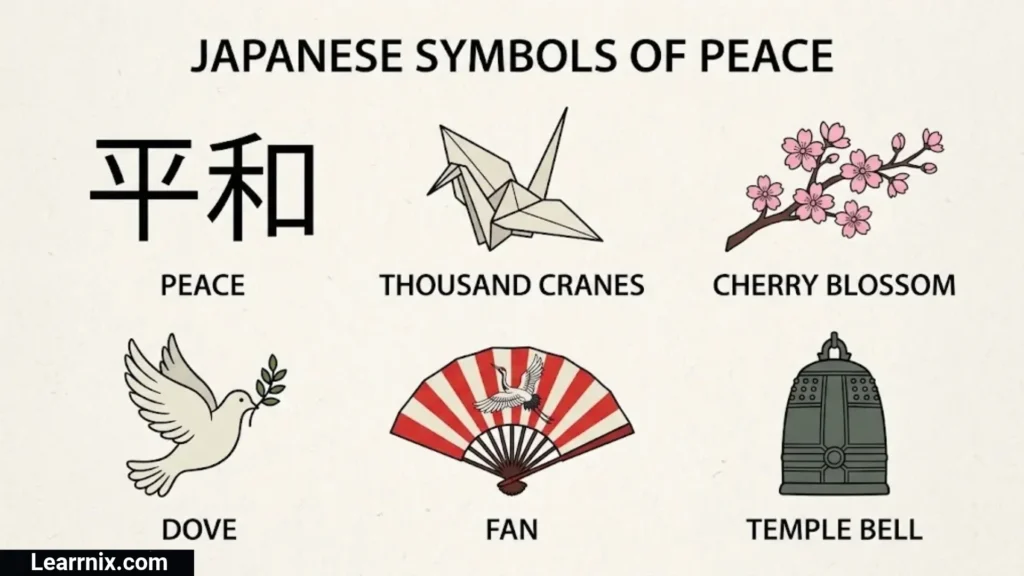
Japanese culture has several meaningful symbols associated with peace, hope, healing, and harmony. Some are traditional, while others became especially popular through modern historical experiences.
Japanese Peace Character
和平-related Japanese writing
平和
Heiwa
Japanese word meaning peace
平 (hei) + 和 (wa)
The characters 平和 are used to write the Japanese word heiwa, meaning peace. It is a useful text option for designs, messages, and artwork about peaceful living.
Origami Crane
The origami crane, known as orizuru, is one of Japan’s best-known symbols of peace and hope.
The tradition of folding paper cranes is connected with wishes for good fortune, health, and long life. The story of Sadako Sasaki, a young girl affected by the Hiroshima atomic bombing, helped make the paper crane an international symbol of peace.
Hiroshima Peace Bell
The Peace Bell at Hiroshima Peace Memorial Park represents the hope for a world without nuclear weapons and war.
Visitors ring the bell as an expression of their wishes for peace.
Cherry Blossom
Cherry blossoms, or sakura, represent the beauty and temporary nature of life in Japanese culture. They are not exclusively peace symbols, but they can express renewal, appreciation, and peaceful reflection.
Buddhist Symbols of Peace
Buddhist traditions include several symbols connected with compassion, wisdom, spiritual development, and freedom from suffering.
These symbols are often found in temples, meditation spaces, religious artwork, and traditional designs.
| Symbol | Name | Meaning |
| 🪷 | Lotus Flower | Purity and spiritual awakening |
| ☸ | Dharma Wheel | The teachings of Buddha |
| ☯ | Yin-Yang | Balance in Chinese philosophical traditions |
| 🪢 | Endless Knot | Interconnection and the relationship between causes and effects |
| ☂ | Parasol | Protection and spiritual authority |
| 🐚 | Conch Shell | The spread of Buddhist teachings |
Lotus Flower
The lotus is among the most important Buddhist symbols. It grows in muddy water while producing a beautiful flower above the surface.
This represents the possibility of spiritual growth despite difficult circumstances.
Dharma Wheel
The Dharma Wheel (☸) represents the teachings of Buddha and the Noble Eightfold Path.
Its eight spokes are associated with the eight aspects of the path that guide Buddhist practice. The wheel is primarily a symbol of Buddhist teachings rather than a general peace sign.
Endless Knot
The endless knot represents interconnectedness and the relationship between actions and consequences. It encourages reflection on how everything is connected.
Buddhist symbols of peace often emphasize inner calmness, compassion, mindfulness, and the reduction of suffering rather than simply the absence of war.
Universal Symbols of Peace
Universal peace symbols are signs that many people can recognize without needing a detailed explanation of their cultural background.
However, no symbol has exactly the same meaning for every person. The following examples are widely associated with peaceful ideas.
Modern Peace Sign
☮
Peace Symbol
A modern international symbol of peace and nuclear disarmament.
The modern peace sign was designed by British artist Gerald Holtom in 1958 for the Campaign for Nuclear Disarmament. Its design combines semaphore signals for the letters N and D inside a circle.
White Dove
The dove is widely used in international peace campaigns, religious artwork, and public celebrations.
Olive Branch
The olive branch represents reconciliation and a desire to end hostility. It is also featured in the United Nations emblem, where olive branches surround a world map.
White Flag
A white flag is traditionally used to communicate surrender, a request for a ceasefire, or a desire to negotiate.
Rainbow
The rainbow is often used to communicate hope, diversity, and peaceful coexistence. Its meaning depends on the context, as it also represents other social and cultural movements.
These symbols are useful for posters, presentations, awareness campaigns, and messages promoting nonviolence.
Symbols of Peace and Unity
Unity means people coming together despite their differences. Peaceful unity involves mutual respect, shared responsibilities, and a willingness to resolve disagreements without violence.
The following symbols can communicate this message:
- 🤝 — Handshake: Cooperation, agreement, and friendship.
- 🌍 — Globe: Global connection and international understanding.
- 🕊 — Dove: Peaceful relationships between communities.
- ☮ — Peace Sign: Commitment to nonviolence.
- 🌈 — Rainbow: Diversity and inclusion.
- ⭕ — Circle: Togetherness, continuity, and wholeness in some symbolic contexts.
- 🫶 — Heart Hands: Love, support, and kindness.
The handshake is particularly useful for representing unity because it suggests that two people or groups are willing to cooperate.
The globe can represent international unity, reminding people that peace is a shared responsibility rather than the concern of one country alone.
These symbols work well in community projects, school activities, nonprofit campaigns, and social media content.
Christian Symbols of Peace
Christianity has several symbols associated with peace, forgiveness, love, and reconciliation. Many come from biblical stories, while others developed through Christian worship and artistic traditions.
Dove
The dove is strongly associated with the Holy Spirit in Christian tradition. In the account of Jesus’ baptism, the Spirit descends like a dove (Matthew 3:16).
This association makes the dove an important Christian image of spiritual peace and divine presence.
Cross
✝
The Christian cross represents the crucifixion and resurrection of Jesus Christ. It is primarily a symbol of Christian faith and salvation, but it can also communicate reconciliation, forgiveness, and hope.
Olive Branch
The olive branch is associated with peace and restoration through the story of Noah. It is also used in Christian artwork to represent reconciliation.
Lamb
The lamb is associated with Jesus Christ as the Lamb of God. It represents innocence, sacrifice, and redemption.
Ichthys
Christian fish symbol
☧
The Ichthys is the traditional Christian fish symbol, commonly drawn as two curved lines forming a fish. It is a symbol of Christian identity rather than a direct peace symbol, although it may appear in designs promoting Christian love and fellowship.
Christian peace symbolism emphasizes forgiveness, compassion, love for neighbors, and reconciliation.
Why Are Doves Symbols of Peace
Doves are symbols of peace because of their long-standing associations with hope, gentleness, love, and reconciliation.
Their connection with peace comes from several historical and religious traditions.
The Story of Noah: In Genesis 8, a dove returns to Noah’s ark carrying an olive leaf. This shows that the floodwaters are receding and that the earth is becoming habitable again. The event connects the dove with hope and a new beginning.
Ancient Greek Traditions: Doves were associated with Aphrodite, the Greek goddess of love. Their connection with love and gentleness contributed to their symbolic importance.
Christian Traditions: The dove is associated with the Holy Spirit, particularly in the account of Jesus’ baptism.
Modern Peace Movements: Artists, organizations, and peace campaigns have used the white dove to communicate nonviolence and reconciliation.
Today, a white dove may appear on peace posters, memorial artwork, greeting cards, and international awareness campaigns.
Its meaning is easy to understand: instead of hostility and fighting, it represents a desire for kindness, hope, and peaceful relationships.
Indian Symbols of Peace
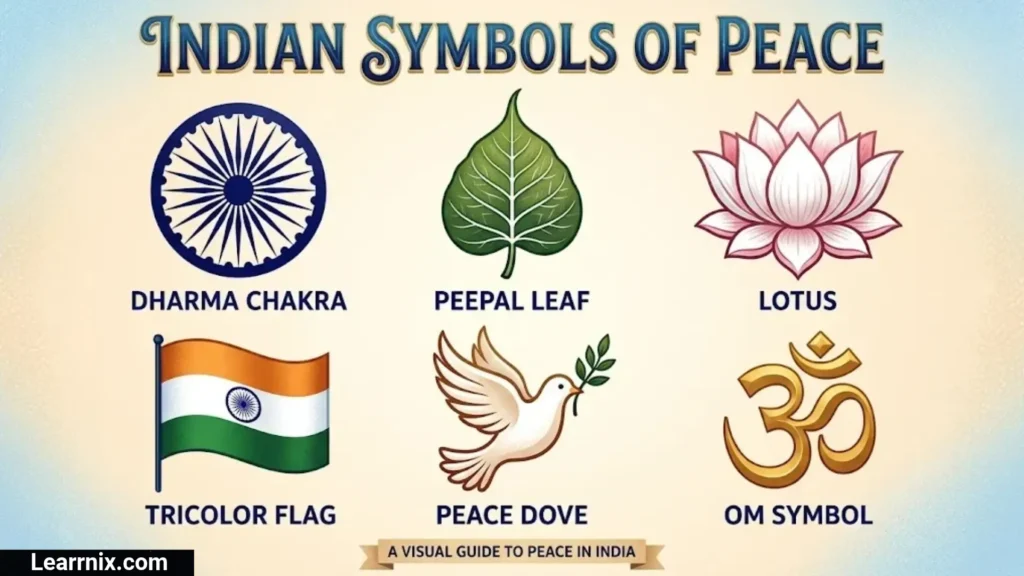
India has a rich collection of religious, philosophical, and cultural symbols associated with peace, nonviolence, and spiritual harmony.
Many of these symbols come from Hinduism, Buddhism, Jainism, and India’s broader philosophical traditions.
Ahimsa Hand
🖐
Ahimsa Hand
The Ahimsa Hand is associated with nonviolence, especially in Jainism. It represents respect for living beings and the principle of avoiding harm.
The word ahimsa means nonviolence or non-harming. It is an important principle in Jainism and also has a significant place in Hindu and Buddhist traditions.
Om Symbol
ॐ
Om or Aum
Om is a sacred syllable in Hinduism. It is used in prayer, meditation, and spiritual practices. It represents a profound spiritual concept rather than simply meaning peace.
Ashoka Chakra
☸
Ashoka Chakra
The Ashoka Chakra appears in the center of India’s national flag. Its 24 spokes are associated with the idea of dharma and righteous living. It represents values such as progress, responsibility, and moral principles.
Lotus Flower
The lotus is important in Indian religious traditions. It represents purity, spiritual development, and the ability to rise above difficult circumstances.
Swastika
The swastika is an ancient symbol used in Hinduism, Jainism, and Buddhism, where it has traditional associations with auspiciousness and well-being.
However, its meaning is highly context-dependent. The Nazi regime appropriated a similar symbol, making it associated with hatred and genocide in many modern contexts. It should not be confused with its traditional religious uses.
Indian symbols of peace often focus on nonviolence, spiritual awareness, compassion, and living responsibly.
Symbols of Peace Crossword Clue
If you are solving a crossword puzzle, the answer to a peace-related clue depends on the number of letters and the exact wording.
Here are some possible answers:
| Crossword Clue | Possible Answer | Letters |
| Symbol of peace | Dove | 4 |
| Peace symbol | Dove | 4 |
| Olive branch symbol | Branch | 6 |
| Sign of peace | Peace | 5 |
| Biblical peace bird | Dove | 4 |
| Peaceful agreement | Accord | 6 |
| Freedom from conflict | Amity | 5 |
| Peaceful condition | Harmony | 7 |
| End of fighting | Truce | 5 |
| Peace and friendship | Amity | 5 |
Helpful crossword tip: If the clue says “symbol of peace” and has four spaces, DOVE is a likely answer. If it has more letters, check whether the clue refers to an olive branch, a truce, or another peaceful concept.
Frequently Asked Questions
What is the most recognized symbol of peace?
The modern peace sign (☮) and the white dove (🕊) are two of the most widely recognized symbols of peace. Both are commonly used in campaigns, artwork, and messages promoting nonviolence.
What flower represents peace?
The lotus flower is strongly associated with spiritual purity, calmness, and growth. The white poppy is also used by some peace organizations to represent remembrance and a commitment to peace.
What color represents peace?
White is commonly associated with peace, purity, and surrender. Blue can represent calmness and harmony, while green may symbolize renewal, growth, and hope.
What is the Japanese word for peace?
The Japanese word for peace is Heiwa (平和). It is commonly used when discussing peaceful relationships, international peace, and the absence of war.
Which symbol represents peace without war?
The peace sign (☮) is one of the clearest symbols associated with opposition to war and nuclear weapons. The white dove and olive branch also communicate nonviolence and reconciliation.
Conclusion
Symbols of peace communicate powerful messages about kindness, hope, unity, love, and freedom from conflict. From the modern peace sign and white dove to the ancient olive branch, each symbol has a different story and cultural background. Understanding these meanings helps us appreciate why certain images have become so important across the world.
Religious and cultural traditions also offer meaningful examples. Buddhist lotus flowers, Japanese origami cranes, Christian doves, and Indian ahimsa symbols express different aspects of peaceful living. Although their origins differ, many encourage compassion, respect, and understanding.
You can use these symbols in messages, social media posts, artwork, tattoos, educational projects, and personal designs. Choose a symbol that matches the message you want to share, and remember that its cultural background can make its meaning even more meaningful.

I am Daniel Harper, an education enthusiast and writer who enjoys creating helpful content to make learning more accessible and engaging.
I focus on sharing knowledge about effective study methods, educational growth, and skills that help learners succeed in a changing world.
Through my writing, I aim to inspire students to explore new ideas and develop a passion for learning.
Books by Daniel Harper:
- The Path to Lifelong Learning
- Unlocking Your Learning Potential
 Charlotte Anderson
 Michael Carter