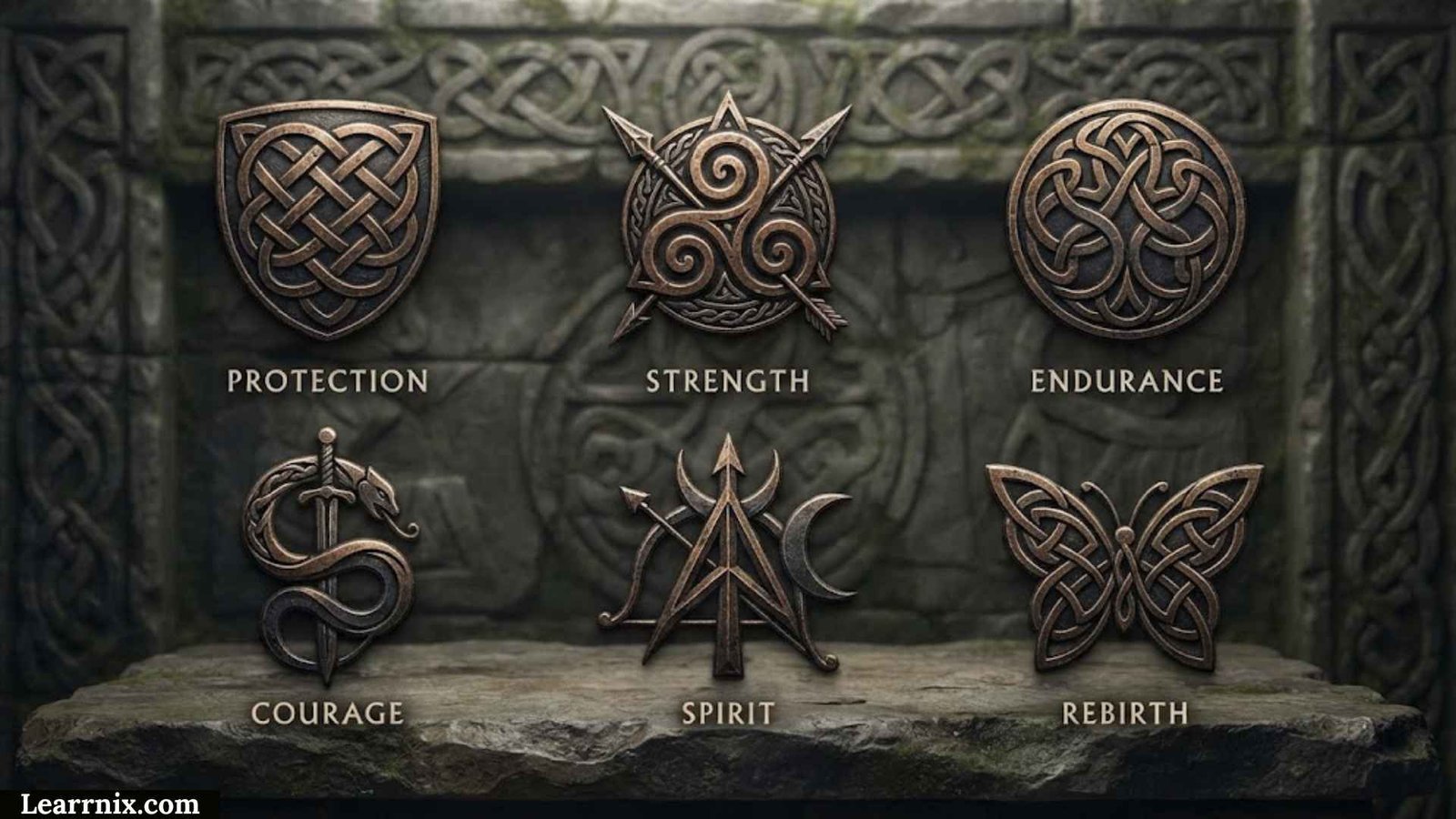
Female warrior Celtic symbols are popular in tattoos, jewelry, artwork, and personal designs because they combine ideas of courage, protection, resilience, independence, and feminine power. There is not one universally documented ancient Celtic symbol that literally means “female warrior.” Instead, modern designs often bring together Celtic-inspired motifs such as spirals, knotwork, shields, horses, ravens, weapons, and nature imagery.
The history behind these symbols is also more interesting than many modern descriptions suggest. Some motifs are genuinely ancient, while others come from medieval Celtic and Insular art or from much later Celtic Revival traditions. For example, the famous triple spiral at Newgrange is prehistoric and predates the Celtic period, while much of the knotwork commonly called “Celtic” is associated with early medieval art.
This guide explains female warrior Celtic symbols and their meanings, ancient warrior-inspired motifs, strength symbols, tattoo ideas, and the meaning of Mukatila. It also separates historically supported information from modern interpretations so you can choose a design that looks meaningful without confusing a modern symbol with an ancient one.
Female Warrior Celtic Symbols and Their Meanings
There is no official ancient Celtic symbol specifically named the “female warrior symbol.” Celtic culture covered different communities and periods, and surviving evidence does not provide a universal symbol dictionary. Many meanings attached to Celtic symbols today are modern interpretations rather than translations preserved in ancient texts.
Still, several motifs work especially well when the goal is to represent a female warrior.
| Symbol | Common Modern Meaning | Warrior-Inspired Use |
| Triskelion / Triple Spiral | Movement, transformation, continuity | Resilience and moving forward |
| Celtic Knotwork | Connection and continuity | Strength through relationships and heritage |
| Triquetra | Unity and threefold connection | Balance and inner power |
| Shield Motif | Protection and defense | Guarding yourself or others |
| Horse | Freedom, movement, power | Independence and warrior energy |
| Raven or Crow | War, fate, transformation | Association with the Morrígan |
| Boar | Ferocity and courage | Warrior strength |
| Oak-Inspired Knotwork | Strength and endurance | Inner resilience |
Triskelion Or Triple Spiral
The triskelion, also called a triskele, consists of three curved arms or spirals connected around a central point. One of the most famous examples appears at Newgrange in Ireland. However, this distinction is important: Newgrange dates to the Neolithic period, around 3200 BC, thousands of years before the period generally associated with Celtic culture in Ireland. Its original meaning is not known.
Today, people commonly interpret the three-part design as representing movement, progress, cycles, transformation, or balance. Those interpretations can work very well for a female warrior tattoo, especially when the intended message is resilience after difficult experiences.
Celtic Knotwork
Interlaced Celtic-style knotwork is visually associated with continuity because its lines appear to flow endlessly. Modern users often connect it with eternity, loyalty, family, heritage, and strength.
Historically, however, individual knots do not have a reliable ancient dictionary of meanings. Much surviving elaborate knotwork belongs to early medieval Insular art, including manuscripts and carved objects. Modern names such as “Dara Knot” and “Shield Knot” should therefore be treated carefully rather than automatically presented as ancient Celtic terminology.
Horse And Warrior Imagery
The horse can be an excellent choice for a female warrior design because horses have strong connections with Celtic-related mythology and religious traditions. Epona, a Gaulish goddess associated with horses, became widely known in the Roman world as well.
A horse surrounded by knotwork can therefore create a design centered on freedom, movement, independence, and feminine power without needing to claim that the exact modern tattoo design existed in ancient Celtic society.
Raven Or Crow
The raven or crow is particularly useful for a darker warrior-inspired design. The Morrígan, an important figure in Irish mythology associated with war and fate, is strongly connected in later descriptions with crow or raven imagery.
A raven combined with a Celtic-inspired knot, shield, or spiral can create a visual theme of battle, transformation, fate, and power.
Ancient Female Warrior Celtic Symbols
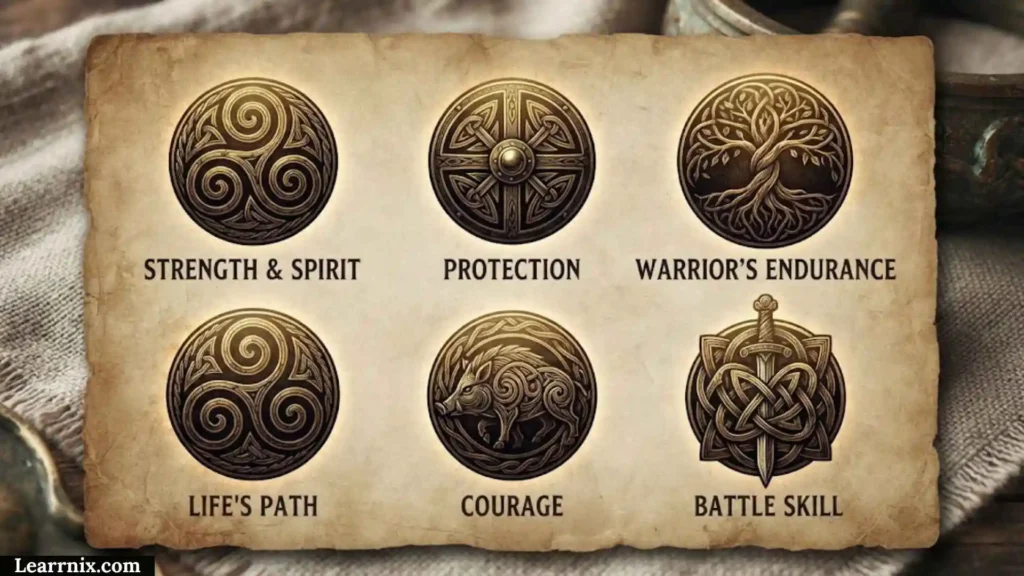
Ancient Celtic-related cultures did not leave behind a simple catalog of symbols labeled specifically for women warriors. However, women appear in Celtic historical and literary traditions as rulers, leaders, supernatural figures, and, in some contexts, warriors.
One of the best-known historical examples is Boudica, the Brittonic queen who led a major uprising against Roman rule in Britain. Her story provides a strong historical association with female leadership and resistance, although there is no surviving ancient “Boudica symbol” that can be identified as her personal emblem.
Irish mythology provides another important source for female warrior imagery. The Morrígan is associated with warfare, fate, battle, and supernatural power. Her mythology gives modern artists a natural source of inspiration when creating a powerful female Celtic warrior concept.
Ancient Motifs Worth Considering
For a historically informed design, focus on motifs that are genuinely found in ancient or medieval Celtic-related material:
- Spiral motifs — especially ancient Irish examples.
- Triple spirals — famously preserved at Newgrange.
- Animal imagery — including horses and boars.
- Weapons — swords, spears, and shields can provide direct warrior imagery.
- Interlaced designs — especially those associated with medieval Insular art.
- Geometric ornament — useful for borders and decorative elements.
The key is to distinguish the age of the motif from the meaning assigned to it today. The Newgrange triple spiral is unquestionably ancient, but its original symbolic meaning remains uncertain. Modern interpretations such as transformation, cycles, and progress are useful ways of understanding the design today, but they should not be presented as proven translations of the prehistoric symbol.
Ancient Does Not Always Mean Celtic
This is one of the most important points for anyone researching female warrior Celtic symbols. A design can be ancient Irish without being Celtic.
The triple spiral at Newgrange is the clearest example. It was carved thousands of years before the arrival of the Celtic cultural tradition in Ireland. Calling it an ancient Irish or prehistoric symbol is more precise than claiming that Neolithic people at Newgrange were Celtic.
Likewise, much of the elaborate knotwork associated with “Celtic” designs today comes from the early medieval period. It should not automatically be described as Iron Age Celtic warrior symbolism.
Strength Female Warrior Celtic Symbols
If the main idea you want to express is strength, several Celtic-inspired motifs can be adapted into a female warrior design.
Dara-Inspired Knot
The Dara Knot is widely marketed today as an oak-root-inspired Celtic knot representing strength, endurance, and deep roots. It is particularly popular for tattoos.
There is an important historical qualification, though. The modern name “Dara Knot” and its specific meaning are not securely documented as an ancient Celtic symbol. It is better described as a modern Celtic-inspired design based on oak imagery and knotwork traditions.
For a tattoo, this motif can represent:
- Inner strength
- Resilience
- Stability
- Family roots
- Endurance
- Personal growth
Triskelion
The three-spiral design works well for someone who wants strength represented through movement rather than aggression. Its flowing structure can suggest continuing forward despite obstacles.
Modern interpretations often connect the three arms with ideas such as past, present, and future or cycles of change. These are interpretations rather than confirmed meanings from the people who created the prehistoric examples.
Shield-Inspired Design
A shield is one of the clearest visual ways to communicate protection. When surrounded by Celtic-inspired knotwork, it can become a strong symbol for personal boundaries, courage, family protection, and determination.
It is best to call this a Celtic-inspired warrior design rather than claiming that a specific four-cornered “shield knot” had one universally established ancient meaning.
Boar Motif
The boar is another strong choice for a warrior-themed design. Its associations with ferocity and courage make it suitable for someone who wants a more aggressive visual style.
A boar can be combined with:
- A Celtic-style border
- Spear or sword imagery
- Interlaced knotwork
- A warrior shield
- A simple spiral background
This approach gives the design a strong warrior identity while avoiding the need to invent a supposed ancient female-warrior glyph.
Horse Motif
A horse offers a softer but still powerful alternative. Instead of focusing on battle, it can emphasize freedom, independence, movement, and strength.
A female figure with a horse can also be inspired by the Celtic goddess Epona, although a modern tattoo should not automatically be described as a historical depiction of her.
Female Warrior Symbol Mukatila
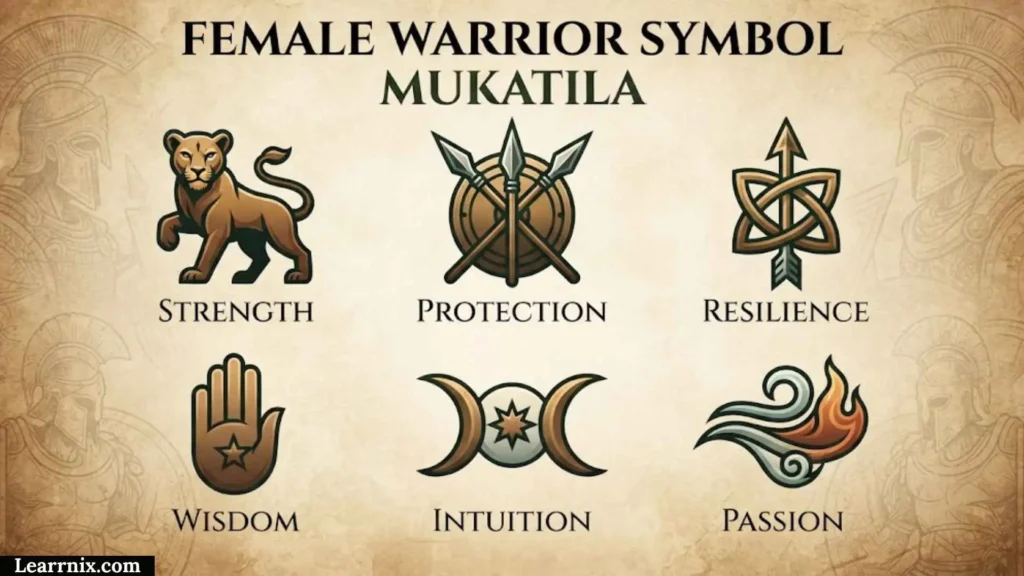
Mukatila is not a Celtic symbol. The word مقاتلة (muqātila) is Arabic and refers to a female fighter or female warrior. This makes it useful for understanding the phrase “female warrior symbol Mukatila,” but it should not be presented as an ancient Celtic word or symbol.
This distinction is especially important because online searches can mix Arabic terminology with Celtic-inspired artwork. A design containing مقاتلة alongside Celtic knotwork would be a modern combination of two cultural elements.
Mukatila In A Modern Warrior Design
If you want to use Mukatila in artwork, you can display the Arabic word:
مقاتلة
You could then pair it with a separate Celtic-inspired visual such as:
- A triple spiral
- Celtic knotwork
- A shield
- A sword
- A horse
- A raven or crow
- An oak-inspired design
The result can communicate the idea of a female warrior through both language and imagery.
However, do not describe مقاتلة itself as a Celtic rune, Celtic glyph, or Celtic warrior symbol. It belongs to Arabic vocabulary.
Mukatila And Celtic Tattoo Ideas
For a bilingual or mixed-cultural tattoo, several layouts can work:
مقاتلة + Celtic knotwork
A simple Arabic word surrounded by an interlaced border.
مقاتلة + triple spiral
The Arabic word placed beneath a modern triple-spiral-inspired design.
مقاتلة + shield
A warrior-protection concept using the Arabic term inside or beside a shield.
مقاتلة + horse
A feminine warrior theme emphasizing freedom and independence.
These are modern design concepts, not archaeological reconstructions.
Female Warrior Celtic Symbols Tattoos
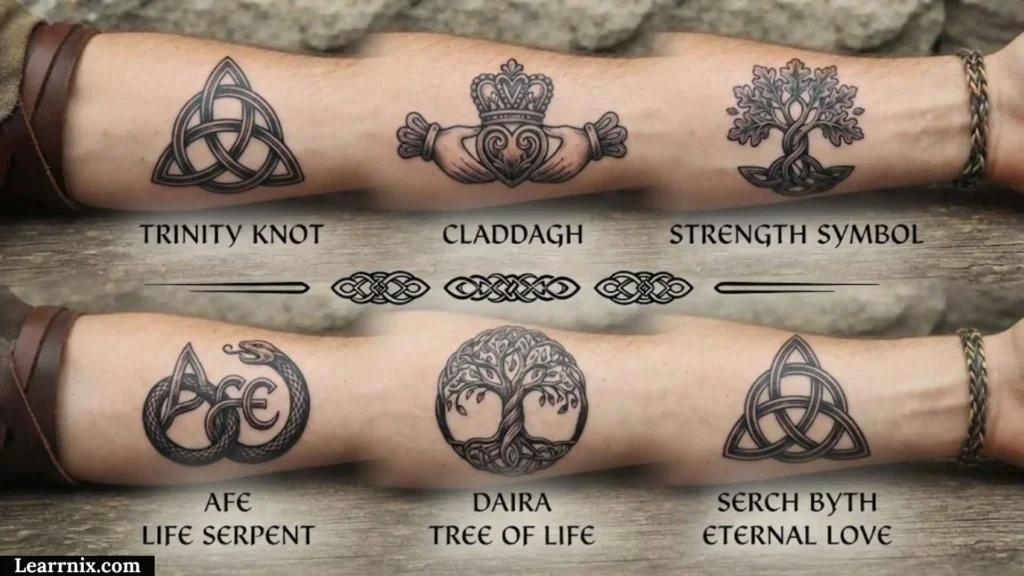
Female warrior Celtic tattoos can range from small minimalist designs to large pieces combining several motifs. The best approach is to decide what the tattoo should communicate first and then choose the imagery.
Small Female Warrior Tattoo Ideas
For a smaller tattoo, consider a single central motif:
- Small Triskelion — movement and resilience
- Simple Knotwork — connection and continuity
- Horse Head — freedom and power
- Raven — battle and transformation
- Shield Shape — protection
- Oak-Inspired Knot — strength and endurance
A small design usually benefits from fewer lines. Highly detailed knotwork can become visually crowded when reduced to a tiny size.
Larger Celtic Warrior Tattoo Ideas
A larger tattoo gives you room to combine several elements. For example:
Warrior Shield + Knotwork
A shield forms the center while knotwork creates the outer border.
Raven + Spiral
A raven sits above or beside a triple-spiral-inspired motif, creating a darker mythology-based design.
Horse + Knotwork
A horse silhouette is framed with flowing interlace for a design focused on freedom and strength.
Sword + Celtic Border
A sword creates the obvious warrior theme while knotwork establishes the Celtic-inspired aesthetic.
Mukatila + Celtic Artwork
The Arabic word مقاتلة can be incorporated into a design using Celtic-inspired decorative elements.
Best Placement For A Detailed Design
The shoulder, upper arm, back, thigh, calf, and forearm can provide enough space for detailed artwork. Smaller placements are better suited to simpler symbols.
Before choosing a tattoo, show the artist exactly which historical reference you want to use. Ask whether the design is based on an archaeological motif, medieval artwork, modern Celtic Revival art, or a newly created interpretation. That small step can prevent inaccurate historical claims.
Copy-And-Paste Warrior-Inspired Symbols
Unicode does not contain an official character named “female warrior Celtic symbol.” However, ordinary Unicode characters can be combined for decorative text:
- ⚔ — sword
- 🛡️ — shield
- 🐎 — horse
- 🐦⬛ — black bird
- ✦ — decorative star
- ☘ — shamrock
- ♞ — knight chess piece
These are Unicode characters, not ancient Celtic symbols. They can be useful in social media bios, usernames, captions, messages, and decorative text.
For example:
⚔ Celtic Warrior ⚔
🛡️ Female Warrior 🛡️
✦ مقاتلة ✦
🐎 Celtic Warrior 🐎
If historical authenticity is important, use a real Celtic-inspired graphic or tattoo design rather than treating Unicode emoji or decorative characters as ancient Celtic writing.
FAQ
What is the Celtic symbol for a female warrior?
There is no single historically confirmed Celtic symbol that specifically means “female warrior.” Modern designs commonly combine warrior imagery such as shields, swords, horses, ravens, and boars with Celtic-inspired spirals or knotwork.
What does Mukatila mean?
Mukatila, written مقاتلة in Arabic, means a female fighter or female warrior. It is an Arabic word rather than a Celtic symbol.
Which Celtic symbol represents female strength?
A triskelion, oak-inspired knot, shield-inspired design, horse, or warrior animal can be used to express female strength. The exact meaning depends on whether the interpretation is historical or modern.
Is the triskelion an ancient Celtic symbol?
The triple spiral is genuinely ancient, but the famous Newgrange example is prehistoric and predates the Celtic period by thousands of years. Its original meaning is unknown, although modern interpretations include movement, cycles, and transformation.
What Celtic symbol is good for a warrior tattoo?
A shield-inspired knotwork design, horse, raven, boar, sword, or triskelion can work well for a warrior tattoo. Combining one central motif with restrained knotwork usually creates a clearer design than using many symbols together.
Conclusion
Female warrior Celtic symbols are best understood as a combination of historical motifs and modern interpretations rather than as a fixed ancient symbol system. Spirals, knotwork, horses, ravens, shields, boars, and oak-inspired designs can all contribute to a visual language of strength, protection, independence, and resilience.
For historical accuracy, pay attention to the age and origin of each motif. The Newgrange triple spiral is prehistoric, while much familiar Celtic knotwork belongs to medieval Insular art. Modern names and meanings can still be meaningful, but they should not automatically be presented as ancient facts.
If you are creating a tattoo or personal emblem, choose the symbol according to the message you want it to communicate. And if you use مقاتلة, remember that it is an Arabic word for female warrior, which can be creatively combined with Celtic-inspired artwork but should not be labeled a Celtic symbol.
I am Daniel Harper, an education enthusiast and writer who enjoys creating helpful content to make learning more accessible and engaging.
I focus on sharing knowledge about effective study methods, educational growth, and skills that help learners succeed in a changing world.
Through my writing, I aim to inspire students to explore new ideas and develop a passion for learning.
Books by Daniel Harper:
- The Path to Lifelong Learning
- Unlocking Your Learning Potential
 Michael Carter
 Charlotte Anderson