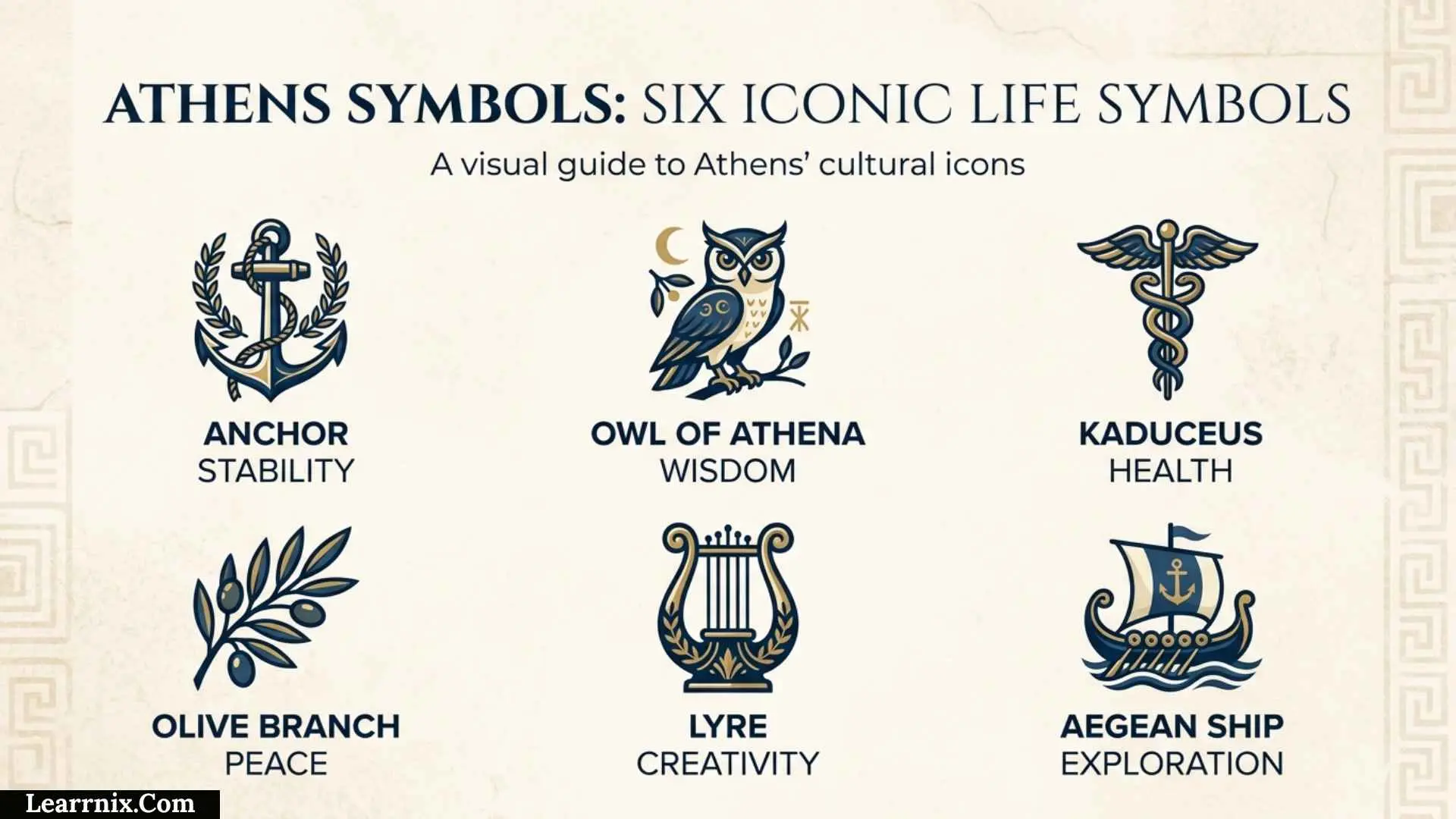
If you are searching for Athens symbols, the most important ones to know are the owl, olive tree, Athena, Acropolis, Parthenon, olive branch, and Athenian coin imagery. These symbols are connected to ancient Athens through mythology, religion, civic identity, art, architecture, and trade.
The owl is closely linked with Athena and became one of the clearest visual signs of Athens through ancient coinage. The olive tree connects to the famous myth in which Athena competed with Poseidon for the city’s patronage. The Acropolis and Parthenon later became powerful symbols of Athens, classical Greek civilization, cultural heritage, and ideas associated with democracy.
This guide explains what Athens symbols mean, where they came from, how to identify them, which symbols belong specifically to Athens, which are broader Greek symbols, and why these images still matter today.
Quick Answer: What Are the Main Symbols of Athens?
The strongest traditional and cultural symbols associated with Athens include the following:
| Symbol | What it represents | How strongly it identifies Athens |
|---|---|---|
| Owl | Athena, wisdom, knowledge, Athens | Very strong |
| Olive tree | Athena, prosperity, agriculture, Athens | Very strong |
| Athena | Wisdom, protection, strategy, civic identity | Very strong |
| Acropolis | Ancient Athens, heritage, civilization | Very strong |
| Parthenon | Athena, classical Athens, architecture, democracy | Very strong |
| Olive branch | Victory, peace, Athena and Athens | Strong, but broader than Athens |
| Athenian owl coin | Ancient Athens, civic identity, trade | Very strong historically |
| Helmet and spear | Athena’s protective and strategic role | Strong for Athena |
| Aegis and Gorgoneion | Protection, divine power, Athena | Strong for Athena |
| Greek key/meander | Greek artistic identity | Broad Greek symbol, not Athens-specific |
The most useful combination to remember is owl + olive branch + Athena. That combination has a particularly strong historical connection to Athens because of ancient Athenian coinage.
Why Athens Has So Many Symbols
Athens does not have one single symbol that explains the entire identity of the city.
Its symbolism developed over thousands of years. Ancient religious traditions produced the connection with Athena, the owl, and the olive tree. The city’s coins turned some of those images into widely circulated civic symbols. The Acropolis and Parthenon later became visual representations of ancient Athens and Greek civilization.
This is why different people may give different answers when asked, “What is the symbol of Athens?”
Someone studying mythology may answer Athena or the owl.
A historian of ancient coins may point to the owl and olive sprig.
An architect may choose the Parthenon.
A modern traveler may immediately think of the Acropolis.
All can be correct, provided the context is clear.
Cultural Symbols vs. Official Symbols
One important distinction is between a cultural symbol and an official civic emblem.
The owl, olive tree, Athena, Acropolis, and Parthenon are widely recognized cultural or historical symbols associated with Athens. That does not mean every one of them is the current official emblem of the Municipality of Athens.
The Municipality of Athens uses its own contemporary visual identity and logo. Its official website displays the municipality’s logo in its government materials.
So it is more accurate to say:
“The owl is a traditional symbol associated with Athens.”
rather than automatically claiming:
“The owl is the official modern logo of Athens.”
That distinction prevents a common factual error in articles about city symbols.
The Owl: The Most Recognizable Ancient Symbol of Athens
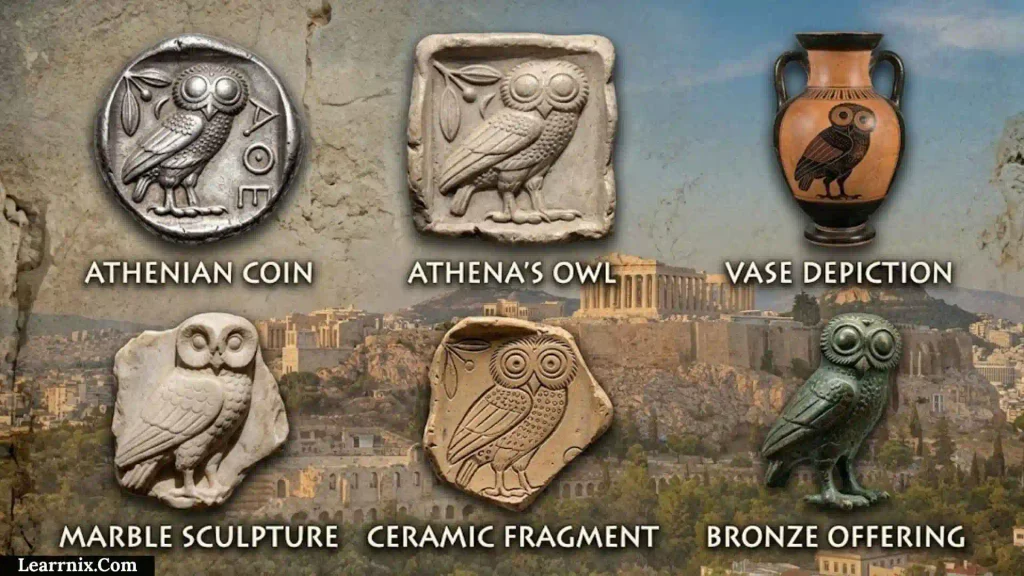
The owl is probably the most famous ancient symbol connected with Athens.
Its connection goes back to Athena, the city’s patron goddess. Ancient Athenian coins regularly showed the head of Athena on one side and an owl on the other. By the late sixth century BC, this design had become standardized.
The owl therefore became more than an animal associated with a goddess. It became a recognizable visual representation of Athens and the Athenians.
What Does the Owl Symbolize?
The owl can communicate several ideas at once:
- Wisdom
- Knowledge
- Intelligence
- Clear perception
- Athena
- Athens
- Civic identity
- Ancient Greek culture
The popular interpretation of the owl as a symbol of wisdom is important, but it is incomplete.
In an ancient Athenian context, the owl also functioned as a civic and political symbol.
It appeared on coins that circulated through the ancient Mediterranean, meaning that the image of the owl could identify Athens far beyond the city itself. Research from the National Gallery of Victoria also documents the strong connection between owl imagery and Athenian artistic traditions.
Why Was the Owl Connected With Athena?
Ancient Greek artists repeatedly associated Athena with the owl.
The exact historical origin of that association is not completely certain, so it is better not to present one modern theory as established fact. What is clear is that the owl became a major attribute of Athena and a major symbol of Athens.
A particularly important species in this tradition is the little owl, Athene noctua. Scholarly research describes its long-standing symbolic relationship with both Athena and Athens.
The Owl on Athenian Coins
The classic Athenian coin provides one of the clearest examples of how several Athens symbols worked together.
The typical design showed:
Obverse: Athena wearing an Attic helmet
Reverse: An owl, often accompanied by an olive sprig and the inscription ΑΘΕ
This was not accidental decoration. Ancient Greek cities used coin imagery to communicate identity, traditions, political authority, and sometimes economic interests. The Greek Ministry of Culture’s 2500 Years project specifically identifies Athens as a major example of this practice.
Real-World Identification Example
Imagine finding an ancient Greek coin in a museum.
You see:
- A helmeted female head.
- An owl on the reverse.
- An olive branch.
- Greek letters associated with Athens.
The combination strongly points toward ancient Athenian coinage.
This is more reliable than identifying the object from the owl alone.
The Olive Tree: Athena’s Gift to Athens
The olive tree is another major symbol of Athens.
Its importance comes from the traditional myth of the contest between Athena and Poseidon for the patronage of the city.
According to the tradition, Poseidon offered a spring while Athena offered an olive tree. Athena’s gift became associated with the prosperity and identity of the city, and the olive became one of her sacred symbols.
The Acropolis itself preserves the memory of this tradition, including the area associated with the sacred olive tree near the Erechtheion. The Greek Ministry of Culture identifies the Acropolis as a sanctuary primarily dedicated to Athena and describes the long historical relationship between the site and the goddess.
What Does the Olive Tree Represent?
In the context of Athens, the olive tree can represent:
- Athena
- The protection of the city
- Prosperity
- Agriculture
- Olive oil
- Peace
- Victory
- Continuity
- Athenian identity
The symbol has both mythological and practical meaning.
Olive cultivation was not merely a religious idea. Olive products were economically important in the ancient Mediterranean, and archaeological and numismatic evidence connects olive imagery with the economic importance of olive products.
Why the Olive Matters More Than a Simple Myth
A weak explanation says:
“Athena gave Athens an olive tree.”
A stronger historical explanation recognizes three layers:
Mythology → Athena’s gift to the city
Religion → The olive became associated with Athena
Economy → Olive cultivation and olive oil had practical value
That combination helps explain why olive imagery became so persistent in Athenian culture.
Athena: The Figure Behind Many Athens Symbols
Athena is central to understanding the symbolism of Athens.
She was the city’s patron goddess and was associated with wisdom, strategy, warfare, crafts, and protection.
Many symbols that appear separate at first are actually connected through Athena:
Athena → owl
Athena → olive tree
Athena → helmet
Athena → spear
Athena → shield
Athena → aegis
Athena → Gorgoneion
Athena → Acropolis
This makes Athena the conceptual link between several of the most recognizable symbols of Athens.
Athena’s Helmet, Spear, and Shield
If you are trying to identify Athena in ancient art, look for her characteristic attributes.
A helmet highlights her warrior and protective role.
A spear emphasizes strategy and warfare.
A shield communicates defense and military power.
These details are especially useful when the owl or olive tree is not present.
For example, a helmeted female figure holding a spear may be Athena, but additional attributes make the identification stronger.
The Aegis and Gorgoneion
The aegis is another important attribute of Athena.
It is often shown as a protective garment or shield-like object and may feature the Gorgoneion, the head of Medusa.
The Gorgoneion helped communicate frightening protective power. It is therefore useful when identifying Athena in sculpture, pottery, reliefs, and other ancient art.
This is one reason the symbol system surrounding Athena is richer than the simple modern equation of:
Athena = wisdom.
Her imagery also communicates protection, strategy, authority, and power.
The Acropolis: Athens’ Greatest Architectural Symbol
If the owl is one of the strongest ancient symbols of Athens, the Acropolis is arguably its strongest architectural symbol.
The Acropolis is the rocky citadel at the heart of Athens and contains several major ancient monuments. The Greek Ministry of Culture describes it as the greatest and finest sanctuary of ancient Athens, closely connected with the city’s religious traditions and the worship of Athena.
The Acropolis is therefore not simply a tourist landmark.
It represents layers of:
- Ancient Athens
- Religion
- Architecture
- Political power
- Cultural heritage
- Classical art
- Greek civilization
- Modern ideas associated with democracy
Why the Acropolis Became a Symbol
The Acropolis became especially powerful symbolically because its monuments were created during the period when Athens was a major cultural and political center.
The official Acropolis resource notes that the fifth-century BC buildings were constructed during a period in which democracy, philosophy, and art flourished in Athens. It also describes the Acropolis and Parthenon as enduring symbols of democracy and Greek civilization.
This is why a simple image of the Acropolis can communicate “Athens” even without words.
The Parthenon: A Symbol of Classical Athens
The Parthenon is the most famous monument on the Acropolis.
It was dedicated to Athena Parthenos, the patron goddess of Athens, and was built between 447 and 438 BC as part of the major building program associated with Pericles.
Today, the Parthenon is commonly used as a visual symbol for:
- Athens
- Classical Greece
- Ancient architecture
- Athena
- Cultural heritage
- Democracy
- Philosophy
- Freedom of thought
The Greek Ministry of Culture describes the Parthenon as a powerful symbol of freedom of thought, democracy, philosophy, harmony, and liberty.
Acropolis vs. Parthenon
This is one of the most common mistakes people make.
| Term | What it is | Symbolic meaning |
|---|---|---|
| Acropolis | The fortified sacred hill and archaeological complex | Athens, ancient civilization, heritage |
| Parthenon | A temple on the Acropolis | Athena, classical architecture, Athens |
| Erechtheion | Another major temple on the Acropolis | Athena, Poseidon, ancient Athenian traditions |
| Temple of Athena Nike | Temple dedicated to Athena Nike | Victory and Athena |
So:
The Parthenon is part of the Acropolis.
They are not interchangeable names.
The Erechtheion and the Sacred Olive Tree
The Erechtheion is particularly important when discussing Athens symbols because it connects architecture with the olive-tree tradition.
The building stands on the Acropolis and is associated with several ancient Athenian cults and myths. The area near the Erechtheion is also identified with the sacred olive tree tradition.
This gives the olive tree a physical connection to the Acropolis rather than leaving it as a purely mythological idea.
For someone studying Athens symbolism, this is an important connection:
Olive tree → Athena → Erechtheion → Acropolis → Athens
The Olive Branch: Peace, Victory, and Athenian Identity
An olive branch has a broader meaning than an olive tree.
In Greek traditions, olive imagery could be connected with victory, peace, and athletic achievement. The olive branch also appears beside the owl on ancient Athenian coins, making it an important part of Athenian visual identity.
This distinction is useful:
| Image | Typical Athens-related meaning |
|---|---|
| Olive tree | Athena, city mythology, prosperity |
| Olive branch | Victory, peace, Athena, Athens |
| Olive wreath | Victory and athletic honor |
| Owl + olive branch | Strong ancient Athenian association |
The olive branch should therefore not automatically be labeled an “Athens symbol” in every context. It has a much broader history.
The Greek Key or Meander: A Greek Symbol, Not an Athens-Only Symbol
The Greek key, also called a meander, is widely associated with ancient Greek decorative art.
It appears in modern designs, architecture, jewelry, textiles, borders, and logos.
But there is an important SEO and historical distinction:
The Greek key is a symbol of Greek artistic identity, not a symbol uniquely belonging to Athens.
It can appear in Athenian-themed designs, but seeing a meander pattern alone is not enough to conclude that an object represents Athens.
This is an example of why context matters when identifying historical symbols.
Athenian Coins: Where Several Symbols Meet
Ancient coins are one of the best ways to understand the symbolism of Athens because they combine several elements in a small, repeatable design.
The classic Athenian silver tetradrachm typically placed:
Athena + helmet on one side
Owl + olive sprig on the other
The Greek Ministry of Culture notes that these Athenian coin designs became standardized from the end of the sixth century BC, with later versions adding details such as olive leaves and, on tetradrachms, a crescent whose exact interpretation remains debated.
Why Coin Symbolism Matters
Coins traveled.
That meant a city’s imagery could be seen by people who never visited that city.
For Athens, the owl therefore became a powerful form of visual communication. The coin effectively carried a small representation of Athenian identity through trade.
This is a useful real-world example of how symbols can function as communication systems, not merely decoration.
How to Tell Whether a Symbol Represents Athens or Athena
Athens and Athena are closely connected, but they are not identical.
Use the context.
| If you see… | Most likely interpretation |
|---|---|
| Owl alone | Wisdom, Athena, or Athens |
| Owl + olive branch | Strong Athenian connection |
| Helmeted woman | Likely Athena |
| Athena + owl | Athena and her connection to Athens |
| Athena + olive tree | Athena’s relationship with Athens |
| Acropolis | Athens / ancient Greek civilization |
| Parthenon | Athens, Athena, classical Greece |
| Aegis + Gorgoneion | Athena and divine protection |
| Greek key alone | Greek culture generally |
| Athenian tetradrachm | Ancient Athens |
This framework is more reliable than memorizing a single “Athens symbol.”
A Simple Decision Tree for Identifying Athens Symbols
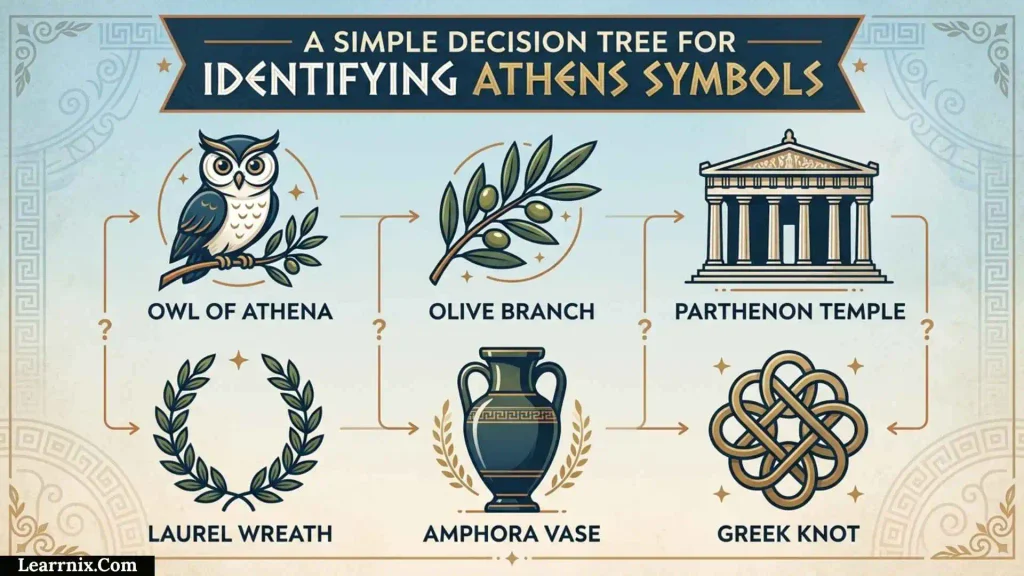
Use this quick guide when looking at an image, artifact, logo, statue, or ancient coin.
Start With the Main Visual Feature
Is there an owl?
→ Yes: Consider Athena or Athens.
→ Owl + olive branch: The Athenian connection becomes especially strong.
Is there a helmeted woman carrying a spear or shield?
→ Yes: Consider Athena.
Is there a large classical temple on a rocky hill?
→ Yes: Consider the Acropolis.
Is the temple the distinctive Parthenon?
→ Yes: It represents Athens and classical Greek heritage, while also being a temple dedicated to Athena.
Is there only a Greek key pattern?
→ Yes: Think broader Greek artistic identity rather than Athens specifically.
Is it an ancient coin showing Athena and an owl?
→ Yes: It is strongly associated with Athenian coinage.
This decision tree is especially useful for students, museum visitors, designers, and anyone trying to identify an ancient Greek symbol from a photograph.
Athens Symbols in Everyday Modern Use
Ancient symbols continue to influence modern visual culture.
You may encounter Athens-related imagery in:
- Museums
- School textbooks
- University branding
- Tourism materials
- Greek restaurants
- Jewelry
- Architecture
- Coins and collectibles
- Tattoos
- Art
- Classical studies
- Travel photography
- Government and cultural publications
The reason these symbols remain effective is simple: they communicate a large amount of information quickly.
An owl can suggest wisdom and Athens.
An olive tree can suggest Athena and the ancient city.
The Acropolis can identify Athens almost instantly.
The Parthenon can suggest classical Greek architecture and heritage.
Example: Choosing a Symbol for a Design
Suppose a designer needs an image representing Athens specifically, rather than Greece generally.
A random Greek key may be too broad.
A Greek flag may represent Greece rather than Athens.
A Parthenon silhouette gives a much stronger Athens association.
An owl can work especially well when the design is meant to communicate ancient Athens, wisdom, or Athena.
An owl combined with an olive branch is even more historically specific.
The best choice therefore depends on the message the design needs to communicate.
Common Misconceptions About Athens Symbols
The owl only means wisdom
Not exactly.
The owl has a strong connection with wisdom, but in ancient Athenian contexts it also represents Athena and became a recognizable symbol of Athens through coinage and art.
The Parthenon is the Acropolis
No.
The Parthenon is one temple located on the Acropolis.
Calling the two things the same can make an otherwise accurate article historically misleading.
Every Greek symbol represents Athens
No.
Some symbols are associated with Greek civilization generally, while others have a much stronger Athenian connection.
The Greek key is a good example of a broad Greek motif.
The olive branch always means Athens
No.
The olive branch has wider meanings, including peace and victory.
Its connection with Athens becomes stronger when it appears with Athena, an owl, Athenian coins, or other Athenian imagery.
Athena only represented wisdom
This is another oversimplification.
Athena was associated with wisdom, but her identity also included strategy, warfare, crafts, protection, and civic guardianship.
Her visual attributes reflect those wider roles.
The Acropolis was built only as a tourist symbol
Obviously not.
The Acropolis was a sacred and political center of ancient Athens long before it became a modern cultural landmark. The Greek Ministry of Culture documents its development as a major sanctuary associated with Athena and its transformation through different historical periods.
Historical Timeline of Athens Symbols
Understanding the timeline helps explain why different symbols became important at different times.
| Period | Important development | Symbolic importance |
|---|---|---|
| Early Greek periods | Development of Athenian religious traditions | Athena and local cults |
| 6th century BC | Athenian coin imagery becomes standardized | Athena and owl |
| 5th century BC | Major Acropolis building program | Parthenon and classical Athens |
| Classical period | Athenian political and cultural influence grows | Athens becomes a major cultural symbol |
| Later antiquity | Monuments acquire new religious and political uses | Symbols continue evolving |
| Modern era | Acropolis becomes a global heritage landmark | Athens and Greek civilization |
| Today | Ancient imagery remains widely used | Cultural identity and tourism |
The exact meaning of a symbol can therefore change over time.
A symbol that originally had a religious purpose may later become a civic emblem, historical reference, tourist image, or global cultural shorthand.
Why Athens Symbols Are Connected With Democracy
Modern discussions often connect Athens, the Acropolis, and democracy.
That connection has historical roots because ancient Athens played a major role in the development of democratic political institutions.
The Acropolis itself was built in a religious and civic context, not as a modern monument to democracy. However, its association with the classical Athenian period has made it a powerful modern symbol for democracy, civic participation, philosophy, and cultural achievement. The official Acropolis resource explicitly identifies the Acropolis and Parthenon with democracy and Greek civilization.
This distinction matters.
A careful article should say:
“The Acropolis is now widely regarded as a symbol of democracy.”
rather than:
“The ancient Athenians built the Parthenon as a modern symbol of democracy.”
The second statement would oversimplify the historical context.
Why the Symbols of Athens Still Matter
The continued importance of Athens symbols comes from their ability to connect the present with several different layers of history.
They represent mythology
Athena and the olive tree connect the city to ancient myths.
They represent religion
The Acropolis and its temples were central to ancient Athenian religious life.
They represent civic identity
The owl appeared on coins used by the Athenian state.
They represent art and architecture
The Parthenon became one of the world’s best-known examples of classical architecture.
They represent cultural heritage
The Acropolis is now recognized as a monument of global cultural importance.
They represent ideas
Modern audiences often associate Athens with wisdom, philosophy, democracy, civic life, and classical learning.
The power of these symbols comes from this stacking of meanings.
Athens Symbols vs. Symbols of Greece
One of the most useful distinctions for readers is between Athens symbols and Greek symbols.
| Athens | Greece generally |
|---|---|
| Owl | Greek key |
| Athena | Greek flag |
| Athenian tetradrachm | Greek national imagery |
| Acropolis | Broader ancient Greek mythology |
| Parthenon | Greek language and script |
| Olive tree in Athenian context | Pan-Greek olive traditions |
| Athenian civic imagery | Wider Hellenic cultural motifs |
There is naturally some overlap.
Athens is part of Greece, so an Athens symbol can also be a Greek symbol.
But the reverse is not always true.
This distinction is particularly useful for branding, education, historical identification, and travel content.
Practical Checklist for Identifying an Athens Symbol
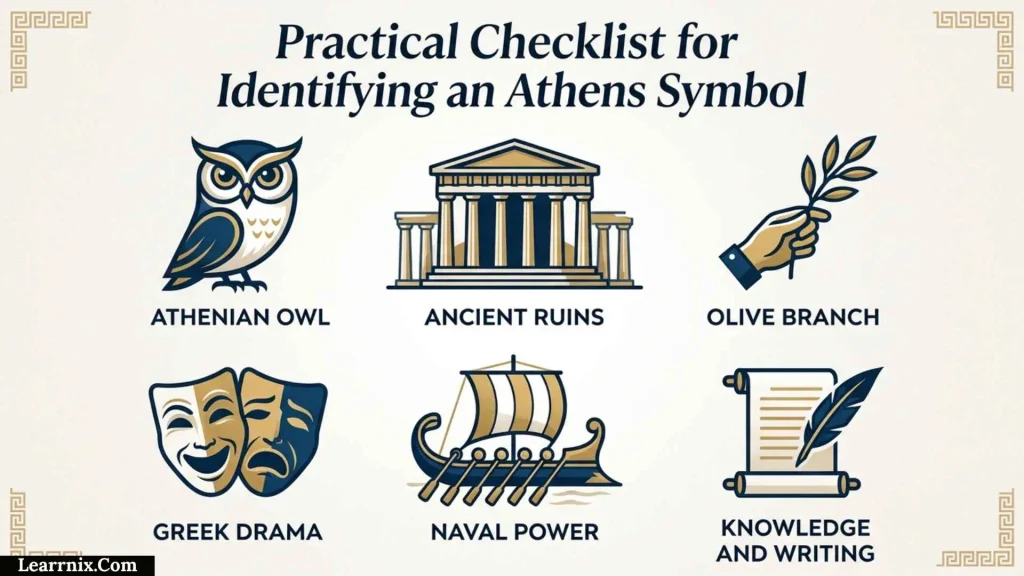
When you see an unfamiliar Greek-looking symbol, ask:
- Is there an owl?
- Is there an olive branch or olive tree?
- Is the figure Athena?
- Is she wearing a helmet?
- Is she carrying a spear or shield?
- Is there an aegis or Gorgoneion?
- Does the object show the Acropolis?
- Does it specifically resemble the Parthenon?
- Is it an ancient Athenian coin?
- Is the design only a Greek key, without any Athenian feature?
- What historical period does the object come from?
- Is the context religious, civic, artistic, political, or modern?
The more Athenian clues appear together, the stronger the identification.
What Is the Most Important Athens Symbol?
There is no single answer for every context.
If the question is about ancient Athenian coinage, the owl is one of the strongest answers.
If the question is about Greek mythology, Athena and the olive tree are central.
If the question is about modern visual recognition of Athens, the Acropolis and Parthenon are arguably the clearest choices.
If the question is about wisdom, the owl is the most recognizable.
If the question is about classical architecture, the Parthenon is the obvious choice.
That is why a good explanation should avoid saying that one symbol completely replaces all others.
Frequently Asked Questions About Athens Symbols
What is the most famous symbol of Athens?
The owl is one of the most famous traditional symbols associated with ancient Athens. The Acropolis and Parthenon are also extremely recognizable modern symbols of the city. The owl’s historical importance comes partly from its repeated appearance on Athenian coins alongside Athena and olive imagery.
Why is the owl a symbol of Athens?
The owl was associated with Athena, the patron goddess of Athens, and became a major civic symbol through ancient Athenian coinage. Its repeated use made the owl strongly identifiable with the city and its people.
What does the owl represent in Greek mythology?
The owl is strongly associated with Athena and is commonly interpreted through ideas such as wisdom, intelligence, perception, and protection. In the specific context of Athens, it also became a civic symbol.
What does the olive tree symbolize in Athens?
The olive tree is associated with Athena’s legendary gift to the city and represents themes such as prosperity, protection, agriculture, and Athenian identity.
What is the connection between Athena and Athens?
Athena was the patron goddess of Athens. Her religious identity became deeply embedded in the city’s mythology, monuments, art, and coinage. The Acropolis was primarily dedicated to her cult in ancient Athens.
What is the difference between the Acropolis and the Parthenon?
The Acropolis is the larger archaeological complex on the rocky hill. The Parthenon is one of the temples located on it.
What does the Parthenon symbolize?
The Parthenon symbolizes ancient Athens, Athena, classical Greek architecture, and Greek cultural heritage. In modern interpretation, it is also strongly associated with democracy, philosophy, harmony, and liberty.
Is the olive branch an Athens symbol?
It can be, especially when shown with an owl or other Athenian imagery. However, the olive branch has broader meanings such as peace and victory, so it should not automatically be treated as an Athens-only symbol.
Is the Greek key a symbol of Athens?
Not specifically. The Greek key or meander is a broad Greek artistic motif. It can be used in Athens-themed designs, but it does not uniquely identify Athens.
What symbols are found on ancient Athenian coins?
The classic Athenian coin design features Athena’s head on one side and an owl on the other, often accompanied by an olive branch. Later coin types could include additional details.
What does Athena’s helmet symbolize?
The helmet emphasizes Athena’s warrior and protective role. It is one of the visual clues used to identify her in ancient art.
What is the Gorgoneion?
The Gorgoneion is the image of a Gorgon’s head, especially Medusa’s head. When associated with Athena’s aegis, it communicates protection and frightening divine power.
Are the owl and olive tree official symbols of the modern city of Athens?
They are best described as traditional and cultural symbols associated with Athens, not automatically as the municipality’s current official logo or emblem. Modern municipal identity uses its own official visual branding.
Why is Athens associated with democracy?
Ancient Athens played an important role in the development of democracy. In modern culture, the Acropolis and Parthenon have consequently become powerful symbols of democracy and civic thought. The historical monuments, however, were created within the religious and political context of ancient Athens rather than being designed as modern democratic symbols.
Key Takeaways About Athens Symbols
The easiest way to understand the topic is to connect the symbols rather than memorize them separately.
- Owl → Athena, wisdom, Athens, civic identity
- Olive tree → Athena’s gift, prosperity, agriculture, Athens
- Olive branch → peace, victory, Athena, Athenian imagery
- Athena → wisdom, strategy, protection, crafts, civic identity
- Helmet → Athena’s warrior and protective role
- Spear and shield → strategy, warfare, defense
- Aegis → divine protection
- Gorgoneion → protective power associated with Athena
- Acropolis → Athens, ancient civilization, cultural heritage
- Parthenon → Athena, classical Athens, architecture and modern democratic symbolism
- Athenian owl coin → ancient Athens and civic identity
- Greek key → broader Greek artistic culture, not Athens alone
The strongest historical combination is Athena + owl + olive.
The strongest architectural combination is Acropolis + Parthenon.
And the most important identification rule is simple:
Do not interpret an Athens symbol in isolation. Look at the complete visual and historical context.
Conclusion
The symbols of Athens tell a much larger story than a list of famous Greek images.
The owl connects Athens with Athena, wisdom, and ancient civic identity. The olive tree links the city with Athena’s traditional gift and the practical importance of olive cultivation. Athena’s helmet, spear, shield, aegis, and Gorgoneion reveal different parts of her identity as a goddess of wisdom, strategy, protection, and crafts.
The Acropolis and Parthenon add another layer. They transformed the visual identity of Athens into something architectural and monumental. Today, they represent not only ancient Athens but also classical Greek civilization and ideas that modern audiences associate with democracy, philosophy, and cultural heritage.
The most important lesson is that there is no need to force every Greek symbol into an Athens category. Some symbols are specifically Athenian, some belong to Athena, and others represent Greek culture more broadly.
If you need to identify an Athens symbol quickly, start with the owl, olive, Athena, Acropolis, and Parthenon. Then examine the surrounding details. An owl beside an olive branch, for example, provides a much stronger Athenian clue than an owl by itself.
That combination of mythology, history, art, architecture, and civic identity is what makes Athens’ symbols so enduring.

I am Michael Carter, an educational content creator who believes that knowledge has the power to transform lives.
I create resources focused on modern education, digital learning, and building essential skills for the future.
I love helping readers discover simple and effective ways to improve their learning journey.
Books by Michael Carter:
- Modern Education for Tomorrow’s World
- Learning Skills for Future Success
 Daniel Harper