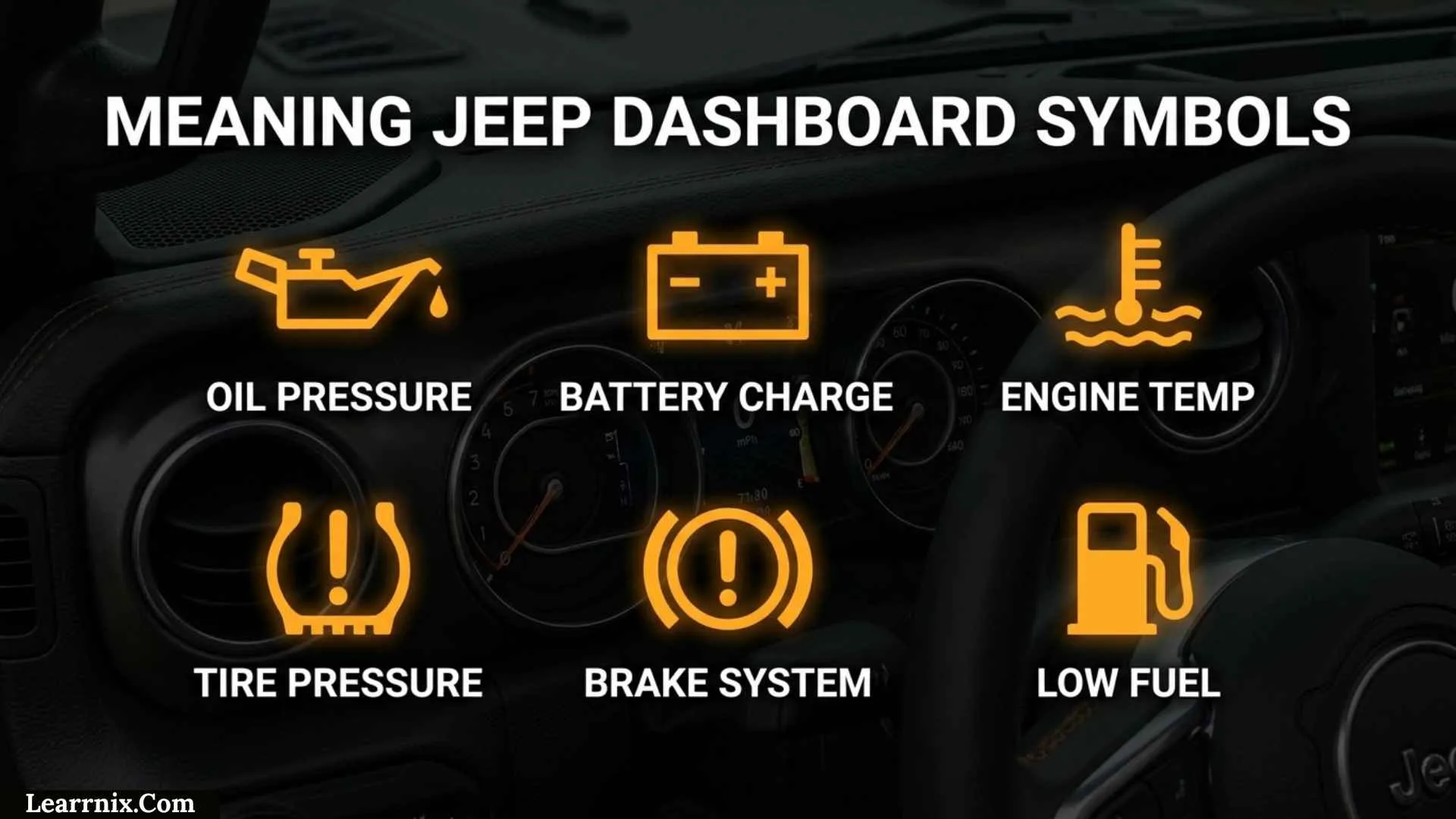
If a symbol suddenly appears on your Jeep dashboard, the first question is usually simple: What does this light mean, and do I need to stop driving?
The meaning of Jeep dashboard symbols depends on the symbol, its color, whether it is flashing or steady, and what your Jeep is doing at the same time. A green indicator may simply show that a feature is active, while a red warning can signal a condition that requires immediate attention.
This guide explains the most common Jeep dashboard symbols and meanings, what each warning can indicate, what you should do next, and which lights are safe to monitor versus those that should never be ignored.
Because Jeep models and model years have different equipment, some symbols are not available on every vehicle. Mopar states that its general dashboard-light guide is not exhaustive and recommends consulting the Owner’s Manual for vehicle-specific information.
Quick Answer: What Do Jeep Dashboard Symbols Mean?
Jeep dashboard symbols are warning and indicator lights that communicate information about the vehicle’s systems.
As a quick guide:
| Light color | General meaning | Typical response |
| Red | Potentially serious warning | Stop safely or take immediate action when required |
| Yellow/Amber | Warning or system fault | Investigate and arrange service if necessary |
| Green | Feature or system is active | Usually informational |
| Blue | Feature/status indicator | Usually informational |
| Flashing | Often more urgent than a steady light | Check the Owner’s Manual and respond promptly |
Color is only a starting point. The actual symbol and accompanying message matter more than color alone.
For example, a flashing check-engine light can indicate a serious condition, while a steady check-engine light may allow the vehicle to continue operating in some circumstances. Mopar says a flashing malfunction indicator light can warn of conditions that may cause immediate power loss or severe catalytic-converter damage.
The simplest rule to remember
Red + unusual vehicle behavior = stop safely and investigate.
Yellow + normal driving = arrange diagnosis or service soon.
Green or blue = usually an active feature or operating status.
These are practical guidelines, not substitutes for your Jeep’s manual.
Jeep Dashboard Warning Lights and Their Meanings
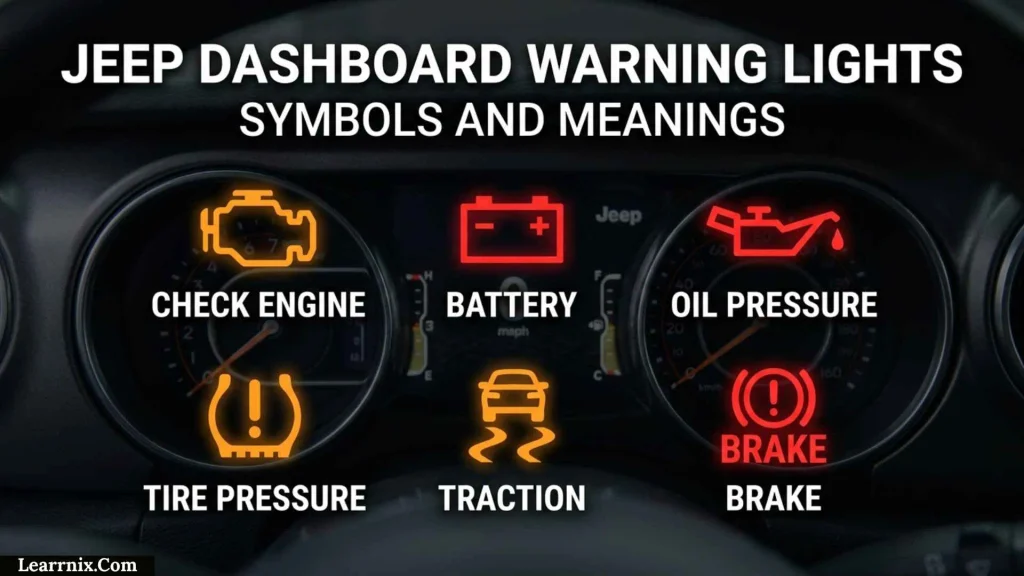
The following symbols cover many of the warning lights Jeep owners commonly encounter. The exact icon, wording, and available systems can vary by model and equipment.
Check Engine Light
The check-engine light is also known as the Malfunction Indicator Light (MIL).
It is connected to the vehicle’s onboard diagnostic system and can indicate a detected problem involving the engine, emissions system, transmission, or another monitored component.
A steady light does not automatically mean the engine is about to fail.
Possible causes can include:
- An emissions-related fault
- A sensor problem
- An ignition or fuel-system issue
- An issue affecting the engine or transmission
- Certain fuel-system conditions
Mopar notes that some less serious conditions, such as a loose or missing fuel cap or poor-quality fuel, can illuminate the MIL. If the light remains on through normal driving, the vehicle should be serviced.
What if the check-engine light is flashing?
A flashing MIL deserves much more attention than a steady one.
Mopar warns that a flashing MIL can indicate serious conditions that may result in immediate loss of power or severe catalytic-converter damage.
If your Jeep’s check-engine light is flashing, avoid treating it as a routine maintenance reminder. Reduce driving as safely as possible and seek professional diagnosis.
Oil Pressure Warning Light
The oil-pressure symbol usually resembles an oil can.
It indicates that the vehicle has detected low engine oil pressure.
This is one of the dashboard warnings that should not be ignored because engine lubrication depends on adequate oil pressure.
Mopar advises that if the oil-pressure warning appears while driving, you should safely pull over and stop the vehicle.
What should you do when the oil light comes on?
- Safely move away from traffic.
- Stop the engine.
- Follow the oil-level checking procedure in your Owner’s Manual.
- Do not continue driving simply because the engine still sounds normal.
- If the warning remains or the cause is unclear, arrange professional assistance.
A low oil-pressure warning is not the same thing as a simple oil-change reminder. Treat the actual oil-pressure warning as a potentially serious condition.
Engine Temperature Warning Light
The engine-temperature warning indicates that the engine coolant temperature is too high.
In simple terms, the engine may be overheating.
Mopar advises drivers to safely pull over and stop when this warning appears while driving.
Possible underlying causes can include a cooling-system problem, insufficient coolant, a cooling fan issue, or another fault. The dashboard warning itself does not identify the exact cause.
What should you avoid doing?
Do not immediately open a hot cooling-system cap. A hot cooling system can be pressurized.
Instead, stop safely and follow the instructions in the Owner’s Manual.
If you see steam, smell coolant, or notice the temperature warning accompanied by unusual engine behavior, treat the situation as urgent.
Battery Warning Light
The battery symbol usually resembles a small rectangular battery.
It generally indicates a problem with the vehicle’s 12-volt charging system, rather than simply telling you that the battery is old.
Mopar describes this warning as an indication that the 12-volt battery is not charging properly.
Possible causes can include a charging-system fault or another electrical-system problem.
Can you keep driving with the battery light on?
You should not assume you can drive indefinitely.
A vehicle with a charging-system problem may eventually lose electrical power. If the warning stays illuminated while the engine is running, arrange service as soon as practical and avoid unnecessary driving.
Brake Warning Light
A brake warning symbol may appear as an exclamation mark inside a circle or another brake-related icon.
Depending on the Jeep, it can indicate:
- The parking brake is applied
- Low brake fluid
- A brake-system malfunction
Mopar notes that if the brake warning remains on when the parking brake is not applied, it can indicate a brake-system malfunction or low brake fluid.
Why is the brake warning especially important?
Braking is a primary safety system. If the warning remains on, don’t assume it is simply an electrical glitch.
If the Jeep’s braking performance changes, the pedal feels unusual, or the warning is accompanied by another brake-related message, stop driving when it is safe to do so and have the vehicle inspected.
ABS Warning Light
The ABS symbol represents the Anti-Lock Braking System.
If the ABS warning remains illuminated while driving, the anti-lock portion of the braking system may not be functioning correctly.
Mopar states that a persistent ABS warning requires service.
A common misconception is that an ABS warning necessarily means the Jeep has no brakes. That is not what the symbol itself tells you.
Instead, it indicates an ABS-related problem. The vehicle’s conventional braking behavior and the exact fault determine the risk, so professional diagnosis is appropriate.
Tire Pressure Warning Light
The Tire Pressure Monitoring System, or TPMS, symbol usually looks like an exclamation mark inside a tire-shaped outline.
It generally means that one or more tires have significantly low pressure.
NHTSA explains that TPMS is designed to warn the driver when tire pressure is significantly underinflated.
What should you do when the TPMS light appears?
Check the pressure of all tires as soon as safely possible.
Use the vehicle manufacturer’s recommended cold tire pressure, not simply the maximum pressure printed on the tire sidewall. NHTSA recommends checking tire pressure when tires are cold and points drivers to the vehicle’s tire-information label or Owner’s Manual for the correct pressure.
What if the TPMS light flashes first?
A flashing TPMS light followed by a steady warning can indicate a TPMS system malfunction, rather than ordinary low tire pressure.
NHTSA explains that this flashing-then-steady pattern can indicate that the monitoring system itself is not functioning correctly.
That distinction is important because adding air may not solve a sensor or system fault.
Airbag Warning Light
The airbag warning symbol indicates a potential fault in the vehicle’s restraint or airbag system.
Some Jeep manuals explain that the light normally illuminates briefly during startup as part of a system check. A light that stays on or appears while driving can indicate a fault that needs inspection.
Because airbags and restraint systems are safety equipment, don’t treat a persistent airbag warning as an ordinary maintenance reminder.
Seat Belt Warning Light
The seat-belt symbol usually depicts a person wearing a seat belt.
It generally means that a driver or passenger has not fastened the seat belt.
Mopar identifies the seat-belt reminder as an indicator that remains on until the applicable seat belt is fastened.
If everyone is properly buckled but the warning remains on, check whether an object placed on a passenger seat may be triggering the occupant-sensing system.
Electronic Throttle Control Warning
The Electronic Throttle Control (ETC) warning indicates a possible problem with the electronic throttle system.
Modern vehicles use electronic signals to control throttle operation rather than relying solely on a traditional mechanical connection.
Depending on the fault, the Jeep may experience:
- Reduced acceleration
- Irregular throttle response
- Reduced engine performance
- A related warning message
If the ETC warning remains illuminated, have the vehicle diagnosed rather than repeatedly resetting the warning.
Electric Power Steering Warning
The Electric Power Steering or EPS warning indicates a potential fault in the electric steering-assistance system.
One important clue is how the steering feels.
If steering suddenly becomes much heavier, especially while maneuvering at low speed, treat the condition seriously.
Jeep documentation identifies electric power steering faults among applicable warning systems.
If steering becomes difficult or unpredictable, find a safe place to stop rather than continuing simply because the Jeep is still moving.
Transmission Temperature Warning
A transmission-temperature warning indicates that transmission fluid temperature is too high.
Mopar notes that high transmission-fluid temperature can occur during strenuous use such as towing.
This is especially relevant for Jeep owners who tow trailers, drive in demanding terrain, or operate the vehicle under heavy loads.
If the warning appears, follow the instructions displayed by the vehicle and consult the Owner’s Manual. Continuing to put heavy loads on an overheating transmission can make the underlying problem worse.
Traction Control and Stability Control Symbols
Jeep vehicles may display symbols associated with traction control, electronic stability control, or related systems.
These symbols do not always indicate a mechanical failure.
For example, a stability or traction-control indicator may illuminate when the system is actively helping the vehicle maintain control.
The important distinction is between:
- A light that briefly flashes while the system is intervening
- A warning that stays illuminated
- A warning accompanied by a message indicating that the system is unavailable or requires service
The exact behavior varies by Jeep model, so use the vehicle’s manual for interpretation.
4WD and 4×4 Indicators
Jeep’s four-wheel-drive systems can display several indicators depending on the model.
A 4WD symbol may communicate that a particular drive mode is engaged rather than indicate a fault.
Some models can display information about:
- 4WD High
- 4WD Low
- Neutral
- Selec-Terrain or terrain modes
- Axle-locking functions
- 4WD system faults
This is an important example of why not every dashboard symbol is a warning light.
If the symbol appears after you deliberately selected a drive mode, it may simply confirm the vehicle’s current configuration.
Vehicle Security Indicator
The security or immobilizer indicator relates to the Jeep’s vehicle-security system.
Depending on the model, it can flash as part of normal security-system operation.
A security symbol should therefore not automatically be interpreted as an engine or mechanical failure.
If the Jeep will not start and the security indicator is behaving unexpectedly, consult the Owner’s Manual for the specific model and key/immobilizer procedure.
Transmission or Gear Position Indicators
Modern Jeep dashboards can display information about the selected gear, transmission mode, or operating condition.
These are generally status indicators, not warnings.
The important point is to distinguish a normal gear-selection display from a warning message involving transmission temperature, transmission malfunction, or another fault.
Electric Vehicle and Hybrid Warning Indicators
Depending on the Jeep model and powertrain, newer vehicles may include additional electrical-system and high-voltage battery indicators.
Mopar’s dashboard guide includes EV-related warnings such as low state of charge, plug-status faults, service-electric-vehicle warnings, and reduced-performance indicators on applicable vehicles.
These symbols should always be interpreted using the manual for the exact vehicle because EV and hybrid systems can differ substantially from conventional gasoline-powered Jeeps.
Jeep Dashboard Lights by Color: Red vs. Yellow vs. Green
The color of a dashboard symbol provides useful context, but it is not enough to diagnose the problem.
What do red Jeep dashboard lights mean?
Red generally indicates a warning that deserves immediate attention.
Examples can include:
- Oil pressure
- Engine temperature
- Brake-system warnings
- Certain airbag or safety-system warnings
- Other serious system faults
Mopar’s own dashboard guide groups many critical warnings under red warning-light categories.
What do yellow or amber Jeep dashboard lights mean?
Yellow or amber usually means that the vehicle has detected a condition that needs attention but may not require an immediate stop in every situation.
Examples include:
- Check engine
- TPMS
- ABS
- Certain electronic-system warnings
- Service-related indicators
The correct response depends on the specific symbol and whether the Jeep is behaving normally.
What do green and blue Jeep dashboard lights mean?
Green and blue indicators are generally informational.
They can show that a feature is active or that the vehicle is operating in a particular mode.
Examples may include:
- Turn signals
- Cruise control
- High beams
- Selected drive modes
- Other active vehicle functions
Do not mistake every illuminated symbol for a fault.
What Should You Do When a Jeep Warning Light Comes On?
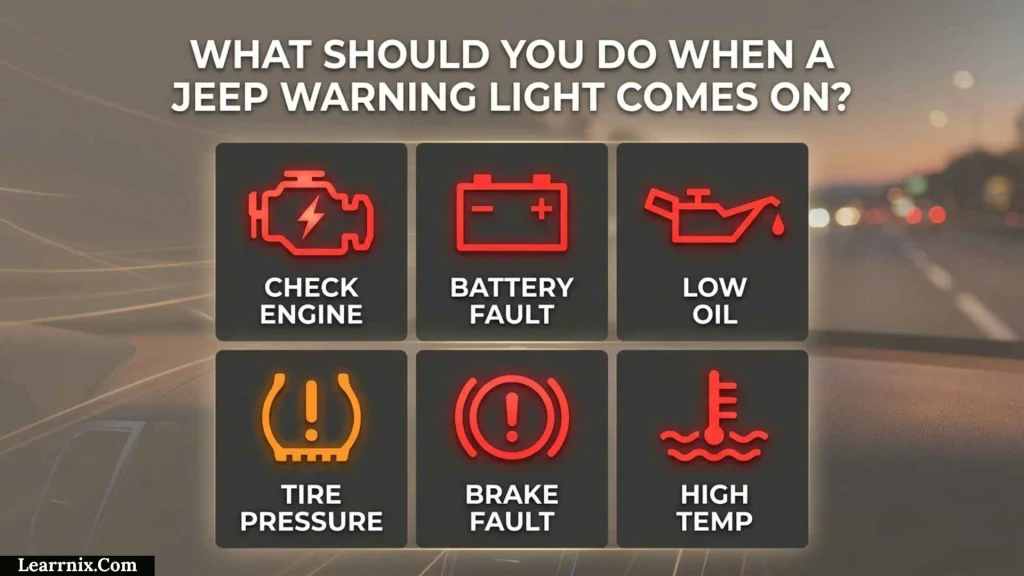
The best response is not to panic and not to ignore it.
Use this simple sequence.
Step 1: Identify the exact symbol
Look at the shape rather than relying only on the color.
An exclamation mark, for example, can appear in different symbols with completely different meanings.
Step 2: Check whether the light is flashing or steady
A flashing warning can indicate a more urgent condition.
The flashing check-engine light is a particularly important example because Mopar associates it with potentially severe conditions.
Step 3: Read the dashboard message
Modern Jeep vehicles may display a written message alongside the symbol.
That message can provide information that the icon alone cannot.
Step 4: Pay attention to how the Jeep feels
Ask yourself:
- Is the engine running normally?
- Is the steering heavier?
- Are the brakes behaving normally?
- Is the engine temperature rising?
- Is there smoke or steam?
- Is there an unusual smell?
- Has the Jeep lost power?
- Is the vehicle shifting normally?
A warning combined with a major change in vehicle behavior deserves more urgency.
Step 5: Check the Owner’s Manual
This is the most important model-specific step.
Mopar explicitly directs owners to the Owner’s Manual for detailed information because available warning and indicator lights differ according to equipment and vehicle status.
Jeep Dashboard Warning Light Decision Tree
Use this quick decision guide when a warning appears.
Is the light red?
Yes → Is it related to oil pressure, overheating, brakes, steering, or another serious system?
→ Yes: Safely pull over and follow the vehicle’s emergency guidance.
→ No: Read the dashboard message and consult the manual.
No → Continue to the next question.
Is the light yellow or amber?
Yes → Is the Jeep driving normally?
→ Yes: Identify the symbol and arrange diagnosis/service as appropriate.
→ No: Reduce driving and seek professional assistance.
Is the light flashing?
Yes → Treat it as more urgent than a steady light.
Check the specific warning in the Owner’s Manual and avoid continuing normal driving if the vehicle is behaving abnormally.
Is the light green or blue?
Yes → It is likely indicating an active feature or operating status.
Confirm its meaning in the Owner’s Manual if you are unfamiliar with the symbol.
This decision tree is a starting point, not a replacement for the manufacturer’s instructions.
Can You Drive With a Jeep Warning Light On?
There is no single answer because different warning lights indicate very different conditions.
Usually do not continue driving
Treat warnings involving conditions such as these as potentially serious:
- Low oil pressure
- Engine overheating
- Major brake-system problems
- Severe steering problems
- Serious electrical faults accompanied by vehicle malfunction
- Flashing check-engine light with abnormal engine behavior
Mopar specifically advises stopping for oil-pressure and engine-temperature warnings.
You may be able to drive cautiously to service
Some persistent yellow warnings may allow limited driving when:
- The Jeep is operating normally
- There is no loss of braking or steering
- The engine temperature is normal
- There is no smoke or severe smell
- The Owner’s Manual does not instruct you to stop
A steady check-engine light is an example where the appropriate response depends on the circumstances. Mopar notes that in many situations the vehicle may continue to drive normally, but the vehicle should be serviced if the light remains illuminated.
Why Are Multiple Jeep Dashboard Lights Coming On at Once?
Seeing several warning lights simultaneously can be alarming.
It does not necessarily mean that five unrelated components failed at exactly the same time.
Mopar identifies an insufficient battery charge as one possible reason multiple warning lights can appear because the battery and charging system affect multiple vehicle systems. Other causes can involve engine, transmission, braking, electrical, and related systems.
What should you do?
Don’t simply clear the warnings without finding the cause.
Record:
- Which lights appeared
- Whether they appeared simultaneously
- Any dashboard messages
- Whether the lights disappear after restarting
- Whether the vehicle behaves differently
That information can help a technician diagnose an intermittent electrical or system fault.
Jeep Dashboard Symbols by Model
The exact collection of dashboard symbols depends on the Jeep model, year, powertrain, and available equipment.
Jeep Wrangler dashboard symbols
Wrangler models can include indicators associated with four-wheel drive, off-road systems, stability control, tire pressure, engine systems, and other vehicle functions.
Off-road and 4×4 indicators are particularly important because some symbols communicate that a drive mode has been selected rather than that something has failed.
Jeep Grand Cherokee dashboard symbols
Grand Cherokee models can have a broad range of driver-assistance, powertrain, braking, suspension, electrical, and comfort-system indicators.
Higher-trim and newer models may have more dashboard messages because they contain more electronically controlled systems.
Jeep Compass dashboard symbols
Compass dashboards can include common engine, brake, tire-pressure, stability-control, driver-assistance, and transmission indicators.
The exact symbols depend on model year and equipment.
Jeep Cherokee dashboard symbols
Cherokee models may use different instrument-cluster graphics across generations, so an older Cherokee should not automatically be interpreted using a newer model’s dashboard chart.
Jeep Gladiator dashboard symbols
The Gladiator combines conventional warning lights with 4×4 and off-road-related indicators.
A symbol associated with a selected drivetrain mode can therefore have a very different meaning from a red powertrain warning.
Why the model year matters
A common mistake is searching for a symbol using only the word “Jeep.”
A 2015 Jeep and a 2025 Jeep may not use exactly the same instrument cluster, technology, or warning systems.
The safest search is closer to:
“2021 Jeep Wrangler dashboard symbol meaning”
rather than:
“Jeep dashboard symbol meaning”
For official information, use the Owner’s Manual for the exact vehicle. Mopar provides vehicle-specific manuals and information through its online vehicle resources.
Common Mistakes Jeep Owners Make
Understanding the symbol is only half the job. The way a driver responds also matters.
Mistake 1: Assuming every warning light means the engine is failing
A TPMS light is not an engine warning. A seat-belt indicator is not a transmission fault. A green cruise-control indicator is not a problem at all.
Identify the complete symbol before diagnosing the vehicle.
Mistake 2: Looking only at the color
Two yellow lights can represent completely different systems.
The symbol, message, flashing behavior, and vehicle symptoms all matter.
Mistake 3: Ignoring a warning because the Jeep still drives
A vehicle can continue moving even when a serious fault is developing.
Oil-pressure and overheating warnings are good examples. Mopar specifically advises stopping when those warnings appear.
Mistake 4: Using tire sidewall pressure instead of vehicle-recommended pressure
The pressure printed on the tire is not necessarily the correct operating pressure for your Jeep.
NHTSA recommends using the vehicle manufacturer’s recommended cold inflation pressure shown on the tire-information label or in the Owner’s Manual.
Mistake 5: Replacing parts based only on a dashboard light
A warning symbol identifies a condition or system that needs attention; it does not always identify the failed component.
For example, a check-engine light is not itself a diagnosis.
A proper diagnostic process should determine the underlying cause before parts are replaced.
Mistake 6: Assuming a warning is fixed because it disappeared
Some intermittent faults can temporarily disappear.
If a warning repeatedly returns, record when it occurs and have the Jeep diagnosed instead of assuming the issue is permanently resolved.
Practical Examples: What Would You Do?
Real-world situations are often more useful than a list of definitions.
Example 1: The TPMS light appears on a cold morning
You start your Jeep on a cold morning and see the tire-pressure warning.
The appropriate first step is to check the tire pressures.
NHTSA notes that temperature changes can affect tire pressure and that a TPMS warning can appear when pressure drops below the warning threshold.
Check the tires when cold and adjust them to the vehicle’s recommended pressure.
Example 2: The check-engine light is steady
The Jeep drives normally, but the check-engine light remains illuminated.
Don’t immediately assume the engine needs to be rebuilt.
The appropriate approach is to have the vehicle’s diagnostic system checked and follow the manufacturer’s service guidance.
Mopar notes that some conditions can illuminate the MIL while the vehicle continues to drive normally.
Example 3: The check-engine light starts flashing
This situation is different.
A flashing MIL can indicate a serious condition, according to Mopar.
If the Jeep is also shaking, losing power, or running poorly, don’t continue normal driving simply because the vehicle still moves.
Example 4: The red oil-pressure light appears
This is not the time to continue driving until you reach your destination.
Mopar specifically instructs drivers to safely pull over and stop when the oil-pressure warning appears while driving.
Example 5: Several warning lights appear after starting
If several systems suddenly report warnings, consider whether there may be an electrical or battery-related issue.
Mopar specifically identifies insufficient battery charge as one possible cause of multiple warning lights.
The correct response is diagnosis, not simply clearing every warning.
How to Find the Exact Meaning of Your Jeep Dashboard Symbol
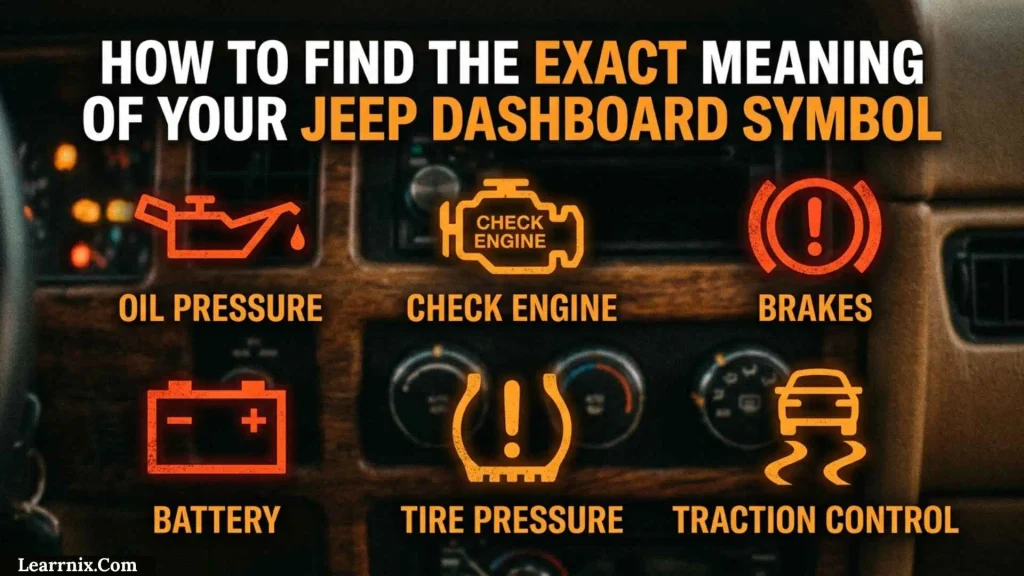
If you cannot identify a symbol from a general chart, use a model-specific approach.
Start with the Owner’s Manual
Your manual is the most reliable source for the exact vehicle.
Mopar describes the Owner’s Manual as the comprehensive source for vehicle operation, technology features, dashboard indicator lights, and maintenance information.
Record the vehicle details
Before searching online, note:
- Jeep model
- Model year
- Engine or powertrain
- Whether the symbol is red, yellow, green, or blue
- Whether it is flashing
- The exact dashboard message
- Any changes in vehicle behavior
This dramatically narrows the possible meaning.
Use an official source before a generic symbol chart
Third-party charts can be useful for identifying a symbol, but the manufacturer’s documentation should take priority when the two disagree.
Mopar itself says its general warning-light information is not exhaustive.
Jeep Dashboard Symbols: Key Takeaways
If you only remember a few things from this guide, remember these:
- Not every dashboard symbol is a warning. Some simply indicate that a feature is active.
- Red warnings generally deserve immediate attention.
- A flashing warning can be more urgent than a steady one.
- A flashing check-engine light should not be treated like an ordinary maintenance reminder.
- Oil-pressure and engine-temperature warnings should be taken seriously. Mopar advises safely stopping for these conditions.
- A TPMS warning means you should check tire pressure promptly.
- A flashing TPMS light followed by steady illumination can indicate a TPMS malfunction.
- Multiple warning lights do not necessarily mean multiple unrelated failures. Battery/charging problems are one possible cause.
- Your exact Jeep Owner’s Manual is the final reference for model-specific symbols.
Frequently Asked Questions About Jeep Dashboard Symbols
What is the most serious Jeep dashboard warning light?
There is no single “most serious” light for every Jeep, but warnings involving oil pressure, overheating, brakes, steering, or other critical systems can require immediate attention. The correct response depends on the symbol and the vehicle’s behavior.
What does a red exclamation mark mean on a Jeep?
The exact meaning depends on the surrounding symbol. A red exclamation mark inside a brake-related symbol can indicate a parking-brake, brake-fluid, or brake-system issue on applicable Jeep vehicles.
Do not interpret an exclamation mark by itself.
What does the yellow triangle mean on a Jeep?
A triangle can be used for different warnings depending on the Jeep model and system. Look for the accompanying message or consult the exact Owner’s Manual rather than assuming every triangle represents the same fault.
Why does my Jeep have a check-engine light but drive normally?
A steady check-engine light can result from a condition that does not immediately prevent normal driving. Mopar notes that certain conditions can illuminate the MIL while the vehicle continues to operate normally.
However, the underlying fault should still be diagnosed if the light remains on.
What does a flashing check-engine light mean on a Jeep?
A flashing MIL can indicate a serious condition that may cause loss of power or severe catalytic-converter damage. Mopar recommends prompt service when this occurs.
Why is my Jeep’s tire-pressure light on when the tires look fine?
A tire can be significantly underinflated without looking obviously flat.
NHTSA recommends checking tire pressure with a gauge and comparing it with the vehicle manufacturer’s recommended cold pressure.
Why does my Jeep TPMS light flash and then stay on?
That pattern can indicate a TPMS system malfunction rather than ordinary low tire pressure. NHTSA explains that flashing followed by continuous illumination can indicate a malfunction in the monitoring system.
Why are several warning lights on at the same time?
An electrical or battery-charging problem is one possible cause. Mopar specifically identifies insufficient battery charge as one reason multiple warning lights may appear.
Other systems can also trigger multiple warnings, so diagnosis is important.
Can I drive my Jeep with the ABS light on?
A persistent ABS warning indicates that the anti-lock portion of the brake system may not be functioning correctly. Mopar recommends service for a persistent ABS warning.
Because braking is safety-critical, drive cautiously and seek professional inspection.
Can I drive with the Jeep battery light on?
You should not assume that continued driving is safe for an extended period. A battery warning can indicate that the charging system is not working properly, and the vehicle may eventually lose electrical power. Mopar recommends having the vehicle checked when this warning remains on.
Does every Jeep have the same dashboard symbols?
No. Dashboard symbols vary by model, model year, equipment, and powertrain. Mopar states that warning and indicator lights differ according to equipment options and current vehicle status.
Where can I find the official meaning of my Jeep dashboard light?
Use the Owner’s Manual for your exact Jeep. Mopar provides vehicle information and Owner’s Manual resources, including dashboard indicator information.
Conclusion
Understanding the meaning of Jeep dashboard symbols is about more than memorizing a collection of icons. The safest interpretation considers the symbol, color, flashing behavior, dashboard message, vehicle model, and what the Jeep is doing at the time.
A green or blue indicator may simply tell you that a feature is operating. A yellow warning generally means the vehicle needs attention. A red warning can indicate a serious condition that requires immediate action.
The most important distinction is between a dashboard indication and an actual diagnosis. A check engine light tells you that the vehicle’s diagnostic system detected a condition; it does not automatically identify the failed part. Similarly, a TPMS light tells you that the system has detected a tire-pressure problem or, in some cases, a TPMS malfunction it does not replace physically checking the tires.
When in doubt, identify the exact symbol, read the accompanying message, safely assess the vehicle’s behavior, and consult the Owner’s Manual for your specific Jeep. That approach is more reliable than relying on a generic dashboard-symbol chart.

I am Daniel Harper, an education enthusiast and writer who enjoys creating helpful content to make learning more accessible and engaging.
I focus on sharing knowledge about effective study methods, educational growth, and skills that help learners succeed in a changing world.
Through my writing, I aim to inspire students to explore new ideas and develop a passion for learning.
Books by Daniel Harper:
- The Path to Lifelong Learning
- Unlocking Your Learning Potential
 Michael Carter