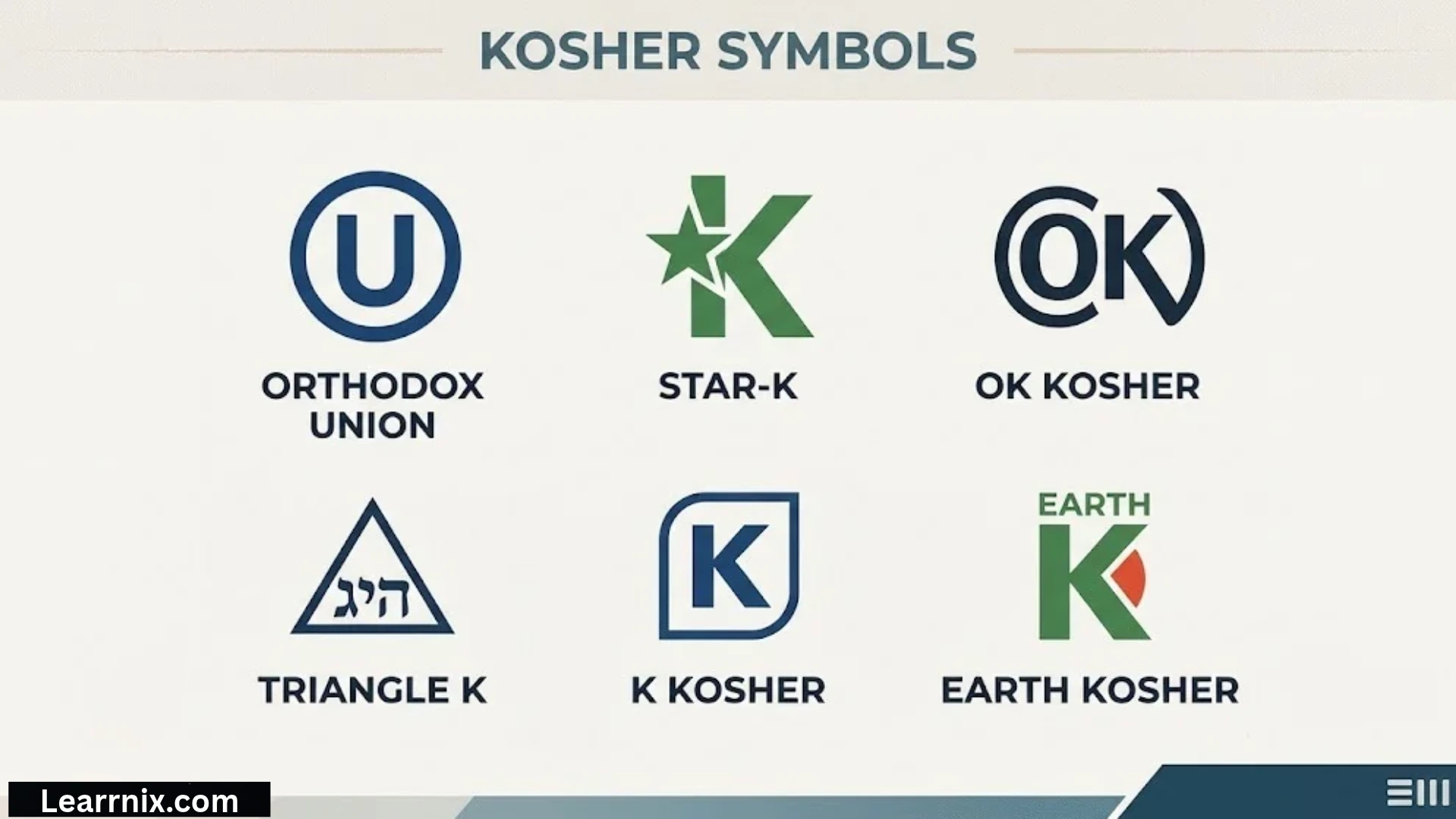
Kosher symbols help shoppers identify foods that meet Jewish dietary requirements. These small marks appear on packaged foods, drinks, snacks, dairy products, and many other grocery items. Learning to recognize them makes shopping easier, especially when a product carries a certification mark that you have never seen before.
There are several kosher certification symbols used in the United States, including OU, OK, Kof-K, and cRc. Although these symbols may look similar at first, each one identifies a certification organization or program. Some marks also include additional letters that indicate whether a product is dairy, meat, or pareve (neither meat nor dairy).
This guide explains kosher symbols and their meanings, shows common certification marks in easy-to-recognize text descriptions, and explains how to read food labels. You will also learn about OU and cRc certification, potentially unreliable symbols, and practical ways to check whether a product meets your dietary requirements.
Kosher Symbols and Meanings
Kosher symbols are certification marks placed on food packaging to show that a product has been reviewed under the standards of a kosher-certifying organization. The word kosher means suitable or fit according to Jewish dietary law, known as kashrut.
A symbol can tell shoppers that a certifying organization has assessed relevant ingredients, manufacturing processes, equipment, and other requirements within its certification program. The exact scope depends on the organization and the product.
Here are some common kosher certification marks and their general meanings:
| Symbol or Mark | Meaning |
| OU | Orthodox Union kosher certification |
| OK | OK Kosher certification |
| Kof-K | Kof-K kosher certification |
| cRc | Chicago Rabbinical Council certification or kosher information associated with the organization |
| Star-K | Star-K kosher certification |
| K | A letter K used by a manufacturer or certifier; its reliability depends on the source |
A certification mark should be interpreted according to the organization that issues it. A plain letter K does not automatically provide the same assurance as a recognizable, verifiable certification mark.
Some symbols include extra letters. For example, a D beside a kosher symbol commonly indicates dairy status, while P may indicate Passover certification. The exact interpretation should be confirmed through the certifying organization.
Kosher Symbols on Food
Kosher symbols commonly appear on the front, back, or side of food packages. You may find them near the ingredients list, nutrition facts panel, product name, or manufacturer information. Their placement varies by brand and packaging design.
Common products carrying kosher certification include:
- Breakfast cereals, crackers, and packaged snacks.
- Bread, cookies, cakes, and other baked goods.
- Milk, cheese, yogurt, and dairy alternatives.
- Canned vegetables, sauces, soups, and seasonings.
- Chocolate, candy, soft drinks, and bottled beverages.
- Frozen meals, processed foods, and packaged meat products.
The presence of a kosher symbol does not mean that a food is organic, vegetarian, vegan, gluten-free, or healthier than a non-certified alternative. Kosher certification addresses kosher requirements, not every other dietary preference.
For example, a kosher-certified chocolate bar may contain milk and therefore be unsuitable for someone avoiding dairy. A kosher-certified snack may also contain gluten. Always check the ingredient list and relevant allergen statements for additional dietary needs.
It is also useful to distinguish between a product’s ingredients and its manufacturing status. Some ingredients may be kosher individually, but production equipment, processing aids, or shared manufacturing arrangements can affect the certification decision.
cRc Kosher Symbols
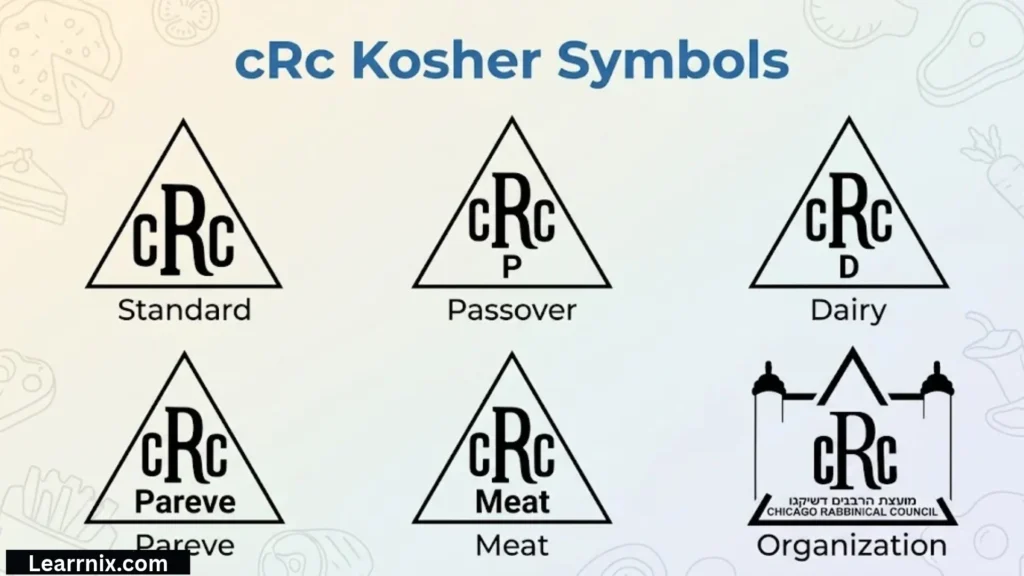
The Chicago Rabbinical Council, commonly abbreviated as cRc, is a kosher-certification and Jewish community organization based in the Chicago area. Its kosher division provides certification services and publishes information to help consumers make informed choices.
The term cRc kosher symbols may refer to the organization’s certification mark or to kosher symbols and product information discussed in its consumer resources.
When checking a product, look for the exact cRc mark and any accompanying designation. Do not assume that every appearance of the letters “cRc” on a package represents kosher certification; the context and authenticity of the mark matter.
The cRc also provides kosher guidance that can help consumers understand products, ingredients, and certification questions. Its published information may distinguish between a product that is certified, one that is acceptable under particular conditions, and one that requires further investigation.
If you are unsure about a specific item, use the organization’s official kosher resources or contact the certifier. Confirm the exact product name, brand, flavor, and manufacturing details when possible. Similar products from the same company can have different certification statuses.
Kosher Symbols on Food in USA
In the United States, kosher certification is provided by many organizations, each with its own mark and certification procedures. Shoppers may encounter American certification marks on domestic products as well as imported foods sold in supermarkets.
Some widely recognized marks include:
| Kosher Symbol | Certifying Organization |
| OU | Orthodox Union |
| OK | OK Kosher Certification |
| Kof-K | Kof-K Kosher Supervision |
| Star-K | Star-K Kosher Certification |
| cRc | Chicago Rabbinical Council |
| KSA | Kosher Supervision of America |
These marks are not interchangeable logos. Each identifies a particular organization, and the exact product must fall within that organization’s certification program.
When buying groceries, check the symbol on the actual package rather than assuming that every item made by a familiar brand is certified. Certification may cover certain flavors, sizes, factories, or product lines but not others.
Imported products can also carry kosher symbols from organizations outside the United States. If you do not recognize a mark, verify the organization and its current certification rather than judging its reliability by appearance alone.
Food Label Kosher Symbols
Food labels often contain additional letters beside a kosher certification mark. These letters help explain a product’s kosher category and whether it meets special dietary requirements.
| Label Example | Common Meaning |
| OU | Certified kosher; generally pareve under OU labeling conventions |
| OU-D | Dairy or classified as dairy under the certifier’s rules |
| OU-DE | Produced on dairy equipment |
| OU-M | Meat or a product classified as meat |
| OU-F | A designation related to fish ingredients under the certifier’s rules |
| OU-P | Certified for Passover |
These examples describe OU’s labeling system. Other organizations may use different formats, so do not assume every letter has exactly the same meaning across all certifiers.
What Do D, DE, P, and Pareve Mean?
- D — Dairy: The product contains dairy ingredients or is classified as dairy by the certifier.
- DE — Dairy Equipment: The product has been made on dairy equipment under the certifier’s applicable rules. It does not necessarily contain dairy ingredients.
- P — Passover: When used as a Passover designation, it indicates certification for that holiday. Do not automatically interpret P as pareve.
- Pareve or Parve: The product is classified as neither meat nor dairy under kosher law. It may still contain eggs or fish, so pareve does not automatically mean vegan.
These distinctions are especially useful when checking snacks, chocolate, baked goods, and foods that might be served alongside meat or dairy. For specific dietary practices, follow the relevant certifier’s guidance or consult a trusted rabbinic authority.
What Are the Kosher Symbols
Kosher symbols, also known as hechsherim (singular: hechsher), are marks that identify kosher certification or supervision. They help consumers determine whether a packaged food has been assessed under the standards of a particular kosher authority.
There is no single universal kosher symbol. Different certification organizations use distinct designs, such as letters inside circles, stars, or other recognizable emblems.
The main purpose of a kosher mark is to provide assurance about a product’s kosher status. Depending on the certification, the organization may assess ingredients, suppliers, production facilities, equipment, and manufacturing procedures.
For example, a circle containing the letters OU identifies Orthodox Union certification. A circle containing OK identifies OK Kosher Certification. The letters cRc identify the Chicago Rabbinical Council in relevant certification contexts.
A symbol alone does not necessarily tell you everything about a product. You may also need to check its dairy or meat status, Passover designation, and the precise product covered by the certification.
Different Kosher Symbols
Kosher symbols vary in shape, lettering, and the organization that issues them. Recognizing several common designs makes it easier to identify certification marks when shopping.
The following descriptions help distinguish the symbols, although plain text cannot reproduce every organization’s exact graphical logo.
- OU: The letters OU arranged in the Orthodox Union’s familiar emblem.
- OK: The letters OK displayed within the organization’s certification design.
- Kof-K: A distinctive Kof-K certification emblem.
- Star-K: A star-based emblem associated with Star-K certification.
- cRc: The initials of the Chicago Rabbinical Council in the appropriate certification context.
- KSA: An abbreviation associated with Kosher Supervision of America.
- Circle K: A K enclosed in a circle; its meaning depends on the actual certifier represented.
Some symbols may appear similar because they use common shapes and letters. That does not make them the same certification mark. A circle around a K, for instance, should not automatically be treated as an OK logo or as proof of certification by a specific organization.
When identifying a mark, compare its exact design and accompanying letters with the certifier’s official information. This is more reliable than relying on visual resemblance alone.
Common Kosher Symbols
The following list is a useful starting point for shoppers who want to recognize common kosher certification names.
| Symbol Name | What to Look For |
| OU | Orthodox Union emblem |
| OK | OK Kosher emblem |
| Kof-K | Kof-K certification logo |
| Star-K | Star-K certification logo |
| cRc | Chicago Rabbinical Council mark |
| KSA | Kosher Supervision of America mark |
| K | A standalone letter whose meaning needs verification |
The first six entries identify particular certification organizations. The last entry is different: a plain K may be printed by a manufacturer without identifying a specific certifying organization.
A product’s certification status can also change. Recipes may be reformulated, suppliers may change, or certification arrangements may end. For this reason, the mark on the current package matters more than a picture of an older package found elsewhere.
For a quick grocery check, locate the symbol, identify the certifier, read any additional letters, and confirm that the mark applies to the exact product you are purchasing.
Jewish Kosher Symbols
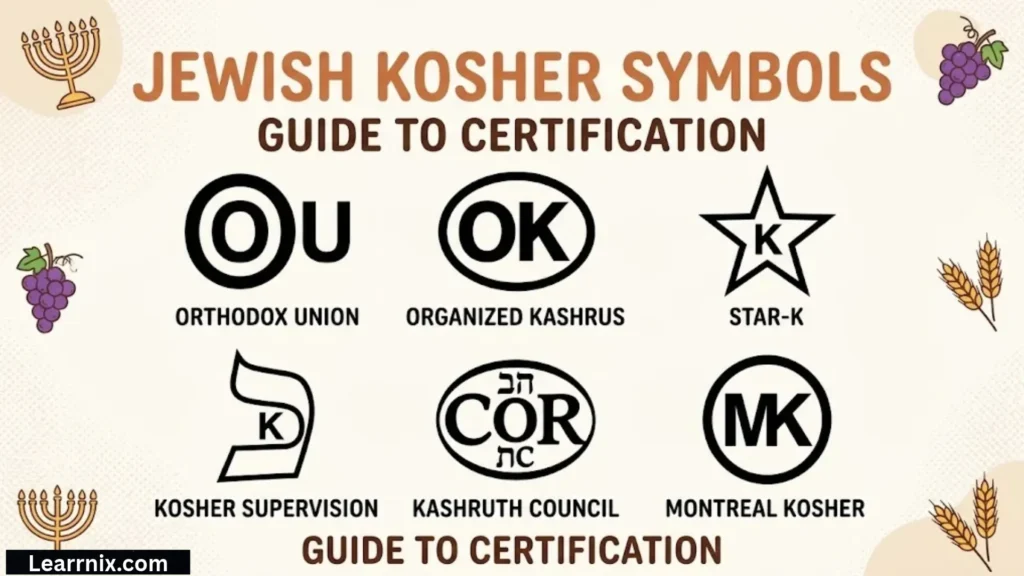
Jewish kosher symbols are connected to kashrut, the body of Jewish dietary laws governing which foods are permitted and how food is prepared. A certification mark helps consumers who follow these laws identify products that have been reviewed by a recognized kosher authority.
Kosher dietary practice includes several important principles:
- Permitted Animals: Jewish dietary law distinguishes between permitted and prohibited animal species.
- Meat and Dairy Separation: Meat and dairy are kept separate according to kosher rules.
- Ingredient Requirements: Ingredients and processing aids must meet the applicable kosher standards.
- Food Preparation: Equipment, production lines, and manufacturing procedures may affect a product’s status.
- Holiday Requirements: Passover has additional dietary restrictions, so ordinary kosher certification does not automatically establish Passover suitability.
A kosher symbol does not represent one universal Jewish tradition or guarantee that every Jewish consumer follows the same certification policy. People and communities may rely on different authorities and have different requirements for particular products.
For example, someone may accept a certification from one organization while asking a rabbi about another unfamiliar mark. When the correct choice depends on personal religious practice, checking with a trusted rabbinic authority is appropriate.
Kosher Symbols cRc
The cRc abbreviation refers to the Chicago Rabbinical Council. Its kosher division offers certification and consumer guidance about kosher food and related questions.
When you see a cRc mark or reference on packaging, check that it is genuinely associated with the organization and applies to the product in question. The mere appearance of the letters does not establish that a product is certified.
The cRc is also a source of practical guidance on complicated label questions. For example, its consumer information discusses the difference between dairy ingredients and dairy equipment, a distinction that can be confusing when a food does not appear to contain milk.
A useful way to evaluate a product is to check the exact name, flavor, and package details against current certification information. If the product’s status is unclear, contact the organization or seek guidance from a rabbi familiar with your requirements.
Unreliable Kosher Symbols
Not every letter, logo, or statement that looks kosher-related represents reliable certification. Some marks identify a genuine certifier, while others may be informal manufacturer claims or unclear references that need further investigation.
The most important example is a plain K. A manufacturer may print the letter K to indicate that it considers a product kosher, but the letter alone does not identify which authority supervised or certified it. A standalone K is not equivalent to a uniquely identifiable certification mark from a named organization.
Warning Signs to Check
- An Unexplained K: The package shows a K without identifying a certifying organization.
- An Unfamiliar Logo: You cannot find reliable information about the organization behind the mark.
- A Vague Claim: The packaging says “kosher ingredients” but does not establish that the finished product is certified.
- An Outdated Mark: The symbol appears in an old image, but current certification cannot be confirmed.
- A Questionable Label: The mark looks altered, unclear, or inconsistent with the organization’s published design.
- An Incorrect Assumption: You assume that certification of one product means every product from that brand is certified.
An unfamiliar symbol is not automatically unreliable. Many legitimate certification organizations exist, and not all marks are widely known. The right response is to verify the certifier rather than reject every unfamiliar logo.
For packaged foods, look for the certifying organization’s name, check its official consumer resources, and confirm that the mark applies to the exact item. If your household follows a particular kosher standard, ask a trusted rabbi whether the certification meets that standard.
Kosher Symbols K
The letter K is often associated with kosher food, but its meaning depends on how it is used. It may appear as a manufacturer’s claim, as part of a registered certification logo, or within a larger symbol belonging to a particular organization.
For example, the K in a recognizable Circle K certification mark is different from a plain K printed without an identifiable certifier. The shape surrounding a letter matters, and so does the organization responsible for the mark.
Here is how to distinguish some common forms:
| Mark | How to Interpret It |
| K | A standalone letter; check who is making the claim |
| Circle K | May identify a particular certification mark; verify the organization |
| K-D or K Dairy | May indicate dairy status within a specific certification system |
| K-P | May indicate Passover certification in a particular system |
| K-M | May indicate meat status in a particular system |
These examples are descriptive, not a universal labeling standard. The exact meaning depends on the certifier, and the letters should not be interpreted without that context.
If you need dependable kosher assurance, do not rely on the letter K alone. Identify the certifying authority and confirm its requirements. This is especially important for processed foods, where ingredients and manufacturing equipment can affect kosher status.
OU Kosher Symbol List
The Orthodox Union (OU) is a major kosher-certification organization. Its symbol is widely encountered on packaged foods in the United States and on products sold internationally.
The OU uses different designations to communicate information about kosher status. The following table summarizes several of its familiar marks.
| OU Designation | General Meaning |
| OU | Certified kosher; generally pareve under OU conventions |
| OU-D | Dairy or a product classified as dairy |
| OU-DE | Produced on dairy equipment |
| OU-M | Meat or meat-classified product |
| OU-F | A designation related to fish ingredients |
| OU-P | Certified for Passover |
These designations follow OU’s own labeling explanations. Always consult the organization’s current guidance if a particular product or letter raises questions.
How to Read OU Labels Correctly
OU: A plain OU mark generally indicates a pareve product under OU conventions, meaning it is neither meat nor dairy. However, consumers should still check the ingredients and any other label information.
OU-D: This designation indicates dairy status under the OU system. A product can be classified as dairy because of its ingredients or because of the equipment used to make it.
OU-DE: This designation identifies dairy equipment rather than necessarily indicating dairy ingredients. Its practical implications can depend on the consumer’s kosher practice.
OU-M: This designation identifies a product classified as meat. Meat and dairy are kept separate under kosher dietary law.
OU-F: This designation concerns fish ingredients under OU rules. Fish has its own place in kosher dietary practice and is not treated exactly like meat or dairy.
OU-P: This mark indicates Passover certification. Passover involves additional dietary requirements, so ordinary kosher certification is not enough to establish that a product is suitable for the holiday.
One important point is that the OU mark applies to the specific product bearing it. Do not assume that every flavor or version from the same brand has the same certification.
Kosher Symbols USA
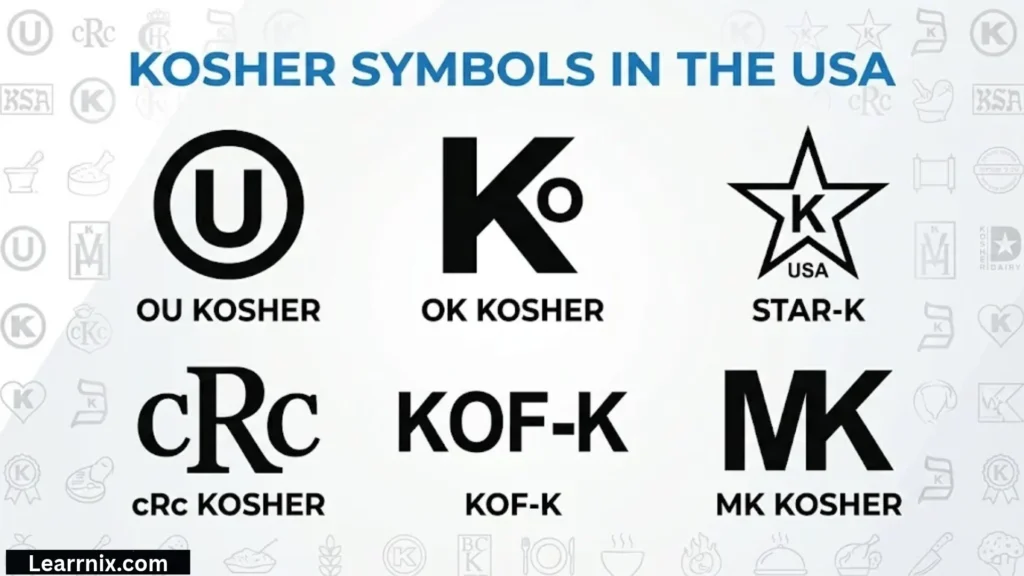
Kosher symbols in the USA come from a range of certification organizations. While some marks are familiar to shoppers nationwide, others are associated with particular communities, regions, or certification programs.
The most useful approach is to recognize the organization rather than memorize every logo. OU, OK, Kof-K, Star-K, and cRc are examples of established certification names that consumers may encounter on American food packaging.
When comparing products, keep these points in mind:
- Check the Actual Package: Look for the certification mark on the product you intend to buy.
- Identify the Certifier: Make sure you know which organization the mark represents.
- Read the Designation: Letters such as D, DE, M, F, and P may provide additional information.
- Check the Exact Product: Certification can differ between flavors, product lines, and manufacturing locations.
- Verify Unfamiliar Marks: Use current information from the certifying organization rather than relying on an unverified image.
American shoppers may also encounter kosher symbols on imported foods. A foreign mark is not automatically unreliable, just as a familiar-looking mark is not automatically sufficient. The organization behind the symbol and the product’s current certification are what matter.
What Are Kosher Symbols on Food
Kosher symbols on food are marks that help consumers identify products certified or supervised under kosher dietary standards. They are especially useful for processed foods because the ingredients alone may not reveal everything about how a product was manufactured.
For instance, a snack may contain familiar ingredients but be produced on equipment that requires additional kosher review. Certification can account for factors that are difficult for an ordinary shopper to evaluate from the ingredients list alone.
When you inspect a package, look for three kinds of information:
- Certification Mark: The logo identifies the organization responsible for certification.
- Product Category: Additional letters may explain whether the food is dairy, meat, or another designated category.
- Other Dietary Information: The ingredient list and allergen statement help you assess concerns that kosher certification does not cover.
It is also useful to distinguish a kosher mark from a vegetarian symbol, vegan label, organic seal, or allergen-free claim. These labels serve different purposes and should not be treated as interchangeable.
If a product has no recognizable kosher mark, that does not necessarily mean every ingredient is prohibited under Jewish dietary law. However, if you require certified products, an ingredient list or a manufacturer’s general statement is not a substitute for the certification standard you follow.
Frequently Asked Questions
What are the most common kosher symbols?
The most common kosher certification names include OU, OK, Kof-K, Star-K, and cRc. Each represents a specific organization, so check the exact mark and its certification status.
What does the K symbol mean on food?
A plain K may indicate a manufacturer’s kosher claim, but it does not identify a specific certifying organization by itself. Check the source before relying on it as certification.
Does an OU symbol mean a product is dairy-free?
A plain OU symbol generally indicates pareve status under OU labeling conventions. However, OU-D indicates dairy classification, and consumers should check the complete label and current OU guidance.
What is the difference between kosher and kosher for passover?
Kosher certification addresses Jewish dietary requirements throughout the year. Passover certification addresses additional holiday restrictions, so an ordinary kosher symbol does not automatically mean a product is suitable for Passover.
Are all kosher symbols in the united states reliable?
No symbol should be accepted solely because it looks familiar. Verify the certifying organization, check the mark on the actual product, and consult a trusted rabbi if you are unsure whether a certification meets your standards.
Conclusion
Kosher symbols make it easier for consumers to identify foods that have been certified according to Jewish dietary requirements. Recognizing marks such as OU, OK, Kof-K, Star-K, and cRc can help you navigate grocery shelves and understand the information printed on food packaging.
The letters accompanying a certification mark are also worth checking. D and DE relate to dairy status or equipment, M indicates a meat classification in certain systems, F can relate to fish, and P often indicates Passover certification. Their exact meanings depend on the organization issuing the mark.
The best habit is to verify the symbol, identify the certifier, and check the specific product rather than relying on assumptions. If you encounter an unfamiliar mark or have questions about your personal kosher standards, seek current guidance from the certifying organization or a trusted rabbi.

I am Michael Carter, an educational content creator who believes that knowledge has the power to transform lives.
I create resources focused on modern education, digital learning, and building essential skills for the future.
I love helping readers discover simple and effective ways to improve their learning journey.
Books by Michael Carter:
- Modern Education for Tomorrow’s World
- Learning Skills for Future Success
 Charlotte Anderson
 Daniel Harper