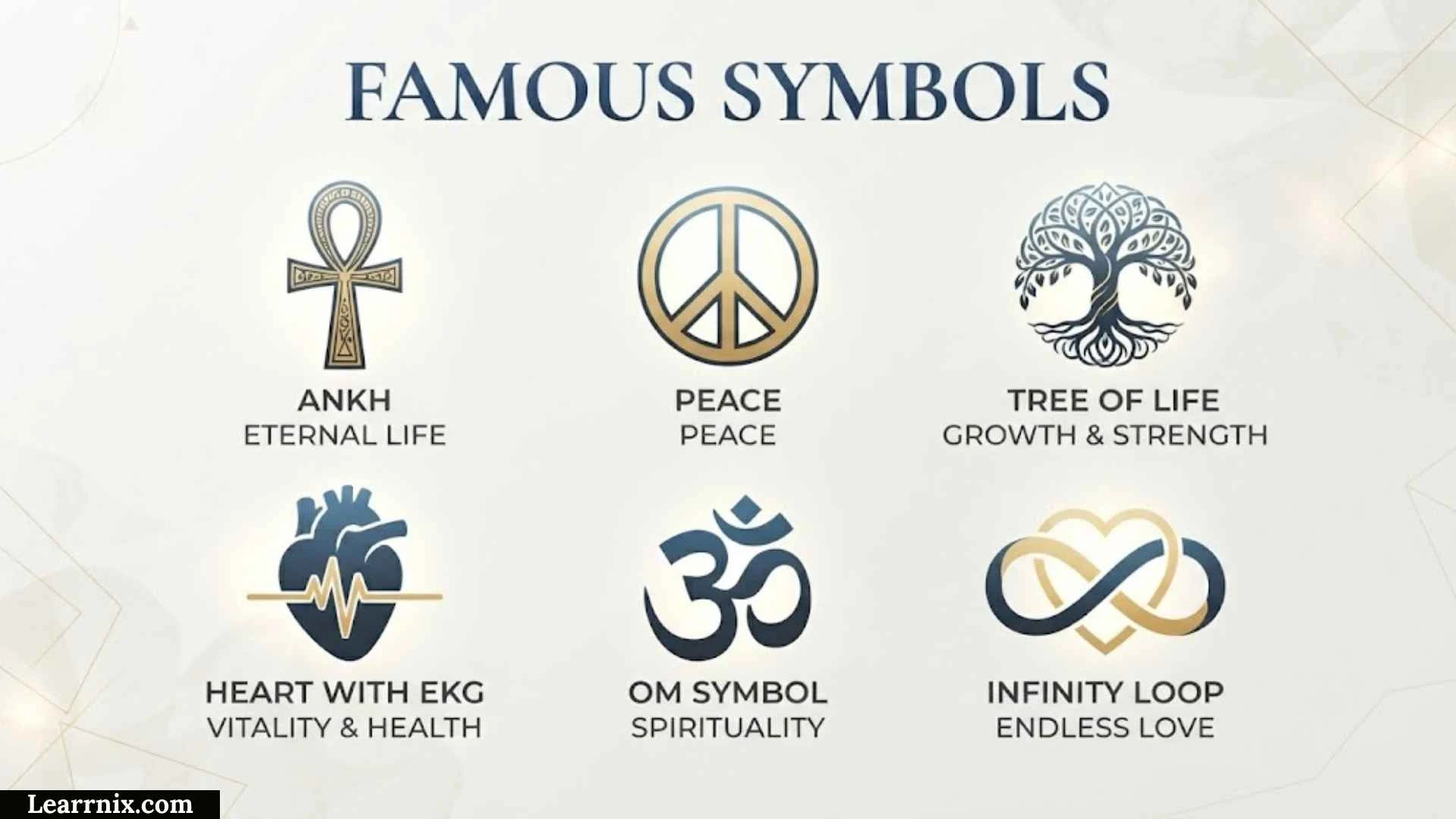
Famous symbols help people communicate ideas, identities, beliefs, warnings, and emotions without relying on long explanations. A heart can suggest love, a dove can represent peace, the recycling symbol can communicate an environmental message, and the infinity sign can express the idea of something without a finite limit.
But famous symbols are much more than a collection of familiar pictures. Their meanings come from history, religion, culture, science, mathematics, government, technology, design, and repeated social use. Some symbols have ancient origins, while others became globally familiar through modern communication and digital technology.
This guide explains famous symbols, what they mean, where they come from, how their meanings developed, and how to interpret them correctly. It covers religious symbols, cultural symbols, national symbols, scientific and mathematical symbols, environmental signs, technology icons, famous symbols of love and peace, and symbols associated with strength, protection, freedom, hope, and other ideas.
It also addresses an important question that is often overlooked: Does a famous symbol have one universal meaning? Usually, no. A symbol can have different meanings depending on its historical period, culture, community, and context.
Quick Answer: What Are Famous Symbols?
Famous symbols are recognizable signs, images, objects, characters, or designs that communicate an idea, identity, concept, organization, belief, or function.
Common examples include:
- ❤️ Heart — love and affection
- ☮ Peace symbol — peace and peace activism
- ♻ Recycling symbol — recycling and recyclable materials
- ⚕ Rod of Asclepius — medicine
- ∞ Infinity symbol — infinity or unboundedness
- ☯ Yin-yang — complementary forces and balance
- ✝ Cross — Christianity
- ☪ Star and crescent — commonly associated with Islam
- 🕉 Om — sacred sound and spiritual traditions
- @ At sign — email and digital communication
- # Number sign/hashtag — numbering and online tagging
- ⚛ Atom symbol — atomic or nuclear science
There is no official worldwide ranking of the “most famous” symbols. Recognition varies by country, culture, education, age, and context.
Unicode’s current documentation illustrates how broad the category of symbols is, including mathematical, currency, astronomical, religious, ideological, recycling, medical, and other symbols.
What Makes a Symbol Famous?
A symbol generally becomes famous through a combination of recognition, repeated use, cultural importance, and effective visual communication.
Simple Designs Are Easier to Remember
A simple shape can often be recognized much faster than a complicated image.
Consider a heart, a plus sign, a recycling loop, or a magnifying glass. Each has a relatively simple visual structure, making it useful in communication.
This is particularly important when people need to understand something quickly.
Historical Use Builds Meaning
Some symbols have been used for centuries or even much longer.
Religious signs, national emblems, astronomical symbols, and traditional cultural motifs often become recognizable because generations of people encounter them repeatedly.
Historical use can give a symbol layers of meaning that cannot be explained by its appearance alone.
Institutions Can Spread Symbols
Governments, scientific organizations, international bodies, businesses, schools, and technology companies can make symbols widely recognized.
For example, a symbol used consistently on public signs can become familiar even to people who do not speak the local language.
Digital Communication Can Make Symbols Global
The internet has dramatically increased the spread of symbols.
Characters such as @, #, emojis, check marks, and interface icons can now be recognized by people across many languages.
Unicode’s documentation notes that symbols can represent many types of non-linguistic content, including mathematical, currency, astronomical, religious, and other information.
Famous Symbols and Their Meanings
The following table provides a broad starting point for understanding common symbols.
| Symbol | Common Meaning or Association | Category |
| ❤️ Heart | Love, affection, care | Cultural |
| ☮ Peace Symbol | Peace, nonviolence, peace activism | Social |
| 🕊 Dove | Peace, hope, reconciliation | Cultural/Religious |
| ♻ Recycling | Recycling, recyclable materials | Environmental |
| ⚕ Rod of Asclepius | Medicine and healing | Medical |
| ☯ Yin-Yang | Complementarity and balance | Philosophical |
| ✝ Cross | Christianity | Religious |
| ☪ Star and Crescent | Commonly associated with Islam | Religious/Cultural |
| 🕉 Om | Sacred sound and spiritual traditions | Religious |
| ☸ Wheel of Dharma | Buddhist tradition and teachings | Religious |
| ✡ Star of David | Judaism and Jewish identity | Religious/Cultural |
| ☬ Khanda | Sikh tradition and identity | Religious |
| ∞ Infinity | Infinity or unboundedness | Mathematical |
| ⚛ Atom | Atomic or nuclear science | Scientific |
| $ Dollar Sign | Dollar currencies | Financial |
| © Copyright | Copyright notice | Legal |
| ® Registered Trademark | Registered trademark | Commercial/Legal |
| ™ Trademark | Trademark designation | Commercial |
| @ At Sign | Email and digital communication | Digital |
| # Hashtag | Number sign and digital tagging | Digital |
| ⚠ Warning | Caution or hazard | Safety |
| ⚖ Scales | Law and justice | Legal |
| ⚓ Anchor | Nautical themes, stability | Maritime/Cultural |
| ⚙ Gear | Technology, machinery, tools | Technical |
These associations are general rather than universal. Unicode’s current symbol charts, for example, identify the peace symbol, yin-yang, star and crescent, Wheel of Dharma, medical staff, scales, atom, anchor, and recycling symbols as distinct encoded symbols.
Famous Symbols of Love
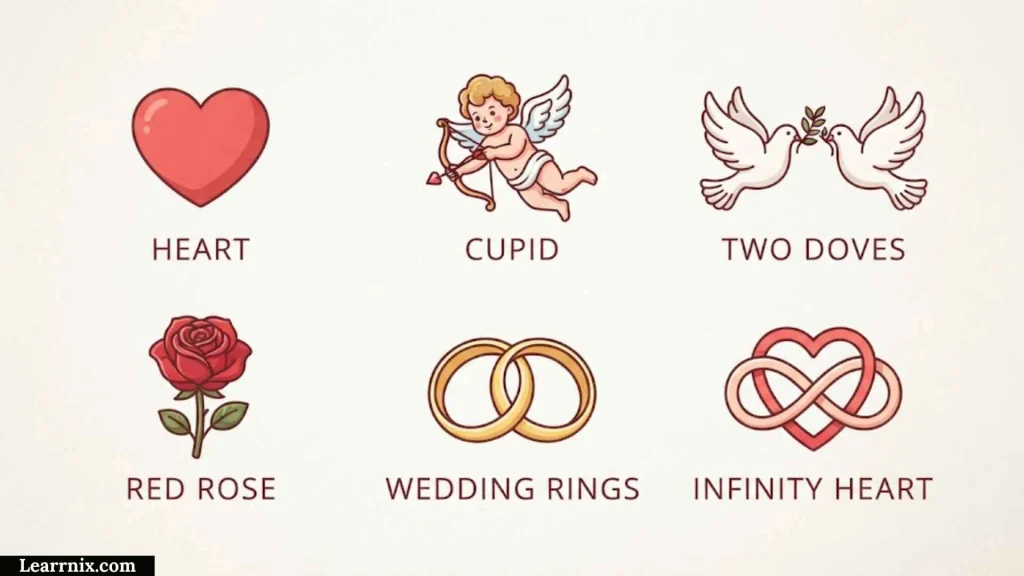
Love is one of the most common ideas represented through symbols.
Heart Symbol
The heart is probably the most familiar visual symbol associated with romantic love and affection.
It can communicate:
- Love
- Romance
- Friendship
- Care
- Compassion
- Emotional attachment
The stylized heart does not closely resemble the anatomical human heart. Its modern visual form developed through artistic and cultural traditions rather than through anatomical accuracy.
Today, the heart appears everywhere from greeting cards and jewelry to social media messages and advertising.
Broken Heart
A broken heart changes the basic meaning of the heart symbol.
It commonly represents:
- Heartbreak
- Loss
- Separation
- Unrequited love
- Emotional pain
This illustrates an important principle of symbolism: small visual changes can significantly alter the meaning of a familiar symbol.
Heart vs. Rose
The heart is a direct visual shorthand for love.
The rose can also represent love, but its meaning is more dependent on cultural tradition, color, and context.
For example, red roses are strongly associated with romantic love in many modern contexts.
Famous Symbols of Peace
Peace is represented by several famous symbols rather than one universal sign.
Peace Symbol
The modern peace symbol is a circle containing a distinctive set of lines.
It became particularly associated with the British Campaign for Nuclear Disarmament after its creation in 1958 and later became widely used by peace and anti-war movements.
Unicode identifies the mark as the PEACE SYMBOL.
Dove Symbol
The dove is another well-known peace symbol.
A white dove can represent:
- Peace
- Hope
- Reconciliation
- Nonviolence
The dove has much older religious and cultural associations than the modern peace sign.
Olive Branch
The olive branch is also strongly associated with peace and reconciliation.
Its historical associations extend into ancient Mediterranean traditions and later religious and cultural interpretations.
Why Are There Several Peace Symbols?
Because symbols develop through different historical paths.
A peace sign created for a modern social movement does not have the same origin as a dove or olive branch from ancient traditions.
They can communicate related ideas while having completely different histories.
Famous Religious Symbols
Religious symbols are among the most historically significant symbols in human culture.
Examples include:
- Cross
- Star of David
- Om
- Dharma wheel
- Khanda
- Star and crescent
- Yin-yang in relevant philosophical/religious contexts
- Menorah
Unicode’s current emoji and symbol documentation includes the Latin cross, Orthodox cross, Star of David, Om, Wheel of Dharma, yin-yang, star and crescent, peace symbol, menorah, and Khanda among its encoded religious or culturally associated symbols.
Cross
The cross is strongly associated with Christianity.
The Latin cross is particularly recognizable, while different Christian traditions use other forms, including the Orthodox cross and other regional or historical designs.
The meaning of the cross is connected to central Christian beliefs concerning the crucifixion and resurrection of Jesus.
Star of David
The six-pointed Star of David is widely associated with Judaism and Jewish identity.
Its history is more complex than simply describing it as an ancient universal symbol of Judaism. Its widespread modern association with Jewish identity developed over time.
Om
The Om symbol, commonly written as ॐ, has major significance in Hindu traditions and also appears in other Indian religious and philosophical contexts.
It is associated with sacred sound, spiritual practice, meditation, and concepts of ultimate reality.
It should not be treated merely as a decorative “spiritual” icon because its meaning is rooted in specific traditions.
Wheel of Dharma
The Dharma wheel, commonly represented as ☸, is strongly associated with Buddhism.
Its meaning relates to Buddhist teachings and the path of practice.
Different representations may contain different numbers of spokes, depending on the context and the concept being represented.
Khanda
The Khanda is associated with Sikhism.
It has several components and is closely connected with Sikh religious identity and teachings.
Unicode identifies the Khanda as a Sikh religious symbol.
Star and Crescent: Meaning and Context
The star and crescent is one of the most recognizable symbols associated with Islam in modern popular culture.
However, it is important to distinguish modern association from historical origin.
Is the Star and Crescent the Universal Symbol of Islam?
No.
Islam does not have a single universally required symbol used by all Muslims.
The crescent and star became strongly associated with Muslim-majority states, particularly through its historical association with the Ottoman Empire and later national flags.
It is therefore more accurate to say that the symbol is widely associated with Islam and Muslim identity in modern contexts, rather than claiming that it is an official universal symbol of the religion.
Famous Symbols of Strength
Strength can be represented in several ways.
Lion
The lion is widely used as a symbol of:
- Strength
- Courage
- Leadership
- Royal authority
Its use appears in heraldry, national imagery, literature, sports, and organizational branding.
Eagle
The eagle is often associated with:
- Power
- Freedom
- Vision
- Leadership
- Sovereignty
Its meaning varies by culture and national context.
Mountain
Mountains can symbolize:
- Strength
- Stability
- Endurance
- Achievement
- Challenges overcome
Unlike a formal religious or scientific symbol, the mountain’s meaning is usually metaphorical and context-dependent.
Famous Symbols of Freedom
Freedom is represented by different symbols across cultures.
Liberty Bell
The Liberty Bell is an important American historical symbol associated with independence and liberty.
Its significance comes from its historical context rather than from the shape of a bell itself.
Statue of Liberty
The Statue of Liberty is widely associated with:
- Liberty
- Freedom
- Immigration
- Opportunity
It is a national landmark with a much more specific historical context than a generic “freedom symbol.”
Broken Chains
Broken chains are commonly used in political, historical, and artistic contexts to represent freedom from oppression or captivity.
The interpretation depends strongly on the surrounding context.
Famous Symbols of Hope
Hope can be represented by several recurring images.
Sunrise
A sunrise can symbolize:
- New beginnings
- Hope
- Renewal
- A fresh start
Rainbow
The rainbow has many meanings depending on the culture and context.
It can represent:
- Hope
- Promise
- Diversity
- Peace
- Renewal
In modern contexts, it may also carry specific social or political associations.
Anchor
An anchor can symbolize:
- Stability
- Security
- Hope
- Grounding
It has a literal nautical meaning but can acquire metaphorical meanings in literature and art.
Famous Symbols of Protection
Protection is commonly represented by shields, eyes, animals, religious motifs, and other objects.
Shield
A shield naturally suggests:
- Defense
- Protection
- Security
- Strength
Because shields were historically used for physical defense, their symbolic meaning is easy to understand.
Eye
An eye can represent:
- Awareness
- Observation
- Knowledge
- Protection
- Divine watchfulness
But the meaning varies significantly among traditions.
Guardian Animals
Lions, eagles, dragons, and other powerful animals are often used in mythology and heraldry to represent protection or authority.
Famous Cultural Symbols
Cultural symbols communicate ideas connected with a particular community, region, tradition, or historical identity.
Examples can include:
- Traditional clothing
- Architectural motifs
- National flowers
- Animals
- Religious objects
- Musical instruments
- Food-related imagery
- Traditional patterns
Why Cultural Context Matters
A symbol can have a deeply specific meaning to one community.
Using it without understanding that context can lead to inaccurate or insensitive interpretations.
For example, describing every traditional geometric design as simply a “spiritual symbol” can erase the cultural history behind the design.
A stronger approach is to identify:
- The community associated with it.
- The historical period.
- The original use.
- The modern use.
- Whether the interpretation is documented or merely popular.
Famous National Symbols
National symbols can include:
- Flags
- Coats of arms
- National animals
- National birds
- National flowers
- National trees
- Monuments
- Historical emblems
Official vs. Popular National Symbols
This distinction is important.
A government may officially designate a national bird or flower through legislation or another formal process.
Another object may become widely associated with the country without having official status.
Therefore, “national symbol” can mean either an officially designated symbol or a widely recognized cultural representation, depending on context.
Famous Animal Symbols
Animals have been used symbolically throughout human history.
Lion
Common associations include:
- Courage
- Strength
- Royalty
- Leadership
Eagle
Common associations include:
- Freedom
- Power
- Vision
- Sovereignty
Owl
Often associated with:
- Wisdom
- Knowledge
- Observation
Dove
Often associated with:
- Peace
- Hope
- Reconciliation
Snake
The snake is particularly interesting because it can have opposing meanings.
It may represent:
- Healing
- Renewal
- Transformation
- Danger
- Deception
- Wisdom
The meaning depends heavily on the tradition and context.
This is why simply asking “What does a snake symbolize?” does not always have one correct answer.
Famous Flower Symbols
Flowers are frequently used to represent emotions, identities, places, and values.
Rose
Commonly associated with:
- Love
- Romance
- Beauty
Lotus
Often associated with:
- Purity
- Spiritual development
- Rebirth
The lotus has important meanings in several Asian religious and cultural traditions.
Lily
Depending on context, lilies can be associated with:
- Purity
- Renewal
- Mourning
- Spirituality
Sunflower
Often associated with:
- Happiness
- Optimism
- Warmth
- Positivity
These meanings are not universal rules. Flower symbolism changes across cultures and historical periods.
Famous Scientific Symbols
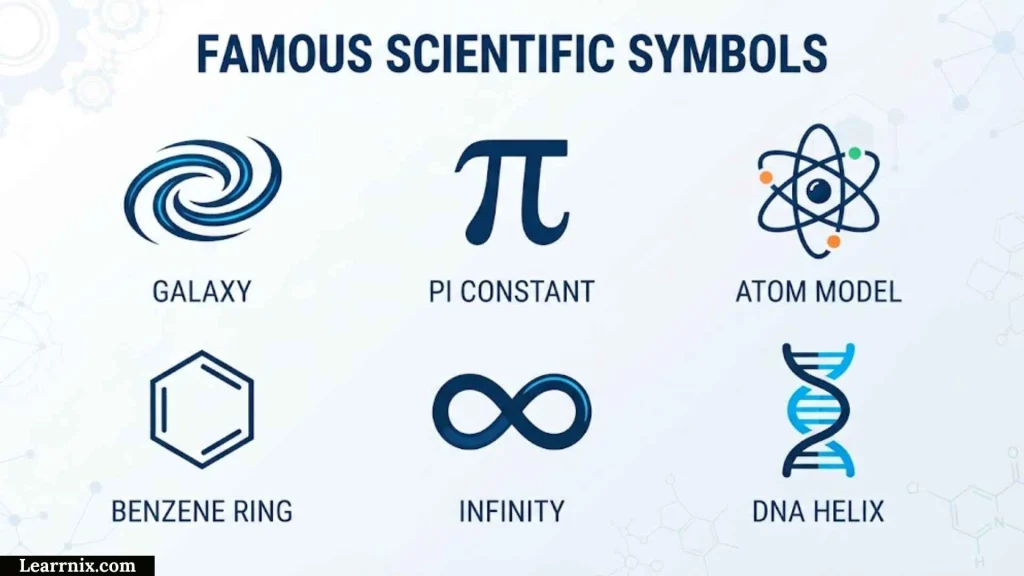
Science uses symbols to represent complex ideas efficiently.
Atom Symbol
The stylized atom symbol is widely associated with:
- Atomic science
- Nuclear energy
- Physics
- Radiation-related contexts
Unicode identifies ⚛ as the atom symbol and notes its use in contexts including nuclear installations on maps.
The familiar image should not be confused with a literal modern visualization of atomic structure.
Medical Symbol
The Rod of Asclepius consists of a serpent wrapped around a staff and is historically associated with medicine.
Unicode identifies ⚕ as the Staff of Aesculapius and distinguishes it from the caduceus.
Rod of Asclepius vs. Caduceus
This is one of the most useful symbol distinctions to know.
| Feature | Rod of Asclepius | Caduceus |
| Serpents | One | Two |
| Wings | No | Traditionally yes |
| Historical association | Asclepius and healing | Hermes and commerce |
| Medical use | Historically appropriate | Often used as a medical symbol in modern contexts |
| Main distinction | Medicine/healing | Commerce/heraldry |
Unicode’s historical documentation specifically discusses the common confusion between these two symbols and identifies their distinct origins.
Famous Mathematical Symbols
Mathematical symbols provide an efficient language for describing relationships.
| Symbol | Common Meaning |
| + | Addition |
| − | Subtraction |
| × | Multiplication |
| ÷ | Division |
| = | Equality |
| ≠ | Not equal |
| < | Less than |
| > | Greater than |
| ≤ | Less than or equal to |
| ≥ | Greater than or equal to |
| √ | Square root |
| π | Pi |
| ∞ | Infinity |
| % | Percentage |
Why Mathematical Symbols Need Context
A symbol can have more than one technical meaning.
For example, the Greek letter π has a well-known association with the circle constant, but Greek letters across mathematics and science can represent many different quantities.
Unicode notes that mathematical symbols are one of the major classes of symbols represented in the Unicode Standard.
Famous Environmental Symbols
Environmental communication depends heavily on symbols because people need to identify materials and environmental actions quickly.
Recycling Symbol
The recycling symbol ♻ is one of the most recognizable environmental symbols.
Unicode identifies the universal recycling symbol and several material-related recycling symbols.
Does the Recycling Symbol Guarantee Recycling?
No.
This is an important misconception.
A recycling symbol can communicate information about recyclable material or recycling, but whether a particular product is accepted depends on the relevant recycling system and local rules.
Material Codes
Different recycling-related symbols can indicate specific material categories.
Unicode’s documentation lists numbered plastic recycling symbols corresponding to different plastic types, including PET, HDPE, PVC, LDPE, polypropylene, polystyrene, and other plastics.
The symbol therefore can provide more information than simply saying “this item is recyclable.”
Famous Legal and Commercial Symbols
Modern commerce depends heavily on symbols.
Copyright Symbol
The copyright symbol © is widely used in copyright notices.
It commonly appears with a year and rights-holder information.
However, the presence or absence of the symbol should not be treated as a complete explanation of copyright protection. Copyright law varies by jurisdiction and involves more than the symbol itself.
Trademark Symbol
The ™ symbol can identify a mark being used as a trademark.
Registered Trademark
The ® symbol is associated with a registered trademark.
The legal rules for registration and use depend on the applicable jurisdiction.
For legal questions, official intellectual-property authorities are more reliable than generic symbol lists.
Famous Symbols in Technology
Technology has created a large collection of symbols that are now familiar to billions of users.
Power Symbol
The power symbol is commonly used on:
- Computers
- Phones
- Appliances
- Vehicles
- Electronics
Its familiarity comes from repeated use across different devices.
Wi-Fi Symbol
The Wi-Fi symbol communicates wireless network connectivity.
Bluetooth Symbol
The Bluetooth logo identifies Bluetooth wireless technology.
Search Icon
The magnifying glass has become a common visual shorthand for search.
Play and Pause Icons
A triangle commonly communicates “play,” while two vertical bars commonly communicate “pause.”
These symbols are powerful because users can often understand them without reading a label.
Famous Symbols in Transportation and Safety
Transportation systems depend on fast visual communication.
Examples include:
- Stop signs
- Pedestrian signs
- Parking symbols
- Airport pictograms
- Railway signs
- Emergency exits
- Warning signs
- Accessibility symbols
Why Standardization Matters
A driver, traveler, or visitor may encounter signs in a country where they cannot read the local language.
Recognizable pictograms reduce the amount of text needed.
However, not every symbol is globally identical. National and regional standards still matter.
Famous Symbols in Digital Communication
The internet has transformed ordinary typographic characters into globally recognized symbols.
At Sign
The @ symbol is now strongly associated with email addresses and online usernames.
Unicode explains that characters such as @, #, and % have interesting classification histories and are not all categorized identically within the Unicode Standard.
Hashtag
The # sign gained a major modern role through hashtags.
It can organize online content around a topic or phrase.
Emoji Symbols
Emoji have expanded visual communication by allowing people to express:
- Emotion
- Objects
- Activities
- Places
- Concepts
- Cultural references
Unicode maintains the technical standards behind many of the characters and emoji used in modern digital communication.
Ancient Symbols vs. Modern Symbols
Not all famous symbols developed in the same way.
Ancient Symbols
Ancient symbols often emerged through:
- Religion
- Astronomy
- Burial practices
- Mythology
- Art
- Writing
- Rituals
Their original meanings may be difficult to reconstruct with certainty.
Modern Symbols
Modern symbols are more likely to be created deliberately for:
- Organizations
- Campaigns
- Technology
- Safety systems
- Brands
- Public information
The modern peace symbol is an example of a symbol with a documented creation in a particular historical movement.
Why the Difference Matters
Knowing whether a symbol was deliberately designed or gradually developed can help you evaluate claims about its origin.
A common mistake is to assume that every famous symbol has one clearly documented creator.
Many do not.
Official Symbols vs. Popular Symbols
This distinction can significantly improve symbol research.
Official Symbol
An official symbol has a documented status established by an appropriate authority.
Examples can include:
- A legally designated national emblem
- A standardized safety sign
- An officially recognized organizational mark
Popular Symbol
A popular symbol may be widely recognized without having any formal legal or institutional designation.
Examples can include:
- Heart for love
- Dove for peace
- Lion for strength
- Sunrise for hope
Why This Matters
If you are writing an academic article, creating educational material, or making a factual claim, distinguish between:
“This is officially designated as…”
and
“This is commonly associated with…”
That small wording difference makes symbolic writing much more accurate.
How Symbols Change Meaning Over Time
Symbols are not frozen.
Their meanings can evolve as societies change.
Technology Can Change a Symbol
The @ sign existed before the internet but became much more prominent because of email and online communication.
The # sign similarly acquired a major new digital role through hashtags.
Political Events Can Change Symbols
A symbol may become associated with a movement, government, conflict, or historical event.
That association can become stronger than its earlier meaning.
Commercial Use Can Change Symbols
A traditional image may become strongly associated with a company or product after decades of branding.
This demonstrates why the meaning of a symbol should be researched within its historical and modern context.
How to Interpret a Famous Symbol Like an Expert
When you encounter an unfamiliar symbol, use this eight-part framework.
1. Identify the Shape
Ask what you are actually seeing:
- Animal
- Plant
- Geometric shape
- Letter
- Number
- Religious design
- Object
- Human figure
- Abstract mark
2. Identify the Context
Where did you see it?
- Flag
- Website
- Vehicle
- Religious building
- Book
- Product
- Jewelry
- Road
- Government document
- Social media
Context can narrow the meaning dramatically.
3. Determine Whether It Is Official
Ask whether a government, standards organization, religious institution, or other authority formally recognizes it.
4. Research Its Origin
Look for reliable historical evidence rather than assuming an attractive story about its origin is true.
5. Separate Historical and Modern Meanings
A symbol can have an original meaning and a completely different popular meaning today.
6. Check Cultural Differences
Ask whether the symbol means something different in another country or tradition.
7. Look for Similar Symbols
Compare the symbol with related designs.
This is particularly important for symbols such as the Rod of Asclepius and caduceus.
8. Identify the Intended Audience
A symbol on a road sign has a different communication purpose from one used in religious art or branding.
Decision Guide: How to Find the Meaning of an Unknown Symbol
You see an unfamiliar symbol
↓
Is it on a vehicle, machine, road, or safety device?
→ Check the owner’s manual, safety label, or applicable standard.
↓
Is it on a flag, seal, or government document?
→ Identify the country or institution first.
↓
Is it religious or spiritual?
→ Identify the specific tradition before assigning a meaning.
↓
Is it mathematical or scientific?
→ Examine the surrounding equation, field, or terminology.
↓
Is it on a product or package?
→ Check whether it represents a material, certification, trademark, recycling instruction, or safety message.
↓
Is it digital?
→ Check the application’s interface conventions.
↓
Is the origin unclear?
→ Compare reliable historical and institutional sources rather than relying on an unsourced symbol list.
Real-World Examples of Symbol Interpretation
Example 1: A Recycling Mark on Packaging
A shopper sees a recycling symbol on a plastic container.
A weak interpretation would be:
“This can definitely be recycled everywhere.”
A better interpretation is:
“The symbol is associated with recycling or material identification, but local recycling rules determine whether the item is actually accepted.”
This distinction prevents a common misunderstanding.
Example 2: A Medical Logo
Someone sees a staff with one serpent.
They identify it as the Rod of Asclepius.
That is more precise than calling every snake-and-staff symbol a “medical symbol,” because the caduceus has two serpents and a different historical origin.
Example 3: A Symbol on a Flag
A traveler sees a star-and-crescent design.
Instead of automatically saying “this is the official symbol of Islam,” they should identify the country and historical context first.
The same visual motif can function as part of a national flag without being a universal religious requirement.
Example 4: A Digital Symbol
A student sees @ in an email address.
They immediately recognize its digital function.
That interpretation is based on modern technological convention rather than the symbol’s original historical uses.
Common Mistakes When Researching Famous Symbols
Mistake 1: Treating One Meaning as Universal
Many symbols have multiple interpretations.
Mistake 2: Confusing Popularity With Official Status
A symbol can be famous without being officially designated.
Mistake 3: Ignoring Historical Context
A modern interpretation may not match the original use.
Mistake 4: Confusing Similar Symbols
Small design differences can carry major historical differences.
Mistake 5: Repeating Unsourced Symbol Myths
Many websites repeat attractive stories about symbols without providing reliable historical evidence.
For important claims, check museums, universities, standards bodies, government sources, religious institutions, or scholarly publications.
Mistake 6: Treating Decorative Use as Original Meaning
A symbol used on jewelry or clothing may be used for fashion rather than as a precise statement of belief.
How to Use Famous Symbols Responsibly
Before using a culturally or religiously significant symbol in a tattoo, logo, artwork, educational project, or commercial product, research it first.
Consider:
- Historical meaning
- Religious significance
- Cultural associations
- Modern political associations
- Trademark status
- Intended audience
- Whether the design has been altered
- Whether the symbol is being used respectfully
This is particularly important when the symbol belongs to a living religious or cultural tradition.
Famous Symbols for Different Ideas
The following quick reference can help when researching symbols by concept.
| Idea | Common Symbolic Examples |
| Love | Heart, rose |
| Peace | Peace sign, dove, olive branch |
| Strength | Lion, eagle, mountain |
| Freedom | Liberty Bell, broken chains, Statue of Liberty |
| Hope | Sunrise, rainbow, anchor |
| Protection | Shield, eye, guardian animals |
| Wisdom | Owl, book |
| Renewal | Phoenix, sunrise, lotus |
| Victory | Laurel wreath, raised hand |
| Justice | Scales |
| Medicine | Rod of Asclepius |
| Recycling | ♻ |
| Infinity | ∞ |
| Technology | Gear, power symbol |
| Accessibility | ♿ |
| Warning | ⚠ |
These are associations rather than universal definitions. The surrounding context should always be considered.
Why Symbol Meaning Is More Complicated Than a Dictionary Definition
A dictionary-style list might say:
Lion = strength
But real symbolism is more complicated.
A lion might represent:
- Royal authority
- Courage
- National identity
- A sports team
- A company
- A historical dynasty
- A religious or mythological figure
The meaning comes from the relationship between the image and its context.
This is why a strong symbol guide should explain not only what a symbol “means,” but also who uses it, where it appears, why it became associated with an idea, and whether that association is official or informal.
Frequently Asked Questions About Famous Symbols
What Are the Most Famous Symbols?
There is no universally accepted ranking. Widely recognizable examples include the heart, peace symbol, recycling symbol, cross, infinity sign, Rod of Asclepius, yin-yang, star and crescent, Om, @ sign, and common technology icons.
What Is the Most Famous Symbol of Love?
The heart is one of the most widely recognized symbols of love and affection.
What Is the Most Famous Symbol of Peace?
The modern peace symbol and the dove are both widely associated with peace. They have different historical origins.
What Symbol Represents Strength?
The lion, eagle, mountain, shield, and other powerful images are commonly used to symbolize strength. Their exact meanings depend on context.
What Symbol Represents Freedom?
The Statue of Liberty, Liberty Bell, broken chains, and other freedom-related imagery can represent liberty depending on the historical or cultural context.
What Symbol Represents Hope?
Common examples include the sunrise, rainbow, anchor, and sometimes a dove. There is no universal symbol of hope.
What Is the Medical Symbol?
The Rod of Asclepius is an important historical medical symbol. It features one serpent wrapped around a staff. It is different from the caduceus, which traditionally has two serpents and is associated with Hermes.
What Is the Meaning of the Yin-Yang Symbol?
Yin-yang represents complementary aspects or forces and is associated with Chinese philosophical traditions. It should not simply be reduced to “good versus evil.”
What Does the Recycling Symbol Mean?
The recycling symbol communicates an association with recycling or recyclable materials. However, its presence does not necessarily mean that a particular local recycling program accepts the item.
Is the Crescent and Star the Official Symbol of Islam?
No single symbol is universally required as an official symbol of Islam. The crescent and star is widely associated with Islam and appears in the national symbols of several Muslim-majority countries, but its history is broader and more complex.
Why Do Famous Symbols Have Different Meanings?
Symbols develop through different cultures, religions, historical periods, institutions, and social movements. A single visual form can therefore acquire several meanings.
Are Famous Symbols Universal?
Some symbols are widely recognized across countries, but recognition does not guarantee identical interpretation. Cultural and historical context remains important.
How Can I Identify an Unknown Symbol?
Identify its shape, location, surrounding text, color, and context. Then compare the symbol with authoritative references relevant to the subject, such as standards organizations, government agencies, universities, museums, or official institutions.
What Is the Difference Between a Symbol and an Icon?
The terms overlap, but an icon often visually resembles the thing it represents, while a symbol can represent an abstract idea through convention or cultural association. In everyday technology, however, “icon” is commonly used for interface graphics.
What Is the Difference Between a Symbol and a Sign?
The distinction varies by field. In general communication, a sign can communicate a specific instruction or piece of information, while a symbol often carries a broader or more abstract association.
Why Are Symbols Important in Communication?
Symbols can communicate ideas quickly, reduce dependence on language, create identity, and help people understand information in environments where there is little time to read.
Final Thoughts on Famous Symbols
Famous symbols are part of nearly every area of human communication. They appear in religion, science, mathematics, national identity, safety, medicine, environmental communication, technology, advertising, art, and everyday conversation.
The most useful way to understand a symbol is not to memorize a single definition. Instead, consider its shape, context, origin, audience, historical use, and modern interpretation.
That approach explains why a heart can represent love, why a dove can suggest peace, why the Rod of Asclepius is associated with medicine, why the recycling symbol communicates information about materials, and why characters such as @ and # have become central to digital communication.
It also prevents common errors. A popular symbol is not necessarily an official symbol. A modern meaning is not necessarily the original meaning. Two similar symbols may have very different histories. And a symbol used decoratively does not always carry the complete meaning associated with its traditional use.
For readers researching famous symbols and their meanings, the best practice is to combine a clear visual identification with reliable historical and institutional sources. Unicode provides a useful technical reference for many encoded symbols and their names, while specialized government, academic, cultural, religious, and standards organizations are better sources for symbols with legal, historical, technical, or cultural significance.
Understanding symbols this way turns a simple list of pictures into a much richer study of how humans communicate ideas.

I am Daniel Harper, an education enthusiast and writer who enjoys creating helpful content to make learning more accessible and engaging.
I focus on sharing knowledge about effective study methods, educational growth, and skills that help learners succeed in a changing world.
Through my writing, I aim to inspire students to explore new ideas and develop a passion for learning.
Books by Daniel Harper:
- The Path to Lifelong Learning
- Unlocking Your Learning Potential
 Michael Carter
 Charlotte Anderson