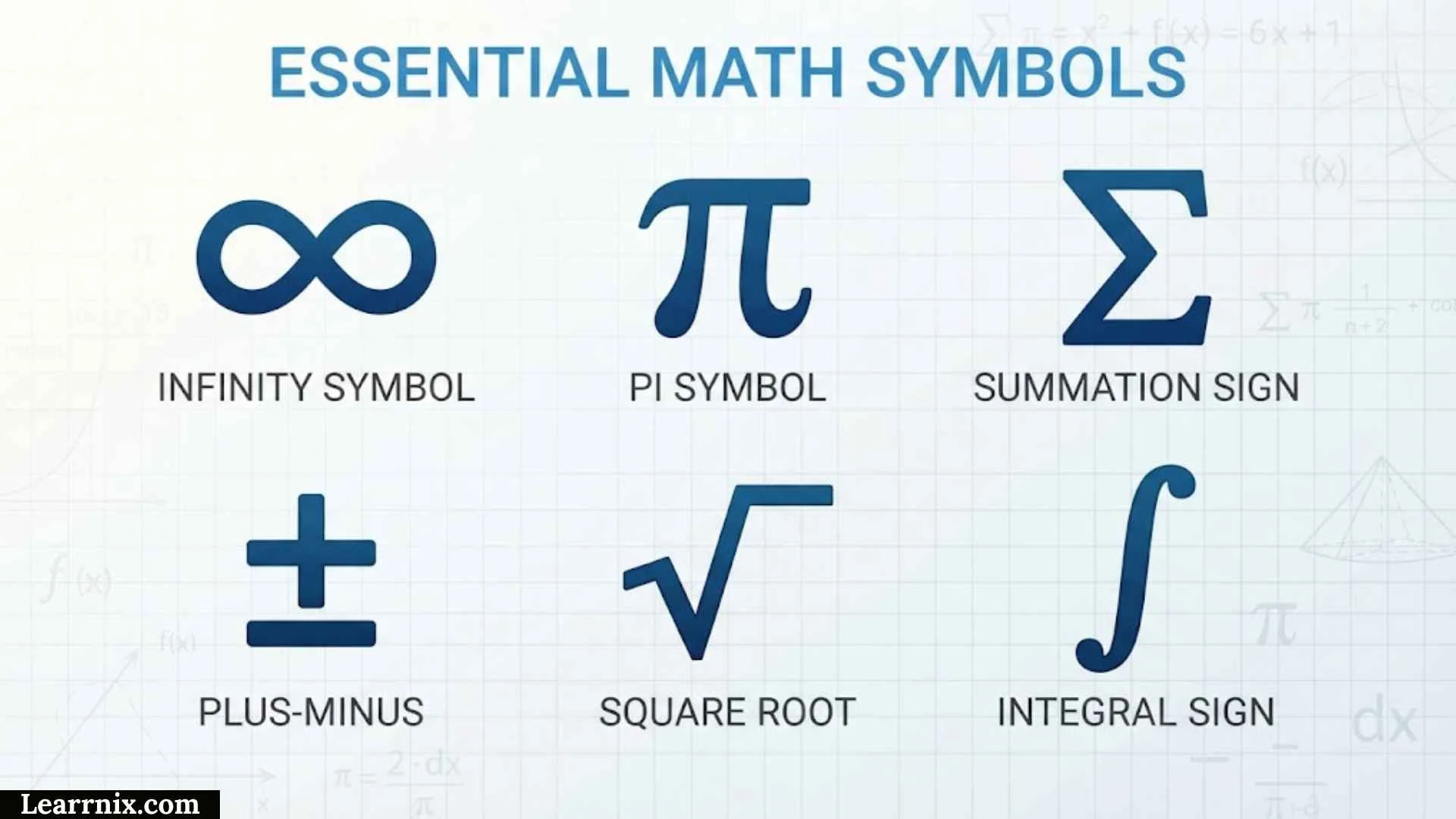
Math symbols make mathematical ideas shorter, clearer, and easier to understand. Instead of writing long explanations, a single symbol can show addition, comparison, equality, infinity, probability, sets, or a mathematical operation. Many of these characters can also be used in notes, documents, educational content, coding, and online communication.
This guide covers common and advanced math symbols, their names and meanings, useful Unicode characters, copy-and-paste options, mathematical charts, drawing ideas, LaTeX notation, Greek letters, and symbols used in discrete mathematics. You will also find less common and unusual mathematical characters with examples of how they are used.
If you need a quick symbol for a worksheet or presentation, want to understand unfamiliar notation, or need a character that can be copied directly, this article brings the main categories together in one place. The goal is to make mathematical notation easier to recognize and use correctly.
Math Symbols Text
Math symbols in text are characters that represent mathematical operations, relationships, quantities, sets, and concepts. Some are ordinary keyboard characters, while others are Unicode characters that may require copy and paste.
Here are useful examples:
- — Plus sign
- − — Minus sign
- × — Multiplication sign
- ÷ — Division sign
- = — Equals sign
- ≠ — Not equal to
- < — Less-than sign
— Greater-than sign- ≤ — Less than or equal to
- ≥ — Greater than or equal to
- ± — Plus-minus sign
- ≈ — Almost equal to
- ∞ — Infinity
- √ — Square root
- ∑ — N-ary summation
- ∫ — Integral
- ∂ — Partial differential
- ∆ — Increment or change; also commonly used for a triangle or difference depending on context
- π — Pi
- θ — Theta
The meaning of a mathematical character can depend on the field and the surrounding expression. For example, Δ can represent a change in a quantity, while the same shape can also be used as a geometric triangle.
Mathematical Symbols With Name
Knowing the name of a symbol makes it easier to search for, discuss, and identify mathematical notation.
| Symbol | Name | Common Use |
| + | Plus sign | Addition |
| − | Minus sign | Subtraction |
| × | Multiplication sign | Multiplication |
| ÷ | Division sign | Division |
| = | Equals sign | Equality |
| ≠ | Not equal to | Inequality |
| < | Less-than sign | Comparison |
| > | Greater-than sign | Comparison |
| ≤ | Less than or equal to | Comparison |
| ≥ | Greater than or equal to | Comparison |
| ≈ | Almost equal to | Approximation |
| % | Percent sign | Percentage |
| √ | Square root | Roots |
| ∞ | Infinity | Unbounded quantity or concept |
| ∑ | Summation sign | Adding a sequence |
| ∫ | Integral sign | Integration |
| ∂ | Partial differential | Multivariable calculus |
| ∴ | Therefore | Mathematical reasoning |
| ∝ | Proportional to | Proportional relationships |
| ∈ | Element of | Set membership |
| ∅ | Empty set | A set containing no elements |
Some symbols have specialized names or several names depending on mathematical tradition. For accurate technical work, the surrounding notation should always be considered.
Math Symbols Copy & Paste
If you need mathematical characters quickly, the following symbols can be copied directly.
Basic operations:
+ − × ÷ = ±
Comparison:
< > ≤ ≥ ≠ ≈
Common mathematical notation:
∞ √ ∑ ∏ ∫ ∂ ∇ ∝
Set notation:
∈ ∉ ⊂ ⊃ ⊆ ⊇ ∪ ∩ ∅
Logic:
¬ ∧ ∨ ⇒ ⇔ ∀ ∃
Greek mathematical letters:
α β γ δ ε θ λ μ π σ φ ω
For reliable copying, copy the actual character rather than typing a similar-looking symbol from memory. Characters such as the hyphen-minus -, minus sign −, and en dash – may look similar but are different characters.
Math Symbols Chart
A chart is useful when you need to scan several categories at once.
| Category | Symbols | Typical Purpose |
| Arithmetic | + − × ÷ | Basic calculations |
| Equality | = ≠ ≈ | Relationships between values |
| Inequality | < > ≤ ≥ | Comparing quantities |
| Algebra | ± √ ∝ | Expressions and equations |
| Calculus | ∫ ∂ ∇ | Integration, derivatives, and vector calculus |
| Sets | ∈ ∉ ∪ ∩ ∅ | Set relationships |
| Logic | ¬ ∧ ∨ ⇒ ⇔ | Logical statements |
| Summation | ∑ ∏ | Adding or multiplying sequences |
| Geometry | ∠ ⊥ ∥ | Angles and geometric relationships |
| Probability | P(X) ∼ | Probability and distributions |
| Greek letters | α β γ λ μ π σ | Variables and constants |
A chart is especially helpful for students because it groups symbols by purpose rather than presenting them as one long list.
Math Symbols Drawing
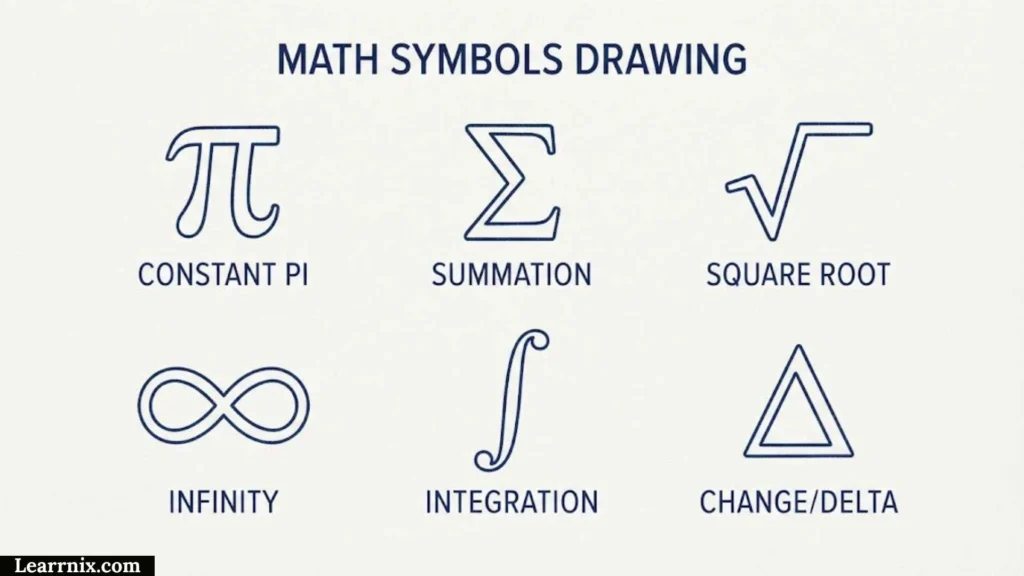
Mathematical symbols can also be used as visual elements in diagrams, worksheets, posters, educational graphics, and mathematical illustrations. Drawing a symbol accurately matters because small changes can alter its meaning.
For example, an equality sign should contain two horizontal lines, while an approximately-equal sign uses curved lines. A square root symbol should connect correctly to the expression under the radical.
When drawing math symbols by hand:
- Start with simple geometric shapes.
- Keep repeated strokes consistent.
- Leave enough space around operators.
- Make similar symbols visibly different.
- Check the final expression for readability.
For digital artwork, use a suitable mathematical font or Unicode character when possible. This usually produces more consistent results than manually drawing every symbol.
LaTeX Math Symbols
LaTeX is widely used for mathematical typesetting because it provides commands for complex expressions that are difficult to type with ordinary keyboard characters.
Some common examples include:
| Symbol | LaTeX |
| α | \alpha |
| β | \beta |
| π | \pi |
| ∞ | \infty |
| ≤ | \leq |
| ≥ | \geq |
| ≠ | \neq |
| ≈ | \approx |
| ∑ | \sum |
| ∫ | \int |
| √ | \sqrt{x} |
| ∂ | \partial |
| ∇ | \nabla |
| ∈ | \in |
| ∅ | \emptyset |
For example, a quadratic expression can be written in LaTeX as:
x^2 + 2x + 1 = 0
A fraction can be written as:
\frac{a}{b}
LaTeX is particularly useful when equations contain fractions, superscripts, subscripts, matrices, integrals, limits, or multiple mathematical operators.
Greek Math Symbols
Greek letters are deeply embedded in mathematical notation. The same letter can represent different concepts depending on the subject.
| Symbol | Name | Common Mathematical Uses |
| α | Alpha | Angles, coefficients, significance levels |
| β | Beta | Coefficients, angles, beta functions |
| γ | Gamma | Angles, functions, constants |
| δ | Delta | Small changes, variation |
| ε | Epsilon | Small quantities, error terms |
| θ | Theta | Angles, parameters |
| λ | Lambda | Eigenvalues, parameters, wavelength |
| μ | Mu | Mean, micro-, parameters |
| π | Pi | Circle-related calculations |
| ρ | Rho | Density, correlation, parameters |
| σ | Sigma | Standard deviation, summation-related notation |
| φ | Phi | Angles, ratios, functions |
| ω | Omega | Angular frequency, parameters |
Uppercase Greek letters can have different meanings from their lowercase forms. For example, Σ is commonly used for summation, while σ can represent standard deviation in statistics.
Math Symbols Clipart
Math symbols clipart is useful for worksheets, classroom materials, educational presentations, posters, icons, and themed designs. Common visual elements include plus signs, minus signs, multiplication signs, division signs, fractions, square roots, pi, geometric shapes, equations, and calculator-style graphics.
When choosing clipart, consider where it will be used. A simple black-and-white symbol may work well on a worksheet, while colorful mathematical illustrations can be more suitable for children’s educational materials.
For professional or published projects, also check the licensing terms of any clipart source. A symbol itself may be a standard mathematical character, but a specific illustration, icon set, or graphic can still have copyright restrictions.
Math Symbols List
Here is a broader list organized by mathematical purpose.
Arithmetic Symbols
- — Addition
- − — Subtraction
- × — Multiplication
- ÷ — Division
- % — Percent
- ± — Plus or minus
Equality And Comparison Symbols
- = — Equal to
- ≠ — Not equal to
- < — Less than
— Greater than- ≤ — Less than or equal to
- ≥ — Greater than or equal to
- ≈ — Approximately equal to
- ≡ — Identically equal to or congruent to, depending on context
Set Symbols
- ∈ — Element of
- ∉ — Not an element of
- ⊂ — Subset of
- ⊃ — Superset of
- ⊆ — Subset of or equal to
- ⊇ — Superset of or equal to
- ∪ — Union
- ∩ — Intersection
- ∅ — Empty set
Calculus Symbols
- ∫ — Integral
- ∂ — Partial differential
- ∇ — Nabla
- ∞ — Infinity
- lim — Limit notation
Geometry Symbols
- ∠ — Angle
- ⊥ — Perpendicular
- ∥ — Parallel
- ° — Degree
This organization makes it easier to find a symbol based on the mathematical task rather than memorizing one large collection.
Advanced Math Symbols
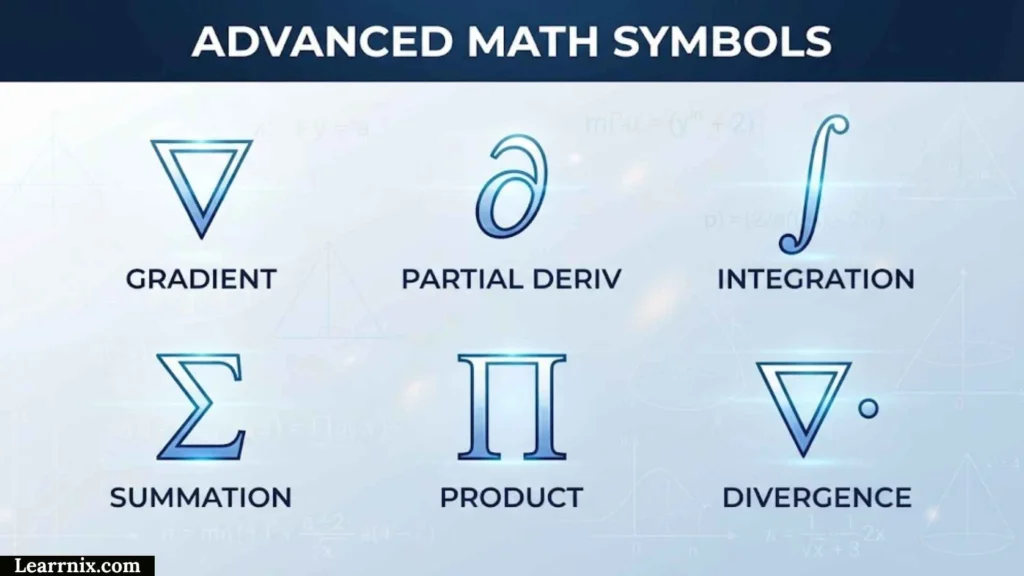
Advanced mathematics uses notation that may be unfamiliar to beginners. These symbols appear in calculus, linear algebra, abstract algebra, analysis, probability, logic, and other fields.
Examples include:
- ∀ — For all
- ∃ — There exists
- ∄ — There does not exist
- ∂ — Partial derivative notation
- ∇ — Gradient or related vector-calculus notation
- ⊕ — Direct sum or other context-dependent operations
- ⊗ — Tensor product or other specialized operations
- ≅ — Isomorphic to or congruent to, depending on context
- ≡ — Identically equal to or congruent to, depending on context
- ∴ — Therefore
- ∵ — Because
- ℕ — Common notation for the natural numbers
- ℤ — Common notation for the integers
- ℚ — Common notation for the rational numbers
- ℝ — Common notation for the real numbers
- ℂ — Common notation for the complex numbers
Some advanced symbols do not have one universal meaning. For example, ⊕ can represent direct sum in one context and a specialized addition-like operation in another. Always read the definitions given in the surrounding text.
Discrete Math Symbols
Discrete mathematics deals with objects and structures such as sets, graphs, relations, logic, counting, algorithms, and finite structures. Its notation frequently overlaps with set theory and mathematical logic.
Useful symbols include:
| Symbol | Meaning | Example |
| ∀ | For all | ∀x |
| ∃ | There exists | ∃x |
| ¬ | Not | ¬P |
| ∧ | And | P ∧ Q |
| ∨ | Or | P ∨ Q |
| ⇒ | Implies | P ⇒ Q |
| ⇔ | If and only if | P ⇔ Q |
| ∈ | Is an element of | x ∈ A |
| ∉ | Is not an element of | x ∉ A |
| ∪ | Union | A ∪ B |
| ∩ | Intersection | A ∩ B |
| Set difference | A \ B | |
| ⊆ | Subset or equal | A ⊆ B |
In discrete mathematics, symbols often describe relationships between objects rather than numerical calculations. Understanding the logical role of a symbol is therefore just as important as knowing its name.
Different Math Symbols
Math symbols can look similar while serving different purposes. Recognizing these differences prevents mistakes in equations and digital text.
For example:
- – — Hyphen-minus, commonly used on keyboards for several purposes
- − — Minus sign used in mathematical notation
- × — Multiplication sign
- x — Letter x, often used as a variable
- * — Asterisk, commonly used for multiplication in programming and plain text
- = — Equals sign
- ≠ — Not equal to
- ≈ — Approximately equal to
- ≤ — Less than or equal to
- ≥ — Greater than or equal to
A good rule is to use the mathematically appropriate character when formatting formal work. Plain keyboard alternatives are useful when a special character is unavailable, but they should not automatically be treated as identical.
Weird Math Symbols
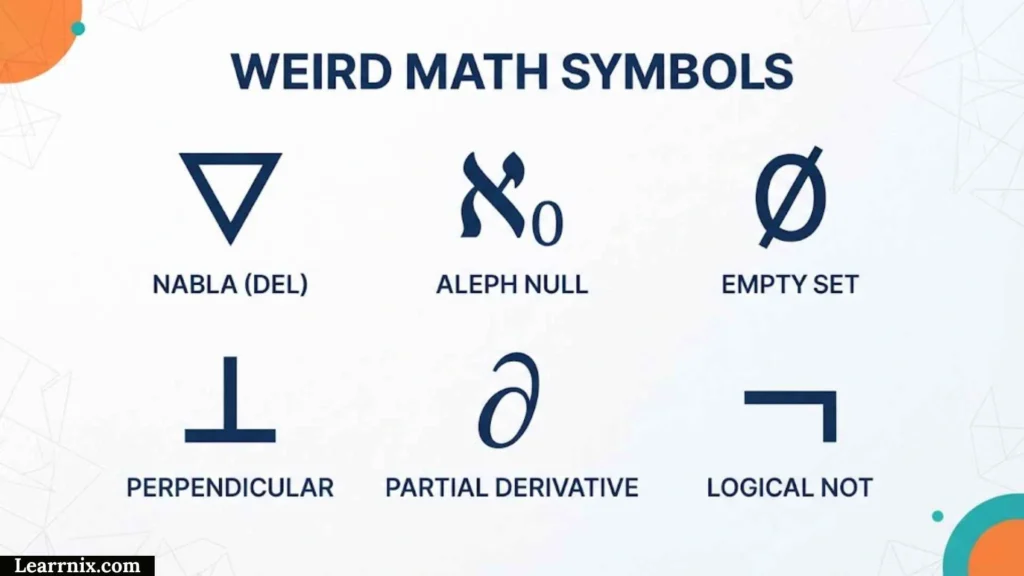
Some mathematical symbols look unusual because they are uncommon outside specialized subjects. Their appearance can make them seem strange even when they have a well-established mathematical purpose.
Examples include:
- ∅ — Empty set
- ∂ — Partial differential
- ∇ — Nabla
- ∴ — Therefore
- ∵ — Because
- ∀ — For all
- ∃ — There exists
- ∄ — There does not exist
- ℵ — Aleph, used in set theory for cardinal numbers
- ∴ — Therefore
Symbols such as ∀ and ∃ are especially recognizable in mathematical logic. The empty set symbol ∅ is also distinctive because it represents a set with no elements.
Unusual does not mean incorrect or decorative. A symbol that looks unfamiliar may carry a precise definition within a particular mathematical field.
Math Symbols And Their Meanings
Understanding a symbol’s meaning is more useful than memorizing its appearance alone. Here are some of the most common examples:
| Symbol | Meaning | Example |
| + | Add | 4 + 3 = 7 |
| − | Subtract | 9 − 2 = 7 |
| × | Multiply | 4 × 5 = 20 |
| ÷ | Divide | 20 ÷ 4 = 5 |
| = | Equal to | 5 + 2 = 7 |
| ≠ | Not equal to | 5 ≠ 6 |
| < | Less than | 3 < 8 |
| > | Greater than | 8 > 3 |
| ≤ | Less than or equal to | x ≤ 10 |
| ≥ | Greater than or equal to | x ≥ 10 |
| √ | Square root | √25 = 5 |
| ∞ | Infinity | x → ∞ |
| ∑ | Sum | ∑xᵢ |
| ∫ | Integral | ∫x dx |
| ∝ | Proportional to | y ∝ x |
| ∈ | Element of | 3 ∈ {1, 2, 3} |
| ∅ | Empty set | A = ∅ |
Context still matters. For example, π is commonly associated with the ratio of a circle’s circumference to its diameter, while in other mathematical expressions the same Greek letter can serve as a variable or parameter.
Frequently Asked Questions
What Are The Most Common Math Symbols?
The most common math symbols include +, −, ×, ÷, =, <, >, ≤, ≥, %, √, and ∞. These appear frequently in arithmetic, algebra, measurement, and everyday mathematical writing.
How Can I Copy And Paste Math Symbols?
You can copy the actual Unicode character from a symbol list or chart and paste it into compatible text fields, documents, messages, and applications. For formal mathematical writing, check that the pasted character is the intended symbol.
What Is The Difference Between Math Symbols And Mathematical Notation?
A math symbol is an individual character or sign, such as + or ∑. Mathematical notation is the broader system that combines symbols, numbers, variables, letters, and formatting to express mathematical ideas.
Are Greek Letters Math Symbols?
Greek letters are widely used in mathematics, although they are also ordinary letters in the Greek alphabet. In mathematical notation, letters such as π, θ, λ, μ, and σ can represent specific variables, constants, parameters, or quantities.
Can I Use Math Symbols In Plain Text?
Yes. Many mathematical characters are available as Unicode text and can be copied into plain-text environments. However, complex equations may need specialized formatting such as LaTeX because plain text cannot always represent mathematical layout accurately.
Conclusion
Math symbols provide a compact way to communicate operations, relationships, quantities, logical statements, sets, and advanced mathematical ideas. From familiar characters such as + and = to specialized notation such as ∂, ∇, ∀, and ∃, each symbol can make mathematical information easier to read when used in the right context.
For everyday use, copy-and-paste characters and symbol charts are convenient. Students and researchers may need a deeper understanding of names, meanings, Greek letters, discrete mathematics notation, and advanced symbols. LaTeX is particularly useful when equations require precise formatting.
The best way to learn mathematical symbols is to connect each character with its purpose and an example. Keep a useful reference nearby, pay attention to similar-looking characters, and use the correct notation for the mathematical context.

I am Charlotte Anderson, an education writer who is passionate about creating meaningful learning resources for students and lifelong learners.
I enjoy researching new educational approaches and sharing ideas that make studying easier and more effective.
Through my work, I aim to inspire curiosity, confidence, and a love for learning.
Books:
- The Complete Guide to Better Learning
- Building Skills for Academic Success
 Michael Carter