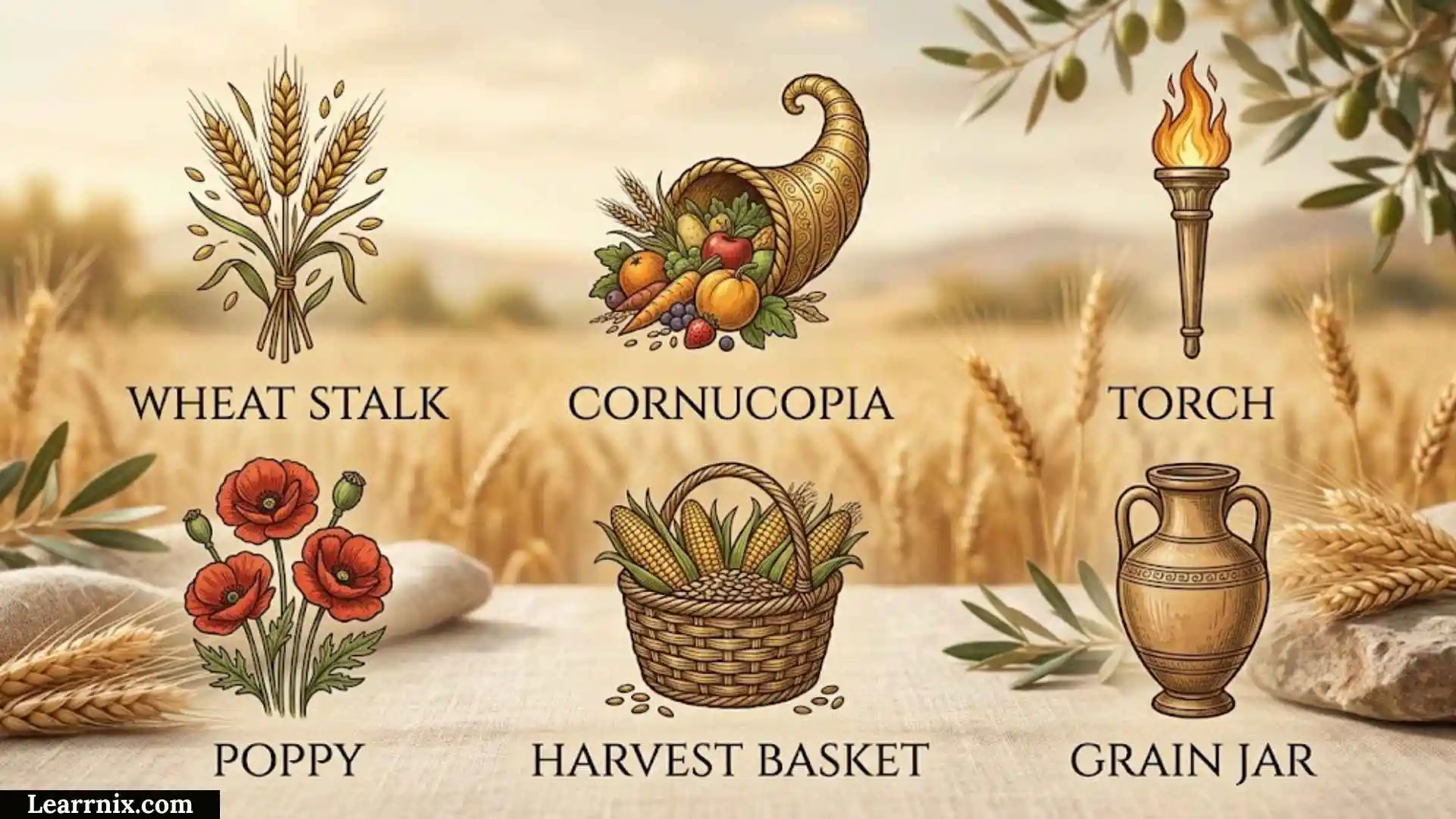
If you are looking for the symbols of Demeter, the most important ones are wheat and grain, the torch, the cornucopia, and the poppy. Demeter was the ancient Greek goddess of agriculture, grain, harvest, and the fertility of the cultivated earth. Her mythology also connects her with motherhood, loss, seasonal change, and the return of vegetation.
Some symbols have a direct connection to Demeter herself. Others belong more specifically to the story of Demeter and Persephone, such as the pomegranate and flowers. Knowing this difference is important because not every object appearing in a Demeter myth was necessarily her personal attribute.
This guide explains the major symbols of Demeter, what each one means, how they appear in ancient art and literature, and how to distinguish Demeter’s symbols from those of Persephone.
Quick Answer: What Are The Symbols Of Demeter?
The primary symbols and attributes associated with Demeter include:
- Wheat and grain — agriculture, nourishment, fertility, and harvest
- Torch — her search for Persephone and maternal devotion
- Cornucopia — abundance, prosperity, and the gifts of the earth
- Poppy — agriculture, fertility, and Demeter’s ritual traditions
- Scepter — divine authority and status
- Serpent — earth, fertility, renewal, and some chthonic aspects of her worship
- Agricultural produce — nourishment and the fertility of cultivated land
- Sickle or golden blade — an attribute connected with her agricultural identity
The pomegranate and flowers are also important when discussing Demeter, but they should be treated more carefully. They are strongly connected with the story of Persephone and the seasonal cycle rather than being equally direct personal attributes of Demeter.
Who Was Demeter?
Demeter was one of the major goddesses of ancient Greek religion. She was associated particularly with agriculture, grain, bread, harvests, and the fertility of the earth.
Her importance went beyond farming. For an agricultural society, the successful growth of grain affected food, survival, wealth, and social stability. This made Demeter’s divine role closely connected with everyday human life.
Demeter was also the mother of Persephone, whose abduction by Hades forms the central myth associated with the goddess. When Persephone disappeared, Demeter searched for her and withdrew her divine care from the earth. The resulting failure of crops became part of the mythological explanation for the seasonal cycle.
Ancient sources and surviving art frequently connect Demeter with grain, agricultural abundance, torches, and the cornucopia. The British Museum, for example, describes Demeter and her Roman counterpart Ceres as goddesses of agriculture and the harvest and notes their representation with wheat, barley, and the cornucopia.
Wheat And Grain: The Most Important Symbols Of Demeter
Wheat and grain are the clearest symbols of Demeter.
Demeter’s agricultural identity is closely tied to the cultivation of grain. In ancient Greek art, she could be shown holding ears of grain or wearing grain as part of her visual representation.
The connection is particularly clear in the mythology surrounding Triptolemos, a figure whom Demeter was said to have taught the cultivation of grain. Ancient Greek and later Roman artworks repeatedly represent Demeter in connection with this agricultural gift.
A surviving Great Eleusinian Relief, for example, shows Demeter alongside Persephone and Triptolemos. The Metropolitan Museum of Art explains that the figure of Triptolemos was traditionally understood as someone sent by Demeter to teach humanity how to cultivate grain.
What Does Wheat Symbolize For Demeter?
Wheat can represent:
- Nourishment
- Fertility
- Agricultural productivity
- Harvest
- Food security
- Growth
- Abundance
- Human dependence on nature
This makes wheat more than a decorative symbol. It communicates the central function that Demeter represented in ancient Greek religion: the earth’s ability to produce food.
Why Is Grain So Closely Connected To Her?
Grain was fundamental to ancient Mediterranean agriculture. A successful harvest could determine whether communities had enough food to survive the coming year.
Demeter therefore represented a relationship between earth, cultivation, harvest, and human survival. Her grain symbolism reflects this practical agricultural reality as well as her divine status.
The Torch: Demeter’s Search For Persephone
The torch is another important symbol associated with Demeter.
Its strongest meaning comes from the myth of Persephone. After her daughter disappeared, Demeter searched for her throughout the world. Ancient literary tradition describes Demeter carrying torches during this search.
The torch consequently became associated with:
- Searching
- Guidance
- Determination
- Maternal love
- Perseverance
- Light in darkness
- The search for a missing person
Ancient art also supports this association. The British Museum identifies the torch as an attribute connected with Demeter’s search for her daughter.
Why Does The Torch Matter?
The torch gives Demeter’s symbolism an emotional dimension.
Wheat represents what Demeter provides to humanity, while the torch represents what she does as a mother. It turns the goddess from a simple agricultural figure into a character associated with grief, determination, and devotion.
This is especially important when interpreting images of Demeter. A figure holding a torch may be referring not only to agriculture but also to the Persephone myth.
The Cornucopia: Abundance And Prosperity
The cornucopia, or horn of plenty, is another well-known symbol connected with Demeter.
It is usually shown as a large horn overflowing with fruits, grain, vegetables, or other forms of produce. The image communicates the idea of an earth capable of providing abundant food.
For Demeter, the cornucopia can represent:
- Abundance
- Fertility
- Prosperity
- Successful harvests
- Nourishment
- Agricultural wealth
The cornucopia is particularly useful as a visual symbol because its meaning can be understood immediately: a container overflowing with food suggests plenty rather than scarcity.
Is The Cornucopia Exclusively A Symbol Of Demeter?
No. The cornucopia appears in the symbolism of several ancient deities and personifications associated with prosperity and abundance.
Therefore, a cornucopia by itself does not always prove that an artwork represents Demeter. Identification becomes stronger when it appears alongside other Demeter attributes such as grain, agricultural imagery, a torch, or an appropriate mythological setting.
This is an important distinction when interpreting ancient art.
The Poppy: A Sacred Plant Of Demeter
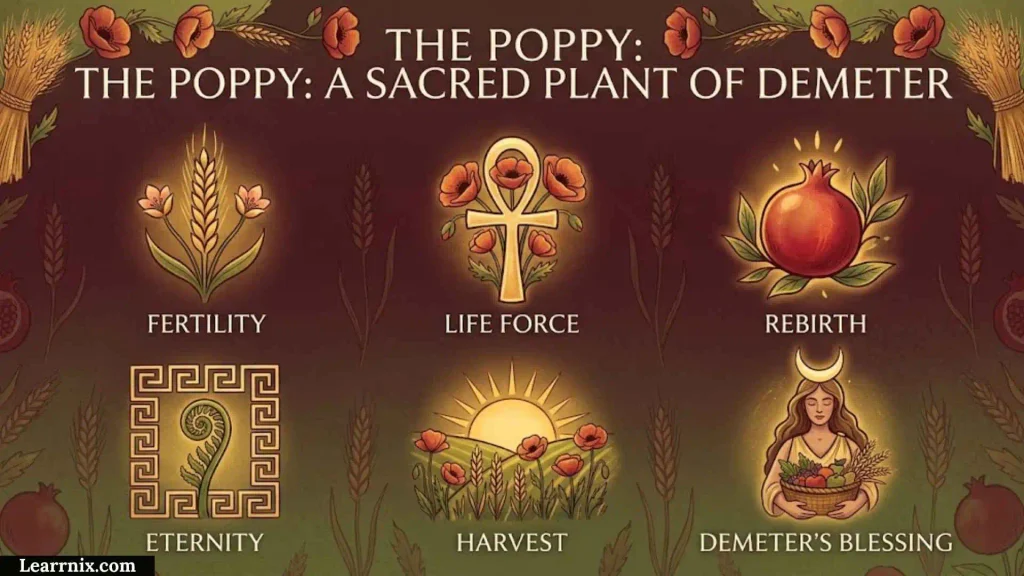
The poppy is a less commonly discussed but historically important symbol associated with Demeter.
Ancient sources connect the poppy with Demeter’s religious traditions, and the flower appears in descriptions of her cult. The poppy’s association with grain fields also makes sense within an agricultural context.
The poppy can therefore be connected with:
- Fertility
- Agriculture
- The cultivated landscape
- Ritual practice
- Natural cycles
An ancient description preserved in the tradition surrounding Callimachus’ Hymn to Demeter mentions a priestess carrying a poppy in connection with the goddess.
Why Is The Poppy Important?
The poppy shows that Demeter’s symbolism was broader than wheat alone. Her sacred plants included crops and plants connected with agriculture and ritual.
It also demonstrates why a complete study of Demeter’s symbols should include sacred plants, not just objects carried by the goddess in artwork.
The Scepter: Authority And Divine Status
The scepter appears in artistic representations of Demeter and communicates her status as a goddess.
Unlike wheat, the scepter is not unique to Demeter. Scepters were common attributes of gods and rulers and could represent:
- Authority
- Divine power
- Social status
- Sovereignty
- Religious importance
The Great Eleusinian Relief at the Metropolitan Museum of Art shows Demeter holding a scepter.
This makes the scepter useful when interpreting artwork, but it should not be treated as Demeter’s defining symbol. Wheat and agricultural imagery provide a much stronger identification.
The Serpent: Earth, Renewal, And Chthonic Associations
The serpent has a more complex relationship with Demeter.
Ancient religious traditions associated serpents with the earth, renewal, fertility, and the realm beneath the ground. These ideas fit naturally with aspects of Demeter’s mythology because agriculture depends on what happens beneath the surface of the earth.
Theoi’s compilation of Demeter’s attributes identifies the serpent among her sacred animals and describes winged serpents as associated with her chariot.
Serpent symbolism should nevertheless be interpreted carefully. A snake in ancient Greek art does not automatically mean Demeter. The surrounding figures, objects, inscription, and mythological context matter.
Why Does The Serpent Fit Demeter’s Symbolism?
Agriculture involves a continuous cycle:
Seed → Earth → Growth → Harvest → Seed Again
The serpent’s association with the earth and renewal can therefore complement Demeter’s agricultural symbolism.
It also fits the goddess’s connection with the boundary between life, death, and renewal that becomes important in the Persephone myth.
The Sickle Or Golden Blade
A less familiar attribute associated with Demeter is the sickle or golden blade.
Theoi’s discussion of Demeter’s attributes connects her epithet Chrysaorus, commonly translated as “Lady of the Golden Blade,” with a golden sword or sickle.
The agricultural interpretation is significant because a sickle is directly connected with harvesting crops.
It can therefore symbolize:
- Harvesting
- Agriculture
- Cutting grain
- Agricultural labor
- The completion of the growing cycle
This attribute is not as visually common in popular representations of Demeter as wheat or the torch, but it adds useful historical depth to the symbolism.
The Harvest As A Symbol Of Demeter
The harvest itself is one of the broadest concepts associated with Demeter.
A harvest represents the point at which cultivation produces food. It connects several stages of the agricultural cycle: planting, growth, ripening, gathering, storing, and consumption.
Demeter’s association with harvest can therefore symbolize:
- Reward for cultivation
- Abundance
- Food
- Fertility
- Completion
- Seasonal change
- Human dependence on the natural world
The British Museum specifically describes Demeter as a goddess of agriculture and the harvest, making the harvest theme central rather than secondary.
The Pomegranate: A Symbol Of Persephone’s Story
The pomegranate requires an important distinction.
It is strongly associated with the Demeter-Persephone myth, but it is more directly connected to Persephone than to Demeter as an individual attribute.
According to the traditional myth, Persephone ate pomegranate seeds while returning from the Underworld. Because of this, she was required to spend part of the year with Hades and part with her mother.
The pomegranate can therefore symbolize:
- Life and death
- The Underworld
- Separation
- Reunion
- Fertility
- Seasonal change
- The connection between the living and the dead
The Metropolitan Museum notes that the pomegranate had funerary and ritual associations in Greek art and that its mythological significance is particularly clear in the story of Persephone.
Should The Pomegranate Be Listed As A Symbol Of Demeter?
It can be included when discussing the symbols associated with Demeter’s mythology, but it is more precise to call it a symbol of the Demeter-Persephone story.
This distinction improves historical accuracy.
Flowers: Spring, Youth, And Seasonal Change
Flowers also belong to the wider mythology of Demeter and Persephone.
In the Homeric Hymn to Demeter, Persephone is gathering flowers when Hades takes her into the Underworld. The flower-filled meadow therefore becomes part of the narrative that begins the separation between mother and daughter.
Flowers can symbolize:
- Spring
- Youth
- Beauty
- Growth
- Fragility
- Seasonal renewal
The important point is that flowers should not automatically be described as Demeter’s primary personal symbol. They are especially meaningful in the story of Persephone and the seasonal cycle.
Demeter And The Seasons
The story of Demeter and Persephone became closely associated with the changing seasons.
When Persephone is separated from her mother, Demeter’s grief is connected with the decline of vegetation. When Persephone returns, the earth becomes productive again.
The Metropolitan Museum describes the Eleusinian tradition as being based around the growth cycles of nature and explains how the myth connected Persephone’s movement between the Underworld and the world above with seasonal change.
The seasonal symbolism can be simplified as:
Persephone leaves → Demeter mourns → Earth becomes barren → Persephone returns → Growth resumes
This interpretation does not mean that ancient Greeks treated the myth as a modern scientific explanation of seasons. Rather, the myth gave religious and cultural meaning to recurring changes in vegetation and agriculture.
Demeter And The Eleusinian Mysteries
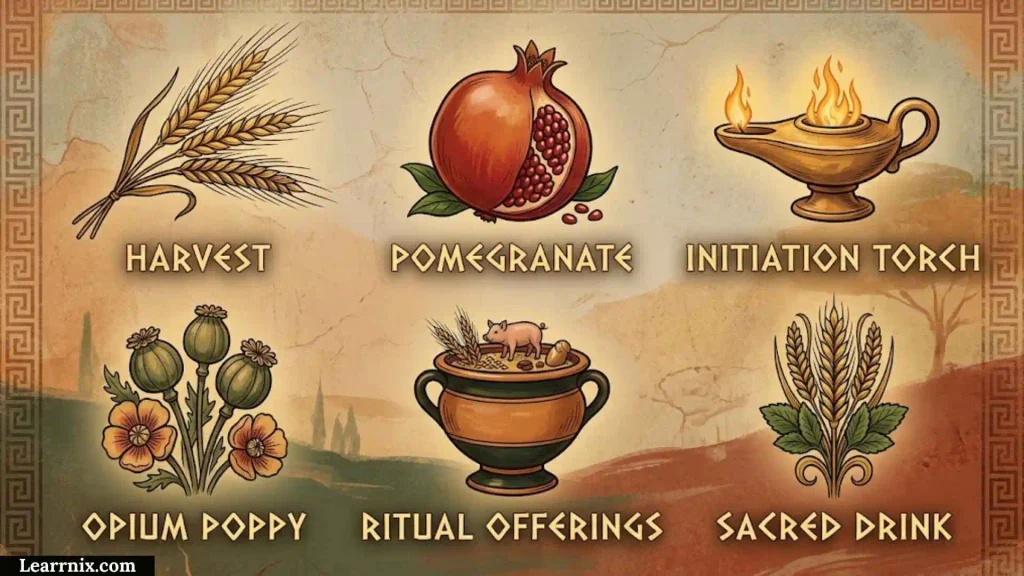
To understand Demeter’s symbols fully, it is important to understand the Eleusinian Mysteries.
Eleusis was a major center of worship dedicated to Demeter and Persephone. The religious tradition became one of the most famous mystery cults of the ancient Greek world.
The Metropolitan Museum explains that the worship of Demeter and Persephone at Eleusis was connected with the growth cycles of nature. The sanctuary was also associated with the tradition that Demeter gave humanity knowledge of grain cultivation.
Why Grain Was Important At Eleusis
The Great Eleusinian Relief is particularly useful evidence. It represents Demeter, Persephone, and Triptolemos, a figure associated with the spread of grain cultivation.
The relief originally stood at Eleusis, and the Metropolitan Museum notes that Demeter was traditionally understood as providing the knowledge of cultivating grain.
This connection reinforces the importance of wheat and grain as Demeter’s central symbols.
Why Do We Know So Little About The Mysteries?
The Eleusinian Mysteries were secret religious rites. Initiates were expected to keep the details confidential.
As a result, historians have evidence from archaeology, art, literature, inscriptions, and later accounts, but they do not have a complete ancient description of every ritual performed.
This is why claims about the exact meaning of every Eleusinian symbol should be treated carefully.
Demeter Symbols In Ancient Art
Ancient artists used attributes to make mythological figures recognizable.
Demeter may appear as a mature, richly dressed woman associated with:
- Ears or sheaves of grain
- A cornucopia
- A torch
- A scepter
- A poppy
- Agricultural produce
- A crown made from grain
The Metropolitan Museum’s collection provides several useful examples.
One Roman-era medallion depicts Demeter with a crown of corn ears while greeting Triptolemos. Another artwork, the Great Eleusinian Relief, connects Demeter with agricultural abundance, Persephone, and the cultivation of grain.
These objects show why symbolism should be studied through actual surviving evidence rather than relying only on modern lists of mythology symbols.
Demeter Symbols And Their Meanings
| Symbol | Main Meaning | Strength Of Connection |
| Wheat | Agriculture, nourishment, fertility, harvest | Very strong |
| Grain | Food, cultivation, abundance | Very strong |
| Torch | Search, devotion, guidance | Strong |
| Cornucopia | Abundance and prosperity | Strong |
| Poppy | Agriculture and ritual tradition | Strong |
| Scepter | Divine authority | Supporting attribute |
| Sickle or golden blade | Harvest and cultivation | Supporting attribute |
| Serpent | Earth, fertility, renewal | Context-dependent |
| Pomegranate | Persephone, Underworld, seasonal change | Mythological association |
| Flowers | Spring, youth, renewal | Primarily Persephone-related |
How To Identify Demeter In Ancient Art
If you are looking at an ancient statue, vase, relief, or painting and want to know whether it represents Demeter, do not rely on one symbol alone.
Use the following identification guide.
Step 1: Look For Grain
If the figure holds ears or sheaves of wheat or wears grain as a crown, Demeter becomes a strong possibility.
Step 2: Check For A Torch
A torch can support the identification, especially when the scene involves Persephone or a search.
Step 3: Look At The Other Figures
Persephone, Triptolemos, or scenes associated with Eleusis can provide important contextual evidence.
Step 4: Look For Agricultural Imagery
Cornucopias, grain, harvested produce, or farming scenes can strengthen the identification.
Step 5: Do Not Identify Her From One Object Alone
A cornucopia or torch can occur in other mythological contexts. The safest interpretation combines the object with the figure’s clothing, companions, inscription, location, and narrative scene.
Demeter Vs. Persephone Symbols
Demeter and Persephone are often confused because their myths and religious traditions are closely connected.
| Demeter | Persephone |
| Wheat and grain | Pomegranate |
| Agriculture | Spring growth |
| Harvest | Flowers |
| Cornucopia | Underworld |
| Torch | Seasonal return |
| Motherhood | Daughter of Demeter |
| Fertility of cultivated earth | Life, death, and renewal |
There is overlap between their symbolism, especially in Eleusinian art. The goal is not to create a rigid separation but to identify which symbols are more strongly associated with each goddess.
Common Misconceptions About Demeter’s Symbols
Myth: Every Plant Is A Symbol Of Demeter
Not necessarily. Some plants are specifically connected with Demeter, such as wheat and poppy, while others belong primarily to Persephone’s story.
Myth: The Pomegranate Is Demeter’s Main Symbol
The pomegranate is important, but its strongest mythological connection is with Persephone and her return from the Underworld.
Myth: The Torch Always Means Demeter
The torch can support an identification of Demeter, especially in the Persephone story, but torches appear in other Greek religious contexts as well.
Myth: The Cornucopia Belongs Only To Demeter
The cornucopia is widely associated with abundance and appears with multiple deities and personifications. Context is necessary.
Myth: The Seasons Were Simply A Scientific Theory In Mythological Form
The Demeter-Persephone story provided a religious and cultural interpretation of seasonal change. It should not be presented as an ancient scientific explanation in the modern sense.
A Simple Decision Guide For Identifying Demeter’s Symbols
Use this quick guide when researching an artwork or symbol:
Does it show wheat or grain?
→ Yes: Strong Demeter association.
Does it show a torch and connect to Persephone?
→ Yes: Strong Demeter-related mythological context.
Does it show a cornucopia filled with agricultural produce?
→ Yes: Possible Demeter association; check the surrounding imagery.
Does it show a pomegranate?
→ Look for Persephone or Underworld imagery before identifying it as a Demeter symbol.
Does it show flowers?
→ Consider Persephone and the spring/seasonal story first.
Does it show a serpent?
→ Examine the broader religious and artistic context because serpent symbolism is not exclusive to Demeter.
This approach is more reliable than assigning a single fixed meaning to every object.
Why Demeter’s Symbols Still Matter
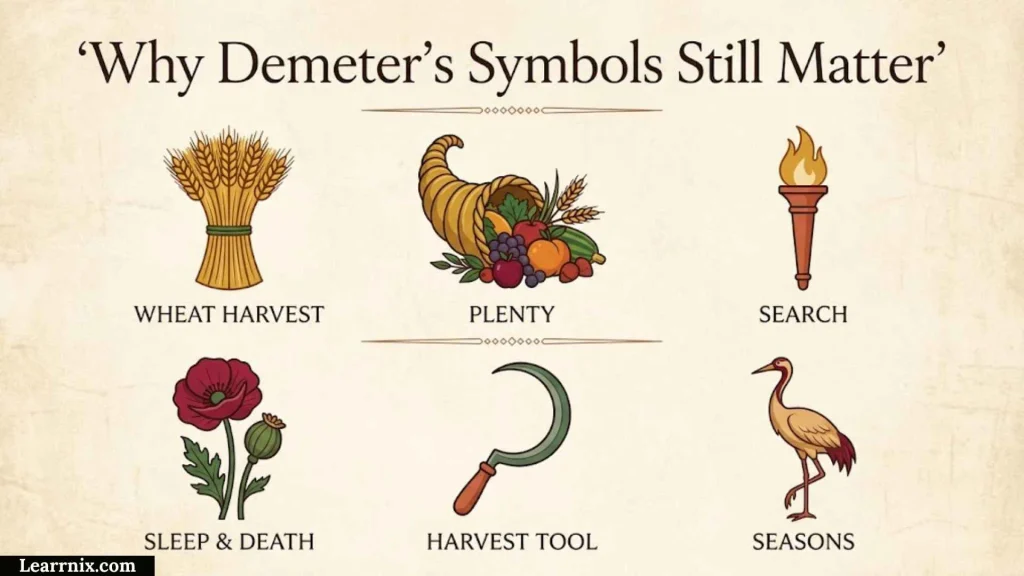
Demeter’s symbolism continues to appear in discussions of mythology, literature, art history, religion, and the relationship between humans and nature.
Her symbols are especially useful because they connect physical objects with larger ideas.
A simple ear of wheat can represent food and survival. A torch can represent a mother’s search. A cornucopia can express abundance. A pomegranate can evoke the boundary between life and death. Together, these images create a much richer picture than a simple list of Greek mythology symbols.
For students and readers studying classical mythology, these distinctions also help prevent a common mistake: treating every object mentioned in a myth as if it were an official symbol of the central character.
Frequently Asked Questions About The Symbols Of Demeter
What Is The Main Symbol Of Demeter?
The main symbol of Demeter is wheat or grain. It reflects her central role as the Greek goddess associated with agriculture, grain, harvest, and nourishment.
What Flower Represents Demeter?
The poppy is one of the plants specifically associated with Demeter in ancient religious traditions. Wheat is also a sacred plant of the goddess. Flowers more generally are strongly connected with Persephone’s story.
What Does Demeter’s Torch Symbolize?
Demeter’s torch represents her search for Persephone and can symbolize maternal devotion, determination, guidance, and searching through darkness.
What Does The Cornucopia Symbolize For Demeter?
The cornucopia represents agricultural abundance, fertility, prosperity, food, and the productive gifts of the earth.
Is Wheat A Symbol Of Demeter?
Yes. Wheat is one of the strongest and most direct symbols associated with Demeter because of her role as goddess of grain and agriculture.
Is The Pomegranate A Symbol Of Demeter?
The pomegranate is associated with Demeter through the story of Persephone, but it is more directly connected to Persephone’s time in the Underworld and the seasonal cycle.
What Animal Is Sacred To Demeter?
The serpent is traditionally associated with Demeter, and the pig is also important in her religious traditions. Ancient sources also associate other animals with her cult, so the answer depends on the particular aspect of Demeter being studied.
What Does Demeter Represent?
Demeter represents agriculture, grain, harvest, nourishment, fertility of cultivated land, motherhood, and aspects of seasonal renewal and loss.
Why Is Demeter Associated With The Seasons?
The myth of Demeter and Persephone connects Persephone’s periodic movement between the Underworld and the world above with changes in the fertility of the earth. The story became a powerful mythological expression of seasonal change and vegetation cycles.
What Is Demeter’s Roman Name?
Demeter’s Roman counterpart is Ceres. Roman religious traditions adapted and developed the worship of Ceres, who was also strongly associated with agriculture and grain.
Why Is Demeter Important In Greek Mythology?
Demeter is important because her mythology connects agriculture and human survival with a major story about motherhood, loss, reunion, and the renewal of nature. Her worship was also central to the Eleusinian Mysteries.
Key Takeaways About Demeter’s Symbols
The most useful points to remember are:
- Wheat and grain are Demeter’s strongest symbols.
- The torch is connected with her search for Persephone.
- The cornucopia represents abundance and agricultural prosperity.
- The poppy is an important sacred plant associated with Demeter.
- The serpent has a more specialized connection with earth, fertility, and renewal.
- The pomegranate belongs primarily to the Persephone story rather than being Demeter’s main personal attribute.
- Flowers are especially important in the story of Persephone and seasonal renewal.
- Ancient art is valuable evidence for understanding how Demeter was represented.
- The Eleusinian Mysteries connected Demeter and Persephone with agriculture, nature, and religious initiation.
- Symbols should always be interpreted in context rather than treated as fixed one-to-one meanings.
Conclusion
The symbols of Demeter provide a visual and cultural map of her role in ancient Greek mythology. Wheat and grain express her central connection with agriculture and nourishment, while the cornucopia represents abundance. The torch recalls her determined search for Persephone, and the poppy reflects an important aspect of her sacred plant tradition.
Other symbols require more careful interpretation. The pomegranate and flowers are central to the Demeter-Persephone myth, but they are more directly associated with Persephone and the seasonal cycle than with Demeter alone. The serpent, scepter, and sickle provide additional layers of meaning connected with earth, divine authority, and agricultural work.
Taken together, these symbols show why Demeter was more than simply a goddess of crops. Her mythology connected food and farming with motherhood, grief, fertility, death, renewal, and the rhythms of nature. That combination explains why her imagery remained important in Greek and Roman art and why Demeter continues to be studied in mythology and classical history today.

I am Charlotte Anderson, an education writer who is passionate about creating meaningful learning resources for students and lifelong learners.
I enjoy researching new educational approaches and sharing ideas that make studying easier and more effective.
Through my work, I aim to inspire curiosity, confidence, and a love for learning.
Books:
- The Complete Guide to Better Learning
- Building Skills for Academic Success
 Daniel Harper
 Michael Carter