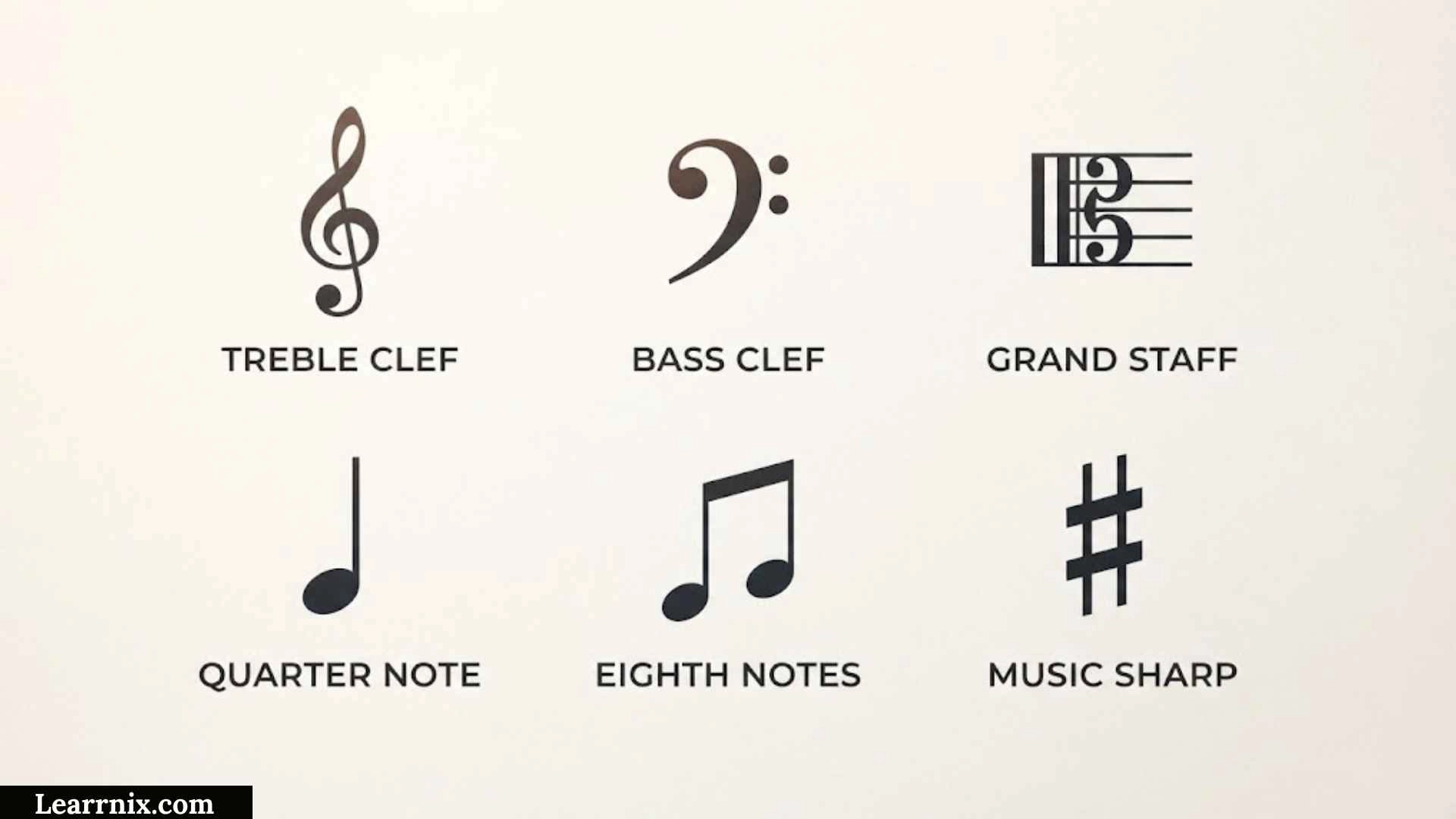
Music symbols are the visual language used to write, read, and understand music. They can show notes, rests, pitch changes, rhythm, dynamics, tempo, expression, and instructions for performing a piece. Familiar characters such as ♪, ♫, ♩, ♯, ♭, and ♮ are only a small part of the larger world of musical notation.
This guide covers the most useful music symbols in one place, including their names, meanings, examples, Unicode characters, copy-and-paste versions, aesthetic combinations, and piano sheet music markings. It also explains the difference between ordinary text music symbols and emoji characters such as 🎵 and 🎶.
If you are learning music notation, searching for a symbol to copy, creating a music-themed username or caption, or trying to understand piano sheet music, the sections below are designed to make each symbol easy to recognize and use.
Music Symbols With Names
Music notation contains several groups of symbols, and each group has a different purpose. Notes show musical sounds and durations, clefs establish pitch references, accidentals modify pitch, rests represent silence, and expression markings tell performers how music should be played.
Here are some common music symbols with their names:
| Symbol | Name | Main Purpose |
| ♩ | Quarter Note | Represents a quarter-note value |
| ♪ | Eighth Note | Represents an eighth-note value |
| ♫ | Beamed Eighth Notes | Represents two connected eighth notes |
| ♬ | Beamed Sixteenth Notes | Represents connected sixteenth notes |
| ♭ | Music Flat Sign | Lowers a pitch by a semitone in common Western notation |
| ♮ | Music Natural Sign | Cancels an applicable sharp or flat |
| ♯ | Music Sharp Sign | Raises a pitch by a semitone in common Western notation |
| 𝄞 | Musical Symbol G Clef | Establishes the G-clef reference |
| 𝄡 | Musical Symbol C Clef | Establishes a C-clef reference |
| 𝄢 | Musical Symbol F Clef | Establishes the F-clef reference |
| 𝄐 | Fermata | Indicates an extended hold or pause |
| 𝄪 | Double Sharp | Raises a pitch by two semitones |
| 𝄫 | Double Flat | Lowers a pitch by two semitones |
| 𝄴 | Common Time | Represents common time |
| 𝄵 | Cut Time | Represents cut time |
Unicode officially encodes many musical characters, including G, C, and F clefs, rests, accidentals, time-signature symbols, and other notation elements. The standard also distinguishes characters used for musical notation from the larger layout and positioning system required to display a complete score.
It is also useful to remember that a Unicode character is not always a complete replacement for professional music notation. A real score depends on positioning, staff lines, note relationships, beams, and other layout information.
Music Symbols Copy And Paste
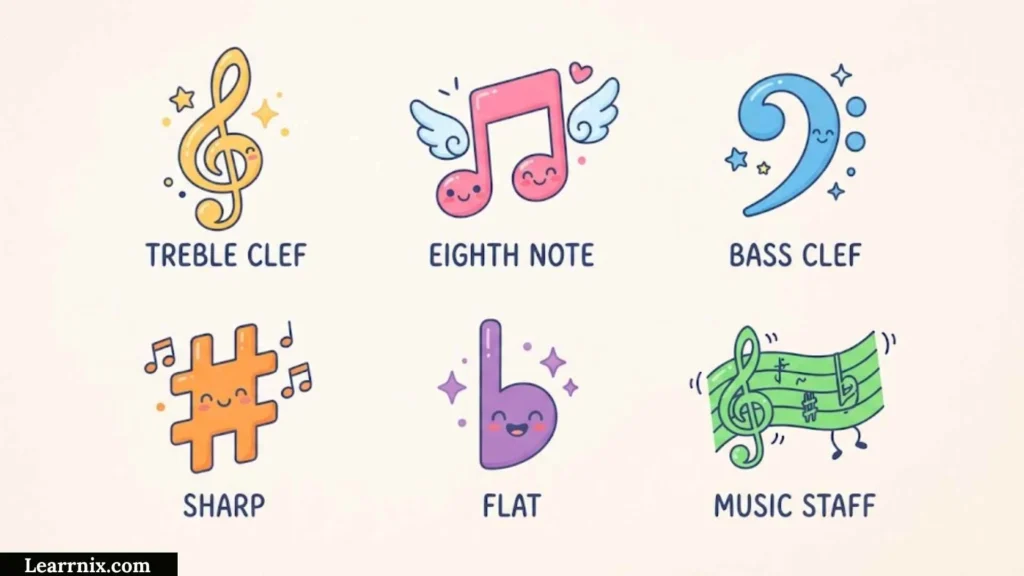
If you need music symbols for a social media caption, profile, message, username, document, invitation, or decorative design, the following characters can be copied directly.
Popular Music Symbols To Copy
- ♩
- ♪
- ♫
- ♬
- ♭
- ♮
- ♯
- 𝄞
- 𝄡
- 𝄢
- 𝄐
- 𝄪
- 𝄫
- 𝄴
- 𝄵
- 🎵
- 🎶
- 🎼
- 🎹
- 🎸
- 🎻
- 🎷
- 🎺
The characters ♩, ♪, ♫, and ♬ are especially convenient for plain-text use. The Unicode Standard identifies ♩ as the quarter note, ♪ as the eighth note, ♫ as beamed eighth notes, and ♬ as beamed sixteenth notes.
For decorative text, you can combine them with words:
- ♪ Music ♪
- ♫ My Playlist ♫
- ♩ Piano Mood ♩
- ♬ Lost In Music ♬
- 𝄞 Classical Music 𝄞
- 🎵 Now Playing 🎵
- 🎶 Good Music, Good Mood 🎶
The emoji characters 🎵 and 🎶 are separate Unicode emoji characters rather than simply colorful versions of ♪ and ♫. Unicode lists 🎵 as MUSICAL NOTE and 🎶 as MULTIPLE MUSICAL NOTES.
List Of Music Symbols With Examples
A useful way to understand music symbols is to organize them by function. This prevents a long list of characters from becoming difficult to remember.
Note Symbols
Note symbols communicate duration and musical sound.
- 𝅝 — Whole Note: A whole-note character used in musical notation.
- 𝅗𝅥 — Half Note: A half-note character.
- ♩ — Quarter Note: A quarter-note character.
- ♪ — Eighth Note: An eighth-note character.
- 𝅘𝅥𝅯 — Sixteenth Note: A sixteenth-note character.
- 𝅘𝅥𝅰 — Thirty-Second Note: A thirty-second-note character.
Unicode also encodes longer and shorter note values, including breve, sixty-fourth note, and one hundred twenty-eighth note characters.
Clef Symbols
Clefs provide the pitch reference needed to interpret notes on a staff.
- 𝄞 — G Clef
- 𝄡 — C Clef
- 𝄢 — F Clef
- 𝄥 — Drum Clef-1
- 𝄦 — Drum Clef-2
The G clef is commonly associated with treble notation, while the F clef is commonly associated with bass notation. The C clef can be positioned in different ways to identify different registers.
Accidental Symbols
Accidentals modify the pitch of notes.
- ♯ — Sharp
- ♭ — Flat
- ♮ — Natural
- 𝄪 — Double Sharp
- 𝄫 — Double Flat
- 𝄲 — Quarter Tone Sharp
- 𝄳 — Quarter Tone Flat
Unicode specifically identifies ♭, ♮, and ♯ as the music flat, natural, and sharp signs, while additional accidentals such as double sharp, double flat, and quarter-tone symbols are included in the Musical Symbols block.
Time And Rhythm Symbols
Time signatures tell performers how beats are organized within measures. Common musical notation also uses barlines, rests, beams, dots, ties, and other rhythm-related marks.
Two directly encoded examples are:
- 𝄴 — Common Time
- 𝄵 — Cut Time
A complete music score contains much more than isolated Unicode characters. The way symbols are positioned on a staff is essential to their interpretation.
Rest Symbols
Rests indicate periods of silence.
Different rests correspond to different durations, just as note values do. Unicode includes specialized rest characters, including a multiple-measure rest.
Music Symbols Images With Names
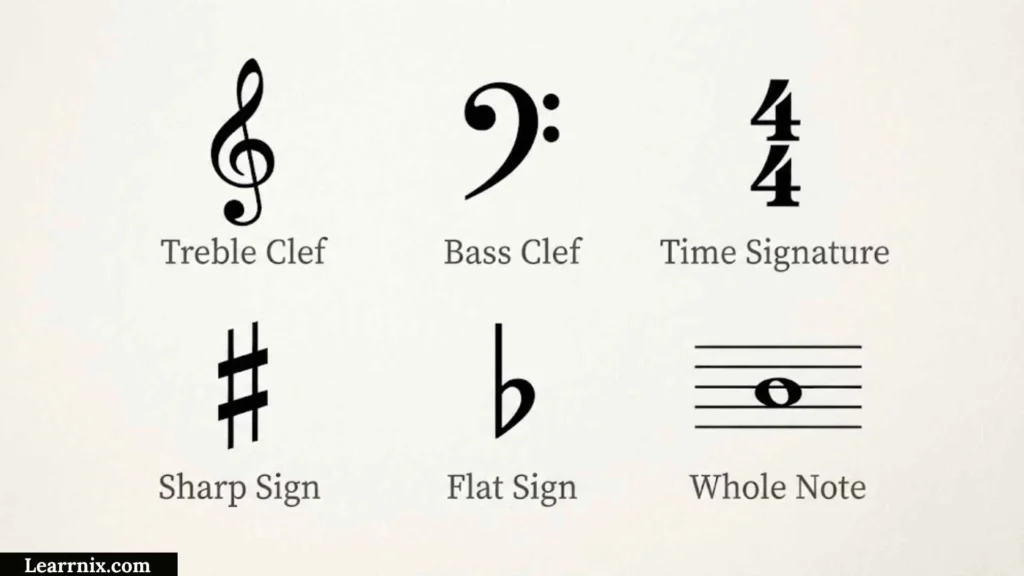
A visual music-symbol chart can be especially useful for beginners because the shape of a symbol is often easier to remember when it is seen beside its name and meaning.
A useful reference chart may include:
- Treble or G clef
- Bass or F clef
- C clef
- Whole, half, quarter, and eighth notes
- Common rests
- Sharp, flat, and natural signs
- Time signatures
- Dynamics
- Repeat signs
- Fermata
- Slurs and ties
- Accent and articulation markings
When learning from an image, try to identify three things: the symbol’s name, its function, and where it appears in a score. This approach is more useful than memorizing shapes without understanding their purpose.
Music Symbols Drawing
Music symbols are popular for hand-drawn artwork, school assignments, posters, music notebooks, greeting cards, logos, and digital illustrations. Some are simple enough to draw with a few basic strokes.
For example, a simple eighth note can be drawn by creating a small notehead, adding a stem, and attaching a flag. Two connected eighth notes can then be joined with a beam.
You can create a decorative music border like this:
♪ ♫ ♩ ♪ ♬ ♫ ♪ ♩
Or make a simple music-themed title:
♫ MUSIC ♫
For a more realistic sheet-music drawing, begin with five horizontal staff lines. Notes can then be placed on lines or spaces, with a clef at the beginning. However, if the drawing is intended to represent actual music, the placement of every note matters.
A decorative drawing can use musical shapes freely, while educational or performance notation needs to follow established notation rules.
Music Symbols Aesthetic
Music symbols are frequently used as decorative characters because they instantly create a musical theme without requiring a long explanation. They can work well in bios, captions, usernames, journal headings, invitations, playlists, and creative posts.
Here are some aesthetic combinations:
- ♫ Music ♫
- ♪ Music Lover ♪
- ♩ Piano ♩
- ♫₊˚⊹♡ Music ♡⊹˚₊♫
- ♪₊˚⊹ Melody ⊹˚₊♪
- ♫ ⋆。°✩ Playlist ✩°。⋆ ♫
- 𝄞 Classical Mood 𝄞
- ♪♡♪ Song Of The Day ♪♡♪
- 🎶 Music Vibes 🎶
- ♫ — Now Playing — ♫
You can also combine musical characters with hearts, stars, flowers, or other decorative symbols. These combinations are aesthetic rather than formal notation, so their purpose is visual styling.
One practical distinction is worth remembering: ♪ and ♫ are text characters, while 🎵 and 🎶 are emoji characters. Emoji designs can change depending on the platform or font, while plain text symbols are generally intended to function as characters within text.
Music Symbols And Their Meanings
The meaning of a musical symbol depends on its position and context. A character used in formal notation can have a precise function, while the same character used in a social media caption may simply communicate a general idea of music.
Common Music Symbol Meanings
♩ — Quarter Note: Represents a quarter-note value. Its actual sounding duration depends on tempo and meter.
♪ — Eighth Note: Represents an eighth-note value.
♫ — Beamed Eighth Notes: Represents two connected eighth-note characters.
♬ — Beamed Sixteenth Notes: Represents connected sixteenth-note characters.
♯ — Sharp: Raises a pitch by a semitone in the standard Western context.
♭ — Flat: Lowers a pitch by a semitone.
♮ — Natural: Cancels an applicable sharp or flat.
𝄞 — G Clef: Identifies the G-clef symbol used to establish a pitch reference.
𝄢 — F Clef: Identifies the F-clef symbol used to establish a pitch reference.
𝄡 — C Clef: Identifies a C-clef symbol.
𝄐 — Fermata: Indicates that a note, chord, or rest is held longer than its ordinary written value, with the exact duration determined by musical context and performance.
𝄪 — Double Sharp: Raises a pitch by two semitones.
𝄫 — Double Flat: Lowers a pitch by two semitones.
Unicode confirms the formal names of these characters, but a full interpretation of written music cannot always be represented by a single character. The standard notes that musical pitch encoding and score layout require higher-level structures beyond individual Unicode symbols.
This is why a symbol copied into plain text can resemble a notation mark without being sufficient to reproduce an entire musical score.
Cute Music Symbols
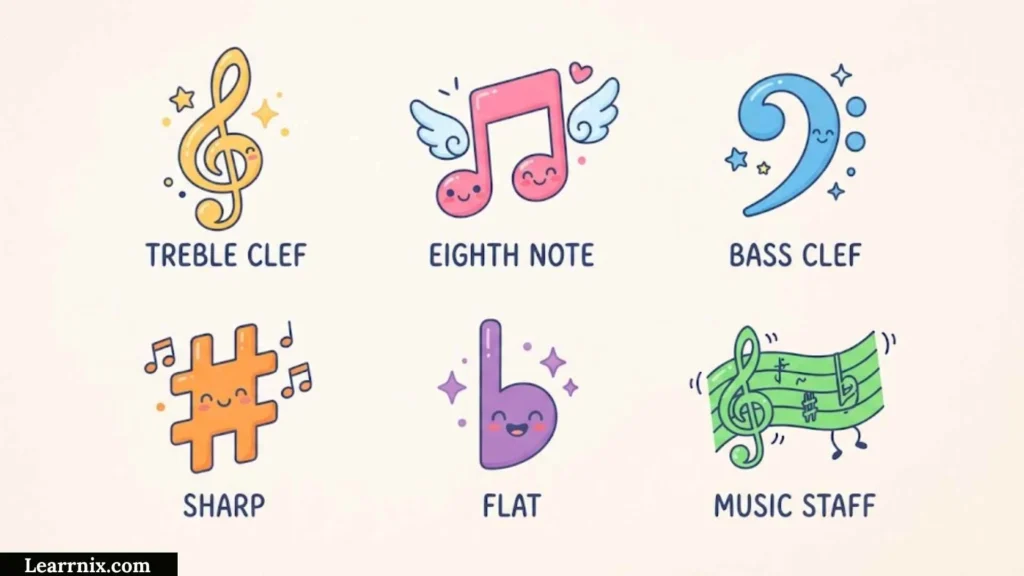
Cute music symbols are useful when you want a playful, soft, or decorative appearance. They are especially popular in captions, bios, digital journals, messages, usernames, and music-themed posts.
Cute Music Symbol Combinations
- ♫♡♫
- ♪♡♪
- ♡♪♡
- ♫₊˚⊹♡
- ♪₊˚⊹
- ♫ ⋆。°✩
- ♪。・:*˚
- ♡🎵♡
- 🎶₊˚⊹
- ♫✧♪✧♫
- ♪ ♡ Music ♡ ♪
- ♫ ˚₊‧꒰ა Music ໒꒱ ‧₊˚ ♫
You can make these combinations more personal by placing a name, song title, playlist label, or short phrase between the symbols.
For example:
♫ My Favorite Song ♫
♪ Late Night Playlist ♪
♡🎶 Music Time 🎶♡
The musical emoji 🎵 and 🎶 can also be mixed with text symbols. Unicode identifies them as Musical Note and Multiple Musical Notes, respectively.
Piano Sheet Music Symbols
Piano sheet music uses a large collection of symbols to communicate pitch, rhythm, dynamics, articulation, phrasing, pedal use, and other performance details. A piano score commonly uses a grand staff, with an upper staff and lower staff connected together.
The upper staff is often written with a G clef and the lower staff with an F clef. This arrangement allows piano music to represent a wide range of pitches without relying on an excessive number of ledger lines.
Common Piano Sheet Music Symbols
| Symbol/Marking | Name | Meaning |
| 𝄞 | G Clef | Establishes the pitch reference for the upper staff |
| 𝄢 | F Clef | Establishes the pitch reference for the lower staff |
| ♯ | Sharp | Raises a pitch by a semitone |
| ♭ | Flat | Lowers a pitch by a semitone |
| ♮ | Natural | Cancels an applicable accidental |
| ♩ | Quarter Note | Indicates a quarter-note value |
| ♪ | Eighth Note | Indicates an eighth-note value |
| 𝄐 | Fermata | Extends a note or rest beyond its normal value |
| p | Piano | Play softly |
| pp | Pianissimo | Play very softly |
| f | Forte | Play loudly |
| ff | Fortissimo | Play very loudly |
| cresc. | Crescendo | Gradually become louder |
| dim. | Diminuendo | Gradually become softer |
| Ped. | Pedal Marking | Indicates pedal use |
| > | Accent | Emphasizes a note when used as an articulation mark |
Piano notation also uses slurs, ties, staccato marks, accents, arpeggio markings, repeat signs, pedal markings, and dynamic changes. These instructions work together rather than independently.
A tie connects notes of the same pitch so their durations are combined. A slur, in contrast, generally groups notes into a connected phrase and affects articulation or phrasing. They can look similar at a glance, so their musical function is important.
Unicode includes many of the basic characters used in musical notation, but it does not attempt to encode the complete spatial layout of a piano score. The Unicode Standard specifically explains that pitch relationships and complex score layout are handled through higher-level systems.
For this reason, professional sheet music is normally created with music-notation software rather than by placing isolated Unicode characters into a text document.
Frequently Asked Questions
What are the most common music symbols?
Common music symbols include notes such as ♩ and ♪, beamed notes such as ♫ and ♬, accidentals such as ♯ and ♭, and clefs such as 𝄞 and 𝄢. Their exact role depends on where they appear in musical notation.
Can I copy and paste music symbols?
Yes. Characters such as ♪, ♫, ♩, ♯, ♭, ♮, 𝄞, and 𝄢 can be copied and pasted into many text fields, documents, captions, and messages. Specialized characters may depend on font and application support.
What is the difference between music symbols and music emojis?
Music symbols such as ♪ and ♫ are text characters used in notation or decoration. Music emojis such as 🎵 and 🎶 are emoji characters designed for visual communication and may have different appearances across platforms.
What do the sharp, flat, and natural symbols mean?
A sharp generally raises a pitch by a semitone, while a flat generally lowers it by a semitone. A natural cancels an applicable sharp or flat. Their effect can depend on the notation and musical context.
Which music symbols are used in piano sheet music?
Piano sheet music commonly uses G and F clefs, notes, rests, accidentals, time signatures, dynamics, articulation marks, ties, slurs, pedal markings, and repeat signs. These symbols work together to communicate how the music should be performed.
Conclusion
Music symbols make written music easier to communicate by representing pitch, rhythm, duration, dynamics, expression, and performance instructions. Common characters such as ♩, ♪, ♫, ♯, ♭, ♮, 𝄞, and 𝄢 are useful starting points for anyone learning notation or looking for musical characters to copy.
For digital use, simple text symbols and music emojis can add a musical touch to captions, bios, messages, usernames, playlists, and creative designs. Symbols such as ♪ and ♫ are especially easy to copy, while 🎵 and 🎶 provide a more colorful emoji-style appearance.
For piano and formal sheet music, however, individual characters are only one part of the notation system. Their position, surrounding marks, staff, rhythm, pitch relationships, and performance instructions all contribute to the meaning of a complete score. Understanding both the symbol and its context is the key to reading music accurately.

I am Daniel Harper, an education enthusiast and writer who enjoys creating helpful content to make learning more accessible and engaging.
I focus on sharing knowledge about effective study methods, educational growth, and skills that help learners succeed in a changing world.
Through my writing, I aim to inspire students to explore new ideas and develop a passion for learning.
Books by Daniel Harper:
- The Path to Lifelong Learning
- Unlocking Your Learning Potential
 Michael Carter
 Charlotte Anderson