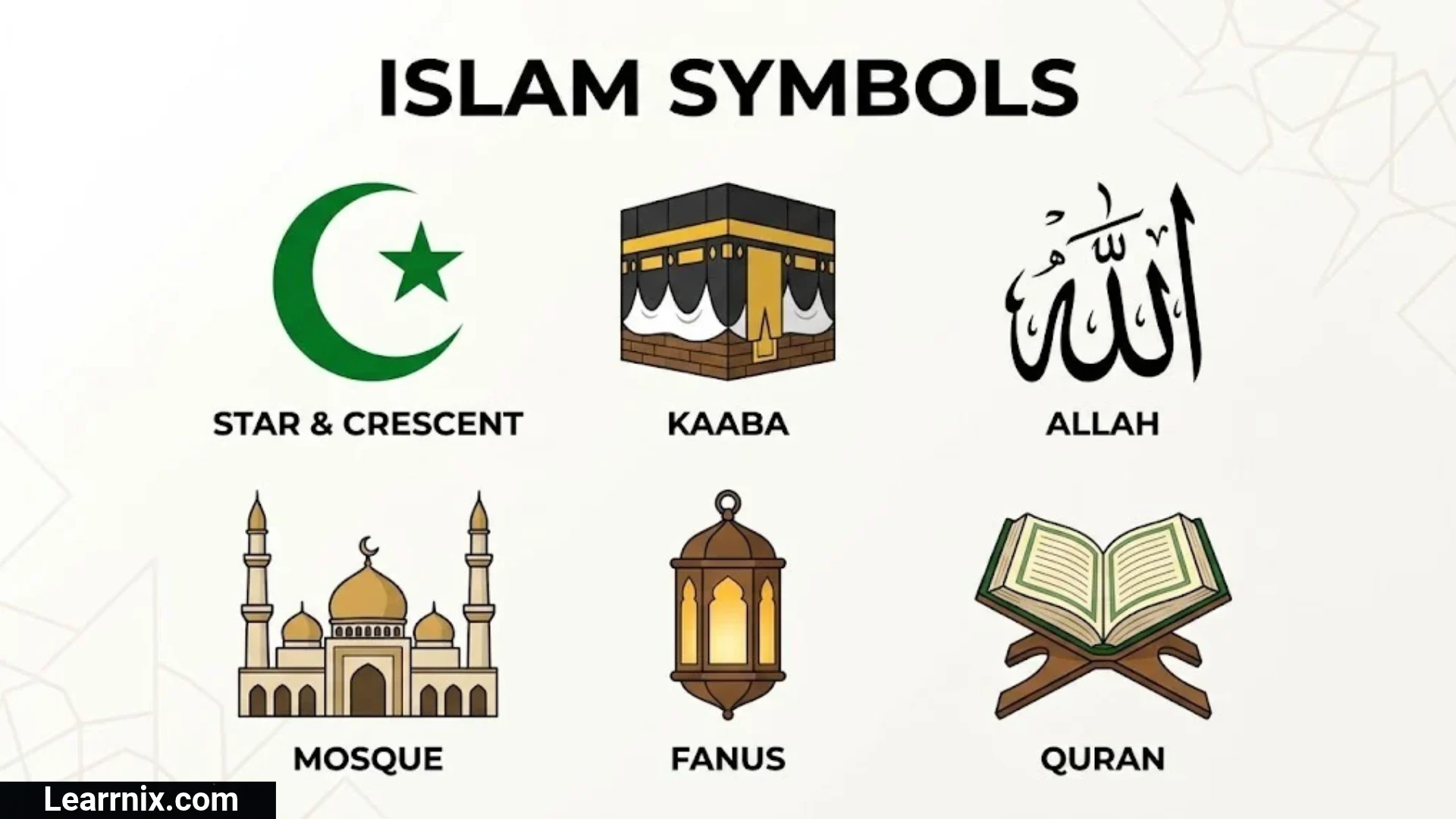
Islamic symbols are widely used in religious artwork, mosque decorations, Arabic calligraphy, social media posts, and personal messages. From the familiar crescent moon and star to the Arabic name of Allah, these symbols help people express faith, recognize Islamic traditions, and share meaningful messages.
However, not every symbol associated with Muslims has an official religious meaning. Some have historical connections, while others represent important Islamic beliefs, practices, or cultural traditions. Understanding these differences helps you use Islamic symbols correctly and respectfully.
In this guide, you will discover Islam symbols and their meanings, Islamic text characters, Arabic symbols, Sunni and Shia symbols, and the five pillars of Islam. You will also find copy-and-paste Islamic symbols, their names, and explanations of how they are used in different religious and cultural contexts.
What Are Islam Symbols
Islam symbols are visual signs, Arabic characters, objects, and decorative designs associated with the Islamic faith and Muslim communities. They can represent beliefs, religious practices, Islamic history, and cultural traditions.
Unlike some religions, Islam does not have one universally accepted official symbol. Nevertheless, several designs have become widely associated with Muslim identity through history, architecture, national flags, and religious artwork.
Some commonly recognized Islamic symbols include:
- ☪ — Crescent and Star
- ☾ — Crescent Moon
- ★ — Star
- ﷲ — Allah Calligraphic Ligature
- 🕋 — Kaaba
- ۞ — Arabic Start of Rub El Hizb
- ☝ — Index Finger Pointing Up
- 🕌 — Mosque
These symbols do not all have the same religious status. For example, the crescent and star are commonly associated with Islam, but they are not prescribed as official religious symbols in the Quran.
Arabic calligraphy, geometric patterns, and images of important Islamic places are also common ways of expressing Islamic identity.
Islam Symbols And Meanings
Different symbols associated with Islam have different historical, religious, and cultural meanings. Some represent Islamic beliefs, while others are connected with worship, sacred places, or Muslim traditions.
Here are some of the most recognized examples.
| Symbol | Name | Common Association |
| ☪ | Crescent and Star | Muslim identity and Islamic heritage |
| ☾ | Crescent Moon | Lunar calendar and Islamic months |
| ﷲ | Allah | The name of God |
| 🕋 | Kaaba | Qibla and pilgrimage |
| 🕌 | Mosque | Islamic worship |
| ۞ | Rub El Hizb | Quranic text division |
| ★ | Star | Decoration and cultural symbolism |
| ☝ | Raised Index Finger | Oneness of God in certain contexts |
| تسبیح | Tasbih | Remembrance of Allah |
| سجادة | Prayer Mat | Daily Islamic prayers |
Crescent Moon And Star ☪
The crescent moon and star are among the most recognizable designs associated with Islam. They appear on mosque decorations, national flags, Islamic artwork, and religious-themed designs.
The crescent is often connected with the lunar calendar used to determine Islamic months, including Ramadan and Shawwal. However, the combined crescent-and-star design is not an official symbol established by Islamic teachings.
Kaaba 🕋
The Kaaba is located inside Masjid al-Haram in Makkah. Muslims around the world face its direction during their daily prayers.
It represents the direction of Muslim worship and is central to the Hajj and Umrah pilgrimages.
Arabic Calligraphy ﷲ
Arabic calligraphy is an important part of Islamic artistic traditions. The name Allah is frequently written in beautiful Arabic lettering and appears in religious artwork, architecture, and decorative designs.
Green Color
Green has traditional associations with Islamic culture. It is also mentioned in descriptions of Paradise in the Quran. However, green is not an official color required to represent Islam.
Islam Symbols Copy And Paste
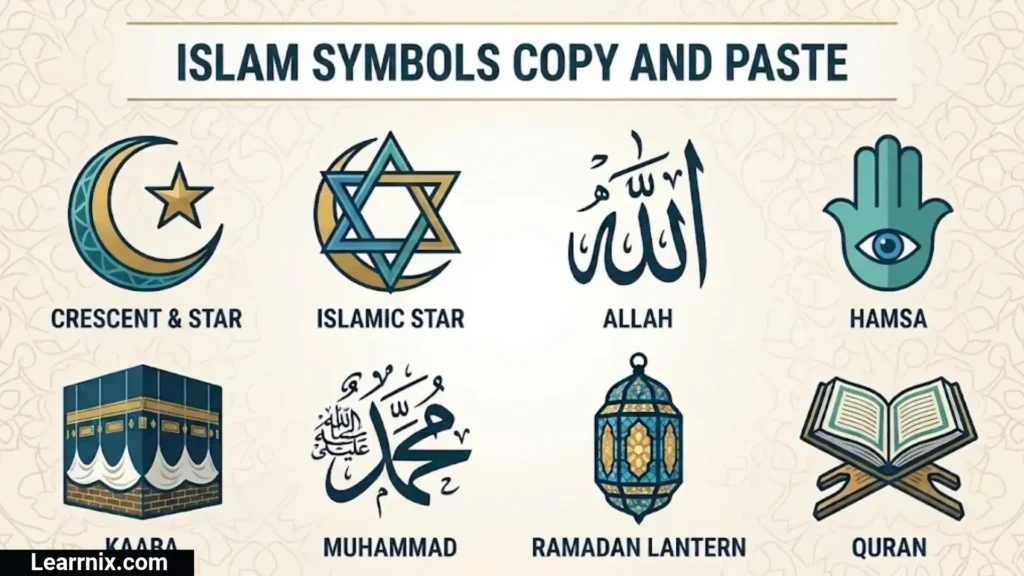
If you are searching for Islamic symbols that you can quickly copy and paste, the following collection includes religiously associated characters, decorative symbols, and useful Unicode text.
You can use these characters in social media bios, captions, messages, usernames, and Islamic-themed designs.
Popular Islamic Symbols
☪
Copy
☾
Copy
★
Copy
☆
Copy
ﷲ
Copy
۞
Copy
✦
Copy
✧
Copy
☝
Copy
✴
Copy
❋
Copy
✺
Copy
✹
Copy
✵
Copy
✶
Copy
✷
Copy
Tap Copy to copy an individual symbol.
Islamic Decorative Symbols
These characters are useful for creating attractive Islamic messages, headings, and profile descriptions.
- ✧ ✦ ✨ ✩ ✪
- ❀ ❁ ❃ ❋ ❊
- ★ ☆ ✯ ✰ ✵
- ۞ ۩ ؞ ؎
- ♡ ♥ ❥ ❣
Islamic Text Combinations
You can combine individual characters to create simple decorative designs.
- ☪ Allah ☪
- ✦ Alhamdulillah ✦
- ☾ Ramadan Kareem ☽
- ۞ Bismillah ۞
- ✧ SubhanAllah ✧
- ★ Allahu Akbar ★
These are decorative text combinations rather than official religious phrases or symbols.
Islamic Symbol Text
Islamic symbol text includes Arabic letters, religious expressions, Quranic characters, and Unicode symbols used in Islamic communication.
Arabic writing is especially important because the Quran was revealed in Arabic. Many Muslims use Arabic religious expressions in messages, social media descriptions, artwork, and personal notes.
Here are some useful Islamic text examples:
| Arabic Text | Transliteration | Meaning |
| الله | Allah | God |
| بسم الله | Bismillah | In the name of Allah |
| الحمد لله | Alhamdulillah | All praise belongs to Allah |
| سبحان الله | SubhanAllah | Glory be to Allah |
| الله أكبر | Allahu Akbar | Allah is the Greatest |
| إن شاء الله | InshaAllah | If Allah wills |
| ما شاء الله | MashaAllah | What Allah has willed |
| السلام عليكم | Assalamu Alaikum | Peace be upon you |
Popular Islamic Unicode Characters
Some Unicode characters are particularly useful in Islamic text and religious documents.
| Character | Unicode | Description |
| ﷲ | U+FDF2 | Arabic Ligature Allah Isolated Form |
| ۞ | U+06DE | Arabic Start of Rub El Hizb |
| ۩ | U+06E9 | Arabic Place of Sajdah |
| ﷺ | U+FDFA | Arabic Ligature Sallallahou Alayhe Wasallam |
| ؎ | U+060E | Arabic Poetic Verse Sign |
Remember that Arabic characters are written from right to left. Their appearance may change depending on the font, application, and device.
Islam Symbol Name And Meaning
Learning the names of Islamic symbols makes it easier to understand their religious, historical, and cultural importance.
Some symbols represent specific Islamic practices, while others are associated with Muslim communities through tradition.
| Symbol Or Object | Name | Meaning Or Association |
| ☪ | Hilal | Crescent moon |
| ★ | Najm | Star |
| 🕋 | Kaaba | Sacred structure in Makkah |
| 🕌 | Masjid | Mosque or place of worship |
| ﷲ | Allah | The one God |
| ۞ | Rub El Hizb | Quranic reading division |
| سجادة | Musalla | Prayer mat |
| مسبحة | Misbaha | Prayer beads |
| هلال | Hilal | Crescent |
| قبلة | Qibla | Direction of prayer |
Misbaha Or Tasbih
Misbaha, also known as tasbih beads, are used by many Muslims to count repetitions of devotional phrases. They commonly contain 33 or 99 beads, although other arrangements exist.
Prayer Mat
A prayer mat provides a clean surface for performing Salah. It is commonly decorated with geometric patterns, mosque designs, or traditional artwork.
Rub El Hizb ۞
The Rub El Hizb is an eight-pointed ornamental Quranic mark. It helps identify divisions in Quranic text and is also used in Islamic geometric designs.
Muslim Symbol For God
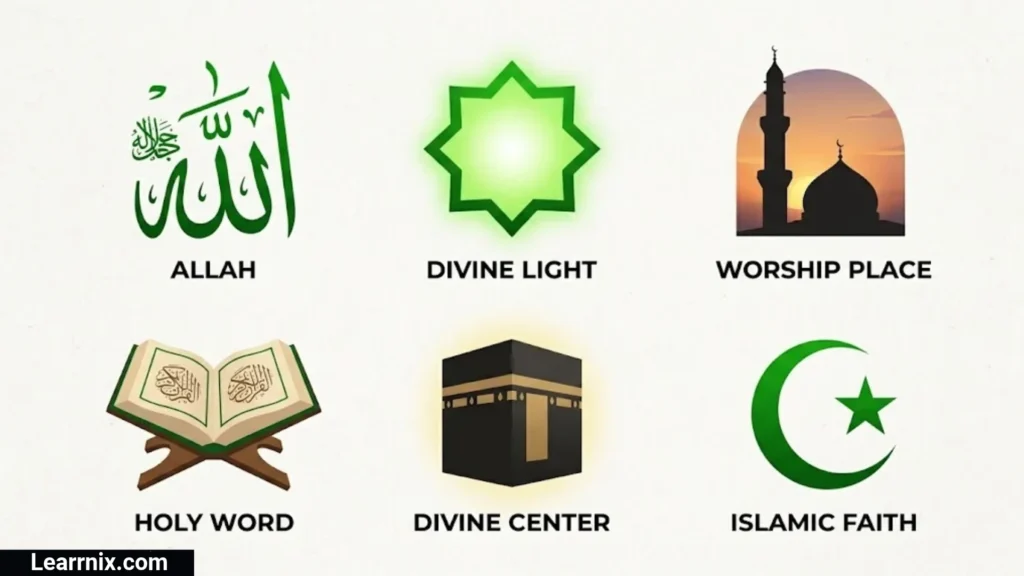
The central belief of Islam is Tawhid, which means the absolute oneness of Allah. Muslims believe that Allah is the one and only God, the Creator of everything.
There is no physical image or universally accepted pictorial symbol of Allah in Islamic belief. However, the Arabic name Allah is widely used in Islamic calligraphy and religious artwork.
ﷲ
Allah
Arabic calligraphic ligature for the name of God
Copy Allah Symbol
Common Islamic Expressions About Allah
- الله — Allah
- الله أكبر — Allahu Akbar
- الحمد لله — Alhamdulillah
- سبحان الله — SubhanAllah
- بسم الله — Bismillah
- لا إله إلا الله — La ilaha illallah
These expressions are frequently used in prayers, everyday conversations, religious messages, and Islamic writing.
Five Pillars Of Islam Symbols
The five pillars of Islam are the fundamental acts of worship and religious duties that form the foundation of Muslim life.
They are Shahada, Salah, Zakat, Sawm, and Hajj. Each pillar has a distinct purpose and importance. Although there are no universally prescribed icons for the five pillars, certain objects and visual designs are commonly used to represent them.
☝
1. Shahada — Declaration Of Faith
Shahada is the Islamic declaration of faith. It confirms that there is no god but Allah and Muhammad is His Messenger.
🕌
2. Salah — Prayer
Salah refers to the five daily prayers performed by Muslims. A prayer mat and mosque are common visual representations.
🤲
3. Zakat — Charity
Zakat is an obligatory charity given to eligible recipients. Hands giving money are often used as an illustrative representation.
☾
4. Sawm — Fasting
Sawm refers to fasting during Ramadan. The crescent moon and dates are common visual associations with this practice.
🕋
5. Hajj — Pilgrimage
Hajj is the pilgrimage to Makkah that Muslims must perform at least once in their lifetime if they are physically and financially able.
These visual associations make the five pillars easier to recognize in educational materials, Islamic posters, and religious presentations.
Shia Islam Symbols
Shia Islam is one of the two major branches of Islam. Shia Muslims recognize the religious importance of the Prophet Muhammad’s family and give special importance to Imam Ali and the other Imams.
Some symbols and objects have particular significance in Shia traditions.
Zulfiqar Sword ⚔
Zulfiqar is the famous sword traditionally associated with Imam Ali. It is often depicted with a distinctive split or double-pointed blade.
The sword represents courage, justice, bravery, and devotion in many Shia cultural and religious settings.
Turbah
A turbah is a small piece of earth or clay used by many Shia Muslims during prostration in prayer. It is commonly associated with Karbala and the martyrdom of Imam Hussain.
Black Banners
Black banners are particularly associated with mourning ceremonies during Muharram, especially the remembrance of the martyrdom of Imam Hussain at Karbala.
Ya Hussain
يا حسين is an Arabic expression meaning “O Hussain.” It is commonly displayed in Shia religious gatherings and mourning ceremonies.
Other associated expressions include:
- يا علي — Ya Ali
- يا حسين — Ya Hussain
- عباس — Abbas
- الله — Allah
These symbols and expressions reflect particular religious traditions and should not be assumed to represent every Shia Muslim in the same way.
Sunni Islam Symbols
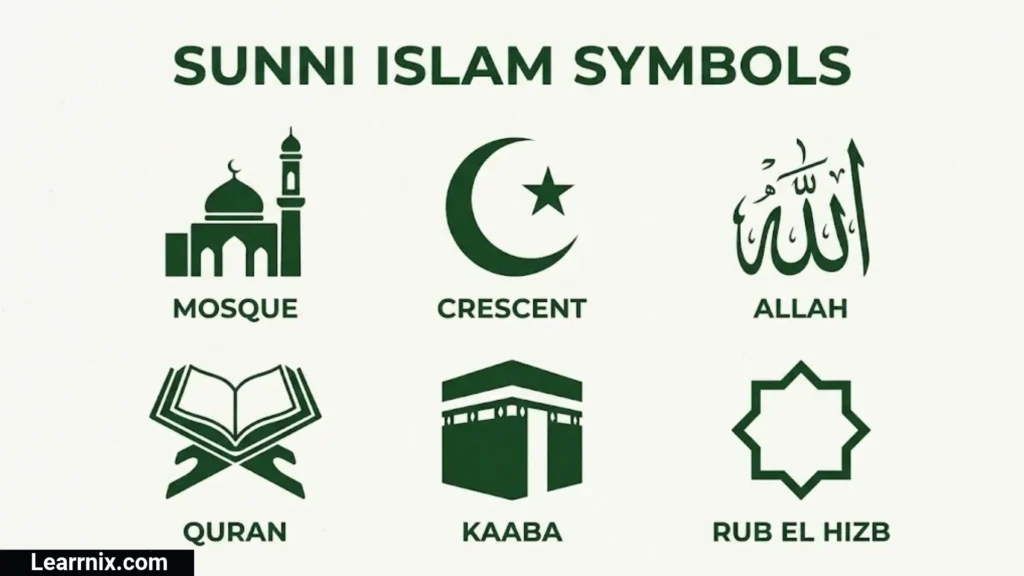
Sunni Islam is the largest branch of Islam. Sunni Muslims follow the Quran and the Sunnah of Prophet Muhammad and recognize the importance of the first four rightly guided caliphs.
Sunni Islam does not have one official symbol that all followers are required to use. However, several visual elements are commonly associated with Sunni communities.
Crescent And Star ☪
Many Sunni mosques, organizations, and cultural institutions use the crescent and star as a recognizable design. Its use is cultural and historical rather than a universally prescribed Sunni religious requirement.
Quranic Calligraphy
Arabic calligraphy featuring Quranic verses and religious expressions is common in Sunni mosques and Islamic artwork.
Prayer Beads
Misbaha or tasbih beads are used by many Sunni Muslims for Dhikr, the remembrance of Allah.
Green Color
Green is often used in Sunni religious decorations, flags, and cultural designs. Its significance varies across communities.
It is important to understand that Sunni Muslims do not have a separate mandatory religious emblem. Their religious identity is primarily based on Islamic beliefs and practices.
Arabic Arabic Islam Symbols
Arabic is the language of the Quran, and Arabic writing plays a major role in Islamic religious expression. Many Arabic characters, calligraphic forms, and Quranic marks are used in Islamic artwork and digital text.
Here are some useful Arabic symbols and characters.
Arabic Religious Characters
| Character | Name Or Use |
| الله | Allah |
| ﷲ | Allah ligature |
| ۞ | Rub El Hizb |
| ۩ | Place of Sajdah |
| ﷺ | Blessings upon Prophet Muhammad |
| | Arabic Number Sign |
| ؎ | Arabic Poetic Verse Sign |
| ٱ | Arabic Letter Alef Wasla |
| ّ | Shadda |
| ْ | Sukun |
Common Arabic Islamic Words
- إيمان — Iman (Faith)
- صلاة — Salah (Prayer)
- زكاة — Zakat (Charity)
- صوم — Sawm (Fasting)
- حج — Hajj (Pilgrimage)
- قرآن — Quran
- مسجد — Masjid (Mosque)
- رحمة — Rahmah (Mercy)
Arabic Calligraphy In Islamic Design
Arabic calligraphy is used to decorate mosque walls, Quran covers, religious buildings, and Islamic greeting cards.
Popular calligraphic styles include:
- Kufic — An early angular Arabic calligraphy style.
- Naskh — A clear and readable script.
- Thuluth — A decorative style often used in architectural inscriptions.
- Diwani — A flowing style associated with Ottoman calligraphy.
- Nastaliq — A sloping style widely used in Persian and Urdu writing.
These styles give Arabic religious writing different visual appearances while preserving the written message.
Anti Islam Symbols
The phrase “anti Islam symbols” generally refers to signs, images, or visual messages used to express hostility toward Islam or Muslims.
It is important to distinguish between symbols genuinely used in anti-Muslim hostility and ordinary religious or cultural symbols that may be misunderstood.
Some examples of imagery that can appear in anti-Islamic or anti-Muslim messaging include:
- Desecrated Quran imagery — Used in some hostile demonstrations to insult Islamic beliefs.
- Crossed-out mosque illustrations — Sometimes used to communicate opposition to Muslim places of worship.
- Hate slogans targeting Muslims — Text-based messages that promote discrimination or hostility.
- Anti-Muslim caricatures — Degrading images intended to stereotype or insult Muslim communities.
Religious Symbols Are Not Automatically Anti-Islamic
Some symbols are incorrectly labeled as anti-Islamic simply because they belong to another religion or culture.
For example:
- ✝ — Christian Cross
- ✡ — Star of David
- ☯ — Yin Yang
These symbols represent different religious or philosophical traditions. Their ordinary use does not automatically express hostility toward Islam.
Similarly, the crescent moon, Arabic writing, and mosque illustrations are not anti-Islamic symbols.
When interpreting potentially offensive imagery, consider its context, accompanying message, and intended meaning rather than judging it by appearance alone.
Judaism Christianity Islam Symbols
Judaism, Christianity, and Islam are three major monotheistic religions. They share some historical connections and beliefs, including the belief in one God, but each has its own religious teachings, traditions, and commonly recognized symbols.
Here is a comparison of their familiar symbols.
✡
Judaism — Star Of David
The six-pointed star is a widely recognized symbol associated with Jewish identity, culture, and religious heritage.
✝
Christianity — Cross
The cross represents the crucifixion and resurrection of Jesus Christ and is the most widely recognized Christian symbol.
☪
Islam — Crescent And Star
The crescent and star are commonly associated with Muslim identity, although they are not an official symbol of Islamic belief.
Main Differences Between These Religious Symbols
| Religion | Common Symbol | Main Association |
| Judaism | ✡ | Jewish identity and heritage |
| Christianity | ✝ | Jesus Christ and Christian faith |
| Islam | ☪ | Muslim cultural identity |
All three religions have different interpretations of God, scripture, religious practices, and spiritual teachings. Their symbols should be understood within their individual religious contexts.
Important Islam Symbols
Several symbols, objects, and visual elements are especially important when discussing Islamic beliefs and Muslim traditions.
Here are additional examples that help explain different aspects of Islam.
- 🕋 Kaaba: Represents the central direction of Muslim prayer and the destination of Hajj.
- 🕌 Mosque: Represents communal worship and Islamic religious life.
- ☪ Crescent: Commonly associated with Muslim identity and the lunar calendar.
- ﷲ Allah: Represents the Arabic name of God.
- ۞ Rub El Hizb: A Quranic reading and division mark.
- 📿 Tasbih: Represents Dhikr and the remembrance of Allah.
- 📖 Quran: Represents the holy book of Islam.
- 🤲 Dua: Represents supplication and asking Allah for help.
- ☝ Tawhid: An illustrative gesture associated with the oneness of God.
- Green Color: Has traditional associations with Islamic culture and descriptions of Paradise.
Important Islamic Concepts And Their Expressions
Some important Islamic concepts are expressed through words rather than pictures.
| Islamic Term | Meaning |
| Tawhid | Oneness of Allah |
| Iman | Faith |
| Taqwa | God-consciousness |
| Sabr | Patience |
| Shukr | Gratitude |
| Rahmah | Mercy |
| Ihsan | Excellence in worship and conduct |
| Dhikr | Remembrance of Allah |
These terms are useful when creating educational Islamic content, religious messages, and decorative Arabic designs.
Religion Islam Symbols
Islamic symbols are used in different religious, educational, cultural, and social settings. Their meanings can depend on the country, community, and purpose for which they are displayed.
Symbols Used In Mosques
Mosques often feature Arabic calligraphy, geometric patterns, Quranic inscriptions, and decorative designs. Some also display crescent-shaped ornaments on domes or minarets.
Symbols Used During Ramadan
Ramadan-themed designs frequently include:
- ☾ Crescent Moon
- ★ Stars
- 🕌 Mosque
- 🏮 Decorative Lantern
- 📿 Prayer Beads
These designs are commonly used for Ramadan greetings, calendars, invitations, and social media posts.
Symbols Used During Eid
Eid decorations often feature crescent moons, stars, lanterns, mosque illustrations, and Arabic greetings.
Common expressions include:
- عيد مبارك — Eid Mubarak
- كل عام وأنتم بخير — May you be well every year
- تقبل الله منا ومنكم — May Allah accept from us and you
Symbols Used In Islamic Education
Islamic educational materials frequently use images and text associated with the five pillars, Quranic verses, prayer, charity, and pilgrimage.
These visual elements make religious information easier to understand, especially for children and beginners.
Frequently Asked Questions
What is the main symbol of Islam?
The crescent moon and star are commonly recognized as symbols associated with Islam. However, Islam does not have one universally prescribed official symbol. The Arabic name of Allah and Islamic calligraphy are also widely used.
What does the crescent moon mean in Islam?
The crescent moon is associated with the Islamic lunar calendar, which determines important months and religious occasions such as Ramadan and Eid. Its use as an Islamic emblem is mainly historical and cultural.
What is the Arabic symbol for Allah?
The Arabic name of God is الله, while ﷲ is a Unicode character representing a calligraphic ligature of the name Allah. Both are used in Islamic writing and artwork.
Are Sunni and Shia Islamic symbols different?
Some symbols have particular importance in Sunni or Shia communities. For example, Zulfiqar and the turbah are especially associated with Shia traditions. However, both branches share fundamental Islamic beliefs and many religious expressions.
Can I use Islamic symbols in my social media bio?
Yes, you can use suitable Islamic Unicode characters, Arabic expressions, and decorative symbols in social media bios. Characters such as ☪, ﷲ, ۞, and ☾ can be used where supported, but religious text should always be treated respectfully.
Conclusion
Islam symbols include a wide range of Arabic characters, calligraphic designs, religious objects, and cultural representations. The crescent and star, Kaaba, mosque, and Arabic name of Allah are among the most recognizable examples, although they do not all have the same religious significance.
Understanding the meanings behind these symbols helps distinguish Islamic beliefs from cultural traditions. The five pillars, Arabic religious expressions, and symbols associated with Sunni and Shia communities provide a broader understanding of Muslim religious life.
If you want to use Islamic symbols in messages, websites, or social media, choose characters that match your intended meaning. Copying the correct Unicode character and understanding its context will help you create meaningful and respectful Islamic text.

I am Daniel Harper, an education enthusiast and writer who enjoys creating helpful content to make learning more accessible and engaging.
I focus on sharing knowledge about effective study methods, educational growth, and skills that help learners succeed in a changing world.
Through my writing, I aim to inspire students to explore new ideas and develop a passion for learning.
Books by Daniel Harper:
- The Path to Lifelong Learning
- Unlocking Your Learning Potential
 Charlotte Anderson
 Michael Carter