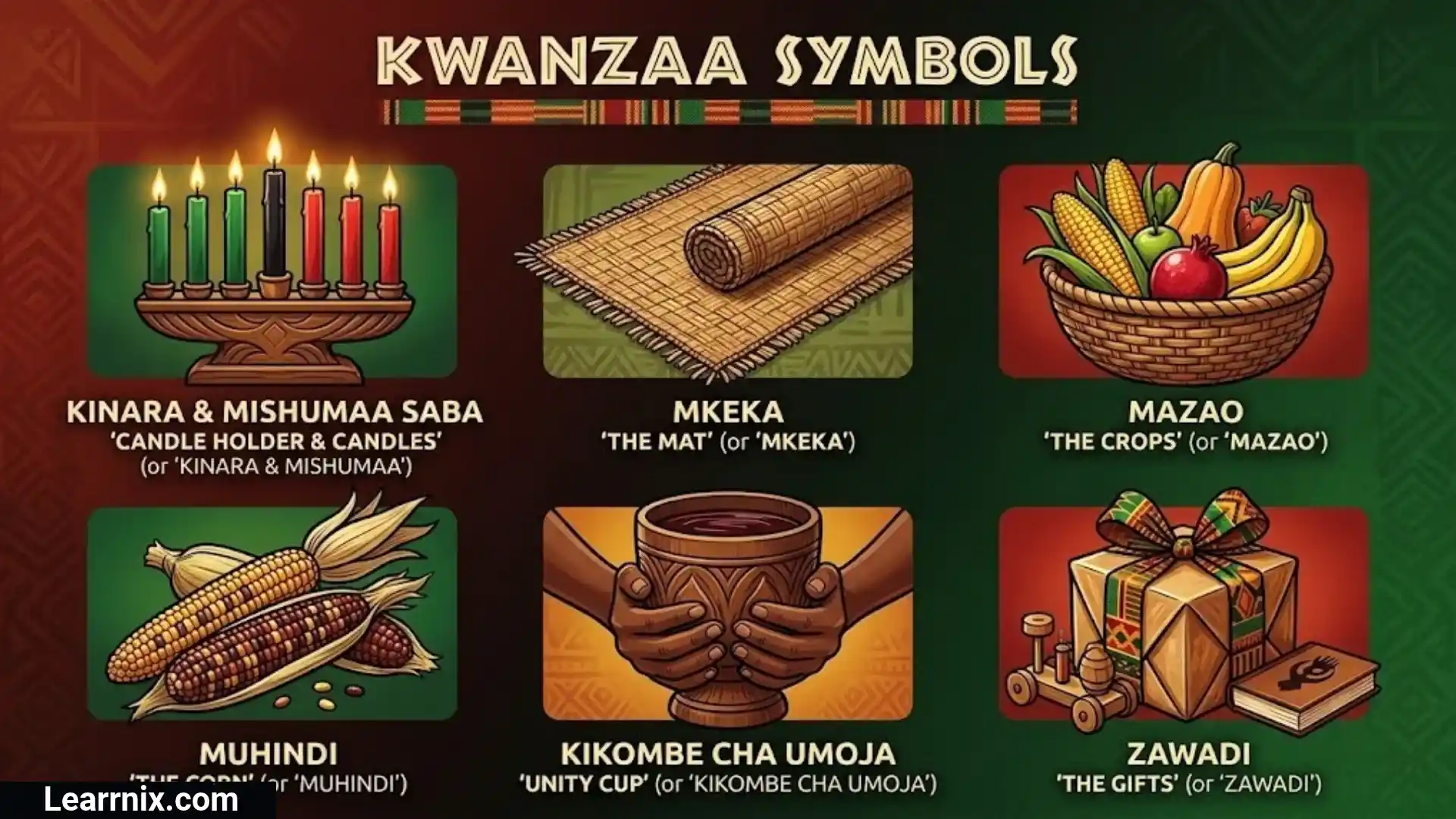
Kwanzaa is a seven-day cultural celebration that honors African heritage, family, unity, creativity, and community values. It takes place every year from December 26 to January 1. During this celebration, families use traditional objects, colorful decorations, candles, and meaningful symbols to remember their history and celebrate the values that bring communities together.
There are seven basic Kwanzaa symbols: Mazao (crops), Mkeka (mat), Kinara (candle holder), Muhindi (corn), Mishumaa Saba (seven candles), Kikombe cha Umoja (unity cup), and Zawadi (gifts). Each symbol has a special meaning connected to African culture, family relationships, shared responsibility, and future generations.
In this complete guide, you will learn about Kwanzaa symbols in order, their meanings, the traditional red, black, and green colors, the seven principles, and the importance of the Kwanzaa flag and candles. You will also discover the meanings of Ujamaa and Kuumba, along with useful ideas for drawing, clip art, coloring pages, and educational activities.
What Are Kwanzaa Symbols?
Kwanzaa symbols are traditional objects and visual representations used during the celebration of Kwanzaa. They communicate important cultural values, including unity, responsibility, creativity, cooperation, and respect for African heritage.
The celebration was created in 1966 by Dr. Maulana Karenga. Its name comes from the Swahili phrase matunda ya kwanza, meaning first fruits. Kwanzaa was developed to celebrate African culture, strengthen community relationships, and encourage people to connect with their cultural roots.
There are seven basic symbols of Kwanzaa. Two additional symbols, the Bendera (flag) and the Nguzo Saba (seven principles), are also commonly included in traditional displays.
The seven basic symbols are:
- Mazao: Crops representing harvest, productivity, and collective labor.
- Mkeka: A woven mat representing African traditions and history.
- Kinara: A candle holder representing ancestral roots.
- Muhindi: Corn representing children and future generations.
- Mishumaa Saba: Seven candles representing the seven principles.
- Kikombe cha Umoja: A unity cup representing togetherness and remembrance.
- Zawadi: Gifts representing love, achievement, and personal growth.
These objects are usually arranged on a special table during the celebration. Together, they explain the central message of Kwanzaa: people can build stronger communities by honoring their history, supporting one another, and working toward a better future.
Kwanzaa Symbols and Their Meanings
Each traditional Kwanzaa symbol has a unique purpose. Some represent the past and cultural heritage, while others focus on family, community cooperation, and future generations.
The following table explains the seven basic symbols and their meanings.
| Kwanzaa Symbol | English Name | Meaning |
| Mazao | Crops | Harvest and collective work |
| Mkeka | Mat | Tradition and history |
| Kinara | Candle holder | Ancestral roots |
| Muhindi | Corn | Children and future generations |
| Mishumaa Saba | Seven candles | Seven principles |
| Kikombe cha Umoja | Unity cup | Unity and remembrance |
| Zawadi | Gifts | Love and achievement |
1. Mazao – Crops
Mazao represents the agricultural products and harvest associated with community labor. Fruits, vegetables, and other crops are placed on the Kwanzaa table to symbolize productivity and the rewards of working together.
This symbol also represents gratitude for the efforts of people who contribute to the well-being of their families and communities.
2. Mkeka – Mat
Mkeka is a traditional woven mat that serves as the foundation of the Kwanzaa display. It represents African traditions, cultural history, and the foundation on which future generations build their lives.
Other Kwanzaa objects are placed on or around the mat. This arrangement reminds people that their achievements and future plans are connected to their history and heritage.
3. Kinara – Candle Holder
Kinara is the special candle holder used during Kwanzaa. It contains seven candle spaces and represents African ancestry and the roots of the community.
The Kinara is one of the most recognizable Kwanzaa symbols because it holds the seven candles associated with the principles of the celebration.
4. Muhindi – Corn
Muhindi represents children and future generations. Corn is placed on the Kwanzaa table to remind families of their responsibility to educate, protect, guide, and support young people.
Families traditionally display one ear of corn for each child in the household. Even families without children may include corn to recognize their responsibility toward the younger generation.
5. Mishumaa Saba – Seven Candles
Mishumaa Saba means seven candles. Each candle represents one of the seven principles of Kwanzaa, including unity, self-determination, collective responsibility, and faith.
The candles have three traditional colors: red, black, and green.
6. Kikombe cha Umoja – Unity Cup
Kikombe cha Umoja is the unity cup. It represents togetherness, family relationships, and respect for ancestors.
During Kwanzaa, families may use the cup in a libation ceremony. This ceremony involves pouring a drink as a way of remembering and honoring ancestors.
7. Zawadi – Gifts
Zawadi represents gifts exchanged during Kwanzaa. These presents are intended to encourage achievement, learning, creativity, and personal development.
Educational books, handmade crafts, meaningful cultural items, and other thoughtful presents are common choices. The emphasis is on the meaning and effort behind a gift rather than its price.
Kwanzaa Symbols in Order
The seven basic Kwanzaa symbols are traditionally displayed together on the Kwanzaa table. Their arrangement gives each object a place in the celebration and helps explain its relationship with the other symbols.
Here is the complete list in a commonly used presentation order:
- Mazao: Crops and harvest products.
- Mkeka: Traditional woven mat.
- Kinara: Seven-candle holder.
- Muhindi: Ears of corn.
- Mishumaa Saba: Seven candles.
- Kikombe cha Umoja: Unity cup.
- Zawadi: Gifts.
The Mkeka is placed underneath the other objects because it represents the cultural foundation of the celebration. The remaining items are arranged on or around it.
It is important to understand that this is a list of the seven basic symbols, not the daily order of the seven principles. The principles have their own sequence, beginning with Umoja on December 26 and ending with Imani on January 1.
What Are the Seven Kwanzaa Symbols?
The seven Kwanzaa symbols are physical objects that represent the cultural beliefs and values behind the celebration. They help families understand the importance of heritage, cooperation, family relationships, and community development.
Although the seven symbols are connected, each one communicates a different message.
- Mazao: Shows the importance of shared work and the rewards of productivity.
- Mkeka: Reminds people to respect their history and cultural foundation.
- Kinara: Connects present generations with their ancestors.
- Muhindi: Highlights the importance of children and future generations.
- Mishumaa Saba: Represents the seven values that guide the celebration.
- Kikombe cha Umoja: Encourages unity and remembrance.
- Zawadi: Promotes learning, achievement, and meaningful gift-giving.
These symbols are important because they turn the ideas behind Kwanzaa into recognizable objects. Children can learn their meanings through classroom activities, family discussions, decorations, and traditional celebrations.
They also help explain why Kwanzaa is more than a holiday. It is a cultural celebration centered on values that can be practiced throughout the year.
Kwanzaa Flag
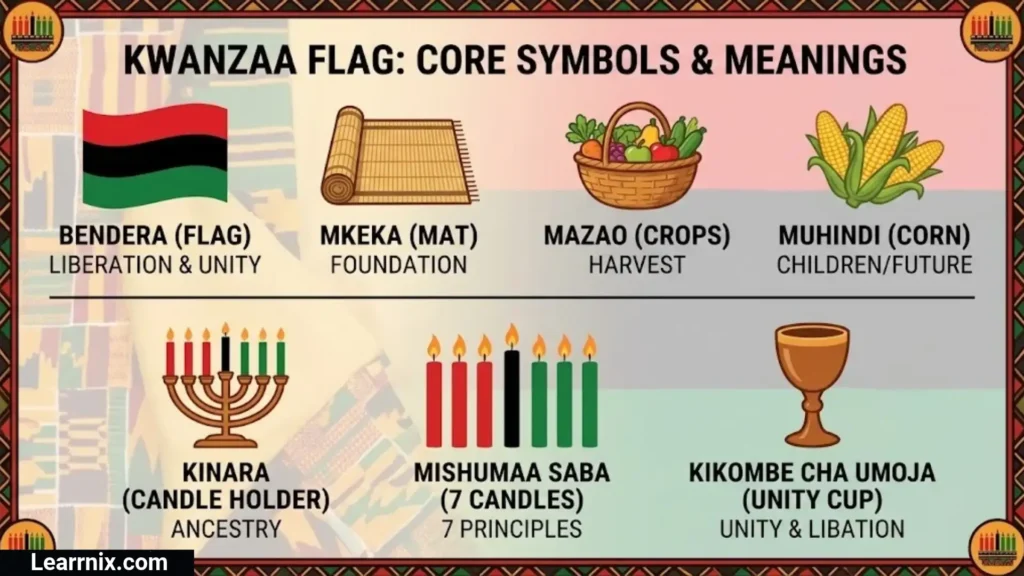
The Kwanzaa flag is called Bendera. It features three horizontal stripes in red, black, and green. These colors are associated with the Pan-African tradition and represent the identity, struggles, and hopes of African people.
The Bendera is commonly displayed during Kwanzaa celebrations to recognize African heritage, cultural pride, and the importance of community.
Kwanzaa Flag Colors and Their Meanings
Each stripe has a particular meaning:
- Red: Represents the struggles and sacrifices of African people throughout history.
- Black: Represents African people, their identity, and their shared heritage.
- Green: Represents hope, growth, prosperity, and the future.
The three colors work together to communicate a message of unity, freedom, and progress.
Difference Between the Kwanzaa Flag and Pan-African Flag
The Kwanzaa flag uses the same three colors associated with the Pan-African flag tradition. However, the Bendera is specifically used as a symbol within Kwanzaa celebrations.
The colors are often included in banners, classroom decorations, greeting cards, clothing, and cultural artwork. When creating a Kwanzaa flag for an educational project, keeping the three horizontal stripes in the traditional color order makes the design recognizable.
Kwanzaa Candles
Kwanzaa candles are called Mishumaa Saba and are among the most recognizable parts of the celebration. There are seven candles, and each one represents one of the seven principles known as Nguzo Saba.
The candles are placed in a special holder called a Kinara. Their arrangement follows the traditional red, black, and green color pattern.
How Many Candles Are Used in Kwanzaa?
Seven candles are used during Kwanzaa:
- One black candle in the center.
- Three red candles on the left.
- Three green candles on the right.
The black candle is called the Mshumaa and represents Umoja (Unity). The red candles represent the principles celebrated on the second, third, and fourth days. The green candles represent the principles celebrated on the fifth, sixth, and seventh days.
Kwanzaa Candle Lighting Order
A candle is lit each day of the celebration, beginning with the black candle on December 26.
| Day | Date | Candle Color | Principle |
| 1 | December 26 | Black | Umoja |
| 2 | December 27 | Red | Kujichagulia |
| 3 | December 28 | Red | Ujima |
| 4 | December 29 | Red | Ujamaa |
| 5 | December 30 | Green | Nia |
| 6 | December 31 | Green | Kuumba |
| 7 | January 1 | Green | Imani |
The black candle is lit first. On the second day, the first red candle is lit. On the third day, the second red candle is lit, and the process continues until all seven candles have been used.
Why Are Kwanzaa Candles Important?
The candles help families focus on one principle each day. They create an opportunity to discuss cultural values, family responsibilities, and ways to improve the community.
For children, the candle-lighting tradition is also a practical way to learn the seven principles and understand their meanings.
Kwanzaa Colors Meaning
The traditional Kwanzaa colors are red, black, and green. They are inspired by the Pan-African colors and communicate important messages about African identity, history, and future possibilities.
These colors are used in candle arrangements, flags, decorations, clothing, and educational materials.
Red – History and Struggle
Red represents the struggles and sacrifices made by African people throughout history. It reminds celebrants of the efforts of previous generations to achieve freedom, dignity, and equality.
It is also associated with the strength and determination needed to overcome challenges.
Black – African People and Identity
Black represents African people and their shared identity. It symbolizes cultural pride, unity, and the connection between individuals and their heritage.
The central black candle in the Kinara reflects this meaning.
Green – Hope and Growth
Green represents hope, growth, prosperity, and the future. It encourages people to develop their communities and create better opportunities for younger generations.
The three green candles are connected to purpose, creativity, and faith.
How to Use Kwanzaa Colors in Decorations
These three colors can be used in different creative ways:
- Red, black, and green tablecloths for Kwanzaa displays.
- Three-color banners and flags.
- Decorative candles and candle holders.
- Cultural greeting cards and invitations.
- Handmade paper ornaments.
- School posters explaining the seven principles.
- Gift wrapping and festive table decorations.
When using Kwanzaa colors, remember that each color has cultural significance. They should be included with an understanding of the history and values they represent.
7 Principles of Kwanzaa Symbols
The seven principles of Kwanzaa are known as Nguzo Saba. They are the foundation of the celebration and encourage people to develop stronger families, responsible communities, and meaningful relationships.
Each principle is represented by one of the seven candles. The principles are Swahili words, and each has a specific meaning.
Umoja – Unity
Umoja means unity. It encourages people to maintain togetherness within their families, communities, and wider society.
It teaches that cooperation, respect, and strong relationships are necessary for building a supportive community.
Kujichagulia – Self-Determination
Kujichagulia means self-determination. It encourages people to define themselves, make their own decisions, and speak for themselves.
This principle promotes independence, confidence, and the ability to shape one’s own future.
Ujima – Collective Work and Responsibility
Ujima means collective work and responsibility. It teaches that community problems should be solved through cooperation and shared effort.
People are encouraged to support one another and take responsibility for improving their surroundings.
Ujamaa – Cooperative Economics
Ujamaa means cooperative economics. It encourages people to support community-owned businesses and develop economic opportunities together.
The principle promotes financial cooperation and shared prosperity.
Nia – Purpose
Nia means purpose. It encourages people to work toward meaningful goals that benefit their families and communities.
It also reminds individuals to use their abilities to contribute to the development of future generations.
Kuumba – Creativity
Kuumba means creativity. It encourages people to use their imagination, talents, and skills to improve their communities.
This can include art, music, education, innovation, and practical activities that make life better for others.
Imani – Faith
Imani means faith. It encourages people to believe in themselves, their families, their communities, and the possibility of a positive future.
It represents confidence, hope, and trust in the efforts of individuals working together.
7 Principles of Kwanzaa Symbols in Order
The seven principles follow a specific sequence, with one principle celebrated on each day of Kwanzaa. This order begins on December 26 and finishes on January 1.
| Day | Date | Swahili Principle | English Meaning |
| First | December 26 | Umoja | Unity |
| Second | December 27 | Kujichagulia | Self-Determination |
| Third | December 28 | Ujima | Collective Work and Responsibility |
| Fourth | December 29 | Ujamaa | Cooperative Economics |
| Fifth | December 30 | Nia | Purpose |
| Sixth | December 31 | Kuumba | Creativity |
| Seventh | January 1 | Imani | Faith |
Each day provides an opportunity to discuss a different value and find practical ways to apply it.
For example, families can practice Umoja by spending time together, Ujamaa by supporting local businesses, and Kuumba by creating something useful or beautiful.
The order is meaningful because it takes celebrants through different aspects of personal and community development, ending with faith in a better future.
Ujamaa Kwanzaa Symbols
Ujamaa is the fourth principle of Kwanzaa and means cooperative economics. It is celebrated on December 29 and focuses on building and supporting businesses within the community.
The principle encourages people to purchase from local businesses, create economic opportunities, and work together to improve financial conditions.
There is no separate traditional physical object exclusively assigned to Ujamaa. However, several visual elements can help explain its meaning.
Common Symbols Associated With Ujamaa
- Shop or Store: Represents community-owned businesses.
- Coins: Represent financial growth and economic activity.
- Hands Working Together: Show cooperation and shared responsibility.
- Marketplace: Represents buying, selling, and supporting local businesses.
- Business Building: Represents entrepreneurship and independence.
- Fourth Red Candle: Represents Ujamaa within the seven-candle arrangement.
How to Celebrate Ujamaa
Families can celebrate Ujamaa by supporting local shops, purchasing handmade products, and discussing ways to strengthen their communities economically.
Children can learn about this principle by drawing a small shop, creating a pretend marketplace, or discussing why supporting local businesses matters.
The main lesson of Ujamaa is that economic success becomes more meaningful when people work together and help their communities grow.
Kuumba Kwanzaa Symbols
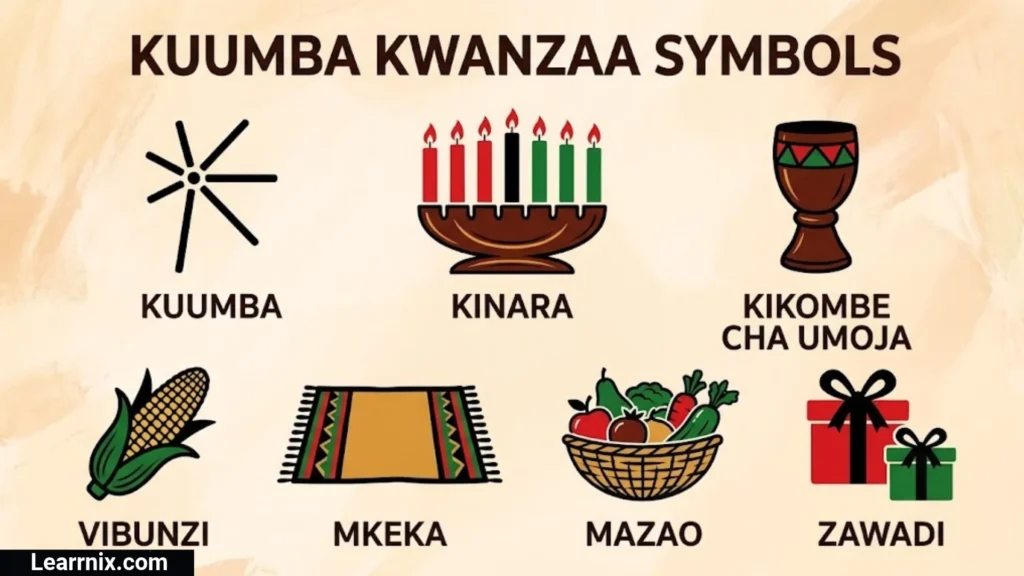
Kuumba is the sixth principle of Kwanzaa and means creativity. It is celebrated on December 31 and encourages people to use their imagination and abilities to improve their surroundings.
The principle teaches that creativity should contribute something valuable to families, communities, and future generations.
Like Ujamaa, Kuumba does not have a separate traditional physical object. Its meaning is expressed through creative work and the sixth candle in the Kinara.
Common Symbols Associated With Kuumba
- Paintbrush: Represents artistic expression and imagination.
- Pencil: Represents writing, learning, and new ideas.
- Musical Instruments: Represent music and cultural creativity.
- Artwork: Represents originality and personal expression.
- Handmade Crafts: Represent practical skills and creative effort.
- Sixth Green Candle: Represents the principle of Kuumba.
How to Celebrate Kuumba
There are many ways to practice creativity during Kwanzaa. Families can create handmade decorations, write poems, prepare traditional meals, perform music, or work on community improvement projects.
Children can draw pictures, make paper crafts, and create cultural artwork.
Kuumba reminds people that creativity is not limited to professional artists. Everyone has the ability to use their talents and ideas to make a positive contribution.
Kwanzaa Symbols Clip Art
Kwanzaa symbols clip art refers to digital illustrations and decorative drawings of the traditional objects used during the celebration. These designs are useful for creating greeting cards, school projects, cultural posters, presentations, and holiday decorations.
Clip art can be simple, colorful, traditional, or modern, depending on the purpose of the design.
Popular Kwanzaa Clip Art Ideas
Some commonly used Kwanzaa illustrations include:
- Kinara Clip Art: A candle holder featuring seven red, black, and green candles.
- Kwanzaa Flag Clip Art: A three-color flag representing African heritage.
- Corn Clip Art: Ears of corn representing Muhindi.
- Unity Cup Clip Art: A cup representing family relationships and togetherness.
- Crops Clip Art: Fruits and vegetables representing Mazao.
- Gift Clip Art: Decorative presents representing Zawadi.
- Woven Mat Clip Art: A traditional mat representing cultural foundations.
How to Use Kwanzaa Clip Art
Kwanzaa illustrations can be used in different creative projects, including:
- Designing holiday greeting cards.
- Creating educational presentations.
- Preparing classroom posters.
- Decorating invitations and celebration materials.
- Making digital banners for social media.
- Creating worksheets for children.
When selecting clip art, make sure the illustrations represent the correct symbols and their cultural meanings. For commercial designs, also check the artwork’s licensing and usage permissions.
Kwanzaa Symbols Coloring Pages
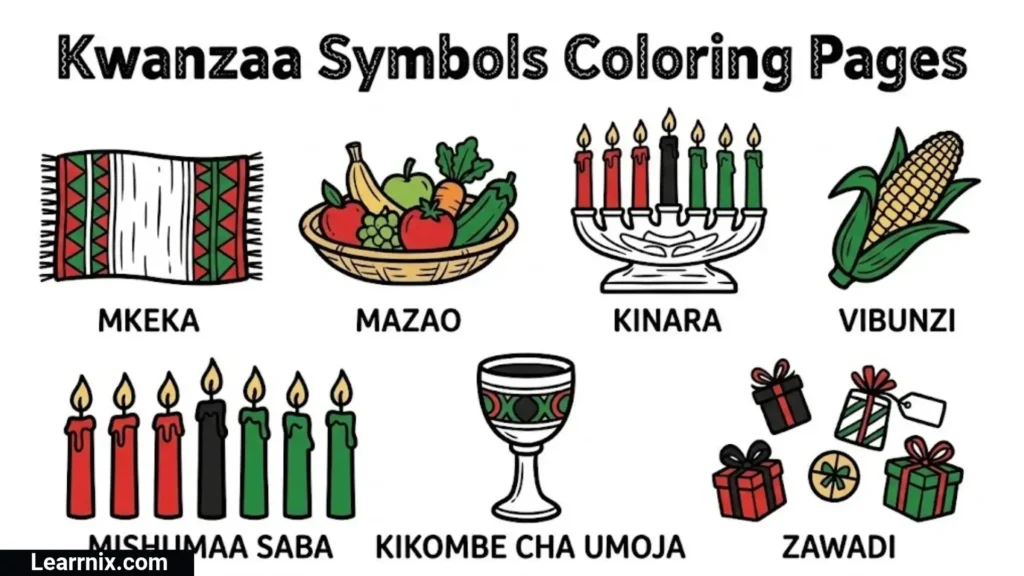
Kwanzaa symbols coloring pages are educational worksheets featuring black-and-white illustrations of traditional Kwanzaa objects. They allow children to learn about the celebration while enjoying a creative activity.
These pages are useful for parents, teachers, students, and families who want to introduce children to African heritage and the seven principles.
Popular Kwanzaa Coloring Page Ideas
Here are some useful ideas for Kwanzaa coloring activities:
| Coloring Page | What Children Can Learn |
| Kinara | Seven candles and their meanings |
| Kwanzaa Flag | Red, black, and green colors |
| Corn | The importance of children |
| Unity Cup | Togetherness and remembrance |
| Traditional Mat | African heritage and history |
| Seven Symbols | The meanings of all seven objects |
| Gift Boxes | Sharing and meaningful presents |
| Seven Principles | The values of Nguzo Saba |
Benefits of Kwanzaa Coloring Activities
Coloring pages make cultural learning more interesting for children. Instead of only reading about the symbols, children can recognize their shapes and understand what they represent.
Parents and teachers can explain each object while children color it. For example, when coloring the Kinara, they can learn why it contains seven candles and why the candles have three different colors.
For better educational results, choose simple illustrations with clear outlines and add the name of each symbol underneath the drawing.
Drawing Kwanzaa Symbols
Drawing Kwanzaa symbols is another creative way to understand the celebration. Students can use pencils, crayons, colored markers, or digital drawing applications to create illustrations of the traditional objects.
Simple drawings are especially helpful for school assignments and cultural activities.
How to Draw a Kinara
A Kinara is one of the easiest Kwanzaa symbols to draw.
Follow these steps:
- Draw a long horizontal rectangle to create the base.
- Add seven small candle holders above the base.
- Draw seven candles of equal height.
- Make the center candle black.
- Color the three candles on the left red.
- Color the three candles on the right green.
- Add small flames above each candle.
This creates a simple illustration of the traditional Kwanzaa candle holder.
How to Draw a Kwanzaa Flag
Start by drawing a rectangular shape and dividing it into three equal horizontal sections.
Use red for the top section, black for the middle section, and green for the bottom section. Keep the lines straight so that all three sections look equal.
How to Draw an Ear of Corn
Draw a long oval shape with slightly pointed ends. Add small curved lines inside the shape to represent corn kernels. Finally, draw two or three leaves around the bottom.
This illustration represents Muhindi, the Kwanzaa symbol associated with children and future generations.
How to Draw a Unity Cup
Draw a wide cup with a curved upper edge and a narrow base. Add simple decorative patterns around the outside to make the illustration more interesting.
The finished drawing represents Kikombe cha Umoja and its message of unity.
Ideas for a Complete Kwanzaa Drawing
For a larger school project, draw a traditional Kwanzaa table with a woven mat, crops, corn, unity cup, gifts, and Kinara. Add labels beneath the objects to explain their meanings.
This type of drawing helps students understand how the seven symbols work together during the celebration.
Frequently Asked Questions About Kwanzaa Symbols
What does Kwanzaa celebrate?
Kwanzaa celebrates African heritage, culture, family, community, and shared values. It takes place from December 26 through January 1.
What is the name of the Kwanzaa candle holder?
The Kwanzaa candle holder is called a Kinara. It has seven spaces for the red, black, and green candles representing the seven principles.
What does the Kwanzaa unity cup represent?
The unity cup, called Kikombe cha Umoja, represents togetherness, family relationships, and remembrance of ancestors. It is also used during traditional libation ceremonies.
What is the difference between Ujima and Ujamaa?
Ujima means collective work and responsibility, focusing on solving community problems together. Ujamaa means cooperative economics and encourages people to support community-owned businesses.
Why is Kwanzaa celebrated for seven days?
Kwanzaa lasts seven days because each day is dedicated to one of the seven principles of Nguzo Saba. The celebration begins with Umoja and ends with Imani.
Conclusion
Kwanzaa symbols represent the history, cultural identity, and community values that make this celebration meaningful. The seven basic symbols, including Mazao, Mkeka, Kinara, Muhindi, Mishumaa Saba, Kikombe cha Umoja, and Zawadi, each communicate an important message about family, heritage, and shared responsibility.
The three traditional colors, red, black, and green, represent struggle, African people, and hope for the future. The seven principles add deeper meaning to the celebration by encouraging unity, self-determination, collective responsibility, cooperative economics, purpose, creativity, and faith. Ujamaa and Kuumba are especially important examples of how these values can be practiced in everyday life.
Learning about Kwanzaa symbols also creates opportunities for creative activities such as drawing, coloring, making decorations, and preparing educational projects. Understanding the meaning behind each object helps people appreciate the celebration beyond its visual traditions and carry its positive values into their daily lives.

I am Michael Carter, an educational content creator who believes that knowledge has the power to transform lives.
I create resources focused on modern education, digital learning, and building essential skills for the future.
I love helping readers discover simple and effective ways to improve their learning journey.
Books by Michael Carter:
- Modern Education for Tomorrow’s World
- Learning Skills for Future Success
 Charlotte Anderson
 Daniel Harper