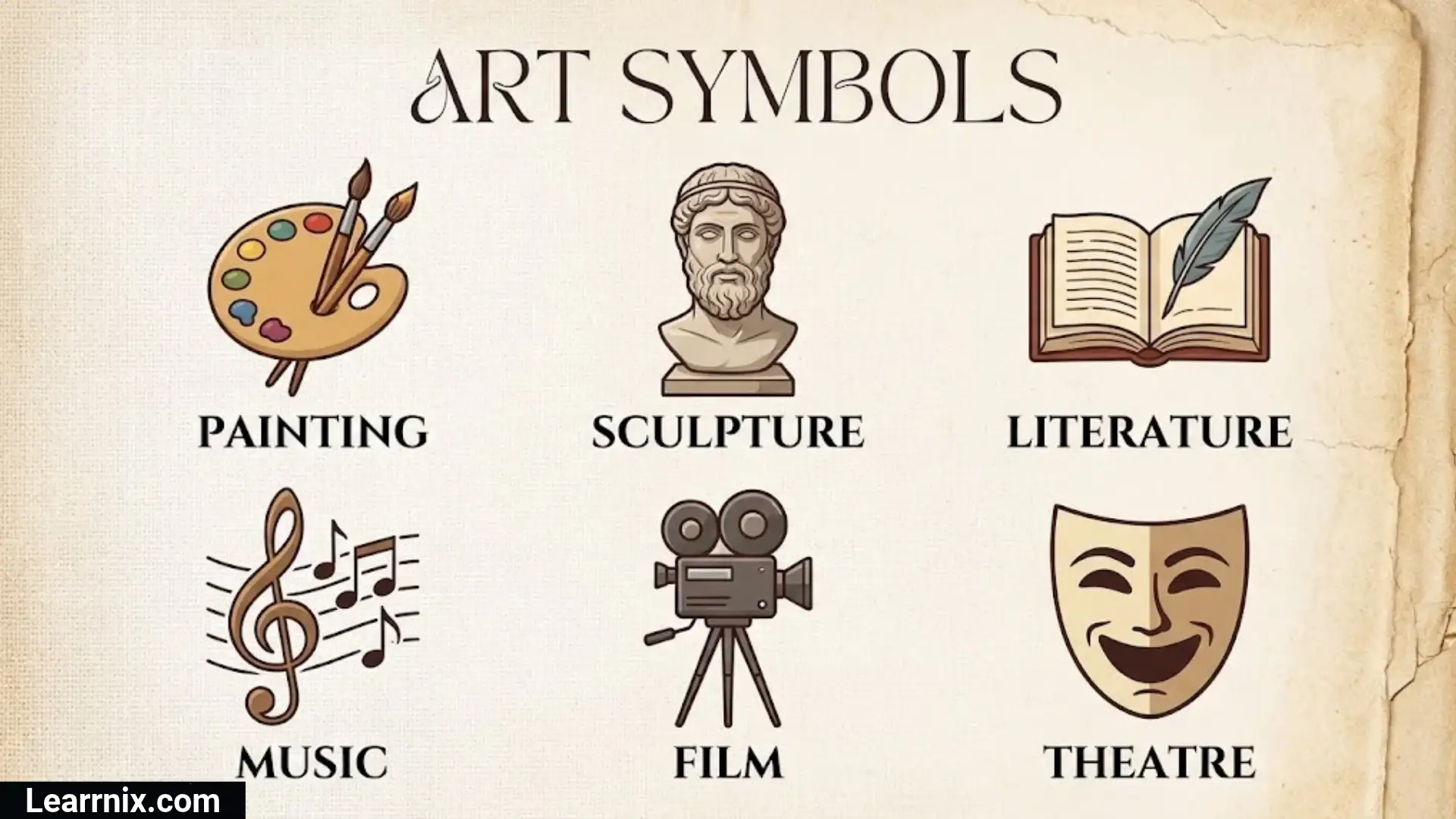
Art symbols have been used for thousands of years to communicate ideas, express emotions, tell stories, and represent important beliefs. From ancient cave paintings to modern pop art, artists use shapes, colors, animals, patterns, and objects to share messages that words cannot always explain. Many of these symbols carry meanings connected to nature, spirituality, identity, and human experiences.
Different cultures have developed their own artistic symbols. Ancient Egyptians used the ankh to represent life, Indigenous communities created meaningful patterns inspired by their environments, and early humans painted animals and geometric shapes on cave walls. Understanding these visual signs helps us explore the history, traditions, and ideas behind different forms of art.
In this guide, you will discover popular art symbols and their meanings, visual symbolism, historical examples, and traditional designs from different cultures. You will also find useful art symbols to copy and paste, along with explanations of cave art, Aboriginal art, Native American artwork, and other important artistic traditions.
Art Symbols And Meanings
Art symbols are visual elements that represent ideas, emotions, objects, or beliefs beyond their literal appearance. Artists use them to communicate messages and give deeper meaning to their work.
The meaning of a symbol can change depending on its cultural background, historical period, and artistic context. Here are some widely recognized art symbols and their common interpretations.
| Symbol | Name | Common Meaning |
| ♥ | Heart | Love, affection, and emotion |
| ★ | Star | Hope, dreams, and achievement |
| ☀ | Sun | Life, energy, and renewal |
| ☾ | Crescent Moon | Change, cycles, and mystery |
| 🕊 | Dove | Peace and freedom |
| 🌳 | Tree | Growth, life, and connection |
| ∞ | Infinity | Eternity and endless possibilities |
| ⚖ | Scales | Justice and balance |
| ☯ | Yin Yang | Complementary forces and balance |
| ⚓ | Anchor | Stability, security, and hope |
| 🔥 | Fire | Passion, transformation, and destruction |
| 🌀 | Spiral | Movement, development, and cycles |
These symbols are useful for understanding how visual communication works. However, their meanings are not universal. For example, a snake can represent danger in one artwork and healing, protection, or renewal in another.
Visual Symbols In Art
Visual symbols are images, shapes, colors, and objects that communicate meaning without requiring written explanations. They help viewers understand the message or emotion an artist wants to express.
Some common visual elements include:
- Colors: Red may represent love, anger, or danger, while blue can suggest calmness, sadness, or spirituality.
- Animals: Birds frequently symbolize freedom, while lions can represent courage and strength.
- Geometric Shapes: Circles may suggest unity, squares can represent stability, and triangles often communicate direction or movement.
- Natural Elements: Trees, mountains, rivers, and flowers can represent growth, change, life, and the natural world.
- Human Figures: Hands, eyes, and faces can communicate protection, awareness, identity, and emotion.
Visual symbols make artwork more expressive because they allow viewers to interpret different layers of meaning. An artist might use a broken chain to represent freedom or a growing plant to communicate hope and recovery.
Art Symbol Design
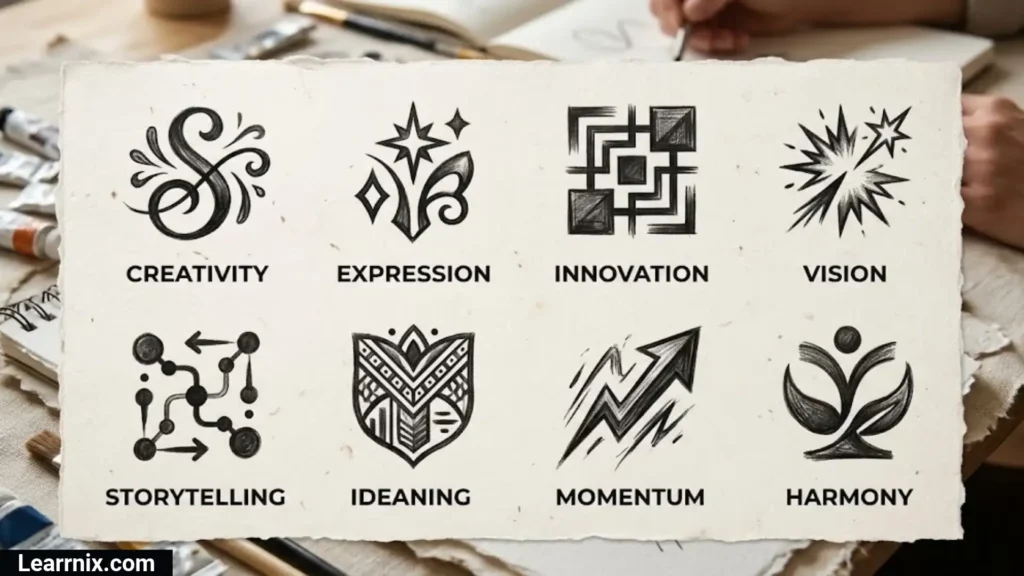
Art symbol design involves creating recognizable visual elements that communicate a particular message. A good symbol should be understandable, visually balanced, and appropriate for its intended purpose.
Artists often begin with simple shapes and gradually add details to develop a recognizable design. The goal is to communicate an idea without making the artwork unnecessarily complicated.
Popular approaches to art symbol design include:
- Geometric Design: Uses circles, lines, triangles, and squares to create structured symbols.
- Nature-Inspired Design: Includes leaves, flowers, animals, trees, and natural patterns.
- Abstract Design: Uses unusual shapes and arrangements to communicate emotions or concepts.
- Cultural Design: Draws inspiration from traditional patterns and artistic practices.
- Minimalist Design: Uses simple lines and shapes to communicate an idea clearly.
For example, a simple circle surrounding a small tree can communicate nature, protection, and environmental awareness. A rising sun can represent new beginnings and optimism.
When designing culturally inspired artwork, it is important to understand the original tradition rather than copying sacred or community-specific designs without permission.
Symbolism Art Examples
Symbolism in art appears in paintings, sculptures, illustrations, architecture, and decorative objects. Artists often use familiar objects to communicate complex ideas.
Here are some recognizable examples:
- The Skull: Often represents mortality, the passage of time, or the temporary nature of human life.
- The Red Rose: Commonly represents romantic love, passion, and beauty.
- The Broken Chain: Represents freedom, independence, and the end of oppression.
- The Open Door: Can symbolize opportunity, transition, and new possibilities.
- The Butterfly: Often represents transformation, personal growth, and rebirth.
- The Hourglass: Represents time, aging, and the passing of life.
- The Mirror: Can represent self-reflection, identity, and truth.
- The White Dove: Frequently represents peace, hope, and reconciliation.
In many artworks, several symbols work together. A painting showing a bird flying above an open landscape might communicate freedom, independence, and hope. Understanding these visual clues makes it easier to interpret an artist’s message.
Art Symbols Copy And Paste
If you are looking for art-related symbols for social media, creative projects, messages, or decorative text, the following collection provides easy-to-copy characters.
Popular Art And Creative Symbols
★ ☆ ✦ ✧ ✨ ♡ ♥ ❀ ✿ ❁ ❃
Nature-Inspired Art Symbols
☀ ☼ ☾ ☽ ❄ ❅ ❆ ☁ ☂ ♧ ♣
Decorative And Geometric Symbols
◇ ◆ ○ ● △ ▲ ▽ ▼ □ ■ ▣ ▤
Creative Expression Symbols
✎ ✏ ✐ ✒ ✍ ♫ ♪ ♬ ♩
Abstract And Spiritual Symbols
∞ ☯ ☮ ॐ ☸ ⚛ ✡ ☥
Aesthetic Text Decorations
୨୧ ꧁ ꧂ ༺ ༻ ༄ ࿐ ❦
You can copy a character by selecting it and using Ctrl + C on Windows or Command + C on Mac. Then paste it wherever you want.
Keep in mind that decorative characters may look different across devices, applications, and fonts. Some symbols may also appear as empty boxes if the selected font does not support them.
Symbols In Art History
Symbols have played an important role in art throughout human history. Their appearance and meanings have changed as societies developed new religious beliefs, political systems, technologies, and artistic styles.
Some important historical periods include:
- Prehistoric Art: Early humans painted animals, handprints, and abstract patterns on cave walls.
- Ancient Egyptian Art: Artists used hieroglyphs and recognizable images to communicate religious beliefs, royal authority, and ideas about the afterlife.
- Ancient Greek And Roman Art: Gods, mythological creatures, and symbolic objects represented power, wisdom, victory, and beauty.
- Medieval Art: Religious paintings and architecture used halos, crosses, and symbolic colors to communicate spiritual ideas.
- Renaissance Art: Artists included carefully selected objects, gestures, and background details to communicate complex themes.
- Modern Art: Symbolism became more experimental, with abstract shapes, unusual colors, and personal interpretations.
Studying historical symbols helps explain how art reflects the values and experiences of different societies.
Cave Art Symbols
Cave art symbols are among the earliest known examples of human visual communication. Ancient people painted and engraved images on cave walls, rock surfaces, and sheltered areas.
Common cave art symbols include:
- Handprints and hand stencils.
- Animal figures such as horses, bison, deer, and mammoths.
- Dots and groups of lines.
- Zigzag patterns.
- Spirals and circular markings.
- Finger-drawn geometric designs.
Researchers believe these images may have been connected to storytelling, social traditions, hunting practices, spiritual beliefs, or communication. However, the exact meaning of many prehistoric markings remains uncertain.
Famous cave art locations include Lascaux in France, Altamira in Spain, and Chauvet Cave in France. Their paintings demonstrate the artistic abilities and visual imagination of early humans.
Hopi Art Symbols
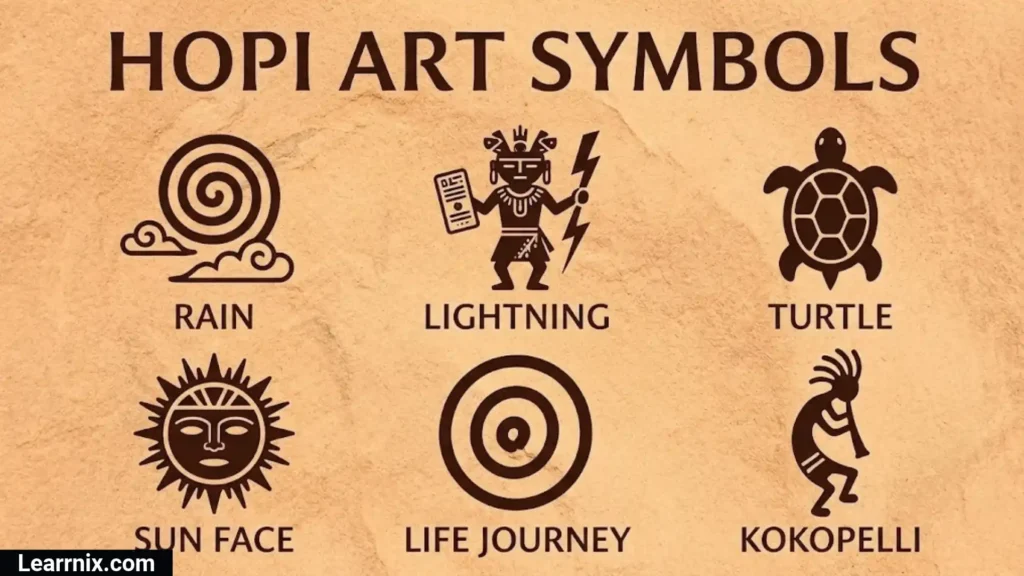
Hopi art comes from the cultural traditions of the Hopi people of the southwestern United States, particularly Arizona. Their artistic expressions include pottery, basketry, textiles, katsina-related objects, and ceremonial designs.
Common subjects and motifs include:
- Corn: Represents an essential food source and has deep connections with Hopi agriculture and cultural life.
- Clouds: Often appear in designs connected with rain and agricultural well-being.
- Rain Patterns: Communicate the importance of rainfall in the desert environment.
- Birds: May appear in traditional designs connected with nature and particular cultural meanings.
- Geometric Patterns: Include lines, stepped forms, and repeated shapes used in different artistic traditions.
Hopi designs should be understood within their specific cultural and ceremonial contexts. Not every geometric pattern has one fixed meaning, and some designs are associated with knowledge or practices that are not intended for general reproduction.
Cherokee Art Symbols
Cherokee art reflects the history, identity, and creative traditions of the Cherokee people. Traditional artistic expressions include basket weaving, pottery, beadwork, wood carving, and decorative designs.
Some recurring artistic elements include:
- Basket Patterns: Demonstrate skilled weaving techniques and connections with everyday life.
- Animal Motifs: Represent relationships with wildlife and the natural environment.
- Plant Designs: Reflect the importance of plants, traditional knowledge, and nature.
- Geometric Patterns: Appear in different forms of pottery, basketry, and decorative work.
- Water And River Motifs: May reflect the importance of waterways in Cherokee history and landscapes.
Cherokee visual traditions are diverse and have developed over generations. It is better to understand individual designs through their historical and community context instead of assigning universal meanings to every pattern.
Taino Art Symbols
Taíno art originated among Indigenous peoples of the Caribbean, including communities across the Greater Antilles. Their artistic traditions included pottery, carved objects, rock engravings, and ceremonial objects.
Important Taíno artistic motifs include:
- Sun Motifs: Associated with the natural world and celestial imagery.
- Zemí Figures: Represent spiritual beings or powers and are important elements of Taíno religious life.
- Human And Animal Figures: Appear in carvings and artwork connected with spiritual and everyday experiences.
- Spirals: Found in some rock carvings and decorative compositions.
- Geometric Designs: Appear in pottery and other artistic objects.
Taíno art provides valuable information about Caribbean history, spiritual traditions, and relationships between people and nature. Its symbols should be interpreted carefully because individual objects can have different meanings.
Huichol Art Symbols
Huichol art is associated with the Wixárika people of Mexico, who are also widely known by the name Huichol. Their artistic traditions include colorful yarn paintings, beadwork, and ceremonial objects.
Common motifs include:
- Deer: An important spiritual figure in Wixárika traditions, associated with sacred narratives and cultural identity.
- Maize: Represents an essential crop and an important part of community life.
- Peyote: A sacred cactus connected with particular ceremonial and spiritual practices.
- Eagles: Appear in traditional imagery and can carry spiritual associations.
- Sun: Represents an important element in Wixárika cosmology.
- Eye Of God: A woven diamond-shaped object associated with protection and spiritual vision.
Wixárika artwork is known for its detailed patterns and bright colors. These designs are not simply decorative; many are connected with sacred stories, ceremonies, and relationships with the natural world.
Native American Rock Art Symbols
Native American rock art includes paintings and engravings created by Indigenous communities across North America. These artworks appear on canyon walls, cliffs, boulders, and sheltered rock surfaces.
Common visual elements include:
- Human figures.
- Animal tracks and animal images.
- Handprints and footprints.
- Sun-like circles.
- Spirals and circular patterns.
- Hunting scenes.
- Geometric shapes.
Different communities created rock art for different reasons. Some images may relate to spiritual practices, territorial histories, ceremonies, storytelling, or observations of the natural environment.
There is no single Native American rock art language. A spiral or animal figure can have different meanings depending on the community, location, and period in which it was created.
Art Symbols And Meanings
Art symbols can be grouped according to the ideas they communicate. This makes it easier to understand their use in paintings, illustrations, crafts, and other creative work.
Here are additional categories of artistic symbolism:
| Category | Symbol | Meaning |
| Love | ♡ | Affection and emotional connection |
| Peace | ☮ | Peace and nonviolence |
| Wisdom | 🦉 | Knowledge and understanding |
| Strength | 🦁 | Courage and power |
| Freedom | 🕊 | Independence and peace |
| Growth | 🌱 | Development and new beginnings |
| Protection | 🛡 | Safety and defense |
| Balance | ☯ | Complementary forces |
| Eternity | ∞ | Endless time |
| Creativity | ✎ | Artistic expression |
These symbols can be used as inspiration for artwork, logos, illustrations, posters, and digital designs. Their interpretations should always consider the surrounding images and the artist’s intention.
Paleolithic Cave Art Symbols
Paleolithic cave art refers to artistic expressions created during the Old Stone Age. These works include paintings, engravings, and markings produced by early human communities.
Many famous examples show animals such as horses, bison, deer, lions, and rhinoceroses. Other artworks include hand stencils, dots, lines, and abstract geometric signs.
Some frequently discussed features include:
- Hand Stencils: Created by placing a hand against a surface and applying pigment around it.
- Animal Paintings: Often show detailed bodies, movement, and recognizable animal features.
- Dots And Lines: Appear in different arrangements and may have had symbolic or practical purposes.
- Abstract Signs: Include repeated geometric shapes whose meanings are still debated.
Paleolithic artists used natural pigments, including ochre and charcoal. These artworks show that early humans had advanced observation skills and a strong interest in visual expression.
Aboriginal Art Symbols And Meanings
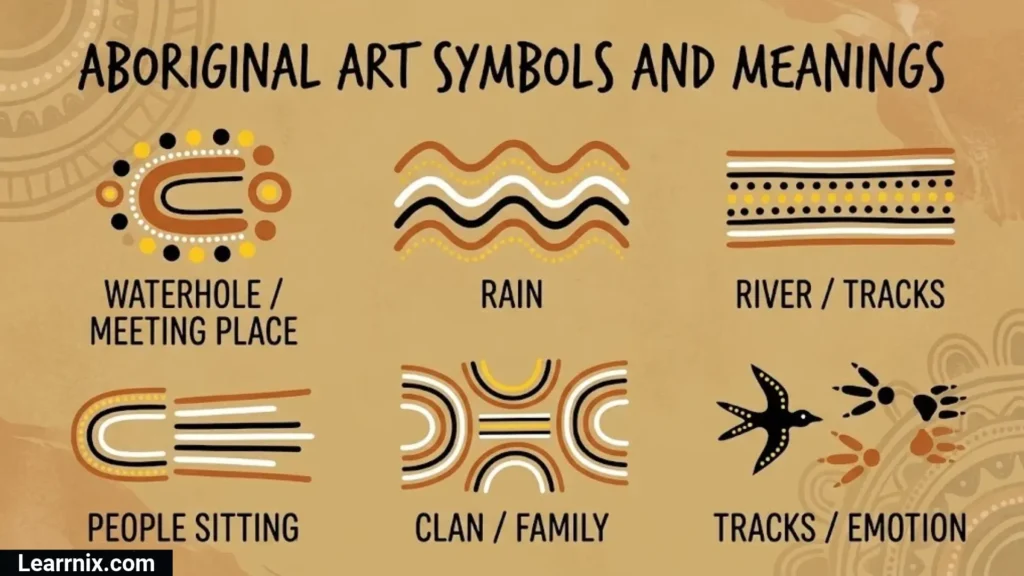
Aboriginal Australian art includes many distinct artistic traditions belonging to Aboriginal peoples across Australia. Different communities have their own languages, stories, designs, and artistic practices.
Some commonly recognized visual motifs include:
- Concentric Circles: May represent waterholes, campsites, meeting places, or other locations, depending on the tradition.
- Wavy Lines: Can represent water, movement, journeys, or natural features.
- Tracks: May represent people, animals, or movement across the landscape.
- U Shapes: In some regional styles, can represent a person sitting or a person viewed from above.
- Dots: Used to create texture, patterns, and layered visual effects.
- Lines And Pathways: May communicate journeys, connections, or landscape features.
These interpretations are not universal. Aboriginal art is highly diverse, and some designs communicate knowledge that is restricted to particular communities or cultural groups.
Egyptian Art Symbols
Ancient Egyptian art used a rich collection of symbols to communicate religious beliefs, royal authority, protection, and ideas about life and death.
Some of the best-known Egyptian symbols include:
| Symbol | Name | Meaning |
| ☥ | Ankh | Life and living |
| 𓂀 | Eye of Horus | Protection and well-being |
| 𓋹 | Ankh Hieroglyph | Symbol of life |
| 𓆣 | Scarab | Renewal and transformation |
| 𓊽 | Djed Pillar | Stability and endurance |
| 𓄤 | Was Scepter | Power and authority |
| 𓇳 | Sun Disc | Solar power and divine associations |
The ankh is one of the most recognizable Egyptian symbols. It frequently appears in ancient artwork, where gods and rulers are shown holding it.
The Eye of Horus was associated with protection and restoration. The scarab beetle was connected with transformation and the cycle of the sun.
Egyptian hieroglyphs were part of a complex writing system, so they should not all be treated as decorative symbols with simple meanings.
Native American Art Symbols
Native American art includes a wide range of artistic traditions developed by Indigenous nations throughout North America. These traditions differ in materials, techniques, patterns, and cultural meanings.
Common artistic subjects include:
- Eagles: Often associated with spiritual significance, strength, or connections with the sky in particular traditions.
- Turtles: May represent creation, protection, or the natural world in some Indigenous stories.
- Bears: Can symbolize strength, healing, or protection in certain cultural contexts.
- Feathers: May have important spiritual, social, or ceremonial meanings.
- Sun Motifs: Represent light, life, and natural cycles in different traditions.
- Geometric Patterns: Appear in textiles, pottery, beadwork, and basketry.
There is no single set of symbols that represents every Native American nation. Cherokee, Navajo, Hopi, Lakota, Haudenosaunee, and other communities have their own artistic histories and cultural practices.
Pop Art Symbols
Pop art is a modern art movement that became popular during the 1950s and 1960s. It used imagery from advertising, comic books, consumer products, celebrities, and popular culture.
Some recognizable pop art symbols and visual elements include:
- Speech Bubbles: Represent conversations and comic-style storytelling.
- Halftone Dots: Create the appearance of printed comic-book images.
- Stars And Explosions: Communicate excitement, action, or dramatic moments.
- Product Images: Represent consumer culture and mass production.
- Bold Hearts: Communicate emotions using bright colors and simple shapes.
- Comic-Style Text: Uses expressive words and lettering to create visual impact.
Artists such as Andy Warhol and Roy Lichtenstein helped establish the visual language associated with pop art.
Pop art symbols are still widely used in posters, graphic design, digital illustrations, fashion, and social media graphics.
Indigenous Art Symbols
Indigenous art represents the creative traditions of the original peoples of different regions around the world. It includes painting, carving, weaving, pottery, beadwork, body art, and many other forms of expression.
Common themes include:
- Nature: Plants, animals, rivers, mountains, and other environmental features.
- Ancestry: Images that communicate family histories and connections between generations.
- Spirituality: Symbols associated with beliefs, ceremonies, and sacred stories.
- Community Identity: Patterns and artistic elements connected with particular cultural groups.
- Land And Place: Designs that communicate relationships with ancestral territories.
Indigenous symbols are not simply decorative patterns. Many are connected with cultural knowledge, historical experiences, and community identity.
When studying or using Indigenous-inspired artwork, always identify the specific people or tradition involved. Avoid treating different Indigenous cultures as one artistic style.
Native American Rock Art Symbols Meanings
The meanings of Native American rock art symbols depend on the community, geographical location, and historical period. Archaeologists and Indigenous knowledge holders use different forms of evidence to understand these images.
Here are several commonly discussed motifs:
| Rock Art Motif | Possible Interpretation |
| Human figures | People, ancestors, or ceremonial activities |
| Animal tracks | Wildlife, movement, or hunting |
| Spiral patterns | Cycles, movement, or other cultural concepts |
| Handprints | Human presence or identity |
| Sun-like circles | Celestial imagery or natural cycles |
| Animal figures | Relationships with wildlife and cultural stories |
| Footprints | Journeys, movement, or presence |
These are possible interpretations rather than fixed translations. A particular image may have a completely different meaning within another community.
Rock art should also be treated as cultural heritage. Visitors should never scratch, paint over, touch fragile surfaces unnecessarily, or remove material from archaeological locations.
Stone Age Cave Art Symbols And Meanings
Stone Age cave art includes some of the earliest surviving examples of human artistic expression. It provides evidence of how ancient communities observed animals, interacted with their surroundings, and communicated through images.
The following symbols and visual patterns are frequently found in prehistoric artwork:
- Handprints: May communicate human presence, identity, or participation in artistic activities.
- Horses: Commonly depicted in European Paleolithic cave paintings.
- Bison: Frequently appear in cave art and demonstrate detailed observation of animal anatomy.
- Deer: Represent important animals within prehistoric environments.
- Mammoths: Show how early humans depicted animals that lived during the Ice Age.
- Spirals: Appear in some prehistoric artistic traditions, although their exact meanings are uncertain.
- Zigzag Lines: Form part of the abstract markings found in prehistoric sites.
- Dots: Appear in groups and arrangements that researchers continue to investigate.
Some prehistoric cave paintings were created using mineral pigments, while others were engraved directly into stone. Artists also used natural rock formations to make their images appear more three-dimensional.
The purpose of these artworks remains a subject of research. They may have served several roles rather than one single purpose.
Frequently Asked Questions About Art Symbols
What are the most common symbols used in art?
Common artistic symbols include hearts, stars, flowers, birds, trees, circles, and geometric patterns. Their meanings depend on the artwork and cultural background.
What does symbolism mean in art?
Symbolism in art means using images, colors, objects, or shapes to communicate ideas beyond their literal appearance. It allows artists to express emotions, beliefs, and complex messages visually.
What are the oldest known art symbols?
Some of the oldest known artistic markings include hand stencils, geometric patterns, animal figures, and abstract lines. Prehistoric cave paintings and engravings provide important evidence of early human visual expression.
Why are animals commonly used as art symbols?
Animals are frequently used because they have strong connections with human experiences, nature, mythology, and cultural beliefs. A particular animal may represent strength, freedom, wisdom, protection, or transformation.
Can I use art symbols in digital designs and social media?
Yes. Many Unicode symbols and decorative characters can be copied into social media posts, messages, and digital designs. However, traditional cultural symbols should be used respectfully and with an understanding of their original meanings.
Conclusion
Art symbols provide a fascinating way to understand human creativity, history, and cultural expression. From ancient Egyptian hieroglyphs and Paleolithic cave paintings to modern pop art, visual symbols have helped people communicate important ideas across generations.
Different cultures have developed unique artistic traditions, including Hopi, Cherokee, Taíno, Wixárika, Aboriginal Australian, and other Indigenous art forms. Exploring their patterns, objects, and imagery helps us appreciate the diversity of human artistic expression while recognizing that many symbols have meanings specific to their communities.
If you are studying art history, creating digital designs, or looking for copy-and-paste art symbols, understanding their meanings makes your creative work more meaningful. Always consider the cultural context behind a symbol before using it, especially when it comes from a traditional or sacred artistic practice.

I am Charlotte Anderson, an education writer who is passionate about creating meaningful learning resources for students and lifelong learners.
I enjoy researching new educational approaches and sharing ideas that make studying easier and more effective.
Through my work, I aim to inspire curiosity, confidence, and a love for learning.
Books:
- The Complete Guide to Better Learning
- Building Skills for Academic Success
 Daniel Harper
 Michael Carter