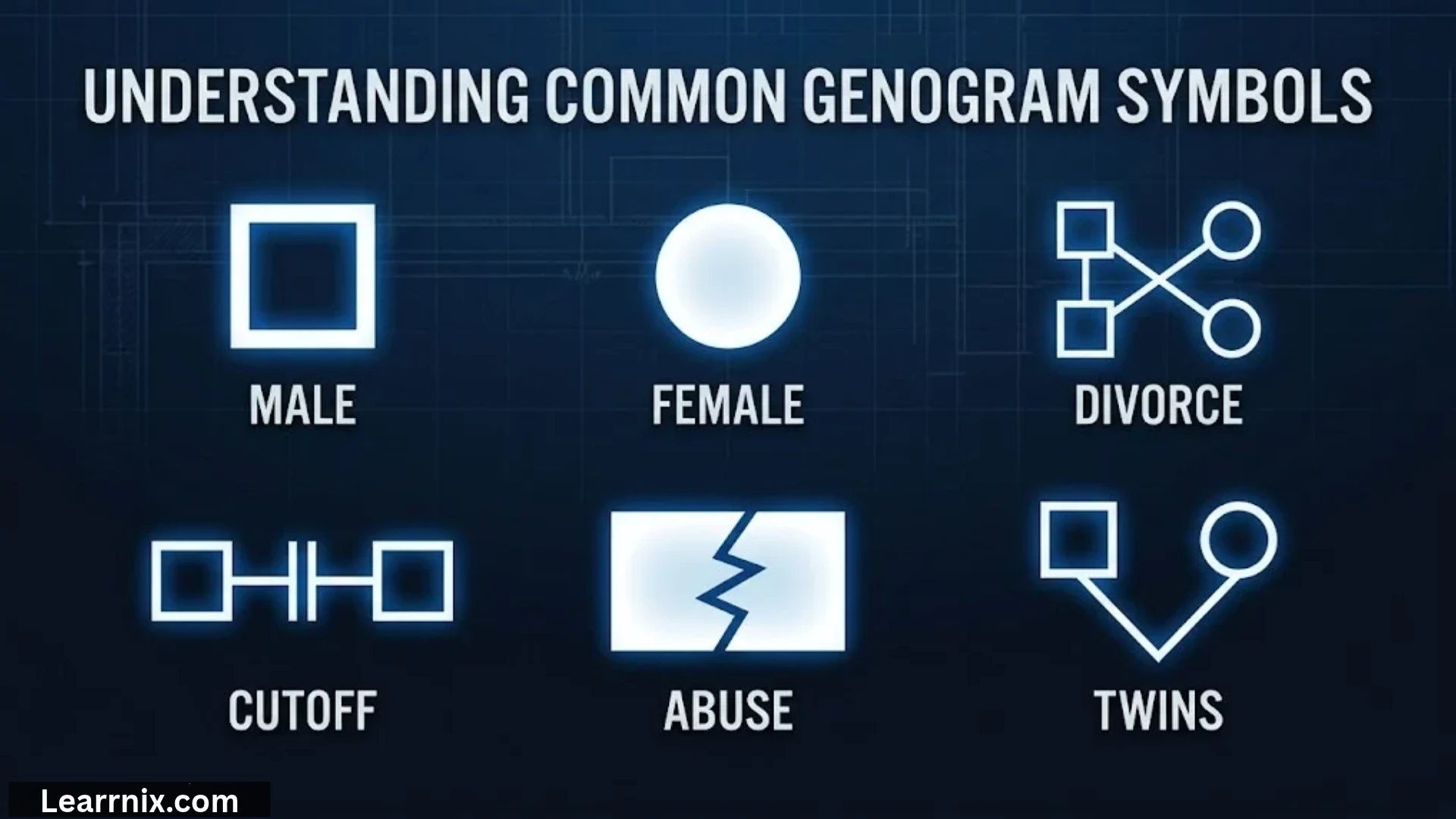
Genogram symbols help people create visual diagrams of family structures, relationships, health conditions, and inherited patterns. They look similar to family tree symbols, but a genogram provides much more information. It can show marriages, divorces, emotional connections, family conflicts, substance abuse, medical conditions, and mental health patterns across multiple generations.
Understanding genogram symbols and their meanings is useful for nurses, healthcare professionals, psychologists, social workers, family therapists, students, and anyone studying family history. Different shapes, lines, and markings represent specific people, relationships, and family circumstances.
In this guide, you will find basic genogram symbols, standard family diagram symbols, medical and nursing symbols, divorce indicators, and relationship markings. You will also learn about Bowen and McGoldrick genogram approaches, cultural genograms, and symbols you can copy and paste when preparing notes or digital diagrams.
Genogram Symbols and Meanings
A genogram is a visual representation of a family’s structure and important relationships. It usually covers at least three generations and provides information that a traditional family tree may not show.
Each symbol has a particular purpose. Squares and circles commonly represent individuals, horizontal lines show partnerships, and vertical lines connect parents with their children. Additional markings communicate personal circumstances, health information, and relationship patterns.
Here are the main categories of genogram symbols:
| Symbol or Marking | Common Meaning |
| □ | Male |
| ○ | Female |
| ◇ | Sex or gender not specified, or unknown in some conventions |
| ─ | Relationship or partnership |
| ═ | Marriage in many conventions |
| // | Separation or divorce marking, depending on placement |
| │ | Parent-child connection |
| † | Death, when used in a legend |
| → | Identified person or person of focus |
| X inside a symbol | Deceased person in many genogram conventions |
These symbols are widely used as a starting point, but not every genogram follows precisely the same visual system. Some textbooks, healthcare institutions, and family therapy models use different conventions.
Why Do Genogram Symbols Matter?
They make complicated family information easier to understand. Instead of writing several paragraphs about family members, a professional can use a diagram to show relationships, important events, and patterns across generations.
For example, a genogram may reveal that several family members experienced depression, diabetes, alcohol misuse, or repeated relationship difficulties. These patterns can guide further questions and discussions, although they do not establish a diagnosis or prove that a condition is inherited.
Basic Genogram Symbols
Basic genogram symbols are the foundation of every family diagram. Learning these markings first makes it easier to understand more detailed medical, psychological, and relationship genograms.
Common Individual Symbols
| Symbol | Name | Meaning |
| □ | Square | Male |
| ○ | Circle | Female |
| ◇ | Diamond | Unknown or unspecified sex/gender in some systems |
| □ with X | Deceased male | Male individual who has died |
| ○ with X | Deceased female | Female individual who has died |
| → □ | Male focus person | Identified male individual |
| → ○ | Female focus person | Identified female individual |
A diagonal cross through a square or circle commonly indicates that the individual is deceased. An arrow pointing toward a person’s symbol often identifies the person being assessed or discussed.
Basic Family Connection Lines
- Horizontal line: Connects partners or spouses.
- Vertical line: Connects parents to their children.
- Horizontal sibling line: Connects children through a shared parental connection.
- Double horizontal line: Often represents a close or particularly significant partnership, depending on the diagram’s legend.
When drawing a genogram, keep generations organized in horizontal rows. Place older generations above younger generations and connect children beneath their parents.
One useful tip is to create a small legend beside the diagram. This helps readers understand the symbols without guessing what each marking represents.
Standard Genogram Symbols
Standard genogram symbols are commonly used conventions that help professionals communicate family information consistently. They are particularly useful in healthcare, counseling, social work, and family research.
Although there is no single universal symbol set used by every organization, many standard genograms follow similar rules.
Standard Person Symbols
- Square (□): Male.
- Circle (○): Female.
- Diamond (◇): Unknown or unspecified sex/gender in some systems.
- Crossed square: Deceased male.
- Crossed circle: Deceased female.
- Arrow: Identified person or index person.
Standard Relationship Markings
| Line or Marking | Typical Interpretation |
| Single horizontal line | Partnership or union |
| Double horizontal line | Marriage |
| Dashed horizontal line | Cohabitation or a relationship type specified in the legend |
| Two diagonal slashes | Divorce in many conventions |
| One diagonal slash | Separation in many conventions |
| Vertical line | Parent-child relationship |
| Multiple vertical lines | Connections to several children |
The exact number and placement of diagonal marks can vary between genogram systems. Always check the legend before interpreting an unfamiliar diagram.
How to Make a Standard Genogram
- Start with the person whose family history you want to document.
- Add parents and grandparents above that person.
- Add siblings, partners, and children.
- Connect family members using appropriate lines.
- Mark important events, health conditions, and relationship patterns.
- Add a legend explaining any specialized symbols.
A clear standard genogram should be easy to read even for someone who has never seen the family before.
Family Genogram Symbols
Family genogram symbols represent the structure and connections within a family. They help show biological relationships, marriages, partnerships, adoptions, siblings, and children.
A family genogram can include parents, grandparents, cousins, stepfamilies, adopted children, and other important family members.
Family Structure Symbols
| Symbol or Arrangement | Meaning |
| □ + ○ connected by a line | Male and female partners |
| □ and ○ connected to a child | Parent-child relationship |
| □ ─ ○ with children below | Family unit |
| Two squares connected to one circle | A family relationship involving multiple partners |
| ○ with several children | Mother and children |
| □ with several children | Father and children |
| Adoptive relationship marked with a dashed connection | Adoption, in conventions using this marking |
| Stepfamily connection | Step-parent or blended family relationship, identified through the diagram’s legend |
Family genograms are especially useful when a household includes remarriages, half-siblings, stepchildren, or adoptive relationships.
For example, consider a person whose mother remarried and had two children with her second husband. A genogram can show the mother’s first partnership, her second marriage, and the children from both relationships without confusing their parentage.
It can also show multiple generations of a family, making it easier to understand how family structures change over time.
Genogram Symbols Copy and Paste
If you are creating a genogram in a document, presentation, assignment, or digital family diagram, copy-and-paste symbols can save time. The following characters are useful for basic notes and simple text-based diagrams.
Individual Symbols
| Symbol | Name |
| □ | Male |
| ○ | Female |
| ◇ | Unknown or unspecified |
| ⊗ | Crossed-circle style marker |
| ⊠ | Crossed-square style marker |
| † | Death marker |
| → | Identified person |
| ? | Unknown information |
| ∅ | Empty or unavailable information marker |
Relationship and Connection Symbols
| Symbol | Common Use |
| ─ | Horizontal relationship line |
| │ | Vertical family connection |
| ├ | Branch connection |
| ┬ | Upper branching connection |
| ┴ | Lower branching connection |
| ═ | Double relationship line |
| ┆ | Broken vertical connection |
| ┄ | Dashed horizontal connection |
| ╳ | Cross or separation marker in a custom legend |
Copy-and-Paste Family Diagram Example
□ ─ ○
│
┌─────┴─────┐
│ │
□ ○
│ │
○ □
This is a simplified illustrative diagram, not a complete standardized genogram. Real genograms need clearly identified relationships, generations, and a legend.
Important Copying Tip: Unicode characters can look different across fonts and operating systems. Some text editors may also replace unsupported characters with empty boxes. For professional diagrams, use a genogram drawing tool rather than relying entirely on copied text characters.
Genogram Symbols Nursing
Nursing genograms help healthcare professionals understand a patient’s family background and identify health-related patterns that may affect care. Nurses can use them during patient assessments, family health interviews, community healthcare planning, and patient education.
A nursing genogram generally combines family relationships with relevant health information. This allows nurses to see how medical conditions, lifestyle factors, and family circumstances may relate to a patient’s health.
Common Symbols Used in Nursing Genograms
| Symbol | Nursing-Related Information |
| □ | Male family member |
| ○ | Female family member |
| □ with X | Deceased male |
| ○ with X | Deceased female |
| → | Patient or identified person |
| DM | Diabetes mellitus |
| HTN | Hypertension |
| CVD | Cardiovascular disease |
| CA | Cancer |
| MH | Mental health history |
| SUD | Substance use disorder |
These medical abbreviations are annotations, not universal genogram symbols. Their meanings should be explained in the diagram’s legend.
How Nurses Use Genograms
- Family health assessment: Identifies health conditions reported across generations.
- Risk identification: Helps recognize possible familial patterns that may require further assessment.
- Patient education: Makes family health information easier to explain.
- Care planning: Supports discussions about prevention, screening, and lifestyle changes.
- Family communication: Helps patients understand relevant family health history.
For example, if a patient’s parents and grandparents have a history of hypertension, a nurse may document this information and discuss appropriate blood pressure monitoring with the patient.
A genogram does not diagnose a disease or establish genetic inheritance. Nurses should combine family history with clinical assessment and relevant medical investigations.
Medical Genogram Symbols
Medical genogram symbols are used to record health conditions, disabilities, causes of death, and other medically relevant information within a family.
They are particularly helpful when a healthcare professional wants to understand whether similar health conditions appear in several generations.
Unlike basic family genograms, medical genograms include additional information inside or beside individual symbols.
Common Medical Annotations
| Abbreviation | Meaning |
| DM | Diabetes mellitus |
| HTN | Hypertension |
| CHD | Coronary heart disease |
| CVD | Cardiovascular disease |
| CA | Cancer |
| CVA | Cerebrovascular accident (stroke) |
| MI | Myocardial infarction (heart attack) |
| CKD | Chronic kidney disease |
| COPD | Chronic obstructive pulmonary disease |
| EPI | Epilepsy |
These abbreviations are examples of medical annotations, not a universal set of official genogram markings. Always write the full condition when an abbreviation could be misunderstood.
Additional Information in Medical Genograms
A medical genogram may record:
- Age at diagnosis.
- Age at death.
- Cause of death.
- Chronic illnesses.
- Hereditary conditions.
- Disabilities.
- Reproductive health history.
- Significant surgeries.
- Relevant genetic test results.
For instance, a family with several reported cases of breast cancer may benefit from a medical genogram that records which relatives were affected and their ages at diagnosis. A healthcare professional can use this information to decide whether a formal hereditary cancer risk assessment is appropriate.
Medical genograms should protect patient confidentiality. Sensitive health information should only be collected and shared for appropriate purposes.
Relationship Genogram Symbols
Relationship genogram symbols describe the emotional and social connections between family members. They provide information that ordinary family tree diagrams cannot easily communicate.
Two relatives may be biologically connected but have very different relationships. For example, siblings may be close, distant, frequently arguing, or completely disconnected.
Common Emotional Relationship Markings
| Line Style | Common Meaning |
| Single solid line | Ordinary or neutral relationship |
| Double solid line | Very close relationship |
| Triple solid line | Extremely close or fused relationship |
| Zigzag line | Conflictual relationship |
| Solid line with a zigzag pattern | Close but conflicted relationship in some systems |
| Dashed line | Distant or limited relationship |
| Broken line | Cutoff or disconnected relationship in some conventions |
| Arrows | Direction of influence or relationship, when defined by the legend |
These relationship markings are particularly common in family therapy genograms, although their precise appearance can differ between practitioners.
Examples of Relationship Patterns
- Close relationship: Two family members share strong emotional support.
- Conflictual relationship: Family members frequently experience disagreements.
- Distant relationship: Limited communication or emotional involvement.
- Estranged relationship: Family members have little or no contact.
- Dependent relationship: One person relies heavily on another.
- Enmeshed relationship: Personal boundaries between family members may be unclear.
Relationship symbols can help therapists identify repeated family interaction patterns. However, a diagram should describe reported experiences rather than label people unfairly.
Genogram Symbols Divorce
Divorce symbols show when a marriage or partnership has legally ended. They help distinguish former spouses from currently married or partnered family members.
In many genogram conventions, a marriage is represented by a horizontal line connecting two individuals. A diagonal slash or pair of diagonal slashes across the relationship line indicates separation or divorce.
Common Divorce and Separation Markings
| Symbol or Marking | Meaning |
| □ ─ ○ | Partnership |
| □ ═ ○ | Marriage |
| □ ═/═ ○ | Separation in some conventions |
| □ ═//═ ○ | Divorce in many conventions |
| □ ─ ○ with date | Relationship with a recorded date or event |
The slash notation is illustrative. Some genogram systems use different markings or distinguish legal divorce from informal separation through written labels.
How Divorce Is Represented in a Family Genogram
A useful divorce entry may include:
- Marriage date.
- Separation date.
- Divorce date.
- Children from the marriage.
- Subsequent marriages.
- Step-parent relationships.
For example, if a father divorces his first wife and later marries another person, the genogram should show both partnerships separately. Children should remain connected to their correct biological or adoptive parents.
This is especially useful for blended families, where children may have half-siblings, step-siblings, or multiple parental relationships.
Genogram Symbols Substance Abuse
Substance abuse genogram symbols help document alcohol and drug-related problems within a family. They are frequently used in addiction counseling, social work, nursing, and family therapy.
Substance-related information can reveal patterns that deserve further investigation. For example, several relatives may have experienced alcohol dependence or problems associated with drug use.
Common Substance-Related Abbreviations
| Symbol or Abbreviation | Meaning |
| A | Alcohol-related history |
| AA | Alcoholics Anonymous, when referring to participation |
| AUD | Alcohol use disorder |
| D | Drug-related history, if defined in the legend |
| SUD | Substance use disorder |
| OUD | Opioid use disorder |
| T | Tobacco use, when defined in the legend |
| REC | Recovery or treatment history, if defined |
These are explanatory abbreviations rather than official Unicode genogram symbols. A professional should specify the substance and relevant history whenever possible.
How to Document Substance-Related Patterns
A genogram may include:
- The family member affected.
- The substance involved.
- The approximate period of use.
- Whether treatment was received.
- Whether the person is currently in recovery, if known.
- Any relevant impact on family relationships.
For example, a therapist may document alcohol use disorder in a grandfather and a reported history of opioid use disorder in an adult child.
It is important not to assume that a family member has an addiction simply because another relative experienced substance-related problems. Use verified or clearly attributed information and avoid stigmatizing labels.
Mental Health Genogram Symbols
Mental health genogram symbols help represent psychological conditions, emotional difficulties, and relevant mental health history across generations.
These genograms are commonly used by mental health professionals, psychologists, counselors, and family therapists. They can help identify reported patterns and understand how family relationships may influence emotional well-being.
Common Mental Health Annotations
| Abbreviation | Meaning |
| DEP | Depression |
| ANX | Anxiety |
| PTSD | Post-traumatic stress disorder |
| OCD | Obsessive-compulsive disorder |
| BD | Bipolar disorder |
| SCZ | Schizophrenia |
| ADHD | Attention-deficit/hyperactivity disorder |
| ED | Eating disorder |
The abbreviations should be accompanied by a legend. They are not standardized shapes and should not replace a clinical diagnosis.
What Can a Mental Health Genogram Reveal?
- Reported mental health conditions in different generations.
- Family experiences of trauma.
- Patterns of emotional support.
- Relationship conflicts.
- Social isolation.
- Significant stressful events.
- History of treatment or hospitalization, where appropriate.
For example, a three-generation genogram may show reported depression in multiple relatives. This information can help a clinician ask more focused questions about family history and environmental influences.
Mental health conditions are influenced by many biological, psychological, and social factors. A genogram cannot establish that a condition was inherited or predict that another family member will develop it.
Bowen Genogram Symbols
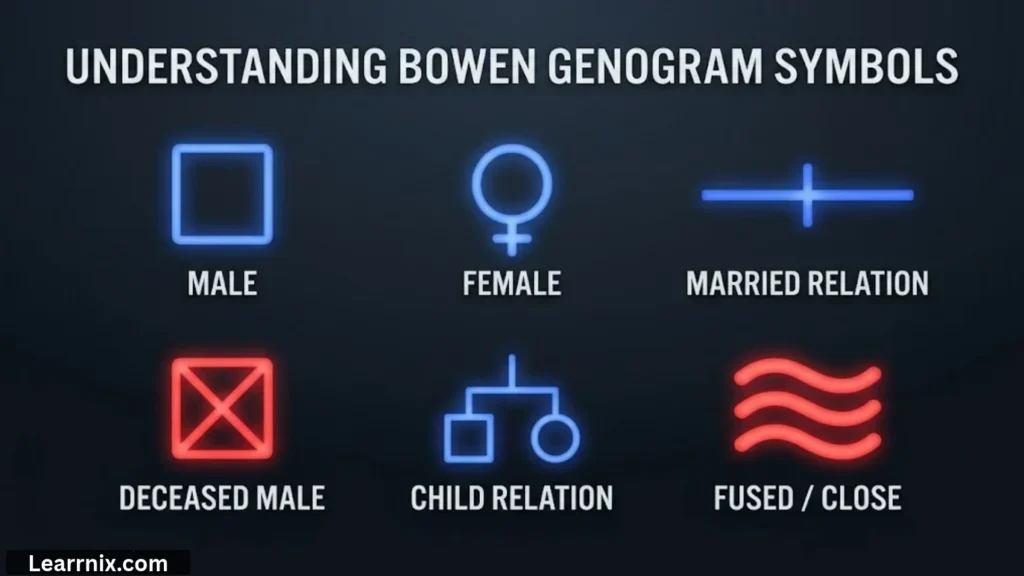
Bowen genogram symbols are associated with Bowen Family Systems Theory, developed by psychiatrist Murray Bowen. This approach examines how emotional relationships and patterns of behavior operate within families across generations.
A Bowen-style genogram helps therapists understand family emotional processes, including anxiety, family conflict, emotional distance, and patterns of dependence.
Important Concepts Represented in Bowen Genograms
- Differentiation of self: How well a person maintains their individual identity while remaining emotionally connected to family members.
- Emotional cutoff: When someone manages difficult family relationships by reducing or ending contact.
- Triangles: Three-person relationship patterns that develop when tension occurs between two people.
- Multigenerational transmission: How emotional and behavioral patterns may continue across generations.
- Family projection process: How parental anxiety and emotional difficulties may affect children.
- Sibling position: How birth order may relate to family roles and interactions.
Bowen Genogram Markings
Bowen genograms generally use the same basic person and relationship symbols found in conventional genograms. Their distinctive value comes from the information recorded about emotional relationships and multigenerational patterns.
| Marking | Information Represented |
| □ | Male family member |
| ○ | Female family member |
| X through symbol | Deceased person |
| → | Identified person |
| Zigzag relationship line | Conflict |
| Dashed relationship line | Emotional distance, where specified |
| Double relationship line | Close relationship |
| Triangle connecting three people | Emotional triangle |
For example, a therapist may use a Bowen genogram to explore how conflict between parents affects their relationship with a child. The diagram can also help identify whether similar patterns appeared in earlier generations.
Bowen’s approach focuses on understanding the family as an emotional system rather than treating an individual’s difficulties as completely separate from family relationships.
McGoldrick Genogram Symbols
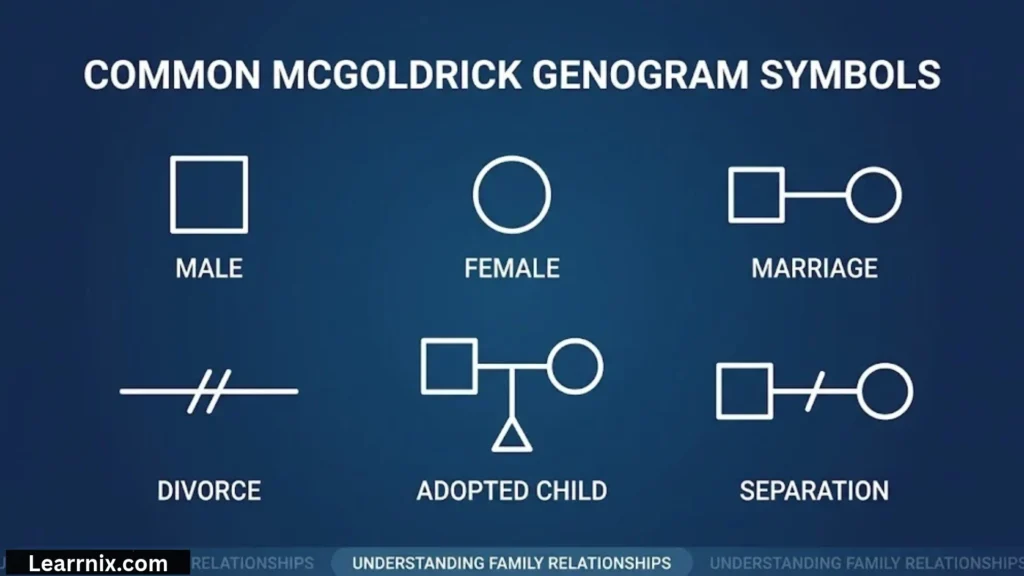
McGoldrick genogram symbols are associated with the work of Monica McGoldrick, a prominent family therapist and author known for her contributions to genogram development and family assessment.
McGoldrick, together with Randy Gerson and later collaborators, helped establish practical genogram methods for understanding family structure, relationships, cultural backgrounds, and multigenerational patterns.
The approach is especially useful in family therapy, clinical assessment, and social work.
Key Features of McGoldrick-Style Genograms
- Multigenerational family structure: Includes grandparents, parents, children, and other relevant relatives.
- Family relationships: Shows marriages, separations, divorces, and emotional connections.
- Medical history: Records important illnesses and health conditions.
- Cultural background: Documents ethnicity, traditions, migration, and family identity where relevant.
- Significant life events: Includes deaths, major transitions, and other important experiences.
- Family patterns: Helps professionals explore repeated behaviors and relationship dynamics.
Symbols Used in McGoldrick Genograms
The approach uses recognizable genogram conventions, including squares for males, circles for females, relationship lines, parent-child connections, and additional markings for health and emotional relationships.
The diagram may also include dates, ages, occupations, migration information, and other details that help explain family history.
One important feature is the attention given to cultural and social context. For example, a family may have experienced migration across several generations, changing household structures, or differences in cultural expectations.
These details can help a therapist understand family experiences without assuming that every family follows the same social or cultural pattern.
Cultural Genogram Symbols
Cultural genogram symbols represent cultural identity, traditions, beliefs, migration experiences, and other social factors that influence family life.
They extend the traditional family genogram by showing how culture and community experiences may shape relationships between generations.
Cultural genograms are particularly useful for counselors, social workers, educators, and family therapists working with families from different cultural backgrounds.
Information Included in Cultural Genograms
| Information | What It Represents |
| Country of origin | Where family members or ancestors originated |
| Migration | Movement between countries or regions |
| Language | Languages spoken within the family |
| Religion or belief system | Relevant family traditions and beliefs |
| Cultural traditions | Important celebrations and customs |
| Family roles | Expectations involving relatives and generations |
| Education | Family educational background |
| Community connections | Relationships with cultural or social communities |
There is no universal Unicode symbol set for cultural genograms. Professionals often use colors, abbreviations, written labels, and custom shapes to represent cultural information.
Examples of Cultural Genogram Annotations
- MIG: Migration history.
- LANG: Language background.
- TRAD: Family traditions.
- EDU: Educational background.
- ORG: Country or region of origin.
- CULT: Cultural background.
These are optional labels that should be explained in the diagram’s legend.
For example, a cultural genogram may show that grandparents migrated from another country, parents grew up speaking two languages, and younger generations adopted different cultural practices.
It can also help identify cultural strengths, such as strong extended-family support, community involvement, shared traditions, and intergenerational knowledge.
Cultural information should be documented respectfully. Never assume that every member of a family follows the same traditions or beliefs.
Flaticon Genogram Symbols
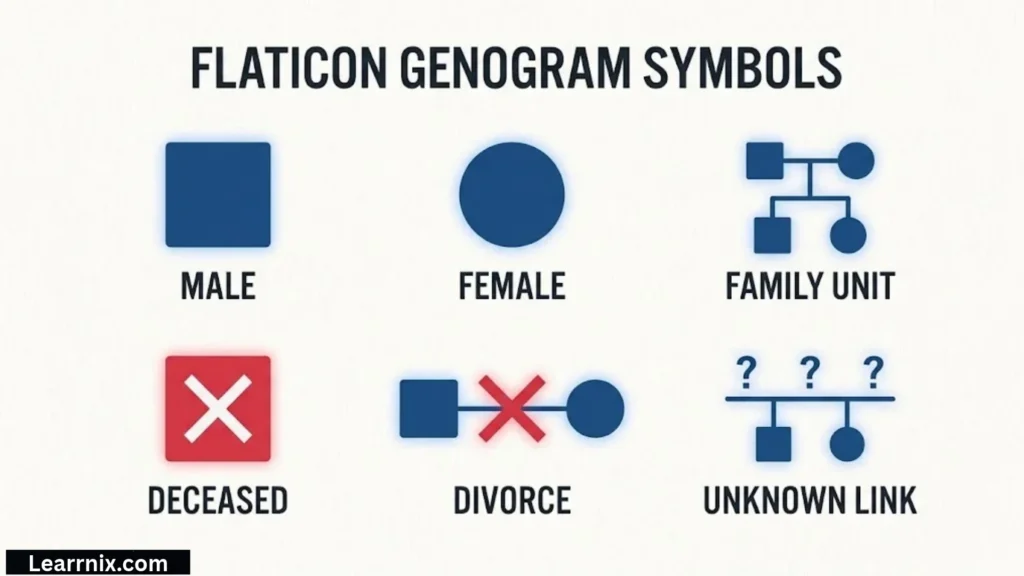
Flaticon is an icon resource that provides downloadable graphic elements for presentations, educational materials, websites, and digital designs. People searching for Flaticon genogram symbols may be looking for ready-made family icons to create attractive genogram diagrams.
It is important to understand that decorative icons and standardized genogram symbols are not necessarily the same thing.
A family icon showing a father, mother, and child may look attractive in a presentation, but it does not automatically communicate the exact relationship conventions used in professional genograms.
Types of Icons Useful for Genogram Designs
- Male and female person icons.
- Family and household icons.
- Parent and child illustrations.
- Marriage and partnership icons.
- Medical and healthcare icons.
- Heart and emotional relationship icons.
- Mental health and counseling icons.
- Addiction and recovery illustrations.
How to Use Icon Resources in a Genogram
- Search for family or individual icons.
- Choose a consistent visual style.
- Download the required icons in an appropriate format.
- Arrange family members according to their generations.
- Add relationship lines and relevant information.
- Include a legend explaining every custom symbol.
SVG icons are useful for designs that need resizing without losing image quality, while PNG icons can be convenient for ordinary presentations.
Always check the licensing conditions before using downloaded icons in commercial projects. Also, avoid replacing essential standardized genogram markings with decorative graphics that could confuse readers.
Flaticon Icons Versus Standard Genogram Symbols
| Feature | Flaticon Icons | Standard Genogram Symbols |
| Main purpose | Visual presentation | Family information |
| Appearance | Illustrative graphics | Geometric shapes and lines |
| Customization | Usually flexible | Follows established conventions |
| Professional interpretation | Depends on the design | More recognizable |
| Best use | Presentations and decoration | Healthcare and family assessment |
For professional documentation, standard genogram symbols should remain the foundation, even when decorative icons are added.
Frequently Asked Questions
What are the most common genogram symbols?
The most common genogram symbols are squares for males, circles for females, horizontal lines for partnerships, vertical lines for parent-child connections, and diagonal crosses for deceased individuals. Additional markings represent divorce, emotional relationships, and health conditions.
What is the difference between a genogram and a family tree?
A family tree mainly displays family connections, ancestry, and generations. A genogram provides more detailed information, including emotional relationships, medical history, mental health conditions, substance use, and significant family events.
How many generations should a genogram include?
Most genograms include at least three generations: grandparents, parents, and children. However, professionals may include additional generations when more family history is available and relevant to the assessment.
Can genogram symbols show mental health and medical conditions?
Yes. Genograms can include medical and mental health information through abbreviations, written labels, and other markings. These details help professionals explore family health patterns, but they cannot independently confirm diagnoses or genetic inheritance.
What is the difference between Bowen and McGoldrick genograms?
Bowen genograms emphasize emotional processes and patterns within family systems, including differentiation, emotional cutoff, and triangles. McGoldrick-style genograms provide a broader framework for documenting family structure, relationships, cultural background, medical history, and multigenerational experiences.
Conclusion
Genogram symbols make it easier to understand family structures, relationships, and important life events across multiple generations. From basic squares and circles to specialized medical, nursing, mental health, and substance-related annotations, each marking helps communicate a different part of family history.
Learning these symbols is useful for students, nurses, psychologists, social workers, family therapists, and anyone interested in understanding family patterns. Bowen and McGoldrick approaches also provide valuable ways to explore emotional connections, cultural experiences, and multigenerational relationships.
When creating a genogram, always use clear symbols, accurate family information, and a readable legend. Remember that symbol conventions can vary, so explain custom markings and use a consistent system. A well-organized genogram can turn complicated family information into a diagram that is easier to understand and discuss.

I am Michael Carter, an educational content creator who believes that knowledge has the power to transform lives.
I create resources focused on modern education, digital learning, and building essential skills for the future.
I love helping readers discover simple and effective ways to improve their learning journey.
Books by Michael Carter:
- Modern Education for Tomorrow’s World
- Learning Skills for Future Success
 Charlotte Anderson
 Daniel Harper