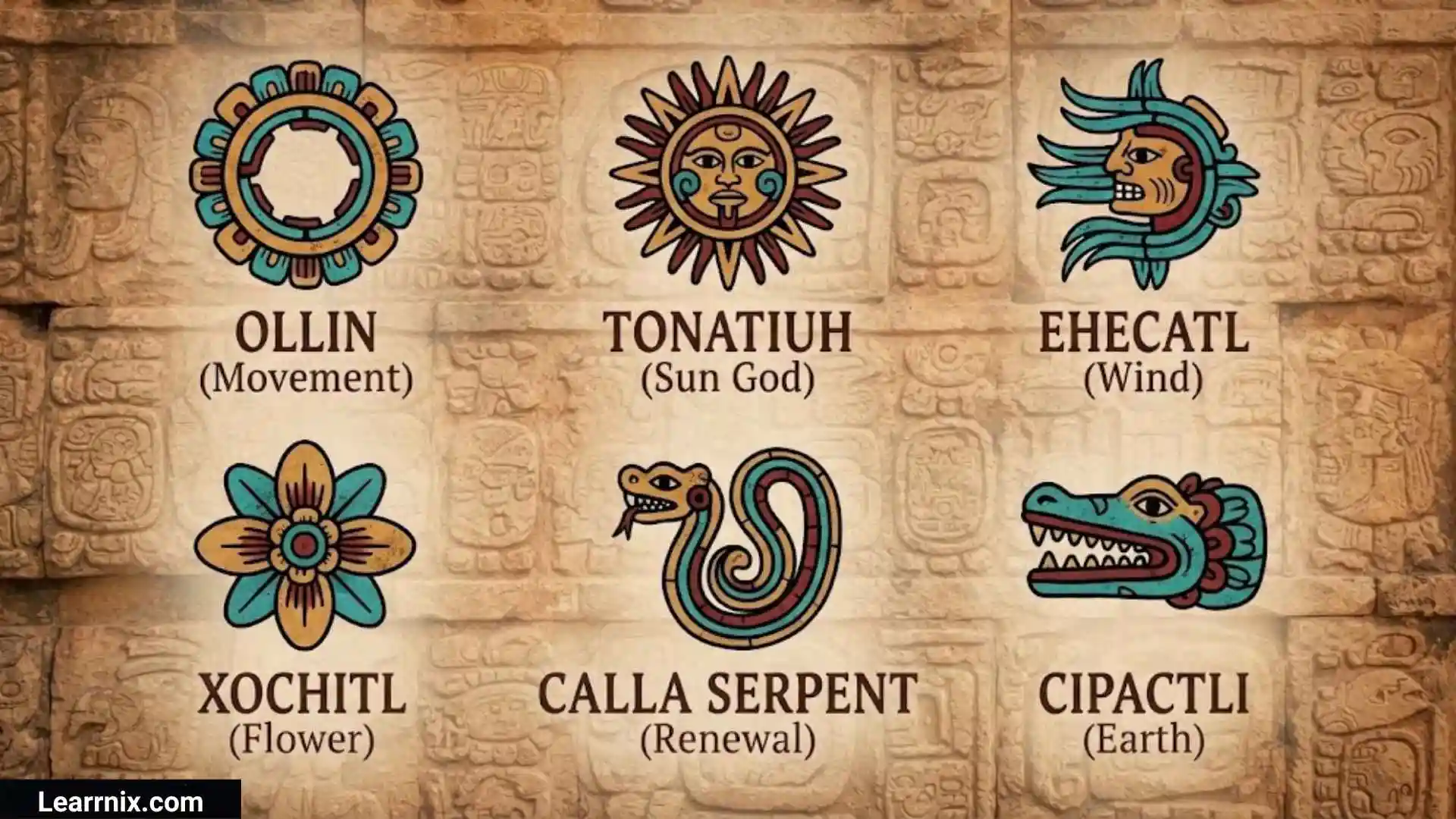
Aztec symbols are among the most recognizable forms of ancient Mesoamerican imagery. Eagles, jaguars, serpents, flowers, the sun, warriors, and geometric patterns appeared in art, codices, architecture, religious objects, and ceremonies. These images were not simply decoration; their meanings could relate to gods, nature, time, warfare, social status, or important cultural stories.
Today, people search for Aztec symbols for many different reasons. Some want to understand ancient meanings, while others are looking for tattoo ideas, decorative patterns, symbols of love, protection, strength, or warrior identity. The same symbol can also have different meanings depending on its historical and artistic context.
This guide explores important Aztec symbols and their meanings while also covering Aztec letters, patterns, Mexican symbolism, warrior imagery, tattoos, and easy designs. It also explains an important distinction for the symbols niche: many ancient Aztec glyphs are pictorial signs rather than modern Unicode characters that can simply be copied and pasted.
Aztec Symbols And Meanings
Aztec symbolism developed within the religious, political, natural, and social world of the Mexica civilization. A single image could communicate several ideas at once, so modern interpretations should be treated as contextual rather than absolute.
Some of the best-known symbols include:
| Symbol | Common Association |
| 🦅 Eagle | Sun, warriors, courage, power |
| 🐆 Jaguar | Night, strength, elite warriors, power |
| 🐍 Serpent | Deities, earth, water, transformation |
| ☀ Sun | Cosmic order, time, divine power |
| 🌸 Flower | Beauty, life, poetry, pleasure |
| 🌵 Nopal Cactus | Tenochtitlan, homeland, identity |
| 💀 Skull | Death, sacrifice, the underworld |
| 🔥 Fire | Transformation, ritual, warfare |
| 💧 Water | Life, fertility, rain, agricultural power |
The eagle was especially significant because eagle imagery was associated with the sun and elite warrior traditions. The jaguar represented another powerful side of the symbolic world, connected with nighttime, strength, stealth, and warrior identity.
The feathered serpent, commonly associated with Quetzalcoatl, is another major image. Serpent imagery also appeared in different religious and political contexts, so it should not automatically be assigned one simple meaning.
The famous Aztec Sun Stone contains many symbols rather than functioning as one isolated symbol. Its imagery includes calendar signs, cosmic concepts, previous world ages, and other elements of Mexica religious thought.
Aztec Symbols And Patterns
Aztec patterns are often recognized by repeated geometric forms, stepped shapes, lines, circles, feathers, serpents, and natural imagery. These patterns appeared in architecture, ceramics, textiles, sculptures, codices, and other forms of visual culture.
Common design elements include:
- Repeating geometric borders
- Step and pyramid shapes
- Sun-inspired circular forms
- Serpent bodies and scales
- Eagle feathers
- Jaguar spots
- Flower and plant motifs
- Water and wave-like patterns
- Calendar-inspired glyph arrangements
A pattern does not necessarily represent one specific ancient symbol. Modern designs often combine several historical motifs for visual effect. That distinction matters when choosing an Aztec-inspired design for artwork, clothing, jewelry, or tattoos.
For a more historically informed design, it is better to identify the original motif first and then build the pattern around it rather than labeling every geometric design as an ancient Aztec symbol.
Ancient Aztec Symbols
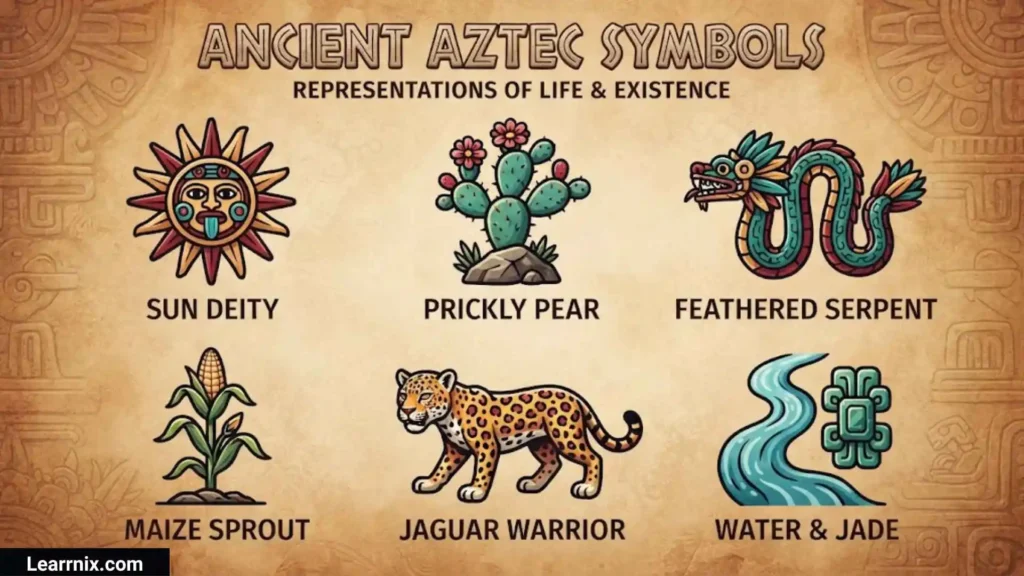
Ancient Aztec symbols were used in visual communication long before modern typography existed. Mexica artists and scribes used pictorial signs and glyphs to represent people, places, objects, names, dates, actions, and ideas. These signs appeared in manuscripts known as codices as well as on monuments and other objects.
The 20 day signs of the sacred calendar are especially useful when studying ancient symbolism. Examples include:
- Cipactli — crocodile or earth monster
- Ehecatl — wind
- Calli — house
- Cuetzpalin — lizard
- Coatl — serpent
- Miquiztli — death
- Mazatl — deer
- Tochtli — rabbit
- Atl — water
- Itzcuintli — dog
- Ozomatli — monkey
- Malinalli — grass
- Acatl — reed
- Ocelotl — jaguar
- Cuauhtli — eagle
- Cozcacuauhtli — vulture
- Ollin — movement
- Tecpatl — flint
- Quiahuitl — rain
- Xochitl — flower
These signs should not be treated like a simple alphabet. They belonged to a larger pictorial and calendrical system, and their meaning could depend on their use and surrounding imagery.
Important Aztec Symbols
Several symbols are particularly useful for understanding Aztec culture.
Eagle — Cuauhtli: The eagle was associated with the sun, power, and elite warrior traditions. It became one of the most recognizable images connected with Mexica identity.
Jaguar — Ocelotl: The jaguar was associated with nighttime power, strength, hunting, and the elite Jaguar Warriors.
Serpent — Coatl: Serpent imagery appears throughout Mesoamerican religious traditions and can represent different ideas depending on the deity or artistic context.
Feathered Serpent: Quetzalcoatl is commonly represented as a feathered serpent and is associated with several important religious and cultural ideas.
Nopal Cactus: The cactus and eagle imagery became closely connected with the traditional founding story of Tenochtitlan and later became an important part of Mexican national symbolism.
Sun: Solar imagery was central to Mexica ideas about time, cosmic order, religion, and the continuation of the world.
Ollin: The movement glyph is especially notable because it appears at the center of the Sun Stone and is associated with the current cosmic era.
Mexican Aztec Symbols
The phrase “Mexican Aztec symbols” often refers to imagery from the Mexica civilization that is now strongly associated with Mexican history and identity.
The eagle and cactus are perhaps the clearest example. The traditional story describes an eagle appearing on a nopal cactus at the location chosen for the founding of Tenochtitlan. This imagery later became part of Mexico’s national emblem.
Other symbols frequently associated with Mexican Aztec heritage include:
- Eagle
- Nopal cactus
- Serpent
- Sun Stone
- Jaguar
- Feathered serpent
- Aztec calendar imagery
- Warrior imagery
- Traditional geometric motifs
It is useful to remember that “Aztec” and “Mexican” are not interchangeable historical terms. Modern Mexico contains many Indigenous cultures and traditions beyond the Mexica, so an ancient symbol should not automatically be presented as representing all Mexican Indigenous peoples.
Aztec Symbols For Love
Aztec love symbolism is often connected with flowers, beauty, fertility, relationships, pleasure, and deities associated with these themes.
The flower symbol, Xochitl, is particularly interesting. Xochitl is the Nahuatl word for flower and is one of the 20 traditional day signs. It was also associated with Xochiquetzal, a goddess connected with beauty, youth, love, pleasure, and fertility.
For a love-inspired design, you might combine:
- 🌸 Flower imagery for beauty and affection
- Feather details for an elegant appearance
- Floral patterns for fertility and life
- Two complementary animals to represent partnership
- A circular design inspired by calendrical artwork
There is no single universally recognized “Aztec love symbol.” Modern tattoo and graphic-design websites sometimes assign fixed meanings to individual motifs that were much more complicated in their original context.
Aztec Symbols For Protection
Protection is another popular modern interpretation of Aztec-inspired imagery. Historically, religious symbols could be connected with gods, warriors, sacred forces, cosmic order, or protective beliefs.
For a protection-themed design, common choices include the eagle, jaguar, serpent, and powerful deity imagery.
The eagle can work well for a design emphasizing vigilance, courage, and strength. The jaguar is suitable for imagery centered on nighttime power and warrior status. Serpent imagery can create a more mysterious design connected with major Mesoamerican religious traditions.
If the goal is historical accuracy, avoid claiming that one particular Aztec glyph was universally used as a “protection symbol.” Meanings were often more specific than modern symbolic lists suggest.
Aztec Symbols For War
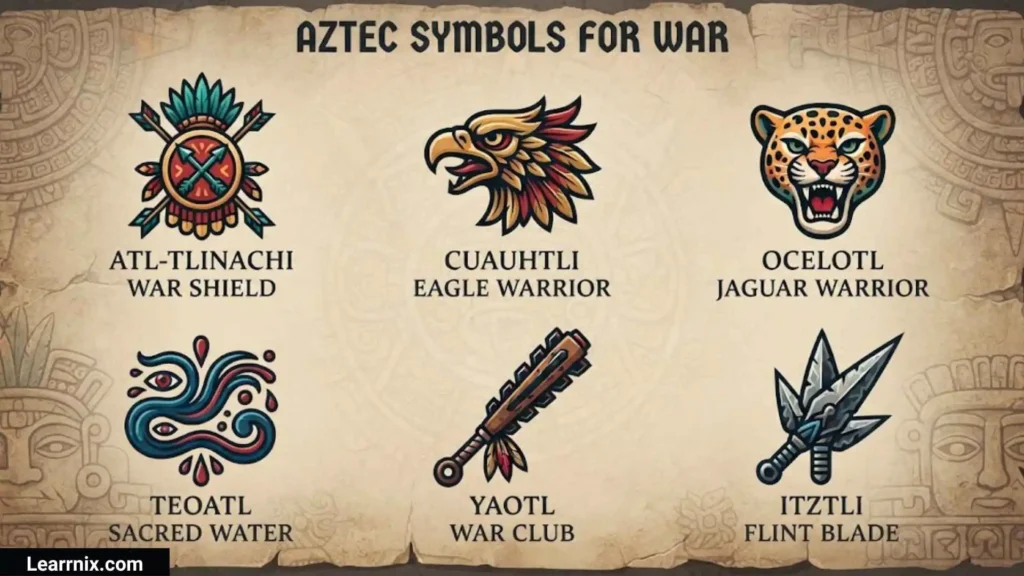
Warfare was a major part of Mexica political and religious life, and military imagery appears throughout surviving Aztec art.
One particularly important concept is Atl Tlachinolli, often described as the intertwined imagery of water and fire. It is strongly associated with warfare and appears in important Mexica artistic contexts.
Other war-related imagery includes:
- Eagle warriors
- Jaguar warriors
- Shields
- Spears and weapons
- Captive imagery
- Fire
- Water-and-fire symbolism
- Warrior costumes
- Eagle and jaguar imagery
The eagle and jaguar were especially powerful because they were associated with elite military orders. Rather than simply meaning “war,” these animals could communicate rank, courage, military achievement, and relationships with the cosmic world.
Warrior Fighter Aztec Symbols
For a warrior or fighter design, the eagle and jaguar are the strongest starting points.
The eagle warrior represents one side of Mexica military symbolism. Eagle imagery was connected with the sun and battlefield prowess. Historical visual sources show eagle imagery in manuscripts and other works associated with warriors.
The jaguar warrior represents another important warrior tradition. The animal’s strength, stealth, and association with nighttime power made it an appropriate emblem for elite military identity.
A warrior-inspired composition can include:
- 🦅 Eagle head
- 🐆 Jaguar head
- Shield
- Spear
- Feathered headdress
- Warrior face or figure
- Sun imagery
- Water-and-fire imagery
- Geometric borders
For tattoos, a detailed eagle or jaguar surrounded by traditional-style geometric elements can create a strong visual without requiring dozens of separate symbols.
Aztec Symbols Of Strength
Strength can be represented through animals, warriors, natural forces, and powerful deities.
The jaguar is one of the clearest choices because it combines physical power with stealth and nighttime symbolism. The eagle also works well when the intended meaning focuses on courage, authority, victory, or warrior strength.
Other useful themes include:
| Design | Strength-Related Idea |
| 🐆 Jaguar | Power, courage, stealth |
| 🦅 Eagle | Courage, authority, warrior ability |
| ☀ Sun | Vitality, cosmic power |
| 🐍 Serpent | Sacred power and transformation |
| Warrior | Discipline, bravery, military status |
| Shield | Defense and resilience |
Modern “strength” interpretations should be presented as symbolic adaptations rather than exact one-word translations of ancient glyphs.
Aztec Symbols Tattoos
Aztec tattoos are popular because the original artwork offers bold shapes, animals, warriors, calendars, and geometric patterns that can translate well into body art.
Popular tattoo concepts include:
- Aztec Eagle Tattoo — Suitable for courage, power, and warrior-inspired designs.
- Aztec Jaguar Tattoo — A strong choice for power, stealth, and elite warrior imagery.
- Aztec Sun Tattoo — Often inspired by the Sun Stone and its circular structure.
- Quetzalcoatl Tattoo — Uses feathered-serpent imagery for a more complex mythological design.
- Aztec Calendar Tattoo — Based on the detailed circular imagery of the Sun Stone.
- Aztec Warrior Tattoo — Focuses on historical military imagery.
- Aztec Geometric Tattoo — Uses repeated shapes and borders inspired by Mesoamerican art.
A good tattoo should distinguish between an authentic historical motif and a modern “Aztec-inspired” design. The Sun Stone itself contains a complex combination of calendrical and cosmological imagery, so using the entire stone as a simple symbol can remove much of its original context.
Aztec Symbols Letters
People searching for “Aztec symbols letters” are often looking for an Aztec alphabet, Aztec font, or characters that can be copied and pasted.
There is an important distinction here: Aztec writing was not a modern alphabet with one Unicode character for every English letter. Mexica scribes used pictorial signs and glyphs, with signs representing names, places, objects, concepts, and other information.
There is also no standard Unicode block containing a complete set of Aztec pictographic characters for ordinary copy-and-paste use.
For digital projects, people therefore commonly use:
- Images of historical glyphs
- Aztec-inspired fonts
- Graphic symbols
- PNG or SVG artwork
- Modern decorative characters
- Unicode symbols combined with Aztec-inspired layouts
A font that visually resembles Aztec writing is not necessarily an authentic representation of historical Nahuatl writing. Check the source and historical basis before using it for educational or cultural purposes.
Easy Aztec Symbols
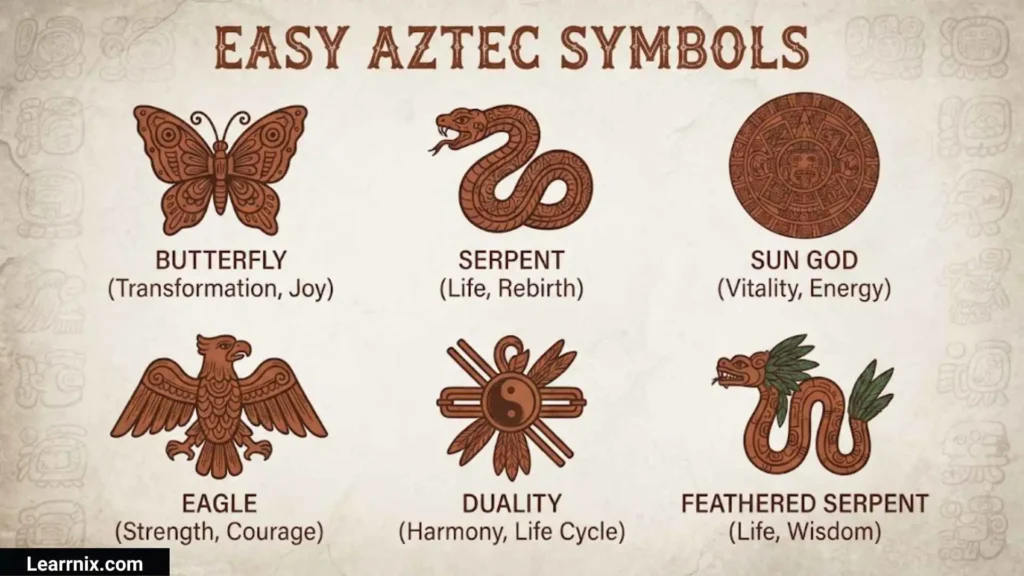
If you want an easy Aztec-inspired design to draw, start with simple shapes rather than attempting a complete calendar stone.
Good beginner options include:
- A simple sun circle
- A geometric step pattern
- An eagle head
- A jaguar face
- A serpent shape
- A flower glyph
- A cactus with an eagle
- A simple shield
- A triangular pyramid pattern
Simple Drawing Tips
Start with an outline and build details gradually. Use repeated lines and geometric shapes to create a traditional-looking border.
For an easy eagle design, draw the head in profile, add the hooked beak, outline a few feathers, and place it inside a geometric frame.
For a simple sun design, begin with a circle, add evenly spaced rays, and use a central face or geometric motif if you want a more elaborate result.
These are modern drawing approaches inspired by historical imagery, not exact reproductions of ancient glyphs.
FAQ
Are Aztec symbols available as copy-and-paste characters?
Most historical Aztec pictographic glyphs are not available as ordinary Unicode characters for direct copy and paste. They are better represented as images, drawings, or specialized digital artwork.
What is the most famous Aztec symbol?
The imagery of the Aztec Sun Stone is among the most recognizable, while the eagle on a nopal cactus is another highly important symbol associated with the founding story of Tenochtitlan and modern Mexican identity.
What Aztec symbol represents strength?
The jaguar and eagle are strong choices for modern strength-themed designs. Both have important historical associations with power and warrior traditions.
What Aztec symbol represents love?
Flower imagery is one of the strongest choices for a love-related design because flowers were connected with beauty, pleasure, youth, and related themes in Mexica symbolism.
Did the Aztecs have an alphabet like English?
No. Mexica writing relied heavily on pictorial and other signs rather than a modern alphabet in which every English letter has its own corresponding historical character.
Conclusion
Aztec symbols provide a fascinating connection between art, religion, warfare, nature, calendars, and the history of central Mexico. The eagle, jaguar, serpent, flower, sun, cactus, and calendar signs each offer different possibilities for understanding ancient Mexica culture.
For modern uses such as tattoos, logos, drawings, jewelry, and decorative patterns, it is helpful to separate historically documented meanings from newer interpretations. A beautiful design can still be respectful and informative when its creator understands where the imagery comes from.
The best approach is to choose a symbol based on the idea you want to express, then research its historical context before using it. Whether you are interested in warrior symbols, protection, love, strength, ancient glyphs, or easy designs, the deeper meaning makes the artwork much more valuable than decoration alone.

I am Charlotte Anderson, an education writer who is passionate about creating meaningful learning resources for students and lifelong learners.
I enjoy researching new educational approaches and sharing ideas that make studying easier and more effective.
Through my work, I aim to inspire curiosity, confidence, and a love for learning.
Books:
- The Complete Guide to Better Learning
- Building Skills for Academic Success
 Michael Carter