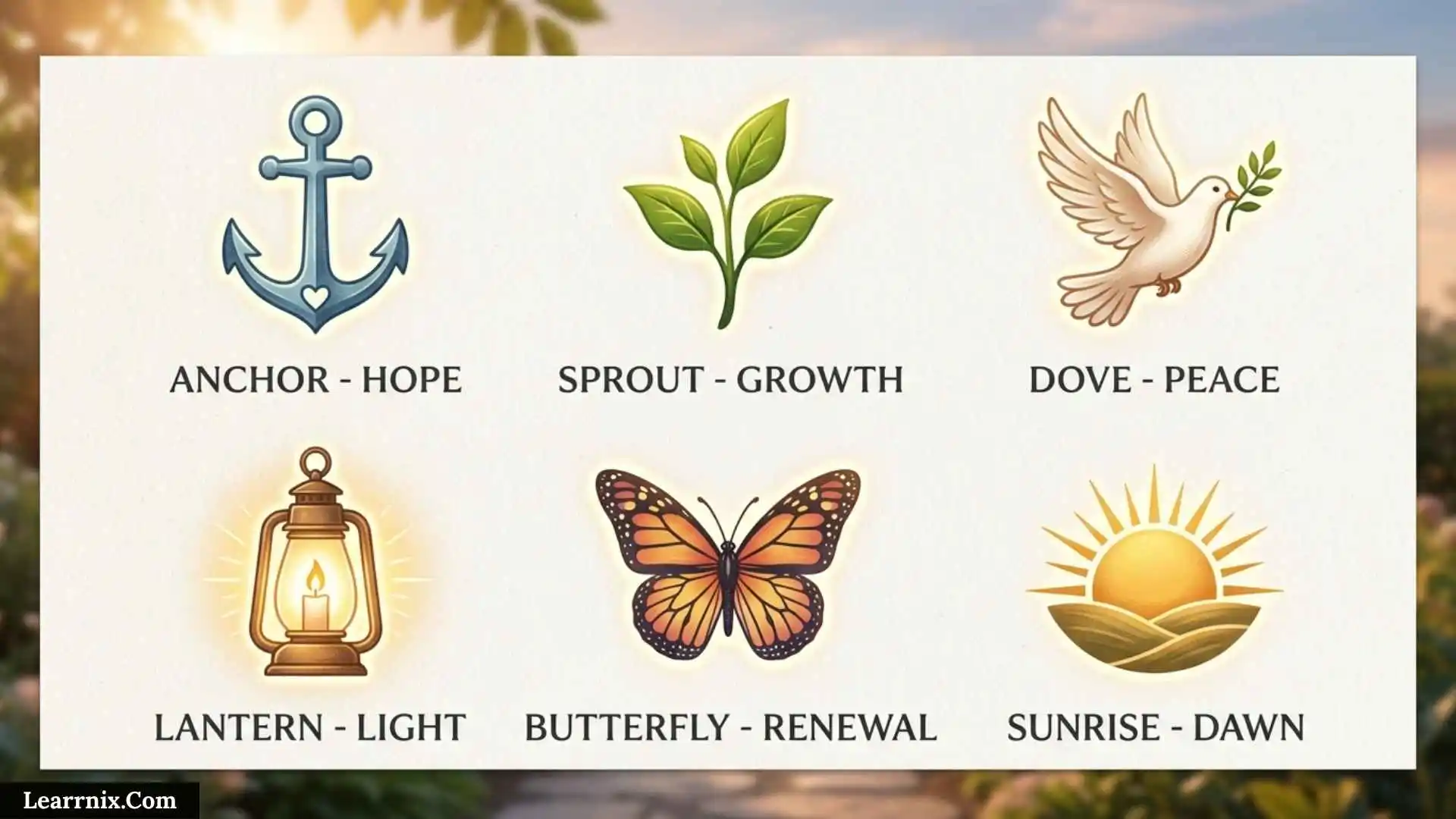
Hope is one of the most widely represented human ideas in art, religion, literature, jewelry, architecture, memorials, flags, and everyday design. Hope symbols give a visual form to ideas such as optimism, renewal, perseverance, peace, healing, faith, and the belief that difficult circumstances can change.
There is no single symbol that means hope in every culture. Some symbols have strong historical or religious associations, while others became popular through literature, art, social movements, or modern design. For example, the anchor has a well-documented connection with Hope in Christian and European art, while the rainbow has been used in different contexts to represent hope, peace, promise, diversity, and new beginnings.
This guide explains the most meaningful symbols of hope, what they represent, where their meanings come from, and how to choose an appropriate symbol for a tattoo, memorial, artwork, logo, jewelry, architectural design, or personal message.
What Are Hope Symbols?
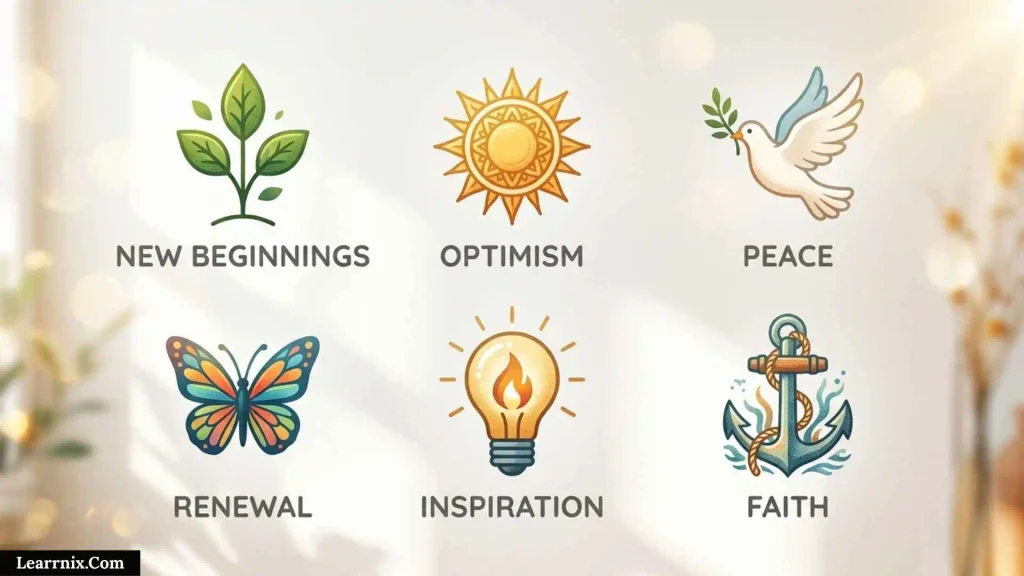
Hope symbols are visual objects, natural forms, colors, animals, plants, or designs that communicate the idea of expecting or working toward something better.
Their meanings can include:
- Hope for the future
- Strength during hardship
- Healing and recovery
- New beginnings
- Peace after conflict
- Faith and spiritual trust
- Perseverance
- Renewal and transformation
- Freedom and possibility
- Light after darkness
A symbol becomes meaningful through cultural history, religious tradition, artistic use, literature, and social context. That is why the same image can carry different meanings for different communities.
Quick Answer: What Is the Most Recognized Symbol of Hope?
The anchor is one of the clearest historically documented symbols of Hope, particularly in Christian art and European allegorical traditions. The Metropolitan Museum of Art identifies the anchor as an attribute of Hope in representations of the theological virtues.
Other widely recognized hope-related symbols include the rainbow, sunrise, dove, olive branch, lotus, phoenix, candle, star, and green color. However, their meanings vary according to culture and context.
Why Do Humans Use Symbols to Represent Hope?
Hope is an abstract idea. You cannot physically hold hope or point to it in the same way you can point to a tree or building.
Symbols solve this problem by giving an invisible idea a visible form.
A sunrise can communicate a new beginning. A growing plant can suggest renewal. A candle can represent light during a difficult period. An anchor can express stability when circumstances feel uncertain.
This makes symbols especially useful in:
- Memorial art
- Religious artwork
- Jewelry
- Tattoos
- Architecture
- Graphic design
- Literature
- Personal gifts
- Public monuments
- Charity campaigns
- Inspirational artwork
Most Powerful Symbols of Hope and What They Mean
Different symbols communicate different forms of hope. Choosing the right one depends on the message you want to express.
| Symbol | Common association | Best suited to |
| Anchor | Stability and steadfast hope | Faith, resilience, memorials |
| Rainbow | Hope after hardship and promise | Renewal, peace, optimism |
| Sunrise | New beginnings | Fresh starts and recovery |
| Dove | Peace and reconciliation | Peace-focused messages |
| Olive branch | Peace and reconciliation | Conflict resolution |
| Lotus | Renewal and transformation | Personal growth |
| Phoenix | Rebirth and overcoming adversity | Resilience |
| Candle | Light in darkness | Remembrance and support |
| Star | Guidance and aspiration | Direction and future goals |
| Green | Growth and renewal | Nature, healing, new beginnings |
The important point is that a symbol’s meaning depends on context. A rainbow, for instance, can represent hope in one artwork and a specific social identity or movement in another.
The Anchor: A Historic Symbol of Hope
The anchor is among the strongest examples of a symbol with a documented historical connection to Hope.
In Christian allegorical art, the three theological virtues were traditionally represented through recognizable attributes: Faith, Hope, and Charity. The anchor was associated with Hope. The Metropolitan Museum of Art documents this symbolism in several works, including representations of Hope holding an anchor.
The image works because an anchor keeps a vessel from drifting. Symbolically, it can suggest:
- Stability
- Steadfastness
- Security
- Endurance
- Remaining grounded during difficult times
This makes the anchor particularly appropriate for memorial jewelry, tattoos, religious artwork, and designs about emotional strength.
Best choice when: you want a symbol that communicates staying strong and holding on to hope.
The Rainbow: Hope After the Storm
The rainbow is one of the most recognizable modern images associated with hope.
Its visual story is simple: after rain or darkness comes light and color. That natural sequence makes it easy to associate the rainbow with recovery, optimism, promise, and a better future.
The Smithsonian American Art Museum has discussed the rainbow as a symbol of hope for peace, including Robert S. Duncanson’s Landscape with Rainbow, painted in 1859.
The rainbow can also have specific meanings in different modern social and cultural contexts. Therefore, anyone using it for a logo, memorial, or public design should consider the audience and surrounding imagery.
Best choice when: you want to communicate optimism, possibility, peace, or hope following a difficult period.
The Sunrise: A New Beginning
A sunrise naturally represents the transition from darkness to light.
Because of this visual relationship, sunrise imagery is often used to express:
- A fresh start
- Recovery
- Second chances
- Optimism
- Personal transformation
- A new chapter
Unlike the anchor, the sunrise does not have one fixed historical meaning as a universal symbol of Hope. Its strength comes mainly from its visual metaphor.
For example, a memorial design might show a sunrise behind mountains to suggest that life continues beyond a period of grief.
Best choice when: your central message is tomorrow can be different from today.
The Dove: Peace, Hope, and Reconciliation
The dove has been used in many cultural and religious contexts, and it is particularly associated with peace.
A dove carrying an olive branch is an especially recognizable combination. The Smithsonian has documented examples in which the dove and olive branch are deliberately used together to communicate peace.
Because peace and hope often overlap, the dove can communicate hope for:
- An end to conflict
- Reconciliation
- Cooperation
- Safety
- A peaceful future
Best choice when: your idea of hope is closely connected to peace.
The Olive Branch: Hope for Peace
The olive branch has a long history as a peace-related image, particularly in Western artistic and political symbolism.
When combined with a dove, it becomes even more strongly associated with peaceful resolution.
The meaning is especially useful for:
- Peace memorials
- Diplomatic imagery
- Reconciliation projects
- Community artwork
- Historical commemorations
However, an olive branch is more specifically associated with peace than hope itself. It is therefore better described as a symbol that can communicate hope for peace rather than a universal symbol of hope.
The Lotus: Renewal and Transformation
The lotus is frequently used in religious, philosophical, and artistic traditions as an image of growth and transformation.
Its visual appeal comes from the way the flower rises above muddy or murky water. This creates a powerful metaphor for moving through difficult circumstances and emerging into a new stage of life.
The lotus can therefore represent:
- Renewal
- Growth
- Transformation
- Inner strength
- Spiritual development
- Rising above adversity
Best choice when: hope is connected to personal growth or transformation.
The Phoenix: Rebirth After Adversity
The phoenix is a legendary bird associated with death, renewal, and rebirth.
It is especially powerful when hope is not simply about waiting for something better but about rebuilding after destruction.
A phoenix can symbolize:
- Rebirth
- Resilience
- Reinvention
- Recovery
- Transformation
- Starting again
This makes it popular in tattoos, fantasy art, inspirational designs, and personal stories of overcoming major challenges.
Best choice when: the message is I survived, changed, and began again.
The Candle: Light in Darkness
A candle is a simple but powerful visual metaphor.
Light becomes particularly meaningful when surrounded by darkness. A single flame can therefore suggest:
- Hope
- Guidance
- Remembrance
- Faith
- Comfort
- Persistence
A candle is particularly suitable for memorials because it can communicate remembrance while also suggesting continuing light.
Best choice when: hope needs to coexist with grief, remembrance, or uncertainty.
The Star: Guidance and Possibility
Stars have long been used in art, literature, navigation, and religious imagery.
Because stars can serve as points of direction in the night sky, they can represent:
- Guidance
- Dreams
- Aspiration
- Direction
- Possibility
- A distant goal
A star is a flexible symbol because it can be used in both spiritual and nonreligious designs.
Best choice when: hope means having something to move toward.
Green: Growth, Renewal, and New Life
Green is frequently associated with plants, spring, growth, and renewal.
For this reason, green can support a visual message of hope, especially when paired with:
- Leaves
- Trees
- New shoots
- Flowers
- Landscapes
- Nature imagery
Color symbolism is highly dependent on cultural and design context, so green should not automatically be treated as a universal symbol of hope.
Best choice when: you want a subtle, modern representation of renewal rather than a specific object.
Hope Symbols Across Different Contexts
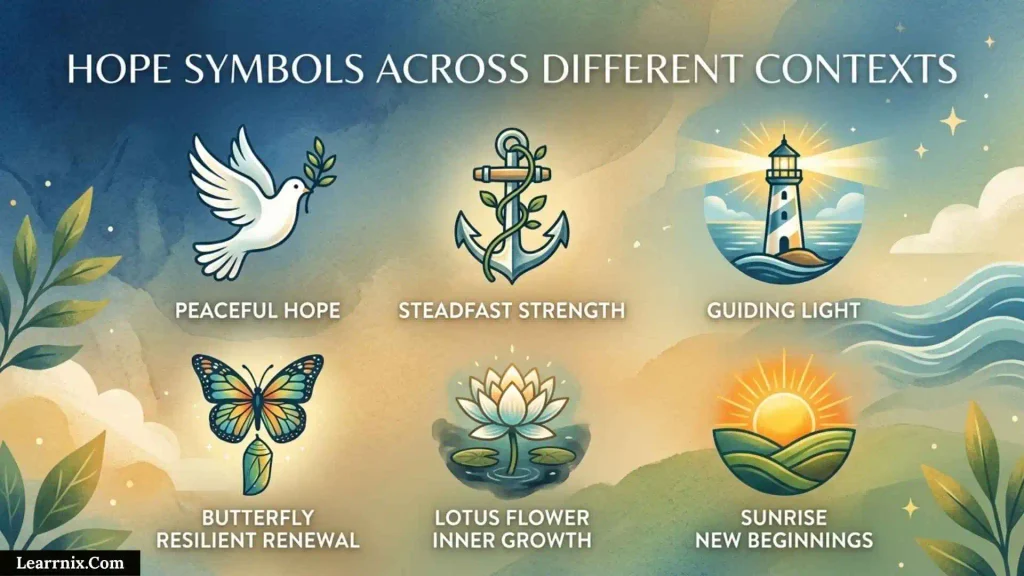
A symbol can change meaning depending on where and how it is used. Understanding context prevents common interpretation mistakes.
Religious Symbols of Hope
Religious traditions contain some of the oldest and most structured systems of symbolism.
In Christian art, for example, the anchor has a documented connection with Hope. Historical representations of Faith, Hope, and Charity often use recognizable objects to communicate abstract virtues.
Religious symbols of hope may include:
- Anchor
- Cross
- Light
- Dove
- Olive branch
- Star
- Prayer-related imagery
Not every religious symbol should automatically be classified as a symbol of hope. The surrounding artwork, text, and tradition matter.
Nature Symbols of Hope
Nature provides many visual metaphors for renewal.
Common examples include:
- Sunrise
- Rainbow
- Spring flowers
- Green leaves
- New tree growth
- Birds
- Light breaking through clouds
Nature-based symbolism works well because the viewer can understand the metaphor without needing specialist knowledge.
Symbols of Hope in Memorials
Memorial designs often need to balance two ideas:
Remembering the past + believing in continued life or peace.
This is why candles, flowers, sunrise imagery, birds, stars, and trees can be effective.
A memorial designer should avoid choosing a symbol solely because it looks attractive. The meaning should fit the person, event, culture, and audience.
Hope Symbols in Tattoos and Jewelry
For personal designs, symbolism can be more intimate.
An anchor may represent staying grounded. A phoenix may represent rebuilding. A sunrise may mark a new chapter. A small star may represent guidance.
A useful approach is to choose the story first and the symbol second.
For example:
“I want a symbol for surviving a difficult period and beginning again.”
A phoenix may communicate that story more directly than a generic heart.
How to Choose the Right Symbol of Hope
The best symbol depends on what kind of hope you want to communicate.
A Simple Decision Guide
Use this quick framework:
Do you want to represent stability?
→ Choose an anchor.
Do you want hope after a difficult period?
→ Consider a rainbow or sunrise.
Do you want peace or reconciliation?
→ Consider a dove or olive branch.
Do you want transformation or personal growth?
→ Consider a lotus.
Do you want survival and rebirth?
→ Consider a phoenix.
Do you want remembrance with a hopeful message?
→ Consider a candle or star.
Do you want a subtle natural symbol?
→ Consider green leaves, new growth, or flowers.
This approach is more reliable than simply choosing the most popular-looking symbol.
What to Consider Before Using a Symbol
Before putting a hope symbol on a tattoo, logo, memorial, website, building, or product, ask:
- What exact message should the symbol communicate?
- Does the symbol have another strong cultural meaning?
- Could the audience interpret it differently?
- Does its historical meaning fit the project?
- Does the surrounding text clarify the intended message?
- Is the symbol appropriate for the cultural or religious setting?
This is especially important for public-facing designs.
Common Misconceptions About Symbols of Hope
Symbolism is rarely as simple as “one image = one meaning.”
There Is No Universal Symbol of Hope
The anchor has a strong historical connection with Hope in Christian and European art, but that does not mean every culture interprets an anchor the same way. Likewise, a rainbow can represent hope in one setting and another specific identity or movement in another.
Symbols gain meaning through context.
A Symbol Can Have More Than One Meaning
A dove may suggest peace, but it can also have religious associations.
A star may represent guidance, but it may also represent achievement, religion, nationality, or astronomy.
A lotus can suggest renewal, but it also has important meanings in particular religious and cultural traditions.
The surrounding design helps determine interpretation.
Modern Meanings Can Differ From Historical Meanings
Symbols evolve.
The meaning attached to an image today may be different from how it was understood centuries ago. The rainbow is a useful example because it has accumulated different meanings across art, literature, religion, and modern social movements.
When historical accuracy matters, research the symbol within its specific time and culture rather than relying on a generic symbolism list.
Practical Uses of Hope Symbols
I hope imagery is useful because it can communicate an emotional idea quickly.
For Graphic Design and Logos
A designer can use a sunrise, leaf, star, or abstract light pattern to communicate growth and optimism without explicitly writing the word “hope.”
For a nonprofit or community project, however, the symbol should be tested with the intended audience before final use.
For Architecture and Public Spaces
Architectural symbolism can communicate collective values.
Examples include:
- Natural light representing openness
- Trees representing growth
- Circular forms representing continuity
- Water representing renewal
- Rising forms suggesting aspiration
A building does not need a literal anchor or rainbow to communicate hope. Abstract architectural symbolism can be more sophisticated.
For Memorial and Commemorative Art
Memorial artwork often benefits from symbols that leave room for personal interpretation.
A sunrise behind a landscape, a tree with new leaves, or a small flame can communicate hope without making the memorial overly literal.
How to Use Hope Symbols Without Losing Their Meaning
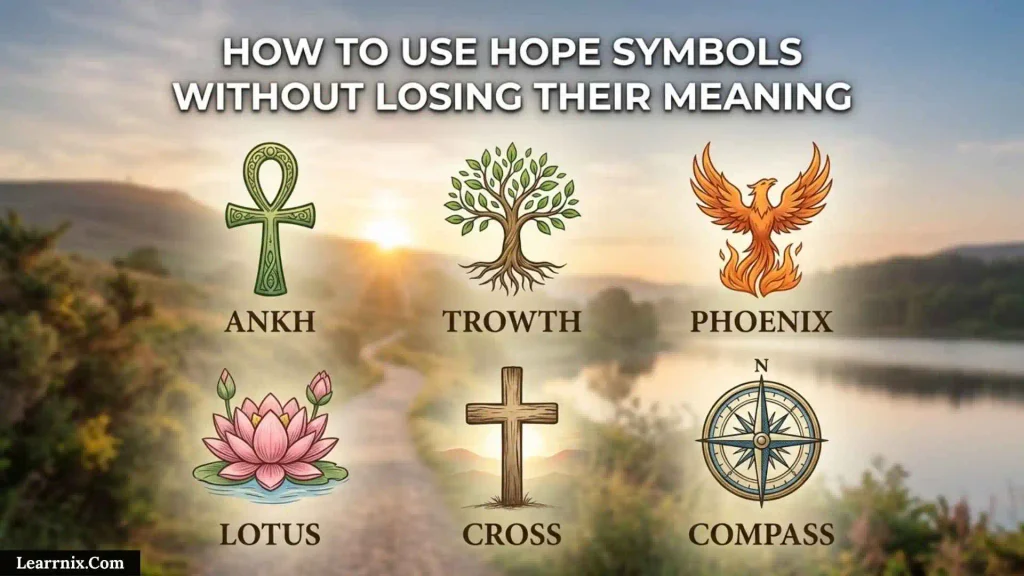
Good symbolic design depends on restraint.
Combine Symbols With a Clear Story
Two compatible symbols can create a stronger message.
For example:
Anchor + light
can suggest stability during difficult times.
Sunrise + tree
can suggest new growth.
Dove + olive branch
strongly reinforces peace.
Phoenix + rising sun
can emphasize rebirth and a new beginning.
The goal is not to fill the design with symbols. It is to make the intended message easier to understand.
Avoid Mixing Conflicting Meanings
A common design mistake is combining many symbols simply because each one has a positive meaning.
A design containing an anchor, phoenix, lotus, rainbow, dove, star, candle, and tree may become visually crowded and conceptually unclear.
Choose one primary symbol and, if necessary, one supporting element.
That usually produces a stronger visual message.
Key Takeaways About Hope Symbols
- The anchor has one of the strongest documented historical links to Hope, especially in Christian allegorical art.
- The rainbow can represent hope, peace, promise, and optimism, but its meaning varies by context.
- The sunrise works well as a visual metaphor for new beginnings.
- The dove and olive branch are more directly connected with peace but can express hope for reconciliation.
- The lotus is useful for themes of growth and transformation.
- The phoenix strongly communicates rebirth and resilience.
- A candle can combine remembrance with hope.
- A star can represent guidance, aspiration, or a hopeful destination.
- Green and natural growth can provide a subtle visual expression of renewal.
- Symbolic meanings are not universal, so culture and context should always be considered.
Frequently Asked Questions About Hope Symbols
What is the strongest symbol of hope?
The anchor is one of the strongest historically documented symbols of Hope. In Christian and European allegorical art, Hope is frequently represented with an anchor.
For modern visual design, however, the strongest choice depends on the intended message. A sunrise may be better for new beginnings, while a phoenix may better represent rebirth.
What flower symbolizes hope?
There is no single flower that universally means hope. The lotus is commonly used in symbolic contexts involving renewal, transformation, and rising above difficult conditions. Other flowers may communicate hope depending on cultural or artistic context.
What animal represents hope?
Several animals can be used to communicate hope, depending on context. Birds are especially useful because flight can suggest freedom, possibility, and movement toward the future. The dove can also connect hope with peace.
What color represents hope?
Green is often associated with growth and renewal, while yellow can suggest brightness and optimism in some design traditions. However, color meanings vary considerably between cultures and contexts.
Is a rainbow a symbol of hope?
Yes, a rainbow can function as a symbol of hope, especially when it appears after a storm or in artwork about peace and a better future. Historical and modern examples demonstrate this association, although the rainbow also has other important cultural meanings.
What symbol represents hope after hardship?
The phoenix, rainbow, and sunrise are particularly effective for this idea. The phoenix emphasizes rebirth, the rainbow suggests hope after difficulty, and the sunrise represents a new beginning.
What symbol represents hope and strength?
The anchor is a strong choice because it combines hope with stability and steadfastness. Its historical use as an attribute of Hope makes it especially appropriate when endurance is part of the message.
What is a good symbol of hope for a memorial?
A candle, sunrise, star, tree, or carefully chosen flower can work well. An anchor may be appropriate when the memorial also has a Christian or historical connection to the symbolism of Hope.
Can I combine two symbols of hope?
Yes. Combining two compatible symbols can create a more specific message. For example, an anchor with a small light can suggest steadfastness during darkness, while a sunrise with new leaves can communicate renewal.
Are hope symbols the same in every culture?
No. Symbolism is strongly influenced by culture, religion, history, geography, and modern social context. A symbol that represents hope in one community may have a different meaning elsewhere.
Conclusion
Hope symbols turn an abstract feeling into something people can see, remember, and share. The anchor, rainbow, sunrise, dove, olive branch, lotus, phoenix, candle, and star can all communicate forms of hope, but they do not carry identical meanings.
The most important step is to decide what kind of hope you want to express. If you mean steadfastness, an anchor may be ideal. If you mean a fresh beginning, a sunrise can be more direct. If the story is about rebuilding after adversity, a phoenix may be the stronger choice. For peace and reconciliation, a dove or olive branch may communicate the message more clearly.
The best symbolic design is not necessarily the one with the most symbols. It is the one where the image, context, history, and intended message work together.

I am Daniel Harper, an education enthusiast and writer who enjoys creating helpful content to make learning more accessible and engaging.
I focus on sharing knowledge about effective study methods, educational growth, and skills that help learners succeed in a changing world.
Through my writing, I aim to inspire students to explore new ideas and develop a passion for learning.
Books by Daniel Harper:
- The Path to Lifelong Learning
- Unlocking Your Learning Potential
 Michael Carter
 Charlotte Anderson