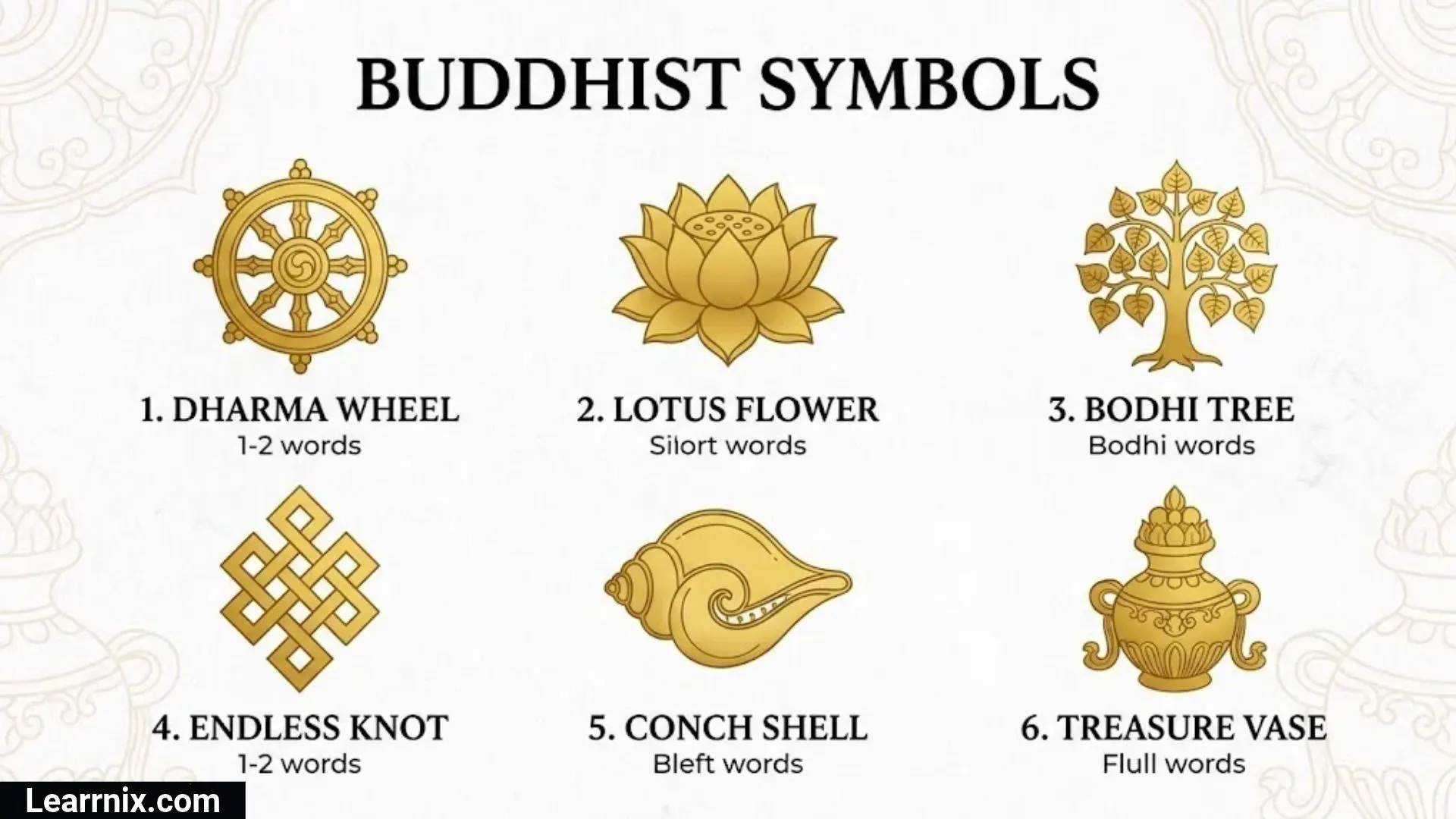
Buddhist symbols carry deep meanings connected to wisdom, compassion, peace, spiritual growth, and enlightenment. For thousands of years, these symbols have helped people understand Buddhist teachings and represent important ideas about life, suffering, mindfulness, and the path toward liberation. Each symbol has its own history and spiritual significance.
Some Buddhist symbols are simple and easy to recognize, such as the lotus flower, Dharma wheel, and endless knot. Others are more detailed designs found in Tibetan temples, Japanese Buddhist art, Chinese traditions, and ancient religious objects. Many people also search for Buddhist symbols for tattoos, meditation, jewelry, artwork, and personal expression.
In this guide, you will discover popular Buddhist symbols and their meanings, ancient and regional variations, and sacred designs associated with strength, peace, and enlightenment. You will also find Buddhist symbols text that you can copy and paste, along with explanations of their cultural significance and common uses.
Buddhist Symbols and Meanings
Buddhist symbols represent important teachings and spiritual principles. They help communicate ideas that can sometimes be difficult to explain through words alone. Some represent the Buddha’s teachings, while others symbolize qualities that people develop through Buddhist practice.
Here are some of the most recognized Buddhist symbols and their meanings.
| Symbol | Name | Meaning |
| ☸ | Dharma Wheel | Buddha’s teachings and the Eightfold Path |
| 🪷 | Lotus Flower | Purity, spiritual growth, and enlightenment |
| 卍 | Buddhist Swastika | Good fortune, auspiciousness, and eternity |
| 🐚 | Conch Shell | The sound of Buddhist teachings |
| ♾ | Endless Knot | Interconnection and the relationship between cause and effect |
| ☂ | Parasol | Protection from spiritual suffering |
| 🐟 | Golden Fish | Freedom, happiness, and liberation |
| 🏺 | Treasure Vase | Spiritual and material abundance |
| 🏳 | Victory Banner | Victory over obstacles and negative emotions |
| 🌸 | Flower | Impermanence and the beauty of existence |
These symbols are particularly important in Buddhist art, temple decorations, religious ceremonies, meditation spaces, and traditional manuscripts.
The Eight Auspicious Symbols, also known as Ashtamangala, are especially important in Tibetan Buddhism. Together, they represent blessings, spiritual progress, and the qualities needed to follow the Buddhist path.
Buddhist Symbols Text
Buddhist symbols text is useful for people who want to include spiritual characters in social media posts, usernames, messages, bios, and decorative writing.
Below are some copy-and-paste characters associated with Buddhist traditions or commonly used to express Buddhist themes.
Popular Buddhist Symbols
- ☸ — Dharma Wheel
- 卍 — Traditional Buddhist Swastika
- 卐 — Swastika Variant
- 🪷 — Lotus Flower
- 🌸 — Flower
- ॐ — Om Sacred Syllable
- ♾ — Infinity Symbol
- ☯ — Yin-Yang Symbol
- 🐚 — Conch Shell
- 🐟 — Fish
- ✨ — Sparkles
- 🙏 — Folded Hands
Buddhist-Inspired Decorative Text
- ☸ Peace And Wisdom ☸
- 🪷 Path To Enlightenment 🪷
- ॐ Inner Peace ॐ
- ☸ Mindfulness And Compassion ☸
- 🪷 Grow Through Life 🪷
- ✨ Wisdom • Peace • Love ✨
How to Use Buddhist Symbols Text
You can copy these characters and paste them into supported applications, including messaging platforms, social media profiles, and personal documents.
However, not every character has the same meaning in every tradition. For example, the infinity symbol is commonly used as a modern representation of interconnectedness, but it is not one of the traditional Eight Auspicious Symbols.
Also, the traditional Dharma wheel is ☸. It should not be confused with the ordinary gear or settings icon.
Simple Buddhist Symbols
Simple Buddhist symbols are popular because their designs are easy to recognize while carrying meaningful spiritual messages. They are commonly used in meditation spaces, artwork, jewelry, and personal decorations.
Here are some simple designs:
- ☸ Dharma Wheel: Represents Buddhist teachings and the path toward liberation.
- 🪷 Lotus: Symbolizes purity and spiritual development.
- 卍 Swastika: Represents auspiciousness and good fortune in Buddhist traditions.
- ♾ Infinity: Can represent interconnectedness in modern spiritual designs.
- 🌸 Flower: Reminds people of impermanence and the changing nature of life.
- 🙏 Folded Hands: Commonly expresses respect, gratitude, and devotion.
The lotus is particularly meaningful because it grows from muddy water but produces a beautiful flower. This represents the possibility of developing wisdom and purity even while living in a world filled with difficulties.
Simple symbols can also make meditation spaces feel peaceful. A small Dharma wheel, lotus decoration, or Buddhist-inspired artwork can serve as a visual reminder of mindfulness.
Ancient Buddhist Symbols
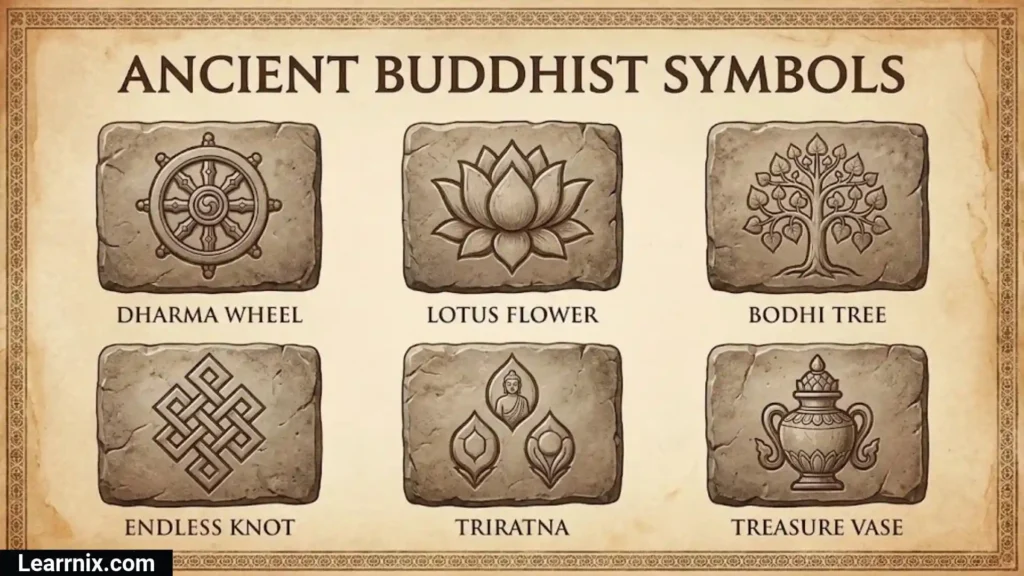
Ancient Buddhist symbols developed over centuries as Buddhism spread across Asia. Before images of the Buddha became common in Buddhist art, artists often represented him through symbolic objects and visual references.
Some early Buddhist symbols include:
The Bodhi Tree: Represents the place where Siddhartha Gautama attained enlightenment. It is associated with wisdom, awakening, and the beginning of the Buddha’s teaching.
The Empty Throne: Represents the Buddha without showing his physical form. It reminds followers of his presence and spiritual importance.
Buddha’s Footprints: Symbolize the Buddha’s journey, teachings, and influence on the world.
The Dharma Wheel: Represents the Buddha’s first teaching and the movement of the Buddhist path.
The Stupa: Represents the Buddha’s enlightened mind and is traditionally associated with sacred relics and Buddhist remembrance.
The Lotus Flower: Represents purity and the possibility of spiritual awakening.
These symbols can be found in early Indian Buddhist sculptures, stupas, stone carvings, and archaeological sites. Their use changed as Buddhist traditions developed in different regions.
Chinese Buddhist Symbols
Chinese Buddhist symbols combine Buddhist teachings with artistic styles and cultural traditions that developed in China. Buddhism entered China from India through Central Asian trade and cultural routes, eventually becoming an important part of Chinese religious and artistic history.
Some popular Chinese Buddhist symbols include:
- 卍 — Wan Symbol: Represents auspiciousness, good fortune, and the Buddha’s enlightened qualities.
- 莲花 — Lotus Flower: Symbolizes purity and spiritual awakening.
- 佛 — Buddha Character: Means Buddha and is commonly seen in Buddhist temples and decorations.
- 法轮 — Dharma Wheel: Represents Buddhist teachings and the path to enlightenment.
- 观音 — Guanyin: Refers to the bodhisattva associated with compassion and mercy.
- 如意 — Ruyi: A traditional auspicious object that can represent good wishes and fulfillment.
Guanyin is particularly important in Chinese Buddhism. This bodhisattva is associated with compassion and helping beings who experience suffering.
Chinese Buddhist art also features dragons, clouds, lotus patterns, sacred objects, and temple ornaments. Some of these images come from broader Chinese cultural traditions rather than exclusively Buddhist teachings.
Tibetan Buddhist Symbols and Meanings
Tibetan Buddhism has a rich collection of spiritual symbols used in temples, meditation practices, paintings, mandalas, and religious ceremonies.
The Eight Auspicious Symbols are especially significant.
| Symbol | Meaning |
| 🪷 Lotus Flower | Purity and enlightenment |
| ☸ Dharma Wheel | Buddha’s teachings |
| 🐚 Conch Shell | The spreading sound of Dharma |
| ☂ Parasol | Spiritual protection |
| 🐟 Golden Fish | Freedom from suffering |
| ♾ Endless Knot | Interdependence and interconnectedness |
| 🏺 Treasure Vase | Abundance and spiritual wealth |
| 🏳 Victory Banner | Victory over negative emotions |
These symbols are frequently displayed together in Tibetan Buddhist artwork.
Their meanings are connected. The lotus represents purity, the Dharma wheel represents the teachings, and the victory banner represents overcoming internal obstacles.
Tibetan Buddhist symbols are also used in prayer flags, ritual objects, sacred paintings called thangkas, and temple decorations.
Tibetan Buddhist Symbols
Tibetan Buddhist symbols are recognized for their detailed artwork and strong connection with spiritual practices.
Apart from the Eight Auspicious Symbols, several other designs are important.
Dorje or Vajra: Represents indestructibility, spiritual power, and the union of wisdom and compassion.
Bell or Ghanta: Represents wisdom. It is frequently used with the vajra during Tibetan Buddhist rituals.
Mandala: Represents a sacred universe or spiritual arrangement. Mandalas are used in meditation and visualization practices.
Prayer Wheel: Contains written mantras and is rotated as part of certain Tibetan Buddhist devotional practices.
Three Jewels: Represent the Buddha, Dharma, and Sangha. They are the three central objects of refuge in Buddhism.
Kalachakra Symbol: Associated with the Kalachakra teachings and their complex understanding of time and the universe.
These designs are not merely decorative. Many have specific ritual meanings and are used according to established Buddhist traditions.
Zen Buddhist Symbols
Zen Buddhism emphasizes meditation, direct experience, mindfulness, and understanding the nature of reality. Its visual symbols are often simple, but their meanings can be profound.
Some common Zen-inspired symbols include:
Enso Circle (◯): Represents emptiness, completeness, enlightenment, and the present moment. It is commonly drawn in a single brushstroke in Zen art.
Lotus Flower (🪷): Represents purity and the development of wisdom.
Bodhi Tree: Represents awakening and the Buddha’s enlightenment.
Buddha Statue: Serves as a reminder of mindfulness, meditation, and spiritual discipline.
Zafu Cushion: Represents the traditional practice of seated meditation, known as zazen.
The Enso is especially popular in Zen-inspired designs. Its circular form may be open or closed. An open Enso can suggest that life and spiritual development are ongoing, while a closed one may suggest completeness.
Zen symbols are frequently used in minimalist artwork, meditation rooms, wall decorations, and tattoos.
Japanese Buddhist Symbols
Japanese Buddhist symbols reflect the development of Buddhism in Japan, where different schools created distinctive forms of art, architecture, and religious expression.
Some important Japanese Buddhist symbols include:
- 卍 Manji: A traditional Buddhist symbol representing auspiciousness and spiritual significance.
- 🪷 Lotus Flower: Represents purity and enlightenment.
- ◯ Enso: Represents Zen ideas of emptiness, completeness, and awareness.
- 五輪塔 Gorinto: A five-element memorial structure representing earth, water, fire, wind, and space.
- 数珠 Juzu: Buddhist prayer beads used for chanting and devotional practices.
- 卒塔婆 Sotoba: A wooden memorial tablet used in certain Japanese Buddhist funerary traditions.
- 仏 Buddha: The Japanese character associated with the Buddha.
The Manji symbol is particularly recognizable in Japanese Buddhist culture. Its traditional form can be seen in temples, religious artwork, and historical architecture.
Japanese Buddhist symbols also appear in gardens, statues, calligraphy, and traditional memorial designs.
Strength Buddhist Symbols and Meanings
Buddhism often connects strength with patience, self-control, wisdom, compassion, and the ability to overcome suffering. Buddhist symbols representing strength do not always suggest physical power. Instead, they often communicate inner courage and spiritual resilience.
Here are several meaningful examples:
| Symbol | Strength-Related Meaning |
| ☸ Dharma Wheel | Strength through wisdom and right action |
| 🪷 Lotus | Growing through difficulties |
| 🏳 Victory Banner | Overcoming negative emotions |
| ⚡ Vajra | Indestructible spiritual strength |
| ♾ Endless Knot | Endurance and interconnectedness |
| 🐉 Dragon | Protection and power in some Buddhist cultural traditions |
The vajra is particularly important in Tibetan Buddhism. It represents an unbreakable quality of awakened wisdom.
The victory banner is another meaningful choice because it represents victory over ignorance, attachment, and other mental obstacles.
People interested in Buddhist-inspired strength designs often choose these symbols for artwork, jewelry, and tattoos.
Enlightenment Buddhist Symbols
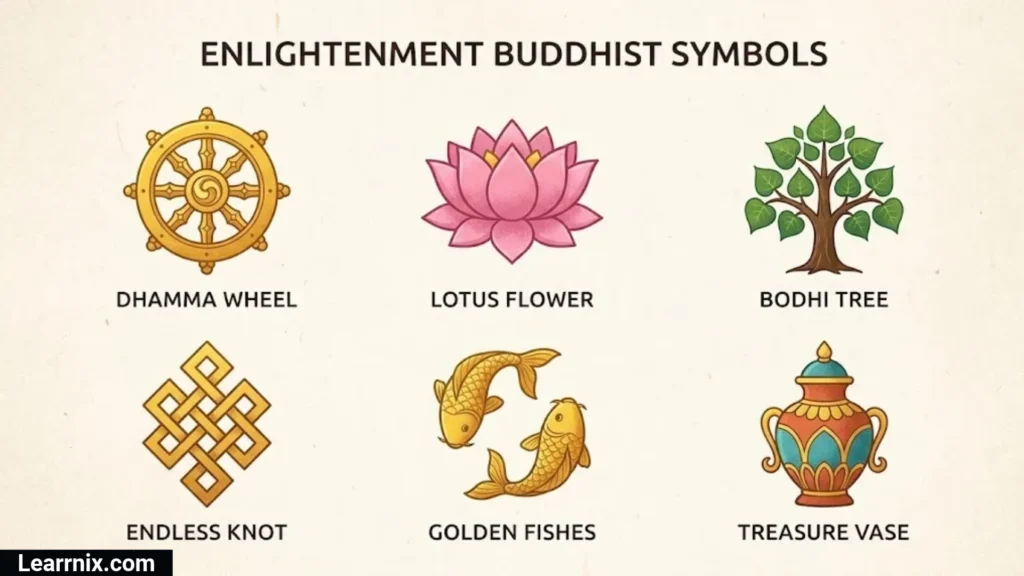
Enlightenment is one of the central goals of Buddhist practice. It refers to awakening from ignorance and understanding the nature of existence, suffering, and liberation.
Several symbols are closely connected with this spiritual idea.
🪷 Lotus Flower: Represents the journey from ignorance toward wisdom. Its growth from muddy water is a powerful image of spiritual development.
☸ Dharma Wheel: Represents the teachings that guide practitioners toward awakening.
Bodhi Tree: Represents the enlightenment of Siddhartha Gautama.
◯ Enso Circle: Represents awakening, emptiness, and the experience of completeness in Zen traditions.
Buddha’s Footprints: Symbolize the Buddha’s journey and the path he taught.
Mandala: Represents a sacred arrangement used in meditation and visualization practices.
These symbols are often displayed together in Buddhist temples and religious artwork. Each offers a different way of understanding spiritual awakening.
Buddhist Symbols Tattoos
Buddhist symbols tattoos are popular among people who appreciate mindfulness, peace, wisdom, spiritual growth, and traditional Asian artwork.
A tattoo can represent a personal belief or serve as a reminder of an important life lesson. However, Buddhist symbols have religious and cultural significance, so it is worth understanding their meanings before choosing a design.
Here are some popular options:
- Lotus Flower Tattoo: Represents purity, transformation, and spiritual growth.
- Dharma Wheel Tattoo: Represents Buddhist teachings and the Eightfold Path.
- Enso Tattoo: Represents mindfulness, completeness, and the present moment.
- Endless Knot Tattoo: Represents interconnectedness and the relationship between actions and consequences.
- Bodhi Tree Tattoo: Represents wisdom and enlightenment.
- Vajra Tattoo: Represents indestructible wisdom and spiritual strength.
- Buddha Tattoo: Represents devotion, wisdom, and spiritual inspiration.
Choosing the Right Buddhist Tattoo
Consider the meaning behind the design rather than selecting a symbol simply because it looks attractive.
For example, a lotus is a suitable choice for someone who wants to represent personal growth. The Enso may appeal to someone interested in Zen philosophy, while the Dharma wheel represents commitment to Buddhist teachings.
Placement also deserves consideration. Buddha images and sacred symbols are treated with respect in many Buddhist cultures. Avoid placing religious imagery where it may be considered disrespectful, and research the traditions associated with the design before getting it permanently tattooed.
Buddhist Symbols Crossword Clue
People searching for a Buddhist symbols crossword clue are usually looking for a short answer that fits a particular number of letters.
The correct answer depends on the puzzle’s wording and available spaces. Common possibilities include:
| Crossword Clue | Possible Answer | Letters |
| Buddhist symbol | Lotus | 5 |
| Buddhist teaching symbol | Wheel | 5 |
| Buddhist sacred diagram | Mandala | 7 |
| Buddhist religious structure | Stupa | 5 |
| Buddhist symbol of eternity | Knot | 4 |
| Buddhist place of enlightenment | Bodhi | 5 |
| Buddhist religious community | Sangha | 6 |
If the clue specifically asks for a Buddhist symbol representing the Buddha’s teachings, wheel is a strong possibility.
Always check the crossing letters before choosing an answer because crossword clues can have multiple correct solutions.
Buddhist Symbols Endless Knot
The endless knot is one of the Eight Auspicious Symbols in Tibetan Buddhism. It is also known as the eternal knot or mystical knot.
Its interwoven design has no obvious beginning or ending. This structure represents the interconnected nature of existence and the relationship between cause and effect.
The symbol carries several important meanings:
- Interdependence: Everything is connected through relationships and conditions.
- Karma: Actions have consequences that influence future experiences.
- Wisdom and Compassion: These qualities are closely connected in Buddhist teachings.
- Eternity: The continuous pattern represents an unending relationship.
- Unity: Different parts of existence are connected rather than completely separate.
The endless knot is commonly found in Tibetan Buddhist paintings, jewelry, decorative objects, and temple artwork.
It is also a popular choice for tattoos because its continuous design can represent lasting connections and personal growth.
Buddhist Symbols Swastika
The swastika is an ancient symbol with an important place in several Asian religious traditions, including Buddhism, Hinduism, and Jainism.
In Buddhist contexts, it generally represents auspiciousness, good fortune, eternity, and the Buddha’s spiritual qualities.
Two commonly encountered text characters are:
- 卍 — A traditional left-facing form.
- 卐 — A traditional right-facing form.
In East Asian Buddhist art, the manji (卍) is particularly familiar. It appears on Buddhist statues, religious objects, temple decorations, and historical artwork.
Buddhist Swastika vs Nazi Swastika
Although the shapes are related, their historical and cultural contexts are different.
The swastika existed for thousands of years before the Nazi Party adopted a modified version as its political emblem in the twentieth century. In Buddhist and other Asian traditions, it continues to have sacred and auspicious meanings.
The Nazi version is associated with racism, antisemitism, persecution, and genocide. It should not be confused with the traditional religious use of the symbol.
Context, orientation, surrounding imagery, and cultural history are important when interpreting this design.
Buddhist Symbols of Peace
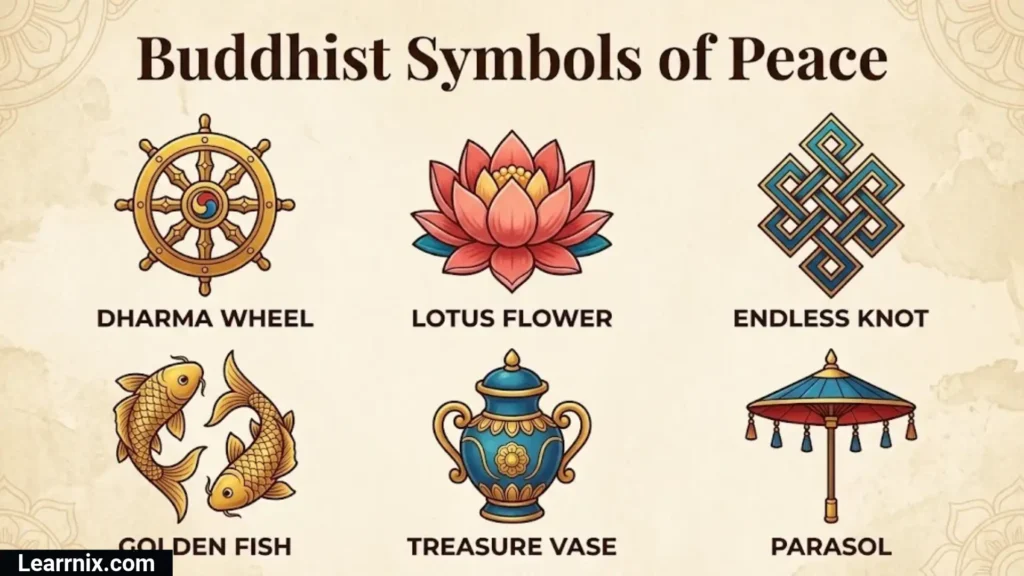
Peace is an important theme in Buddhist philosophy. It is associated with compassion, non-harming, mindfulness, and freedom from destructive mental states.
Several Buddhist symbols communicate these ideas.
- 🪷 Lotus Flower: Represents inner purity and spiritual calm.
- ☸ Dharma Wheel: Represents the teachings that guide people toward liberation.
- ◯ Enso Circle: Represents stillness, awareness, and completeness.
- 🐚 Conch Shell: Represents the spreading of Buddhist teachings.
- ☂ Parasol: Represents protection from suffering and harmful influences.
- 🙏 Folded Hands: Commonly express respect, gratitude, and devotion.
The lotus is especially popular as a symbol of peace because it represents the ability to remain spiritually grounded despite difficult surroundings.
The Dharma wheel represents a deeper kind of peace achieved through understanding, ethical conduct, and mental discipline.
Buddhist peace symbols are frequently used in meditation rooms, spiritual artwork, greeting cards, and personal decorations.
Hindu and Buddhist Symbols
Hinduism and Buddhism developed in the Indian subcontinent and share several historical and cultural connections. As a result, some symbols appear in both traditions, although their meanings and religious roles may differ.
Understanding these similarities helps prevent confusion between the two religions.
| Symbol | Hindu Meaning | Buddhist Meaning |
| ॐ | Sacred syllable associated with ultimate reality and spiritual practice | Used in certain Buddhist mantras and devotional traditions |
| 卍 | Auspiciousness, prosperity, and good fortune | Auspiciousness and the Buddha’s spiritual qualities |
| 🪷 Lotus | Associated with deities, purity, and divine beauty | Represents purity and enlightenment |
| 🔱 Trishula | Associated with Shiva and divine power | Appears in some Buddhist cultural and artistic contexts |
| 🐚 Conch Shell | Associated with deities and sacred rituals | Represents the spreading sound of Dharma |
| ☸ Dharma Wheel | Not a central traditional Hindu emblem | Represents the Buddha’s teachings |
Important Differences Between the Traditions
The Om symbol (ॐ) is particularly important in Hindu religious practice. It also appears in some Buddhist mantras, including the well-known Tibetan mantra associated with Avalokiteshvara.
The lotus is another shared symbol, but its interpretation depends on the religious context.
Similarly, the swastika has a long history in both Hinduism and Buddhism. It represents auspiciousness in traditional religious settings, although its appearance and usage can vary.
The Dharma wheel, however, is much more directly associated with Buddhist teachings and the Buddha’s Eightfold Path.
Buddhist Symbols Crossword Clue
If you are solving another crossword puzzle and encounter a clue about Buddhist symbols, the exact wording and letter count can help narrow down the answer.
Here are additional possible answers that may fit related clues:
| Crossword Clue | Answer | Letters |
| Buddhist temple monument | Stupa | 5 |
| Buddhist spiritual awakening | Nirvana | 7 |
| Buddhist community | Sangha | 6 |
| Buddhist meditation diagram | Mandala | 7 |
| Buddhist sacred tree | Bodhi | 5 |
| Buddhist spiritual teacher | Lama | 4 |
| Buddhist teachings | Dharma | 6 |
| Buddhist religious figure | Monk | 4 |
| Buddhist flower symbol | Lotus | 5 |
Quick Crossword Tips
- Look at the total number of empty spaces.
- Check letters provided by intersecting answers.
- Consider whether the clue refers to a symbol, object, teaching, or religious concept.
- Remember that crossword answers may use simplified English spellings.
For example, a five-letter clue about a Buddhist flower is likely to be LOTUS, while a seven-letter clue about a sacred meditation diagram may be MANDALA.
Frequently Asked Questions
What is the most important symbol in Buddhism?
The Dharma wheel is one of the most important Buddhist symbols. It represents the Buddha’s teachings and the Eightfold Path, which guides followers toward spiritual liberation.
What does the lotus flower mean in Buddhism?
The lotus flower represents purity, spiritual growth, and enlightenment. It grows in muddy water but produces a beautiful flower, symbolizing the possibility of developing wisdom despite life’s difficulties.
What are the eight main Buddhist symbols?
The Eight Auspicious Symbols are the lotus flower, Dharma wheel, conch shell, parasol, golden fish, endless knot, treasure vase, and victory banner. They represent blessings and important Buddhist teachings.
Is the Buddhist swastika different from the Nazi symbol?
Yes. The swastika is an ancient religious symbol used in Buddhism, Hinduism, and Jainism long before the Nazi Party adopted its version. In traditional Buddhist settings, it represents auspiciousness and spiritual significance.
Which Buddhist symbol represents inner peace?
The lotus flower and Enso circle are commonly associated with inner peace. The lotus represents purity and spiritual development, while the Enso represents awareness, stillness, and completeness in Zen traditions.
Conclusion
Buddhist symbols communicate some of the most important ideas in Buddhist philosophy, including wisdom, compassion, mindfulness, peace, and enlightenment. From the Dharma wheel and lotus flower to the endless knot and vajra, each design carries a meaningful connection to spiritual teachings and personal development.
Different Buddhist traditions have developed their own artistic styles and symbolic practices. Tibetan, Chinese, Japanese, and Zen Buddhism all use distinctive symbols that reflect their history, beliefs, and religious experiences. Some designs are shared with Hinduism and other Asian traditions, making their cultural backgrounds especially interesting.
Understanding these symbols helps you appreciate their meanings before using them in tattoos, artwork, meditation spaces, messages, or decorative designs. Rather than choosing a symbol only for its appearance, learn the story behind it and use it with respect for the tradition it represents.

I am Michael Carter, an educational content creator who believes that knowledge has the power to transform lives.
I create resources focused on modern education, digital learning, and building essential skills for the future.
I love helping readers discover simple and effective ways to improve their learning journey.
Books by Michael Carter:
- Modern Education for Tomorrow’s World
- Learning Skills for Future Success
 Charlotte Anderson
 Daniel Harper