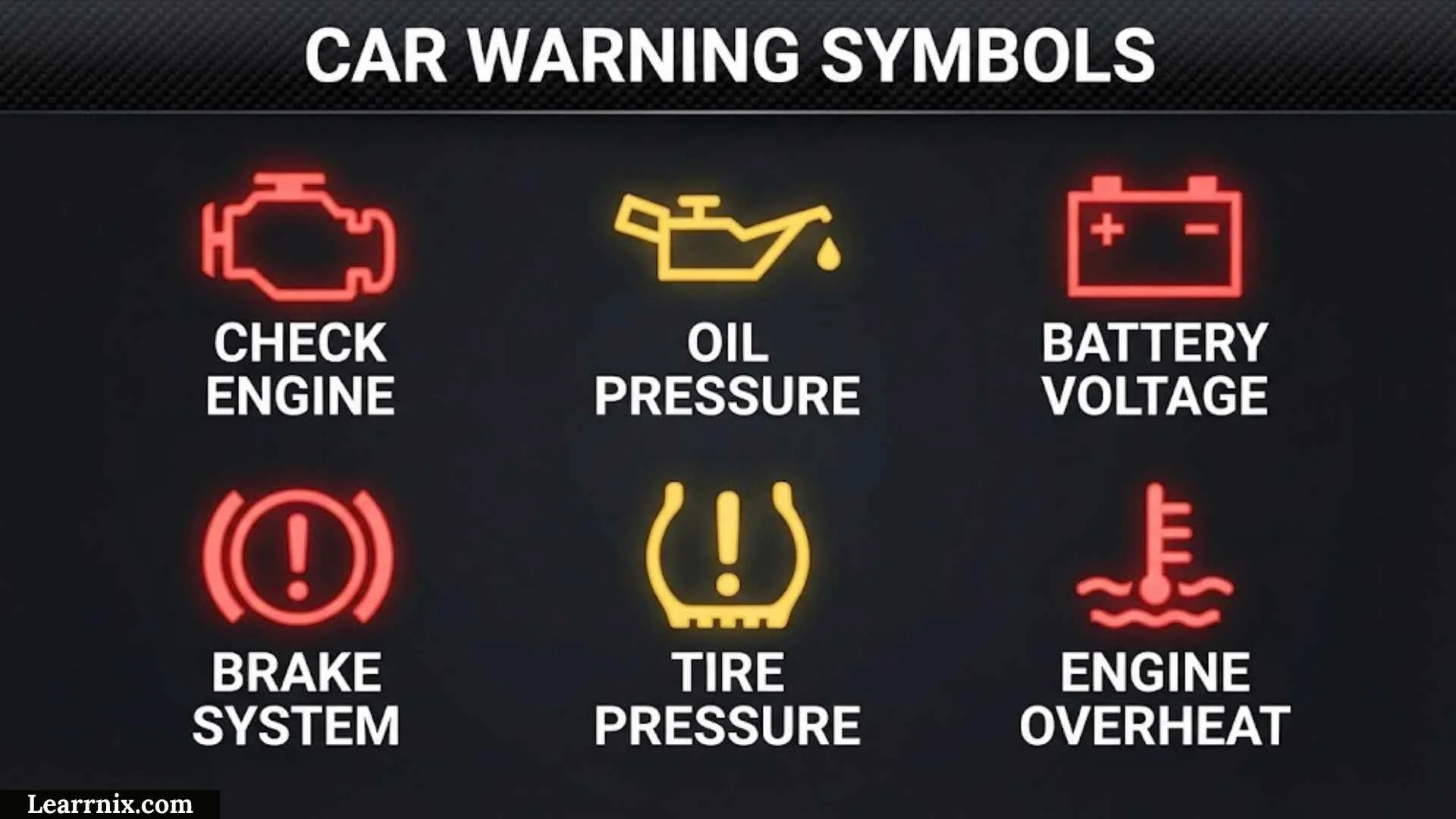
Car warning symbols can tell you a surprising amount about what is happening inside your vehicle. A small red oil-can icon may mean you should stop driving, while a yellow tire-pressure symbol may simply mean that one or more tires need air. A green or blue symbol may not indicate a fault at all; it may only show that a vehicle function is active.
The challenge is knowing which car warning symbols require immediate action, which ones can wait for service, and which ones are simply status indicators.
This guide explains the most common car warning symbols and dashboard lights, what their colors and flashing patterns generally mean, how to decide whether you can keep driving, and what to do when an unfamiliar symbol appears. It also covers ABS, TPMS, engine, brake, airbag, traction control, steering, EV and hybrid warnings, common mistakes, and practical troubleshooting steps.
Because dashboard symbols vary between manufacturers and models, use this guide as a general reference and confirm the exact meaning in your vehicle’s owner’s manual. ISO 2575:2021 establishes conventional symbols for controls, indicators, and tell-tales used on road vehicles and also addresses possible tell-tale colors. SAE J2402 is another industry standard covering road-vehicle symbols and tell-tales.
Quick Answer: What Do Car Warning Symbols Mean?
Car warning symbols are dashboard icons that communicate information about a vehicle’s systems. Some indicate normal operation, while others alert the driver to a fault, unsafe condition, or required maintenance.
As a general guide:
- Red: Usually indicates a serious condition requiring immediate attention.
- Yellow or amber: Usually indicates a fault or condition that needs attention soon.
- Green: Usually indicates that a feature or system is operating.
- Blue: Often indicates an active lighting or system function, such as high beams.
- Flashing: May indicate a more urgent or active condition than a steady light, depending on the symbol.
These color conventions are general rather than universal instructions. AAA’s current guidance similarly describes red alerts as requiring immediate action, amber warnings as requiring attention, and blue or green indicators as commonly showing system status.
The Most Important Rule
Do not decide whether a warning is safe to ignore based only on its color.
The symbol, accompanying message, flashing pattern, vehicle behavior, and owner’s manual all matter.
For example, a tire-pressure warning and an oil-pressure warning are both dashboard alerts, but their appropriate responses can be very different.
Car Warning Symbols vs. Indicator Lights
Not every dashboard symbol is technically a warning.
Modern vehicles use several types of dashboard tell-tales and indicators.
Warning Lights
Warning lights tell you that the vehicle has detected a condition that may require attention.
Examples include:
- Oil pressure
- Engine temperature
- Brake system
- ABS
- Airbag
- Check engine
- Tire pressure
The appropriate response depends on the particular system.
Indicator Lights
Indicator lights often tell you that a feature is active.
Examples include:
- Turn signals
- High beams
- Cruise control
- Fog lights
- Headlights
A green or blue indicator may therefore be completely normal.
Status and Information Messages
Modern vehicles increasingly use digital instrument displays instead of relying exclusively on fixed dashboard icons.
A vehicle might display:
“Low Tire Pressure”
or
“Service Electronic Stability Control”
alongside a symbol.
These messages can provide more useful information than the symbol alone.
Why This Difference Matters
Calling every dashboard icon a “warning light” can make the situation seem more serious than it is.
A high-beam indicator, for example, normally does not mean the car has a mechanical fault. It tells you that the high beams are active.
Dashboard Warning Light Colors Explained
Color is one of the quickest ways to understand the general urgency of a dashboard alert.
Red Car Warning Symbols
Red commonly indicates a serious warning.
Depending on the vehicle, red may be used for:
- Low engine oil pressure
- High engine temperature
- Brake-system warnings
- Airbag or restraint-system warnings
- Certain charging or electrical warnings
- Other critical conditions
A red warning that appears while driving should not automatically be treated as something you can continue driving with.
AAA’s current guidance states that red warnings generally require immediate action and gives low oil pressure, engine temperature, and brake-system warnings as examples.
Yellow or Amber Car Warning Symbols
Yellow or amber generally indicates that a problem or condition has been detected and requires attention.
Common examples include:
- Check engine
- Low tire pressure
- ABS
- Stability control
- Traction control
- Some driver-assistance faults
An amber light does not necessarily mean “stop immediately,” but it also should not be ignored.
Green Car Symbols
Green usually communicates that a feature is active or operating.
Examples include:
- Turn signals
- Parking lights
- Cruise control
- Some exterior-light indicators
- Certain driver-assistance functions
Green normally does not mean that something is broken.
Blue Car Symbols
Blue is commonly used for certain active functions.
The most familiar example is the high-beam indicator.
Some vehicles may use blue for additional system-status information.
Why Colors Are Not Enough
Different manufacturers can use dashboard displays differently. ISO 2575 specifies possible tell-tale colors, but the actual application and vehicle-specific meaning still need to be confirmed using the vehicle documentation.
Think of color as a first clue, not a complete diagnosis.
Common Car Warning Symbols and Their Meanings
The following table provides a quick reference to common dashboard symbols.
| Symbol or Indicator | Common Meaning | Typical Response |
| Oil Can | Low engine oil pressure | Stop safely and follow manual instructions |
| Thermometer | Engine temperature problem | Stop safely if overheating is indicated |
| Battery | Charging-system problem | Arrange inspection promptly |
| BRAKE / ! | Brake or parking-brake warning | Check immediately |
| ABS | Anti-lock brake system fault | Have system inspected |
| Engine Icon | Engine/emissions fault | Diagnose the vehicle |
| Tire With ! | Low tire pressure or TPMS issue | Check tire pressures promptly |
| Airbag | SRS/airbag fault | Arrange inspection |
| Seat Belt | Seat belt not fastened | Fasten seat belt |
| Steering Wheel | Steering-system warning | Follow vehicle instructions |
| Skidding Car | Traction/stability activity or fault | Check whether system is active or faulty |
| Fuel Pump | Low fuel | Refuel |
| Door/Ajar Symbol | Door or hatch open | Close securely |
| Windshield Symbol | Washer fluid or wiper-related information | Check fluid/system |
| High-Beam Symbol | High beams active | Normal indicator |
| Turn Arrow | Turn signal active | Normal indicator |
These meanings are intentionally described as general meanings because the same symbol can behave differently across vehicle models.
Oil Pressure Warning Symbol
The oil pressure symbol usually looks like an oil can.
It is one of the dashboard warnings that should be taken seriously because engine lubrication depends on adequate oil pressure.
What It Can Mean
An illuminated oil-pressure warning can be associated with:
- Low engine oil pressure
- Low oil level
- An oil pump problem
- An oil-system fault
- A sensor or electrical problem
The dashboard symbol alone cannot tell you which of these has occurred.
What Should You Do?
If the oil-pressure warning appears while driving:
- Reduce risk and safely pull over.
- Turn off the engine when appropriate.
- Consult the owner’s manual.
- Check the oil level if the vehicle’s instructions allow it.
- Do not continue driving simply because the engine still sounds normal.
AAA specifically warns that driving with low oil pressure can cause severe engine damage.
Oil Pressure vs. Oil Level
These terms are not interchangeable.
An oil-level warning concerns the amount of oil in the engine.
An oil-pressure warning concerns whether the lubrication system is maintaining adequate pressure.
A normal oil level does not automatically prove that oil pressure is normal.
Engine Temperature Warning Symbol
The engine-temperature symbol often resembles a thermometer over waves.
It indicates that the vehicle has detected a temperature-related condition.
What Causes An Overheating Warning?
Possible causes include:
- Low coolant
- Cooling-system leaks
- Radiator problems
- Cooling-fan failure
- Thermostat problems
- Water-pump problems
- Heavy operating conditions
The exact cause requires diagnosis.
What Should You Do?
If the temperature warning indicates overheating:
- Reduce driving as safely as possible.
- Stop in a safe location.
- Follow the owner’s manual.
- Allow the vehicle to cool as instructed.
- Do not open a hot pressurized cooling system unless the manufacturer’s procedure specifically says it is safe.
Continuing to operate an overheating engine can cause serious damage.
Battery Warning Symbol
The battery-shaped dashboard symbol often indicates a problem with the vehicle’s charging system.
What Does the Battery Light Actually Mean?
It does not necessarily mean that the battery itself is simply “dead.”
Possible causes include:
- Alternator problems
- Battery problems
- Charging-system wiring issues
- Drive-belt problems on vehicles that use a belt-driven alternator
- Electrical-system faults
A charging-system failure can eventually leave the vehicle unable to continue operating.
AAA notes that a battery warning can indicate an electrical problem and that the vehicle may eventually stop once available battery power is depleted.
Brake Warning Symbol
The brake warning symbol may appear as an exclamation mark inside a circle or with the word BRAKE.
What Can It Mean?
Depending on the vehicle, it can indicate:
- Parking brake engaged
- Low brake fluid
- Brake-system malfunction
- Hydraulic brake-system problem
- Another brake-related condition
NHTSA materials also document federal requirements relating to brake-system tell-tales for certain conditions.
Why Brake Warnings Matter
Brakes are a primary safety system.
If a brake warning remains illuminated after releasing the parking brake, do not simply assume the light is defective.
Check the owner’s manual and have the vehicle inspected as appropriate.
ABS Warning Symbol
The ABS symbol usually displays the letters ABS.
ABS stands for Anti-lock Braking System.
What Does an ABS Light Mean?
A persistent ABS warning generally means that the vehicle has detected a problem with its anti-lock braking system.
Some vehicles may continue to have conventional braking while the ABS function is unavailable.
For example, a Dodge owner manual available through NHTSA states that a persistent ABS light indicates the anti-lock portion is not functioning, while conventional braking may continue if the separate brake warning is not also illuminated.
ABS Light vs. Brake Warning Light
These are not necessarily the same problem.
| Light | General Concern |
| ABS | Anti-lock braking function |
| Brake | Brake system, parking brake, or related condition |
| ABS + Brake | Potentially more serious combined braking-system concern |
If both appear together, follow the vehicle’s instructions and treat the situation with increased caution.
Check Engine Warning Symbol
The check engine symbol is usually shaped like an engine.
It is also called the malfunction indicator lamp, or MIL, in automotive terminology.
Why Does the Check Engine Light Come On?
Possible causes include problems involving:
- Engine management
- Emissions-control systems
- Sensors
- Fuel or air systems
- Ignition
- Catalytic-converter-related systems
- Other electronically monitored components
The light does not identify the failed component by itself.
Solid vs. Flashing Check Engine Light
A steady check engine light generally means a fault has been detected and should be diagnosed.
A flashing check engine light can indicate a more urgent condition on many vehicles.
AAA also notes that a flashing check engine light deserves particular caution.
If the vehicle is running roughly, losing power, producing unusual smells, or showing other serious symptoms, do not assume the light can safely be ignored.
Tire Pressure Warning Symbol
The TPMS symbol usually resembles a tire cross-section with an exclamation mark.
TPMS means Tire Pressure Monitoring System.
What Does the TPMS Light Mean?
A TPMS warning generally indicates that one or more tires are significantly underinflated.
NHTSA explains that TPMS monitors tire pressure and warns the driver when pressure is significantly below the acceptable level.
What Pressure Should You Use?
Use the vehicle manufacturer’s recommended pressure rather than the maximum pressure printed on the tire sidewall.
The recommended pressure can usually be found on the driver’s door or doorjamb label or in the owner’s manual.
What If the TPMS Light Flashes?
A flashing TPMS warning followed by continued illumination can indicate a TPMS malfunction rather than simply low tire pressure.
NHTSA explains that many TPMS systems use a flashing sequence followed by continuous illumination to indicate a system malfunction.
Why Can the Light Appear on a Cold Morning?
Temperature changes can affect tire pressure.
NHTSA notes that a TPMS warning may temporarily appear during colder conditions when pressure falls below the warning threshold and then disappear after the tires warm up. The tires should still be checked with a gauge.
Airbag or SRS Warning Symbol
The airbag symbol normally shows a seated person with an airbag in front.
SRS commonly refers to the Supplemental Restraint System.
What Does the Airbag Light Mean?
A persistent airbag warning can indicate that the vehicle has detected a problem in the restraint system.
Potentially affected components can include:
- Airbags
- Seat-belt pretensioners
- Sensors
- Wiring
- Restraint-system control modules
Because the system is designed to protect occupants during a crash, a persistent warning should not be treated as an ordinary maintenance reminder.
NHTSA has distinguished safety-related airbag readiness indicators from ordinary maintenance reminder displays in its regulatory interpretations.
Seat Belt Warning Symbol
The seat-belt symbol usually depicts a person wearing a seat belt.
It generally indicates that a seat belt has not been fastened.
Why Can It Stay On?
Depending on the vehicle, the warning may respond to:
- Driver seat-belt status
- Passenger seat-belt status
- Rear passenger seat status
- Weight detected on a seat
Some vehicles can activate the passenger-seat reminder when a heavy object is placed on the seat.
The simplest solution is to check that all occupants are properly restrained and that no object is triggering the passenger-seat sensor.
Steering Wheel Warning Symbol
The steering warning symbol generally looks like a steering wheel.
It can indicate a problem with the power-steering or electronic steering system.
What Should You Watch For?
Pay attention to changes such as:
- Steering becoming unusually heavy
- Increased steering effort
- Steering-system messages
- Warning appearing together with other electrical faults
If steering becomes difficult or unpredictable, safely stop and follow the manufacturer’s instructions rather than continuing normally.
Traction Control Warning Symbol
The traction-control symbol often looks like a car with curved or wavy marks underneath.
What Does It Mean?
It can mean several different things:
- Traction control is actively intervening.
- Traction control has been switched off.
- A fault has been detected.
A brief illumination during acceleration on a slippery surface may simply indicate that the system is working.
A continuously illuminated fault indicator may require diagnosis.
AAA similarly distinguishes temporary traction/stability-system activation from a persistent warning that can indicate the system has been switched off or has a malfunction.
Electronic Stability Control Symbol
The ESC symbol commonly shows a vehicle with skid marks.
ESC helps the vehicle manage certain loss-of-control situations by selectively applying braking and/or adjusting engine torque according to the system design.
When the Symbol Flashes
A flashing symbol can indicate that the system is actively intervening.
This may occur during:
- Hard acceleration on a slippery road
- Sudden cornering
- Loss of traction
- Certain emergency maneuvers
When the Symbol Stays On
A continuously illuminated symbol can indicate:
- System switched off
- System fault
- Another related vehicle-system issue
The exact interpretation varies by manufacturer.
Fuel Warning Symbol
The fuel-pump icon generally means that the fuel level is low.
Is It Safe to Keep Driving?
A low-fuel warning does not provide a guaranteed remaining distance.
Driving range depends on:
- Vehicle
- Fuel capacity
- Driving style
- Traffic
- Speed
- Road conditions
- Weather
- Terrain
Treat the warning as a prompt to refuel rather than as a precise mileage calculator.
Door Open Warning Symbol
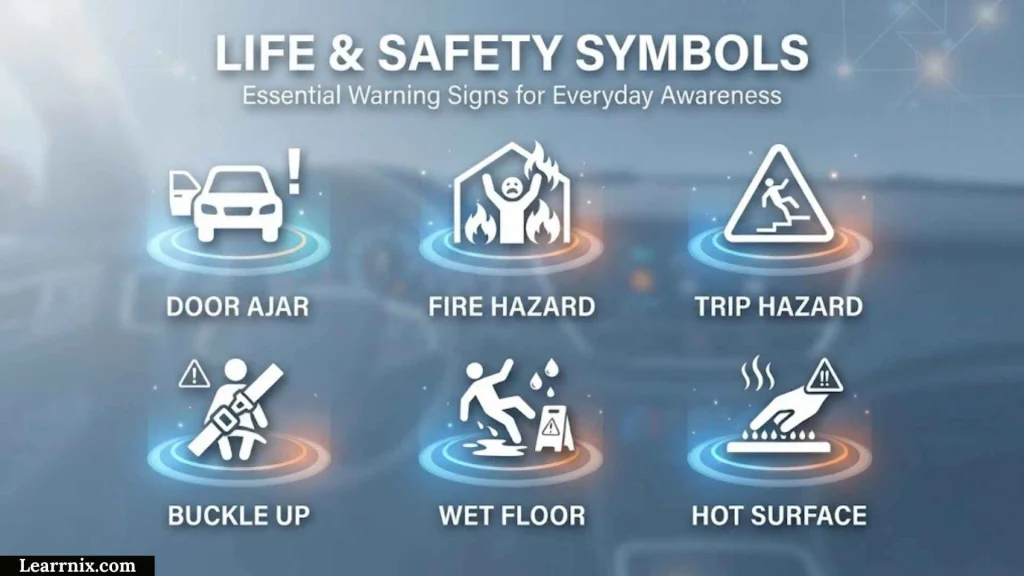
A door-open symbol can indicate that:
- A side door is open
- The trunk is open
- The liftgate is open
- The hood is not properly closed
The exact display depends on the vehicle.
Before driving, verify that all doors and access panels are properly secured.
Windshield Washer Fluid Warning
Some vehicles display a windshield-shaped symbol or washer-fluid message when the reservoir is low.
This is generally not an emergency warning, but low washer fluid can reduce visibility during dirty or wet driving conditions.
Keep the appropriate washer fluid available, particularly before long trips.
High-Beam Indicator
The blue high-beam symbol is generally an indicator rather than a warning.
It tells the driver that the high beams are active.
If the blue light appears unexpectedly, check the lighting controls rather than assuming the vehicle has a mechanical fault.
What Does It Mean When Several Warning Lights Appear Together?
Multiple dashboard warnings can be confusing.
They do not necessarily represent several unrelated failures.
A Single Electrical Problem Can Trigger Multiple Warnings
Modern vehicles have interconnected electronic systems.
A problem with:
- Battery voltage
- Charging
- Communication between control modules
- Sensors
can sometimes cause multiple warning lights to appear.
Startup Can Also Illuminate Several Symbols
Many dashboard indicators illuminate briefly during startup as part of a system check.
The important distinction is whether they disappear after the vehicle starts or remain illuminated.
What Should You Do?
If several serious warnings appear simultaneously:
- Read the dashboard message.
- Observe how the vehicle is behaving.
- Check the owner’s manual.
- If braking, steering, temperature, or engine operation is affected, prioritize getting to a safe location.
- Seek professional diagnosis when necessary.
Can You Drive With a Car Warning Symbol On?
There is no universal answer.
The safest approach is to classify the warning based on the symbol, color, behavior, and vehicle response.
Usually Status-Related
Examples can include:
- Turn signal
- High beam
- Cruise control
- Exterior-light indicators
These generally indicate that a feature is active.
Usually Requires Prompt Attention
Examples can include:
- Check engine
- TPMS
- ABS
- Stability-control faults
- Certain charging-system warnings
The exact urgency varies by vehicle and symptoms.
Potentially Requires Immediate Action
Examples can include:
- Low oil pressure
- Engine overheating
- Serious brake warning
- Severe steering warning
- Other red warnings identified by the owner’s manual as requiring immediate stopping
AAA’s current guidance identifies red warnings as requiring immediate action and specifically warns against driving with certain oil-pressure and overheating alerts.
A Simple Decision Tree for Dashboard Warning Lights
Use this quick decision guide when a new symbol appears.
Warning appears
↓
Is it only a normal green or blue status indicator?
→ Yes: Identify the active feature and continue normally if appropriate.
→ No: Continue checking.
↓
Is the warning red or accompanied by a serious vehicle symptom?
→ Yes: Safely stop and follow the owner’s manual.
→ No: Continue checking.
↓
Is the warning yellow or amber?
→ Yes: Read the message, check the manual, and arrange diagnosis or maintenance as required.
↓
Is the warning flashing?
→ Yes: Treat it as potentially more urgent and check the vehicle-specific instructions immediately.
↓
Is the meaning still unclear?
→ Use the owner’s manual or contact a qualified automotive professional.
This decision tree is deliberately conservative because the same-looking symbol can have different meanings across vehicles.
What To Do When a Warning Light Appears While Driving
A warning appearing while you are moving creates a different situation from one appearing while the vehicle is parked.
Step 1: Stay Calm
Avoid sudden braking or steering simply because a light appeared.
Maintain control of the vehicle.
Step 2: Look for a Message
Check whether the instrument display provides additional information.
Step 3: Assess Vehicle Behavior
Ask yourself:
- Is steering normal?
- Are the brakes normal?
- Is the engine overheating?
- Is there smoke?
- Is the vehicle losing power?
- Are unusual sounds present?
Step 4: Find a Safe Location
If the warning is serious, move to a safe location when possible.
Step 5: Check the Manual
Use the vehicle-specific instructions before deciding whether to continue.
Step 6: Arrange Assistance if Necessary
If the vehicle should not be driven, contact roadside assistance or an appropriate repair service.
Common Mistakes Drivers Make With Warning Symbols
Ignoring a Light Because the Car Still Drives
A vehicle can remain driveable while a monitored system has a fault.
“Still driving” does not automatically mean “safe to ignore.”
Assuming Red Always Means the Same Thing
Red indicates urgency, but the actual problem still depends on the symbol.
A brake warning and a temperature warning require different diagnostic steps.
Treating the Check Engine Light as a Diagnosis
The check engine light identifies a detected fault condition; it does not tell you which individual part has failed.
A diagnostic scan may be necessary.
Guessing Tire Pressure
Do not use the maximum pressure printed on the tire as the normal inflation target.
NHTSA recommends using the manufacturer’s specified pressure on the vehicle label or in the owner’s manual.
Resetting a Warning Without Fixing the Problem
Clearing a diagnostic code or disconnecting a battery does not necessarily repair the underlying fault.
If the problem remains, the warning may return.
Assuming All Dashboard Symbols Are Standard
Many symbols follow established conventions, but manufacturers can add model-specific icons, messages, and functions.
Industry standards such as ISO 2575 and SAE J2402 help establish recognizable vehicle symbols, but they do not eliminate model-specific differences.
How to Identify an Unknown Car Warning Symbol
If you do not recognize a dashboard icon, use this method.
Record the Symbol
Note:
- Shape
- Color
- Whether it is solid or flashing
- When it appeared
- Any text displayed beside it
Identify Your Vehicle
Write down:
- Make
- Model
- Model year
- Powertrain type
- Trim or equipment package when relevant
Check the Owner’s Manual
The owner’s manual should be the first source for the exact meaning.
Many manuals contain a complete dashboard-symbol reference.
Check for Changes in Vehicle Behavior
A warning accompanied by a new mechanical symptom deserves more attention than a symbol appearing without any noticeable change.
Avoid Guessing From a Similar Icon
Two symbols may look nearly identical while representing different systems.
Car Warning Symbols in Electric and Hybrid Vehicles
Electric and hybrid vehicles can have many of the familiar warning symbols found in gasoline-powered cars, but they can also display powertrain-specific warnings.
High-Voltage System Warnings
Some EVs and hybrids use warnings related to the high-voltage battery and electrical system.
These systems can operate at voltages that are hazardous to handle without proper training.
If a high-voltage warning appears, follow the manufacturer’s instructions rather than attempting DIY electrical repairs.
Regenerative Braking Messages
Hybrid and electric vehicles may display information about regenerative braking or changes in braking operation.
A warning involving the braking system should not be confused with a normal regenerative-braking status message.
EV Charging Warnings
Electric vehicles can display messages concerning:
- Charging faults
- Charging cable connections
- Battery temperature
- Charging-system status
- Reduced charging power
The exact symbol depends heavily on the manufacturer.
How Car Warning Symbols Have Changed Over Time
Dashboard warning systems have evolved with vehicle technology.
Early dashboards provided relatively limited information through gauges and simple indicator lights. AAA describes historical dashboards as having basic information such as fuel and coolant temperature, with simple warning “idiot lights” used for conditions such as oil pressure and charging.
Modern vehicles now monitor far more systems, including:
- Engine control
- Tire pressure
- ABS
- Stability control
- Airbags
- Driver assistance
- Battery management
- Hybrid systems
- EV power electronics
- Emissions systems
This development explains why modern dashboards can contain dozens of symbols and messages.
Why Standardized Car Symbols Matter
Drivers may operate vehicles manufactured in different countries and encounter unfamiliar dashboard designs.
Standardized symbols help make important functions more recognizable.
ISO 2575
ISO 2575:2021 specifies conventional symbols used for controls, indicators, and tell-tales on passenger cars, commercial vehicles, and buses. It also addresses possible colors for optical tell-tales.
The standard was published in 2021 and has a 2024 amendment.
SAE J2402
SAE J2402 is a related technical standard covering road-vehicle symbols for controls, indicators, and tell-tales. The current listed edition is J2402_202311, stabilized in November 2023.
These standards provide useful context for why many dashboard symbols look familiar across different vehicles.
Real-World Dashboard Warning Scenarios
Understanding symbols becomes easier when you see how they work in everyday situations.
Scenario 1: TPMS Appears on a Cold Morning
You start the car on a cold morning and notice the tire-pressure warning.
The correct response is not to assume the sensor is broken.
Check all tire pressures with a reliable gauge and compare them with the vehicle manufacturer’s recommended values. NHTSA specifically notes that cold temperatures can cause marginally low pressure to trigger the warning.
Scenario 2: Check Engine Light Appears
The car drives normally but the check engine light remains illuminated.
Do not assume that the engine has failed completely.
Instead, arrange a diagnostic check. The light indicates that the vehicle has detected a monitored fault, but further diagnosis is required.
Scenario 3: Red Temperature Warning Appears
You are driving and the engine-temperature warning appears.
This is different from a minor information message.
Safely reduce risk, stop as instructed, and follow the owner’s manual. Continuing to drive an overheating engine can cause serious damage.
Scenario 4: ABS Light Appears
The ABS light stays on after startup.
The vehicle may still have conventional braking, depending on the system, but the anti-lock function may not be available. A vehicle manual available through NHTSA illustrates this distinction.
Arrange inspection and drive only as permitted by the manufacturer’s instructions.
Scenario 5: Skidding-Car Symbol Flashes on a Wet Road
The stability/traction symbol flashes briefly while accelerating on a wet road.
That can indicate active intervention rather than a fault.
If the light remains on continuously afterward, check the owner’s manual because a persistent light may indicate the system has been switched off or has detected a malfunction.
A Practical Car Warning Symbol Checklist
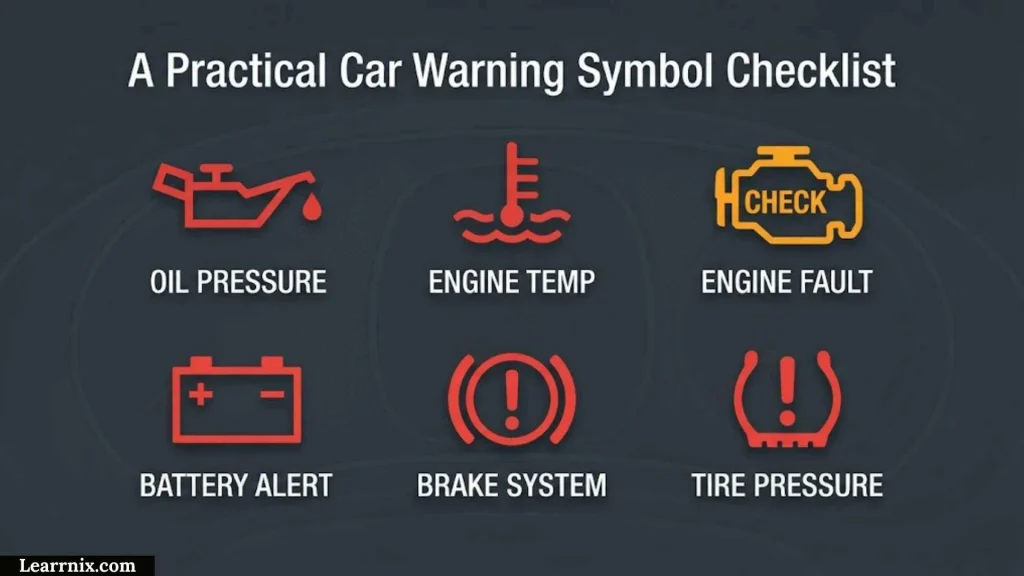
Keep this checklist in mind whenever a new dashboard symbol appears.
- Identify the symbol.
- Check its color.
- Determine whether it is steady or flashing.
- Read any accompanying message.
- Notice whether the vehicle feels different.
- Check the owner’s manual.
- Do not ignore red safety-related warnings.
- Check tire pressure when the TPMS warning appears.
- Do not confuse the check engine light with a specific diagnosis.
- Do not reset a warning without finding the cause.
- Get persistent warnings diagnosed.
- Never perform high-voltage EV or hybrid repairs without appropriate expertise.
When Should You Call a Mechanic?
Professional diagnosis is appropriate when:
- A warning remains illuminated.
- The same warning repeatedly returns.
- Multiple warnings appear.
- The vehicle behaves differently.
- You cannot identify the symbol.
- The warning involves brakes, steering, airbags, oil pressure, or overheating.
- A diagnostic code needs interpretation.
- An EV or hybrid displays a high-voltage system warning.
A qualified technician can use diagnostic equipment and vehicle-specific service information to determine what caused the warning.
Frequently Asked Questions About Car Warning Symbols
What Are the Most Important Car Warning Symbols to Know?
Drivers should be familiar with oil pressure, engine temperature, brake, ABS, check engine, battery/charging, tire pressure, airbag, steering, and stability-control symbols.
These systems can affect vehicle safety or mechanical reliability.
What Does a Red Car Warning Symbol Mean?
A red symbol generally indicates a serious condition requiring prompt or immediate attention. The exact action depends on the symbol and the vehicle.
What Does a Yellow Car Warning Symbol Mean?
Yellow or amber usually indicates that the vehicle has detected a condition or fault requiring attention. It may not require immediate stopping, but it should not be ignored.
Are Green and Blue Dashboard Lights Warning Lights?
Usually, no. Green and blue lights commonly indicate that a vehicle function is active, such as turn signals, cruise control, headlights, or high beams.
Can I Drive With the Check Engine Light On?
It depends on the light and the vehicle’s behavior. A steady light generally requires diagnosis, while a flashing check engine light can indicate a more urgent condition. If the vehicle is running poorly or showing additional serious symptoms, stop safely and follow the manufacturer’s instructions.
Why Is My Tire Pressure Light On?
It generally means that one or more tires are significantly underinflated. Check all tires with a gauge and use the pressure specified by the vehicle manufacturer.
Why Does the TPMS Light Flash?
A flashing TPMS warning followed by continued illumination can indicate a TPMS malfunction rather than simply low tire pressure.
Why Do Warning Lights Turn On When I Start My Car?
Many vehicles illuminate dashboard indicators briefly during startup as part of their system checks. What matters is whether a warning remains illuminated after startup or appears while driving.
What Does the ABS Light Mean?
An ABS light generally indicates that the anti-lock braking system has detected a fault. Some vehicles retain conventional braking even when ABS is unavailable, but the vehicle should be checked according to the manufacturer’s instructions.
What Does the Battery Warning Light Mean?
It commonly indicates a charging-system or electrical problem rather than simply a weak battery. Possible causes include the battery, alternator, wiring, or related components.
What Does the Oil Symbol Mean?
It generally represents an engine oil-pressure warning. If it appears while driving, safely stop and follow the manufacturer’s instructions because continued operation with inadequate oil pressure can damage the engine.
What Does the Skidding Car Symbol Mean?
It commonly relates to traction control or electronic stability control. A flashing symbol can indicate that the system is actively intervening, while a continuously illuminated symbol can indicate that the system is disabled or has detected a fault.
Why Are Several Dashboard Warning Lights On at Once?
Multiple lights can result from several faults, a shared electrical or communication problem, or a system event that affects several vehicle functions. Read the accompanying message and consult the owner’s manual.
Are Car Warning Symbols the Same on Every Vehicle?
No. Many symbols follow standardized conventions, but manufacturers can use different designs, messages, colors, and system-specific indicators. ISO 2575 and SAE J2402 establish standardized vehicle symbols, but the owner’s manual remains the best source for a particular model.
Where Can I Find the Exact Meaning of My Car’s Dashboard Symbol?
Start with the owner’s manual. You can also use the manufacturer’s official documentation or have the vehicle inspected by a qualified technician.
Should I Reset a Warning Light Myself?
Resetting a warning without diagnosing its cause is not a reliable repair. The warning may return if the underlying problem remains.
Do Electric Cars Have Different Warning Symbols?
They can. EVs and hybrids share many conventional vehicle symbols but may also use warnings related to high-voltage batteries, charging, regenerative braking, and electric power systems.
Final Takeaway
Car warning symbols are designed to communicate important information quickly, but the symbol alone does not always provide a complete diagnosis.
The most useful approach is to consider the symbol, color, flashing behavior, accompanying message, and vehicle symptoms together. Red warnings involving oil pressure, overheating, brakes, or other critical systems can require immediate action, while amber warnings commonly indicate problems that need attention. Green and blue indicators often show that a feature is active.
For tire-pressure warnings, use the vehicle manufacturer’s recommended pressure rather than the number printed as the tire’s maximum. NHTSA also emphasizes that TPMS is not a replacement for regular tire inspection and pressure checks.
Most importantly, do not assume that an online chart can replace the owner’s manual. Vehicle manufacturers can use model-specific symbols, messages, and procedures. Standards such as ISO 2575:2021 and SAE J2402 help explain the common language of dashboard symbols, but your vehicle’s documentation provides the final model-specific instructions.
When a warning appears, identify it, assess the urgency, follow the manufacturer’s instructions, and seek professional diagnosis when necessary. Understanding these symbols before an emergency occurs makes it much easier to respond calmly and safely.

I am Charlotte Anderson, an education writer who is passionate about creating meaningful learning resources for students and lifelong learners.
I enjoy researching new educational approaches and sharing ideas that make studying easier and more effective.
Through my work, I aim to inspire curiosity, confidence, and a love for learning.
Books:
- The Complete Guide to Better Learning
- Building Skills for Academic Success
 Michael Carter