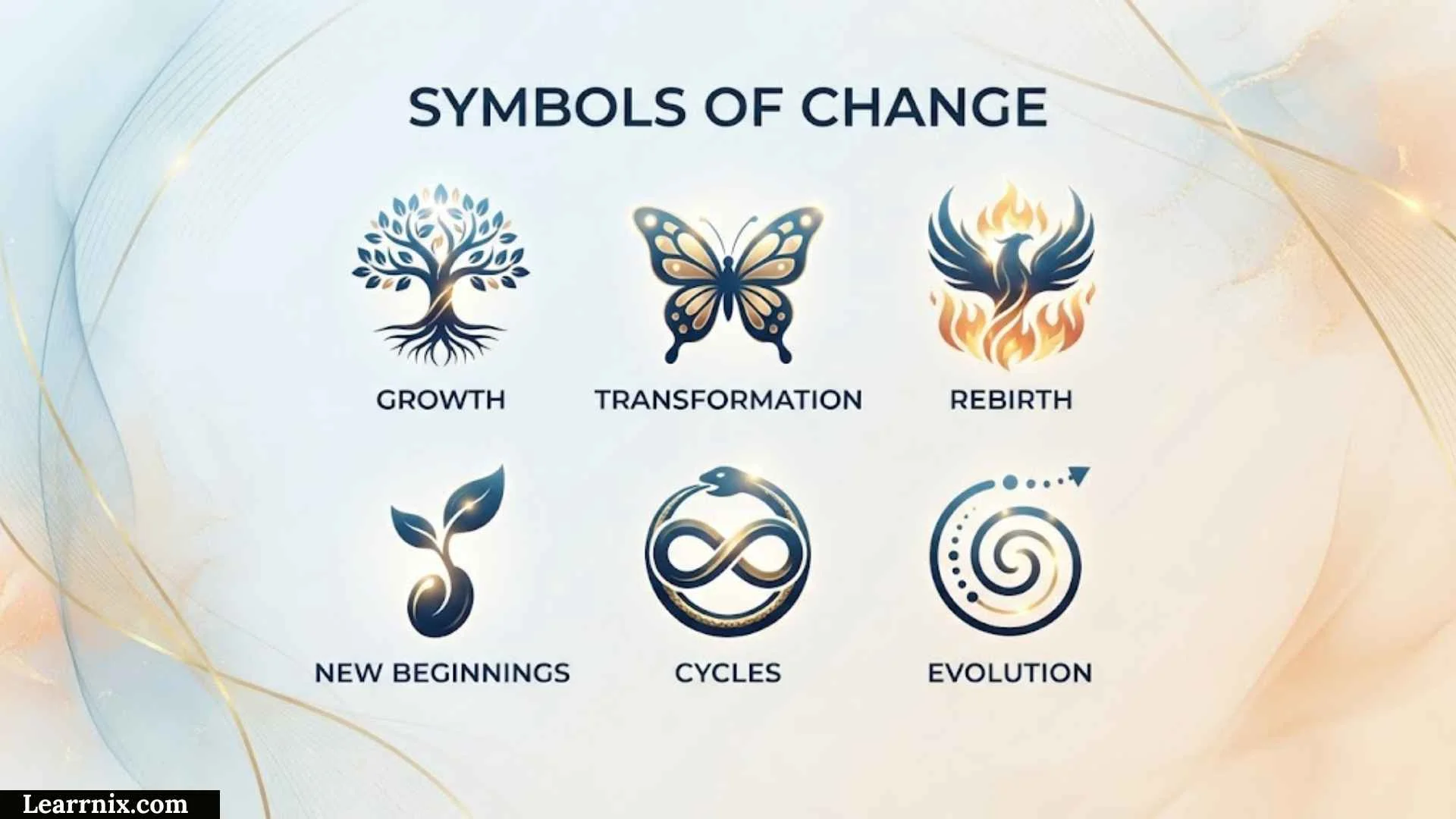
Change can mean many things: starting over, growing into a new version of yourself, leaving something behind, adapting to difficult circumstances, or entering a completely different stage of life. Because these ideas can be difficult to express directly, people have long used images from nature, mythology, religion, art, and everyday life as symbols of change.
Some symbols are especially powerful because they show change visually. A butterfly passes through metamorphosis. A snake sheds its old skin. Plants respond to the changing seasons. A sunrise marks the beginning of a new day. The ouroboros forms a circle that suggests continuity and cycles.
But there is no single universal symbol that means “change.” Meaning depends on context, culture, history, and the particular kind of transformation being represented.
This guide explains the most recognizable symbols of change, what they can represent, how their meanings developed, and how to choose an appropriate symbol for personal growth, a new beginning, transformation, letting go, or a major life transition.
Quick Answer: What Are Symbols of Change?
Symbols of change are images, objects, animals, natural processes, or cultural signs used to represent transformation, transition, growth, renewal, adaptation, endings, or new beginnings.
Some widely recognized examples include:
- Butterfly — metamorphosis and personal transformation
- Phoenix — rebirth and renewal
- Snake — shedding, renewal, and transformation
- Ouroboros — cycles, continuity, and renewal
- Lotus — spiritual development and transcendence in specific traditions
- Moon phases — cycles and gradual change
- Seasons — transition and recurring natural change
- Sunrise — a new beginning
- Spiral — movement and development
- Crossroads — choice and transition
- Tree — growth, continuity, and development
- Falling leaves — release and seasonal transition
- Water — movement and adaptability
- Open door — opportunity and entering a new stage
The same symbol can have different meanings in different cultures. For that reason, symbolic interpretations should be treated as contextual rather than universal definitions.
Why Are Symbols Used to Represent Change?
Change is an abstract idea. You cannot physically hold “personal growth” or see “a new chapter” as an object.
Symbols make these ideas easier to visualize.
Symbols Turn Abstract Ideas Into Images
Consider the difference between saying:
“I have changed significantly.”
and showing a butterfly.
The butterfly provides an immediate visual metaphor for transformation because its life cycle includes a dramatic change in physical form.
Similarly:
- A sunrise can represent a new day.
- A crossroads can represent a major decision.
- A falling leaf can represent release.
- A spiral can suggest continuing development.
- A wheel can represent recurring cycles.
This makes symbols useful in literature, artwork, tattoos, jewelry, memorials, branding, religious art, and personal storytelling.
Not Every Change Is a Transformation
This distinction is important when selecting symbolism.
Change is a broad term. It can mean moving to a new place, changing a job, aging, adapting to circumstances, or entering a new season.
Transformation usually suggests a deeper change in form, identity, condition, or character.
For example, a new job is a change. Rebuilding your identity after a major life event may be described as transformation.
A useful symbol should match the type of change rather than simply being labeled “a symbol of change.”
The Most Common Symbols of Change at a Glance
| Symbol | Common Association | Best Fit For |
| Butterfly | Metamorphosis | Personal transformation |
| Phoenix | Rebirth | Starting again after hardship |
| Snake | Shedding and renewal | Leaving an old state behind |
| Ouroboros | Cycles | Repeated change |
| Lotus | Growth and transcendence | Spiritual development |
| Moon | Cycles | Gradual or recurring change |
| Seasons | Transition | Natural life stages |
| Sunrise | New beginning | Fresh starts |
| Spiral | Development | Ongoing growth |
| Crossroads | Choice | Major decisions |
| Tree | Growth and continuity | Long-term development |
| Falling leaf | Release | Letting go |
| Water | Flow and adaptation | Flexibility |
| Open door | Opportunity | Entering a new stage |
| Broken chain | Liberation | Breaking away from restrictions |
These associations are useful starting points, but they are not fixed definitions. Cultural history can change the meaning of a symbol.
Butterfly: A Symbol of Transformation
The butterfly is one of the clearest natural metaphors for transformation.
Its life cycle includes distinct stages, culminating in the adult butterfly. Because the change is so visible, butterfly imagery has become strongly associated with metamorphosis and personal transformation.
What Does the Butterfly Symbolize?
The butterfly can represent:
- Transformation
- Metamorphosis
- Personal growth
- Freedom
- Renewal
- A new identity
- Moving beyond an earlier stage
The butterfly’s meaning can also extend beyond modern self-development. In ancient Greek thought, psychē could be associated with both the soul and butterfly imagery. Modern interpretations should not erase that historical complexity.
When Is a Butterfly a Good Symbol of Change?
A butterfly works particularly well when the message is:
“I have become something different.”
For example, someone marking a major personal transition may choose butterfly imagery because it communicates transformation rather than simply movement from one place to another.
Phoenix: Rebirth After an Ending
The phoenix is a mythical bird commonly associated with death, renewal, and rebirth.
Its importance as a symbol comes from mythology rather than a natural biological process.
What Does the Phoenix Represent?
Modern symbolic uses commonly connect the phoenix with:
- Rebirth
- Renewal
- Resilience
- Recovery
- Starting again
- Transformation after destruction
The key idea is not simply “change.” It is renewal after an ending.
Phoenix vs. Butterfly
These two symbols are often grouped together, but they communicate different stories.
A butterfly emphasizes metamorphosis.
A phoenix emphasizes rebirth after destruction or loss.
For example, a person celebrating personal development may connect with a butterfly, while someone marking a difficult recovery may prefer phoenix imagery.
Phoenix imagery also appears in historical Asian art. For example, the Metropolitan Museum of Art documents phoenixes appearing alongside lotuses and Buddhist symbols on a fifteenth-century Chinese textile. This demonstrates that phoenix imagery has existed in multiple cultural and artistic contexts, rather than belonging to one single modern interpretation.
Snake: Shedding the Old
A snake provides a powerful natural metaphor for renewal because snakes shed their skin.
The discarded skin can easily become a visual representation of an earlier state that has been left behind.
What Does the Snake Symbolize?
Depending on cultural context, a snake may represent:
- Renewal
- Regeneration
- Transformation
- Healing
- Knowledge
- Danger
- Temptation
- Rebirth
This is an important example of why symbolic meanings should not be oversimplified.
A snake does not universally mean “positive change.” Its meaning varies widely across religions, mythologies, medical symbolism, folklore, and popular culture.
Why Is Shedding Symbolically Important?
The strongest connection to change comes from the physical act of shedding.
The metaphor is straightforward:
Old layer → shedding → renewed state
This makes snake imagery useful for themes such as leaving an old identity behind, changing habits, or beginning another stage of life.
Ouroboros: The Symbol of Cyclical Change
The ouroboros is generally depicted as a serpent or dragon forming a circle by biting its own tail.
The British Museum describes the ouroboros as an emblem associated with eternity and documents its appearance in historical objects. A British Museum description of an ouroboros sculpture also identifies it with the cyclical nature of the world and notes its appearance across multiple ancient cultural contexts.
What Does the Ouroboros Mean?
The ouroboros can represent:
- Cycles
- Continuity
- Eternity
- Renewal
- Beginning and ending
- Repetition
- Self-renewal
Its symbolism differs from that of the phoenix.
The phoenix tells a story of ending followed by rebirth.
The ouroboros presents ending and beginning as part of a continuing cycle.
When Should You Choose the Ouroboros?
It works well when the intended message is:
“Change is continuous, and endings are connected to beginnings.”
This can suit ideas about recurring life stages, personal evolution, nature’s cycles, or philosophical reflections on time.
Lotus: Growth and Spiritual Transformation
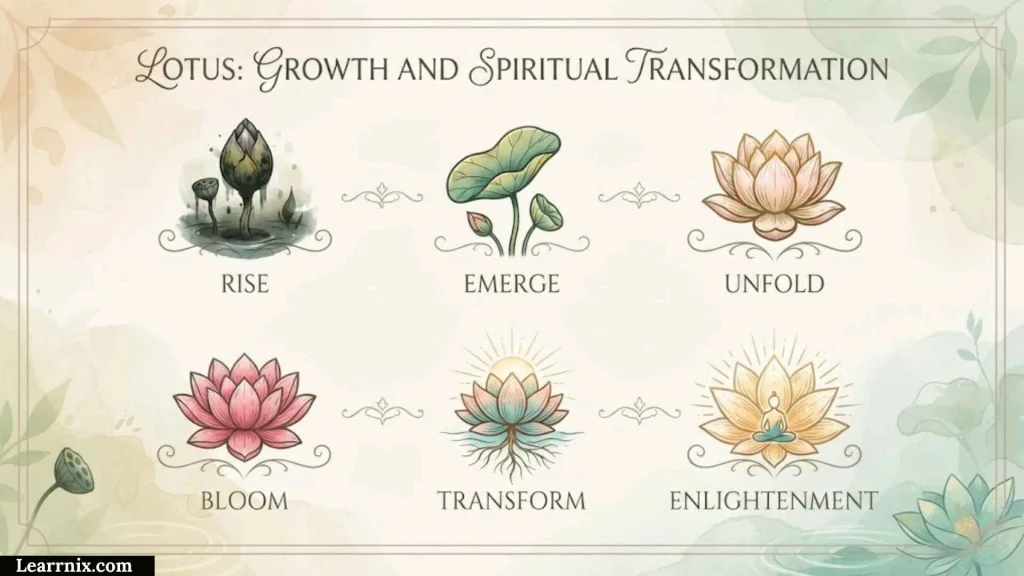
The lotus has deep symbolic importance in South and Southeast Asian religious art.
It should not simply be described as a generic “flower of change.” Its meaning is tied to specific religious and cultural traditions.
What Does the Lotus Represent?
In Hindu and Buddhist contexts, lotus imagery can be associated with ideas such as:
- Purity
- Spiritual development
- Transcendence
- Awakening
- Perfection
- Renewal
The Metropolitan Museum of Art explains that lotus imagery in Indian art is associated with spiritual perfection and the idea of rising from muddy water into a purified or transformed state.
The Met also identifies the lotus as an auspicious symbol connected with the Buddha’s enlightenment in a first-century BCE Bharhut sculpture.
Why Does the Lotus Represent Growth?
The plant’s growth from water into an open flower creates a powerful visual metaphor.
The important distinction is that the lotus is not merely a modern symbol for “change.” In Buddhist and Hindu art, it carries much deeper religious meanings.
For example, the Met documents lotus imagery associated with Buddhist salvation in Japanese art and with Buddhist iconography across South and East Asia.
Moon Phases: Change That Happens in Cycles
The moon is often used as a metaphor for recurring change because its visible appearance changes throughout the lunar cycle.
What Can Moon Phases Represent?
Moon imagery may be used to suggest:
- Cycles
- Time
- Transition
- Growth and decline
- Renewal
- Impermanence
- Recurring stages
The moon is especially useful when change is gradual rather than dramatic.
A butterfly says, in effect, “I transformed.”
Moon phases can suggest:
“I am moving through different stages.”
When Is Moon Symbolism Useful?
Moon imagery can work well for:
- Personal reflection
- Life transitions
- Journaling themes
- Artwork
- Jewelry
- Tattoos
- Stories about cycles
- Themes of impermanence
Its exact meaning still depends on cultural and personal context.
Seasons: Nature’s Ongoing Cycle of Change
The changing seasons are among the easiest natural examples of transition.
Spring develops into summer, summer into autumn, and autumn into winter in regions where those four seasonal patterns occur.
The scientific cause is Earth’s axial tilt as it orbits the Sun, not simply its changing distance from the Sun.
What Can Each Season Represent?
Spring can suggest:
- New beginnings
- Growth
- Renewal
- Fresh opportunities
Summer can suggest:
- Full development
- Energy
- Abundance
- Activity
Autumn can suggest:
- Transition
- Maturity
- Release
- Preparation
Winter can suggest:
- Rest
- Dormancy
- Stillness
- An ending before renewal
These are symbolic associations, not universal rules.
Seasons Do Not Mean the Same Thing Everywhere
A common mistake is assuming every culture experiences or interprets the four seasons in the same way.
Climate matters.
Arizona State University’s Ask A Biologist explains that tropical regions may have wet and dry seasons instead of the familiar four-season pattern.
This matters when discussing symbols because seasonal imagery is shaped by lived experience.
Sunrise: A Symbol of New Beginnings
A sunrise is one of the simplest visual metaphors for starting again.
Darkness gives way to light, and one day begins.
What Does Sunrise Symbolize?
Sunrise imagery can suggest:
- Hope
- Renewal
- Opportunity
- A fresh beginning
- A new chapter
- Moving forward
Unlike the phoenix, the sunrise does not require destruction or dramatic transformation.
It can simply represent:
“Today is a new beginning.”
This makes sunrise imagery suitable for motivational artwork, personal writing, logos, memorial designs, and other situations where the focus is on hope and forward movement.
Falling Leaves: Letting Go and Transition
Falling leaves provide a quieter image of change.
Trees lose leaves as part of seasonal cycles in many temperate environments. The visual process has naturally encouraged metaphors about release, aging, transition, and impermanence.
What Can Falling Leaves Represent?
They can suggest:
- Letting go
- Acceptance
- Transition
- Aging
- Seasonal change
- The end of a chapter
- Making space for something new
The symbolism works particularly well when change is not being presented as dramatic or heroic.
Sometimes change means accepting that something has reached its natural end.
Spiral: Development Without a Straight Line
A spiral is useful because it combines movement with repetition.
Unlike a straight line, it can suggest that development does not always happen in one direction.
What Can a Spiral Represent?
A spiral may be interpreted as:
- Growth
- Expansion
- Development
- Movement
- Evolution
- Returning to familiar themes from a new position
This makes it especially useful for representing personal development.
Someone can encounter a similar challenge more than once while responding to it differently each time.
That is a different concept from simply moving from point A to point B.
Wheel: Movement and Recurring Change
The wheel is a natural metaphor for cycles because it turns continuously.
What Does the Wheel Symbolize?
Depending on context, a wheel can represent:
- Movement
- Time
- Cycles
- Progress
- Repetition
- Transition
The wheel is particularly useful when the intended message is that life keeps moving.
It differs from the spiral because a wheel emphasizes recurrence, while a spiral can emphasize development through recurrence.
Crossroads: Change Through Choice
Some symbols do not represent change itself. They represent the decision that causes change.
The crossroads is a strong example.
What Does a Crossroads Represent?
It can symbolize:
- Choice
- Uncertainty
- Opportunity
- Risk
- Transition
- A turning point
- Multiple possible futures
Imagine someone choosing between two careers.
The crossroads does not represent the new career itself. It represents the moment when the person’s direction can change.
That makes it especially useful for stories, artwork, tattoos, and writing about major decisions.
Tree: Growth While Keeping Your Roots
A tree represents a different type of transformation.
A tree grows substantially over time, yet it remains connected to its roots.
What Can a Tree Symbolize?
Depending on cultural context, tree imagery can represent:
- Growth
- Strength
- Continuity
- Family
- Knowledge
- Connection
- Long-term development
The tree is a useful choice when the message is not:
“I became someone completely different.”
Instead, it can communicate:
“I grew while remaining connected to where I came from.”
This makes tree symbolism particularly appropriate for family history, personal development, ancestry, and long-term growth.
Water: Flow, Adaptation, and Movement
Water is constantly changing form and direction.
It can flow through a river, collect in a lake, freeze into ice, fall as rain, or become vapor.
What Can Water Represent?
Water imagery can suggest:
- Adaptability
- Movement
- Flow
- Renewal
- Emotional change
- Flexibility
- Transition
Water is therefore useful when the desired message is not dramatic rebirth but the ability to adapt.
The underlying metaphor is simple:
The environment changes, and water changes with it.
Dragonfly: Transformation and Adaptability
Dragonflies undergo major changes during their life cycle, spending an important part of their development in an aquatic juvenile stage before becoming flying adults.
Because of this visible life-cycle shift, dragonfly imagery is often used in modern symbolic contexts for transformation and adaptability.
When Is a Dragonfly a Useful Symbol?
Dragonfly imagery can work when the intended theme is:
- Personal growth
- Adaptation
- Transformation
- New perspectives
- Flexibility
It is a useful alternative to the butterfly for people who want a less common transformation image.
Egg: Potential Before Transformation
An egg represents something that has not yet fully emerged.
That makes it different from a butterfly.
What Does an Egg Symbolize?
An egg can represent:
- Potential
- Possibility
- Birth
- New beginnings
- Hidden development
- A future that has not yet taken shape
The distinction is useful:
Egg = potential
Butterfly = transformation
If the message is about what something could become, an egg may be more appropriate than a butterfly.
Open Door: Entering a New Stage
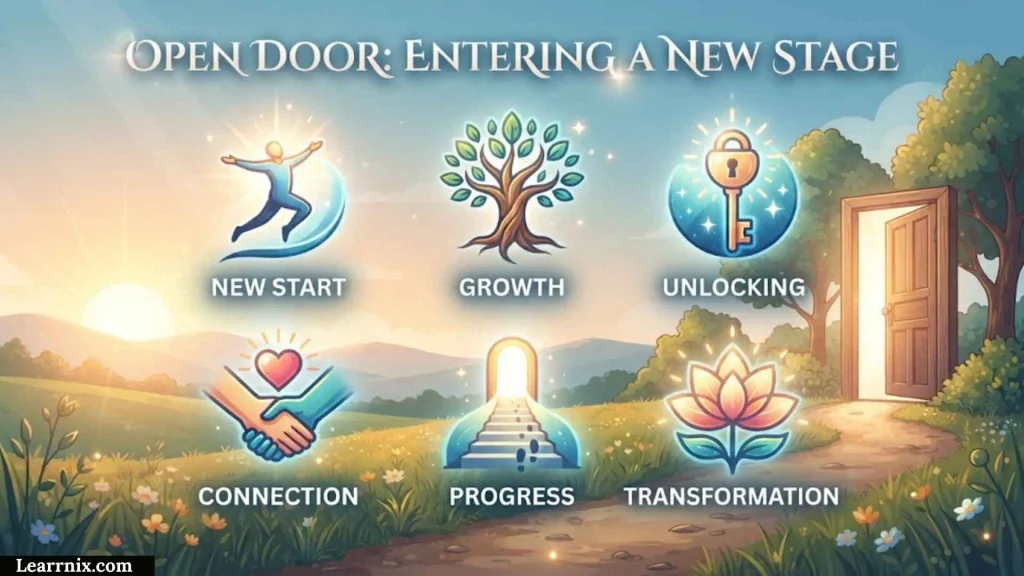
An open door is a modern and easily understood metaphor for transition.
What Can an Open Door Represent?
It may suggest:
- Opportunity
- New experiences
- A fresh start
- Leaving the past
- Entering another stage
- Possibility
Its strength is simplicity.
A person does not need specialized cultural knowledge to understand why an open door can represent a new opportunity.
Broken Chain: Breaking From the Past
A broken chain represents a different kind of change: liberation.
What Does a Broken Chain Represent?
It can symbolize:
- Freedom
- Independence
- Release
- Breaking restrictions
- Ending a limiting pattern
- Moving away from the past
This symbol is particularly appropriate when change involves separation rather than gradual growth.
For example, an artist could use broken-chain imagery to represent freedom from an old limitation, while a sunrise might better represent what comes next.
Symbols of Change Across Cultures
Symbolism becomes much more accurate when cultural context is included.
Ancient Greek Associations With the Butterfly
Greek psychē has a complex history connecting the word with the soul and butterfly imagery. Scholarly discussion shows that butterfly imagery became an important visual expression associated with the soul in Greek thought.
This is more precise than simply claiming that “the ancient Greeks believed butterflies always meant transformation.”
Indian and Buddhist Lotus Symbolism
The lotus has a documented and extensive history in Indian and Buddhist art.
The Metropolitan Museum of Art describes the lotus as a symbol connected with Buddhist enlightenment in the Bharhut tradition and discusses its role as a metaphor for spiritual perfection in Indian iconography.
This provides a stronger historical basis for interpreting the lotus as a symbol of spiritual transformation than generic modern symbolism lists do.
Ouroboros and Cyclical Meaning
The British Museum identifies the ouroboros as a serpent biting its own tail and associates the image with eternity. Its collection also documents historical examples and describes the motif as connected with cyclical ideas.
This makes the ouroboros particularly relevant to discussions of recurring change.
Seasons and Cultural Context
Even the meaning of seasonal change depends on geography and culture.
Four-season symbolism is familiar in many temperate regions, but tropical regions may experience wet and dry seasons instead.
Modern research also shows that seasonal timing is not simply a fixed cultural idea: phenology tracks recurring biological events such as leaf emergence and leaf fall, and these timings respond to environmental conditions.
Change vs. Transformation vs. Renewal
These words are related, but they should not be treated as synonyms.
Change
Change is the broadest term.
Examples include:
- Moving to another city
- Changing jobs
- Learning a new skill
- Aging
- Adapting to circumstances
Transformation
Transformation suggests a deeper alteration in form, identity, or condition.
Examples include:
- Caterpillar to butterfly
- Major personal development
- A profound change in identity
- Rebuilding after a life-changing event
Renewal
Renewal focuses on restoring, refreshing, or beginning again.
Examples include:
- A new year
- Recovery
- Rebuilding
- Spring after winter
Rebirth
Rebirth suggests a new state after an ending.
The phoenix is a strong example of this concept.
Understanding these differences makes symbolic choices much more precise.
Which Symbol of Change Fits Your Situation?
Use this simple decision guide when choosing a symbol.
If You Want to Represent Personal Transformation
Choose:
Butterfly → visible metamorphosis
Dragonfly → transformation and adaptability
Snake → shedding an earlier state
If You Want to Represent Rebirth
Choose:
Phoenix → renewal after destruction or hardship
Sunrise → beginning again
Spring → renewal and growth
If You Want to Represent Letting Go
Choose:
Falling leaves → release and acceptance
Snake shedding → leaving an old layer behind
Broken chain → breaking free from restrictions
If You Want to Represent Cycles
Choose:
Ouroboros → continuity and recurring cycles
Moon phases → changing stages
Wheel → recurring movement
If You Want to Represent Growth
Choose:
Tree → long-term development
Lotus → spiritual growth in relevant traditions
Spiral → continuing development
If You Want to Represent a Major Decision
Choose:
Crossroads → choice and uncertainty
Open door → opportunity
Path → movement toward a new direction
How to Choose a Symbol for a Tattoo or Personal Design
A symbol may look attractive while still communicating the wrong idea.
Before choosing one, ask five questions.
1. What Exactly Is Changing?
Is it your identity, location, relationship, career, beliefs, habits, or circumstances?
2. Is the Change Positive, Difficult, or Neutral?
A phoenix may communicate survival after hardship.
A sunrise may communicate optimism.
A falling leaf may communicate acceptance.
3. Is the Change Sudden or Gradual?
For gradual development, consider:
- Tree
- Spiral
- Moon
- Seasons
For dramatic transformation, consider:
- Butterfly
- Phoenix
- Dragonfly
4. Is the Symbol Culturally Specific?
If a symbol comes from a religious or cultural tradition, research its original context before using it.
This is particularly important for lotus, religious symbols, sacred animals, and traditional iconography.
5. What Story Should the Symbol Tell?
The best personal symbol usually communicates a specific story rather than a vague idea.
Instead of saying:
“I want a symbol of change.”
Try:
“I want a symbol showing that I survived a difficult period and started again.”
That answer points more clearly toward phoenix imagery than toward a generic change symbol.
Common Mistakes When Interpreting Symbols
Assuming Every Symbol Has One Meaning
Symbols can have multiple meanings.
A snake may represent renewal in one context and danger in another.
Confusing Modern Meanings With Historical Meanings
A symbol may have a popular modern interpretation that differs from its documented historical use.
When writing about ancient symbolism, separate evidence from modern interpretation.
Treating Similar Symbols as Identical
Butterfly, phoenix, snake, and dragonfly can all be connected with transformation, but they do not communicate the same story.
Ignoring Cultural Context
A religious symbol should not automatically be reduced to a motivational quote.
For example, lotus symbolism has deep significance in Hindu and Buddhist traditions that extends beyond the modern idea of “personal growth.”
Choosing a Symbol Only Because It Looks Good
Visual appeal matters for design, but meaning matters when the symbol is intended to communicate a personal story.
How to Research the Meaning of a Symbol
If accuracy matters, especially for cultural or historical content, use a simple research process.
Identify the Exact Symbol
Make sure you know whether the image is a butterfly, moth, phoenix, serpent, dragon, lotus, wheel, or another related form.
Identify Its Cultural Context
Ask:
- Where was it used?
- By whom?
- During what period?
- In what type of art or text?
- Was it religious, political, decorative, or literary?
Separate Historical Evidence From Modern Interpretation
A museum record documenting a symbol is evidence of historical use.
A modern website saying that a symbol “means transformation” is an interpretation.
Those two types of information should not be presented as equally authoritative.
Prefer Primary and Institutional Sources
For historical symbolism, useful sources include:
- Museums
- University research
- Academic publications
- Archaeological institutions
- Cultural organizations
- Scholarly reference works
This approach helps avoid repeating unsupported claims that spread through social media and generic symbolism websites.
Real-Life Ways People Use Symbols of Change
Symbols are not limited to historical studies. They continue to appear in modern life.
Tattoos and Jewelry
People often select butterflies, phoenixes, lotus flowers, trees, and ouroboros designs to mark personal milestones.
The important consideration is whether the chosen symbol accurately reflects the person’s intended story.
Literature and Poetry
Writers use seasonal change, journeys, doors, roads, birds, flowers, and natural cycles to represent character development.
A character who leaves home, for example, may encounter a road or crossroads that functions as a visual representation of an internal decision.
Art and Design
Artists can use color, shape, natural cycles, and transformation imagery to communicate change without words.
A sequence showing a closed flower becoming an open flower can suggest development even without explanatory text.
Personal Milestones
A symbol can also serve as a private reminder.
Someone beginning a new career may choose an open door.
Someone recovering from a difficult period may choose a phoenix.
Someone accepting gradual growth may prefer a tree or spiral.
The meaning does not have to be universal to be personally valuable.
Frequently Asked Questions About Symbols of Change
What Is the Most Recognized Symbol of Change?
The butterfly is one of the most recognizable modern symbols of transformation because its life cycle provides a clear visual example of metamorphosis. However, there is no officially universal symbol of change.
What Symbol Represents a Major Life Change?
Butterflies, phoenixes, crossroads, sunrise, open doors, and trees can all represent major life changes. The right choice depends on whether the change involves transformation, recovery, choice, opportunity, or gradual growth.
What Symbol Represents New Beginnings?
Sunrise, spring, an open door, an egg, and new plant growth can represent new beginnings. Sunrise emphasizes a new day, while spring emphasizes renewal and an egg emphasizes potential.
What Animal Represents Change?
Butterflies, snakes, and dragonflies are commonly associated with change or transformation. Their meanings differ: the butterfly emphasizes metamorphosis, the snake can suggest shedding and renewal, and the dragonfly can suggest adaptation and transformation.
What Flower Symbolizes Transformation?
The lotus is strongly associated with spiritual transformation and awakening in several South Asian religious traditions. Its meaning should be understood within those traditions rather than reduced to a universal modern definition.
What Symbol Represents Letting Go?
Falling leaves, a snake shedding its skin, and a broken chain can all represent letting go. Falling leaves emphasize natural release, while a broken chain emphasizes liberation.
What Symbol Represents Rebirth?
The phoenix is a major symbol of rebirth in modern symbolic language. Sunrise and spring can also communicate renewal without the stronger mythological association of the phoenix.
What Symbol Represents Personal Growth?
A tree, butterfly, lotus, spiral, or growing plant can represent personal growth. The tree emphasizes gradual development, while the butterfly emphasizes transformation.
What Symbol Represents a New Chapter in Life?
An open door, sunrise, crossroads, path, butterfly, or spring can represent a new chapter. The best choice depends on whether the focus is opportunity, decision, renewal, or transformation.
What Does the Ouroboros Represent?
The ouroboros is an ancient symbolic motif depicting a serpent biting its own tail. It is associated with eternity and cyclical ideas, making it particularly useful for representing recurring change and renewal.
Is the Butterfly an Ancient Symbol of Transformation?
Butterfly imagery has a long symbolic history, including associations with the soul in ancient Greek thought. However, the modern idea of the butterfly as a general symbol of personal transformation should not be projected unchanged onto every ancient culture.
Does the Lotus Always Mean Change?
No. Lotus symbolism varies by tradition. In Buddhist and Hindu art, it can carry religious meanings involving purity, transcendence, enlightenment, prosperity, or divine imagery.
Are Symbols of Change Always Positive?
No.
Change can involve growth and opportunity, but it can also involve loss, uncertainty, endings, aging, or disruption.
A symbol such as a falling leaf may communicate acceptance of an ending rather than excitement about a new beginning.
Key Takeaways About Symbols of Change
- There is no single universal symbol of change.
- The butterfly is strongly associated with metamorphosis.
- The phoenix emphasizes rebirth and renewal.
- The snake can represent shedding and renewal, but its meaning varies by culture.
- The ouroboros represents cyclical ideas and continuity.
- The lotus has deep spiritual and religious meanings in South and Southeast Asian traditions.
- Moon phases and seasons represent recurring change.
- A sunrise is a simple metaphor for a new beginning.
- A crossroads represents a choice or turning point.
- A tree represents long-term growth and continuity.
- Falling leaves can symbolize release and transition.
- Water can represent adaptation and movement.
- Historical meaning should be separated from modern personal interpretation.
- Cultural symbols should be researched in their original context.
Conclusion: Finding the Right Symbol for Change
The most meaningful symbols of change are not necessarily the most famous ones. They are the ones that accurately express the type of change being described.
Choose a butterfly when the focus is metamorphosis. Choose a phoenix when the story is about rebirth after hardship. Consider a snake when the idea is shedding an old state. The ouroboros works well for recurring cycles, while the lotus carries rich spiritual meanings within particular traditions. A sunrise can express a fresh beginning, a crossroads can represent an important decision, and a tree can show growth without losing one’s roots.
The deeper lesson is that change does not always look the same.
Sometimes it is dramatic. Sometimes it happens slowly. Sometimes it means starting again. Sometimes it means letting go. And sometimes it means returning to a familiar place with a completely different perspective.

I am Daniel Harper, an education enthusiast and writer who enjoys creating helpful content to make learning more accessible and engaging.
I focus on sharing knowledge about effective study methods, educational growth, and skills that help learners succeed in a changing world.
Through my writing, I aim to inspire students to explore new ideas and develop a passion for learning.
Books by Daniel Harper:
- The Path to Lifelong Learning
- Unlocking Your Learning Potential
 Michael Carter
 Charlotte Anderson