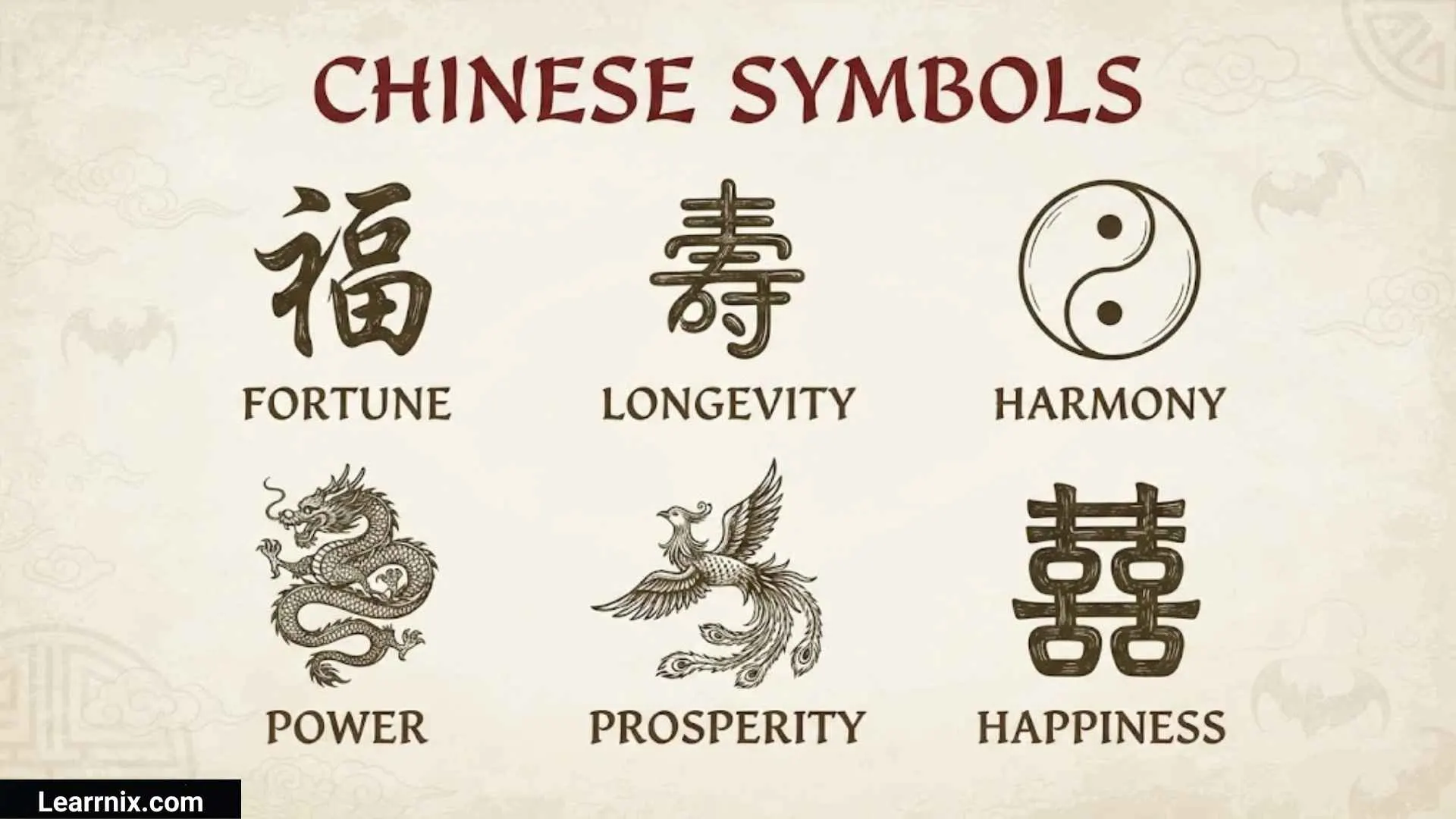
Chinese symbols are often searched for as decorative characters, meaningful text, tattoo ideas, and symbols that represent concepts such as love, luck, peace, strength, and happiness. While people commonly call them “Chinese symbols,” most are actually Chinese characters used in writing.
This guide covers traditional and common Chinese symbols, their meanings, English translations, ancient forms, and easy characters you can copy and paste. It also explains how popular characters are used in tattoos, messages, artwork, usernames, and decorative designs.
If you are looking for a character with a specific meaning, the sections below make it easier to compare your options. You will also find useful distinctions between modern Chinese characters and ancient Chinese writing, along with practical tips for choosing a character accurately.
Chinese Symbols and Meanings
Chinese characters can represent individual words, ideas, qualities, names, or parts of larger words. A single character can have a broad meaning, and its exact interpretation may change depending on context.
Here are some widely recognized Chinese characters:
| Symbol | Pinyin | Common Meaning |
| 爱 / 愛 | ài | Love |
| 福 | fú | Fortune, blessing, good luck |
| 和 | hé | Harmony, peace |
| 寿 / 壽 | shòu | Longevity |
| 喜 | xǐ | Happiness, joy |
| 勇 | yǒng | Courage |
| 力 | lì | Strength, power |
| 龙 / 龍 | lóng | Dragon |
| 虎 | hǔ | Tiger |
| 美 | měi | Beauty |
| 心 | xīn | Heart, mind |
| 梦 / 夢 | mèng | Dream |
| 家 | jiā | Family, home |
Meanings should not always be treated as one-to-one translations. For example, 和 can relate to harmony, peace, agreement, or being gentle depending on how it is used.
The character 福 is especially associated with blessings and good fortune, while 寿 is commonly connected with longevity. These characters are often found in traditional decorations and festive contexts.
Popular Chinese Symbols
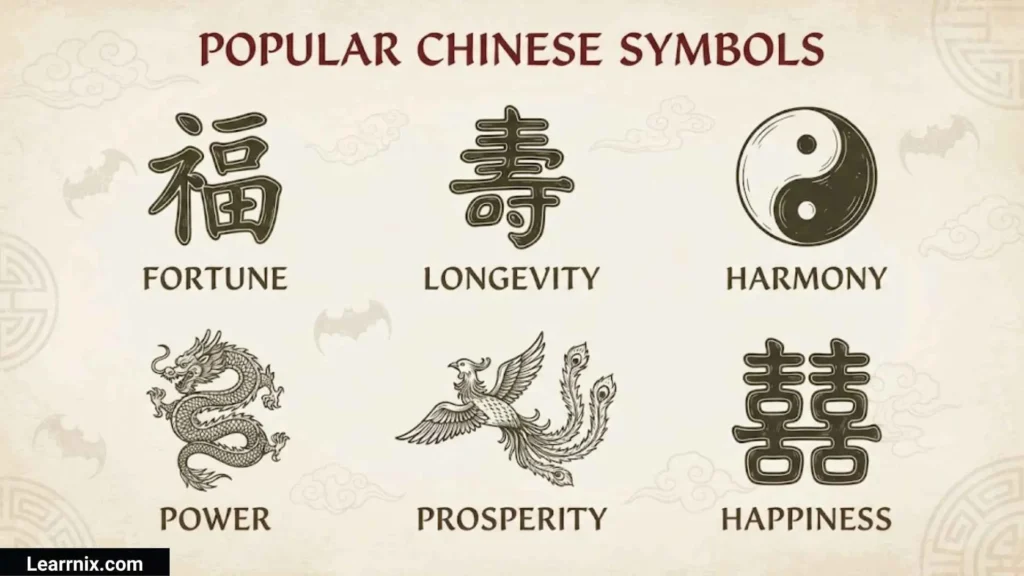
Some Chinese characters have become especially popular outside Chinese-speaking communities because their meanings are easy to associate with positive ideas.
Popular examples include:
- 爱 / 愛 — love
- 福 — fortune or blessing
- 和 — harmony
- 喜 — happiness or joy
- 寿 / 壽 — longevity
- 龙 / 龍 — dragon
- 凤 / 鳳 — phoenix
- 虎 — tiger
- 心 — heart
- 勇 — courage
- 力 — strength
- 美 — beauty
- 禅 / 禪 — Zen or meditation-related concepts
Characters such as 龙, 虎, and 凤 can carry cultural and symbolic associations beyond their basic dictionary meanings. Their significance depends on the historical and cultural context in which they appear.
Common Chinese Symbols
Common Chinese characters are useful when you want symbols that are recognizable and relatively simple.
A few examples are:
人 — person or human
天 — sky or heaven
大 — big or great
山 — mountain
水 — water
火 — fire
木 — wood or tree
心 — heart or mind
日 — sun or day
月 — moon or month
家 — home or family
爱 — love
These characters can appear alone, but many are also combined with other characters to create words and phrases. For example, 家 means home or family, while 家庭 means family or household.
Traditional Chinese Symbols
Traditional Chinese characters are forms that preserve older character structures and are still used in places such as Taiwan and Hong Kong. They are also frequently seen in historical artwork, calligraphy, temples, traditional decorations, and cultural designs.
Some familiar traditional forms include:
| Traditional | Simplified | Meaning |
| 愛 | 爱 | Love |
| 龍 | 龙 | Dragon |
| 鳳 | 凤 | Phoenix |
| 壽 | 寿 | Longevity |
| 夢 | 梦 | Dream |
| 喜 | 喜 | Joy, happiness |
| 福 | 福 | Fortune, blessing |
| 禪 | 禅 | Zen-related concept |
| 國 | 国 | Country |
| 門 | 门 | Door |
The traditional and simplified versions are sometimes identical, as with 福 and 喜.
If you are choosing a character for a permanent design, check whether you want simplified or traditional Chinese before finalizing it. The two forms can look noticeably different.
Ancient Chinese Symbols
Ancient Chinese writing looked very different from modern Chinese characters. One of the most important early writing systems is oracle bone script, which was carved or written on animal bones and turtle shells during the late Shang period.
Many early characters were pictographic or visually suggestive. For example, early forms could resemble things such as the sun, moon, mountain, or tree. Over centuries, these forms developed into more standardized scripts.
Important stages in the development of Chinese writing include:
- Oracle bone script — an early form associated with inscriptions on bones and shells.
- Bronze inscriptions — characters found on ancient bronze objects.
- Seal script — a highly stylized script that became important during the Qin period.
- Clerical script — a more standardized form that influenced later writing.
- Regular script — the basis for the standard character forms commonly recognized today.
Ancient Chinese symbols should therefore not be treated as a separate collection of modern decorative icons. They are part of the historical development of the Chinese writing system.
Chinese Symbols Pictures
Pictures of Chinese symbols are useful when you want to compare character shapes, calligraphy styles, traditional forms, or ancient writing. However, the appearance of a character can change significantly depending on the script or artistic style.
For example, 龍 in traditional Chinese has a much more complex visual structure than the simplified form 龙.
When searching for Chinese symbol pictures, look for:
- Modern Chinese characters
- Traditional Chinese characters
- Chinese calligraphy
- Seal script examples
- Oracle bone script examples
- Brush-written characters
- Decorative Chinese typography
It is also useful to identify the character before using an image in a tattoo or design. A visually attractive character is not necessarily the character you intended to use.
Chinese Symbols to English
Chinese-to-English translation is not always as simple as translating one character into one English word. A character can have several related meanings, and pronunciation also matters.
Here are some common examples:
- 爱 / 愛 → love
- 和平 → peace
- 幸福 → happiness
- 好运 → good luck
- 力量 → strength or power
- 勇气 / 勇氣 → courage
- 自由 → freedom
- 希望 → hope
- 友谊 / 友誼 → friendship
- 梦想 / 夢想 → dream
Notice that some English concepts require two or more Chinese characters. For example, “peace” is commonly expressed as 和平, rather than simply treating 和 as the universal translation of “peace.”
For names, phrases, and tattoos, translation should consider the intended meaning rather than replacing every English word with an isolated character.
Chinese Symbols Text
Chinese symbols can be used as text in messages, captions, usernames, artwork, profiles, and decorative designs. Modern devices generally support many common Chinese characters through Unicode, although the exact appearance depends on the font and platform.
Examples of Chinese text include:
爱 — love
福 — fortune
和平 — peace
希望 — hope
勇气 — courage
自由 — freedom
幸福 — happiness
梦想 — dream
家 — home or family
友谊 — friendship
Chinese characters are already text characters, so you normally do not need a special symbol font to copy them. Simply select the character or phrase, copy it, and paste it into a supported text field.
Easy Chinese Symbols
If you are new to Chinese characters, simpler-looking characters can be easier to recognize and reproduce by hand.
Some relatively straightforward examples include:
- 人 — person
- 大 — big
- 天 — sky
- 山 — mountain
- 木 — tree or wood
- 水 — water
- 火 — fire
- 日 — sun or day
- 月 — moon or month
- 心 — heart or mind
Simple does not mean meaningless. Characters such as 山, 水, and 心 have broad cultural and linguistic uses.
If your goal is drawing or calligraphy, learn the correct stroke order rather than copying the visual outline alone. Proper stroke order helps produce a more natural character.
Chinese Symbols for Love
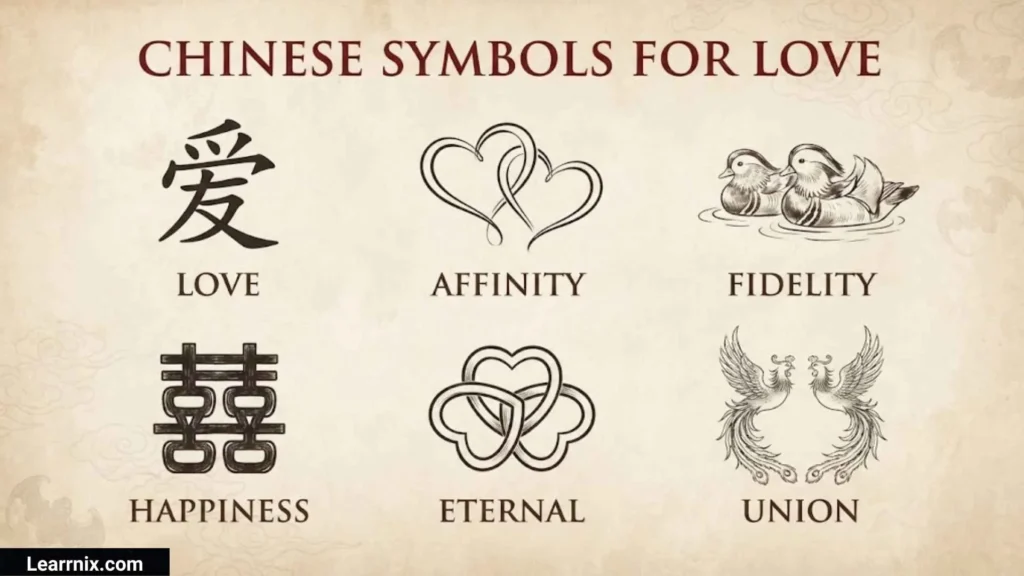
The most direct Chinese character associated with love is 爱 in simplified Chinese and 愛 in traditional Chinese.
爱 / 愛 — love
Other characters and phrases can express related ideas:
- 心 — heart or mind
- 情 — feeling, emotion, affection
- 爱人 / 愛人 — loved one or spouse, depending on context
- 爱情 / 愛情 — romantic love
- 友爱 / 友愛 — friendly affection or mutual love
For a simple decorative design, 爱 or 愛 may be enough. For a tattoo or formal artwork, however, the intended context matters because Chinese expressions can communicate more specific meanings than a single character.
Chinese Symbols for Luck
福 is one of the most recognizable Chinese characters associated with good fortune, blessings, and auspiciousness.
福 — fortune, blessing, good luck
Other characters and expressions related to positive fortune include:
- 吉 — auspicious or lucky
- 祥 — auspiciousness
- 瑞 — auspicious or propitious
- 好运 — good luck
- 幸运 / 幸運 — luck or fortunate
福 is particularly prominent in Chinese New Year decorations. It may also be displayed upside down as a traditional decorative practice because the pronunciation of “upside down” is associated with a phrase meaning that fortune has arrived. This is a cultural wordplay tradition rather than a different meaning of the character itself.
Chinese Symbols for Peace
The Chinese word commonly translated as “peace” is 和平.
- 和 — harmony, peace, agreement
- 平 — level, even, peaceful in certain compounds
- 和平 — peace
Other related characters include:
- 安 — peace, safety, calm
- 宁 / 寧 — peaceful, tranquil
- 静 / 靜 — quiet, still, calm
If you specifically want the concept of peace, 和平 is generally more precise than choosing 和 alone. For a shorter decorative character, 安 can communicate ideas of peace, safety, or tranquility depending on context.
Powerful Chinese Symbols
Chinese symbolism includes many characters and cultural figures associated with strength, authority, courage, or power.
Some examples are:
- 力 — strength or force
- 勇 — courage
- 强 / 強 — strong or powerful
- 威 — might, authority, prestige
- 龙 / 龍 — dragon
- 虎 — tiger
- 王 — king
The dragon is particularly important in Chinese culture and has associations with power, strength, authority, and auspiciousness. The tiger is also traditionally associated with strength and courage.
A character such as 力 is a direct choice for physical or personal strength, while 勇 focuses more specifically on courage.
Cool Chinese Symbols
“Cool Chinese symbols” usually refers to characters that look visually striking while also having an appealing meaning.
Good options include:
龍 — traditional dragon
龙 — simplified dragon
虎 — tiger
風 / 风 — wind
火 — fire
月 — moon
夢 / 梦 — dream
魂 — soul or spirit
影 — shadow
勇 — courage
雷 — thunder
星 — star
These can work well in digital designs, artwork, gaming profiles, decorative text, and themed graphics. A visually impressive character should still be checked for its actual meaning before you use it publicly.
Chinese Symbols Tattoo
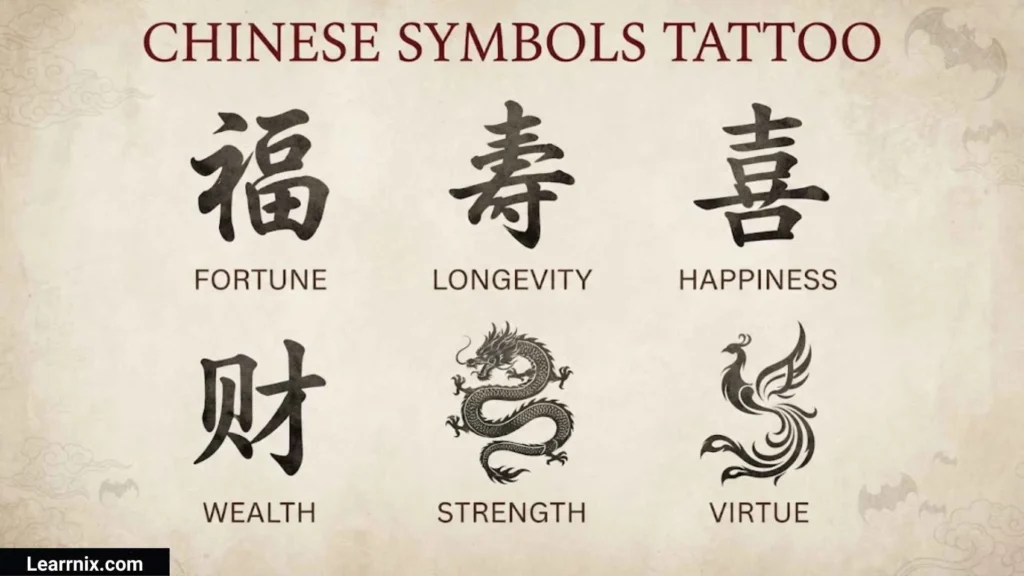
Chinese character tattoos are often chosen because one character can represent a meaningful concept in a compact visual form. Popular choices include love, strength, courage, peace, luck, family, and freedom.
Common tattoo ideas include:
- 爱 / 愛 — love
- 勇 — courage
- 力 — strength
- 和 — harmony
- 福 — fortune or blessing
- 寿 / 壽 — longevity
- 心 — heart or mind
- 自由 — freedom
- 和平 — peace
Before getting a tattoo, verify the exact character, intended meaning, writing system, and traditional or simplified form with a reliable Chinese speaker or qualified translator. Online lists sometimes present literal translations without explaining context.
Pay special attention to fonts and calligraphy. A decorative style can make a character difficult to read, while an incorrect character can permanently change the intended meaning.
Chinese Symbols Copy and Paste
If you need Chinese characters for social media, messages, designs, or quick searches, these examples are ready to copy:
| Copy | Meaning |
| 爱 | Love |
| 愛 | Love, traditional |
| 福 | Fortune or blessing |
| 和 | Harmony |
| 和平 | Peace |
| 喜 | Joy or happiness |
| 寿 | Longevity |
| 壽 | Longevity, traditional |
| 龙 | Dragon |
| 龍 | Dragon, traditional |
| 虎 | Tiger |
| 勇 | Courage |
| 力 | Strength |
| 心 | Heart or mind |
| 梦 | Dream |
| 夢 | Dream, traditional |
| 家 | Home or family |
| 美 | Beauty |
| 安 | Peace, safety, calm |
| 吉 | Auspicious or lucky |
To use them, highlight the character or phrase, copy it, and paste it into your preferred app. If a character appears as a box or does not display correctly, the issue may be related to the device, font, or application rather than the character itself.
How to Choose the Right Character
Start with the meaning you actually want. Then check whether you need a single character, a Chinese word, or a longer phrase.
For example, if you want “love,” 爱 is a single character. If you want “peace,” 和平 is a more direct Chinese expression. If you want “good luck,” 好运 is more specific than using a character that is merely associated with fortune.
This distinction helps prevent one of the most common mistakes in Chinese symbol searches: choosing a character because it looks attractive without confirming what it actually means.
FAQ
What is the Chinese symbol for love?
The common simplified Chinese character for love is 爱, while the traditional form is 愛. Both relate to the concept of love.
What Chinese symbol means good luck?
福 is strongly associated with fortune, blessings, and good luck. 吉 can also mean auspicious or lucky.
What is the Chinese symbol for peace?
和平 is the standard Chinese expression for peace. The character 和 can also relate to harmony and peace depending on context.
Are Chinese symbols and Chinese characters the same thing?
People often use “Chinese symbols” informally, but most examples are actually Chinese characters. Chinese characters are part of the writing system and can represent words or meaningful units.
Which Chinese characters are good for tattoos?
Popular choices include 爱, 勇, 力, 福, 和, and 寿. The best choice depends on the exact meaning you want, and the character should be professionally verified before tattooing.
Conclusion
Chinese characters offer a compact way to represent ideas such as love, luck, peace, courage, strength, family, and happiness. Their visual forms also make them popular for calligraphy, artwork, social media, decorative text, and tattoos.
From simple characters such as 山, 水, and 心 to culturally important characters such as 福 and 龍, each character has a linguistic and cultural background. Traditional and simplified forms can also differ, so choosing the correct version is important.
When using Chinese symbols, focus on meaning first and appearance second. For copy-and-paste use, ordinary Unicode characters are convenient, while tattoos and permanent artwork deserve extra verification to make sure the character, form, pronunciation, and intended meaning are correct.

I am Daniel Harper, an education enthusiast and writer who enjoys creating helpful content to make learning more accessible and engaging.
I focus on sharing knowledge about effective study methods, educational growth, and skills that help learners succeed in a changing world.
Through my writing, I aim to inspire students to explore new ideas and develop a passion for learning.
Books by Daniel Harper:
- The Path to Lifelong Learning
- Unlocking Your Learning Potential
 Michael Carter
 Charlotte Anderson