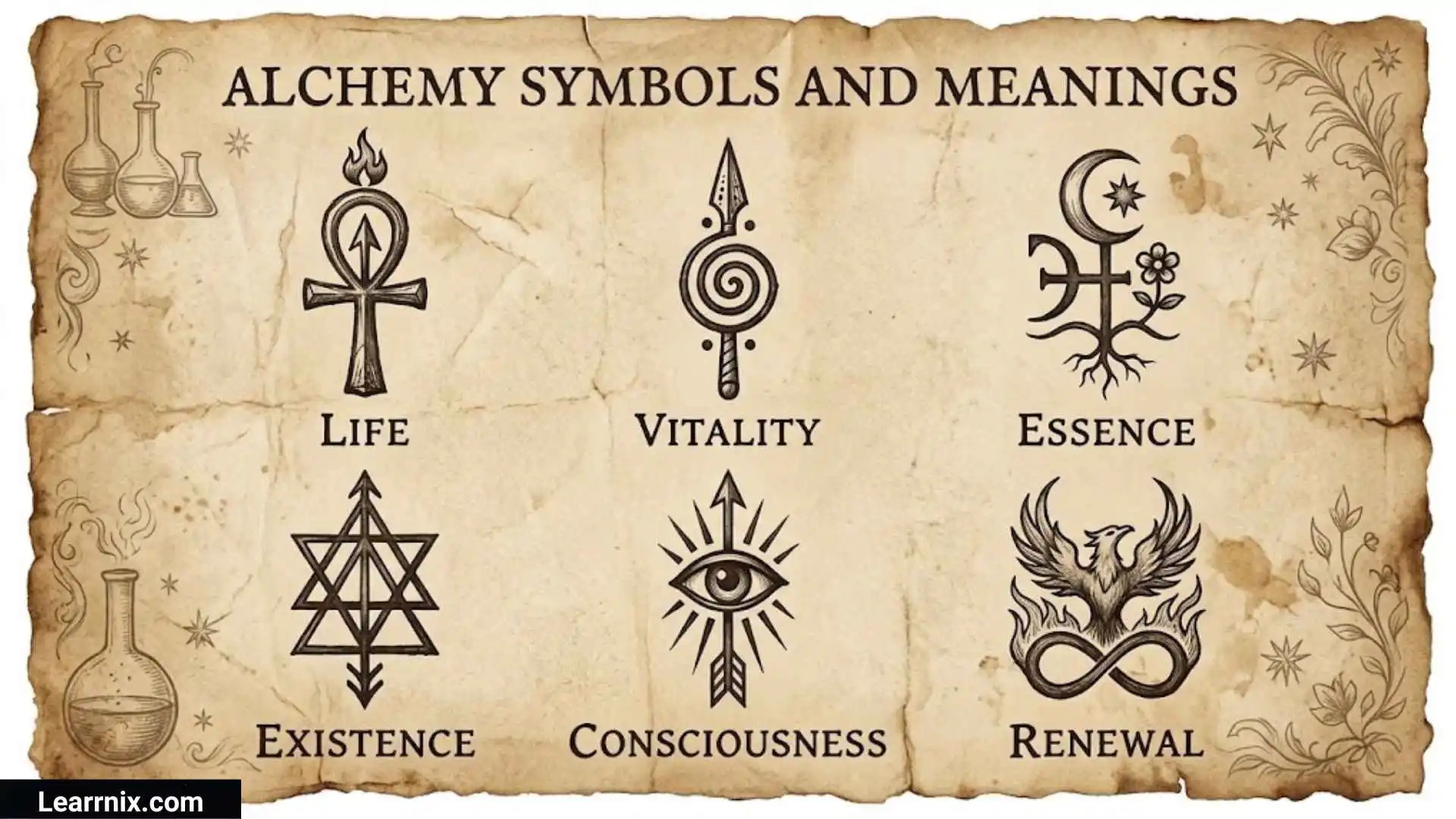
Alchemy symbols have been used for centuries to represent elements, metals, planets, chemical processes, and philosophical ideas. From the four elemental triangles to the Sun, Moon, and Ouroboros, these symbols offer a fascinating look into how ancient thinkers understood nature and transformation. Today, they remain popular in tattoos, jewelry, spiritual artwork, and digital designs.
People search for alchemy symbols for different reasons. Some want to understand their historical meanings, while others are interested in spiritual alchemy, protection symbols, sacred geometry, or characters they can copy and paste into social media bios. Understanding the purpose behind each symbol helps you choose one that matches your interests.
In this guide, you will discover popular alchemy symbols and meanings, explore their connections to ancient and medieval traditions, and learn how they represent physical and spiritual transformation. You will also find copy-and-paste symbols, tattoo ideas, and practical explanations to help you distinguish historical facts from modern interpretations.
Alchemy Symbols and Meanings
Alchemy symbols formed a visual language used by alchemists to identify substances, metals, planets, elements, and laboratory operations. Their meanings developed over many centuries, so a symbol could have different interpretations depending on the manuscript, author, and historical tradition.
Many familiar alchemical signs come from European traditions that connected metals with the seven classical planets. Other symbols represented the four classical elements or substances that played important roles in alchemical experiments.
| Symbol | Name | Common Meaning |
| 🜂 | Fire | Heat, combustion, and transformation |
| 🜁 | Air | The airy element and volatile processes |
| 🜃 | Earth | Solid matter and stability |
| 🜄 | Water | Liquids and dissolution |
| ☉ | Sun | Gold and solar associations |
| ☽ | Moon | Silver and lunar associations |
| ☿ | Mercury | Mercury and its planetary association |
| 🜍 | Sulfur | Sulfur and its role in alchemical theories |
| 🜔 | Salt | Salt and material principles in some traditions |
The four elemental symbols are particularly recognizable. Fire is represented by an upward-pointing triangle, while water uses a downward-pointing triangle. Air has an upward triangle crossed by a horizontal line, and earth has a downward triangle crossed by a horizontal line.
Planetary symbols were also important. In many European alchemical systems, Mars was associated with iron, Venus with copper, Jupiter with tin, Saturn with lead, and Mercury with the metal mercury.
These associations reflected historical ideas about relationships between the heavens and earthly materials. They were part of traditional natural philosophy rather than modern scientific explanations of metals.
When researching a symbol, consider its historical context. Some signs had practical laboratory uses, while others appeared in philosophical diagrams or symbolic illustrations. Modern spiritual meanings can be interesting, but they should not automatically be treated as the original historical interpretation.
Spiritual Alchemy Symbols and Meanings
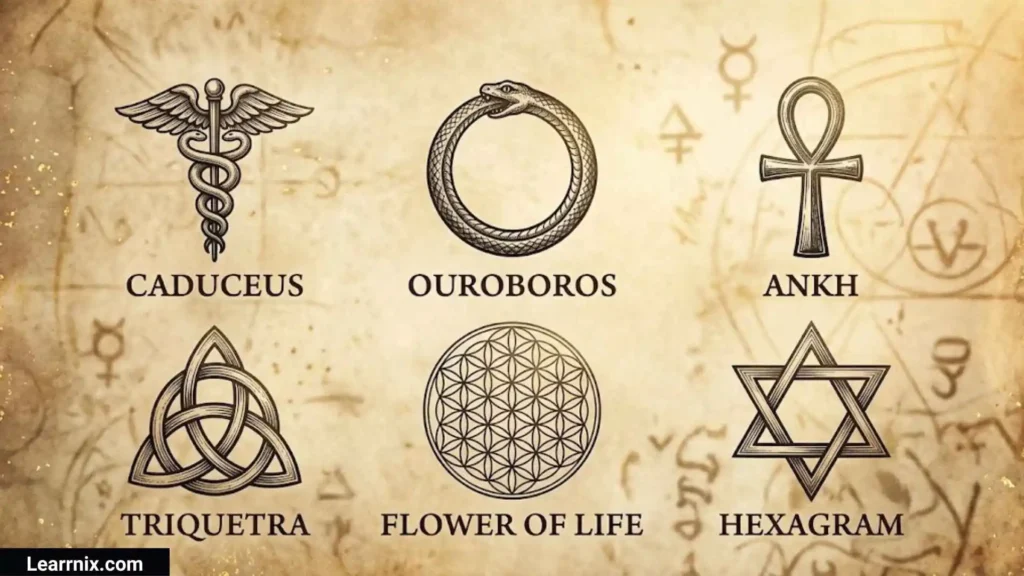
Spiritual alchemy interprets transformation as a process of inner development. Instead of focusing only on physical substances, it uses alchemical imagery to explore wisdom, self-awareness, emotional maturity, and the search for a more balanced life.
Several symbols are commonly associated with spiritual alchemy, although their interpretations vary across traditions.
- Philosopher’s Stone: Represents the legendary goal of alchemy and is often interpreted as wisdom, perfection, or spiritual fulfillment.
- Ouroboros: A serpent or dragon consuming its own tail, commonly associated with cycles, continuity, and renewal.
- Sun (☉): Can represent illumination, vitality, clarity, and gold.
- Moon (☽): May represent reflection, cycles, and the silver associated with lunar symbolism.
- Rebis: A figure combining masculine and feminine characteristics in certain alchemical illustrations, often interpreted as a union of opposites.
- Fire (🜂): Can symbolize purification, determination, and transformation.
- Water (🜄): May represent cleansing, adaptability, or reflection in modern spiritual interpretations.
How Spiritual Alchemy Represents Personal Growth
Transformation is a central theme in spiritual interpretations of alchemy. A person might use the image of fire to represent overcoming a difficult period or the Ouroboros to symbolize beginning again after a major life change.
The Philosopher’s Stone is especially significant because it represents the legendary achievement sought by many alchemists. In modern spiritual writing, it is frequently used as a metaphor for discovering wisdom or developing a deeper understanding of oneself.
However, spiritual alchemy is not one universally defined belief system. Some historical writers combined philosophical, religious, and material ideas, while modern interpretations often emphasize personal growth.
These symbols can serve as reminders of personal goals, but their meaning depends on the individual and the tradition in which they are used.
Alchemy Symbols for Elements
The four classical elements—fire, air, water, and earth—are among the most recognizable parts of alchemical symbolism. Ancient and medieval philosophers used elemental theories to explain the qualities and behavior of matter.
These elements belong to a historical philosophical model, not the modern periodic table of chemical elements.
| Symbol | Element | Shape | Common Association |
| 🜂 | Fire | Upward triangle | Heat, energy, and transformation |
| 🜁 | Air | Upward triangle with a horizontal line | Airiness and volatile processes |
| 🜃 | Earth | Downward triangle with a horizontal line | Solid matter and stability |
| 🜄 | Water | Downward triangle | Liquids and dissolution |
Fire (🜂) was associated with heating, combustion, and processes that changed the properties of materials. In modern symbolic designs, it can represent courage, energy, or a period of personal change.
Air (🜁) represented the airy element and was connected with certain volatile processes. Contemporary interpretations may associate it with thought, movement, communication, or freedom.
Earth (🜃) represented solid matter and the earthly element. Today, it is often used to symbolize stability, grounding, strength, or a connection with nature.
Water (🜄) represented liquids and processes involving dissolution. In modern spiritual artwork, it may suggest adaptability, reflection, cleansing, or renewal.
These four signs are useful for educational projects, tattoos, and designs inspired by historical alchemy. Their traditional meanings should be distinguished from contemporary personal interpretations.
Hermetic Alchemy Symbols
Hermetic alchemy is connected with a philosophical tradition associated with Hermes Trismegistus, a legendary figure combining characteristics of the Greek Hermes and the Egyptian Thoth. Hermetic writings influenced Western esoteric philosophy and some approaches to alchemy.
Hermetic ideas often explore the relationship between humanity, nature, and the wider cosmos. Symbols provided a visual language for expressing these connections, although no single symbol system applied to every Hermetic author.
Common symbols encountered in Hermetic or related alchemical traditions include:
- ☉ Sun: Associated with gold and solar principles.
- ☽ Moon: Associated with silver and lunar principles.
- ☿ Mercury: Represents the metal mercury and its planetary namesake.
- 🜍 Sulfur: An important substance and philosophical principle in many alchemical systems.
- 🜔 Salt: A material principle in some later alchemical frameworks.
- Ouroboros: A serpent consuming its tail, often associated with cycles and continuity.
The Emerald Tablet is one of the best-known texts associated with Hermetic traditions. Its ideas about correspondence between different levels of existence influenced later interpretations of alchemy.
The phrase “as above, so below” is commonly associated with interpretations of the Emerald Tablet. It is often used to describe a relationship between the cosmos and the earthly world, although interpretations differ.
Hermetic symbols can be useful for philosophical study and historically inspired artwork. To understand a particular sign accurately, examine the text or tradition in which it appears rather than assuming that every modern explanation is historically established.
Sacred Geometry Alchemy Symbols
Sacred geometry explores shapes and patterns that people have considered meaningful in philosophical, religious, artistic, and spiritual traditions. Circles, triangles, and squares appear in many historical diagrams, including some associated with alchemy.
Not every geometric shape is an alchemical symbol. Its significance depends on the context in which it appears.
| Symbol | Geometric Name | Possible Interpretation |
| ○ | Circle | Unity, wholeness, or cycles |
| △ | Triangle | Elemental symbolism or three-part relationships |
| □ | Square | Stability, structure, and order |
| ☉ | Sun | Gold and solar associations |
| ⊙ | Circle with a dot | A geometric form with solar associations in some contexts |
| ◇ | Diamond shape | A decorative geometric form whose meaning depends on context |
The circle appears in many alchemical illustrations. Depending on the image, it may represent a boundary, a cycle, a celestial body, or part of a larger diagram.
Triangles have a particularly clear role in classical elemental symbolism because their orientation and horizontal lines distinguish fire, air, water, and earth.
Modern spiritual artwork sometimes combines alchemical signs with the pentagram, hexagram, or Flower of Life. These patterns have their own histories and should not automatically be described as symbols that originated in alchemy.
If you are creating an alchemy-inspired design, select shapes that support the meaning you want to express. For historical accuracy, compare the design with a documented manuscript or scholarly source.
Transmutation Alchemy Symbols
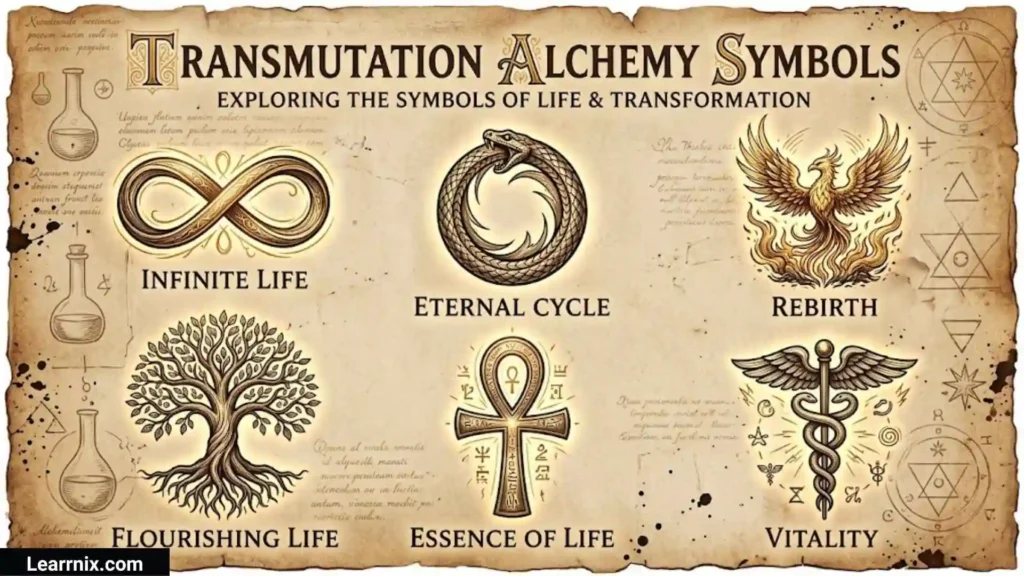
Transmutation refers to changing one substance into another. Historical alchemists were especially interested in whether less valuable metals could be transformed into gold. They also investigated processes such as heating, dissolving, refining, and combining materials.
Several symbols and images are associated with alchemical transmutation.
- 🜂 Fire: Represents heat and the use of fire in material transformations.
- 🜄 Water: Represents liquids and processes involving dissolution.
- ☉ Sun: Associated with gold in many European alchemical systems.
- ☿ Mercury: Represents the metal mercury and its role in alchemical theories.
- Philosopher’s Stone: A legendary substance believed by some alchemists to enable metallic transmutation.
- Ouroboros: Often associated with cycles and recurring processes in symbolic interpretations.
The Philosopher’s Stone became one of the most famous goals in alchemical literature. Some writers described it as a substance capable of transforming base metals into gold, while others also gave it philosophical or spiritual significance.
Transmutation symbols did not always describe one fixed procedure. Their meanings depended on the author, historical period, and surrounding instructions.
Modern chemistry distinguishes ordinary chemical reactions from nuclear reactions. Chemical reactions do not change one element into another, whereas nuclear processes can change atomic nuclei and transform elements. Traditional attempts to produce gold through ordinary chemical methods did not achieve that result.
Today, transmutation is also used metaphorically to describe change. In artwork or writing, an alchemical transformation can represent learning from difficult experiences, developing new skills, or moving toward a more considered way of life.
Ancient Spiritual Alchemy Symbols
Ancient alchemy developed through interactions among different cultures, particularly in the Hellenistic world of Egypt. Later scholars writing in Arabic and Latin translated, expanded, and adapted earlier alchemical knowledge.
Some historical symbols later acquired spiritual interpretations, while others were connected to practical experiments. The distinction matters because modern explanations sometimes assign meanings that cannot be confirmed from ancient sources.
Commonly discussed symbols include:
- Ouroboros: A serpent or dragon consuming its own tail, associated with cyclical imagery and renewal.
- ☉ Sun: Connected with solar imagery and later European associations with gold.
- ☽ Moon: Connected with lunar imagery and later European associations with silver.
- Four Elemental Signs: Represent fire, air, water, and earth in classical elemental systems.
- Philosopher’s Stone: A legendary alchemical goal associated with metallic transmutation and, in some later interpretations, perfection.
The Ouroboros is especially recognizable because its circular form suggests continuity. It can represent an ongoing process in which an ending becomes part of another beginning.
The Sun and Moon also appear in numerous symbolic traditions. Their associations with gold and silver became particularly influential in European alchemy, but their meanings were not identical across every culture and historical period.
When researching ancient spiritual alchemy, check whether an interpretation comes from an early text, a later philosophical tradition, or a modern spiritual source. This approach helps you understand the symbol without confusing historical evidence with contemporary belief.
Alchemy Symbols Manuscript
Alchemy manuscripts provide important evidence of how symbols were used in historical settings. They contain recipes, laboratory instructions, diagrams, illustrations, and philosophical discussions.
Three well-known works are useful starting points for learning about the visual language of alchemy.
Splendor Solis
Splendor Solis is a richly illustrated alchemical work dating to the sixteenth century. It is known for its elaborate paintings and symbolic imagery, which offer insight into the visual traditions of European alchemy.
Its illustrations can help readers explore how alchemical authors communicated ideas about transformation, nature, and philosophical change.
Mutus Liber
Mutus Liber, published in the seventeenth century, presents alchemical themes largely through illustrations. Its visual approach demonstrates why images should be studied alongside the surrounding context instead of interpreted as isolated symbols.
The work is particularly interesting for readers exploring how historical alchemists used sequences of images to communicate complex ideas.
Aurora Consurgens
Aurora Consurgens is a medieval work containing alchemical, philosophical, and religious imagery. It illustrates the close relationship between different kinds of symbolic expression in some historical traditions.
When examining an alchemy manuscript, pay attention to its date, language, and surrounding text. A symbol beside a laboratory instruction may have a practical function, while a similar-looking sign in an allegorical illustration may have a broader philosophical meaning.
Unicode characters are useful for displaying familiar alchemical symbols digitally, but they cannot reproduce every handwritten variation found in historical documents. Some manuscript marks may also lack a direct Unicode equivalent.
For reliable research, use digitized library and museum collections or scholarly editions. Comparing the original image with an explanation from a knowledgeable source is more dependable than relying on symbol charts without historical references.
Transmutation Spiritual Alchemy Symbols
Transmutation in spiritual alchemy describes a metaphorical journey from one state to another. It may represent the development of patience, the search for wisdom, or the process of learning from difficult experiences.
Several symbols are frequently used to express these ideas.
- Philosopher’s Stone: Represents the pursuit of wisdom, completion, or a refined state of understanding.
- Ouroboros: Represents continuity, renewal, and recurring cycles.
- 🜂 Fire: Can symbolize determination, purification, and the release of old patterns.
- 🜄 Water: May represent adaptability, reflection, and renewal in modern interpretations.
- ☉ Sun and ☽ Moon: Can symbolize complementary forces and different aspects of experience.
- Rebis: Represents the union of opposites in certain alchemical illustrations.
For example, someone who learns from a major setback may use the idea of transmutation to describe turning a difficult experience into an opportunity for growth. The symbol becomes a visual reminder of that personal meaning.
This interpretation is different from claiming that a symbol causes a transformation. Spiritual symbolism can express an intention, but the character itself does not guarantee a particular outcome.
There is no universally accepted list of spiritual transmutation symbols. If you want to use one in a journal, tattoo, or personal design, consider both its historical background and the meaning you want it to represent.
Alchemy Symbols Tattoo
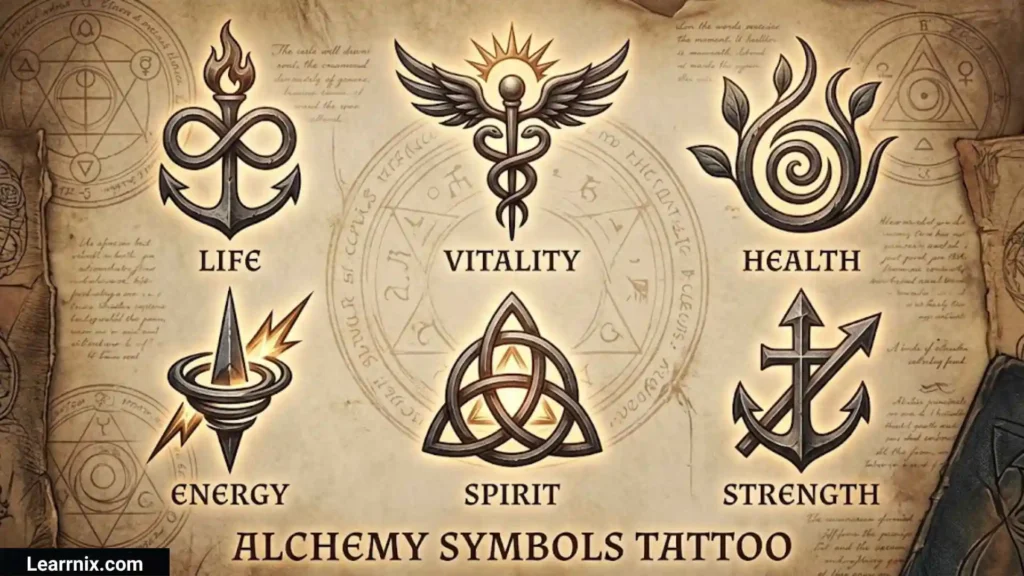
Alchemy tattoos appeal to people interested in ancient philosophy, geometric artwork, historical mysteries, and the idea of personal transformation. A design may feature one small symbol or combine several signs into a larger composition.
Popular options include the elemental triangles, the Ouroboros, the Sun and Moon, and geometric designs inspired by alchemical manuscripts.
Four Elements Tattoo
The four elemental symbols make a recognizable geometric design. You can display them separately or arrange them together to represent fire, air, earth, and water.
This option works well for people who appreciate classical elemental symbolism and want a simple design rather than a detailed illustration.
Ouroboros Tattoo
The Ouroboros depicts a serpent or dragon consuming its own tail. It is often interpreted as a symbol of continuity, renewal, and cycles.
A circular outline can create a clean design, while a more detailed version may include scales or decorative lines. If historical accuracy matters, research the particular image you want to reproduce.
Sun and Moon Tattoo
The symbols ☉ and ☽ are associated with gold and silver in many European alchemical traditions. Together, they can create a balanced design inspired by celestial imagery.
Some people also use the pair to express complementary qualities, such as action and reflection. This broader interpretation should be understood as symbolic rather than universal.
Geometric Alchemy Tattoo
Circles, triangles, and intersecting lines can create a design inspired by historical diagrams. Such designs can be minimalist or elaborate, depending on the placement and level of detail.
Before choosing a tattoo, check the symbol’s origin and meaning. Modern designs sometimes combine unrelated symbols or assign them meanings that are not supported by historical evidence.
Consider size and placement as well. Small characters may suit the wrist or ankle, while detailed designs usually need more room. Ask an experienced tattoo artist to review line thickness and spacing so the symbol remains clear over time.
Alchemy Symbols Copy Paste
If you need alchemy symbols for social media bios, usernames, captions, messages, or digital artwork, the following characters can be copied directly.
The list includes dedicated alchemical Unicode characters alongside familiar astronomical symbols used in alchemical traditions.
| Symbol | Name | Unicode Code Point |
| 🜂 | Alchemical Symbol for Fire | U+1F702 |
| 🜁 | Alchemical Symbol for Air | U+1F701 |
| 🜃 | Alchemical Symbol for Earth | U+1F703 |
| 🜄 | Alchemical Symbol for Water | U+1F704 |
| ☉ | Sun | U+2609 |
| ☽ | First Quarter Moon | U+263D |
| ☿ | Mercury | U+263F |
| ♂ | Male Sign; also used for Mars | U+2642 |
| ♀ | Female Sign; also used for Venus | U+2640 |
| ♃ | Jupiter | U+2643 |
| ♄ | Saturn | U+2644 |
| 🜍 | Alchemical Symbol for Sulfur | U+1F70D |
| 🜔 | Alchemical Symbol for Salt | U+1F714 |
Copy and paste: 🜂 🜁 🜃 🜄 ☉ ☽ ☿ ♂ ♀ ♃ ♄ 🜍 🜔
How To Use Alchemy Symbols
- Social media bios: Add an elemental, solar, or lunar character to personalize your profile.
- Text messages: Use a symbol as a decorative accent or separator.
- Digital artwork: Combine elemental signs with circles, triangles, and lines.
- Personal journals: Mark entries about reflection, learning, or change.
- Creative projects: Add historically inspired characters to posters, invitations, or book covers.
Why Some Alchemy Symbols May Not Display
Unicode characters depend on the fonts and software available on your device. Some alchemical characters may appear as empty boxes if the required glyph is missing. Their appearance can also vary between browsers, operating systems, and applications.
Test your selected character where you intend to use it. If it does not display correctly, consider a simpler geometric alternative, but remember that a substitute shape may not carry the same historical meaning.
Protection Transmutation Alchemy Symbols
Protection and transmutation symbols are popular in modern spiritual artwork, jewelry, and tattoos. People may choose them to express resilience, personal boundaries, renewal, or the wish to move beyond difficult experiences.
However, there is no single historical alchemical symbol universally recognized as a guarantee of protection. Some protective interpretations come from broader esoteric traditions, while others are modern associations or personal meanings.
| Symbol | Possible Symbolic Interpretation |
| Ouroboros | Continuity, resilience, and renewal |
| 🜂 Fire | Purification and transformation |
| 🜃 Earth | Stability and grounding |
| ☉ Sun | Clarity, light, and vitality |
| ☽ Moon | Reflection and changing cycles |
| ○ Circle | Wholeness or a symbolic boundary |
| Philosopher’s Stone | Wisdom and refinement |
Someone who wants a reminder to stay grounded might choose an earth symbol. Another person may prefer the Ouroboros to represent resilience after a challenging period.
These meanings are symbolic rather than evidence that a character provides supernatural or physical protection.
Choosing A Protection Symbol
Begin by identifying what you want the symbol to represent. For stability, the earth triangle may fit your intention. For renewal, the Ouroboros can express the idea of beginning again. For clarity, the Sun can serve as a visual metaphor.
Avoid combining unrelated marks simply because they look mysterious. A simple design with a clear meaning is often more effective than a crowded arrangement.
If you want an authentic historical protective mark, research its original cultural context. Alchemical signs, religious emblems, and magical talismans are not interchangeable, even when they appear together in some historical settings.
Medieval Alchemy Symbols
Medieval alchemy developed through the exchange of knowledge across Greek, Syriac, Arabic, and Latin scholarly traditions. Arabic-language scholars preserved and expanded earlier works, and many texts later entered European intellectual life through translation.
Alchemists used symbols to represent metals, substances, planetary associations, and laboratory processes. Their notation was not fully standardized, so a symbol’s appearance or meaning could differ between manuscripts.
Common signs in medieval and later European alchemy include:
- ☉ Sun: Associated with gold and solar principles.
- ☽ Moon: Associated with silver and lunar principles.
- ☿ Mercury: Associated with the metal mercury and its planetary namesake.
- ♂ Mars: Associated with iron and martial symbolism.
- ♀ Venus: Associated with copper and Venusian symbolism.
- ♃ Jupiter: Associated with tin.
- ♄ Saturn: Associated with lead.
- 🜂 Fire: Associated with the classical fire element and heating.
- 🜄 Water: Associated with the classical water element and liquids.
The planetary-metal system reflected the natural philosophy of the period. It connected celestial bodies with earthly substances, but it should not be confused with modern scientific explanations of chemical elements.
Medieval alchemy also involved medicinal preparations, mineral substances, distillation, and theories about the composition of matter. Its practitioners explored more than the popular goal of transforming base metals into gold.
To understand a medieval alchemy symbol accurately, examine the manuscript in which it appears. Nearby text, illustrations, and instructions may reveal whether the sign refers to a material, an operation, or a broader philosophical concept.
Frequently Asked Questions
What are the most common alchemy symbols?
The four elemental symbols, Sun, Moon, Mercury, sulfur, and salt are among the best-known alchemical signs. The Ouroboros and Philosopher’s Stone are also widely recognized in alchemical imagery.
What does the alchemy symbol for transformation mean?
There is no single universal symbol for transformation. Fire, the Ouroboros, and the Philosopher’s Stone are commonly used to represent change, renewal, or refinement, depending on the context.
What is the difference between spiritual alchemy and physical alchemy?
Physical alchemy involved working with substances and studying processes such as heating, dissolution, and distillation. Spiritual alchemy uses transformation as a metaphor for personal growth, wisdom, or inner change.
Can I copy and paste alchemy symbols into my bio?
Yes. Many alchemical and related astronomical symbols are available as Unicode characters. Their appearance depends on the device, font, and application, so test them before publishing.
Do alchemy symbols have universal meanings?
No. Some symbols have established historical associations, but interpretations vary across periods, manuscripts, and traditions. Modern spiritual meanings may differ from their original technical uses.
Conclusion
Alchemy symbols offer a fascinating way to explore historical ideas about matter, nature, philosophy, and transformation. From the four elemental triangles to planetary signs and the Ouroboros, these characters connect readers with traditions that developed over many centuries.
They also have practical uses today. You can copy and paste them into social media bios, use them as inspiration for tattoos, or incorporate them into digital artwork and personal journals. Understanding their origins makes it easier to choose symbols that match your intended message.
The most useful approach is to consider each symbol in context rather than assuming that every sign has one fixed meaning. Whether your interest is ancient history, spiritual symbolism, or creative design, learning the background of alchemy symbols will help you use and understand them more confidently.

I am Michael Carter, an educational content creator who believes that knowledge has the power to transform lives.
I create resources focused on modern education, digital learning, and building essential skills for the future.
I love helping readers discover simple and effective ways to improve their learning journey.
Books by Michael Carter:
- Modern Education for Tomorrow’s World
- Learning Skills for Future Success
 Charlotte Anderson