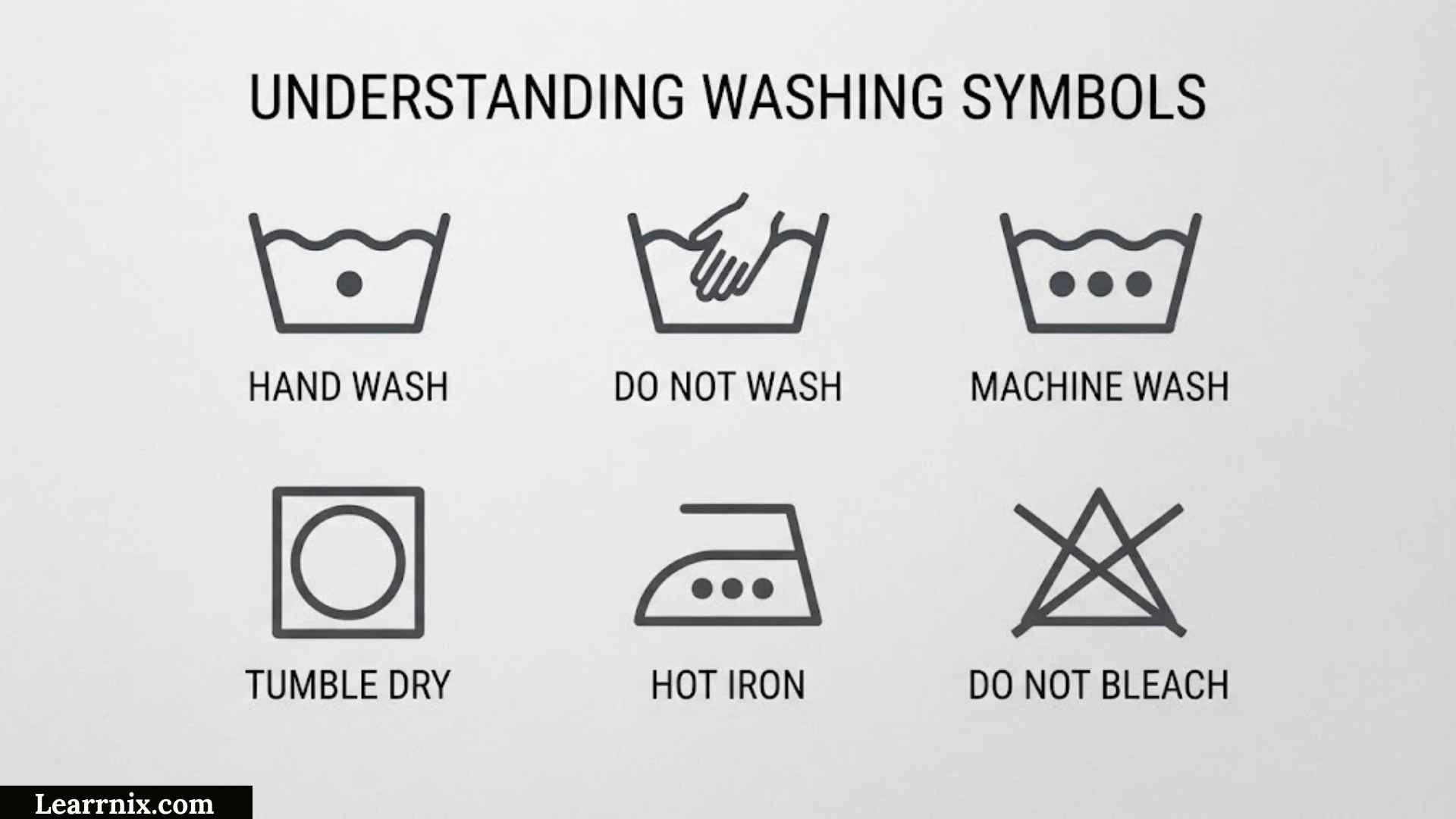
Washing symbols make clothing care easier by replacing long washing instructions with simple visual marks. A small symbol on a shirt, dress, towel, or pair of trousers can tell you whether the item should be machine washed, hand washed, washed at a particular temperature, or treated with a gentler cycle. Learning these symbols can help you avoid common problems such as shrinking, stretching, fading, and fabric damage.
The most familiar washing symbol is the tub filled with water. Numbers inside the tub indicate the maximum washing temperature, while a hand, lines underneath, or a cross can change the instruction. These symbols are often accompanied by separate icons for bleaching, drying, ironing, and professional cleaning, creating a complete care guide on a small clothing tag.
In this guide, you will learn what washing symbols mean, how to read laundry symbols on clothes and tags, what the 30°C symbol with a line underneath means, how permanent press symbols work, and how international and fabric washing symbols differ. The practical chart and examples below make the most common care instructions easier to understand.
Washing Symbols and Meanings
Washing symbols are graphical instructions that explain how a garment should be cleaned with water. The basic washing symbol is a wash tub, and additional markings provide details about temperature, washing method, and mechanical action.
Here are the most useful washing symbols to recognize:
| Washing Symbol | Meaning |
| Tub with no temperature shown | Washing instruction; follow the specified care information |
| Tub with 30 | Wash at a maximum of 30°C |
| Tub with 40 | Wash at a maximum of 40°C |
| Tub with 60 | Wash at a maximum of 60°C |
| Tub with a hand | Hand wash |
| Tub with one line underneath | Use a reduced or mild washing process |
| Tub with two lines underneath | Use a very gentle washing process |
| Crossed-out tub | Do not wash with water |
The number inside the tub is a maximum temperature, not necessarily a command to use that exact temperature. For example, a 40°C symbol means the garment should not be washed above 40°C.
Lines underneath the tub are also important. They indicate that the garment requires reduced mechanical action. A garment with one line should generally receive gentler treatment than one with a plain tub symbol.
The crossed-out tub is one of the easiest symbols to understand: it means water washing should not be used. Other cleaning instructions on the label should then be followed.
The Federal Trade Commission’s care-symbol guide includes wash categories such as normal, permanent press, delicate/gentle, and hand washing, along with maximum temperature markings.
What Do Washing Symbols Mean
Washing symbols tell you how much washing stress a garment can safely receive. They are particularly useful because a garment may look durable while still having a finish, dye, construction, or combination of materials that needs special treatment.
The main elements to look for are:
- Tub: Indicates washing.
- Number: Shows the maximum washing temperature in systems that use temperature numbers.
- Hand: Indicates hand washing.
- One line: Indicates reduced mechanical action.
- Two lines: Indicates a very gentle process.
- Cross: Indicates that the process should not be used.
For example, a 30°C tub with one line underneath means the garment should be washed at no more than 30°C using reduced mechanical action. A 40°C tub without a line permits a normal washing process up to 40°C.
The meaning of a symbol should not be separated from the rest of the care label. A garment might be machine washable but require a low temperature, gentle cycle, special drying method, or no bleaching.
Care labels are intended to communicate regular care instructions, and manufacturers covered by the FTC’s U.S. Care Labeling Rule must have a reasonable basis for the instructions they provide.
Washing Symbols on Clothes
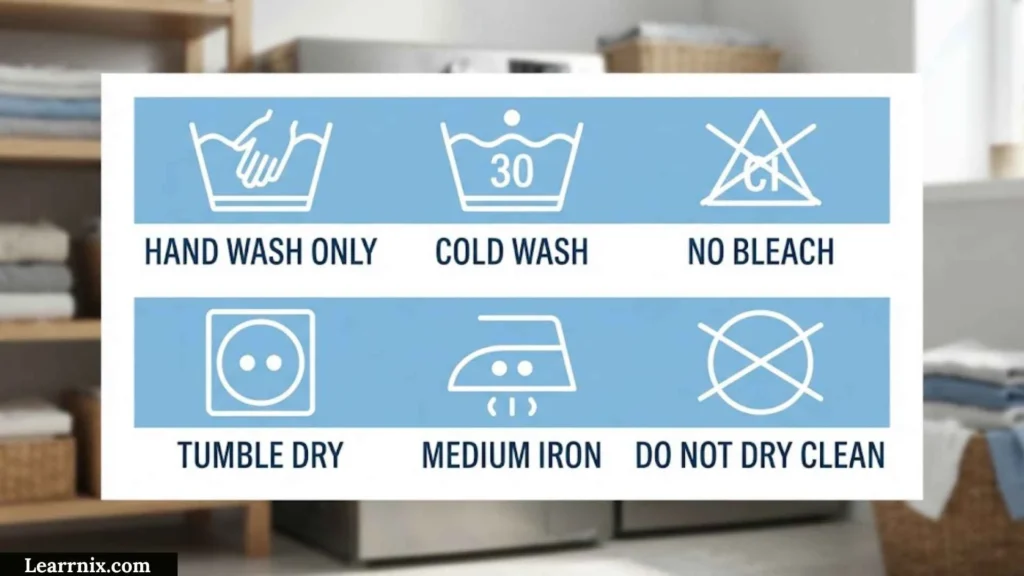
Washing symbols on clothes are normally found on a permanent care label sewn into the garment. Depending on the clothing design, you may find the label inside a side seam, near the waistband, inside the collar, or in another location that is easy to access but not highly visible during wear.
A clothing care label can contain several groups of symbols:
- Washing symbols — shown with a tub.
- Bleaching symbols — shown with a triangle.
- Drying symbols — shown with a square.
- Ironing symbols — shown with an iron.
- Professional cleaning symbols — shown with a circle.
This order is useful because it lets you understand the garment’s complete care routine instead of looking only at the washing instruction.
For instance, a shirt may allow machine washing at 30°C but prohibit tumble drying. In that case, choosing the correct washing cycle alone is not enough. The drying symbol also needs to be followed.
The safest habit is to check the care label before washing a new garment, particularly if it is made from a delicate material, contains decorative details, or has a complicated fabric blend.
Washing Symbols on Tags
Washing symbols on tags provide compact instructions that can be understood without relying entirely on written language. This is particularly helpful for garments sold internationally.
A typical care tag may show a sequence similar to:
Wash → Bleach → Dry → Iron → Professional Care
Not every garment needs every category. The manufacturer provides the instructions that apply to the product.
When reading a tag, look for three kinds of information:
Numbers
Numbers inside washing symbols generally indicate maximum washing temperatures. A 30 symbol means a maximum of 30°C, while 40 means a maximum of 40°C.
Lines
Lines beneath the wash tub indicate reduced mechanical action. More lines mean a gentler process.
Crossed Symbols
A cross indicates that the corresponding process should not be used. A crossed washing tub, for example, means the garment should not be washed with water.
In the United States, the FTC requires covered manufacturers and importers to provide appropriate regular-care information, and care labels may use approved care symbols under the applicable rules.
Laundry Symbols Chart
A laundry symbols chart gives you a quick reference when you cannot remember what each icon means.
| Symbol Type | Meaning | Practical Instruction |
| Wash tub | Washing | Follow the temperature and process shown |
| Tub + 30 | Maximum 30°C | Use a wash cycle at or below 30°C |
| Tub + 40 | Maximum 40°C | Use a wash cycle at or below 40°C |
| Tub + 60 | Maximum 60°C | Do not exceed 60°C |
| Tub + hand | Hand washing | Wash gently by hand |
| Tub + one line | Mild process | Reduce mechanical action |
| Tub + two lines | Very mild process | Use a very gentle cycle |
| Crossed tub | Do not wash | Do not wash with water |
| Triangle | Bleaching | Check whether bleach is permitted |
| Square | Drying | Follow the drying instructions |
| Iron | Ironing | Follow the indicated heat level |
| Circle | Professional cleaning | Check professional-care instructions |
This chart is a quick guide rather than a replacement for the complete label. Extra markings can change how a symbol should be interpreted.
For example, a square with a circle concerns tumble drying, while a square without a circle can represent other drying methods. Similarly, dots inside an iron indicate heat levels.
The FTC’s published ASTM care-symbol chart separates care instructions into washing, bleaching, drying, ironing, and drycleaning categories and includes additional warning symbols such as do not wash and do not tumble dry.
Machine Washing Symbols
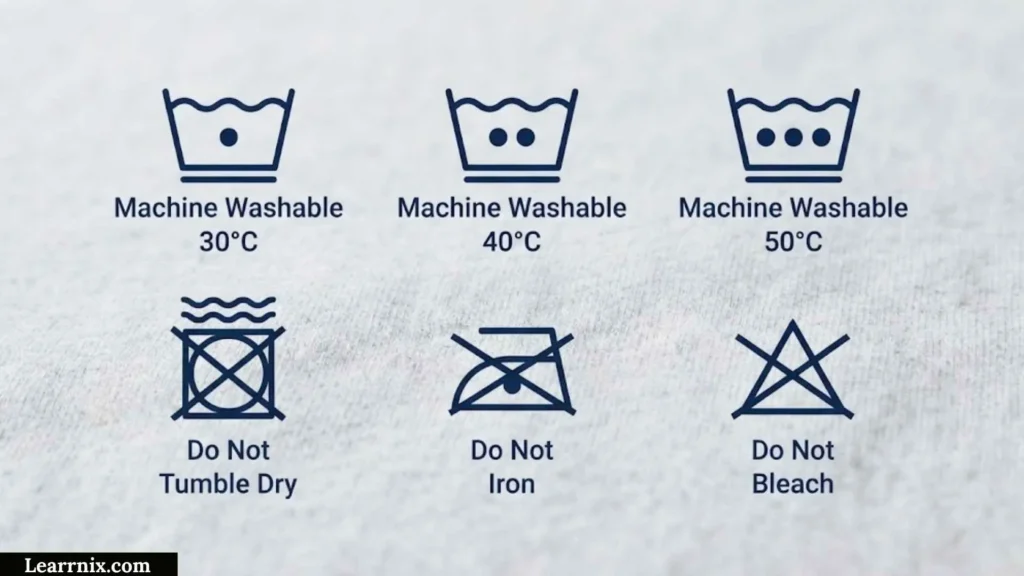
Machine washing symbols help you select an appropriate washing-machine cycle. The wash tub is the main symbol, while numbers, hands, lines, and crosses provide additional instructions.
A plain tub generally represents a normal machine-washing process when the label permits machine washing. A tub with one line underneath calls for reduced mechanical action, and two lines indicate an even gentler process.
Common examples include:
- 30°C tub: Maximum temperature of 30°C.
- 40°C tub: Maximum temperature of 40°C.
- 30°C tub with one line: Maximum 30°C with reduced mechanical action.
- 40°C tub with two lines: Maximum 40°C with very gentle mechanical action.
- Hand in tub: Hand wash rather than a normal machine cycle.
- Crossed tub: Do not machine wash or water wash.
Modern washing machines may use settings such as delicate, gentle, wool, synthetics, or permanent press. The exact operation of these settings differs between machines, so the garment label should be the starting point.
A gentle setting does not automatically make every garment safe to wash. If the label says do not wash, a gentle machine cycle should not be used.
Washing Symbols 30 With Line Under
The 30°C washing symbol with one line underneath combines two instructions.
First, the 30 indicates a maximum washing temperature of 30°C. Second, the single line underneath the tub indicates reduced mechanical action.
In practical terms, select a washing-machine program that stays at or below 30°C and provides a mild or reduced-action wash.
This symbol should not be confused with a plain 30°C wash symbol. The temperature limit is the same, but the line adds a mechanical-action requirement.
This can matter for garments that are more sensitive to agitation, spinning, or other mechanical stress. Using a normal heavy-duty cycle simply because the machine is set to 30°C may still provide more mechanical action than the care label recommends.
A useful way to remember the symbol is:
30 = temperature limit
One line = gentler mechanical treatment
The FTC’s published ASTM guide identifies different machine-washing levels, including normal, permanent press, and delicate/gentle processes, showing why the additional markings matter rather than being decorative details.
Washing Symbols Permanent Press
Permanent press is associated with clothing designed or finished to reduce wrinkling and with a care process that uses reduced mechanical treatment. In care-symbol systems, a line beneath the wash tub can identify a permanent-press or similar reduced-action process.
A single line under the washing tub is therefore important when interpreting care instructions for garments that should receive a reduced washing action.
Permanent press can also appear as a named setting on a washing machine or dryer. In the U.S. care terminology described by the FTC, a durable-press or permanent-press washing cycle includes a cool-down rinse or cold rinse before reduced spinning.
The important point is that permanent press does not mean “wash normally.” It indicates a particular type of reduced-action care.
If a garment has a permanent-press instruction, choose the corresponding cycle when your machine provides it. If the machine does not have that exact setting, compare its available cycles with the care label and choose one that provides the required temperature and reduced mechanical action.
Garment Washing Symbols
Garment washing symbols are part of a larger visual care system. They help explain what can happen to a garment during washing and finishing.
The five major care categories are easy to recognize:
Washing
The tub represents washing. Numbers indicate maximum temperatures, while the hand and lines provide additional instructions.
Bleaching
The triangle represents bleaching. Depending on the marking, the garment may allow bleach, restrict it to certain types, or prohibit bleaching.
Drying
The square represents drying. A square containing a circle is associated with tumble drying, while other square-based symbols provide instructions for line drying, drip drying, or drying flat.
Ironing
The iron represents ironing. Dots inside the symbol indicate permitted heat levels.
Professional Cleaning
The circle represents professional cleaning. Additional letters or markings can provide information for the cleaning professional.
These categories should be read together. For example, a garment may be safe to machine wash but require flat drying and low-temperature ironing.
Fabric Washing Symbols
Fabric washing symbols provide care instructions for the finished textile product rather than simply identifying the fiber inside it. This distinction matters because two garments made from the same general fiber can have different construction, dyes, finishes, trims, or blends.
Some common examples include:
- Cotton: May have normal machine-washing instructions, but the exact temperature depends on the garment.
- Wool: Often requires a gentler washing process or hand washing.
- Synthetic fabrics: May have lower-temperature or reduced-action instructions.
- Blended fabrics: Care requirements depend on the complete garment and its most sensitive components.
- Decorated garments: Prints, embroidery, beads, coatings, or other details can affect care instructions.
Do not assume that a fiber name automatically tells you the correct washing temperature. The manufacturer’s care label is more specific to the actual garment.
For example, a cotton T-shirt and a cotton sweater may not have identical washing instructions. The difference can result from construction, dye, finishing, or additional components.
The FTC’s rules also recognize that care instructions should account for components such as linings, trim, buttons, and zippers when determining appropriate garment care.
International Washing Symbols
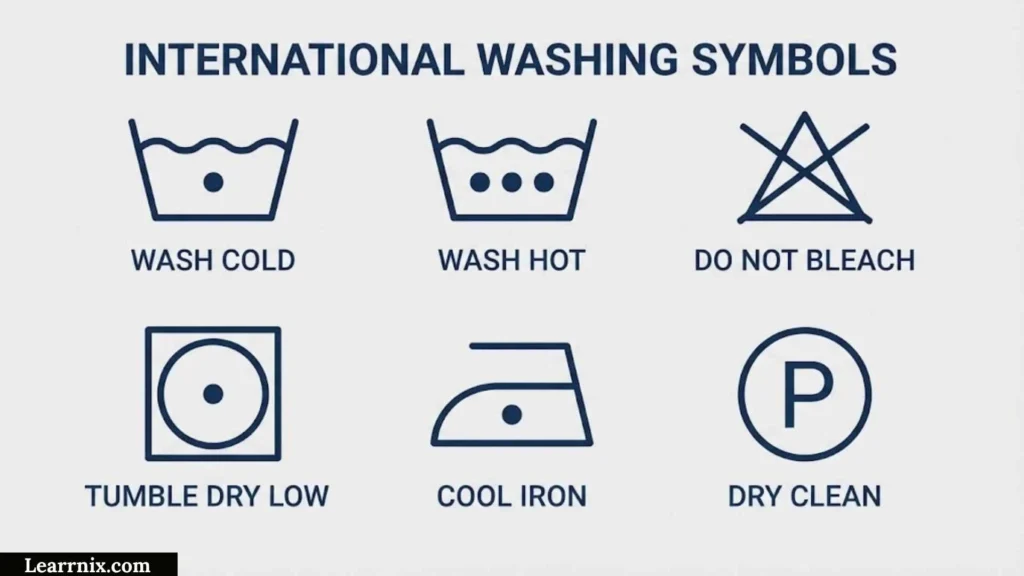
International washing symbols make clothing-care instructions easier to understand across languages and markets. The same basic visual ideas are widely recognizable: a tub for washing, triangle for bleaching, square for drying, iron for ironing, and circle for professional cleaning.
However, it is better to think of these symbols as standardized care systems rather than perfectly identical symbols everywhere. Different regional standards can use similar but not completely identical symbol sets.
The FTC specifically notes that ASTM symbols and international ISO symbols are similar but not identical.
This distinction matters when researching washing symbols online. A symbol chart from one country may not perfectly match the labeling system used on a garment from another market.
If you are looking at an imported garment, use the complete care label rather than relying on a single chart. Temperature numbers, crosses, lines, and accompanying written instructions can provide important context.
Universal Washing Symbols
Washing symbols are often called universal because their visual language allows people to understand clothing-care instructions without reading a particular language. The main shapes are highly recognizable and are used across many garment-care systems.
Still, no single chart should be treated as a guarantee that every symbol looks identical worldwide. Standards can differ, and some manufacturers use words alongside symbols to make instructions clearer.
The easiest way to remember the major care symbols is:
- Tub = washing
- Triangle = bleaching
- Square = drying
- Iron = ironing
- Circle = professional cleaning
- Crossed symbol = do not use that process
- Number in wash tub = maximum washing temperature
- Lines under tub = reduced mechanical action
You can also use this simple reading method when checking a clothing tag:
- Find the wash tub.
- Check whether there is a number inside it.
- Look for a hand or lines underneath.
- Check whether the tub is crossed out.
- Read the drying, bleaching, and ironing symbols as well.
- Follow the most restrictive applicable instruction.
This approach is more reliable than guessing based on the appearance or material of the garment alone.
FAQ
What do the washing symbols on clothes mean?
Washing symbols explain how a garment should be cleaned with water. They can show the maximum temperature, whether hand or machine washing is appropriate, and whether reduced mechanical action is required.
What does a 30 degree washing symbol mean?
A 30°C washing symbol means the garment should be washed at a maximum temperature of 30°C. If a line appears underneath the tub, a gentler mechanical process is also required.
What does a line under the washing symbol mean?
A line underneath the wash tub indicates reduced mechanical action. It means the garment should receive a milder washing process than a normal cycle.
Can I put clothes in the washing machine if the tag has a hand symbol?
A hand inside the wash tub indicates hand washing. You should not automatically replace that instruction with a regular machine cycle. If your machine has a specific hand-wash or equivalent gentle program, check whether its operation is suitable for the garment.
Are washing symbols the same in every country?
The major care-symbol shapes are widely recognized internationally, but different regional standards can use similar rather than completely identical symbols. For example, ASTM and ISO care-symbol systems are similar but not identical.
Conclusion
Washing symbols provide a compact way to understand how clothes should be washed and cared for. The wash tub, temperature numbers, hand symbol, lines underneath, and crossed-out marks each add useful information. Learning these basic elements makes clothing labels much easier to read.
For the best results, do not look at the washing symbol alone. Check the complete care label, including bleaching, drying, ironing, and professional-cleaning instructions. A garment can tolerate one process while being sensitive to another, so every part of the label can matter.
The most useful habit is simple: check the tag before washing, respect the temperature limit, and pay attention to lines or crossed symbols. Once you recognize the basic laundry symbols, choosing the right washing cycle becomes much easier and you can take better care of your clothes over time.

I am Daniel Harper, an education enthusiast and writer who enjoys creating helpful content to make learning more accessible and engaging.
I focus on sharing knowledge about effective study methods, educational growth, and skills that help learners succeed in a changing world.
Through my writing, I aim to inspire students to explore new ideas and develop a passion for learning.
Books by Daniel Harper:
- The Path to Lifelong Learning
- Unlocking Your Learning Potential
 Michael Carter
 Charlotte Anderson